REVIEW 3 major objections 4 minor 44 references
Flash3D: Super-scaling Point Transformers through Joint Hardware-Geometry Locality
T0 review · 3 major / 4 minor · reviewed 2026-08-11 · deepseek-v4-flash
Pith's one-line read Flash3D claims that aligning point-cloud bucketing with GPU tile boundaries lets Swin-style attention shifts run at zero extra cost, beating the prior state of the art by 2.25x in speed and 2.4x in memory.
desk verdict Clever bucket-aligned attention trick with a plausible zero-overhead argument; the speed claims hold up analytically, but the accuracy gains over PTv3 rest on undocumented baselines and no code. read the letter →
The pith
A machine-rendered reading of the paper's core claim, the machinery that carries it, and where it could break.
The reading
What carries the argument
The central object is the bucket: a fixed-size, memory-contiguous group of points produced by Perfect Spatial Hashing (PSH), a bijection that maps spatially sparse 3D points into a compact array so that memory-address proximity equals spatial proximity. All bucket sizes are multiples of 16, so each bucket-aligned subarray is exactly a GPU tile for FlashAttention-2's 16x16 tile operations. Bucket-Swin attention defines an attention scope as a logical set of buckets and shifts or strides that set by changing which tile addresses the kernel fetches into L1, avoiding any permutation of the feature array. The mechanism carries the argument by replacing the global shuffle of previous point transformers with one up-front PSH scatter plus local kernel-level address redirection, and by confining pooling to the same tiles.
What would settle it
Profile the fused attention kernel with hardware counters while comparing three cases—contiguous buckets, shifted buckets, and strided buckets at the same attention scope size—and check whether the shifted or strided cases show measurably more tile loads, cache misses, or DRAM transactions than the contiguous case; if they do, the zero-overhead Bucket-Swin claim is false and the speedup must be recomputed.
Extended reading notes
Core claim
On its own terms, the paper establishes a claim about data movement: point-cloud attention should be organized so that every attention scope is a logical set of contiguous, bucket-aligned subarrays that fit GPU tiles, instead of physically re-serializing the point cloud for each new neighborhood definition. The discovery is that FlashAttention-2's tile addressing can be redirected to arbitrary bucket-aligned subarrays, making shifted and strided windows a zero-extra-cost operation after one initial Perfect Spatial Hashing scatter. This turns the expensive global shuffle of prior point transformers into a negligible one-time cost (the paper reports PSH latency at 0.19% of total latency versus serialization dominating PTv3), and it lets pooling run inside GPU tiles. The claimed consequence is state-of-the-art accuracy with a 2.25x speedup and 2.4x memory reduction over PTv3 on nuScenes, and the same pattern on Waymo.
Load-bearing premise
The speed gain depends on the assumption that redirecting which fixed-size data tiles the attention kernel loads, so that attention scopes span non-contiguous buckets, adds no extra memory traffic or latency beyond a plain contiguous-tile attention pass; if that redirection is not free, the reported 2.25x speedup weakens.
Editorial extensions
If this is right
- If the central claim is correct, point-cloud transformers can drop global sorting from their forward pass entirely; window shifts and strides become address redirection inside the attention kernel.
- Attention scopes can be widened (e.g., to 8192 points) and model width expanded under a fixed memory budget without the usual scaling penalty, which the paper shows as rising mIoU on nuScenes and Waymo when memory is held constant.
- Equal-parameter comparisons on nuScenes (81.2 vs. 80.4 mIoU at 2.25x speed and 2.4x less memory) and equal-memory comparisons (81.5 mIoU with 2.8x parameters) are concrete corollaries of the design, not tuning artifacts, if the speed claim holds.
- In-bucket pooling removes the need for global neighbor queries during downsampling, so backbone throughput should stay roughly linear in input size rather than super-linear, matching the paper's latency scaling profile.
Reading between the lines
- Editorial inference: the same bucket-tile alignment should transfer to other sparse-data transformers on tiled GPUs (graphs, masked images, voxel grids), since the speedup mechanism is about replacing global reordering with tile-address redirection, not about 3D data specifically.
- Editorial inference: the four hand-defined hash functions leave room for learned or data-dependent hash selection; if locality quality is what drives the accuracy gains, an optimized hash family could raise accuracy further without changing the kernel.
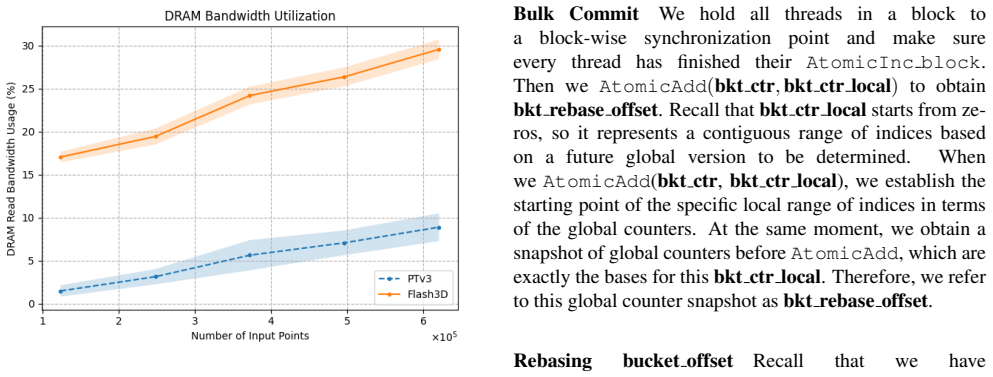
- Editorial inference: PTv3's reported sub-5% TensorCore utilization suggests that many current point-cloud backbones are memory-movement-bound rather than compute-bound; if that diagnosis generalizes, Flash3D is a template for reworking other backbones, though the paper only demonstrates the comparison against PTv3.
Signed reviews
Editorial analysis
A structured set of objections, weighed in public.
Referee Report
Summary. Flash3D is a point-cloud transformer backbone that unifies geometric locality with GPU memory tiling. It first scatters points into contiguous buckets via Perfect Spatial Hashing (Algorithms 1 and 2), then applies multi-head self-attention with FlashAttention-2, where Swin-style scope shifts are realized by loading different bucket-aligned tiles rather than physically shuffling features (Section 4.2 and Appendix 9.3). In-bucket pooling reduces features with fixed reduction factors. The paper claims state-of-the-art accuracy on nuScenes and Waymo semantic segmentation while being 2.25x faster and 2.4x more memory-efficient than PTv3, and it provides latency and hardware-utilization profiling on A100 and H100 GPUs. The central claims are therefore both architectural (zero-overhead locality alignment) and empirical (accuracy and speed superiority over PTv3).
Significance. If the claims hold, this is a valuable systems contribution: it replaces PTv3's global serialization and shuffle step with a cheap PSH construction and a zero-overhead logical shift, and the reported 2.25x speedup and 2.4x memory reduction at equal parameters would be a strong efficiency result for point transformers. The paper includes useful ablations (Table 2) and hardware profiling (Figures 5-13), and the zero-overhead argument in Section 9.3 is analytically plausible under the stated invariants. The main weakness is empirical: the accuracy advantage over PTv3 is small (0.4-1.4 mIoU) and is reported without error bars or a clear baseline protocol, and the code is withheld. The contribution is therefore significant but conditional on verification.
major comments (3)
- [Section 5.1, Tables 1-4] The central accuracy claim is not yet substantiated. Tables 1, 3, and 4 report Flash3D gains over PTv3 of 0.8-1.4 mIoU on nuScenes and 0.4-1.2 mIoU on Waymo, but the paper gives no error bars, no number of seeds, and no training recipe (epochs, optimizer, learning-rate schedule, augmentations, input sampling). Section 9 states that code will be released only after review, and there is no statement of whether the PTv3 numbers were re-run under the same protocol or taken from the original paper. Since Table 2 shows that individual design choices (hash combination, rebalancing, stride, swin) move mIoU by 0.1-1.0 points, the reported margins are within the range of protocol sensitivity. The 'outperforms PTv3' claim therefore needs either re-run baselines under identical conditions or seed-averaged statistics before it can be accepted.
- [Section 4.1, Algorithms 1-2; Section 9.3] The presented PSH algorithms do not enforce the fixed bucket capacity that the zero-overhead attention argument requires. In Algorithm 1, the check `if bkt ctr[hi] < S` followed by `ATOMIC INC` is a read-check-act race: two threads can both observe count S-1 and increment, producing S+1 points in a bucket. In Algorithm 2, the commit condition `prev_off <= S` accepts offset S, one past the valid range 0..S-1 for capacity S. Section 9.1's two-stage counters do not remove the race, because the bulk `AtomicAdd` commits the full local increment without a capacity check. If a bucket can exceed S, the feature array is no longer a concatenation of fixed-size, tile-aligned buckets, and Section 9.3's claim that `FP16[512:1024,d]` is exactly one bucket collapses. Please either replace the pseudocode with a capacity-enforcing parallel algorithm (e.g., atomic CAS or a two-phase scheme that checks the returned offset before commit) or state explicitly how the implementation guarantees the bucket-size invariant.
- [Section 9.3; Section 5.2] The 'zero-overhead' claim is supported only by an analytic argument, not by a direct measurement. The argument in Section 9.3 is plausible under the stated assumptions (contiguous concatenated buckets, bucket sizes multiples of 16, scopes formed by contiguous bucket ranges), and the latency breakdowns in Figures 5-7 are consistent with it. However, because the 2.25x speedup is a headline result, the paper should include a microbenchmark that isolates Bucket-Swin attention from plain FlashAttention-2 on the same layout, and should report the profiling setup (batch size, precision, PTv3 version, input generation) for Figures 8-13. Without this, the reader cannot distinguish the claimed zero-overhead switch from a small but real per-tile redirection cost.
minor comments (4)
- [Section 4.1] The sentence 'The index of the i-th point can be determined bybucket base[bucket id[i]]+ bucket offset[i]' is missing spaces and should reference the defined notation (e.g., bucket_base, bucket_id, bucket_offset); also 'geometric overage' in the XOR-mod description is likely 'geometric coverage'.
- [Figure 1 caption] The caption 'Effectiveness our Flash3D transformer...' is missing 'of'; please rephrase.
- [Table 2 caption] The header 'Hashs' should be 'Hashes', and the abbreviations XD, ZD, XM, ZM should be defined in the caption (XOR-div, Zorder-div, XOR-mod, Zorder-mod).
- [Section 5.1] The sentence 'Flash3D outperforms PTv3 on mIoU for 1.0% at 2.25x inference speed' should be 'by 1.0%' and should state the absolute mIoU gain (0.8 points) to avoid ambiguity; similarly, 'PTv3 uses 2.4x amount of memory than Flash3D' needs rewording.
Circularity Check
No circular derivation found; the central claims rest on external benchmarks and an independent architectural argument.
full rationale
The paper's derivation chain is self-contained against external evidence. The PSH-based bucketing is a construction algorithm with stated inputs and outputs, and the claim that contiguous memory proximity implies spatial proximity is a property of that construction, not a conclusion derived from the target performance numbers. The Bucket-Swin attention mechanism is justified by an independent architectural argument in Appendix 9.3: because feature arrays are concatenations of buckets whose sizes are multiples of 16, redirecting tile addresses changes which 16x16 K/V tiles are loaded without changing the number of tile loads. That argument may rest on an unverified hardware assumption about address-redirection costs, but it is not circular: the conclusion 'no overheads' is not assumed in the premise, and the paper does not define the conclusion into existence. The reported mIoU gains over PTv3 are empirical comparisons against external baseline numbers and datasets, not quantities derived from fitted parameters renamed as predictions. Validation-set ablations in Table 2 select hash-function combinations and attention-scope shifts, but reporting the resulting validation mIoU is standard evaluation rather than a fitted-input-called-prediction pattern. There are no load-bearing self-citations: the cited PSH, FlashAttention, ThunderKittens, and PTv3 works are all external to the authorship, and no uniqueness theorem or ansatz is imported from the authors' own prior work. The absence of error bars and training-protocol details for the PTv3 baseline is a legitimate correctness and reproducibility concern, but under the stated review rules it is not a circularity argument. No step in the paper reduces, by the paper's own equations or by self-citation, to its own inputs.
Assumptions & free parameters
free parameters (6)
- Bucket capacity S =
Not stated exactly; example uses 512, pooling loads 1024 points per tile
- Number of buckets K =
256 in the worked counter example
- Attention scope size =
4096 default (1024 and 8192 ablated)
- Hash function combination =
XOR-div + XOR-mod + Zorder-div + Zorder-mod stacked
- Pooling reduction factor rho =
2
- Bucket stride and swin shift distances =
Stride of 2 buckets, swin shift of 1 bucket
assumptions (5)
- domain assumption Perfect spatial hashing yields a bijection that packs sparse 3D points into a contiguous array where address proximity implies spatial proximity.
- domain assumption GPU architectures are tiled, with L1/shared memory and 16x16 matrix tiles, and the H100 L2 cache can coalesce the PSH global shuffle at near memory-bandwidth limits.
- domain assumption Redirecting FlashAttention-2 tile addresses so attention scopes include arbitrary bucket subarrays adds no extra memory traffic or latency beyond normal MHSA.
- domain assumption Optimistic racing and the recycle bucket in Algorithm 2 preserve enough geometric locality for downstream attention and pooling.
- domain assumption The four hand-designed hash functions (XOR-mod, XOR-div, Zorder-mod, Zorder-div) capture useful locality for point cloud attention.
Cite this review
Pith. "Pith review of Flash3D: Super-scaling Point Transformers through Joint Hardware-Geometry Locality." pith.science (2026). https://pith.science/paper/PXQQCMDH
@misc{pith2026241216481,
  author       = {Pith},
  title        = {Pith review of: Flash3D: Super-scaling Point Transformers through Joint Hardware-Geometry Locality},
  year         = {2026},
  howpublished = {\url{https://pith.science/paper/PXQQCMDH}},
  note         = {Machine review of arXiv:2412.16481}
}
read the original abstract
Recent efforts recognize the power of scale in 3D learning (e.g. PTv3) and attention mechanisms (e.g. FlashAttention). However, current point cloud backbones fail to holistically unify geometric locality, attention mechanisms, and GPU architectures in one view. In this paper, we introduce Flash3D Transformer, which aligns geometric locality and GPU tiling through a principled locality mechanism based on Perfect Spatial Hashing (PSH). The common alignment with GPU tiling naturally fuses our PSH locality mechanism with FlashAttention at negligible extra cost. This mechanism affords flexible design choices throughout the backbone that result in superior downstream task results. Flash3D outperforms state-of-the-art PTv3 results on benchmark datasets, delivering a 2.25x speed increase and 2.4x memory efficiency boost. This efficiency enables scaling to wider attention scopes and larger models without additional overhead. Such scaling allows Flash3D to achieve even higher task accuracies than PTv3 under the same compute budget.
Figures


Figures from the paper (9 more)


Reference graph
Works this paper leans on
-
[1]
Real-time parallel hashing on the gpu
Dan A Alcantara, Andrei Sharf, Fatemeh Abbasinejad, Shubhabrata Sengupta, Michael Mitzenmacher, John D Owens, and Nina Amenta. Real-time parallel hashing on the gpu. In ACM SIGGRAPH asia 2009 papers, pages 1–9
work page 2009
-
[2]
nuscenes: A multi- modal dataset for autonomous driving
Holger Caesar, Varun Bankiti, Alex H Lang, Sourabh V ora, Venice Erin Liong, Qiang Xu, Anush Krishnan, Yu Pan, Gi- ancarlo Baldan, and Oscar Beijbom. nuscenes: A multi- modal dataset for autonomous driving. In Proceedings of the IEEE/CVF conference on computer vision and pattern recognition, pages 11621–11631, 2020. 6, 1
work page 2020
-
[3]
Ran Cheng, Ryan Razani, Ehsan Taghavi, Enxu Li, and Bingbing Liu. 2-s3net: Attentive feature fusion with adap- tive feature selection for sparse semantic segmentation net- work. In Proceedings of the IEEE/CVF conference on com- puter vision and pattern recognition , pages 12547–12556,
-
[4]
4d spatio-temporal convnets: Minkowski convolutional neural networks
Christopher Choy, JunYoung Gwak, and Silvio Savarese. 4d spatio-temporal convnets: Minkowski convolutional neural networks. In Proceedings of the IEEE Conference on Com- puter Vision and Pattern Recognition , pages 3075–3084,
-
[5]
Zbigniew J Czech, George Havas, and Bohdan S Majewski. Perfect hashing. Theoretical Computer Science , 182(1-2): 1–143, 1997. 2
work page 1997
-
[6]
Flashattention-2: Faster attention with bet- ter parallelism and work partitioning
Tri Dao. Flashattention-2: Faster attention with bet- ter parallelism and work partitioning. arXiv preprint arXiv:2307.08691, 2023. 1, 2, 3, 4
arXiv 2023
-
[7]
Flashattention: Fast and memory-efficient exact at- tention with io-awareness
Tri Dao, Dan Fu, Stefano Ermon, Atri Rudra, and Christo- pher R´e. Flashattention: Fast and memory-efficient exact at- tention with io-awareness. Advances in Neural Information Processing Systems, 35:16344–16359, 2022. 2, 3
work page 2022
-
[8]
Embracing single stride 3d object detector with sparse trans- former
Lue Fan, Ziqi Pang, Tianyuan Zhang, Yu-Xiong Wang, Hang Zhao, Feng Wang, Naiyan Wang, and Zhaoxiang Zhang. Embracing single stride 3d object detector with sparse trans- former. In Proceedings of the IEEE/CVF conference on computer vision and pattern recognition, pages 8458–8468,
Show all 44 references
-
[9]
Panoptic nuscenes: A large-scale benchmark for lidar panoptic segmentation and tracking
Whye Kit Fong, Rohit Mohan, Juana Valeria Hurtado, Lub- ing Zhou, Holger Caesar, Oscar Beijbom, and Abhinav Val- ada. Panoptic nuscenes: A large-scale benchmark for lidar panoptic segmentation and tracking. IEEE Robotics and Au- tomation Letters, 7(2):3795–3802, 2022. 6, 1
2022
-
[10]
Paterson, and Kyle Johnsen
Anton Franzluebbers, Changying Li, Andrew H. Paterson, and Kyle Johnsen. Virtual reality point cloud annotation. 2022 IEEE Conference on Virtual Reality and 3D User In- terfaces Abstracts and Workshops (VRW) , pages 886–887,
2022
-
[11]
Storing a sparse table with 0 (1) worst case access time.Jour- nal of the ACM (JACM), 31(3):538–544, 1984
Michael L Fredman, J ´anos Koml ´os, and Endre Szemer ´edi. Storing a sparse table with 0 (1) worst case access time.Jour- nal of the ACM (JACM), 31(3):538–544, 1984. 2
1984
-
[12]
Hennessy and David A
John L. Hennessy and David A. Patterson. Computer Ar- chitecture, Sixth Edition: A Quantitative Approach. Morgan Kaufmann Publishers Inc., San Francisco, CA, USA, 6th edi- tion, 2017. 2 5
2017
-
[13]
Processing, assessing, and enhancing the waymo autonomous vehicle open dataset for driving behavior re- search
Xiangwang Hu, Zuduo Zheng, Danjue Chen, Xi Zhang, and Jian Sun. Processing, assessing, and enhancing the waymo autonomous vehicle open dataset for driving behavior re- search. Transportation Research Part C: Emerging Tech- nologies, 134:103490, 2022. 1
2022
-
[14]
Planning-oriented autonomous driving
Yihan Hu, Jiazhi Yang, Li Chen, Keyu Li, Chonghao Sima, Xizhou Zhu, Siqi Chai, Senyao Du, Tianwei Lin, Wenhai Wang, et al. Planning-oriented autonomous driving. In Pro- ceedings of the IEEE/CVF Conference on Computer Vision and Pattern Recognition, pages 17853–17862, 2023. 1
2023
-
[15]
Stratified trans- former for 3d point cloud segmentation
Xin Lai, Jianhui Liu, Li Jiang, Liwei Wang, Hengshuang Zhao, Shu Liu, Xiaojuan Qi, and Jiaya Jia. Stratified trans- former for 3d point cloud segmentation. In Proceedings of the IEEE/CVF conference on computer vision and pattern recognition, pages 8500–8509, 2022. 1
2022
-
[16]
Spherical transformer for lidar-based 3d recognition
Xin Lai, Yukang Chen, Fanbin Lu, Jianhui Liu, and Jiaya Jia. Spherical transformer for lidar-based 3d recognition. In Pro- ceedings of the IEEE/CVF Conference on Computer Vision and Pattern Recognition, pages 17545–17555, 2023. 1
2023
-
[17]
Perfect spatial hash- ing
Sylvain Lefebvre and Hugues Hoppe. Perfect spatial hash- ing. ACM Transactions on Graphics (TOG), 25(3):579–588,
-
[18]
Swin transformer: Hierarchical vision transformer using shifted windows
Ze Liu, Yutong Lin, Yue Cao, Han Hu, Yixuan Wei, Zheng Zhang, Stephen Lin, and Baining Guo. Swin transformer: Hierarchical vision transformer using shifted windows. In Proceedings of the IEEE/CVF international conference on computer vision, pages 10012–10022, 2021. 1, 2
2021
-
[19]
Flatformer: Flattened window attention for efficient point cloud transformer
Zhijian Liu, Xinyu Yang, Haotian Tang, Shang Yang, and Song Han. Flatformer: Flattened window attention for efficient point cloud transformer. In Proceedings of the IEEE/CVF Conference on Computer Vision and Pattern Recognition, pages 1200–1211, 2023. 1, 2, 5
2023
-
[20]
Spatial hash- joins
Ming-Ling Lo and Chinya V Ravishankar. Spatial hash- joins. In Proceedings of the 1996 ACM SIGMOD interna- tional conference on Management of data , pages 247–258,
1996
-
[21]
Point cloud based reinforcement learning for sim-to-real and partial ob- servability in visual navigation
Kenzo Lobos-Tsunekawa and Tatsuya Harada. Point cloud based reinforcement learning for sim-to-real and partial ob- servability in visual navigation. 2020 IEEE/RSJ Interna- tional Conference on Intelligent Robots and Systems (IROS), pages 5871–5878, 2020. 1
2020
-
[22]
Online normalizer calculation for softmax
Maxim Milakov and Natalia Gimelshein. Online normalizer calculation for softmax. arXiv preprint arXiv:1805.02867 ,
-
[23]
A computer oriented geodetic data base and a new technique in file sequencing
Guy M Morton. A computer oriented geodetic data base and a new technique in file sequencing. 1966. 5
1966
-
[24]
Weiss, Benjamin Sapp, Zhifeng Chen, and Jonathon Shlens
Jiquan Ngiam, Benjamin Caine, Vijay Vasudevan, Zheng- dong Zhang, Hao-Tien Lewis Chiang, Jeffrey Ling, Re- becca Roelofs, Alex Bewley, Chenxi Liu, Ashish Venugopal, David J. Weiss, Benjamin Sapp, Zhifeng Chen, and Jonathon Shlens. Scene transformer: A unified multi-task model ...
-
[25]
Nvidia nsight systems 2024.6.1
CUDA Nvidia. Nvidia nsight systems 2024.6.1. NVIDIA: Santa Clara, CA, 2024. 7
2024
-
[26]
Dexpoint: Generalizable point cloud rein- forcement learning for sim-to-real dexterous manipulation
Yuzhe Qin, Binghao Huang, Zhao-Heng Yin, Hao Su, and Xiaolong Wang. Dexpoint: Generalizable point cloud rein- forcement learning for sim-to-real dexterous manipulation. In Conference on Robot Learning, 2022. 1
2022
-
[27]
Semantic segmen- tation for real point cloud scenes via bilateral augmentation and adaptive fusion
Shi Qiu, Saeed Anwar, and Nick Barnes. Semantic segmen- tation for real point cloud scenes via bilateral augmentation and adaptive fusion. 2021 IEEE/CVF Conference on Com- puter Vision and Pattern Recognition (CVPR), pages 1757– 1767, 2021. 1
2021
-
[28]
Build- ingnet: Learning to label 3d buildings
Pratheba Selvaraju, Mohamed Nabail, Marios Loizou, Maria Maslioukova, Melinos Averkiou, Andreas Andreou, Sid- dhartha Chaudhuri, and Evangelos Kalogerakis. Build- ingnet: Learning to label 3d buildings. In 2021 IEEE/CVF International Conference on Computer Vision, ICCV 2021, M...
2021
-
[29]
Flashattention-3: Fast and accurate attention with asynchrony and low-precision
Jay Shah, Ganesh Bikshandi, Ying Zhang, Vijay Thakkar, Pradeep Ramani, and Tri Dao. Flashattention-3: Fast and accurate attention with asynchrony and low-precision. arXiv preprint arXiv:2407.08608, 2024. 2, 3, 4
2024 arXiv
-
[30]
Efficient attention: Attention with lin- ear complexities
Zhuoran Shen, Mingyuan Zhang, Haiyu Zhao, Shuai Yi, and Hongsheng Li. Efficient attention: Attention with lin- ear complexities. In Proceedings of the IEEE/CVF winter conference on applications of computer vision, pages 3531– 3539, 2021. 2
2021
-
[31]
Thunderkittens: Simple, fast, and adorable ai kernels
Benjamin F Spector, Simran Arora, Aaryan Singhal, Daniel Y Fu, and Christopher R ´e. Thunderkittens: Simple, fast, and adorable ai kernels. arXiv preprint arXiv:2410.20399, 2024. 2, 6, 3
2024 arXiv
-
[32]
Scalability in perception for autonomous driving: Waymo open dataset
Pei Sun, Henrik Kretzschmar, Xerxes Dotiwalla, Aurelien Chouard, Vijaysai Patnaik, Paul Tsui, James Guo, Yin Zhou, Yuning Chai, Benjamin Caine, et al. Scalability in perception for autonomous driving: Waymo open dataset. In Proceed- ings of the IEEE/CVF conference on computer ...
2020
-
[33]
Swformer: Sparse window transformer for 3d object detection in point clouds
Pei Sun, Mingxing Tan, Weiyue Wang, Chenxi Liu, Fei Xia, Zhaoqi Leng, and Dragomir Anguelov. Swformer: Sparse window transformer for 3d object detection in point clouds. In European Conference on Computer Vision , pages 426–
-
[34]
Searching efficient 3d architec- tures with sparse point-voxel convolution
Haotian Tang, Zhijian Liu, Shengyu Zhao, Yujun Lin, Ji Lin, Hanrui Wang, and Song Han. Searching efficient 3d architec- tures with sparse point-voxel convolution. In European con- ference on computer vision, pages 685–702. Springer, 2020. 1
2020
-
[35]
Sim-to-real deep reinforcement learning for safe end-to-end planning of aerial robots
Halil Ibrahim Ugurlu, Huy Xuan Pham, and Erdal Kayacan. Sim-to-real deep reinforcement learning for safe end-to-end planning of aerial robots. Robotics, 11:109, 2022. 1
2022
-
[36]
Octformer: Octree-based transformers for 3d point clouds
Peng-Shuai Wang. Octformer: Octree-based transformers for 3d point clouds. ACM Transactions on Graphics (TOG), 42(4):1–11, 2023. 1, 2
2023
-
[37]
Point transformer v2: Grouped vector atten- tion and partition-based pooling
Xiaoyang Wu, Yixing Lao, Li Jiang, Xihui Liu, and Heng- shuang Zhao. Point transformer v2: Grouped vector atten- tion and partition-based pooling. Advances in Neural Infor- mation Processing Systems, 35:33330–33342, 2022. 2, 5, 6, 1, 4
2022
-
[38]
Point transformer v3: Simpler faster stronger
Xiaoyang Wu, Li Jiang, Peng-Shuai Wang, Zhijian Liu, Xi- hui Liu, Yu Qiao, Wanli Ouyang, Tong He, and Hengshuang Zhao. Point transformer v3: Simpler faster stronger. In Pro- ceedings of the IEEE/CVF Conference on Computer Vision 6 and Pattern Recognition, pages 4840–4851, 2024...
2024
-
[39]
Data- efficient learning for sim-to-real robotic grasping using deep point cloud prediction networks
Xinchen Yan, Mohi Khansari, Jasmine Hsu, Yuanzheng Gong, Yunfei Bai, S ¨oren Pirk, and Honglak Lee. Data- efficient learning for sim-to-real robotic grasping using deep point cloud prediction networks. ArXiv, abs/1906.08989,
1906 arXiv
-
[40]
Swin3d: A pretrained transformer backbone for 3d indoor scene understanding
Yu-Qi Yang, Yu-Xiao Guo, Jian-Yu Xiong, Yang Liu, Hao Pan, Peng-Shuai Wang, Xin Tong, and Baining Guo. Swin3d: A pretrained transformer backbone for 3d indoor scene understanding. arXiv preprint arXiv:2304.06906 ,
-
[41]
Fusionad: Multi-modality fusion for pre- diction and planning tasks of autonomous driving
Tengju Ye, Wei Jing, Chunyong Hu, Shikun Huang, Ling- ping Gao, Fangzhen Li, Jingke Wang, Ke Guo, Wencong Xiao, Wei Mao, Hang Zheng, Kun Li, Junbo Chen, and Kaicheng Yu. Fusionad: Multi-modality fusion for pre- diction and planning tasks of autonomous driving. ArXiv, abs/2308....
2023 arXiv
-
[42]
Toward zero-shot sim-to-real transfer learning for pneumatic soft robot 3d proprioceptive sensing
Uksang Yoo, Hanwen Zhao, Alvaro Altamirano, Wenzhen Yuan, and Chen Feng. Toward zero-shot sim-to-real transfer learning for pneumatic soft robot 3d proprioceptive sensing. 2023 IEEE International Conference on Robotics and Au- tomation (ICRA), pages 544–551, 2023. 1
2023
-
[43]
Point transformer
Hengshuang Zhao, Li Jiang, Jiaya Jia, Philip HS Torr, and Vladlen Koltun. Point transformer. In Proceedings of the IEEE/CVF international conference on computer vision, pages 16259–16268, 2021. 2
2021
-
[44]
Cylinder3d: An effective 3d framework for driving-scene lidar semantic segmentation
Hui Zhou, Xinge Zhu, Xiao Song, Yuexin Ma, Zhe Wang, Hongsheng Li, and Dahua Lin. Cylinder3d: An effective 3d framework for driving-scene lidar semantic segmentation. arXiv preprint arXiv:2008.01550, 2020. 1 7
2008 arXiv
Reviewed August 11, 2026 · model on record in the stance chip above.
Discussion (0). Continue with ORCID to comment.