REVIEW 3 major objections 4 minor 1 cited by
FlameForge: Combustion of Generalized Wooden Structures
T0 review · 3 major / 4 minor · reviewed 2026-08-11 · deepseek-v4-flash
Pith's one-line read FlameForge claims a unified voxel-based simulator reproduces multi-phase combustion of arbitrary wooden structures, matching real interior temperature and mass-loss measurements.
desk verdict A solid systems paper that unifies existing combustion models into one volumetric pipeline; the SDF char-insulation proxy is a real limitation, but the hedged claims and genuine experiment make it worth refereeing. read the letter →
The pith
A machine-rendered reading of the paper's core claim, the machinery that carries it, and where it could break.
The reading
What carries the argument
The engine of the method is the combination of a multiresolution voxel grid for the material and a signed distance field that is iteratively updated as mass is consumed. The char insulation coefficient $c = c_{\min} + (1 - c_{\min}) \exp(-h c_r)$, where $h$ is the distance of a voxel from the material boundary, replaces the exact integral over all possible paths to the surface that true char insulation would require, and virgin wood and char are treated identically. Around this sit a one-step global pyrolysis model converting solid fuel into volatiles and char, a temperature-dependent reaction rate with a smooth interpolation function, and a bidirectional air-material temperature coupling that lets flames ignite material and combusting material feed flames.
What would settle it
Measure sub-surface temperature histories in an oven for a thin-walled wooden box whose wall thickness is comparable to the char layer thickness, or for a block with a detached char layer; if the simulated curve does not reproduce the real curve because the signed-distance proxy over- or under-insulates, the central claim fails.
Extended reading notes
Core claim
On its own terms, the paper's central claim is that the multi-phase combustion of charring materials can be simulated at the scale of whole structures with a unified volumetric model. Wood pyrolysis is treated as an instantaneous one-step decomposition into volatiles and char; the char layer's insulating effect, which slows combustion of the material underneath, is computed from a signed distance field giving each voxel's distance to the material surface; and the air, temperature, smoke, and material fields are coupled through a multiresolution adaptive voxel grid. The quantitative evidence is a set of 40 mm cube experiments in an oven: real and simulated wood samples both show a parabolic mass-loss curve and the same convex-sub-surface/concave-core temperature split attributed to char insulation, while non-charring PMMA shows an S-shaped mass curve and a rapid inner temperature rise. The paper concludes that the simulator successfully reproduces the general trends of the measured curves, providing the basis for accurately capturing combustion phenomena, while noting that exact calibration to a given real environment is only partially addressed.
Load-bearing premise
Everything quantitative rests on the assumption that the char layer's insulation can be summarized by one voxel's distance to the material surface, with virgin wood and char treated identically; if that proxy fails for thin walls or concave geometry, the match with the cube experiment is a coincidence and the larger scenes are unsupported.
Editorial extensions
If this is right
- Arbitrary wooden geometries, from thin roof slats to thick walls, can burn in one framework, with fire spreading across connected and disconnected objects through the air.
- Non-charring materials such as acrylic glass and non-combustible materials such as stone can be mixed into the same scene, changing how fire spreads and what remains standing.
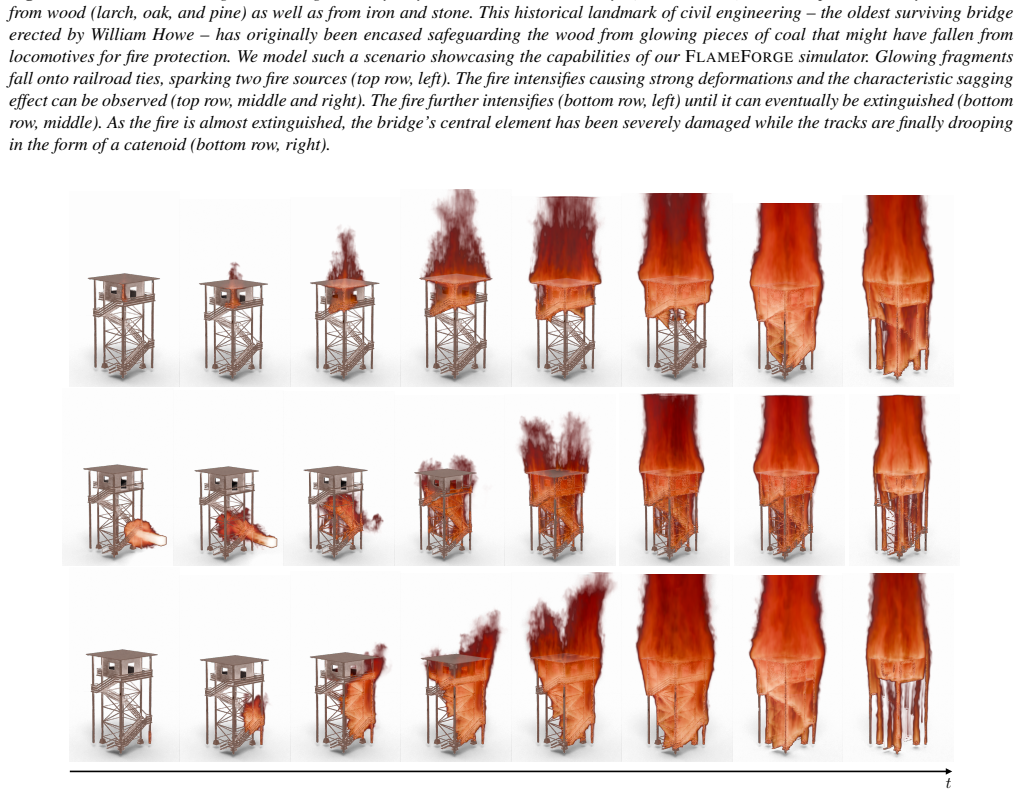
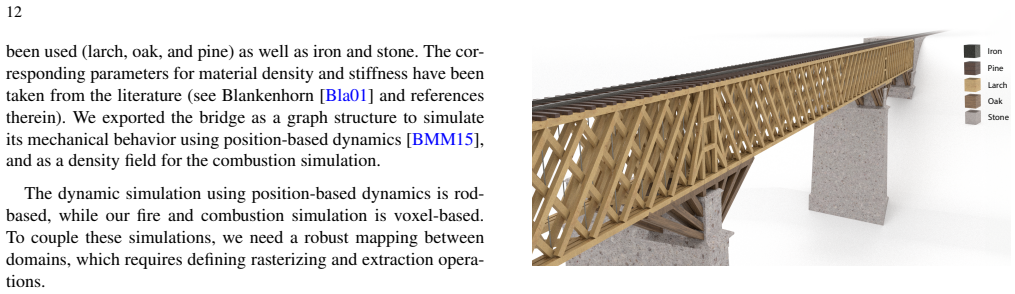
- Two-way coupling with position-based dynamics makes mechanical deformation, including the sagging of a burning bridge, follow from the combustion state.
- Wind can be the deciding factor in whether a fire spreads from one object to a neighboring structure, as shown by the tree-to-house scenes.
- The cube experiments give a quantitative baseline that the authors say provides the basis for accurately capturing combustion phenomena, even though exact calibration to a specific environment remains open.
- If the simulator's distance-to-surface proxy for char insulation fails for thin walls, concave corners, or detached char layers, the cube-experiment match would be coincidental and the generalization to house, boat, and bridge scenes would not be supported.
Reading between the lines
- The distance-to-surface proxy for char insulation is the likeliest point of failure: for thin walls, concave corners, or char layers that detach from the surface, a single signed distance cannot encode the integrated shielding along all paths, so the cube match may be coincidental for geometry that differs from a solid block.
- A direct test would be to run the same oven experiment on a thin-walled box or a slab with a deliberate void; the simulator's char-insulation term would predict a different interior temperature history than a path-integral model, and the measured curve would decide.
- The model contains no oxygen transport, so in enclosed spaces the simulated fire will likely burn longer than a real fire that self-extinguishes from oxygen starvation; adding a fuel-oxygen reaction term would change extinction behavior.
- The claimed generality across wood species rests on a single calibration of a handful of parameters; transferring to different moisture contents or species-specific pyrolysis rates would require re-calibration from new measurements.
Editorial analysis
A structured set of objections, weighed in public.
Referee Report
Summary. The paper presents FlameForge, a voxel-based combustion simulator for generalized wooden structures. The system couples a low-resolution compressible-flow air solver with a high-resolution material grid, uses a signed distance field to evaluate char insulation, supports charring and non-charring materials, and demonstrates two-way coupling with position-based dynamics. The method is validated qualitatively on house, boat, tower, tree, and bridge scenes, and quantitatively against a new small-scale experiment in which cubic wood and PMMA samples are burned in an oven while subsurface temperatures and mass loss are recorded.
Significance. If the central claims hold, the paper offers a useful unification: a single volumetric framework for charring and non-charring solids with adaptive grids, SDF-based surface queries, and a working bidirectional coupling to a mechanical rod solver. The numerical building blocks (staggered MacCormack advection, AMGCL projection, fast sweeping for the SDF, OpenVDB data structures) are standard and appear to be implemented carefully. The inclusion of new external experimental data is a genuine strength, and the qualitative reproduction of the convex subsurface versus concave core temperature feature for wood is a promising indicator. However, the quantitative evidence is weaker than the abstract and Section 5.3 claim, and the char-insulation model that drives the headline validation is an acknowledged simplification whose generalization to arbitrary geometry is not directly tested.
major comments (3)
- [Section 3.2.3, Eq. (8)] The central generalization claim is only supported by a geometry-specific validation, because the char-insulation mechanism in Eq. (8) uses nearest-surface distance rather than the path-integrated insulation that the text itself identifies as physically correct. For concave regions, thin walls, and detached char, the proxy and the true path integral diverge, and the cube experiment cannot detect this divergence.
- [Section 5.3, Figure 8] The paper's headline quantitative claim is based on plots without error bars, metrics, or repeated trials; the admitted PMMA discrepancies show that the match is only qualitative. This is a core validation gap for a paper that claims to "quantitatively assess" the volumetric combustion process.
- [Table 1 and Section 3.2.4] Without exact parameter values and a sensitivity analysis, the reader cannot tell whether the good qualitative match on the cube is robust or the result of favorable parameter selection. This is especially important because many parameters are inherited from Pirk et al. [PJH*17] and are only given as ranges.
minor comments (4)
- [Figure 8 caption] The caption labels appear to be copy-pasted from the charring panel and make the figure harder to read.
- [References, [HKV07]] This is a citation/presentation issue that should be corrected.
- [Table 1, units for TMc and TMv] The unit notation is confusing as written and should be reconciled with the relative-mass formulation.
- [Eq. (9) and Eq. (11)] A reader has to infer that Eq. (9) actually describes mass-loss rates (negative time derivatives of stored mass).
Circularity Check
No significant circularity: the quantitative cube comparison rests on external measurements, and the char-insulation model is an acknowledged simplification rather than a fitted or self-referential identity.
full rationale
The paper's central quantitative claim is a comparison between simulated and measured sub-surface temperatures and mass-loss curves for cube samples (Section 5.3). The experimental data are new and external to the simulator; no equation in the paper fits the model to these measurements, and the 'general trends' comparison is therefore an actual test rather than a tautology. The char-insulation coefficient in Eq. (8) is explicitly imported from the authors' prior work [PJH*17] rather than derived in this paper, and the paper openly labels the SDF distance query a simplification of a path integral (Section 3.2.3). Reusing a previously published, externally validated model with overlapping authorship is self-citation, but it is not circular: the model is an assumption with acknowledged limits, and the cube experiment provides independent evidence that the model can reproduce the observed convex/concave and mass-curve trends. The stated calibration difficulty (Section 5.3) and the absence of quantitative sensor data for the large scenes limit generalization, but they remain correctness/validation concerns rather than circularity. No predicted quantity reduces by construction to a fitted input or to a self-citation.
Assumptions & free parameters
free parameters (9)
- Tm0 (pyrolysis/combustion lower threshold) =
150-280 K (range)
- Tm1 (temperature limit for maximum combustion rate) =
400-500 K (range)
- epsilon_v (volatiles mass loss rate) =
0.1 kg/s
- epsilon_c (char mass loss rate) =
0.1-1.0e-3 kg/s (range)
- Cr (char insulation rate) =
75.0 m^-1
- Cmin (minimum char insulation) =
0.1
- phi_a, phi_m (air-material heat exchange rates) =
5e-2 s^-1, 2e-2 s^-1
- TMc, TMv (heat generation per consumed mass) =
3e7, 2e7 (as in Table 1)
- beta, gamma_m (material diffusivity and radiative cooling) =
0.82e-7 m^2/s, 5.9e-14 K^-3 s^-1
assumptions (7)
- domain assumption Air flow follows the simplified compressible Navier-Stokes model of Nielsen et al.: Eqs. (1)-(2) with density rho approx rho_amb Tamb/Ta
- domain assumption One-step global pyrolysis: a sufficiently hot voxel is immediately decomposed into volatiles and char (Section 3.2.2)
- domain assumption Char insulation is a function of SDF distance to the material surface only (Eq. (8), Section 3.2.3)
- domain assumption Virgin wood and pure char have identical insulation behavior (Section 3.2.3)
- domain assumption Combustion rate depends only on temperature through Eq. (10); oxygen availability is ignored
- ad hoc to paper Parameters calibrated for wood combustion in prior literature transfer unchanged to this voxel discretization and to the specific wood species burned in the experiment (Table 1)
- domain assumption Thermocouple readings at the surface, 5 mm, and 20 mm depth are reliable probes of the internal temperature field of the sample
Cite this review
Pith. "Pith review of FlameForge: Combustion of Generalized Wooden Structures." pith.science (2026). https://pith.science/paper/6CCO7VKI
@misc{pith2026241216735,
  author       = {Pith},
  title        = {Pith review of: FlameForge: Combustion of Generalized Wooden Structures},
  year         = {2026},
  howpublished = {\url{https://pith.science/paper/6CCO7VKI}},
  note         = {Machine review of arXiv:2412.16735}
}
read the original abstract
We propose a unified volumetric combustion simulator that supports general wooden structures capturing the multi-phase combustion of charring materials. Complex geometric structures can conveniently be represented in a voxel grid for the effective evaluation of volumetric effects. In addition, a signed distance field is introduced to efficiently query the surface information required to compute the insulating effect caused by the char layer. Non-charring materials such as acrylic glass or non-combustible materials such as stone can also be modeled in the simulator. Adaptive data structures are utilized to enable memory-efficient computations within our multiresolution approach. The simulator is qualitatively validated by showcasing the numerical simulation of a variety of scenes covering different kinds of structural configurations and materials. Two-way coupling of our combustion simulator and position-based dynamics is demonstrated capturing characteristic mechanical deformations caused by the combustion process. The volumetric combustion process of wooden structures is further quantitatively assessed by comparing our simulated results to sub-surface measurements of a real-world combustion experiment.
Figures


Figures from the paper (8 more)


Forward citations
Cited by 1 Pith paper
-
FieryGS: In-the-Wild Fire Synthesis with Physics-Integrated Gaussian Splatting
FieryGS integrates LLM-based material reasoning, volumetric combustion simulation, and a unified renderer with 3D Gaussian Splatting to generate physically plausible and user-controllable fire in in-the-wild scenes.
Reference graph
Works this paper leans on
-
[1]
write newline
" write newline "" before.all 'output.state := FUNCTION fin.entry add.period write newline FUNCTION new.block output.state before.all = 'skip after.block 'output.state := if FUNCTION new.sentence output.state after.block = 'skip output.state before.all = 'skip after.sentence 'output.state := if if FUNCTION not #0 #1 if FUNCTION and 'skip pop #0 if FUNCTIO...
-
[2]
write newline
" write newline "" before.all 'output.state := FUNCTION fin.entry.original add.period write newline FUNCTION new.block output.state before.all = 'skip after.block 'output.state := if FUNCTION new.sentence output.state after.block = 'skip output.state before.all = 'skip after.sentence 'output.state := if if FUNCTION not #0 #1 if FUNCTION and 'skip pop #0 i...
-
[3]
Blankenhorn P. : Wood: Sawn materials. In Encyclopedia of Materials: Science and Technology, Buschow K. J., Cahn R. W., Flemings M. C., Ilschner B., Kramer E. J., Mahajan S., Veyssière P., (Eds.). Elsevier, Oxford, 2001, pp. 9722--9732
work page 2001
-
[4]
: Position-Based Simulation Methods in Computer Graphics
Bender J., Müller M., Macklin M. : Position-Based Simulation Methods in Computer Graphics . In EG 2015 - Tutorials (2015), Zwicker M., Soler C., (Eds.), The Eurographics Association
work page 2015
-
[5]
: Fluid simulation for computer graphics
Bridson R. : Fluid simulation for computer graphics. CRC press, 2015
work page 2015
-
[6]
Birch F., Schairer J. F., Spicer H. C. : Handbook of physical constants, vol. 36. Geological Society of America, 1942
work page 1942
-
[7]
: Modeling and simulation of combustion processes of charring and non-charring solid fuels
Di Blasi C. : Modeling and simulation of combustion processes of charring and non-charring solid fuels. Progress in energy and combustion science 19, 1 (1993), 71--104
work page 1993
-
[8]
: Amgcl: An efficient, flexible, and extensible algebraic multigrid implementation
Demidov D. : Amgcl: An efficient, flexible, and extensible algebraic multigrid implementation. Lobachevskii Journal of Mathematics 40 (2019), 535--546
work page 2019
Show all 51 references
-
[9]
C., Hu F., Pope C
Edholm J., Stomakhin A., Deshprabhu R., Cebrian D. C., Hu F., Pope C. : Fire and explosions in avatar: The way of water. In ACM SIGGRAPH 2023 Talks (New York, NY, USA, 2023), SIGGRAPH '23, Association for Computing Machinery
2023
-
[10]
: Animating suspended particle explosions
Feldman B., O'Brien J., Arikan O. : Animating suspended particle explosions. ACM Trans. Graph. 22 (07 2003), 708--715
2003
-
[11]
: Wood buildings as a climate solution
Himes A., Busby G. : Wood buildings as a climate solution. Developments in the Built Environment 4 (2020), 100030
2020
-
[12]
T., Pa ubicki W., Pirk S., Michels D
H \"a drich T., Banuti D. T., Pa ubicki W., Pirk S., Michels D. L. : Fire in paradise: Mesoscale simulation of wildfires. ACM Transactions on Graphics (TOG) 40, 4 (2021), 1--15
2021
-
[13]
: Directable, high-resolution simulation of fire on the gpu
Horvath C., Geiger W. : Directable, high-resolution simulation of fire on the gpu. ACM Transactions on Graphics (TOG) 28, 3 (2009), 1--8
2009
-
[14]
: Physically-based modeling, simulation and rendering of fire for computer animation
Huang Z., Gong G., Han L. : Physically-based modeling, simulation and rendering of fire for computer animation. Multimedia Tools and Applications 71, 3 (Aug 2014), 1283--1309
2014
-
[15]
Herrera J. A. A., H\"adrich T., Pa ubicki W., Banuti D. T., Pirk S., Michels D. L. : Weatherscapes: Nowcasting heat transfer and water continuity. ACM Transaction on Graphics 40, 6 (12 2021)
2021
-
[16]
Herrera J. A. A., Klein J., Liu D., Pa ubicki W., Pirk S., Michels D. L. : Cyclogenesis: Simulating hurricanes and tornadoes. ACM Transaction on Graphics 43, 4 (7 2024)
2024
-
[17]
Versteeg W
Henk K. Versteeg W. M. : An Introduction to Computational Fluid Dynamics: The Finite Volume Method. Pearson Education Limited, 2007
2007
-
[18]
T., Pirk S., Michels D
H\" a drich T., Makowski M., Pa ubicki W., Banuti D. T., Pirk S., Michels D. L. : Stormscapes: Simulating cloud dynamics in the now. ACM Transaction on Graphics 39, 6 (12 2020)
2020
-
[19]
L., Jiang C
Huang L., Qu Z., Tan X., Zhang X., Michels D. L., Jiang C. : Ships, splashes, and waves on a vast ocean. ACM Transaction on Graphics 40, 6 (12 2021)
2021
-
[20]
: Wrinkled flames and cellular patterns
Hong J.-M., Shinar T., Fedkiw R. : Wrinkled flames and cellular patterns. ACM Trans. Graph. 26, 3 (jul 2007), 47–es
2007
-
[21]
: Geometry-based control of fire simulation
Hong Y., Zhu D., Qiu X., Wang Z. : Geometry-based control of fire simulation. Vis. Comput. 26, 9 (sep 2010), 1217–1228
2010
-
[22]
: Animation of Reactive Gaseous Fluids through Chemical Kinetics
Ihm I., Kang B., Cha D. : Animation of Reactive Gaseous Fluids through Chemical Kinetics . In Symposium on Computer Animation (2004), Boulic R., Pai D. K., (Eds.), Eurographics
2004
-
[23]
T., Fedkiw R
Kwatra N., Gr\' e tarsson J. T., Fedkiw R. : Practical animation of compressible flow for shock waves and related phenomena. In Proceedings of the 2010 ACM SIGGRAPH/Eurographics Symposium on Computer Animation (Goslar, DEU, 2010), SCA '10, Eurographics, p. 207–215
2010
-
[24]
: Animation of Chemically Reactive Fluids Using a Hybrid Simulation Method
Kang B., Jang Y., Ihm I. : Animation of Chemically Reactive Fluids Using a Hybrid Simulation Method . In Eurographics/SIGGRAPH Symposium on Computer Animation (2007), Metaxas D., Popovic J., (Eds.), Eurographics
2007
-
[25]
: Physics-inspired controllable flame animation
Kim T., Lee J., Kim C.-H. : Physics-inspired controllable flame animation. 871–880
-
[26]
: Neuralvdb: High-resolution sparse volume representation using hierarchical neural networks
Kim D., Lee M., Museth K. : Neuralvdb: High-resolution sparse volume representation using hierarchical neural networks. arXiv preprint arXiv:2208.04448 (2022)
2022 arXiv
-
[27]
A., Potter M
Kroos K. A., Potter M. C. : Thermodynamics for Engineers, SI Edition. Cengage Learning, 2014
2014
-
[28]
L., Pirk S., Palubicki W
Kokosza A., Wrede H., Gonzalez Esparza D., Makowski M., Liu D., Michels D. L., Pirk S., Palubicki W. : Scintilla: Simulating combustible vegetation for wildfires. ACM Transactions on Graphics (TOG) 43, 4 (2024), 1--21
2024
-
[29]
: Structural modeling of flames for a production environment
Lamorlette A., Foster N. : Structural modeling of flames for a production environment. ACM Trans. Graph. 21, 3 (jul 2002), 729–735
2002
-
[30]
: Melting and burning solids into liquids and gases
Losasso F., Irving G., Guendelman E., Fedkiw R. : Melting and burning solids into liquids and gases. IEEE Transactions on Visualization and Computer Graphics 12, 3 (may 2006), 343–352
2006
-
[31]
: Fluid Mechanics Aspects of Fire and Smoke Dynamics in Enclosures
Merci B., Beji T. : Fluid Mechanics Aspects of Fire and Smoke Dynamics in Enclosures. CRC Press, 2016
2016
-
[32]
: Interactive simulation of fire
Melek Z., Keyser J. : Interactive simulation of fire. Pacific Graphics (2002), 431--432
2002
-
[33]
E., Law A., Hadden R
MacLeod C. E., Law A., Hadden R. M. : Quantifying the heat release from char oxidation in timber. Fire Safety Journal 138 (2023), 103793
2023
-
[34]
: Vdb: High-resolution sparse volumes with dynamic topology
Museth K. : Vdb: High-resolution sparse volumes with dynamic topology. ACM transactions on graphics (TOG) 32, 3 (2013), 1--22
2013
-
[35]
: Nanovdb: A gpu-friendly and portable vdb data structure for real-time rendering and simulation
Museth K. : Nanovdb: A gpu-friendly and portable vdb data structure for real-time rendering and simulation. In ACM SIGGRAPH 2021 Talks. 2021, pp. 1--2
2021
-
[36]
B., Bojsen-Hansen M., Stamatelos K., Bridson R
Nielsen M. B., Bojsen-Hansen M., Stamatelos K., Bridson R. : Physics-based combustion simulation. ACM Transactions on Graphics (TOG) 41, 5 (2022), 1--21
2022
-
[37]
Q., Fedkiw R., Jensen H
Nguyen D. Q., Fedkiw R., Jensen H. W. : Physically based modeling and animation of fire. In Proceedings of the 29th annual conference on Computer graphics and interactive techniques (2002), pp. 721--728
2002
-
[38]
B., Stamatelos K., Bojsen-Hansen M., Bridson R
Nielsen M. B., Stamatelos K., Bojsen-Hansen M., Bridson R. : Physics-based combustion simulation in bifrost. In ACM SIGGRAPH 2019 Talks. 2019, pp. 1--2
2019
-
[39]
: A second-order advection-reflection solver
Narain R., Zehnder J., Thomaszewski B. : A second-order advection-reflection solver. Proc. ACM Comput. Graph. Interact. Tech. 2, 2 (jul 2019)
2019
-
[40]
: Turbulent Combustion
Peters N. : Turbulent Combustion. Cambridge Monographs on Mechanics. Cambridge University Press, 2000
2000
-
[41]
L., Palubicki W
Pirk S., Jarz a bek M., H \"a drich T., Michels D. L., Palubicki W. : Interactive wood combustion for botanical tree models. ACM Transactions on Graphics (TOG) 36, 6 (2017), 1--12
2017
-
[42]
L., Pirk S
Pa ubicki W., Makowski M., Gajda W., H \"a drich T., Michels D. L., Pirk S. : Ecoclimates: Climate-response modeling of vegetation. ACM Transactions on Graphics (TOG) 41, 4 (2022), 1--19
2022
-
[43]
: Depicting fire and other gaseous phenomena using diffusion processes
Stam J., Fiume E. : Depicting fire and other gaseous phenomena using diffusion processes. In Proceedings of the 22nd Annual Conference on Computer Graphics and Interactive Techniques (New York, NY, USA, 1995), SIGGRAPH '95, Association for Computing Machinery, p. 129–136
1995
-
[44]
: An unconditionally stable maccormack method
Selle A., Fedkiw R., Kim B., Liu Y., Rossignac J. : An unconditionally stable maccormack method. Journal of Scientific Computing 35 (2008), 350--371
2008
-
[45]
Shao H., Huang L., Michels D. L. : A fast unsmoothed aggregation algebraic multigrid framework for the large-scale simulation of incompressible flow. ACM Transaction on Graphics 41, 4 (07 2022)
2022
-
[46]
: Augmented mpm for phase-change and varied materials
Stomakhin A., Schroeder C., Jiang C., Chai L., Teran J., Selle A. : Augmented mpm for phase-change and varied materials. ACM Trans. Graph. 33, 4 (2014), 138:1--138:11
2014
-
[47]
: Stable fluids
Stam J. : Stable fluids. In Proceedings of the 26th Annual Conference on Computer Graphics and Interactive Techniques (USA, 1999), SIGGRAPH '99, ACM Press/Addison-Wesley Publishing Co., p. 121–128
1999
-
[48]
: Stable fluids
Stam J. : Stable fluids. Proc. of ACM SIGGRAPH (1999), 121--128
1999
-
[49]
Tritton D. J. : Physical Fluid Dynamics. Springer Science & Business Media, 2012
2012
-
[50]
: A semi-lagrangian high-order method for navier–stokes equations
Xiu D., Karniadakis G. : A semi-lagrangian high-order method for navier–stokes equations. Journal of Computational Physics 172 (09 2001), 658--684
2001
-
[51]
: A fast sweeping method for eikonal equations
Zhao H. : A fast sweeping method for eikonal equations. Mathematics of computation 74, 250 (2005), 603--627
2005
Reviewed August 11, 2026 · model on record in the stance chip above.
Discussion (0). Continue with ORCID to comment.