REVIEW 2 major objections 6 minor 135 references
The Interplay Between Electron Localization, Magnetic Order, and Jahn-Teller Distortion that Dictates LiMnO$_2$ Phase Stability
T0 review · 2 major / 6 minor · reviewed 2026-08-11 · deepseek-v4-flash
Pith's one-line read Standard density-functional theory with an empirical Hubbard U predicts a never-observed gamma-LiMnO2 phase as the ground state; self-consistent Hubbard parameters and hybrid functionals recover the experimentally known orthorhombic…
desk verdict Clear and useful benchmark showing that empirical Hubbard U gets LiMnO2's ground state wrong and self-consistent U fixes it, though a thin HSE06 margin and a limited magnetic search keep it from being the last word. read the letter →
The pith
A machine-rendered reading of the paper's core claim, the machinery that carries it, and where it could break.
The reading
What carries the argument
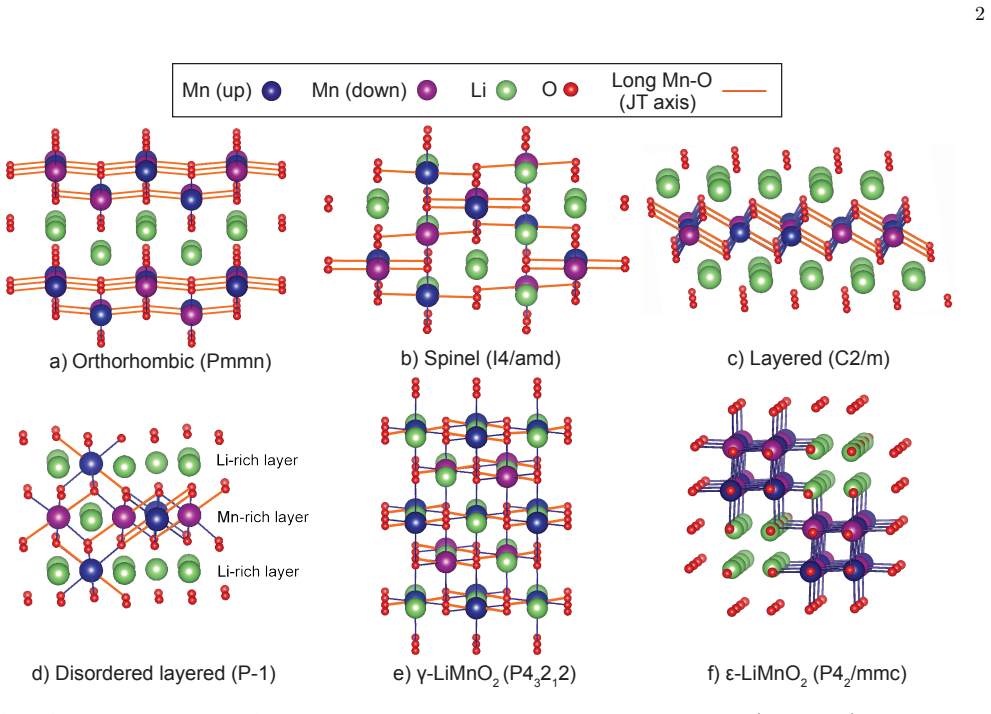
The load-bearing object is the self-consistent on-site Hubbard parameter U, computed from linear-response theory for each polymorph, together with the ordering pattern of Jahn-Teller axes. A Jahn-Teller distortion is the elongation of two Mn-O bonds in an MnO6 octahedron that lowers symmetry when the Mn3+ eg orbital is singly occupied; 'collinear' means all elongated axes point the same way, 'noncollinear' means they do not. The paper correlates U with the Mn magnetic moment (linear fit, R2 ~ 94%) and the inter-site V with Mn-O bond length, and shows that Mn sites in 180-degree Mn-O-Mn units with one long and one short bond carry the large U values. The machinery works by showing that empirical or averaged U erases these site-to-site differences, producing a spurious gamma ground state, while self-consistent U encodes the local orbital ordering and restores the experimental stability order.
What would settle it
Enumerate and relax noncollinear and incommensurate antiferromagnetic orderings for the six phases (for example with spin-spiral DFT) and add their energies to the same free-energy comparison; if gamma-LiMnO2 or disordered layered drops below orthorhombic once its true magnetic order is included, the paper's central stability conclusion fails.
Extended reading notes
Core claim
On the paper's own terms, the central discovery is that the phase stability of LiMnO2 is controlled by the interplay of antiferromagnetic order, Jahn-Teller distortion direction, and the degree of electron localization, and that this interplay is only rendered correctly by methods that let the Hubbard interaction strength respond to the local environment. Empirically fixed U over-stabilizes gamma-LiMnO2, the ordering with the lowest electrostatic energy, because it applies the same localization penalty to every phase; self-consistently computed U is smaller in the phases with collinearly ordered JT axes (orthorhombic, layered, spinel, and the newly identified epsilon phase) and larger in gamma and disordered layered phases that have noncollinear JT arrangements. This variation of about 0.6 eV in U flips the ground state. The paper further shows, through charge-density differences and projected densities of states, that antiferromagnetic order increases Mn-O covalency along the JT axis, that the band gap is large (HSE06 3.1 eV, G0W0 3.8 eV), and that the collinear JT phases have higher phonon entropy, so vibrational free energy reinforces the stability of the experimental phases up to 1000 K.
Load-bearing premise
The magnetic ground state of each phase is assumed to be one of the roughly thirty collinear antiferromagnetic spin arrangements that were enumerated and relaxed with a single empirical Hubbard U; if any phase's true magnetic ordering is a different pattern, including one with non-collinear spins, the relative energies could shift enough to change the predicted ground state.
Editorial extensions
If this is right
- Phase-stability calculations for manganese-rich cathodes should not rely on a single empirical U applied to every polymorph; self-consistent U or a hybrid functional is required to find the correct ground state.
- Collinear ordering of Jahn-Teller axes carries concrete physical consequences: larger Jahn-Teller bond ratio, increased Mn-O covalency, stronger antiferromagnetic stabilization, and higher phonon entropy.
- The layered-to-disorder anti-site defect formation energy is substantial (112 meV/defect at HSE06 and about 400 meV/defect with self-consistent U+V), so cation disorder in layered LiMnO2 is energetically costly.
- The previously unreported epsilon-LiMnO2 ordering is predicted to be within about 2 meV/atom of the orthorhombic ground state and more stable than layered or spinel, making it a plausible hidden low-energy phase.
- Orthorhombic LiMnO2 is predicted to be a strongly insulating cathode with a band gap above 3 eV, which has direct implications for its electronic conductivity and electrochemical kinetics.
Reading between the lines
- If this mechanism generalizes, other cathode oxides with Jahn-Teller-active ions (Ni3+, Cu2+) may also need self-consistent Hubbard parameters: an empirical U fitted to average properties will not see orbital-ordering-dependent localization.
- The paper's finite-temperature free energies use harmonic phonons from an empirical-U calculation; recomputing phonons with self-consistent U, or including anharmonicity, would test whether the vibrational stabilization of collinear JT phases survives beyond the harmonic approximation.
- The predicted epsilon-LiMnO2 phase has an XRD pattern close to orthorhombic but with one missing peak near 37 degrees; searching for that fingerprint in existing LiMnO2 samples would test the prediction without new synthesis.
- A broader practical implication: Hubbard U should be treated as a local material descriptor, not a transferable constant, so high-throughput databases built with fixed U may need to be reexamined for Mn-rich compounds.
Editorial analysis
A structured set of objections, weighed in public.
Referee Report
Summary. The paper presents an ab initio study of the phase stability of LiMnO2 polymorphs, focusing on the interplay among electron localization, magnetic order, and Jahn-Teller (JT) distortions. Using PBEsol+U, r2SCAN+U, HSE06, and PBEsol with self-consistently determined Hubbard U and V parameters, the authors find that empirical Hubbard U methods spuriously predict a gamma-LiFeO2-like phase (gamma-LiMnO2) as the ground state, whereas HSE06 and PBEsol+Usc(+Vsc) correctly recover orthorhombic (Pmmn) LiMnO2. The self-consistent U values are shown to correlate linearly with Mn magnetic moments, and smaller U values are associated with collinear JT ordering, increased Mn-O covalency, and enhanced vibrational entropy. The paper also reports large HSE06 and G0W0 band gaps (>3 eV) for ortho-LiMnO2 and identifies a previously unreported low-energy epsilon-LiMnO2 phase.
Significance. If correct, the central claim is significant for the DFT community: it demonstrates that empirical Hubbard U parameters can be qualitatively wrong for phase stability in a Jahn-Teller active oxide, and that self-consistent Hubbard parameters (or hybrids) are necessary. The paper's strengths include the use of multiple independent electronic-structure methods (HSE06, PBEsol+Usc, PBEsol+(U+V)sc, and r2SCAN+Usc in the SI) that agree on the ground state, a clean demonstration of the correlation between self-consistent U and magnetic moment, and a physical mechanism (cooperative JT ordering) that rationalizes the energy differences. The paper also makes testable predictions, such as the near-degeneracy of ortho and epsilon phases and the strongly insulating character of ortho-LiMnO2. The reproducibility of the methodology is good, with code versions and calculation parameters documented in the text and SI.
major comments (2)
- [Section II, Section III A, Figure 3] The AFM ground state of each phase is selected by enumerating ~30 collinear AFM orderings relaxed with PBEsol+U (U=3.9 eV), and this ordering is then used for all subsequent functionals (HSE06, PBEsol+Usc, PBEsol+(U+V)sc). No convergence test is reported for this enumeration, and for gamma-LiMnO2 and disordered layered there is no experimental magnetic reference. The HSE06 energy of gamma is only ~1 meV/atom above ortho (Figure 3). If the true magnetic ground state of gamma involves a different propagation vector, a larger supercell, or noncollinear ordering not included in the enumeration, its energy could be lower by more than 1 meV/atom, which would overturn the HSE06 claim that ortho is the ground state. Because the abstract explicitly relies on the HSE06 result, this concern is load-bearing. Please demonstrate that the magnetic ordering search is converged (e.g., by testing a larger set of orderings or by re-ranking the low-lying magnetic states with HSE06 or self-consistent U), or qualify the HSE06 prediction as marginal and rest the main claim on the self-consistent Hubbard methods, which give a much larger energy gap (~25 meV/atom).
- [Section III A, Figure 4] The finite-temperature free energy is computed by adding harmonic phonon free energies obtained with PBEsol+U (U=3.9 eV) to PBEsol+(U+V)sc electronic energies. Since the paper argues that PBEsol+U mis-orders the phases, the vibrational free energies of gamma and disordered layered could be biased by the functional choice. The phonon entropy differences among phases are 0.3–0.5 kB/f.u. (Table III), which corresponds to ~3–9 meV/atom over the 300–900 K range. While the direction of the vibrational correction (destabilizing gamma) is consistent with the 0 K electronic result, a quantitative verification of at least one phase's phonons with a more accurate functional (e.g., PBEsol+(U+V)sc or HSE06 on a reduced supercell) would strengthen the statements in the abstract and Discussion about vibrational entropy stabilizing the collinear-JT phases.
minor comments (6)
- [Abstract and Introduction] The abstract uses 'g-LiMnO2' while the text uses 'gamma-LiMnO2'; please use a single notation throughout.
- [References] References [128] and [132] appear to be the same paper (Radin and Van der Ven, Chemistry of Materials 30, 607), but they are listed with different years (2018 and 2017). Please consolidate and correct the year.
- [Table I and Section III B] The statement in the abstract and Section III B that U in gamma and disordered layered is 'by 0.5–0.6 eV' larger than in the observed phases is not uniformly accurate for disordered layered, where U spans 5.92–6.34 eV; some sites differ by only ~0.1 eV. Please rephrase to 'up to 0.5–0.6 eV' or refer to the specific Mn sites with noncollinear JT distortions.
- [Section III A, Figure 2 caption] The caption uses 'E - Eortho' while the text uses Delta E; please align the notation.
- [Section II] For reproducibility, specify the number of AFM orderings actually enumerated for each phase, the size of the magnetic supercells, and the criteria used to define a distinct ordering.
- [SI, Section S4] The SI text refers to 'SI Table III' but the table is labeled Table S3; please correct the cross-reference.
Circularity Check
No significant circularity: self-consistent Hubbard parameters and HSE06 benchmarks are independent of the target phase-stability ranking.
full rationale
The central claim is that empirical-U DFT spuriously stabilizes gamma-LiMnO2, while HSE06 and PBEsol with self-consistent Hubbard U/V recover ortho-LiMnO2 as the experimental ground state. The self-consistent U and V are computed per phase by DFPT linear response (Section II and SI S2), not by fitting to relative phase energies. The experimental ortho ground state is used only as an external benchmark. The averaged-U control (U = 6 eV, V = 0.6 eV) is explicitly constructed as the mean of the computed Hubbard parameters and is used to show that uniform HPs fail; it is not fitted to any phase stability outcome. The correlations between U, magnetic moment, and JT ordering (Figure 5) are outputs of the calculations, not constraints. The limited collinear AFM enumeration and the use of PBEsol+U phonons are important accuracy limitations, but they do not make any predicted energy difference equivalent by construction to an input. Self-citations appear only as references to standard methods and tools (QE HP code, pymatgen, smol, prior empirical U fitting works used as strawmen); none carries a load-bearing uniqueness argument. No equation in the paper defines a predicted quantity in terms of the fitted or cited inputs, so no circular step can be exhibited.
Assumptions & free parameters
free parameters (5)
- Empirical Hubbard U for PBEsol+U (Mn 3d) =
3.9 eV
- Empirical Hubbard U for r2SCAN+U (Mn 3d) =
1.8 eV
- Averaged Hubbard U and V for PBEsol+(U+V)avg =
U = 6 eV, V = 0.6 eV
- HSE06 parameters alpha and omega =
alpha = 0.25, omega = 0.2
- Cluster expansion hyperparameters =
pair cutoff 9 A, triplet 6 A, quadruplet 4.2 A
assumptions (6)
- domain assumption The ~30 collinear AFM orderings enumerated capture each phase's true magnetic ground state.
- domain assumption Orthorhombic LiMnO2 (Pmmn) is the experimental ground state at 0 K.
- domain assumption DFPT linear response as implemented in Quantum ESPRESSO HP yields accurate Hubbard U and V for these oxides.
- domain assumption The harmonic approximation for phonons is valid for these phases.
- domain assumption The cluster expansion trained on PBEsol+U/HSE06 energies adequately samples the LiMnO2-Li2MnO3 configurational space.
- domain assumption G0W0 starting from PBEsol+U is a reliable reference for the band gap.
invented entities (1)
-
epsilon-LiMnO2 (P42/mmc) phase
Cite this review
Pith. "Pith review of The Interplay Between Electron Localization, Magnetic Order, and Jahn-Teller Distortion that Dictates LiMnO$_2$ Phase Stability." pith.science (2026). https://pith.science/paper/Z5CO6X34
@misc{pith2026241216816,
  author       = {Pith},
  title        = {Pith review of: The Interplay Between Electron Localization, Magnetic Order, and Jahn-Teller Distortion that Dictates LiMnO$_2$ Phase Stability},
  year         = {2026},
  howpublished = {\url{https://pith.science/paper/Z5CO6X34}},
  note         = {Machine review of arXiv:2412.16816}
}
abstract
The development of Mn-rich cathodes for Li-ion batteries promises to alleviate supply chain bottlenecks in battery manufacturing. Challenges in Mn-rich cathodes arise from Jahn-Teller (JT) distortions of Mn$^{3+}$, Mn migration, and phase transformations to spinel-like order, which can affect the electrochemical performance. These phenomena motivate an ab initio re-examination of the thermodynamics of the LiMnO2 polymorphs. It is found that the generalized gradient approximation (GGA - PBEsol) and meta-GGA (r2SCAN) density functionals with empirical on-site Hubbard U corrections yield spurious stable phases for LiMnO2, such as predicting a phase with gamma-LiFeO2-like order (g-LiMnO2) to be the ground state instead of the orthorhombic (Pmmn) phase, which is the experimentally known ground state. Accounting for the antiferromagnetic (AFM) order in each structure has a substantial effect on the total energies and resulting phase stability. By using hybrid-GGA (HSE06) and GGA with self-consistent Hubbard parameters (on-site U and inter-site V), the experimentally observed LiMnO2 phase stability trends are recovered. The calculated Hubbard U in the experimentally observed orthorhombic, layered, and spinel phases are significantly smaller than U in g-LiMnO2 and disordered layered structures. The smaller values of U are correlated with a collinear ordering of JT distortions, in which all $e_g$ orbitals are oriented in the same direction. This cooperative JT effect leads to increased Mn-O covalency, which contributes to the greater electronic stability compared to the phases with noncollinear JT arrangements, and also generate greater vibrational entropy, which helps stabilize these phases at high temperature. These phases are shown to be strongly insulating with large calculated band gaps > 3 eV, computed using HSE06 and $G_0W_0$.
Figures


Figures from the paper (7 more)


Reference graph
Works this paper leans on
-
[1]
J. B. Goodenough and K.-S. Park, The Li-Ion Recharge- able Battery: A Perspective, Journal of the American Chemical Society 135, 1167 (2013). 17
2013
-
[2]
M. M. Thackeray, C. Wolverton, and E. D. Isaacs, Elec- trical energy storage for transportation—approaching the limits of, and going beyond, lithium-ion batteries, Energy & Environmental Science 5, 7854 (2012)
2012
-
[3]
beyond li-ion
Y. Tian, G. Zeng, A. Rutt, T. Shi, H. Kim, J. Wang, J. Koettgen, Y. Sun, B. Ouyang, T. Chen, Z. Lun, Z. Rong, K. Persson, and G. Ceder, Promises and chal- lenges of next-generation “beyond li-ion” batteries for electric vehicles and grid decarbonization, Chemical Re- views 121, 1623–1669 (2020)
2020
-
[4]
L. Xie, C. Singh, S. K. Mitter, M. A. Dahleh, and S. S. Oren, Toward carbon-neutral electricity and mobility: Is the grid infrastructure ready?, Joule 5, 1908–1913 (2021)
2021
-
[5]
Maisel, C
F. Maisel, C. Neef, F. Marscheider-Weidemann, and N. F. Nissen, A forecast on future raw material de- mand and recycling potential of lithium-ion batteries in electric vehicles, Resources, Conservation and Recycling 192, 106920 (2023)
2023
-
[6]
E. A. Olivetti, G. Ceder, G. G. Gaustad, and X. Fu, Lithium-Ion Battery Supply Chain Considerations: Analysis of Potential Bottlenecks in Critical Metals, Joule 1, 229 (2017)
2017
-
[7]
M. M. Thackeray, Manganese oxides for lithium batter- ies, Progress in Solid State Chemistry 25, 1 (1997)
1997
-
[8]
Manthiram, J
A. Manthiram, J. C. Knight, S. Myung, S. Oh, and Y. Sun, Nickel-Rich and Lithium-Rich Layered Oxide Cathodes: Progress and Perspectives, Advanced Energy Materials 6, 1501010 (2016)
2016
Show all 135 references
-
[9]
Mizushima, P
K. Mizushima, P. Jones, P. Wiseman, and J. Goode- nough, LixCoO2 (0 < x < 1): A new cathode material for batteries of high energy density, Materials Research Bulletin 15, 783 (1980)
1980
-
[10]
E. J. Wu, P. D. Tepesch, and G. Ceder, Size and charge effects on the structural stability of LiMO2 (M = tran- sition metal) compounds, Philosophical Magazine Part B 77, 1039 (1998)
1998
-
[11]
S. K. Mishra and G. Ceder, Structural stability of lithium manganese oxides, Physical Review B 59, 6120 (1999)
1999
-
[12]
Dittrich and R
G. Dittrich and R. Hoppe, Zur Kristallstruktur von LiMnO2, Zeitschrift f¨ ur anorganische und allgemeine Chemie 368, 262 (1969)
1969
-
[13]
A. R. Armstrong and P. G. Bruce, Synthesis of layered LiMnO2 as an electrode for rechargeable lithium bat- teries, Nature 381, 499 (1996)
1996
-
[14]
Capitaine, P
F. Capitaine, P. Gravereau, and C. Delmas, A new va- riety of LiMnO2 with a layered structure, Solid State Ionics 89, 197 (1996)
1996
-
[15]
David, M
W. David, M. Thackeray, L. D. Picciotto, and J. Goode- nough, Structure refinement of the spinel-related phases Li2Mn2O4 and Li0.2Mn2O4, Journal of Solid State Chemistry 67, 316 (1987)
1987
-
[16]
Kanamori, Crystal Distortion in Magnetic Com- pounds, Journal of Applied Physics 31, S14 (1960)
J. Kanamori, Crystal Distortion in Magnetic Com- pounds, Journal of Applied Physics 31, S14 (1960)
1960
-
[17]
Greedan, N
J. Greedan, N. Raju, and I. Davidson, Long Range and Short Range Magnetic Order in Orthorhombic LiMnO2, Journal of Solid State Chemistry 128, 209 (1997)
1997
-
[18]
Hoppe, G
R. Hoppe, G. Brachtel, and M. Jansen, Zur Kenntnis der Oxomanganate(III):, ¨Uber LiMnO2 und b-NaMnO2 [1], Zeitschrift f¨ ur anorganische und allgemeine Chemie 417, 1 (1975)
1975
-
[19]
Akimoto, Y
J. Akimoto, Y. Takahashi, Y. Gotoh, K. Kawaguchi, K. Dokko, and I. Uchida, Synthesis, Crystal Structure, and Magnetic Property of Delithiated Li x MnO2 (x ¡ 0.1) Single Crystals: A Novel Disordered Rocksalt- Type Manganese Dioxide, Chemistry of Materials 15, 2984 (2003)
2003
-
[20]
Thackeray, W
M. Thackeray, W. David, P. Bruce, and J. Goodenough, Lithium insertion into manganese spinels, Materials Re- search Bulletin 18, 461 (1983)
1983
-
[21]
J. N. Reimers, E. W. Fuller, E. Rossen, and J. R. Dahn, Synthesis and Electrochemical Studies of LiMnO2 Pre- pared at Low Temperatures, Journal of The Electro- chemical Society 140, 3396 (1993)
1993
-
[22]
Gummow, D
R. Gummow, D. Liles, and M. Thackeray, Lithium ex- traction from orthorhombic lithium manganese oxide and the phase transformation to spinel, Materials Re- search Bulletin 28, 1249 (1993)
1993
-
[23]
R. J. Gummow and M. M. Thackeray, An Investigation of Spinel-Related and Orthorhombic LiMnO2 Cathodes for Rechargeable Lithium Batteries, Journal of The Electrochemical Society 141, 1178 (1994)
1994
-
[24]
Jang and Y.-M
Y.-I. Jang and Y.-M. Chiang, Stability of the monoclinic and orthorhombic phases of LiMnO2 with temperature, oxygen partial pressure, and Al doping, Solid State Ion- ics 130, 53 (2000)
2000
-
[25]
A. R. Armstrong, N. Dupre, A. J. Paterson, C. P. Grey, and P. G. Bruce, Combined Neutron Diffraction, NMR, and Electrochemical Investigation of the Layered-to- Spinel Transformation in LiMnO2, Chemistry of Ma- terials 16, 3106 (2004)
2004
-
[26]
Barr´ e and M
M. Barr´ e and M. Catti, Neutron diffraction study of the β′ and γ phases of LiFeO2, Journal of Solid State Chemistry 182, 2549 (2009)
2009
-
[27]
Supplemental Material also con- tains Refs
See Supplemental Material at [URL will be inserted by publisher] for additional details of DFT, linear response calculation of Hubbard parameters, phonon, and clus- ter expansion calculations; phonon density of states and entropy for each phase. Supplemental Material also con-...
-
[28]
V. I. Anisimov, J. Zaanen, and O. K. Andersen, Band theory and Mott insulators: Hubbard U instead of Stoner I, Physical Review B 44, 943 (1991)
1991
-
[29]
V. I. Anisimov, F. Aryasetiawan, and A. I. Lichtenstein, First-principles calculations of the electronic structure and spectra of strongly correlated systems: the LDA+ U method, Journal of Physics: Condensed Matter 9, 767 (1997)
1997
-
[30]
J. P. Perdew and A. Zunger, Self–interaction correction to density–functional approximations for many–electron systems, Phys. Rev. B 23, 5048 (1981)
1981
-
[31]
S. L. Dudarev, G. A. Botton, S. Y. Savrasov, C. J. Humphreys, and A. P. Sutton, Electron-energy-loss spectra and the structural stability of nickel oxide: An LSDA+U study, Physical Review B 57, 1505 (1998)
1998
-
[32]
L. Wang, T. Maxisch, and G. Ceder, Oxidation energies of transition metal oxides within the GGA+U frame- work, Physical Review B 73, 195107 (2006)
2006
-
[33]
F. Zhou, M. Cococcioni, C. A. Marianetti, D. Morgan, and G. Ceder, First-principles prediction of redox po- tentials in transition-metal compounds with LDA+U, Physical Review B 70, 235121 (2004)
2004
-
[34]
Cococcioni and S
M. Cococcioni and S. d. Gironcoli, Linear response ap- proach to the calculation of the effective interaction pa- 18 rameters in the LDA+U method, Physical Review B71, 035105 (2004)
2004
-
[35]
H. J. Kulik, M. Cococcioni, D. A. Scherlis, and N. Marzari, Density Functional Theory in Transition- Metal Chemistry: A Self-Consistent Hubbard U Ap- proach, Physical Review Letters 97, 103001 (2006)
2006
-
[36]
V. I. Anisimov, I. V. Solovyev, M. A. Korotin, M. T. Czy˙ zyk, and G. A. Sawatzky, Density-functional theory and nio photoemission spectra, Phys. Rev. B 48, 16929 (1993)
1993
-
[37]
V. L. C. Jr and M. Cococcioni, Extended DFT + U + V method with on-site and inter-site electronic interac- tions, Journal of Physics: Condensed Matter 22, 055602 (2010), 0907.5272
2010 arXiv
-
[38]
Timrov, F
I. Timrov, F. Aquilante, M. Cococcioni, and N. Marzari, Accurate Electronic Properties and Intercalation Volt- ages of Olivine-Type Li-Ion Cathode Materials from Extended Hubbard Functionals, PRX Energy 1, 10.1103/prxenergy.1.033003 (2022), 2203.15732
2022 arXiv
-
[39]
Binci, M
L. Binci, M. Kotiuga, I. Timrov, and N. Marzari, Hybridization driving distortions and multiferroicity in rare-earth nickelates, Physical Review Research 5, 033146 (2023), 2212.12529
2023 arXiv
-
[40]
Mahajan, I
R. Mahajan, I. Timrov, N. Marzari, and A. Kashyap, Importance of intersite Hubbard interactions in β- MnO2: A first-principles DFT+U+V study, Physical Review Materials 5, 104402 (2021), 2106.00520
2021 arXiv
-
[41]
Tancogne-Dejean, M
N. Tancogne-Dejean, M. A. Sentef, and A. Rubio, Ul- trafast modification of hubbard u in a strongly corre- lated material: Ab initio high-harmonic generation in nio, Phys. Rev. Lett. 121, 097402 (2018)
2018
-
[42]
B. G. Jang, M. Kim, S.-H. Lee, W. Yang, S.-H. Jhi, and Y.-W. Son, Intersite coulomb interactions in charge- ordered systems, Phys. Rev. Lett. 130, 136401 (2023)
2023
-
[43]
G. S. Gautam and E. A. Carter, Evaluating transition metal oxides within DFT-SCAN and SCAN+U frame- works for solar thermochemical applications, Physical Review Materials 2, 095401 (2018), 1809.09713
2018 arXiv
-
[44]
Swathilakshmi, R
S. Swathilakshmi, R. Devi, and G. S. Gautam, Perfor- mance of the r2SCAN Functional in Transition Metal Oxides, Journal of Chemical Theory and Computation 19, 4202 (2023)
2023
-
[45]
V. I. Anisimov and O. Gunnarsson, Density-functional calculation of effective coulomb interactions in metals, Phys. Rev. B 43, 7570 (1991)
1991
-
[46]
Timrov, N
I. Timrov, N. Marzari, and M. Cococcioni, Hubbard pa- rameters from density-functional perturbation theory, Physical Review B 98, 085127 (2018), 1805.01805
2018 arXiv
-
[47]
Binci and N
L. Binci and N. Marzari, Noncollinear DFT+u and hub- bard parameters with fully relativistic ultrasoft pseu- dopotentials, Phys. Rev. B 108, 115157 (2023)
2023
-
[48]
G. C. Moore, M. K. Horton, E. Linscott, A. M. Ganose, M. Siron, D. D. O’Regan, and K. A. Persson, High- throughput determination of Hubbard U and Hund J values for transition metal oxides via the linear response formalism, Physical Review Materials 8, 014409 (2024)
2024
-
[49]
Kotani, Ab initio random-phase-approximation cal- culation of the frequency-dependent effective interaction between 3d electrons: Ni, Fe, and MnO, J
T. Kotani, Ab initio random-phase-approximation cal- culation of the frequency-dependent effective interaction between 3d electrons: Ni, Fe, and MnO, J. Phys.: Con- dens. Matter 12, 2413 (2000)
2000
-
[50]
Aryasetiawan, M
F. Aryasetiawan, M. Imada, A. Georges, G. Kotliar, S. Biermann, and A. I. Lichtenstein, Frequency- dependent local interactions and low-energy effective models from electronic structure calculations, Phys. Rev. B 70, 195104 (2004)
2004
-
[51]
Aryasetiawan, K
F. Aryasetiawan, K. Karlsson, O. Jepsen, and U. Sch¨ onberger, Calculations of hubbard u from first- principles, Phys. Rev. B 74, 125106 (2006)
2006
-
[52]
N. J. Mosey and E. A. Carter, Ab initio evaluation of coulomb and exchange parameters for DFT + U calcu- lations, Phys. Rev. B 76, 155123 (2007)
2007
-
[53]
L. A. Agapito, S. Curtarolo, and M. Buon- giorno Nardelli, Reformulation of DFT + u as a pseudohybrid hubbard density functional for accel- erated materials discovery, Phys. Rev. X 5, 011006 (2015)
2015
-
[54]
Lee and Y.-W
S.-H. Lee and Y.-W. Son, First-principles approach with a pseudohybrid density functional for extended hubbard interactions, Phys. Rev. Res. 2, 043410 (2020)
2020
-
[55]
M. Yu, S. Yang, C. Wu, and N. Marom, Machine learning the Hubbard U parameter in DFT+ U us- ing Bayesian optimization, npj Comput. Mater. 6, 180 (2020)
2020
-
[56]
G. Cai, Z. Cao, F. Xie, H. Jia, W. Liu, Y. Wang, F. Liu, X. Ren, S. Meng, and M. Liu, Predicting structure- dependent Hubbard U parameters via machine learning, Mater. Futures 3, 025601 (2024)
2024
-
[57]
Uhrin, A
M. Uhrin, A. Zadoks, L. Binci, N. Marzari, and I. Tim- rov, Machine learning hubbard parameters with equiv- ariant neural networks, npj Computational Materials 11, 10.1038/s41524-024-01501-5 (2025)
2025 doi
-
[58]
Timrov, M
I. Timrov, M. Kotiuga, and N. Marzari, Unraveling the effects of inter-site Hubbard interactions in spinel Li-ion cathode materials, Physical Chemistry Chemical Physics 25, 9061 (2023), 2301.11143
2023 arXiv
-
[59]
J. Sun, A. Ruzsinszky, and J. P. Perdew, Strongly Constrained and Appropriately Normed Semilocal Den- sity Functional, Physical Review Letters 115, 036402 (2015)
2015
-
[60]
J. Sun, R. C. Remsing, Y. Zhang, Z. Sun, A. Ruzsinszky, H. Peng, Z. Yang, A. Paul, U. Waghmare, X. Wu, M. L. Klein, and J. P. Perdew, Accurate first-principles struc- tures and energies of diversely bonded systems from an efficient density functional, Nature Chemistry 8, 831 (2016)
2016
-
[61]
A. P. Bart´ ok and J. R. Yates, Regularized SCAN func- tional, J. Chem. Phys. 150, 161101 (2019)
2019
-
[62]
J. W. Furness, A. D. Kaplan, J. Ning, J. P. Perdew, and J. Sun, Accurate and Numerically Efficient r2SCAN Meta-Generalized Gradient Approximation, The Jour- nal of Physical Chemistry Letters 11, 8208 (2020)
2020
-
[63]
Kingsbury, A
R. Kingsbury, A. S. Gupta, C. J. Bartel, J. M. Munro, S. Dwaraknath, M. Horton, and K. A. Persson, Per- formance comparison of r2SCAN and SCAN metaGGA density functionals for solid materials via an automated, high-throughput computational workflow, Physical Re- view Materials ...
2022
-
[64]
Hinuma, H
Y. Hinuma, H. Hayashi, Y. Kumagai, I. Tanaka, and F. Oba, Comparison of approximations in density func- tional theory calculations: Energetics and structure of binary oxides, Physical Review B 96, 094102 (2017)
2017
-
[65]
J. H. Yang, D. A. Kitchaev, and G. Ceder, Rationalizing accurate structure prediction in the meta-GGA SCAN functional, Physical Review B 100, 035132 (2019)
2019
-
[66]
D. A. Kitchaev, H. Peng, Y. Liu, J. Sun, J. P. Perdew, and G. Ceder, Energetics of MnO2 polymorphs in den- sity functional theory, Physical Review B 93, 045132 (2016). 19
2016
-
[67]
K¨ ummel and L
S. K¨ ummel and L. Kronik, Orbital-dependent density functionals: Theory and applications, Rev. Mod. Phys. 80, 3 (2008)
2008
-
[68]
Paier, M
J. Paier, M. Marsman, K. Hummer, G. Kresse, I. C. Gerber, and J. G. ´Angy´ an, Screened hybrid density functionals applied to solids, The Journal of Chemical Physics 124, 10.1063/1.2187006 (2006)
2006 doi
-
[69]
J. Heyd, G. E. Scuseria, and M. Ernzerhof, Hybrid func- tionals based on a screened Coulomb potential, The Journal of Chemical Physics 118, 8207 (2003)
2003
-
[70]
A. V. Krukau, O. A. Vydrov, A. F. Izmaylov, and G. E. Scuseria, Influence of the exchange screening parameter on the performance of screened hybrid functionals, The Journal of Chemical Physics 125, 224106 (2006)
2006
-
[71]
V. L. Chevrier, S. P. Ong, R. Armiento, M. K. Y. Chan, and G. Ceder, Hybrid density functional calculations of redox potentials and formation energies of transi- tion metal compounds, Physical Review B 82, 075122 (2010)
2010
-
[72]
M. C. Toroker, D. K. Kanan, N. Alidoust, L. Y. Is- seroff, P. Liao, and E. A. Carter, First principles scheme to evaluate band edge positions in potential transition metal oxide photocatalysts and photoelectrodes, Physi- cal Chemistry Chemical Physics 13, 16644 (2011)
2011
-
[73]
H¨ user, T
F. H¨ user, T. Olsen, and K. S. Thygesen, Quasipar- ticle GW calculations for solids, molecules, and two- dimensional materials, Physical Review B 87, 235132 (2013), 1305.6512
2013 arXiv
-
[74]
Erg¨ onenc, B
Z. Erg¨ onenc, B. Kim, P. Liu, G. Kresse, and C. Fran- chini, Converged GW quasiparticle energies for transi- tion metal oxide perovskites, Physical Review Materials 2, 024601 (2018), 1711.00916
2018 arXiv
-
[75]
M. S. Hybertsen and S. G. Louie, First-principles the- ory of quasiparticles: Calculation of band gaps in semi- conductors and insulators, Phys. Rev. Lett. 55, 1418 (1985)
1985
-
[76]
Shishkin and G
M. Shishkin and G. Kresse, Self-consistent gw calcula- tions for semiconductors and insulators, Phys. Rev. B 75, 235102 (2007)
2007
-
[77]
van Schilfgaarde, T
M. van Schilfgaarde, T. Kotani, and S. Faleev, Quasi- particle self-consistent gw theory, Phys. Rev. Lett. 96, 226402 (2006)
2006
-
[78]
Jiang, R
H. Jiang, R. I. Gomez-Abal, P. Rinke, and M. Scheffler, First-principles modeling of localized d states with the gw@LDA+u approach, Phys. Rev. B82, 045108 (2010)
2010
-
[79]
R¨ odl, F
C. R¨ odl, F. Fuchs, J. Furthm¨ uller, and F. Bechstedt, Quasiparticle band structures of the antiferromagnetic transition-metal oxides mno, feo, coo, and nio, Phys. Rev. B 79, 235114 (2009)
2009
-
[80]
D. J. Singh, Magnetic and electronic properties of limno2s, Phys. Rev. B 55, 309 (1997)
1997
-
[81]
J. P. Perdew, A. Ruzsinszky, G. I. Csonka, O. A. Vy- drov, G. E. Scuseria, L. A. Constantin, X. Zhou, and K. Burke, Restoring the Density-Gradient Expansion for Exchange in Solids and Surfaces, Physical Review Letters 100, 136406 (2008), 0707.2088
2008 arXiv
-
[82]
Kresse and J
G. Kresse and J. Hafner, Ab initio molecular dynamics for liquid metals, Phys. Rev. B 47, 558 (1993)
1993
-
[83]
Kresse and J
G. Kresse and J. Hafner, Ab initio molecular-dynamics simulation of the liquid-metalamorphous-semiconductor transition in germanium, Phys. Rev. B49, 14251 (1994)
1994
-
[84]
Kresse and J
G. Kresse and J. Furthm¨ uller, Efficient iterative schemes for ab initio total-energy calculations using a plane-wave basis set, Physical Review B 54, 11169 (1996)
1996
-
[85]
Kresse and J
G. Kresse and J. Furthm¨ uller, Efficiency of ab-initio to- tal energy calculations for metals and semiconductors using a plane-wave basis set, Comp. Mater. Sci. 6, 15 (1996)
1996
-
[86]
S. P. Ong, W. D. Richards, A. Jain, G. Hautier, M. Kocher, S. Cholia, D. Gunter, V. L. Chevrier, K. A. Persson, and G. Ceder, Python Materials Genomics (py- matgen): A robust, open-source python library for ma- terials analysis, Computational Materials Science 68, 314 (2013)
2013
-
[87]
Giannozzi, S
P. Giannozzi, S. Baroni, N. Bonini, M. Calandra, R. Car, C. Cavazzoni, D. Ceresoli, G. L. Chiarotti, M. Cococcioni, I. Dabo, A. D. Corso, S. d. Giron- coli, S. Fabris, G. Fratesi, R. Gebauer, U. Gerst- mann, C. Gougoussis, A. Kokalj, M. Lazzeri, L. Martin- Samos, N. Marzari, F...
2009 arXiv
-
[88]
Giannozzi, O
P. Giannozzi, O. Andreussi, T. Brumme, O. Bunau, M. B. Nardelli, M. Calandra, R. Car, C. Cavazzoni, D. Ceresoli, M. Cococcioni, N. Colonna, I. Carn- imeo, A. D. Corso, S. d. Gironcoli, P. Delugas, R. A. D. Jr, A. Ferretti, A. Floris, G. Fratesi, G. Fugallo, R. Gebauer, U. Gers...
2017 arXiv
-
[89]
Timrov, N
I. Timrov, N. Marzari, and M. Cococcioni, Self- consistent Hubbard parameters from density-functional perturbation theory in the ultrasoft and projector- augmented wave formulations, Physical Review B 103, 045141 (2021), 2011.03271
2021 arXiv
-
[90]
Timrov, N
I. Timrov, N. Marzari, and M. Cococcioni, HP – A code for the calculation of Hubbard parameters using density-functional perturbation theory, Com- puter Physics Communications 279, 108455 (2022), 2203.15684
2022 arXiv
-
[91]
Timrov, F
I. Timrov, F. Aquilante, L. Binci, M. Cococcioni, and N. Marzari, Pulay forces in density-functional theory with extended hubbard functionals: From nonorthogo- nalized to orthogonalized manifolds, Phys. Rev. B 102, 235159 (2020)
2020
-
[92]
Barroso-Luque, J
L. Barroso-Luque, J. H. Yang, F. Xie, T. Chen, R. L. Kam, Z. Jadidi, P. Zhong, and G. Ceder, smol: A Python package for cluster expansions and beyond, The Journal of Open Source Software 10.21105/joss.04504
-
[93]
M. K. Horton, J. H. Montoya, M. Liu, and K. A. Pers- son, High-throughput prediction of the ground-state collinear magnetic order of inorganic materials using Density Functional Theory, npj Computational Mate- rials 5, 64 (2019)
2019
-
[94]
M. A. Marques, M. J. Oliveira, and T. Burnus, Libxc: A library of exchange and correlation functionals for 20 density functional theory, Computer Physics Communi- cations 183, 2272 (2012), 1203.1739
2012 arXiv
-
[95]
Togo and I
A. Togo and I. Tanaka, First principles phonon calcu- lations in materials science, Scripta Materialia 108, 1 (2015)
2015
-
[96]
Zhang, S
P. Zhang, S. G. Louie, and M. L. Cohen, Electron- Phonon Renormalization in Cuprate Superconductors, Physical Review Letters 98, 067005 (2007)
2007
-
[97]
Floris, S
A. Floris, S. d. Gironcoli, E. K. U. Gross, and M. Co- coccioni, Vibrational properties of MnO and NiO from DFT +U-based density functional perturbation theory, Physical Review B 84, 161102 (2011)
2011
-
[98]
Floris, I
A. Floris, I. Timrov, B. Himmetoglu, N. Marzari, S. d. Gironcoli, and M. Cococcioni, Hubbard-corrected den- sity functional perturbation theory with ultrasoft pseu- dopotentials, Physical Review B 101, 064305 (2020), 1910.06195
2020 arXiv
-
[99]
Petretto, S
G. Petretto, S. Dwaraknath, H. P. Miranda, D. Win- ston, M. Giantomassi, M. J. v. Setten, X. Gonze, K. A. Persson, G. Hautier, and G.-M. Rignanese, High-throughput density-functional perturbation the- ory phonons for inorganic materials, Scientific Data 5, 180065 (2018)
2018
-
[100]
Hinuma, G
Y. Hinuma, G. Pizzi, Y. Kumagai, F. Oba, and I. Tanaka, Band structure diagram paths based on crys- tallography, Computational Materials Science 128, 140 (2017), 1602.06402
2017 arXiv
-
[101]
M. S. Hybertsen and S. G. Louie, Electron correlation in semiconductors and insulators: Band gaps and quasi- particle energies, Physical Review B 34, 5390 (1986)
1986
-
[102]
Deslippe, G
J. Deslippe, G. Samsonidze, D. A. Strubbe, M. Jain, M. L. Cohen, and S. G. Louie, BerkeleyGW: A mas- sively parallel computer package for the calculation of the quasiparticle and optical properties of materi- als and nanostructures, Computer Physics Communica- tions 183, 1269 ...
2012 arXiv
-
[103]
D. Wing, G. Ohad, J. B. Haber, M. R. Filip, S. E. Gant, J. B. Neaton, and L. Kronik, Band gaps of crys- talline solids from Wannier-localization–based optimal tuning of a screened range-separated hybrid functional, Proceedings of the National Academy of Sciences 118, e21045561...
2021 arXiv
-
[104]
Camarasa-G´ omez, S
M. Camarasa-G´ omez, S. E. Gant, G. Ohad, J. B. Neaton, A. Ramasubramaniam, and L. Kronik, Excita- tions in layered materials from a non-empirical Wannier- localized optimally-tuned screened range-separated hy- brid functional, npj Computational Materials 10, 288 (2024)
2024
-
[105]
W. Chen, G. Miceli, G.-M. Rignanese, and A. Pasquarello, Nonempirical dielectric-dependent hybrid functional with range separation for semicon- ductors and insulators, Physical Review Materials 2, 073803 (2018)
2018
- [106]
-
[107]
N. E. Kirchner-Hall, W. Zhao, Y. Xiong, I. Timrov, and I. Dabo, Extensive Benchmarking of DFT+U Calcula- tions for Predicting Band Gaps, Applied Sciences 11, 2395 (2021), 2102.04636
2021 arXiv
-
[108]
K. Hoang, Defect Physics, Delithiation Mechanism, and Electronic and Ionic Conduction in Layered Lithium Manganese Oxide Cathode Materials, Physical Review Applied 3, 024013 (2015), 1412.4688
2015 arXiv
-
[109]
Galakhov, M
V. Galakhov, M. Korotin, N. Ovechkina, E. Kurmaev, V. Gorshkov, D. Kellerman, S. Bartkowski, and M. Neu- mann, Electronic structure of LiMnO: X-ray emission and photoelectron spectra and band structure calcula- tions, The European Physical Journal B - Condensed Matter and Comp...
2000
-
[110]
Banerjee, C
H. Banerjee, C. P. Grey, and A. J. Morris, Importance of electronic correlations in exploring the exotic phase diagram of layered LixMnO2, Physical Review B 108, 165124 (2023), 2209.14682
2023 arXiv
-
[111]
J. B. Goodenough and A. L. Loeb, Theory of Ionic Or- dering, Crystal Distortion, and Magnetic Exchange Due to Covalent Forces in Spinels, Physical Review 98, 391 (1954)
1954
-
[112]
J. B. Goodenough, An interpretation of the mag- netic properties of the perovskite-type mixed crystals La1−xSrxCoO3-λ, Journal of Physics and Chemistry of Solids 6, 287 (1958)
1958
-
[113]
J. B. Goodenough, Theory of the Role of Covalence in the Perovskite-Type Manganites [La, M(II)]MnO3, Physical Review 100, 564 (1955)
1955
-
[114]
P. W. Anderson, Theory of Magnetic Exchange Interac- tions:Exchange in Insulators and Semiconductors, Solid State Physics 14, 99 (1963)
1963
-
[115]
Kanamori, Superexchange interaction and symmetry properties of electron orbitals, Journal of Physics and Chemistry of Solids 10, 87 (1959)
J. Kanamori, Superexchange interaction and symmetry properties of electron orbitals, Journal of Physics and Chemistry of Solids 10, 87 (1959)
1959
-
[116]
Croguennec, P
L. Croguennec, P. Deniard, and R. Brec, Electrochemi- cal Cyclability of Orthorhombic LiMnO2 : Characteri- zation of Cycled Materials, Journal of The Electrochem- ical Society 144, 3323 (1997)
1997
-
[117]
J. Reed, G. Ceder, and A. V. D. Ven, Layered-to- Spinel Phase Transition in LixMnO2, Electrochemical and Solid-State Letters 4, A78 (2001)
2001
-
[118]
J. M. Paulsen and J. R. Dahn, Phase Diagram of Li- Mn-O Spinel in Air, Chemistry of Materials 11, 3065 (1999)
1999
-
[119]
A. Jain, S. P. Ong, G. Hautier, W. Chen, W. D. Richards, S. Dacek, S. Cholia, D. Gunter, D. Skinner, G. Ceder, and K. A. Persson, Commentary: The Ma- terials Project: A materials genome approach to accel- erating materials innovation, APL Materials 1, 011002 (2013)
2013
-
[120]
W. Sun, S. T. Dacek, S. P. Ong, G. Hautier, A. Jain, W. D. Richards, A. C. Gamst, K. A. Persson, and G. Ceder, The thermodynamic scale of inorganic crys- talline metastability, Science Advances 2, e1600225 (2016)
2016
-
[121]
Zunger, S.-H
A. Zunger, S.-H. Wei, L. G. Ferreira, and J. E. Bernard, Special quasirandom structures, Physical Review Let- ters 65, 353 (1990)
1990
-
[122]
A. v. d. Walle, P. Tiwary, M. d. Jong, D. Olmsted, M. Asta, A. Dick, D. Shin, Y. Wang, L.-Q. Chen, and Z.- K. Liu, Efficient stochastic generation of special quasir- andom structures, Calphad 42, 13 (2013)
2013
-
[123]
G. A. Samara and B. Morosin, Anharmonic Effects in KTaO3: Ferroelectric Mode, Thermal Expansion,and Compressibility, Physical Review B 8, 1256 (1973)
1973
-
[124]
Zhang, W
P. Zhang, W. Luo, V. H. Crespi, M. L. Cohen, and S. G. Louie, Doping effects on the electronic and struc- tural properties of CoO2: An LSDA+U study, Physical Review B 70, 085108 (2004), cond-mat/0403704. 21
2004 arXiv
-
[125]
M. D. Radin, J. C. Thomas, and A. V. d. Ven, Order- disorder versus displacive transitions in Jahn-Teller ac- tive layered materials, Physical Review Materials 4, 043601 (2020)
2020
-
[126]
A. J. Millis, Cooperative Jahn-Teller effect and electron- phonon coupling in La1-xAxMnO3, Physical Review B 53, 8434 (1996), cond-mat/9510147
1996 arXiv
-
[127]
Pavarini and E
E. Pavarini and E. Koch, Origin of Jahn-Teller Distor- tion and Orbital Order in LaMnO3, Physical Review Letters 104, 086402 (2010), 0904.4603
2010 arXiv
-
[128]
M. D. Radin and A. V. d. Ven, Simulating Charge, Spin, and Orbital Ordering: Application to Jahn–Teller Dis- tortions in Layered Transition-Metal Oxides, Chemistry of Materials 30, 607 (2018)
2018
-
[129]
A. R. Genreith-Schriever, A. Alexiu, G. S. Phillips, C. S. Coates, L. A. V. Nagle-Cocco, J. D. Bocarsly, F. N. Sayed, S. E. Dutton, and C. P. Grey, Jahn–Teller Distortions and Phase Transitions in LiNiO2: In- sights from Ab Initio Molecular Dynamics and Variable- Temperature X...
2024
-
[130]
Huang, A
Q. Huang, A. Santoro, J. W. Lynn, R. W. Erwin, J. A. Borchers, J. L. Peng, and R. L. Greene, Structure and magnetic order in undoped lanthanum manganite, Physical Review B 55, 14987 (1997)
1997
-
[131]
Eriksson, S
S.-G. Eriksson, S. Ivanov, J. Eriksen, M. Valkeap¨ a¨ a, L. G. Johansson, H. Rundl¨ of, R. McGreevy, P. Be- rastegui, P. Bj¨ ornsson, M. Rubhausen, J. B¨ ackstr¨ om, M. K¨ all, and L. B¨ orjesson, A Neutron Powder Diffraction and Inelastic Light Scattering Study of (La,Sr)MnO3...
2001
-
[132]
M. D. Radin and A. V. d. Ven, Simulating Charge, Spin, and Orbital Ordering: Application to Jahn–Teller Dis- tortions in Layered Transition-Metal Oxides, Chemistry of Materials 30, 607 (2017)
2017
-
[133]
Prandini, A
G. Prandini, A. Marrazzo, I. E. Castelli, N. Mounet, and N. Marzari, Precision and efficiency in solid-state pseu- dopotential calculations, npj Computational Materials 4, 72 (2018), http://materialscloud.org/sssp
2018
-
[134]
M. v. Setten, M. Giantomassi, E. Bousquet, M. Ver- straete, D. Hamann, X. Gonze, and G.-M. Rignanese, The PseudoDojo: Training and grading a 85 ele- ment optimized norm-conserving pseudopotential ta- ble, Computer Physics Communications 226, 39 (2018), 1710.10138
2018 arXiv
-
[135]
MPRelaxSet
G. Kresse and D. Joubert, From ultrasoft pseudopoten- tials to the projector augmented-wave method, Physical Review B 59, 1758 (1998). S1 Functional Code Pseudo- Energy Energy Forces Hubbard potentials cutoff [eV] conv. [eV] conv. [eV/ ˚A] U [eV] PBEsol+U V ASP PBE-PA W 520 1e...
1998
Reviewed August 11, 2026 · model on record in the stance chip above.
Discussion (0). Continue with ORCID to comment.