REVIEW 3 major objections 5 minor 41 references
RealisID: Scale-Robust and Fine-Controllable Identity Customization via Local and Global Complementation
T0 review · 3 major / 5 minor · reviewed 2026-08-11 · deepseek-v4-flash
Pith's one-line read RealisID claims one zero-shot adapter can preserve small-face identity, control pose and location, and compose multiple people by pairing a face-cropped local branch with a location-guided global branch.
desk verdict A solid single-person identity customization paper with a clever local-branch design; the zero-shot multi-person claim is an unproven heuristic that needs much stronger evidence. read the letter →
The pith
A machine-rendered reading of the paper's core claim, the machinery that carries it, and where it could break.
The reading
What carries the argument
The load-bearing objects are two ControlNet variants (trainable conditional copies of the diffusion U-Net that inject signals through zero convolutions) and the data flow between them. The local branch receives a cropped, up-sampled face latent $\hat{z}_t$ and facial-landmark coordinates $c_{p\&e}$; its output is down-sampled and relocated into a zero tensor according to the location mask $c_{loc}$. The global branch receives the full latent $z_t$ plus the mask $c_{loc}$. Both are conditioned on a projected CLIP identity embedding $p_{id}$. The training loss adds a face-mask-weighted noise-reconstruction term $\lambda \|(\epsilon_\theta(z_t,p_{text},t)-\epsilon)\odot c_{loc}\|^2$ to the standard diffusion loss, concentrating detail learning inside the face box. At multi-person inference, the local injections are summed and the global injections averaged, on the assumption that local face signals do not interfere.
What would settle it
Take two reference identities, generate a two-person image with heavily overlapping location masks, and measure each person's FaceNet similarity against its reference. If per-identity similarity falls well below the same method's non-overlapping score, or identities appear swapped between the two boxes, the linear-combination multi-person claim fails. A second test: run the same recipe with three or four identities and check whether global averaging still preserves each face at the specified location.
Extended reading notes
Core claim
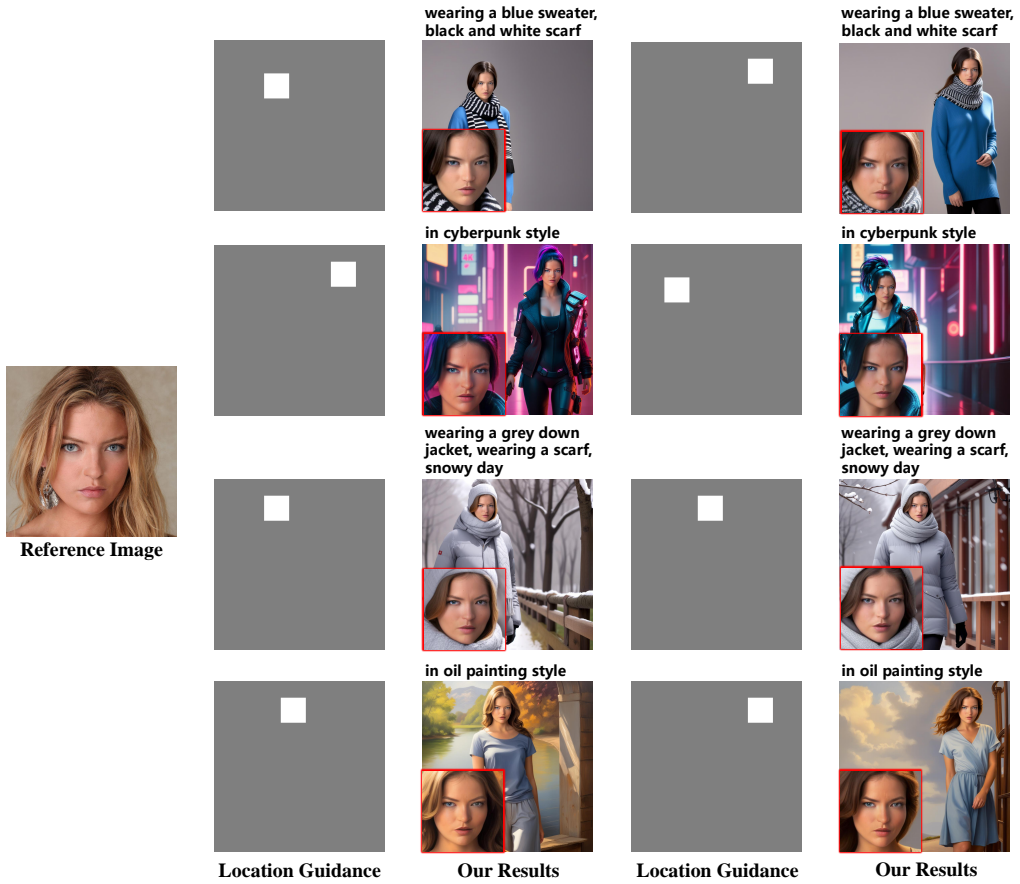
The central claim is that the complementarity of two ControlNet-style branches is enough to satisfy all three requirements simultaneously. The local branch crops the face region from the noisy latent, up-samples it, and injects identity plus facial-landmark pose/expression conditions; because the face is normalized in scale, identity details survive even when the target face is a small fraction of the image. A relocation operation then places the local features back into the full latent at the position given by the location mask. The global branch takes the same identity embedding and the mask itself as conditions, providing layout, body/background placement, and overall coherence. The authors further claim that because each branch is a ControlNet variant, multi-person inference can be done without multi-person training by summing local-branch outputs and averaging global-branch outputs for the different identities. The paper's stated boundary is that this per-person control covers face-region factors only; per-person clothing and hairstyle in group images remain governed by the text prompt.
Load-bearing premise
Multi-person inference assumes that the control signals from different identities combine linearly—local branch outputs can simply be summed and global outputs averaged—and the paper gives no derivation or dedicated multi-person training to justify that superposition, so overlapping or crowded faces could cross-contaminate identities.
Editorial extensions
If this is right
- Small faces keep identity: because the local branch sees a scale-normalized face crop, FaceNet/CLIP-I scores stay high for face sizes down to 1/7 of the image edge.
- Fine control becomes mask-driven: editing the binary mask changes location and size, and swapping facial landmarks changes pose and expression, with no text engineering.
- Multi-person generation emerges from single-person training: summing local ControlNet outputs and averaging global outputs creates two-person and three-person composites without multi-person data.
- The framework plugs into a pretrained SDXL backbone and inherits its prompt and style handling.
- The method's own scope note: per-person clothing and hairstyle in group images are not precisely controllable.
Reading between the lines
- We infer the 'sum local, average global' recipe is a linear-superposition assumption; it should be stress-tested by increasing overlap between location masks and by going beyond three identities, since the paper only self-compares FaceNet on two/three-person examples.
- We infer that the local branch's robustness hinges on face-detection quality: if the detector misses or mis-sizes a face, the up-sampling normalization will encode the wrong region, so detector noise is likely the main practical failure mode.
- The relocation operation is a hard spatial copy, so identity features may not blend with surrounding content; the paper's own ablation shows the global branch is needed for harmony, and we suspect the same boundary will appear for partial occlusions.
- Because training data are single-person and style is a global signal, the method likely transfers to other backbones but will inherit each backbone's text-encoder limitations on spatial language.
Editorial analysis
A structured set of objections, weighed in public.
Referee Report
Summary. The paper proposes RealisID, a zero-shot identity customization method built on SDXL and two ControlNet-style branches. A local branch crops and up-samples the face region of the noisy latent and injects identity, pose, and expression information, while a global branch consumes a face-location mask and injects layout information. The two branches are trained jointly on single-person data with the loss in Eq. (7), which adds a face-region-weighted denoising term. At inference, multi-person customization is performed by summing the local-branch injections and averaging the global-branch injections across identities. Experiments compare RealisID with IP-Adapter-face-plus, FlashFace, PhotoMaker, InstantID, and PuLID on regular and small-face settings, and include ablations, fine-control demonstrations, and a single-vs-multi-person self-comparison.
Significance. If the reported results are reliable, RealisID would be a useful contribution: it offers a simple branch decomposition that jointly provides small-face identity fidelity, fine location/pose/expression control, and a zero-shot route to multi-person customization from single-person training. The paper's strengths are a clearly specified architecture, an explicit training objective with a face-mask term, and quantitative comparisons against five published baselines. The ablation evidence for branch complementarity is also informative. However, the multi-person extension rests on an untested linear-superposition assumption, the quantitative evidence lacks error bars and significance tests, and the small-face evaluation protocol is asymmetric between methods. These issues directly affect the headline claims, so the manuscript needs additional evidence before it can be accepted.
major comments (3)
- [Inference for Multi-Person Customization; Fig. 2(c); Table 9] The multi-person customization claim is supported only by an untrained integration rule. Summing the local-branch injections and averaging the global-branch injections across identities is not motivated by the training objective in Eq. (7), which only ever sees one identity, and no analysis shows that the summed injections preserve identity separation. Table 9 is a self-comparison of RealisID single vs. multi on the same 40 identities; it does not measure cross-identity leakage (e.g., whether the generated face of person A contains features of person B), does not separate overlapping from non-overlapping layouts, and includes no baseline. Because multi-person customization is one of the three headline requirements, this needs direct evidence: e.g., identity confusion rates, separate results for overlapping and non-overlapping face boxes, and a comparison against a method trained for multi-ID generation or against an oracle combination.
- [Quantitative Comparisons; Table 1] The central quantitative claim of small-face superiority is not backed by variance or significance information. Table 1 reports single-point means over 2800 images per method; differences such as FaceNet 0.767 vs. 0.693 for InstantID and 0.767 vs. 0.497 for PuLID are presented without standard deviations, confidence intervals, or tests, so the reader cannot tell whether the ordering is stable. In addition, the small-face protocol is asymmetric: methods that cannot control face size receive the extra text prompt "a full-body people image," while RealisID instead receives a location guidance mask. This changes the conditioning between arms and may affect all four metrics; the prompt list in Table 5 does not include this extra phrase. Please report per-method error bars and a same-prompt control (e.g., give all methods the same text prompt while RealisID additionally uses location guidance, or evaluate PhotoMaker and PuLID with the identical unmodified prompt as well).
- [Ablation Studies, Scale Robustness; Table 2; Fig. 5] The scale-alignment mechanism is not isolated. Table 2 and Fig. 4 compare the full model with and without the entire local branch, so they show that the local branch matters overall, but they do not show that the proposed cropping/up-sampling and relocation operation (Eqs. (4)-(5)) are what confer scale robustness. An ablated local branch that consumes the full latent z_t without cropping/up-sampling, or one that omits relocation, would directly test the paper's stated mechanism. Without such an ablation, the "scale-robust" property could plausibly come from the face-mask loss in Eq. (7) or from the global location branch rather than from the up-sampling operation.
minor comments (5)
- [Figure 3 caption] The caption says "the odd rows display the quantitative results," but the context indicates these are qualitative results; please correct the wording.
- [Section 'Qualitative Comparisons'] The first sentence of the Regular Case paragraph says "the odd rows display the quantitative results" and should read "qualitative results."
- [Eqs. (3)-(5)] The notation around Eq. (5) is confusing: Eq. (3) already defines i_t^l, Eq. (4) then defines \hat{i}_t^l = R(i_t^l, c_loc), and Eq. (5) redefines i_t^l using \hat{z}_t. Please reorder or rename the variables so the dependency chain is unambiguous.
- [Text after Eq. (5)] There is a typo: "desnoier" should be "denoiser."
- [Reproducibility] The paper does not state whether code or trained models will be released; given that the architecture is the main contribution, a code-release statement would improve reproducibility.
Circularity Check
No significant circularity: RealisID's claims are self-contained and tested against held-out identities; the multi-person inference rule is an untested heuristic but not a circular derivation.
full rationale
RealisID's central claims are evaluated against held-out identities from CelebA-HQ and external baselines, with no prediction that reduces by construction to a fitted parameter or a self-citation. The local/global branch design, the training objective in Eq. (7), and the classifier-free guidance in Eq. (8) are architectural choices whose effectiveness is measured with FaceNet, CLIP-I, CLIP-T, and ASP; the model is trained with a noise-prediction loss, not with these evaluation metrics, so the reported identity-fidelity numbers are not forced. The multi-person inference rule (summing local-branch injections and averaging global-branch injections) is an untested linear-combination heuristic, and Table 9 is a self-comparison that does not isolate cross-identity leakage; this is a validation weakness rather than circularity, because the claim is empirically testable and is not defined in terms of its own output. The only mild definitional point is that 'Scale-Robust' in Table 6 is operationalized via a FaceNet threshold and then demonstrated with FaceNet; that is a labeling convention, not a derivation, and it does not make the architectural result equivalent to its input. No load-bearing self-citation is present: references to CosmicMan, IP-Adapter, ControlNet, FlashFace, and related works are external, and no uniqueness theorem is invoked to force the design. Therefore the paper's derivation chain is self-contained and warrants a score of 0.
Assumptions & free parameters
free parameters (5)
- lambda balance weight in Eq. (7) =
1.0
- lambda_t text guidance scale =
7.5
- lambda_i image guidance scale =
5.0
- small-face threshold =
face bounding box long side less than 1/6 of image edge
- condition dropout probability =
0.05
assumptions (5)
- domain assumption SDXL, CLIP, ControlNet, MTCNN, BiSeNet, MediaPipe, FaceNet, and DECA are treated as reliable pre-trained components.
- ad hoc to paper Cropped and up-sampled latents from the face region retain identity and pose information and align with pose-expression conditions.
- ad hoc to paper Multi-person inference can be achieved by summing local branch outputs and averaging global branch outputs across identities.
- domain assumption CelebA-HQ identities are unseen relative to CosmicMan training and form an adequate held-out test distribution.
- standard math Standard Stable Diffusion training dynamics continue to hold when adding ControlNet branches with zero convolution.
invented entities (4)
-
Local ControlNet branch with face-crop and up-sampling
-
Global ControlNet branch with location mask
-
Relocation operation R
-
Multi-person integration rule (sum local, average global)
Cite this review
Pith. "Pith review of RealisID: Scale-Robust and Fine-Controllable Identity Customization via Local and Global Complementation." pith.science (2026). https://pith.science/paper/ZXUIOXC3
@misc{pith2026241216832,
  author       = {Pith},
  title        = {Pith review of: RealisID: Scale-Robust and Fine-Controllable Identity Customization via Local and Global Complementation},
  year         = {2026},
  howpublished = {\url{https://pith.science/paper/ZXUIOXC3}},
  note         = {Machine review of arXiv:2412.16832}
}
read the original abstract
Recently, the success of text-to-image synthesis has greatly advanced the development of identity customization techniques, whose main goal is to produce realistic identity-specific photographs based on text prompts and reference face images. However, it is difficult for existing identity customization methods to simultaneously meet the various requirements of different real-world applications, including the identity fidelity of small face, the control of face location, pose and expression, as well as the customization of multiple persons. To this end, we propose a scale-robust and fine-controllable method, namely RealisID, which learns different control capabilities through the cooperation between a pair of local and global branches. Specifically, by using cropping and up-sampling operations to filter out face-irrelevant information, the local branch concentrates the fine control of facial details and the scale-robust identity fidelity within the face region. Meanwhile, the global branch manages the overall harmony of the entire image. It also controls the face location by taking the location guidance as input. As a result, RealisID can benefit from the complementarity of these two branches. Finally, by implementing our branches with two different variants of ControlNet, our method can be easily extended to handle multi-person customization, even only trained on single-person datasets. Extensive experiments and ablation studies indicate the effectiveness of RealisID and verify its ability in fulfilling all the requirements mentioned above.
Figures


Figures from the paper (12 more)




Reference graph
Works this paper leans on
-
[1]
Bai, Y.; Zhang, Y.; Ding, M.; and Ghanem, B. 2018. Sod-mtgan: Small object detection via multi-task generative adversarial network. In Proceedings of the European conference on computer vision (ECCV), 206--221
work page 2018
-
[2]
Cui, S.; Guo, J.; An, X.; Deng, J.; Zhao, Y.; Wei, X.; and Feng, Z. 2024. IDAdapter: Learning Mixed Features for Tuning-Free Personalization of Text-to-Image Models. In Proceedings of the IEEE/CVF Conference on Computer Vision and Pattern Recognition, 950--959
work page 2024
-
[3]
J.; and Bolkart, T
Feng, Y.; Feng, H.; Black, M. J.; and Bolkart, T. 2021. Learning an animatable detailed 3D face model from in-the-wild images. ACM Transactions on Graphics (ToG), 40(4): 1--13
2021
-
[4]
H.; Chechik, G.; and Cohen-Or, D
Gal, R.; Alaluf, Y.; Atzmon, Y.; Patashnik, O.; Bermano, A. H.; Chechik, G.; and Cohen-Or, D. 2022. An image is worth one word: Personalizing text-to-image generation using textual inversion. arXiv preprint arXiv:2208.01618
arXiv 2022
-
[5]
Guo, Z.; Wu, Y.; Chen, Z.; Chen, L.; and He, Q. 2024. PuLID: Pure and Lightning ID Customization via Contrastive Alignment. arXiv preprint arXiv:2404.16022
arXiv 2024
-
[6]
Ho, J.; and Salimans, T. 2022. Classifier-free diffusion guidance. arXiv preprint arXiv:2207.12598
arXiv 2022
-
[7]
J.; Shen, Y.; Wallis, P.; Allen-Zhu, Z.; Li, Y.; Wang, S.; Wang, L.; and Chen, W
Hu, E. J.; Shen, Y.; Wallis, P.; Allen-Zhu, Z.; Li, Y.; Wang, S.; Wang, L.; and Chen, W. 2021. Lora: Low-rank adaptation of large language models. arXiv preprint arXiv:2106.09685
arXiv 2021
-
[8]
Karras, T.; Aila, T.; Laine, S.; and Lehtinen, J. 2017. Progressive growing of gans for improved quality, stability, and variation. arXiv preprint arXiv:1710.10196
arXiv 2017
Show all 41 references
-
[9]
Kim, C.; Lee, J.; Joung, S.; Kim, B.; and Baek, Y.-M. 2024 a . InstantFamily: Masked Attention for Zero-shot Multi-ID Image Generation. arXiv preprint arXiv:2404.19427
2024 arXiv
-
[10]
Kim, J.; Gu, G.; Park, M.; Park, S.; and Choo, J. 2024 b . Stableviton: Learning semantic correspondence with latent diffusion model for virtual try-on. In Proceedings of the IEEE/CVF Conference on Computer Vision and Pattern Recognition, 8176--8185
2024
-
[11]
Li, S.; Fu, J.; Liu, K.; Wang, W.; Lin, K.-Y.; and Wu, W. 2024 a . CosmicMan: A Text-to-Image Foundation Model for Humans. In Proceedings of the IEEE/CVF Conference on Computer Vision and Pattern Recognition, 6955--6965
2024
-
[12]
Li, Z.; Cao, M.; Wang, X.; Qi, Z.; Cheng, M.-M.; and Shan, Y. 2024 b . Photomaker: Customizing realistic human photos via stacked id embedding. In Proceedings of the IEEE/CVF Conference on Computer Vision and Pattern Recognition, 8640--8650
2024
-
[13]
Liang, C.; Ma, F.; Zhu, L.; Deng, Y.; and Yang, Y. 2024. Caphuman: Capture your moments in parallel universes. In Proceedings of the IEEE/CVF Conference on Computer Vision and Pattern Recognition, 6400--6409
2024
-
[14]
G.; Lee, J.; et al
Lugaresi, C.; Tang, J.; Nash, H.; McClanahan, C.; Uboweja, E.; Hays, M.; Zhang, F.; Chang, C.-L.; Yong, M. G.; Lee, J.; et al. 2019. Mediapipe: A framework for building perception pipelines. arXiv preprint arXiv:1906.08172
2019 arXiv
-
[15]
Ma, Y.; Liu, H.; Wang, H.; Pan, H.; He, Y.; Yuan, J.; Zeng, A.; Cai, C.; Shum, H.-Y.; Liu, W.; et al. 2024. Follow-Your-Emoji: Fine-Controllable and Expressive Freestyle Portrait Animation. arXiv preprint arXiv:2406.01900
2024 arXiv
-
[16]
Mou, C.; Wang, X.; Xie, L.; Wu, Y.; Zhang, J.; Qi, Z.; and Shan, Y. 2024. T2i-adapter: Learning adapters to dig out more controllable ability for text-to-image diffusion models. In Proceedings of the AAAI Conference on Artificial Intelligence, volume 38, 4296--4304
2024
-
[17]
Nichol, A.; Dhariwal, P.; Ramesh, A.; Shyam, P.; Mishkin, P.; McGrew, B.; Sutskever, I.; and Chen, M. 2021. Glide: Towards photorealistic image generation and editing with text-guided diffusion models. arXiv preprint arXiv:2112.10741
2021 arXiv
-
[18]
Noh, J.; Bae, W.; Lee, W.; Seo, J.; and Kim, G. 2019. Better to follow, follow to be better: Towards precise supervision of feature super-resolution for small object detection. In Proceedings of the IEEE/CVF international conference on computer vision, 9725--9734
2019
-
[19]
Peng, X.; Zhu, J.; Jiang, B.; Tai, Y.; Luo, D.; Zhang, J.; Lin, W.; Jin, T.; Wang, C.; and Ji, R. 2024. Portraitbooth: A versatile portrait model for fast identity-preserved personalization. In Proceedings of the IEEE/CVF Conference on Computer Vision and Pattern Recognition, ...
2024
-
[20]
Podell, D.; English, Z.; Lacey, K.; Blattmann, A.; Dockhorn, T.; M \"u ller, J.; Penna, J.; and Rombach, R. 2023. Sdxl: Improving latent diffusion models for high-resolution image synthesis. arXiv preprint arXiv:2307.01952
2023 arXiv
-
[21]
W.; Hallacy, C.; Ramesh, A.; Goh, G.; Agarwal, S.; Sastry, G.; Askell, A.; Mishkin, P.; Clark, J.; et al
Radford, A.; Kim, J. W.; Hallacy, C.; Ramesh, A.; Goh, G.; Agarwal, S.; Sastry, G.; Askell, A.; Mishkin, P.; Clark, J.; et al. 2021. Learning transferable visual models from natural language supervision. In International conference on machine learning, 8748--8763. PMLR
2021
-
[22]
Ramesh, A.; Dhariwal, P.; Nichol, A.; Chu, C.; and Chen, M. 2022. Hierarchical text-conditional image generation with clip latents. arXiv preprint arXiv:2204.06125
2022 arXiv
-
[23]
Rombach, R.; Blattmann, A.; Lorenz, D.; Esser, P.; and Ommer, B. 2022. High-resolution image synthesis with latent diffusion models. In Proceedings of the IEEE/CVF conference on computer vision and pattern recognition, 10684--10695
2022
-
[24]
Ruiz, N.; Li, Y.; Jampani, V.; Pritch, Y.; Rubinstein, M.; and Aberman, K. 2023. Dreambooth: Fine tuning text-to-image diffusion models for subject-driven generation. In Proceedings of the IEEE/CVF conference on computer vision and pattern recognition, 22500--22510
2023
-
[25]
L.; Ghasemipour, K.; Gontijo Lopes, R.; Karagol Ayan, B.; Salimans, T.; et al
Saharia, C.; Chan, W.; Saxena, S.; Li, L.; Whang, J.; Denton, E. L.; Ghasemipour, K.; Gontijo Lopes, R.; Karagol Ayan, B.; Salimans, T.; et al. 2022. Photorealistic text-to-image diffusion models with deep language understanding. Advances in neural information processing syste...
2022
-
[26]
Schroff, F.; Kalenichenko, D.; and Philbin, J. 2015. Facenet: A unified embedding for face recognition and clustering. In Proceedings of the IEEE conference on computer vision and pattern recognition, 815--823
2015
-
[27]
Schuhmann, C.; Beaumont, R.; Vencu, R.; Gordon, C.; Wightman, R.; Cherti, M.; Coombes, T.; Katta, A.; Mullis, C.; Wortsman, M.; et al. 2022. Laion-5b: An open large-scale dataset for training next generation image-text models. Advances in Neural Information Processing Systems,...
2022
-
[28]
Song, J.; Meng, C.; and Ermon, S. 2020. Denoising diffusion implicit models. arXiv preprint arXiv:2010.02502
2020 arXiv
-
[29]
Wang, Q.; Bai, X.; Wang, H.; Qin, Z.; and Chen, A. 2024 a . Instantid: Zero-shot identity-preserving generation in seconds. arXiv preprint arXiv:2401.07519
2024 arXiv
-
[30]
Wang, Q.; Jia, X.; Li, X.; Li, T.; Ma, L.; Zhuge, Y.; and Lu, H. 2024 b . Stableidentity: Inserting anybody into anywhere at first sight. arXiv preprint arXiv:2401.15975
2024 arXiv
-
[31]
Wei, H.; Yang, Z.; and Wang, Z. 2024. Aniportrait: Audio-driven synthesis of photorealistic portrait animation. arXiv preprint arXiv:2403.17694
2024 arXiv
-
[32]
Wei, Z.; Su, Q.; Qin, L.; and Wang, W. 2024. MM-Diff: High-Fidelity Image Personalization via Multi-Modal Condition Integration. arXiv preprint arXiv:2403.15059
2024 arXiv
-
[33]
T.; Durand, F.; and Han, S
Xiao, G.; Yin, T.; Freeman, W. T.; Durand, F.; and Han, S. 2023. Fastcomposer: Tuning-free multi-subject image generation with localized attention. arXiv preprint arXiv:2305.10431
2023 arXiv
-
[34]
Yang, B.; Gu, S.; Zhang, B.; Zhang, T.; Chen, X.; Sun, X.; Chen, D.; and Wen, F. 2023. Paint by example: Exemplar-based image editing with diffusion models. In Proceedings of the IEEE/CVF Conference on Computer Vision and Pattern Recognition, 18381--18391
2023
-
[35]
Ye, H.; Zhang, J.; Liu, S.; Han, X.; and Yang, W. 2023. Ip-adapter: Text compatible image prompt adapter for text-to-image diffusion models. arXiv preprint arXiv:2308.06721
2023 arXiv
-
[36]
Yu, C.; Wang, J.; Peng, C.; Gao, C.; Yu, G.; and Sang, N. 2018. Bisenet: Bilateral segmentation network for real-time semantic segmentation. In Proceedings of the European conference on computer vision (ECCV), 325--341
2018
-
[37]
Zhang, K.; Zhang, Z.; Li, Z.; and Qiao, Y. 2016. Joint face detection and alignment using multitask cascaded convolutional networks. IEEE signal processing letters, 23(10): 1499--1503
2016
-
[38]
Zhang, L.; Rao, A.; and Agrawala, M. 2023. Adding conditional control to text-to-image diffusion models. In Proceedings of the IEEE/CVF International Conference on Computer Vision, 3836--3847
2023
-
[39]
Zhang, S.; Huang, L.; Chen, X.; Zhang, Y.; Wu, Z.-F.; Feng, Y.; Wang, W.; Shen, Y.; Liu, Y.; and Luo, P. 2024. FlashFace: Human Image Personalization with High-fidelity Identity Preservation. arXiv preprint arXiv:2403.17008
2024
-
[40]
, " * write output.state after.block = add.period write newline
ENTRY address archivePrefix author booktitle chapter edition editor eid eprint howpublished institution isbn journal key month note number organization pages publisher school series title type volume year label extra.label sort.label short.list INTEGERS output.state before.all...
-
[41]
write newline
" write newline "" before.all 'output.state := FUNCTION n.dashify 't := "" t empty not t #1 #1 substring "-" = t #1 #2 substring "--" = not "--" * t #2 global.max substring 't := t #1 #1 substring "-" = "-" * t #2 global.max substring 't := while if t #1 #1 substring * t #2 gl...
Reviewed August 11, 2026 · model on record in the stance chip above.
Discussion (0). Continue with ORCID to comment.