REVIEW 4 major objections 6 minor 46 references
Semantic Hierarchical Prompt Tuning for Parameter-Efficient Fine-Tuning
T0 review · 4 major / 6 minor · reviewed 2026-08-11 · deepseek-v4-flash
Pith's one-line read Visual prompt tuning places prompts according to the frozen model's own layer semantics, beating uniform prompt injection by 4.9 average accuracy points on VTAB-1k with only 0.38M trainable parameters.
desk verdict The adaptive hierarchy is the least-supported part of a useful, well-ablated PEFT method; the 4.9% claim is likely carried by the other components. read the letter →
The pith
A machine-rendered reading of the paper's core claim, the machinery that carries it, and where it could break.
The reading
What carries the argument
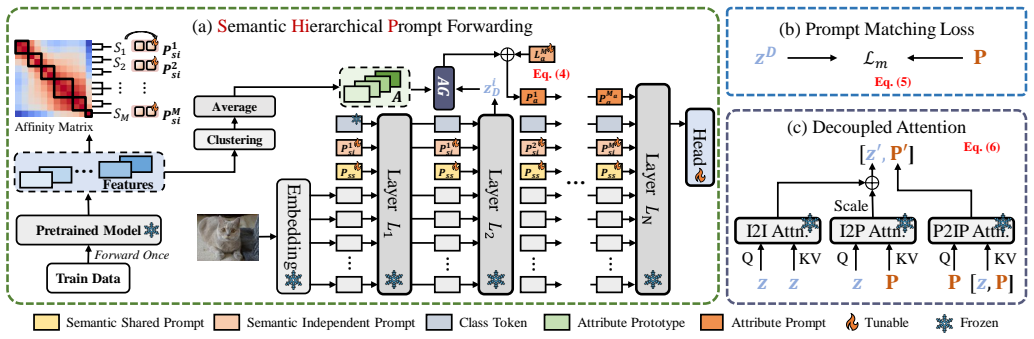
The carrying object is the semantic hierarchy: an adaptive partition of the transformer's layers into groups whose features are highly similar to one another. The paper takes intermediate features from the frozen pretrained ViT, forms an inter-layer affinity measure by cosine similarity, averages it over sampled training images, and applies a greedy search with a threshold of 0.95 to group consecutive layers. Each group receives Semantic-Independent Prompts shared within the group; Semantic-Shared Prompts are inserted at every layer; Attribute Prompts are built from cluster prototypes of the training set and inserted in the last two hierarchies. A Prompt Matching Loss attracts each prompt to its nearest high-attention instance token, and Decoupled Attention splits attention into instance-to-instance, instance-to-prompt, and prompt-to-instance-and-prompt parts so prompts do not dilute the pretrained attention.
What would settle it
On a held-out set, compare SHIP's accuracy using the frozen-feature hierarchy against SHIP using a hierarchy recomputed after training, and sweep the threshold from 0.85 to 0.99 across all 19 VTAB-1k tasks; if the best hierarchy shifts or accuracy swings by more than the claimed 4.9-point margin, the hierarchy estimates are not what carry the gain.
Extended reading notes
Core claim
SHIP establishes that the right place for prompt tokens is not every layer but the boundaries of task-specific semantic hierarchies read off the frozen pretrained model. It computes average cosine affinity between features of adjacent layers, segments layers into semantic levels by a greedy search with a similarity threshold of 0.95, and inserts Semantic-Independent Prompts at the start of each level. Semantic-Shared Prompts and Attribute Prompts add cross-level and sample-specific capacity; a Prompt Matching Loss aligns prompts with the most-attended instance tokens; Decoupled Attention keeps the original instance-to-instance attention intact. On VTAB-1k with ViT-B/16, this yields 76.9% average accuracy, 4.9 points above VPT, with 0.38M trainable parameters.
Load-bearing premise
The load-bearing premise is that the semantic hierarchy read from cosine similarity between neighboring layers of the frozen pretrained network tells where prompts should be inserted once the model is trained; if prompt placement should shift after learning, or if the 0.95 threshold is fragile across tasks, the main accuracy gain is not guaranteed.
Editorial extensions
If this is right
- If SHIP is right, uniformly injecting prompts at every layer is not just wasteful but harmful, and task-adaptive placement is a main source of the gain.
- Sharing prompts within semantic levels lets a small prompt budget learn deeper representations, so the 0.38M parameter count is part of the result, not a separate trick.
- Attributing prompts to high-attention instance tokens and aligning them with a matching loss gives the model an explicit route to class-discriminative features.
- The largest gains on structured VTAB tasks (6.4 points over VPT) suggest geometric and spatial-relation tasks benefit most from the semantic hierarchy.
- Decoupled attention prevents prompt tokens from diluting the pretrained instance attention, which should improve training stability and reduce overfitting, as the paper's loss curves indicate.
Reading between the lines
- This is an inference, not a paper claim: the same affinity-based hierarchy could choose insertion points for other parameter-efficient modules such as adapters or low-rank updates, not just prompt tokens.
- A testable extension the paper does not run is to recompute the hierarchy after prompt training; if accuracy improves, the frozen-feature hierarchy is not the final word.
- The class-token attention used by the prompt matching loss may transfer poorly to dense prediction tasks, so the discrimination gain is likely classification-specific.
- The threshold and cluster counts are validated per task; a learned or gradient-based hierarchy might make the method less sensitive to those choices.
Editorial analysis
A structured set of objections, weighed in public.
Referee Report
Summary. The paper proposes SHIP, a parameter-efficient fine-tuning method for Vision Transformers. SHIP partitions transformer layers into semantic levels using an inter-layer affinity matrix and greedy search, inserts semantic-independent prompts per level together with semantic-shared prompts and attribute prompts, and trains with a prompt matching loss and a decoupled attention mechanism. On the VTAB-1k benchmark with a ViT-B/16 backbone, SHIP reports 76.9% average top-1 accuracy with 0.38M trainable parameters, a 4.9% improvement over VPT (72.0%).
Significance. If the reported results are reproducible, SHIP is a competitive prompt-based PEFT method with a modest parameter budget, and the paper includes component ablations and a code release. The central novelty, however, is the adaptive semantic hierarchy that decides where prompts are inserted and shared. The paper's own ablation (Table III) shows that this hierarchy provides only a 0.5% accuracy gain over a simple uniform interval partition on the Natural tasks, which weakens the attribution of the headline improvement to the semantic-hierarchy mechanism. The single-run results without baseline re-implementation details further limit the strength of the empirical claims.
major comments (4)
- [IV-C, Table III] The adaptive semantic hierarchy, which is the central novelty of the paper, is not convincingly validated. The semantic-independent prompting from the hierarchy achieves 80.8 average accuracy on the Natural tasks, only 0.5% above the uniform interval I=2 strategy (80.3), and the 3.0% gain quoted in the text is relative to VPT-Deep (77.8), not to the uniform partition. This does not establish that the hierarchy, rather than within-level prompt sharing or the other components, is responsible for the 4.9% improvement over VPT in Table I. Please provide per-task partitions, sensitivity to lambda, and a comparison with matched prompt budgets.
- [IV-A, Table I] The main comparison reports a single accuracy number per method with no variance or number of seeds, and it is not stated whether the baseline results are reproduced in the same training harness or taken from the original publications. Because VPT and related prompt-tuning methods are known to be sensitive to hyperparameters and prompt length, the 4.9% gain over VPT needs error bars on at least three independent runs for SHIP and for the baselines that are claimed to be re-run.
- [IV-C, Table IV] The decoupled-attention coefficient lambda_d shows extreme sensitivity, with accuracy falling from 76.6 at lambda_d=0.1 to 40.5 at lambda_d=0.5. This indicates that the default value sits on a narrow peak. The paper does not report how lambda_d was selected for the other 18 tasks or whether the same value is optimal. If lambda_d is tuned per task on the validation split, the reported average gain may be optimistic; please provide the cross-task distribution of the selected lambda_d and a stability analysis.
- [III-B] The greedy search for semantic levels relies on a fixed affinity threshold lambda=0.95, but the paper gives no analysis of how the number of levels M or the partition boundaries vary across the 19 VTAB tasks, nor how sensitive performance is to lambda. Since the hierarchy is computed once from frozen features and never re-evaluated after prompt training, the assumption that frozen-feature affinity predicts the optimal prompt-sharing structure remains unexamined. Please add a sensitivity study of lambda and a comparison of the inferred partitions against task properties.
minor comments (6)
- [IV-C] The sentence comparing SIP with an equivalent number of ordinary prompts (74.5 vs 74.2) is unclear and appears to undermine the attribution of gains to SSP/AP; please rephrase and report the configuration explicitly.
- [III-B, Eq. (4)] It is not clear from which layer the instance tokens z_i^D are taken when constructing attribute prompts, and whether the attribute prototypes are computed from frozen features or from features updated during training; please clarify.
- [III-B, Decoupled Attention] The statement that the P2IP component 'can be omitted with minimal impact' is not supported by an ablation; either add the ablation or mark it as an informal observation.
- [Table III caption] The caption contains a typo: 'on the on VTAB-1k Natural tasks.'
- [References] References [28] and [33] are the same work; please consolidate them.
- [Abstract and IV-B] The claim of 'reduced inference costs' in the abstract is not quantified; since SHIP inserts more prompt tokens than VPT, a FLOPs or parameter comparison would be helpful.
Circularity Check
No circularity found: SHIP is an empirical fine-tuning method whose gains are measured on an external benchmark, not derived from its own fitted inputs.
full rationale
This paper is an empirical method paper. The central claim, a 4.9% accuracy improvement over VPT on VTAB-1k, is established by running the proposed method on an external benchmark and comparing against published baselines; it is not constructed from fitted values or from the paper's own definitions. The semantic hierarchy in Section III-B is estimated from frozen pretrained features via cosine affinity and greedy search, but this is a design choice for prompt placement, not a prediction of the reported accuracy. The paper does not fit a parameter to a subset of data and then present a closely related quantity as a prediction; the ablations in Tables II and III attribute gains to individual components empirically. The mildly self-referential aspect that the hierarchy is computed from the same pretrained model being fine-tuned is a methodological choice and could raise validation concerns, but it does not make any derived result equivalent to its inputs by construction. Author self-citations in the reference list are related-work citations and are not load-bearing. No equation in the paper reduces another equation to itself, and no uniqueness theorem or prior result by the same authors is invoked to force the method's choices. Therefore there is no significant circularity. Concerns about whether the semantic hierarchy remains optimal after prompt training or about sensitivity to the threshold lambda are correctness risks, not circularity.
Assumptions & free parameters
free parameters (5)
- Affinity threshold lambda for semantic hierarchy partition =
0.95 (default; searched per task on validation)
- Semantic hierarchy partition (number and boundaries of semantic levels) =
Task-dependent, determined by greedy search
- Attribute-prototype count K =
200
- Decoupled-attention mixing coefficient lambda_d =
0.1
- Prompt matching loss weight lambda_m and prompt lengths (NSS=10, Na=10, Nm=10, lambda_a=0.1) =
Listed defaults, selected by validation tuning
assumptions (4)
- domain assumption The cosine affinity between pretrained intermediate features is a valid and stable indicator of where semantic hierarchies should be drawn for prompt insertion.
- domain assumption The original instance-to-instance self-attention structure of the pretrained ViT should be preserved, and disruption by inserted prompts harms transfer.
- domain assumption Attribute prototypes formed by K-means clustering of training features capture discriminative visual attributes.
- standard math Standard transformer forward equations and the VTAB-1k evaluation protocol from [7], [41] are correct and applicable.
Cite this review
Pith. "Pith review of Semantic Hierarchical Prompt Tuning for Parameter-Efficient Fine-Tuning." pith.science (2026). https://pith.science/paper/6NQZ2NCD
@misc{pith2026241216956,
  author       = {Pith},
  title        = {Pith review of: Semantic Hierarchical Prompt Tuning for Parameter-Efficient Fine-Tuning},
  year         = {2026},
  howpublished = {\url{https://pith.science/paper/6NQZ2NCD}},
  note         = {Machine review of arXiv:2412.16956}
}
read the original abstract
As the scale of vision models continues to grow, Visual Prompt Tuning (VPT) has emerged as a parameter-efficient transfer learning technique, noted for its superior performance compared to full fine-tuning. However, indiscriminately applying prompts to every layer without considering their inherent correlations, can cause significant disturbances, leading to suboptimal transferability. Additionally, VPT disrupts the original self-attention structure, affecting the aggregation of visual features, and lacks a mechanism for explicitly mining discriminative visual features, which are crucial for classification. To address these issues, we propose a Semantic Hierarchical Prompt (SHIP) fine-tuning strategy. We adaptively construct semantic hierarchies and use semantic-independent and semantic-shared prompts to learn hierarchical representations. We also integrate attribute prompts and a prompt matching loss to enhance feature discrimination and employ decoupled attention for robustness and reduced inference costs. SHIP significantly improves performance, achieving a 4.9% gain in accuracy over VPT with a ViT-B/16 backbone on VTAB-1k tasks. Our code is available at https://github.com/haoweiz23/SHIP.
Figures


Reference graph
Works this paper leans on
-
[1]
An image is worth 16x16 words: Transformers for image recognition at scale,
A. Dosovitskiy, L. Beyer, A. Kolesnikov, D. Weissenborn, X. Zhai, T. Unterthiner, M. Dehghani, M. Minderer, G. Heigold, S. Gelly, J. Uszkoreit, and N. Houlsby, “An image is worth 16x16 words: Transformers for image recognition at scale,” in ICLR, 2021. 1, 3
2021
-
[2]
Learning transferable visual models from natural language supervi- sion,
A. Radford, J. W. Kim, C. Hallacy, A. Ramesh, G. Goh, S. Agarwal, G. Sastry, A. Askell, P. Mishkin, J. Clark, G. Krueger, and I. Sutskever, “Learning transferable visual models from natural language supervi- sion,” pp. 8748–8763, 2021. 1
work page 2021
-
[3]
High- resolution image synthesis with latent diffusion models,
R. Rombach, A. Blattmann, D. Lorenz, P. Esser, and B. Ommer, “High- resolution image synthesis with latent diffusion models,” in Proceedings of the IEEE/CVF conference on computer vision and pattern recognition, pp. 10684–10695, 2022. 1
work page 2022
-
[4]
Dual cross- attention learning for fine-grained visual categorization and object re- identification,
H. Zhu, W. Ke, D. Li, J. Liu, L. Tian, and Y . Shan, “Dual cross- attention learning for fine-grained visual categorization and object re- identification,” in Proceedings of the IEEE/CVF conference on computer vision and pattern recognition , pp. 4692–4702, 2022. 1
work page 2022
-
[5]
Distribution-aware data expansion with diffusion models,
H. Zhu, L. Yang, J.-H. Yong, H. Yin, J. Jiang, M. Xiao, W. Zhang, and B. Wang, “Distribution-aware data expansion with diffusion models,” in The Thirty-eighth Annual Conference on Neural Information Processing Systems, 2024. 1
work page 2024
-
[6]
Dip-go: A diffusion pruner via few-step gradient optimization,
H. Zhu, D. Tang, J. Liu, M. Lu, J. Zheng, J. Peng, D. Li, Y . Wang, F. Jiang, L. Tian, et al. , “Dip-go: A diffusion pruner via few-step gradient optimization,” in The Thirty-eighth Annual Conference on Neural Information Processing Systems , 2024. 1
work page 2024
-
[7]
M. Jia, L. Tang, B.-C. Chen, C. Cardie, S. Belongie, B. Hariharan, and S.-N. Lim, “Visual prompt tuning,” in ECCV, 2022. 1, 2, 3
work page 2022
-
[8]
Sensitivity-aware visual parameter-efficient fine-tuning,
H. He, J. Cai, J. Zhang, D. Tao, and B. Zhuang, “Sensitivity-aware visual parameter-efficient fine-tuning,” in Proceedings of the IEEE/CVF International Conference on Computer Vision , pp. 11825–11835, 2023. 1, 2
work page 2023
Show all 46 references
-
[9]
Neural prompt search,
Y . Zhang, K. Zhou, and Z. Liu, “Neural prompt search,” arXiv preprint arXiv:2206.04673, 2022. 1, 2, 3
2022 arXiv
-
[10]
E2vpt: An effective and efficient approach for visual prompt tuning,
H. Cheng, W. Qifan, C. Yiming, C. Zhiwen, W. Wenguan, Q. Siyuan, and L. Dongfang, “E2vpt: An effective and efficient approach for visual prompt tuning,” in ICCV, 2023. 1, 2, 3, 4
2023
-
[11]
Convolutional bypasses are better vision transformer adapters,
S. Jie and Z.-H. Deng, “Convolutional bypasses are better vision transformer adapters,” arXiv preprint arXiv:2207.07039 , 2022. 1
2022 arXiv
-
[12]
Adapt- former: Adapting vision transformers for scalable visual recognition,
S. Chen, C. Ge, Z. Tong, J. Wang, Y . Song, J. Wang, and P. Luo, “Adapt- former: Adapting vision transformers for scalable visual recognition,” NeurIPS, 2022. 1, 2
2022
-
[13]
LoRA: Low-rank adaptation of large language models,
E. J. Hu, yelong shen, P. Wallis, Z. Allen-Zhu, Y . Li, S. Wang, L. Wang, and W. Chen, “LoRA: Low-rank adaptation of large language models,” in ICLR, 2022. 1, 2, 3
2022
-
[14]
Side-tuning: a baseline for network adaptation via additive side networks,
J. O. Zhang, A. Sax, A. Zamir, L. Guibas, and J. Malik, “Side-tuning: a baseline for network adaptation via additive side networks,” in ECCV, pp. 698–714, Springer, 2020. 1, 2
2020
-
[15]
Sct: A simple baseline for parameter-efficient fine-tuning via salient channels,
H. H. Zhao, P. Wang, Y . Zhao, H. Luo, F. Wang, and M. Z. Shou, “Sct: A simple baseline for parameter-efficient fine-tuning via salient channels,” International Journal of Computer Vision , pp. 1–19, 2023. 1, 3
2023
-
[16]
Sa 2vp: Spatially aligned-and-adapted visual prompt,
W. Pei, T. Xia, F. Chen, J. Li, J. Tian, and G. Lu, “Sa 2vp: Spatially aligned-and-adapted visual prompt,” in Proceedings of the AAAI Con- ference on Artificial Intelligence , vol. 38, pp. 4450–4458, 2024. 1, 3
2024
-
[17]
Lion: Implicit vision prompt tuning,
H. Wang, J. Chang, Y . Zhai, X. Luo, J. Sun, Z. Lin, and Q. Tian, “Lion: Implicit vision prompt tuning,” in Proceedings of the AAAI Conference on Artificial Intelligence , vol. 38, pp. 5372–5380, 2024. 1, 2
2024
-
[18]
Argue: Attribute-guided prompt tuning for vision-language models,
X. Tian, S. Zou, Z. Yang, and J. Zhang, “Argue: Attribute-guided prompt tuning for vision-language models,” in Proceedings of the IEEE/CVF Conference on Computer Vision and Pattern Recognition , pp. 28578– 28587, 2024. 1
2024
-
[19]
Aapl: Adding attributes to prompt learning for vision-language models,
G. Kim, S. Kim, and S. Lee, “Aapl: Adding attributes to prompt learning for vision-language models,” in Proceedings of the IEEE/CVF Conference on Computer Vision and Pattern Recognition , pp. 1572– 1582, 2024. 1
2024
-
[20]
Tinytl: Reduce memory, not pa- rameters for efficient on-device learning,
H. Cai, C. Gan, L. Zhu, and S. Han, “Tinytl: Reduce memory, not pa- rameters for efficient on-device learning,” NeurIPS, vol. 33, pp. 11285– 11297, 2020. 2
2020
-
[21]
Parameter-efficient transfer learning for nlp,
N. Houlsby, A. Giurgiu, S. Jastrzebski, B. Morrone, Q. De Laroussilhe, A. Gesmundo, M. Attariyan, and S. Gelly, “Parameter-efficient transfer learning for nlp,” in ICML, pp. 2790–2799, 2019. 2, 3
2019
-
[22]
Tip-adapter: Training-free clip-adapter for better vision-language modeling,
R. Zhang, R. Fang, P. Gao, W. Zhang, K. Li, J. Dai, Y . Qiao, and H. Li, “Tip-adapter: Training-free clip-adapter for better vision-language modeling,” in ECCV, 2022. 2
2022
-
[23]
Revisiting the parameter efficiency of adapters from the perspective of precision redundancy,
S. Jie, H. Wang, and Z.-H. Deng, “Revisiting the parameter efficiency of adapters from the perspective of precision redundancy,” in Proceed- ings of the IEEE/CVF International Conference on Computer Vision , pp. 17217–17226, 2023. 2
2023
-
[24]
Learning multiple visual domains with residual adapters,
S.-A. Rebuffi, H. Bilen, and A. Vedaldi, “Learning multiple visual domains with residual adapters,” Advances in neural information pro- cessing systems, vol. 30, 2017. 2
2017
-
[25]
Adapterhub: A framework for adapting transformers,
J. Pfeiffer, A. R ¨uckl´e, C. Poth, A. Kamath, I. Vuli ´c, S. Ruder, K. Cho, and I. Gurevych, “Adapterhub: A framework for adapting transformers,” arXiv preprint arXiv:2007.07779 , 2020. 2
2007 arXiv
-
[26]
Caps-adapter: Caption-based multi- modal adapter in zero-shot classification,
Q. Wang, G. Liu, and B. Wang, “Caps-adapter: Caption-based multi- modal adapter in zero-shot classification,” in Proceedings of the 32nd ACM International Conference on Multimedia , pp. 5442–5450, 2024. 2
2024
-
[27]
Distribution-aware prompt tuning for vision-language models,
E. Cho, J. Kim, and H. J. Kim, “Distribution-aware prompt tuning for vision-language models,” in Int. Conf. Comput. Vis. , pp. 22004–22013,
-
[29]
Understanding and improving visual prompting: A label-mapping perspective,
A. Chen, Y . Yao, P.-Y . Chen, Y . Zhang, and S. Liu, “Understanding and improving visual prompting: A label-mapping perspective,” in Proceedings of the IEEE/CVF Conference on Computer Vision and Pattern Recognition, pp. 19133–19143, 2023. 2
2023
-
[30]
Autovp: An au- tomated visual prompting framework and benchmark,
H.-a. Tsao, L. Hsiung, P.-Y . Chen, S. Liu, and T.-y. Ho, “Autovp: An au- tomated visual prompting framework and benchmark,” in International Conference on Learning Representations , 2024. 2
2024
-
[31]
Pro- gressive visual prompt learning with contrastive feature re-formation,
C. Xu, H. Shen, F. Shi, B. Chen, Y . Liao, X. Chen, and L. Wang, “Pro- gressive visual prompt learning with contrastive feature re-formation,” arXiv preprint arXiv:2304.08386 , 2023. 2
2023 arXiv
-
[32]
Hierarchical side-tuning for vision transformers,
W. Lin, Z. Wu, J. Chen, W. Yang, M. Huang, J. Huang, and L. Jin, “Hierarchical side-tuning for vision transformers,” arXiv preprint arXiv:2310.05393, 2023. 2
2023 arXiv
-
[33]
Explor- ing visual prompts for adapting large-scale models,
H. Bahng, A. Jahanian, S. Sankaranarayanan, and P. Isola, “Explor- ing visual prompts for adapting large-scale models,” arXiv preprint arXiv:2203.17274, 2022. 2
2022 arXiv
-
[34]
Diversity-aware meta visual prompting,
Q. Huang, X. Dong, D. Chen, W. Zhang, F. Wang, G. Hua, and N. Yu, “Diversity-aware meta visual prompting,” in Proceedings of the IEEE/CVF Conference on Computer Vision and Pattern Recognition (CVPR), pp. 10878–10887, June 2023. 2
2023
-
[35]
Apollo: Unified adapter and prompt learning for vision language models,
S. Chowdhury, S. Nag, and D. Manocha, “Apollo: Unified adapter and prompt learning for vision language models,” in The 2023 Conference on Empirical Methods in Natural Language Processing , 2023. 2
2023
-
[36]
Dynamic focus-aware positional queries for semantic segmentation,
H. He, J. Cai, Z. Pan, J. Liu, J. Zhang, D. Tao, and B. Zhuang, “Dynamic focus-aware positional queries for semantic segmentation,” in CVPR,
-
[37]
Adept: Adapter-based efficient prompt tuning approach for language models,
A. Shah, S. Thapa, A. Jain, and L. Huang, “Adept: Adapter-based efficient prompt tuning approach for language models,” in Proceedings of The Fourth Workshop on Simple and Efficient Natural Language Processing (SustaiNLP), pp. 121–128, 2023. 2
2023
-
[38]
Swin transformer: Hierarchical vision transformer using shifted windows,
Z. Liu, Y . Lin, Y . Cao, H. Hu, Y . Wei, Z. Zhang, S. Lin, and B. Guo, “Swin transformer: Hierarchical vision transformer using shifted windows,” in ICCV, 2021. 3
2021
-
[39]
Pyramid vision transformer: A versatile backbone for dense prediction without convolutions,
W. Wang, E. Xie, X. Li, D.-P. Fan, K. Song, D. Liang, T. Lu, P. Luo, and L. Shao, “Pyramid vision transformer: A versatile backbone for dense prediction without convolutions,” in Proceedings of the IEEE/CVF international conference on computer vision , pp. 568–578, 2021. 3
2021
-
[40]
Some methods for classification and analysis of multi- variate observations,
J. Macqueen, “Some methods for classification and analysis of multi- variate observations,” in Proceedings of 5-th Berkeley Symposium on Mathematical Statistics and Probability/University of California Press ,
-
[41]
A large-scale study of representation learning with the visual task adaptation benchmark,
X. Zhai, J. Puigcerver, A. Kolesnikov, P. Ruyssen, C. Riquelme, M. Lu- cic, J. Djolonga, A. S. Pinto, M. Neumann, A. Dosovitskiy, et al. , “A large-scale study of representation learning with the visual task adaptation benchmark,” arXiv preprint arXiv:1910.04867 , 2019. 3
1910 arXiv
-
[42]
Fixing weight decay regularization in adam,
I. Loshchilov and F. Hutter, “Fixing weight decay regularization in adam,” 2018. 3
2018
-
[43]
Diversity-aware meta visual prompting,
Q. Huang, X. Dong, D. Chen, W. Zhang, F. Wang, G. Hua, and N. Yu, “Diversity-aware meta visual prompting,” in Proceedings of the IEEE/CVF Conference on Computer Vision and Pattern Recognition , pp. 10878–10887, 2023. 3
2023
-
[44]
Imagenet: A large-scale hierarchical image database,
J. Deng, W. Dong, R. Socher, L.-J. Li, K. Li, and L. Fei-Fei, “Imagenet: A large-scale hierarchical image database,” in IEEE Conf. Comput. Vis. Pattern Recog., pp. 248–255, 2009. 3
2009
-
[45]
Learning multiple layers of features from tiny images,
A. Krizhevsky, G. Hinton, et al., “Learning multiple layers of features from tiny images,” 2009. 4
2009
-
[46]
Sun database: Large-scale scene recognition from abbey to zoo,
J. Xiao, J. Hays, K. A. Ehinger, A. Oliva, and A. Torralba, “Sun database: Large-scale scene recognition from abbey to zoo,” in 2010 IEEE computer society conference on computer vision and pattern recognition, pp. 3485–3492, 2010. 4
2010
-
[47]
Cats and dogs,
O. M. Parkhi, A. Vedaldi, A. Zisserman, and C. V . Jawahar, “Cats and dogs,” in IEEE Conf. Comput. Vis. Pattern Recog., pp. 3498–3505, 2012. 4
2012
Reviewed August 11, 2026 · model on record in the stance chip above.
Discussion (0). Continue with ORCID to comment.