REVIEW 4 major objections 4 minor 40 references
Pinwheel-shaped Convolution and Scale-based Dynamic Loss for Infrared Small Target Detection
T0 review · 4 major / 4 minor · reviewed 2026-08-11 · deepseek-v4-flash
Pith's one-line read Replacing standard convolutions with a pinwheel-shaped layer and re-weighting losses by target size improves infrared small-target detection.
desk verdict New benchmark is the real contribution; the PConv/SD gains are plausible but not yet statistically supported. read the letter →
The pith
A machine-rendered reading of the paper's core claim, the machinery that carries it, and where it could break.
The reading
What carries the argument
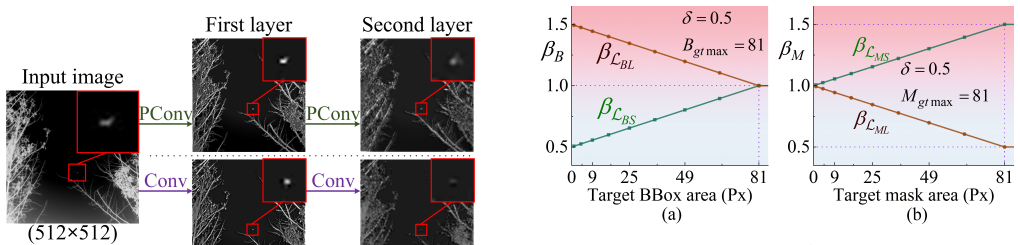
The central object is the pinwheel-shaped convolution (PConv), a plug-in replacement for a standard convolution layer: it runs four thin kernels ($1\times3$ and $3\times1$) in parallel with asymmetric padding, concatenates their outputs, and projects the concatenation with a $2\times2$ convolution, so the effective receptive field is a cross-shaped pattern whose weights are densest at the center and taper outward—the paper's claimed match to the Gaussian intensity profile of small infrared targets. The second carrying mechanism is the scale-based dynamic (SD) loss, defined by a target-size-dependent weight $\beta$ (clamped to a tunable $\delta$) that controls how much the scale term $L_{BS}$/$L_{MS}$ and the location term $L_{BL}$/$L_{ML}$ contribute; for bounding boxes $\beta$ is proportional to box area times the resolution-change ratio, and for masks it is proportional to mask area, with larger $\beta$ down-weighting location loss for small targets. Together these two devices convert two generic assumptions—Gaussian target appearance and label-noise asymmetry between scale and location—into concrete modifications of the convolution and the loss surface.
What would settle it
Replace PConv with a $3\times3$ convolution that has the same number of parameters and the same effective receptive field (e.g., via dilation) on the same YOLOv8n-p2 and MSHNet baselines. If the equal-receptive-field baseline matches PConv's mAP50 and IoU gains, then the pinwheel shape itself is not driving the improvement and the central 'Gaussian alignment' claim is refuted; if PConv still wins, the shape-specific mechanism is confirmed.
Extended reading notes
Core claim
The paper's central claim is that the pixel intensity distribution of infrared small targets is approximately Gaussian, and that this shape should be reflected in the convolution itself. PConv replaces the first two standard $3\times3$ convolutions in a backbone with interleaved $1\times3$ and $3\times1$ kernels in four orientations, using asymmetric padding and grouped convolution; the resulting effective receptive field is a pinwheel whose weight tapers from the center outward, which the authors say matches the target's Gaussian spread and expands the receptive field by 178% (kernel length 3) or 444% (length 4) while roughly doubling parameters in the first two layers when channels quadruple. On the loss side, SD loss observes that IoU-based scale losses fluctuate severely on small targets—up to 86% for boxes and 62% for masks—while the centroid location error stays within about one pixel, so it scales the two loss terms by a factor $\beta$ computed from target area relative to the maximum IRST size, with separate schedules for boxes (SDB) and masks (SDM). Integrated into YOLOv5n, YOLOv8n-p2, EFLNet, DNANet, ISNet, and MSHNet, the combination yields higher mAP50, IoU, and probability of detection and lower false alarms than the corresponding baselines on IRSTD-1K and the new SIRST-UAVB dataset. The paper also introduces SIRST-UAVB itself, 3,000 real infrared images of UAVs and birds collected over a year, which it claims is the largest public single-frame IRST dataset with a high proportion of near-invisible targets.
Load-bearing premise
The method hinges on the assumption that the brightness profile of a dim infrared target is a single bell-shaped (Gaussian) peak and that a cross-shaped arrangement of thin convolution kernels is the right way to match that profile; the paper supports this with one illustrative 3D plot and no quantitative distribution test.
Editorial extensions
If this is right
- Replacing the first two backbone convolutions with PConv should raise mAP50 and IoU over standard $3\times3$ convolutions on both IRSTD-1K and SIRST-UAVB, with the largest relative gains on very small targets (box area at most 16).
- SDB and SDM losses should cut the fluctuation of scale loss on tiny targets and improve convergence stability; SDB with a larger $\delta$ is better suited to datasets with very small targets, while $\delta=0.5$ is a robust default for mask loss.
- The combined PConv plus SD loss recipe generalizes across detection and segmentation architectures (YOLOv5n, YOLOv8n-p2, EFLNet, DNANet, ISNet, MSHNet) with no architectural change.
- PConv kernel length should be set by target scale: larger kernels help larger targets, while smaller targets prefer a shorter second kernel to avoid over-expanding the receptive field.
- SIRST-UAVB provides a harder benchmark with more small, dim targets than existing real-shot datasets, so future models can be compared on it for precision and recall under complex backgrounds.
Reading between the lines
- Because PConv is a drop-in convolution replacement, the same Gaussian-matching logic might transfer to other tiny-object detection domains such as aerial or remote-sensing imagery, provided the target's point spread is similarly bell-shaped; this is an extension the paper does not test.
- The SD loss's $\beta$ schedule is a heuristic based on area; a natural next step, not in the paper, would be to measure the per-target IoU variance directly and set $\beta$ from that noise estimate, which could remove the need to tune $\delta$.
- The paper's Gaussian premise could be validated or refuted by fitting actual target intensity profiles from SIRST-UAVB; if many targets are not single-peaked, the argument would reduce to 'a wider cross-shaped receptive field helps', which is a weaker but still testable claim.
- The mask labels exclude birds because of annotation difficulty, so mask-based (SDM) conclusions depend entirely on UAV targets; adding bird masks or semi-automatic annotation would extend the method's evidentiary base.
Editorial analysis
A structured set of objections, weighed in public.
Referee Report
Summary. This paper proposes two plug-and-play components for infrared small target detection and segmentation: PConv, a pinwheel-shaped convolution intended to replace the first two standard convolution layers, and Scale-based Dynamic (SD) loss, which reweights scale and location loss terms according to target size for both bounding-box and mask supervision. The authors also release SIRST-UAVB, a new benchmark of 3,000 infrared images containing UAV and bird targets with box and (UAV-only) mask annotations. The experimental sections compare PConv with standard and alternative convolution modules and SD loss with CIoU/DIoU/GIoU/NWD/SAFit and SLS/Dice/IoU losses on IRSTD-1K and SIRST-UAVB, reporting that the proposed components improve mAP50, precision, recall, IoU, Pd, and Fa across several YOLO-style and U-Net-style architectures (Tables 1-4, with an additional target-scale ablation in Table 5).
Significance. If the reported gains are reproducible, the paper offers two easy-to-integrate components with a new public benchmark, which would be useful to the IRST community. The release of code and of a relatively large real-shot dataset are concrete strengths. However, the significance is currently limited by the lack of repeated-seed evaluation, by post-hoc selection of hyperparameters on the test benchmarks, and by unresolved quantitative support for the Gaussian-motivation and for the parameter-count claims.
major comments (4)
- [Experiments, Tables 1-5] All performance comparisons are single-run point estimates, with no standard deviations, confidence intervals, or significance tests. Several headline differences are small relative to the run-to-run noise expected in YOLOv8n-p2 and MSHNet: for example, Table 1 shows SIRST-UAVB mAP50 of 93.2 (Conv) versus 93.8 (PConv(4,3)); Table 2 shows IRSTD-1K mAP50 of 87.4 (CIoU) versus 88.6 (SDB(0.3)); Table 3 shows IRSTD-1K IoU of 66.82 (SLS) versus 68.49 (SDM(0.5)). Moreover, the best PConv kernel lengths and delta values are selected from the same test sets on which improvement is claimed (PConv(4,4) is best on IRSTD-1K while PConv(4,3) is presented as the preferred configuration; delta=0.3 is preferred on IRSTD-1K while delta=0.5 is preferred on SIRST-UAVB). Please report multi-seed means and variances, and specify a fixed selection protocol so that the 'consistent improvements' conclusion is supported.
- [Methodology, Pinwheel-shaped Convolution, Eq. (7)] The parameter-count arithmetic is internally inconsistent. Eq. (7) gives PConv params = 7 c2 c1, which is only valid when c2 = c1. Under the stated architecture with c2 = 4 c1 (the YOLO setting in the next paragraph), the four first-layer 1x3/3x1 convolutions contribute 3 c1 c2 = 12 c1^2, and the final 2x2 convolution, whose input has c2 channels after concatenation, contributes 4 c2^2 = 64 c1^2, for a total of 76 c1^2. The text instead states 72 c1^2 and simultaneously says this is a 111% increase over 36 c1^2; 76/36 = 2.11, so the percentage corresponds to 76, not 72. Please correct the formula and the resulting parameter-overhead claims, and re-derive the receptive-field percentages in the same paragraph.
- [Methodology, Scale-based Dynamic Loss and Limitation] The loss definition in Eqs. (12)-(13) and the explanatory Figure 5 present beta_M as a function of the individual target's mask area Mgt, but the Limitation section states that SDM actually uses the average target size over the batch and therefore 'does not really assign Sloss and Lloss influence coefficients according to the target size.' This is a direct contradiction between the method description and the implementation. Because the claimed mechanism of SDM is per-target reweighting, please either implement true per-target coefficients (for example, by avoiding the batch-averaged SLS computation) or revise the equations and the interpretive claims, and report the effect of this discrepancy on the empirical results.
- [Methodology, Pinwheel-shaped Convolution, Figure 1] The core motivation—that infrared small targets have a Gaussian spatial intensity distribution and that a center-weighted pinwheel arrangement of thin 1x3/3x1 kernels is the matching inductive bias—is supported only by the illustrative 3D view in Figure 1. No quantitative fit, distribution test, or comparison across target appearances is provided, and the cited effective-receptive-field result (Luo et al. 2016) applies to any CNN, not specifically to pinwheel kernels. Please add quantitative evidence (for example, fitted Gaussian parameters and goodness-of-fit statistics over the datasets) or weaken the Gaussian-alignment claim in the abstract and Section 3 accordingly.
minor comments (4)
- [Throughout] The dataset name appears as 'SIRST-UA VB' with an erroneous space in several places; unify to 'SIRST-UAVB' including in the repository name.
- [Tables 1 and 4] Tables 1 and 4 use symbols such as '%', check marks, and 'Fa' with only partial explanation; please spell out all column meanings in the captions and use explicit 'yes/no' columns for the ablation configurations.
- [Methodology, Eq. (9)] The parameter omega in Eq. (9) is only described verbally; give an explicit formula for omega and for the polar-coordinate terms, or cite the SLS paper precisely, since these quantities enter the SDM objective.
- [Appendix, Table 5] Table 5 reports per-scale-bracket results but does not state how the scale brackets are computed; please define the brackets (for example, whether area is in original-image pixels or feature-map pixels) in the caption.
Circularity Check
No significant circularity: the central claims rest on external benchmark evaluations and the proposed design is tested empirically, not derived from its own definitions.
full rationale
The paper's central claims are empirical: replacing the first two convolutional layers with PConv and using SD loss is reported to improve detection and segmentation metrics on IRSTD-1K and the authors' SIRST-UAVB. Those claims are supported by comparisons against external baselines (Conv, GConv, DSConv, DRConv, LSKConv, DConv, MixConv, AKConv; CIoU/DIoU/GIoU/IoU/NWD/SAFit/SLS/Dice/IoU) in Tables 1-5, not by deriving the improvement from the proposed equations. The Gaussian-distribution rationale for PConv is an inductive-bias assumption stated from Figure 1 and the effective-receptive-field literature (Luo et al. 2016); it motivates the design but is not claimed as a theorem, and the module is then tested on data. The SD loss formulas (Eqs. 8-17) explicitly define the dynamic coefficients, and the reported gains are evaluations, not predictions obtained by fitting those coefficients to the same quantity they are supposed to predict. I also flag the appended Limitation, which states that the implemented SDM loss uses batch-averaged target sizes and therefore "does not really assign Sloss and Lloss influence coefficients according to the target size" as Eqs. (12)-(13) describe; this is an internal-consistency and correctness weakness, not a circular reduction. Hyperparameter choices (delta and PConv kernel lengths) are selected after inspecting the test tables, which is a statistical-reproducibility concern about the strength of the reported gains, but it does not make any equation equal to its own input. No load-bearing self-citation chain or imported uniqueness theorem appears in the paper. Hence the derivation chain is self-contained enough that no circularity step is identifiable.
Assumptions & free parameters
free parameters (2)
- delta (δ) in SDB and SDM loss =
0.3, 0.5, 0.7; selected per dataset, e.g., 0.3 best on IRSTD-1K, 0.7 best on SIRST-UAVB, 0.5 for mask losses
- PConv fanleaf kernel lengths =
(4,3), (4,4), and (3,3) variants; (4,3) is called the best balanced choice
assumptions (4)
- domain assumption Infrared small target pixel intensity distribution is approximately Gaussian
- standard math Effective receptive fields in CNNs follow a Gaussian falloff, so a center-heavy pinwheel kernel arrangement is the correct inductive bias
- domain assumption Bounding-box centroid coordinates always deviate by no more than 1 pixel from the target center of gravity, regardless of target size
- domain assumption The maximum size of an infrared small target is 81 pixels, following the SPIE definition
Cite this review
Pith. "Pith review of Pinwheel-shaped Convolution and Scale-based Dynamic Loss for Infrared Small Target Detection." pith.science (2026). https://pith.science/paper/ZAA42MCM
@misc{pith2026241216986,
  author       = {Pith},
  title        = {Pith review of: Pinwheel-shaped Convolution and Scale-based Dynamic Loss for Infrared Small Target Detection},
  year         = {2026},
  howpublished = {\url{https://pith.science/paper/ZAA42MCM}},
  note         = {Machine review of arXiv:2412.16986}
}
read the original abstract
These recent years have witnessed that convolutional neural network (CNN)-based methods for detecting infrared small targets have achieved outstanding performance. However, these methods typically employ standard convolutions, neglecting to consider the spatial characteristics of the pixel distribution of infrared small targets. Therefore, we propose a novel pinwheel-shaped convolution (PConv) as a replacement for standard convolutions in the lower layers of the backbone network. PConv better aligns with the pixel Gaussian spatial distribution of dim small targets, enhances feature extraction, significantly increases the receptive field, and introduces only a minimal increase in parameters. Additionally, while recent loss functions combine scale and location losses, they do not adequately account for the varying sensitivity of these losses across different target scales, limiting detection performance on dim-small targets. To overcome this, we propose a scale-based dynamic (SD) Loss that dynamically adjusts the influence of scale and location losses based on target size, improving the network's ability to detect targets of varying scales. We construct a new benchmark, SIRST-UAVB, which is the largest and most challenging dataset to date for real-shot single-frame infrared small target detection. Lastly, by integrating PConv and SD Loss into the latest small target detection algorithms, we achieved significant performance improvements on IRSTD-1K and our SIRST-UAVB dataset, validating the effectiveness and generalizability of our approach. Code -- https://github.com/JN-Yang/PConv-SDloss-Data
Figures


Figures from the paper (3 more)


Reference graph
Works this paper leans on
-
[1]
Chen, J.; Wang, X.; Guo, Z.; Zhang, X.; and Sun, J. 2021. Dynamic region-aware convolution. In Proceedings of the IEEE/CVF Conference on Computer Vision and Pattern Recognition, 8064--8073
work page 2021
-
[2]
Chollet, F. 2017. Xception: Deep learning with depthwise separable convolutions. In Proceedings of the IEEE Conference on Computer Vision and Pattern Recognition, 1251--1258
work page 2017
-
[3]
$\textit{A Contrario}$ Paradigm for YOLO-based Infrared Small Target Detection
Ciocarlan, A.; H \'e garat-Mascle, S. L.; Lefebvre, S.; Woiselle, A.; and Barbanson, C. 2024. A Contrario Paradigm for YOLO-based Infrared Small Target Detection. arXiv:2402.02288
work page Pith review arXiv 2024
-
[4]
Dai, Y.; Li, X.; Zhou, F.; Qian, Y.; Chen, Y.; and Yang, J. 2023. One-Stage Cascade Refinement Networks for Infrared Small Target Detection. IEEE Transactions on Geoscience and Remote Sensing, 61: 1--17
work page 2023
-
[5]
Dai, Y.; Wu, Y.; Zhou, F.; and Barnard, K. 2021 a . Asymmetric contextual modulation for infrared small target detection. In 2021 IEEE Winter Conference on Applications of Computer Vision (WACV), 949--958
work page 2021
-
[6]
Dai, Y.; Wu, Y.; Zhou, F.; and Barnard, K. 2021 b . Attentional local contrast networks for infrared small target detection. IEEE Transactions on Geoscience and Remote Sensing, 59(11): 9813--9824
2021
- [7]
-
[8]
Du, P.; and Hamdulla, A. 2019. Infrared small target detection using homogeneity-weighted local contrast measure. IEEE Geoscience and Remote Sensing Letters, 17(3): 514--518
work page 2019
Show all 40 references
-
[9]
Jocher, G.; Chaurasia, A.; Stoken, A.; Borovec, J.; Kwon, Y.; Michael, K.; Fang, J.; Wong, C.; Yifu, Z.; Montes, D.; et al. 2022. ultralytics/yolov5: v6. 2-yolov5 classification models, apple m1, reproducibility, clearml and deci. ai integrations. Zenodo
2022
-
[10]
Karim, A.; and Andersson, J. Y. 2013. Infrared detectors: Advances, challenges and new technologies. In IOP Conference Series: Materials Science and Engineering, volume 51, 012001. IOP Publishing
2013
-
[11]
Kou, R.; Wang, C.; Fu, Q.; Yu, Y.; and Zhang, D. 2022. Infrared small target detection based on the improved density peak global search and human visual local contrast mechanism. IEEE Journal of Selected Topics in Applied Earth Observations and Remote Sensing, 15: 6144--6157
2022
-
[12]
Kou, R.; Wang, C.; Peng, Z.; Zhao, Z.; Chen, Y.; Han, J.; Huang, F.; Yu, Y.; and Fu, Q. 2023. Infrared small target segmentation networks: A survey. Pattern Recognition, 143: 109788
2023
-
[13]
Li, B.; Xiao, C.; Wang, L.; Wang, Y.; Lin, Z.; Li, M.; An, W.; and Guo, Y. 2022. Dense nested attention network for infrared small target detection. IEEE Transactions on Image Processing, 32: 1745--1758
2022
-
[14]
Li, R.; and Shen, Y. 2023. YOLOSR-IST: A deep learning method for small target detection in infrared remote sensing images based on super-resolution and YOLO. Signal Processing, 208: 108962
2023
-
[15]
Li, Y.; Hou, Q.; Zheng, Z.; Cheng, M.-M.; Yang, J.; and Li, X. 2023. Large selective kernel network for remote sensing object detection. In Proceedings of the IEEE/CVF International Conference on Computer Vision, 16794--16805
2023
-
[16]
Li, Y.; Zhang, Y.; Yu, J.-G.; Tan, Y.; Tian, J.; and Ma, J. 2016. A novel spatio-temporal saliency approach for robust dim moving target detection from airborne infrared image sequences. Information Sciences, 369: 548--563
2016
-
[17]
Liu, Q.; Liu, R.; Zheng, B.; Wang, H.; and Fu, Y. 2024. Infrared Small Target Detection with Scale and Location Sensitivity. arXiv:2403.19366
2024 arXiv
-
[18]
Liu, T.; Yin, Q.; Yang, J.; Wang, Y.; and An, W. 2023 a . Combining deep denoiser and low-rank priors for infrared small target detection. Pattern Recognition, 135: 109184
2023
-
[19]
Liu, Y.; Liu, X.; Hao, X.; Tang, W.; Zhang, S.; and Lei, T. 2023 b . Single-Frame Infrared Small Target Detection by High Local Variance, Low-Rank and Sparse Decomposition. IEEE Transactions on Geoscience and Remote Sensing
2023
-
[20]
Luo, W.; Li, Y.; Urtasun, R.; and Zemel, R. 2016. Understanding the effective receptive field in deep convolutional neural networks. Advances in Neural Information Processing Systems, 29
2016
-
[21]
Ma, T.; Yang, Z.; Wang, J.; Sun, S.; Ren, X.; and Ahmad, U. 2022. Infrared small target detection network with generate label and feature mapping. IEEE Geoscience and Remote Sensing Letters, 19: 1--5
2022
-
[22]
Rezatofighi, H.; Tsoi, N.; Gwak, J.; Sadeghian, A.; Reid, I.; and Savarese, S. 2019. Generalized intersection over union: A metric and a loss for bounding box regression. In Proceedings of the IEEE/CVF Conference on Computer Vision and Pattern Recognition, 658--666
2019
-
[23]
Rivest, J.-F.; and Fortin, R. 1996. Detection of dim targets in digital infrared imagery by morphological image processing. Optical Engineering, 35(7): 1886--1893
1996
-
[24]
H.; Li, W.; Vercauteren, T.; Ourselin, S.; and Jorge Cardoso, M
Sudre, C. H.; Li, W.; Vercauteren, T.; Ourselin, S.; and Jorge Cardoso, M. 2017. Generalised dice overlap as a deep learning loss function for highly unbalanced segmentations. In Deep Learning in Medical Image Analysis and Multimodal Learning for Clinical Decision Support: Thi...
2017
-
[25]
Sun, H. 2024. Ultra-High Resolution Segmentation via Boundary-Enhanced Patch-Merging Transformer. arXiv:2412.10181
2024 arXiv
-
[26]
Sun, Y.; Yang, J.; and An, W. 2020. Infrared dim and small target detection via multiple subspace learning and spatial-temporal patch-tensor model. IEEE Transactions on Geoscience and Remote Sensing, 59(5): 3737--3752
2020
-
[27]
Tan, M.; and Le, Q. V. 2019. Mixconv: Mixed depthwise convolutional kernels. arXiv:1907.09595
2019 arXiv
-
[28]
Wang, J.; Xu, C.; Yang, W.; and Yu, L. 2021. A normalized Gaussian Wasserstein distance for tiny object detection. arXiv:2110.13389
2021 arXiv
-
[29]
Yang, B.; Zhang, X.; Zhang, J.; Luo, J.; Zhou, M.; and Pi, Y. 2024. EFLNet: Enhancing Feature Learning Network for Infrared Small Target Detection. IEEE Transactions on Geoscience and Remote Sensing, 62: 1--11
2024
-
[30]
Ying, X.; Xiao, C.; Li, R.; He, X.; Li, B.; Li, Z.; Wang, Y.; Hu, M.; Xu, Q.; Lin, Z.; et al. 2024. Visible-Thermal Tiny Object Detection: A Benchmark Dataset and Baselines. arXiv:2406.14482
2024 arXiv
-
[31]
Yu, F.; and Koltun, V. 2015. Multi-scale context aggregation by dilated convolutions. arXiv:1511.07122
2015 arXiv
-
[32]
Zhang, M.; Zhang, R.; Yang, Y.; Bai, H.; Zhang, J.; and Guo, J. 2022. ISNet: Shape matters for infrared small target detection. In 2022 IEEE/CVF Conference on Computer Vision and Pattern Recognition (CVPR), 867--876
2022
-
[33]
Zhang, T.; Qi, G.-J.; Xiao, B.; and Wang, J. 2017. Interleaved group convolutions. In Proceedings of the IEEE International Conference on Computer Vision, 4373--4382
2017
-
[34]
Zhang, W.; Cong, M.; and Wang, L. 2003. Algorithms for optical weak small targets detection and tracking. In International Conference on Neural Networks and Signal Processing, 2003. Proceedings of the 2003, volume 1, 643--647. IEEE
2003
-
[35]
Zhang, X.; Song, Y.; Song, T.; Yang, D.; Ye, Y.; Zhou, J.; and Zhang, L. 2023. AKConv: Convolutional kernel with arbitrary sampled shapes and arbitrary number of parameters. arXiv:2311.11587
2023 arXiv
-
[36]
Zhao, M.; Li, W.; Li, L.; Hu, J.; Ma, P.; and Tao, R. 2022. Single-frame infrared small-target detection: A survey. IEEE Geoscience and Remote Sensing Magazine, 10(2): 87--119
2022
-
[37]
Zheng, Z.; Wang, P.; Liu, W.; Li, J.; Ye, R.; and Ren, D. 2020. Distance-IoU loss: Faster and better learning for bounding box regression. In Proceedings of the AAAI Conference on Artificial Intelligence, volume 34, 12993--13000
2020
-
[38]
Zhou, X.; Li, P.; Zhang, Y.; Lu, X.; and Hu, Y. 2023. Deep Low-Rank and Sparse Patch-Image Network for Infrared Dim and Small Target Detection. IEEE Transactions on Geoscience and Remote Sensing, 61: 1--14
2023
-
[39]
, " * write output.state after.block = add.period write newline
ENTRY address archivePrefix author booktitle chapter edition editor eid eprint howpublished institution isbn journal key month note number organization pages publisher school series title type volume year label extra.label sort.label short.list INTEGERS output.state before.all...
-
[40]
write newline
" write newline "" before.all 'output.state := FUNCTION n.dashify 't := "" t empty not t #1 #1 substring "-" = t #1 #2 substring "--" = not "--" * t #2 global.max substring 't := t #1 #1 substring "-" = "-" * t #2 global.max substring 't := while if t #1 #1 substring * t #2 gl...
Reviewed August 11, 2026 · model on record in the stance chip above.
Discussion (0). Continue with ORCID to comment.