REVIEW 2 major objections 4 minor 31 references
Search for Dyson rings around pulsars: unexpected light curves
T0 review · 2 major / 4 minor · reviewed 2026-08-11 · deepseek-v4-flash
Pith's one-line read A pulsar's superluminal beam spot can create multiple phantom images on a Dyson ring, producing light curves that differ sharply from the uniformly bright ring assumed in previous searches.
desk verdict New application of RID to Dyson rings with a load-bearing idealization gap; the math is simple and sound, but the observability claim needs a finite-beam-width treatment. read the letter →
The pith
A machine-rendered reading of the paper's core claim, the machinery that carries it, and where it could break.
The reading
What carries the argument
The machinery is the total light-travel time formula $t_{\rm tot} = \frac{p\beta}{2\pi} + \frac{R}{c} + \frac{R}{c}\cos\theta \sin\beta$, which gives the arrival time at a distant observer of light reflected (or thermally emitted) from each azimuthal point $\beta$ on the ring. Setting $d t_{\rm tot}/d\beta = 0$ yields the RID condition $\cos\beta_{IC/IA} = -c/(v\cos\theta)$, the angular positions of image creation and annihilation. The brightness is then weighted by Lambert's cosine law, $\cos\theta \sin\beta$, and the ring is divided into discrete azimuthal sections whose arrival times are binned into exposure windows; counting intersections of the $t_{\rm tot}$ versus $\beta$ curve with a vertical time line gives the number of simultaneously visible spot images.
What would settle it
Take a pulsar with known period and a candidate ring radius and inclination; compute the expected IC/IA times and brightness curve, then observe at high time resolution (exposure much shorter than the period). If no bright IC/IA flashes and no periodic windowing effect appear over many cycles, the model's prediction for that geometry fails.
Extended reading notes
Core claim
The central claim is that when the beam spot's speed toward the observer drops from superluminal to subluminal, relativistic image doubling creates a pair of perceived spot images in a formally infinite flash (an image creation event), and when it rises back, the images merge and vanish (an image annihilation event). On a circular ring, these events occur at angular positions given by $\cos\beta = -c/(v\cos\theta)$, so they depend only on the ring's radius, the pulsar's period, and the ring's inclination to the line of sight. Because the spot can complete many rotations while some images persist, multiple spot images are visible simultaneously, and the light curve contains sharp peaks, non-uniform brightening, and a phase-dependent windowing effect when exposures are binned. The paper therefore concludes that Dyson ring detections should not assume uniform brightness, and that RID features may also appear in naturally occurring dust rings around pulsars.
Load-bearing premise
The light curves assume a point-like beam spot on an infinitely thin ring with Lambertian reflection, so the predicted bright flashes are infinitely bright only in this idealization; a real beam's finite size and a ring's finite thickness would smooth and weaken the signature, and the paper does not quantify when the signature disappears.
Editorial extensions
If this is right
- Searches for Dyson rings around pulsars should look for time-variable, non-uniform light curves with bright IC/IA flashes, not just steady infrared excess.
- The windoing effect provides a new detection channel: random exposure phases relative to the pulsar's sweeping beam cause a periodic on/off increase in detected flux.
- The same RID features should appear in reflected or thermally emitted radiation from any ring-like structure around a pulsar, including natural dust rings.
- Detection of a Dyson ring via RID flashes does not require the observer to be aligned with the pulsar beam, widening the set of target pulsars.
- If past surveys recorded such light curves without recognizing them, reanalysis of archival pulsar photometry could uncover existing Dyson ring candidates.
Reading between the lines
- If real pulsar beams have finite opening angles and rings have finite width, the formally infinite IC/IA flashes will be smoothed into finite pulses; quantifying that smoothing would let observers predict whether the signature survives in realistic observations.
- The windoing effect could be tested on known pulsars with surrounding material by staring long enough to catch multiple exposure phases; a periodic extra-flux signature would be a falsifiable prediction of the model.
- The same RID formalism might apply to other superluminal spots, such as light echoes from fast-spinning magnetars or gamma-ray pulsar wind nebulae, where ring-like geometries are observed.
Editorial analysis
A structured set of objections, weighed in public.
Referee Report
Summary. The paper proposes that a pulsar beam sweeping a Dyson ring can move superluminally, and that relativistic image doubling (RID) then creates image creation (IC) and image annihilation (IA) events. It derives the arrival-time formula Eq. (1) and the critical condition Eq. (2), discusses the dependence on ring geometry and inclination, computes example light curves by binning discrete ring points in exposure time, and argues that the resulting spikes and multiple simultaneous images distinguish Dyson rings from the uniformly bright rings assumed in previous work. The same mechanism is suggested for naturally occurring dust rings around pulsars.
Significance. If the predicted IC/IA spikes survive realistic beam widths and ring thicknesses, the paper identifies a new observable for technosignature searches and for studies of pulsar environments. The analytic arrival-time derivation is compact, the geometry is well motivated, and the code is made publicly available; the step from an assumed uniformly bright ring to one with RID-specific brightness structure is a genuine extension of earlier Dyson-ring studies. However, the idealized point-spot and zero-thickness model, together with an internal inconsistency in the face-on example, currently limit how strongly the observational claims can be endorsed.
major comments (2)
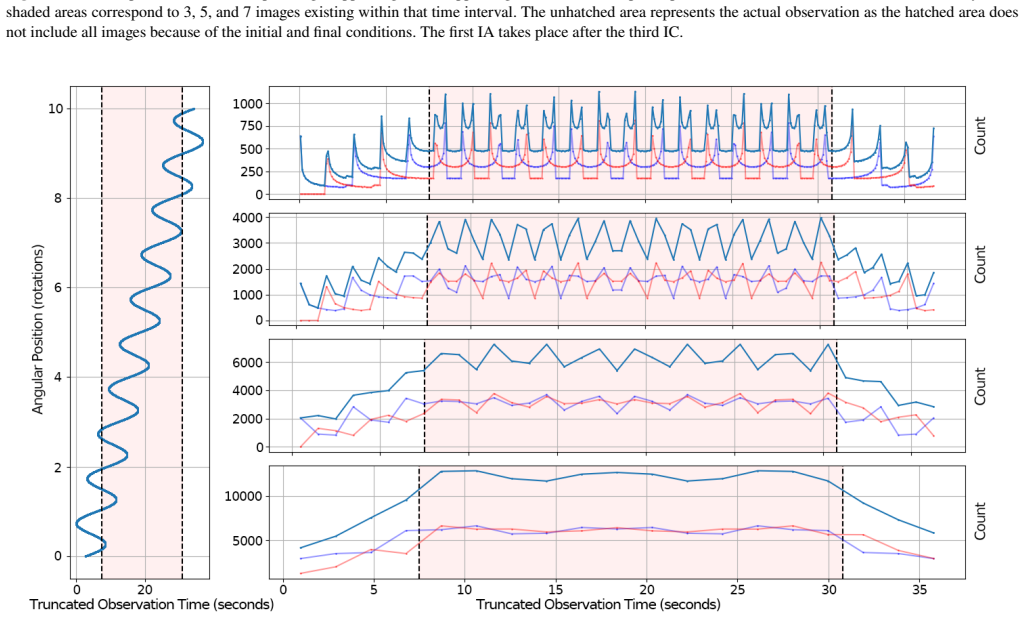
- [Section 4, Figure 10] The text states that Figure 10 shows a case with beam speed v = 10c and theta = 90 degrees. This cannot be correct as written: Section 2 explicitly states that face-on rings with theta = pi/2 produce no RID event, Eq. (2) has no solution when cos(theta) = 0, and the Lambert factor used in Section 4 vanishes at theta = 90 degrees. Please state the inclination angle actually used in the simulations and relabel or rerun the affected figures, since the multiple-image and windowing claims tied to Figure 10 depend on this geometry.
- [Section 4, light-curve calculation] The light-curve calculation treats the beam spot as a point and the ring as an infinitesimally thin collection of azimuthal points. Because dt_tot/d beta = 0 at IC/IA, the number of points per exposure-time bin is formally infinite; the paper itself notes that RID points are formally infinitely bright. A real pulsar beam has finite opening angle, a real ring has finite radial and vertical thickness, and thermal emission has a finite response time, all of which smooth and attenuate the caustic spikes. The paper gives no quantitative estimate of these smoothing scales or a threshold beyond which the IC/IA signature becomes undetectable. This is load-bearing because the central claim is that real observations could reveal Dyson rings through these spikes.
minor comments (4)
- [Equation (1)] The displayed expression for t_tot includes the term R/c plus (1/c)[R cos(theta)(1 + sin(beta))], which contains an extra constant R cos(theta)/c beyond the stated quantities t_beam = R/c and t_ref = d/c with d = R cos(theta) sin(beta). The derivative condition in Eq. (2) is unaffected, but the constant offset should be absorbed into k_3 explicitly or Eq. (1) should be corrected.
- [General notation] The pulsar period is denoted p in Eq. (1) and Figure 2 but P in Eq. (2) and parts of Section 3; please unify the notation to avoid confusion.
- [Section 3, geometry] The text says that positive values of sin(beta) correspond to the farthest half of the ring, but the accompanying Figure 5 and the definition of d could be clarified by stating the sign convention for beta explicitly, in particular whether beta = 0 points toward or away from the observer.
- [Section 4, Lambert factor] The same Lambertian factor cos(theta) sin(beta) is applied to both reflection and thermal emission, but for optically thick thermal emission a Lambertian angular distribution is only one possible assumption; a sentence justifying this choice for the thermal case would improve the presentation.
Circularity Check
No significant circularity: the claimed RID light curves follow from a forward model using Eq. (1); the only self-cited input, RID theory, has independent laboratory support.
full rationale
The paper's derivation chain is an analytic forward model, not a fit. The observed time of each ring point is computed from geometry alone in Eq. (1), t_tot = (p beta)/(2 pi) + R/c + (1/c)[R cos theta (1+sin beta)], and IC/IA locations are obtained by setting d t_tot/d beta = 0 (Eq. 2). The light curves in Section 4 are produced by counting equally spaced azimuthal points whose arrival times fall in an exposure bin; no observed data are used to set any parameter, and no quantity that appears in the output is re-inserted as an input. The superluminal spot speeds are imported from Osmanov (2016, 2018), an external citation, and the ring stability arguments come from Haliki (2019) and are not the claimed result. The paper does rely on the prior RID theory of Nemiroff (2015, 2018, 2023), which is a self-citation, but that theory is not the target of the present claim and it has independent support: the paper cites Clerici et al. (2016), a laboratory measurement of the pair-creation event, and Bolotovskii & Bykov (1990), an earlier independent derivation for circular trajectories. Thus the self-citations are not load-bearing in the circular sense. The 'formally infinitely bright' RID flashes are a stated consequence of the point-spot, thin-ring idealization, not a hidden re-use of the conclusion. The comparison with 'classical' uniform-ring light curves is a comparison of two forward models, and the difference follows from the equations, not from imposing the answer.
Assumptions & free parameters
free parameters (1)
- exposure time =
0.2 s, 0.5 s, 1 s, 2 s in Figure 10
assumptions (7)
- domain assumption The pulsar is at the center of a thin circular Dyson ring and its beam creates a point-like spot on the ring's inner surface.
- domain assumption The observer is effectively at infinity, so light rays from the ring to the observer are parallel.
- domain assumption Reflection and thermal emission follow Lambert's cosine law, represented by the factor cos(theta) sin(beta).
- domain assumption The ring is optically thin or the geometry is such that the observer sees the relevant parts; for opaque rings, only the far half is visible.
- domain assumption A single-ring Dyson configuration is stable and workable, while two-ring configurations are unstable (Haliki 2019).
- domain assumption Dyson ring radii and pulsar periods in the ranges R = 10^-4 to 1 AU and p = 10^-3 to 10 s produce superluminal beam spot speeds.
- domain assumption The pulsar beam has constant brightness while sweeping and is always on during each rotation.
Cite this review
Pith. "Pith review of Search for Dyson rings around pulsars: unexpected light curves." pith.science (2026). https://pith.science/paper/QQMA2CRK
@misc{pith2026241217086,
  author       = {Pith},
  title        = {Pith review of: Search for Dyson rings around pulsars: unexpected light curves},
  year         = {2026},
  howpublished = {\url{https://pith.science/paper/QQMA2CRK}},
  note         = {Machine review of arXiv:2412.17086}
}
read the original abstract
Finding Dyson rings around distant pulsars may involve identifying light curve features that have not been previously identified. Previous studies covered the detection of a ring structure uniformly brightened by the central pulsar, mostly in infrared light. Here, more complex light curves are explored, which arise inherently from the pulsar beam spot's commonly predicted superluminal speed. These speeds may cause multiple images of the pulsar's spot on the Dyson ring to appear simultaneously to a distant observer, and so feature bright creation and annihilation events. Therefore, it is possible that even if Dyson ring structures had been observed previously, they might have remained unnoticed. Similar light curve features may appear on naturally occurring dust rings around pulsars that reflect detectable pulsar radiation.
Figures


Figures from the paper (6 more)


Reference graph
Works this paper leans on
-
[1]
write newline
" write newline "" before.all 'output.state := FUNCTION fin.entry write newline FUNCTION new.block output.state before.all = 'skip after.block 'output.state := if FUNCTION new.sentence output.state after.block = 'skip output.state before.all = 'skip after.sentence 'output.state := if if FUNCTION not #0 #1 if FUNCTION and 'skip pop #0 if FUNCTION or pop #1...
-
[2]
Bagchi M., 2013, International Journal of Modern Physics D, 22, 1330021
work page 2013
-
[3]
Baune S., 2009, @doi [Physics Education] 10.1088/0031-9120/44/3/010 , 44, 296
-
[4]
Bolotovskiĭ B. M., Bykov V. P., 1990, @doi [Soviet Physics Uspekhi] 10.1070/PU1990v033n06ABEH002601 , 33, 477
-
[5]
Cavaliere A., Morrison P., Sartori L., 1971, @doi [Science] 10.1126/science.173.3996.525 , 173, 525
-
[6]
P., Lorimer D., Werthimer D., 2015, New Astronomy, 34, 245
Chennamangalam J., Siemion A. P., Lorimer D., Werthimer D., 2015, New Astronomy, 34, 245
work page 2015
-
[7]
Clerici M., et al., 2016, Science advances, 2, e1501691
work page 2016
-
[8]
DeBiase R. L., 2008, in 56th International Astronautical Congress of the International Astronautical Federation, the International Academy of Astronautics, and the International Institute of Space Law. pp A4--1
work page 2008
Show all 31 references
-
[9]
J., 1960, Science, 131, 1667
Dyson F. J., 1960, Science, 131, 1667
1960
-
[10]
Haliki E., 2019, International Journal of Astrobiology, 18, 455
2019
-
[11]
Haliki E., 2020, @doi [International Journal of Astrobiology] 10.1017/S1473550420000257 , 19, 474–481
2020 doi
-
[12]
R., Richards J., Shostak S., Tarter J
Harp G. R., Richards J., Shostak S., Tarter J. C., Vakoch D. A., Munson C., 2016, @doi [The Astrophysical Journal] 10.3847/0004-637x/825/2/155 , 825, 155
2016 doi
-
[13]
Y.-Y., et al., 2021, @doi [Monthly Notices of the Royal Astronomical Society] 10.1093/mnras/stab1832 , 506, 1723
Hsiao T. Y.-Y., et al., 2021, @doi [Monthly Notices of the Royal Astronomical Society] 10.1093/mnras/stab1832 , 506, 1723
2021 doi
-
[14]
S., 1964, Soviet Astronomy, 8, 217
Kardashev N. S., 1964, Soviet Astronomy, 8, 217
1964
-
[15]
J., 2020, @doi [The Astrophysical Journal] 10.3847/1538-4357/ab98fa , 898, 53
Kaushal N., Nemiroff R. J., 2020, @doi [The Astrophysical Journal] 10.3847/1538-4357/ab98fa , 898, 53
2020 doi
-
[16]
pp 148--02
Kayali O., Nemiroff R., 2022, in American Astronomical Society Meeting Abstracts. pp 148--02
2022
-
[17]
Kijak J., Gil J., 2003, Astronomy & Astrophysics, 397, 969
2003
-
[18]
J., 2015, Publications of the Astronomical Society of Australia, 32, e001
Nemiroff R. J., 2015, Publications of the Astronomical Society of Australia, 32, e001
2015
-
[19]
J., 2018, @doi [Annalen der Physik] https://doi.org/10.1002/andp.201700333 , 530, 1700333
Nemiroff R. J., 2018, @doi [Annalen der Physik] https://doi.org/10.1002/andp.201700333 , 530, 1700333
2018 doi
-
[20]
J., 2023, Faster Than Light: How Your Shadow Can Do It but You Can't
Nemiroff R. J., 2023, Faster Than Light: How Your Shadow Can Do It but You Can't. Betelgeuse Press
2023
-
[21]
J., Kaushal N., 2020, @doi [The Astrophysical Journal] 10.3847/1538-4357/ab6440 , 889, 122
Nemiroff R. J., Kaushal N., 2020, @doi [The Astrophysical Journal] 10.3847/1538-4357/ab6440 , 889, 122
2020 doi
-
[22]
Osmanov Z., 2016, @doi [International Journal of Astrobiology] 10.1017/S1473550415000257 , 15, 127–132
2016 doi
-
[23]
Osmanov Z., 2018, @doi [International Journal of Astrobiology] 10.1017/S1473550417000155 , 17, 112–115
2018 doi
-
[24]
Osmanov Z., Berezhiani V., 2019, Journal of the British Interplanetary Society, 72, 254
2019
-
[25]
Mac Millan
Rayleigh L., 1896, The Theory of Sound. Mac Millan
-
[26]
Shaw E., Tudor V., Winkworth D., 2012, Physics Special Topics, 11
2012
-
[27]
Shostak S., 2020, @doi [International Journal of Astrobiology] 10.1017/S1473550420000233 , 19, 456–461
2020 doi
-
[28]
I., Gil J., Xu R.-X., 2014, The Astrophysical Journal, 784, 59
Szary A., Zhang B., Melikidze G. I., Gil J., Xu R.-X., 2014, The Astrophysical Journal, 784, 59
2014
-
[29]
Wright J., 2020, @doi [Serbian Astronomical Journal] 10.2298/saj2000001w , pp 1--18
2020 doi
-
[30]
Y., 1972, @doi [Astrophysics] 10.1007/BF01041744 , 8, 359
Éidman V. Y., 1972, @doi [Astrophysics] 10.1007/BF01041744 , 8, 359
1972 doi
-
[31]
write newline
" write newline "" before.all 'output.state := FUNCTION fin.entry write newline FUNCTION new.block output.state before.all = 'skip after.block 'output.state := if FUNCTION new.sentence output.state after.block = 'skip output.state before.all = 'skip after.sentence 'output.stat...
Reviewed August 11, 2026 · model on record in the stance chip above.
Discussion (0). Continue with ORCID to comment.