Classical simulability of Clifford+T circuits with Clifford-augmented matrix product states
Pith reviewed 2026-05-23 07:20 UTC · model grok-4.3
The pith
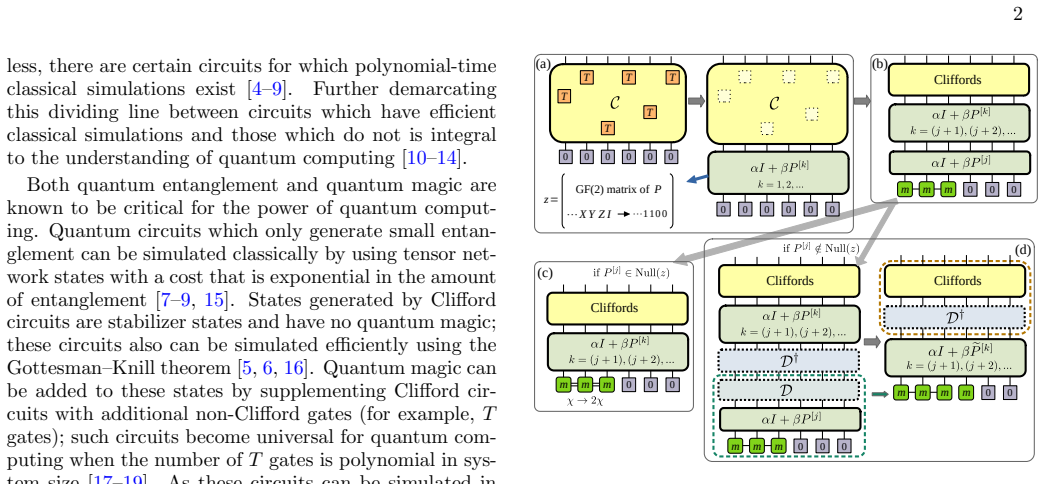
An algebraic criterion based on the null space of a GF(2) matrix determines when Clifford circuits doped with gates of the form alpha I + beta P admit efficient classical simulation via Clifford-augmented matrix product states.
A machine-rendered reading of the paper's core claim, the machinery that carries it, and where it could break.
Core claim
For Clifford circuits with added gates of the form alpha I + beta P, the optimization-free disentangling algorithm produces a Clifford-augmented matrix product state whose bond dimension is set by the size of the null space of a GF(2) matrix from the tableau of the twisted Pauli strings P. Circuits for which this null space is small therefore permit classical computation of Pauli expectations in time polynomial in the system size.
What carries the argument
The GF(2) null-space dimension of the matrix induced by the tableau of twisted Pauli strings, which controls the bond dimension in the Clifford-augmented matrix product state representation after optimization-free disentangling.
If this is right
- A larger class of Clifford+T circuits now has a rigorous guarantee of polynomial-time classical simulation.
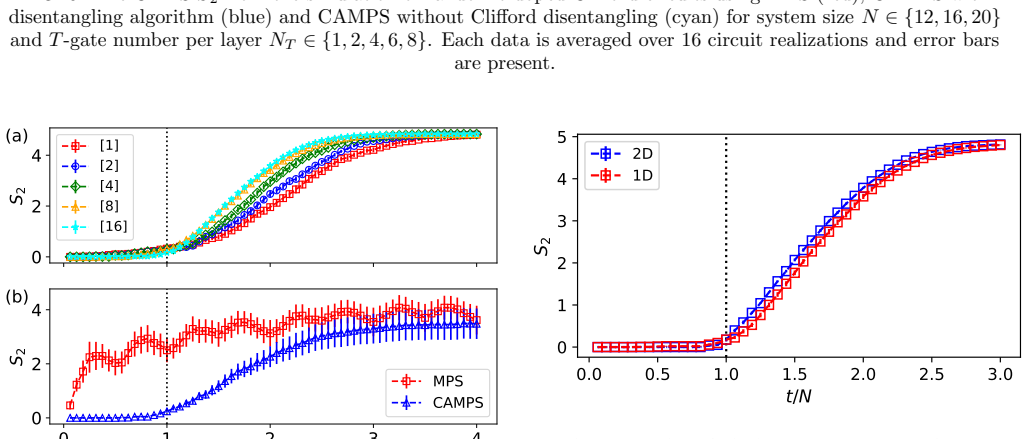
- Random Clifford circuits with N T gates of poly-log depth typically have polynomial bond dimension under this representation.
- CAMPS enables more efficient algorithms than standard MPS for sampling, probability estimation, and Renyi entropy, even if still exponential overall.
- The interplay between entanglement and magic can be analyzed through this algebraic lens for simulatability.
Where Pith is reading between the lines
- One could design quantum circuits that deliberately violate the criterion to ensure they are hard to simulate classically.
- The method might inspire similar algebraic criteria for other non-Clifford gate families beyond the alpha I + beta P form.
- Small-scale numerical experiments could directly compute the matrix nullity and compare it to observed bond dimensions to test the prediction.
Load-bearing premise
The non-Clifford gates must all be exactly of the form alpha I + beta P where P is a Pauli string.
What would settle it
Observe a specific circuit containing only such gates for which the CAMPS bond dimension after applying the OFD algorithm is larger than predicted by the null space dimension of its GF(2) tableau matrix.
Figures








read the original abstract
Determining the quantum-classical boundary between quantum circuits which can be efficiently simulated classically and those which cannot remains a fundamental question. One approach to classical simulation is to represent the output of a quantum circuit as a Clifford-augmented Matrix Product State (CAMPS) which, via a disentangling algorithm, decomposes the wave function into Clifford and MPS components and from which Pauli expectation values can be computed in time polynomial in the MPS bond-dimension. In this work, we develop an optimization-free disentangling (OFD) algorithm for Clifford circuits either doped with multi-qubit gates of the form $\alpha I+\beta P$. We give a simple algebraic criterion which characterizes the individual quantum circuits for which OFD generates an efficient CAMPS - the bond-dimension is exponential in the null space of a GF(2) matrix induced by a tableau of the twisted Pauli strings $P$. This significantly increases the number of circuits with rigorous polynomial time classical simulations. We also give evidence that the typical $N$ qubit random Clifford circuit doped with $N$ uniformly distributed $T$ gates of poly-logarithmic depth or greater has a CAMPS with polynomial bond-dimension. In addition, we compare OFD against disentangling by optimization. We further explore the representability of CAMPS for random Clifford circuits doped with more than $N$ $T$-gates. We also propose algorithms for sampling, probability and amplitude estimation of bitstrings, and evaluation of entanglement R\'enyi entropy from CAMPS, which, though still having exponential complexity, are more efficient than standard MPS simulations. This work establishes a versatile framework for understanding classical simulatability of Clifford+$T$ circuits and explores the interplay between quantum entanglement and quantum magic in quantum systems.
Editorial analysis
A structured set of objections, weighed in public.
Referee Report
Summary. The manuscript introduces an optimization-free disentangling (OFD) algorithm applicable to Clifford circuits doped with multi-qubit non-Clifford gates of the form αI + βP. It claims to supply a simple algebraic criterion that characterizes precisely those circuits for which OFD produces an efficient Clifford-augmented matrix product state (CAMPS): the bond dimension is exponential in the dimension of the null space of a GF(2) matrix constructed from the tableau of the twisted Pauli strings P. The work additionally reports typical-case evidence that random Clifford circuits of poly-logarithmic depth doped with N uniformly placed T gates possess polynomial-bond-dimension CAMPS, compares OFD with optimization-based disentangling, examines representability for circuits containing more than N T gates, and proposes CAMPS-based algorithms for bitstring sampling, probability/amplitude estimation, and Rényi entropy evaluation.
Significance. If the algebraic criterion is placed on a fully rigorous footing, the result would enlarge the rigorously simulable fragment of Clifford+T circuits by supplying an explicit, parameter-free test based on linear algebra over GF(2). The typical-case evidence for random ensembles and the auxiliary algorithms for sampling and entropy from CAMPS constitute further contributions. The direct connection drawn between tableau null-space dimension and post-disentangling bond dimension is a conceptually clean approach that, once verified, would be a clear strength.
major comments (1)
- [paragraph presenting the algebraic criterion (following the description of the OFD algorithm)] The central claim that OFD produces a CAMPS whose bond dimension is exactly exponential in the null-space dimension of the GF(2) matrix induced by the tableau of twisted Pauli strings P is stated without an explicit derivation of the mapping or verification against counter-examples. The implicit assumption that the linear dependence relations captured by the null space fully determine the residual entanglement rank after disentangling, with no additional growth arising from the Clifford component or gate ordering, is not demonstrated in the text.
Simulated Author's Rebuttal
We thank the referee for their careful reading of the manuscript and for the constructive suggestion to strengthen the presentation of the algebraic criterion. We address the major comment below.
read point-by-point responses
-
Referee: The central claim that OFD produces a CAMPS whose bond dimension is exactly exponential in the null-space dimension of the GF(2) matrix induced by the tableau of twisted Pauli strings P is stated without an explicit derivation of the mapping or verification against counter-examples. The implicit assumption that the linear dependence relations captured by the null space fully determine the residual entanglement rank after disentangling, with no additional growth arising from the Clifford component or gate ordering, is not demonstrated in the text.
Authors: We agree that an explicit derivation would improve the rigor of the central claim. The manuscript presents the algebraic criterion and its connection to the null-space dimension of the GF(2) matrix constructed from the twisted Pauli strings, but the step-by-step mapping from the null-space dimension to the post-OFD bond dimension (including why Clifford operations and gate ordering introduce no additional entanglement growth) is only sketched implicitly through the structure of the OFD algorithm. In the revised manuscript we will add a dedicated subsection that derives this relation in detail from the tableau update rules and the action of the OFD procedure, together with explicit verification on small-scale examples that confirm the absence of extra rank growth. This will place the criterion on a fully rigorous footing as the referee recommends. revision: yes
Circularity Check
Algebraic criterion derived directly from tableau structure with no reduction to inputs
full rationale
The paper's central result is an algebraic criterion stating that CAMPS bond dimension after OFD is exponential in the null-space dimension of a GF(2) matrix constructed from the tableau of twisted Pauli strings P. This mapping is presented as following from the linear algebra of the circuit tableau and the definition of the OFD disentangling procedure for gates of the form αI + βP. No parameter is fitted to simulation outcomes and then relabeled as a prediction, no self-citation chain is invoked to justify the uniqueness or correctness of the mapping, and the derivation does not redefine any quantity in terms of the claimed result. The abstract and described claims remain self-contained against external benchmarks such as explicit tableau construction and null-space computation.
Axiom & Free-Parameter Ledger
axioms (1)
- domain assumption Non-Clifford gates are restricted to the two-qubit or multi-qubit form αI + βP for Pauli string P.
Forward citations
Cited by 1 Pith paper
-
Classical Simulations of Low Magic Quantum Dynamics
Classical simulation algorithms for low-magic adaptive quantum circuits with high Pauli measurement rates, demonstrated on all-to-all monitored circuits with sub-extensive T-gates to study measurement-induced phase tr...
Reference graph
Works this paper leans on
-
[1]
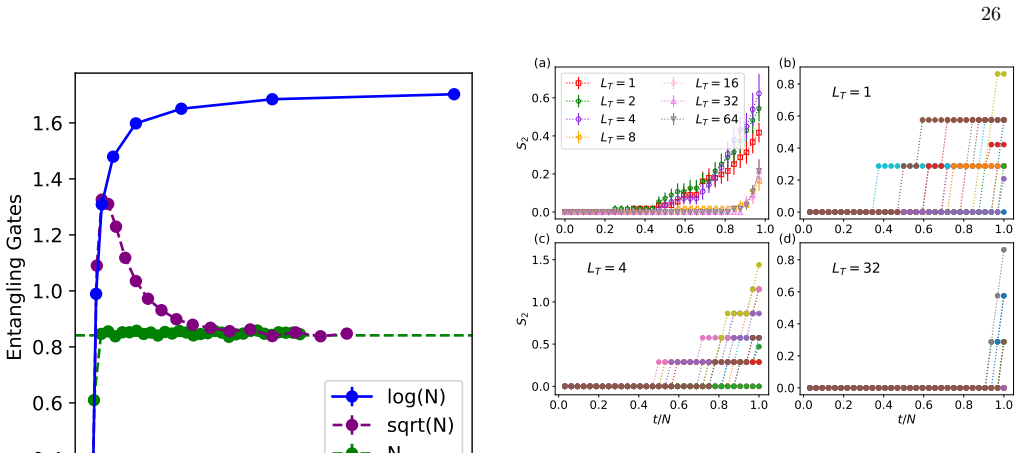
In Fig. 12(b), when LT = 1, S2 has the same rate of growth per layer for NT > 1, while NT = 1 displays obvious deviation
-
[2]
In Fig. 12(a), when NT = 1, S2 has the same rate of growth per T -gate, regardless of the number of Clifford layers LT
-
[3]
In Fig. 12(a), when NT > 1, LT affects S2 incre- ment per T -gate in a non-trivial way, for example, the rate of S2 growth per T -gate for ( LT , NT ) = (2, 2) is close to that of ( LT , NT ) = (1 , 1), and (LT , NT ) = (4, 4) is close to ( LT , NT ) = (1, 2). We also show in Fig. 13 the distribution of ∆ S2 – the amount S2 changes from each T -gate – bef...
-
[4]
(29) We can evaluate the probability of any bitstring using the method described in Sec
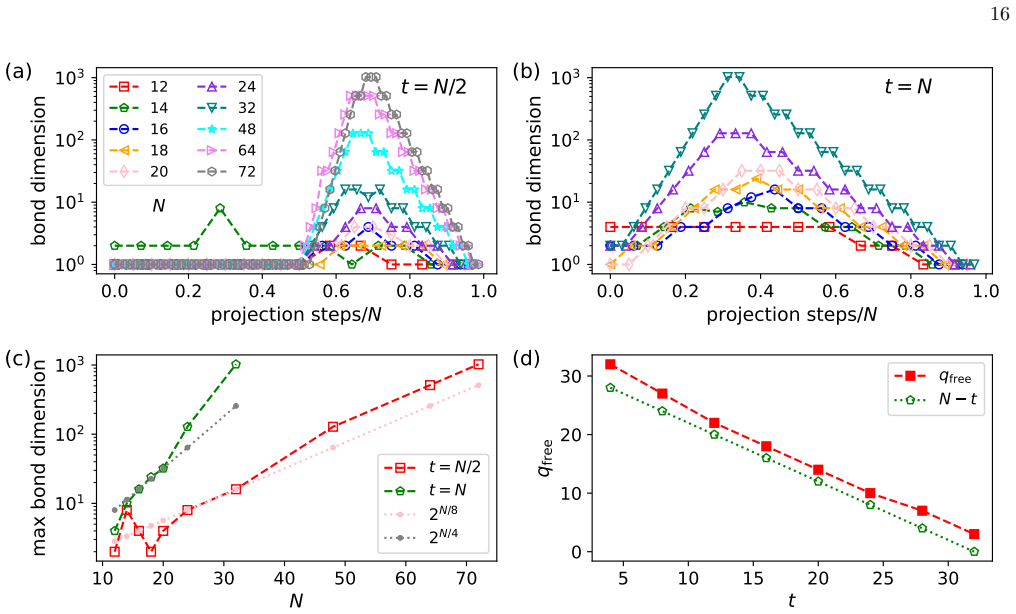
For simplicity, we define z[0] = ⟨s[j] N \kj 0|C|ψ⟩, z [1] = ⟨s[j] N \kj 1|C|ψ⟩. (29) We can evaluate the probability of any bitstring using the method described in Sec. VI A. Thus, we can ob- tain p0 = |z[0]|2, p1 = |z[1]|2, p2 = |z[0] + z[1]|2/2, 16 0.0 0.2 0.4 0.6 0.8 1.0 projection steps/N 100 101 102 103 bond dimension (a) t = N/2 N 12 14 16 18 20 24...
-
[5]
R. P. Feynman, Simulating physics with computers, in Feynman and computation (cRc Press, 2018) pp. 133– 153
work page 2018
-
[6]
A. Bouland, B. Fefferman, C. Nirkhe, and U. Vazirani, On the complexity and verification of quantum random circuit sampling, Nature Physics 15, 159 (2019)
work page 2019
-
[7]
D. Hangleiter and J. Eisert, Computational advantage of quantum random sampling, Reviews of Modern Physics 95, 035001 (2023)
work page 2023
-
[8]
R. Jozsa and A. Miyake, Matchgates and classical simu- lation of quantum circuits, Proceedings of the Royal Soci- ety A: Mathematical, Physical and Engineering Sciences 464, 3089 (2008)
work page 2008
-
[9]
S. Aaronson and D. Gottesman, Improved simulation of stabilizer circuits, Phys. Rev. A 70, 052328 (2004)
work page 2004
-
[10]
The Heisenberg Representation of Quantum Computers
D. Gottesman, The heisenberg representation of quan- tum computers (1998), arXiv:quant-ph/9807006 [quant- ph]
work page internal anchor Pith review Pith/arXiv arXiv 1998
-
[11]
J. C. Napp, R. L. La Placa, A. M. Dalzell, F. G. S. L. Brand˜ ao, and A. W. Harrow, Efficient classical simula- tion of random shallow 2d quantum circuits, Phys. Rev. X 12, 021021 (2022)
work page 2022
-
[12]
Vidal, Efficient classical simulation of slightly entan- gled quantum computations, Phys
G. Vidal, Efficient classical simulation of slightly entan- gled quantum computations, Phys. Rev. Lett.91, 147902 (2003)
work page 2003
-
[13]
Vidal, Efficient simulation of one-dimensional quan- tum many-body systems, Phys
G. Vidal, Efficient simulation of one-dimensional quan- tum many-body systems, Phys. Rev. Lett. 93, 040502 (2004)
work page 2004
-
[14]
F. Pan, K. Chen, and P. Zhang, Solving the sampling problem of the sycamore quantum circuits, Phys. Rev. Lett. 129, 090502 (2022)
work page 2022
- [15]
-
[16]
B. Villalonga, M. Y. Niu, L. Li, H. Neven, J. C. Platt, V. N. Smelyanskiy, and S. Boixo, Efficient approximation of experimental gaussian boson sampling, arXiv preprint arXiv:2109.11525 (2021)
-
[17]
T. Beguˇ si´ c, J. Gray, and G. K.-L. Chan, Fast and con- verged classical simulations of evidence for the utility of quantum computing before fault tolerance, Science Ad- vances 10, eadk4321 (2024)
work page 2024
-
[18]
J. Tindall, M. Fishman, E. M. Stoudenmire, and D. Sels, Efficient tensor network simulation of ibm’s eagle kicked ising experiment, PRX Quantum 5, 010308 (2024)
work page 2024
-
[19]
R. Or´ us, A practical introduction to tensor networks: Matrix product states and projected entangled pair states, Annals of Physics 349, 117 (2014)
work page 2014
-
[20]
Classical simulation of quantum computation, the Gottesman-Knill theorem, and slightly beyond
M. Nest, Classical simulation of quantum computation, the gottesman-knill theorem, and slightly beyond, arXiv preprint arXiv:0811.0898 (2008)
work page internal anchor Pith review Pith/arXiv arXiv 2008
-
[21]
G. Nebe, E. M. Rains, and N. J. Sloane, The invariants of the clifford groups, Designs, Codes and Cryptography 24, 99 (2001)
work page 2001
-
[22]
E. T. Campbell, H. Anwar, and D. E. Browne, Magic- state distillation in all prime dimensions using quantum reed-muller codes, Physical Review X 2, 041021 (2012)
work page 2012
-
[23]
S. Bravyi and A. Kitaev, Universal quantum computa- tion with ideal clifford gates and noisy ancillas, Physical Review A—Atomic, Molecular, and Optical Physics 71, 022316 (2005)
work page 2005
- [24]
-
[25]
A. Kissinger and J. van de Wetering, Simulating quan- tum circuits with zx-calculus reduced stabiliser decom- positions, Quantum Science and Technology 7, 044001 (2022). 21
work page 2022
-
[26]
T. Beguˇ si´ c, K. Hejazi, and G. K.-L. Chan, Simulating quantum circuit expectation values by clifford perturba- tion theory (2023), arXiv:2306.04797 [quant-ph]
-
[27]
H. Pashayan, O. Reardon-Smith, K. Korzekwa, and S. D. Bartlett, Fast estimation of outcome probabilities for quantum circuits, PRX Quantum 3, 020361 (2022)
work page 2022
- [28]
-
[29]
X. Qian, J. Huang, and M. Qin, Augmenting density ma- trix renormalization group with clifford circuits, Phys. Rev. Lett. 133, 190402 (2024)
work page 2024
- [30]
- [31]
- [32]
- [33]
-
[34]
A. Paviglianiti, G. Lami, M. Collura, and A. Silva, Es- timating non-stabilizerness dynamics without simulating it (2024), arXiv:2405.06054 [quant-ph]
-
[35]
V. F. Kolchin, Random graphs, 53 (Cambridge University Press, 1999)
work page 1999
-
[36]
Gidney, Stim: a fast stabilizer circuit simulator, Quan- tum 5, 497 (2021)
C. Gidney, Stim: a fast stabilizer circuit simulator, Quan- tum 5, 497 (2021)
work page 2021
-
[37]
Y. Zhou, E. M. Stoudenmire, and X. Waintal, What lim- its the simulation of quantum computers?, Phys. Rev. X 10, 041038 (2020)
work page 2020
- [38]
-
[39]
A. F. Mello, A. Santini, and M. Collura, Clifford-dressed variational principles for precise loschmidt echoes, Phys- ical Review A 111, 052401 (2025)
work page 2025
-
[40]
D. M. Ceperley and B. J. Alder, Ground state of the electron gas by a stochastic method, Phys. Rev. Lett. 45, 566 (1980)
work page 1980
-
[41]
R. M. Martin, L. Reining, and D. M. Ceperley, Interact- ing electrons (Cambridge University Press, 2016)
work page 2016
- [42]
-
[43]
Entanglement in the stabilizer formalism
D. Fattal, T. S. Cubitt, Y. Yamamoto, S. Bravyi, and I. L. Chuang, Entanglement in the stabilizer formalism (2004), arXiv:quant-ph/0406168 [quant-ph]
work page internal anchor Pith review Pith/arXiv arXiv 2004
-
[44]
M. Viscardi, M. Dalmonte, A. Hamma, and E. Tirrito, In- terplay of entanglement structures and stabilizer entropy in spin models (2025), arXiv:2503.08620 [quant-ph]
-
[45]
A. Gu, S. F. E. Oliviero, and L. Leone, Magic-induced computational separation in entanglement theory (2024), arXiv:2403.19610 [quant-ph]
work page internal anchor Pith review Pith/arXiv arXiv 2024
- [46]
-
[47]
Y. Zhang and Y. Zhang, Classical simulability of quantum circuits with shallow magic depth (2024), arXiv:2409.13809 [quant-ph]
-
[48]
F. Wei and Z.-W. Liu, Long-range nonstabilizerness from quantum codes, orders, and correlations, arXiv preprint arXiv:2503.04566 (2025)
-
[49]
A. C. Nakhl, B. Harper, M. West, N. Dowling, M. Sev- ior, T. Quella, and M. Usman, Stabilizer tensor networks with magic state injection, Phys. Rev. Lett. 134, 190602 (2025)
work page 2025
-
[50]
G. Lami and M. Collura, Unveiling the stabilizer group of a matrix product state, Phys. Rev. Lett. 133, 010602 (2024). Appendix A: Notations In this section we introduce the notations used throughout this work. We denote the identity and Pauli operators as I = 1 0 1 0 , X = 0 1 1 0 , Y = 0 −i i 0 , Z = 1 0 0 −1 . (A1) For a quantum system composed of N qu...
work page 2024
discussion (0)
Sign in with ORCID, Apple, or X to comment. Anyone can read and Pith papers without signing in.