REVIEW 4 major objections 6 minor 1 cited by
Discriminative Image Generation with Diffusion Models for Zero-Shot Learning
T0 review · 4 major / 6 minor · reviewed 2026-08-11 · deepseek-v4-flash
Pith's one-line read A diffusion-based pipeline that generates discriminative images for unseen classes can train a zero-shot classifier, surpassing prior nonhuman-annotated semantic prototype methods by a large margin on four benchmarks.
desk verdict Strong new idea for image-based ZSL, but missing vanilla-SD control and contamination audit leave the headline claim unproven. read the letter →
The pith
A machine-rendered reading of the paper's core claim, the machinery that carries it, and where it could break.
The reading
What carries the argument
The carrying object is the discriminative class token: a single learned embedding vector added to the tokenizer vocabulary and placed into the diffusion prompt between 'A photo of' and the class name. The token is optimized so that images generated by Stable Diffusion receive high cosine similarity under the category discrimination model to the correct unseen class's CLIP text prototype and low similarity to other unseen classes; an early-stopping threshold on classification accuracy prevents over-training. The category discrimination model provides the only learning signal from seen data, so the whole pipeline needs no human-annotated attributes. The same backbone features are reused when training the final classifier.
What would settle it
Run the exact DIG-ZSL protocol on a set of newly created classes that provably did not exist when Stable Diffusion and CLIP were trained, verify their absence by retrieval-style overlap checks, and measure Top-1 accuracy; if accuracy collapses toward chance level on such held-out classes while staying high on AWA2, CUB, FLO, and SUN, the benchmark result would be explained by pretraining leakage rather than by the proposed mechanism.
Extended reading notes
Core claim
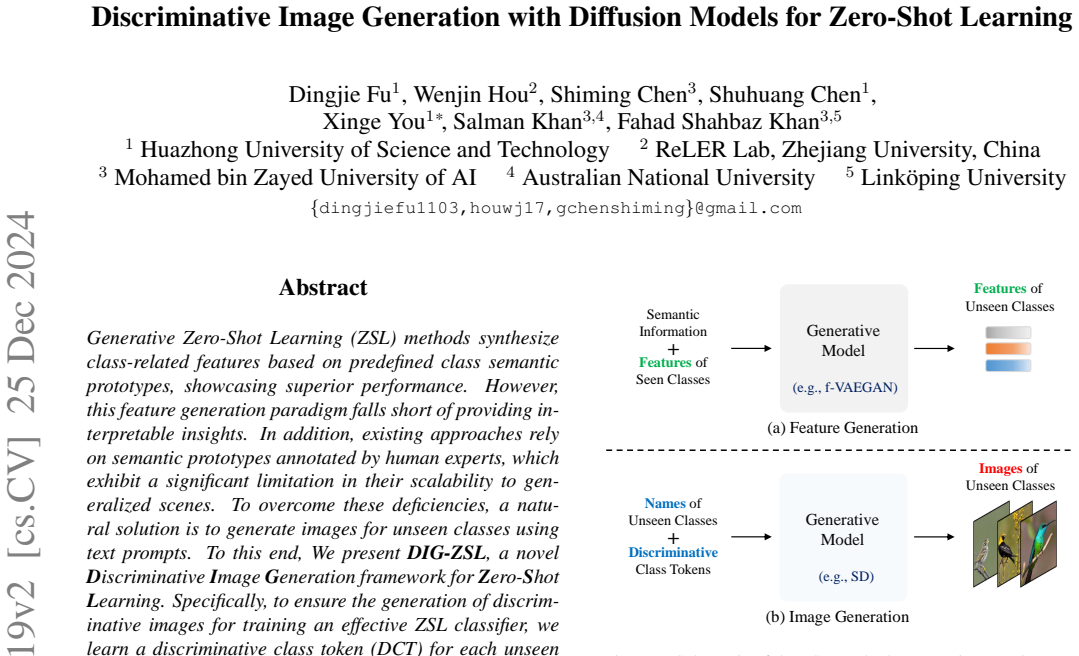
The central claim is that zero-shot recognition can be driven by image generation: instead of learning a conditional generator of visual features, one can prompt a frozen text-to-image diffusion model with a learned discriminative class token to synthesize photorealistic training images for each unseen class. The token is inserted into the prompt 'A photo of S* [name]' and optimized under the guidance of a category discrimination model, a frozen vision backbone with a trainable projection trained only on seen classes, using a cross-entropy loss on cosine similarities between the generated image's feature and the CLIP text prototypes of the unseen classes. The generated images are then combined with real seen data to train a standard classifier for both conventional and generalized zero-shot settings. The paper demonstrates the claim on AWA2, CUB, FLO, and SUN, reporting substantial improvements over nonhuman-annotated semantic prototype baselines and accuracy competitive with human-annotated attribute methods; it also shows that fine-tuning the category discrimination model on seen data raises accuracy further and that generated images have lower FID than plain Stable Diffusion outputs.
Load-bearing premise
The result depends on Stable Diffusion and CLIP not already having seen images of the benchmark 'unseen' classes during pretraining; if those classes appear in the training data, the generated images and the CLIP features carry class information, and the reported accuracy measures memorization rather than zero-shot transfer.
Editorial extensions
If this is right
- If the central claim holds, generative zero-shot learning no longer needs human-annotated attributes: class names alone suffice, so new categories can be added without expert annotation cost.
- Generated images provide interpretable evidence of what the model believes an unseen class looks like, which feature-synthesis methods do not offer.
- The same pipeline applies to both conventional and generalized zero-shot settings; on the reported benchmarks, it surpasses previous nonhuman-annotated semantic prototype methods and remains competitive with human-annotated ones.
- The number of generated images per class is a controllable resource; accuracy rises with more samples and saturates around 100 per class, so users can trade generation cost against accuracy.
- Improving the category discrimination model, for example by fine-tuning on seen classes, is a direct lever that further boosts the final zero-shot accuracy by 1.2 to 5.1 percentage points on the tested datasets.
Reading between the lines
- Inference: Because the method's benchmark numbers could be inflated if Stable Diffusion or CLIP encountered the unseen classes during web-scale pretraining, the zero-shot claim would be strengthened by repeating the protocol on genuinely novel classes invented after the training cutoff.
- Inference: The token-learning step is decoupled from the classifier, so the same discriminative class tokens could be reused to generate images at any resolution or count later, or to feed other downstream tasks such as retrieval and captioning.
- Inference: The category discrimination model is modular; replacing the vision backbone and projection with any model that can score generated images against unseen-class semantic prototypes, trained only on seen data, would likely yield similar behavior.
- Inference: A few-shot extension is natural: a handful of real images from a new class could refine its token, potentially closing the remaining gap on fine-grained datasets like CUB where the paper reports lower accuracy.
Signed reviews
Editorial analysis
A structured set of objections, weighed in public.
Referee Report
Summary. This paper proposes DIG-ZSL, a zero-shot learning method that synthesizes images for unseen classes with Stable Diffusion. In the first stage, a Category Discrimination Model (CDM), composed of a frozen CLIP visual encoder and a trainable MLP, is trained on seen classes to align visual features with CLIP text embeddings. In the second stage, for each unseen class a discriminative class token (DCT) is optimized so that images generated with the prompt "A photo of S* [name]" maximize the CDM-based cosine similarity to that class's CLIP prototype. In the third stage, a classifier is trained on real seen images plus generated unseen images and evaluated under both conventional and generalized ZSL on AWA2, CUB, FLO, and SUN. The paper reports large improvements over nonhuman-annotated semantic prototype baselines and competitive results against human-annotated attribute methods.
Significance. If the results reflect genuine zero-shot transfer, the paper makes a useful contribution: it demonstrates an interpretable image-generation route to ZSL, removes the need for human-annotated attributes, and provides extensive experiments, visualizations, and hyperparameter analyses. The CDM-guided DCT idea is simple and plausible. However, the significance is currently conditional on two unresolved issues: possible contamination of the web-scale pretrained SD/CLIP models with the benchmark unseen classes, and the absence of a vanilla-SD classification control. The paper also omits details of the DCT optimization and of the validation protocol. Until these are addressed, the headline accuracies cannot be interpreted as evidence of zero-shot generalization. No code is released, so reproducibility rests entirely on the written description.
major comments (4)
- [§4.1, Implementation Details, with §3.2–§3.4]
- [§4.3, Table 4]
- [§3.3 and Appendix A]
- [§4.1 and §4.5]
minor comments (6)
- [§3.1] The heading "Stable Difusion" contains a typo; it should read "Stable Diffusion."
- [§1, §4.1, Table 3] The dataset name is inconsistent: "AW A2" appears in the text while "AWA2" appears in tables; please use one canonical form.
- [Appendix A] In the "Supervised Classifier Training" paragraph, the text says the default setting is the same as CDM "as shown in Tab. 7," but Tab. 7 reports DCT learning settings; this cross-reference appears to be wrong.
- [§4.3, Table 4] Table 4 reports a single FID value per method without seeds or confidence intervals; given the small margins, the comparison would be more informative with multiple runs or error bars.
- [§4.2, Table 2] The phrase "as indicated in gray font" cannot be verified in the text version of Table 2; please use a dedicated column or note to identify the large vision-language baselines.
- [§4.2, Table 3] Table 3 omits FLO without explanation; please either include FLO results or note why it is excluded.
Circularity Check
No significant circularity: the pipeline is self-contained, with unseen test labels entering only at final evaluation.
full rationale
DIG-ZSL's derivation chain is not circular. The CDM is trained exclusively on seen-class images and CLIP text prototypes (Section 3.2), the DCT is optimized for each unseen class using only generated images and the CDM's cosine-similarity score against unseen-class prototypes (Eqs. 4-5, Section 3.3), and the final ZSL classifier is trained on generated unseen images plus real seen images (Section 3.4). Unseen test images and labels are never used in the CDM, DCT, or classifier training stages; they appear only in the final evaluation. The paper's self-citations to the authors' prior ZSL works (e.g., [5, 7, 20, 55]) are background and baseline references, and none is invoked as a load-bearing uniqueness theorem or as justification for the central framework. The main external-validity concern, that Stable Diffusion and CLIP may have been pretrained on images from the benchmark unseen classes, is a potential contamination/memorization risk rather than an internal derivational circularity: no equation reduces to another by construction, and no fitted test statistic is renamed as a prediction. Therefore the reported results, even if contestable on contamination grounds, do not arise from a circular argument within the paper itself.
Assumptions & free parameters
free parameters (4)
- Discriminative class token embedding e* =
learned vector, dimension equals CLIP text token dimension
- Early-stopping threshold gamma =
0.4 (CUB, FLO), 0.6 (SUN, AWA2)
- Calibration coefficient lambda =
0.95 (CUB), 0.6 (SUN), 0.9 (FLO), 0.8 (AWA2)
- Number of generated images per unseen class Ngen =
100
assumptions (5)
- domain assumption CLIP text embeddings of class names are valid semantic prototypes for unseen classes.
- domain assumption A category discrimination model trained only on seen classes provides useful guidance for unseen classes via cosine similarity to unseen prototypes.
- domain assumption Stable Diffusion can generate images that, when steered by a token embedding, display discriminative attributes of unseen classes.
- ad hoc to paper Gradients can be obtained for the token embedding through the stochastic image sampling process.
- domain assumption The pretrained models (CLIP and Stable Diffusion) were not trained on the benchmark datasets' unseen classes.
invented entities (1)
-
Discriminative class token (DCT) S*
Cite this review
Pith. "Pith review of Discriminative Image Generation with Diffusion Models for Zero-Shot Learning." pith.science (2026). https://pith.science/paper/426FTNFN
@misc{pith2026241217219,
  author       = {Pith},
  title        = {Pith review of: Discriminative Image Generation with Diffusion Models for Zero-Shot Learning},
  year         = {2026},
  howpublished = {\url{https://pith.science/paper/426FTNFN}},
  note         = {Machine review of arXiv:2412.17219}
}
read the original abstract
Generative Zero-Shot Learning (ZSL) methods synthesize class-related features based on predefined class semantic prototypes, showcasing superior performance. However, this feature generation paradigm falls short of providing interpretable insights. In addition, existing approaches rely on semantic prototypes annotated by human experts, which exhibit a significant limitation in their scalability to generalized scenes. To overcome these deficiencies, a natural solution is to generate images for unseen classes using text prompts. To this end, We present DIG-ZSL, a novel Discriminative Image Generation framework for Zero-Shot Learning. Specifically, to ensure the generation of discriminative images for training an effective ZSL classifier, we learn a discriminative class token (DCT) for each unseen class under the guidance of a pre-trained category discrimination model (CDM). Harnessing DCTs, we can generate diverse and high-quality images, which serve as informative unseen samples for ZSL tasks. In this paper, the extensive experiments and visualizations on four datasets show that our DIG-ZSL: (1) generates diverse and high-quality images, (2) outperforms previous state-of-the-art nonhuman-annotated semantic prototype-based methods by a large margin, and (3) achieves comparable or better performance than baselines that leverage human-annotated semantic prototypes. The codes will be made available upon acceptance of the paper.
Figures


Figures from the paper (8 more)


Forward citations
Cited by 1 Pith paper
-
GenPrior: Unleashing Text-to-Motion Generative Priors for Zero-Shot Skeleton-based Action Recognition
Using text-to-motion generation to inject kinematic structure into text prototypes improves zero-shot skeleton action recognition, though most of the reported gain comes from test-time prototype self-refinement.
Reference graph
Works this paper leans on
-
[1]
Synthetic data from diffusion models improves imagenet classification
Shekoofeh Azizi, Simon Kornblith, Chitwan Saharia, Mo- hammad Norouzi, and David J Fleet. Synthetic data from diffusion models improves imagenet classification. arXiv preprint arXiv:2304.08466, 2023. 2
arXiv 2023
-
[2]
Long- former: The long-document transformer
Iz Beltagy, Matthew E Peters, and Arman Cohan. Long- former: The long-document transformer. arXiv preprint arXiv:2004.05150, 2020. 2, 5
arXiv 2004
-
[3]
iedit: Lo- calised text-guided image editing with weak supervision
Rumeysa Bodur, Erhan Gundogdu, Binod Bhattarai, Tae- Kyun Kim, Michael Donoser, and Loris Bazzani. iedit: Lo- calised text-guided image editing with weak supervision. In Proceedings of the IEEE/CVF Conference on Computer Vi- sion and Pattern Recognition, pages 7426–7435, 2024. 2
work page 2024
-
[4]
Muse: Text-to-image generation via masked generative transform- ers
Huiwen Chang, Han Zhang, Jarred Barber, AJ Maschinot, Jose Lezama, Lu Jiang, Ming-Hsuan Yang, Kevin Mur- phy, William T Freeman, Michael Rubinstein, et al. Muse: Text-to-image generation via masked generative transform- ers. arXiv preprint arXiv:2301.00704, 2023. 3
arXiv 2023
-
[5]
Free: Feature re- finement for generalized zero-shot learning
Shiming Chen, Wenjie Wang, Beihao Xia, Qinmu Peng, Xinge You, Feng Zheng, and Ling Shao. Free: Feature re- finement for generalized zero-shot learning. In Proceedings of the IEEE/CVF international conference on computer vi- sion, pages 122–131, 2021. 2
work page 2021
-
[6]
Hsva: Hierarchical semantic-visual adaptation for zero-shot learning
Shiming Chen, Guosen Xie, Yang Liu, Qinmu Peng, Baigui Sun, Hao Li, Xinge You, and Ling Shao. Hsva: Hierarchical semantic-visual adaptation for zero-shot learning. Advances in Neural Information Processing Systems, 34:16622–16634,
-
[7]
Evolving semantic prototype improves generative zero-shot learning
Shiming Chen, Wenjin Hou, Ziming Hong, Xiaohan Ding, Yibing Song, Xinge You, Tongliang Liu, and Kun Zhang. Evolving semantic prototype improves generative zero-shot learning. In International Conference on Machine Learning, pages 4611–4622. PMLR, 2023. 1, 2, 6
work page 2023
-
[8]
Causal visual-semantic correlation for zero- shot learning
Shuhuang Chen, Dingjie Fu, Shiming Chen, Wenjin Hou, Xinge You, et al. Causal visual-semantic correlation for zero- shot learning. In ACM Multimedia 2024, 2024. 2
work page 2024
Show all 62 references
-
[9]
Progressive semantic-guided vision transformer for zero-shot learning
Shiming Chen, Wenjin Hou, Salman Khan, and Fahad Shah- baz Khan. Progressive semantic-guided vision transformer for zero-shot learning. InProceedings of the IEEE/CVF Con- ference on Computer Vision and Pattern Recognition, pages 23964–23974, 2024
2024
-
[10]
Duet: Cross- modal semantic grounding for contrastive zero-shot learning
Zhuo Chen, Yufeng Huang, Jiaoyan Chen, Yuxia Geng, Wen Zhang, Yin Fang, Jeff Z Pan, and Huajun Chen. Duet: Cross- modal semantic grounding for contrastive zero-shot learning. In Proceedings of the AAAI conference on artificial intelli- gence, pages 405–413, 2023. 2, 6
2023
-
[11]
Latentpaint: Image inpainting in latent space with diffusion models
Ciprian Corneanu, Raghudeep Gadde, and Aleix M Mar- tinez. Latentpaint: Image inpainting in latent space with diffusion models. In Proceedings of the IEEE/CVF Win- ter Conference on Applications of Computer Vision , pages 4334–4343, 2024. 2
2024
-
[12]
An image is worth 16x16 words: Transformers for image recognition at scale
Alexey Dosovitskiy. An image is worth 16x16 words: Transformers for image recognition at scale. arXiv preprint arXiv:2010.11929, 2020. 4
2010 arXiv
-
[13]
Dream the impossible: Outlier imagination with diffusion models
Xuefeng Du, Yiyou Sun, Jerry Zhu, and Yixuan Li. Dream the impossible: Outlier imagination with diffusion models. Advances in Neural Information Processing Systems , 36,
-
[14]
An image is worth one word: Personalizing text-to- image generation using textual inversion
Rinon Gal, Yuval Alaluf, Yuval Atzmon, Or Patash- nik, Amit H Bermano, Gal Chechik, and Daniel Cohen- Or. An image is worth one word: Personalizing text-to- image generation using textual inversion. arXiv preprint arXiv:2208.01618, 2022. 3
2022 arXiv
-
[15]
Generative adversarial nets
Ian Goodfellow, Jean Pouget-Abadie, Mehdi Mirza, Bing Xu, David Warde-Farley, Sherjil Ozair, Aaron Courville, and Yoshua Bengio. Generative adversarial nets. Advances in neural information processing systems, 27, 2014. 1
2014
-
[16]
Is synthetic data from generative models ready for image recognition? arXiv preprint arXiv:2210.07574, 2022
Ruifei He, Shuyang Sun, Xin Yu, Chuhui Xue, Wenqing Zhang, Philip Torr, Song Bai, and Xiaojuan Qi. Is synthetic data from generative models ready for image recognition? arXiv preprint arXiv:2210.07574, 2022. 2
2022 arXiv
-
[17]
Gans trained by a two time-scale update rule converge to a local nash equilib- rium
Martin Heusel, Hubert Ramsauer, Thomas Unterthiner, Bernhard Nessler, and Sepp Hochreiter. Gans trained by a two time-scale update rule converge to a local nash equilib- rium. Advances in neural information processing systems , 30, 2017. 7
2017
-
[18]
Classifier-free diffusion guidance
Jonathan Ho and Tim Salimans. Classifier-free diffusion guidance. arXiv preprint arXiv:2207.12598, 2022. 4
2022 arXiv
-
[19]
Denoising dif- fusion probabilistic models
Jonathan Ho, Ajay Jain, and Pieter Abbeel. Denoising dif- fusion probabilistic models. Advances in neural information processing systems, 33:6840–6851, 2020. 4
2020
-
[20]
Visual-augmented dynamic seman- tic prototype for generative zero-shot learning
Wenjin Hou, Shiming Chen, Shuhuang Chen, Ziming Hong, Yan Wang, Xuetao Feng, Salman Khan, Fahad Shahbaz Khan, and Xinge You. Visual-augmented dynamic seman- tic prototype for generative zero-shot learning. In Proceed- ings of the IEEE/CVF Conference on Computer Vision and Patt...
2024
-
[21]
Fine-grained generalized zero-shot learning via dense attribute-based attention
Dat Huynh and Ehsan Elhamifar. Fine-grained generalized zero-shot learning via dense attribute-based attention. In Proceedings of the IEEE/CVF conference on computer vi- sion and pattern recognition, pages 4483–4493, 2020. 2, 6
2020
-
[22]
Transferable contrastive network for generalized zero- shot learning
Huajie Jiang, Ruiping Wang, Shiguang Shan, and Xilin Chen. Transferable contrastive network for generalized zero- shot learning. In Proceedings of the IEEE/CVF International Conference on Computer Vision, pages 9765–9774, 2019. 6
2019
-
[23]
Kingma and M
Diederik P. Kingma and M. Welling. Auto-encoding varia- tional bayes. In ICLR, 2014. 1
2014
-
[24]
Learning to detect unseen object classes by between- class attribute transfer
Christoph H Lampert, Hannes Nickisch, and Stefan Harmel- ing. Learning to detect unseen object classes by between- class attribute transfer. In 2009 IEEE conference on com- puter vision and pattern recognition, pages 951–958. IEEE,
2009
-
[25]
Your diffusion model is secretly 9 a zero-shot classifier
Alexander C Li, Mihir Prabhudesai, Shivam Duggal, Ellis Brown, and Deepak Pathak. Your diffusion model is secretly 9 a zero-shot classifier. In Proceedings of the IEEE/CVF Inter- national Conference on Computer Vision, pages 2206–2217,
-
[26]
Towards understanding cross and self-attention in stable diffusion for text-guided image editing
Bingyan Liu, Chengyu Wang, Tingfeng Cao, Kui Jia, and Jun Huang. Towards understanding cross and self-attention in stable diffusion for text-guided image editing. InProceed- ings of the IEEE/CVF Conference on Computer Vision and Pattern Recognition, pages 7817–7826, 2024. 2
2024
-
[27]
Structure matters: Tackling the semantic discrepancy in diffusion models for image inpainting
Haipeng Liu, Yang Wang, Biao Qian, Meng Wang, and Yong Rui. Structure matters: Tackling the semantic discrepancy in diffusion models for image inpainting. In Proceedings of the IEEE/CVF Conference on Computer Vision and Pattern Recognition, pages 8038–8047, 2024. 2
2024
-
[28]
Progressive semantic-visual mutual adap- tion for generalized zero-shot learning
Man Liu, Feng Li, Chunjie Zhang, Yunchao Wei, Huihui Bai, and Yao Zhao. Progressive semantic-visual mutual adap- tion for generalized zero-shot learning. In Proceedings of the IEEE/CVF conference on computer vision and pattern recognition, pages 15337–15346, 2023. 2
2023
-
[29]
Distributed representations of words and phrases and their compositionality
Tomas Mikolov, Ilya Sutskever, Kai Chen, Greg S Corrado, and Jeff Dean. Distributed representations of words and phrases and their compositionality. Advances in neural in- formation processing systems, 26, 2013. 2
2013
-
[30]
A generative model for zero shot learn- ing using conditional variational autoencoders
Ashish Mishra, Shiva Krishna Reddy, Anurag Mittal, and Hema A Murthy. A generative model for zero shot learn- ing using conditional variational autoencoders. In Proceed- ings of the IEEE conference on computer vision and pattern recognition workshops, pages 2188–2196, 2018. 1
2018
-
[31]
I2dformer: Learning image to document attention for zero-shot image classification
Muhammad Ferjad Naeem, Yongqin Xian, Luc V Gool, and Federico Tombari. I2dformer: Learning image to document attention for zero-shot image classification. Advances in Neural Information Processing Systems , 35:12283–12294,
-
[32]
I2mvformer: Large language model generated multi-view document supervi- sion for zero-shot image classification
Muhammad Ferjad Naeem, Muhammad Gul Zain Ali Khan, Yongqin Xian, Muhammad Zeshan Afzal, Didier Stricker, Luc Van Gool, and Federico Tombari. I2mvformer: Large language model generated multi-view document supervi- sion for zero-shot image classification. In Proceedings of the I...
2023
-
[33]
I2dformer+: Learning image to doc- ument summary attention for zero-shot image classification
Muhammad Ferjad Naeem, Yongqin Xian, Luc Van Gool, and Federico Tombari. I2dformer+: Learning image to doc- ument summary attention for zero-shot image classification. International Journal of Computer Vision, pages 1–17, 2024. 2, 5, 6
2024
-
[34]
Latent embedding feedback and discriminative features for zero-shot classification
Sanath Narayan, Akshita Gupta, Fahad Shahbaz Khan, Cees GM Snoek, and Ling Shao. Latent embedding feedback and discriminative features for zero-shot classification. In Computer Vision–ECCV 2020: 16th European Conference, Glasgow, UK, August 23–28, 2020, Proceedings, Part XXII ...
2020
-
[35]
Automated flower classification over a large number of classes
Maria-Elena Nilsback and Andrew Zisserman. Automated flower classification over a large number of classes. In 2008 Sixth Indian conference on computer vision, graphics & im- age processing, pages 722–729. IEEE, 2008. 2, 5
2008
-
[36]
Sun attribute database: Discovering, annotating, and recognizing scene attributes
Genevieve Patterson and James Hays. Sun attribute database: Discovering, annotating, and recognizing scene attributes. In 2012 IEEE conference on computer vision and pattern recognition, pages 2751–2758. IEEE, 2012. 2, 5
2012
-
[37]
Glove: Global vectors for word representation
Jeffrey Pennington, Richard Socher, and Christopher D Man- ning. Glove: Global vectors for word representation. In Proceedings of the 2014 conference on empirical methods in natural language processing (EMNLP) , pages 1532–1543,
2014
-
[38]
Learning transferable visual models from natural language supervi- sion
Alec Radford, Jong Wook Kim, Chris Hallacy, Aditya Ramesh, Gabriel Goh, Sandhini Agarwal, Girish Sastry, Amanda Askell, Pamela Mishkin, Jack Clark, et al. Learning transferable visual models from natural language supervi- sion. In International conference on machine learning, ...
2021
-
[39]
Hierarchical text-conditional image gener- ation with clip latents
Aditya Ramesh, Prafulla Dhariwal, Alex Nichol, Casey Chu, and Mark Chen. Hierarchical text-conditional image gener- ation with clip latents. arXiv preprint arXiv:2204.06125, 1 (2):3, 2022. 2, 3
2022 arXiv
-
[40]
Learning deep representations of fine-grained visual descrip- tions
Scott Reed, Zeynep Akata, Honglak Lee, and Bernt Schiele. Learning deep representations of fine-grained visual descrip- tions. In Proceedings of the IEEE conference on computer vision and pattern recognition, pages 49–58, 2016. 1
2016
-
[41]
High-resolution image synthesis with latent diffusion models
Robin Rombach, Andreas Blattmann, Dominik Lorenz, Patrick Esser, and Bj ¨orn Ommer. High-resolution image synthesis with latent diffusion models. In Proceedings of the IEEE/CVF conference on computer vision and pattern recognition, pages 10684–10695, 2022. 1, 2, 3, 4, 5
2022
-
[42]
Photorealistic text-to-image diffusion models with deep language understanding
Chitwan Saharia, William Chan, Saurabh Saxena, Lala Li, Jay Whang, Emily L Denton, Kamyar Ghasemipour, Raphael Gontijo Lopes, Burcu Karagol Ayan, Tim Salimans, et al. Photorealistic text-to-image diffusion models with deep language understanding. Advances in neural information...
2022
-
[43]
Term-weighting ap- proaches in automatic text retrieval
Gerard Salton and Christopher Buckley. Term-weighting ap- proaches in automatic text retrieval. Information processing & management, 24(5):513–523, 1988. 5
1988
-
[44]
Generalized zero-and few-shot learning via aligned variational autoencoders
Edgar Schonfeld, Sayna Ebrahimi, Samarth Sinha, Trevor Darrell, and Zeynep Akata. Generalized zero-and few-shot learning via aligned variational autoencoders. In Proceed- ings of the IEEE/CVF conference on computer vision and pattern recognition, pages 8247–8255, 2019. 1, 6
2019
-
[45]
Discriminative class tokens for text-to-image diffusion models
Idan Schwartz, V ´esteinn Snæbjarnarson, Hila Chefer, Serge Belongie, Lior Wolf, and Sagie Benaim. Discriminative class tokens for text-to-image diffusion models. In Proceedings of the IEEE/CVF International Conference on Computer Vi- sion, pages 22725–22735, 2023. 3, 4
2023
-
[46]
Zero-shot learning through cross-modal transfer
Richard Socher, Milind Ganjoo, Christopher D Manning, and Andrew Ng. Zero-shot learning through cross-modal transfer. Advances in neural information processing systems, 26, 2013. 1, 2
2013
-
[47]
Deep unsupervised learning using nonequilibrium thermodynamics
Jascha Sohl-Dickstein, Eric Weiss, Niru Maheswaranathan, and Surya Ganguli. Deep unsupervised learning using nonequilibrium thermodynamics. In International confer- ence on machine learning, pages 2256–2265. PMLR, 2015. 4
2015
-
[48]
Mpnet: Masked and permuted pre-training for language understanding
Kaitao Song, Xu Tan, Tao Qin, Jianfeng Lu, and Tie-Yan Liu. Mpnet: Masked and permuted pre-training for language understanding. Advances in neural information processing systems, 33:16857–16867, 2020. 5, 6
2020
-
[49]
Learning vision from mod- 10 els rivals learning vision from data
Yonglong Tian, Lijie Fan, Kaifeng Chen, Dina Katabi, Dilip Krishnan, and Phillip Isola. Learning vision from mod- 10 els rivals learning vision from data. In Proceedings of the IEEE/CVF Conference on Computer Vision and Pattern Recognition, pages 15887–15898, 2024. 3
2024
-
[50]
Stablerep: Synthetic images from text-to- image models make strong visual representation learners
Yonglong Tian, Lijie Fan, Phillip Isola, Huiwen Chang, and Dilip Krishnan. Stablerep: Synthetic images from text-to- image models make strong visual representation learners. Advances in Neural Information Processing Systems , 36,
-
[51]
Improving zero-shot generalization for clip with synthesized prompts
Zhengbo Wang, Jian Liang, Ran He, Nan Xu, Zilei Wang, and Tieniu Tan. Improving zero-shot generalization for clip with synthesized prompts. In Proceedings of the IEEE/CVF International Conference on Computer Vision, pages 3032– 3042, 2023. 6
2023
-
[52]
Caltech-ucsd birds 200
Peter Welinder, Steve Branson, Takeshi Mita, Catherine Wah, Florian Schroff, Serge Belongie, and Pietro Perona. Caltech-ucsd birds 200. 2010. 2, 5
2010
-
[53]
Zero-shot learning—a comprehensive eval- uation of the good, the bad and the ugly
Yongqin Xian, Christoph H Lampert, Bernt Schiele, and Zeynep Akata. Zero-shot learning—a comprehensive eval- uation of the good, the bad and the ugly. IEEE transactions on pattern analysis and machine intelligence , 41(9):2251– 2265, 2018. 2, 5
2018
-
[54]
Feature generating networks for zero-shot learning
Yongqin Xian, Tobias Lorenz, Bernt Schiele, and Zeynep Akata. Feature generating networks for zero-shot learning. In Proceedings of the IEEE conference on computer vision and pattern recognition, pages 5542–5551, 2018. 1, 6
2018
-
[55]
f-vaegan-d2: A feature generating framework for any-shot learning
Yongqin Xian, Saurabh Sharma, Bernt Schiele, and Zeynep Akata. f-vaegan-d2: A feature generating framework for any-shot learning. In Proceedings of the IEEE/CVF con- ference on computer vision and pattern recognition , pages 10275–10284, 2019. 1, 2, 6
2019
-
[56]
Attribute prototype network for zero-shot learning
Wenjia Xu, Yongqin Xian, Jiuniu Wang, Bernt Schiele, and Zeynep Akata. Attribute prototype network for zero-shot learning. Advances in Neural Information Processing Sys- tems, 33:21969–21980, 2020. 6
2020
-
[57]
Attribute prototype network for zero-shot learning
Wenjia Xu, Yongqin Xian, Jiuniu Wang, Bernt Schiele, and Zeynep Akata. Attribute prototype network for zero-shot learning. Advances in Neural Information Processing Sys- tems, 33:21969–21980, 2020. 2
2020
-
[58]
Vgse: Visually-grounded semantic em- beddings for zero-shot learning
Wenjia Xu, Yongqin Xian, Jiuniu Wang, Bernt Schiele, and Zeynep Akata. Vgse: Visually-grounded semantic em- beddings for zero-shot learning. In Proceedings of the IEEE/CVF Conference on Computer Vision and Pattern Recognition, pages 9316–9325, 2022. 2, 5, 6
2022
-
[59]
Progressive ensemble networks for zero-shot recognition
Meng Ye and Yuhong Guo. Progressive ensemble networks for zero-shot recognition. In Proceedings of the IEEE/CVF conference on computer vision and pattern recognition , pages 11728–11736, 2019. 6
2019
-
[60]
Exploring data efficiency in zero-shot learning with diffusion models
Zihan Ye, Shreyank N Gowda, Xiaobo Jin, Xiaowei Huang, Haotian Xu, Yaochu Jin, and Kaizhu Huang. Exploring data efficiency in zero-shot learning with diffusion models. arXiv preprint arXiv:2406.02929, 2024. 2
2024 arXiv
-
[61]
Learning to prompt for vision-language models
Kaiyang Zhou, Jingkang Yang, Chen Change Loy, and Ziwei Liu. Learning to prompt for vision-language models. In- ternational Journal of Computer Vision, 130(9):2337–2348,
-
[2022]
A photo of S∗ [name]
6 11 Discriminative Image Generation with Diffusion Models for Zero-Shot Learning Supplementary Material Organization of the appendix: • Appendix A: More Implementation Details. • Appendix B: More Visualizations. A. More Implementation Details Category Discrimination Model Tra...
Reviewed August 11, 2026 · model on record in the stance chip above.
Discussion (0). Continue with ORCID to comment.