REVIEW 3 major objections 6 minor 63 references
Non-Convex Tensor Recovery from Local Measurements
T0 review · 3 major / 6 minor · reviewed 2026-08-11 · deepseek-v4-flash
Pith's one-line read A low-tubal-rank tensor can be recovered from independent compressive measurements of each lateral slice, and a preconditioned alternating-minimization method reaches epsilon-accurate recovery in O(log 1/epsilon) iterations independent of…
desk verdict Useful new local tensor sensing model, but the headline κ-independent convergence is not proven as stated because the Theorem 3 warm start is too weak for the contraction lemma unless r κ³ is bounded. read the letter →
The pith
A machine-rendered reading of the paper's core claim, the machinery that carries it, and where it could break.
The reading
What carries the argument
The load-bearing machinery is the low-tubal-rank factorization $X = U * V$ with $U^c * U = I_r$ under the t-product, in which tensor multiplication is block-circulant convolution and becomes elementwise matrix products in the Fourier domain. The algorithm alternates an exact least-squares solve for each $V$ slice (a closed form via $H_{t,i}H_{t,i}^c$ inversion) with a projected gradient step on $U$ followed by QR projection onto the orthogonal-tensor constraint. Alt-ScalePGD-Min changes only the $U$ update to $\hat U_{t+1}=U_t-\eta T_t*V_t^c*(V_t*V_t^c)^{-1}$; the extra inverse is an $r\times r\times n_3$ tensor and is cheap to compute. The proof tracks the principal-angle distance $\mathrm{Dis}(U_t,U_\star)$ through a Wedin-type sin $\theta$ bound, and uses sample splitting so each iteration sees fresh independent measurements.
What would settle it
Take a synthetic tensor with $r=4$ and $\kappa=10$ and initialize by the proved spectral bound: $\mathrm{Dis}(U_0,U_\star)\le 0.016\sqrt{4}\,10^2=3.2$, which is larger than the small constant required by the contraction step (67); running Alt-ScalePGD-Min on such a tensor and checking whether the $O(\log 1/\epsilon)$ iteration bound actually holds would settle whether the condition-number-free claim is valid as stated.
Extended reading notes
Core claim
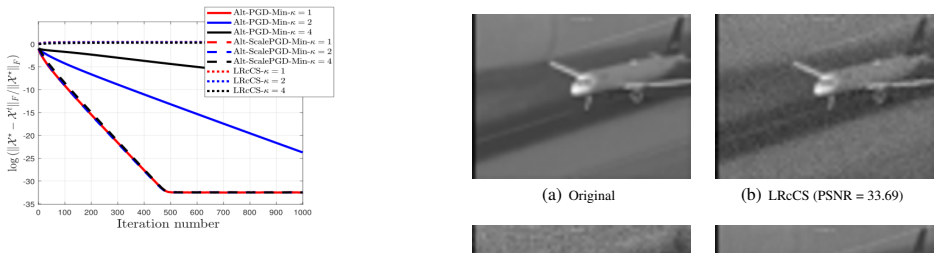
The paper's central claim is Theorem 5 with Corollaries 4 and 5: under Assumptions 1 and 2 (tubal rank $r$, tensor incoherence, i.i.d. Gaussian local sensing matrices), the truncated spectral initialization followed by Alt-ScalePGD-Min recovers an $\epsilon$-accurate estimate in $O(\log 1/\epsilon)$ iterations, with total per-slice sample complexity $O(\kappa^4 \mu^2 r n_3 \log n_3 (\kappa^4 r (n_1+n_2) + n_1 \log 1/\epsilon))$ with high probability. The companion result for Alt-PGD-Min gives iteration complexity $O(\kappa^2 \log 1/\epsilon)$ and establishes that the local-sensing model itself is tractable: exact $V$-updates decouple across slices and a projected gradient on $U$ converges linearly once $U_0$ is near $U^\star$. Experiments on synthetic tensors, video, and MRI report that Alt-ScalePGD-Min keeps its convergence rate when $\kappa$ grows, while the un-preconditioned version slows down as $\kappa^2$ predicts.
Load-bearing premise
The guarantees assume the spectral initialization lands inside a small contraction basin around the true factor space, and the initialization bound proved in the paper only guarantees that closeness when the condition number is small; for the large-$\kappa$ regime the advertised condition-number-free result relies on a warm start that is not proved.
Editorial extensions
If this is right
- Video and dynamic-MRI volumes can be reconstructed from independent compressed measurements of individual frames, with no need to sense or hold the whole tensor at once.
- Because Alt-ScalePGD-Min's iteration complexity is $O(\log 1/\epsilon)$ uniformly in the condition number, ill-conditioned low-tubal-rank tensors do not require a longer run just because they are harder to condition.
- The per-slice sample-complexity formula contains a shared-factor term that decreases with the number of lateral slices $n_2$, so adding more frames or slices amortizes the cost of learning the common tensor factor $U$.
- The exact minimization step for $V$ is decoupled across lateral slices, so each iteration can be parallelized across slices, matching distributed or streaming sensing architectures.
- When the number of lateral slices is large, the analysis shows the total per-slice sample complexity drops to roughly $O(\kappa^4\mu^2 r n_1 n_3\log n_3 \log 1/\epsilon)$, which is close to the information-theoretic degrees of freedom up to small factors.
Reading between the lines
- The same preconditioning idea should transfer to other tensor formats: replacing $(V*V^c)^{-1}$ by the inverse Gram tensor is cheap whenever the core size is small, so Tucker or tensor-train factorizations might inherit condition-number-free convergence.
- The paper's fixed step size of 0.8 for Alt-ScalePGD-Min across all video and MRI experiments suggests the preconditioned update may be insensitive to $\kappa$ in practice, which would make it a plug-and-play solver for low-tubal-rank inverse problems beyond the measured setting.
- Removing sample splitting, which the conclusion names as future work, would eliminate the $\log 1/\epsilon$ term from the sample complexity; a leave-one-out analysis is the natural route, as in matrix completion.
- The proof of Theorem 5 relies on a small-basin contraction condition (inequality (67)) while the proved initialization bound is $\mathrm{Dis}(U_0,U_\star)\le 0.016\sqrt{r}\,\kappa^2$; for large $\kappa$ this gap needs a sharper initialization or a larger basin, so the advertised regime is most rigorous for bounded $\kappa$.
Signed reviews
Editorial analysis
A structured set of objections, weighed in public.
Referee Report
Summary. The paper introduces a tensor compressed sensing model in which each lateral slice of a low-tubal-rank tensor is sensed by an independent local measurement matrix, and formulates recovery as a nonconvex factored problem over two tensor factors. Two alternating-minimization algorithms are proposed: Alt-PGD-Min, which alternates a projected gradient step on the orthogonal factor with an exact least-squares update on the other factor, and Alt-ScalePGD-Min, which preconditions the gradient step by an approximate Hessian. The paper proves, under Gaussian local measurements and a tensor incoherence condition, that a truncated spectral initialization provides a warm start and that both algorithms converge linearly with sample complexity stated in terms of the tensor condition number kappa; the headline claim is that Alt-ScalePGD-Min has iteration complexity O(log(1/epsilon)) independent of kappa. Numerical experiments on synthetic tensors, video, and MRI data support the practical efficacy of the proposed methods.
Significance. If the theoretical claims were fully established, this would be a valuable contribution: the local slice-wise sensing model is new for tensors, the sample-splitting and truncation analysis is carefully designed, and the constants in the main bounds are fixed universal numbers rather than fitted parameters. The preconditioned method's claimed kappa-independent iteration complexity would be a substantial improvement over the kappa^2 dependence of unaccelerated factoring methods and over the sub-linear rates of convex tensor nuclear norm approaches. The experimental section is reasonably extensive and includes comparisons with the closest column-wise matrix sensing method. However, the central contraction proof contains a load-bearing smallness gap: the initialization bound proved in Theorem 3 is not strong enough to enter the contraction regime required by Lemma 4 and the proofs of Theorems 4 and 5 for large kappa, which is precisely the regime the preconditioned algorithm is advertised to address. The core idea is defensible and likely repairable, but the stated kappa-independent result is not currently proven.
major comments (3)
- [Proof of Theorem 4; Lemma 4; Eq. (67)] The displayed lower bound for sigma_min(V_t) subtracts the perturbation 0.36*Dis(U_t,U*)*sqrt(r)*||X*|| from sigma*_min*sqrt(1-Dis^2(U_t,U*)). Since ||X*|| = kappa*sigma*_min, concluding sigma_min(V_t) >= 0.94*sigma*_min requires Dis(U_t,U*) to be at most of order 1/(6*sqrt(r)*kappa). The only initialization guarantee proved is Dis(U_0,U*) <= 0.016*sqrt(r)*kappa^2 (Theorem 3, Eq. (18)), which can satisfy that smallness requirement only when r*kappa^3 is bounded by an absolute constant. No such restriction is stated in Theorem 4, Theorem 5, or Corollaries 2-5; for the ill-conditioned regime emphasized by the paper the initialization bound is vacuous, since 0.016*sqrt(r)*kappa^2 can exceed 1. Consequently the contraction steps at Eq. (79) and Eq. (88) are not justified as stated, and the kappa-independent iteration complexity of Theorem 5 and Corollary 4 is not established.
- [Alt-PGD-Min Algorithm; Eq. (23); Corollaries 2-5] The exact V-step computes v_{t,i} = (H_{t,i}H_{t,i}^c)^{-1} H_{t,i} y_i, which requires the matrix H_{t,i}H_{t,i}^c in R^{r*n3 x r*n3} to be nonsingular. This can hold only when the number of measurements per lateral slice satisfies m_c >= r*n3. The sample-size conditions in Corollary 2, Eq. (28), and in Corollaries 3-5 only impose m_c >= max{log n2, r log n3} together with a lower bound on m_c*n2; for large n2 this permits m_c to be much smaller than r*n3. The proof of Lemma 3 uses the same invertibility and the spectral lower bound sigma_min(Q_{t,i}Q_{t,i}^c) >= 0.86*m_c, so the per-slice identifiability condition m_c >= r*n3 is a missing necessary condition in the stated sample-complexity guarantees.
- [Proof of Theorem 4; Eq. (79) and Eq. (88)] Step (d) of Eq. (79) estimates 1.41*eta*m*sqrt(r)*||X*||^2*Dis(U_t,U*) by 0.03, but substituting eta = 0.9/(m||X*||^2) and Dis <= 0.016*sqrt(r)*kappa^2 gives 1.41*0.9*0.016*r*kappa^2 = 0.0203*r*kappa^2, which is not an absolute constant. The subsequent inequality (1-x)(1+2x) >= 1 therefore requires r*kappa^2 to be small. In Theorem 5, Eq. (88), the analogous term is 1.6*0.9*sqrt(r)*Dis*kappa^2 <= 0.023*r*kappa^4, which is not bounded for large kappa. This is an independent manifestation of the same missing smallness condition and, by itself, invalidates the displayed contraction unless an explicit bound on r*kappa^2 or r*kappa^4 is imposed.
minor comments (6)
- [Figures throughout] The main text refers to Figures 6-9 for the synthetic and video results, but the displayed figures in the manuscript are labeled Figures 1-4; the numbering should be made consistent.
- [Eq. (67)] The perturbation term is printed as 0.36*Dis^2(U_t,U*)*sqrt(r)*||X*||, while Lemma 3 fact (3) gives 0.36*Dis(U_t,U*)*sqrt(r)*||X*||; the square on Dis appears to be a typo and should be corrected.
- [Corollary 2] The step size is stated as eta = 0.8/(m||X*||), but Theorem 4 and the gradient normalization require eta = 0.8/(m||X*||^2); the missing square changes the dimensional consistency of the step size.
- [Corollary 1] The success probability is stated as 1 - 1/(n1+n3)^10, while Theorem 3 contains the term c1(n1+n2) log n3; the indices n2 and n3 should be made consistent.
- [Supplementary Table 1] The table reports the Alt-ScalePGD-Min sample complexity with an inner factor kappa^2*r*(n1+n2), whereas Corollary 5 and the abstract use kappa^4*r*(n1+n2); one of these is a typo.
- [Lemma 13 and references] Lemma 13 cites (Kumar et al. 2022), a paper on fine-tuning pretrained features, for the standard inequality sigma_min(AB) >= sigma_min(A)*sigma_min(B); a standard linear algebra reference would be more appropriate.
Circularity Check
No circularity: derivation is self-contained; the initialization-to-contraction gap is a proof-completeness concern, not a reduction to inputs.
full rationale
I walked the paper's claimed derivation chain. The truncated spectral initialization (Theorem 3) is proved from the t-SVD Wedin sin-theta theorem and sub-Gaussian/sub-exponential concentration arguments, with fixed universal constants (0.016, 0.84, 0.89, 1.4, etc.) chosen in the proof rather than fitted to any measured outcome. The contraction theorems (Theorems 4 and 5) assume a warm-start condition Dis(U_t, U_star) <= 0.016 sqrt(r) kappa^2, which is exactly the guarantee that Theorem 3 proves; this is standard local-convergence reasoning, not self-definition, because the contraction factor is strictly less than one and the proof shows the distance decreases iteration by iteration. The algorithm uses kappa, mu, and ||X_star|| to set the truncation threshold and step size; these are oracle quantities, which is a practical limitation, but the guarantees do not define the recovery target in terms of the algorithm's own output. The only self-citations (Wu & Sun 2024 and Wu & Fan 2024) appear in motivation, related work, and experiment-quality indices; none supplies a load-bearing theorem used in the convergence proofs. The proof gap identified by the reviewer concerns Eq. (67): the displayed bound sigma_min(V_t) >= sigma*_min sqrt(1 - Dis^2) - 0.36 Dis sqrt(r) ||X_star|| requires Dis to be of order 1/(sqrt(r) kappa) to reach 0.94 sigma*_min, while Theorem 3 only provides 0.016 sqrt(r) kappa^2, so the claimed kappa-independent rate is not fully established for large kappa. That is a correctness and proof-completeness issue, not circularity, because assuming a stronger warm-start condition would not make the conclusion identical to the assumption by construction. Therefore no circular step is present, and the central derivation is self-contained.
Assumptions & free parameters
free parameters (3)
- truncation threshold alpha =
C * kappa^2 * mu^2 * (sum y^2) / (m * n2)
- step size eta =
c_eta / (m_c * ||X*||^2) for Alt-PGD-Min; c_eta / m_c for Alt-ScalePGD-Min, with c_eta <= 0.9
- tubal rank r =
known input
assumptions (6)
- domain assumption Ground truth X* has tubal rank r << min(n1,n2,n3) and satisfies the incoherence condition max_i ||Z*(:,i,:)||_F <= mu * sqrt(r/n2) * ||X*|| (Assumption 1).
- domain assumption Each sensing tensor A_i has i.i.d. standard Gaussian entries (Assumption 2).
- domain assumption Samples are split into 2T+1 independent groups, one fresh group per iteration (sample splitting).
- ad hoc to paper The initialization satisfies Dis(U0,U*) <= c0 for a fixed small constant, or equivalently kappa is bounded by a constant (implicit in Lemma 4 and the proof of Theorem 4, Eq. 67).
- ad hoc to paper m_c >= r * n3 so that H_{t,i}H_{t,i}^c is invertible in the exact V update (Eq. 23).
- standard math Standard tools: Wedin sin theta theorem, sub-exponential Bernstein inequalities, epsilon-net covering bounds, t-SVD and t-QR properties, and the matrix column-wise analysis of Vaswani (2024).
Cite this review
Pith. "Pith review of Non-Convex Tensor Recovery from Local Measurements." pith.science (2026). https://pith.science/paper/WXXUQWAM
@misc{pith2026241217281,
  author       = {Pith},
  title        = {Pith review of: Non-Convex Tensor Recovery from Local Measurements},
  year         = {2026},
  howpublished = {\url{https://pith.science/paper/WXXUQWAM}},
  note         = {Machine review of arXiv:2412.17281}
}
abstract
Motivated by the settings where sensing the entire tensor is infeasible, this paper proposes a novel tensor compressed sensing model, where measurements are only obtained from sensing each lateral slice via mutually independent matrices. Leveraging the low tubal rank structure, we reparameterize the unknown tensor ${\boldsymbol {\mathcal X}}^\star$ using two compact tensor factors and formulate the recovery problem as a nonconvex minimization problem. To solve the problem, we first propose an alternating minimization algorithm, termed \textsf{Alt-PGD-Min}, that iteratively optimizes the two factors using a projected gradient descent and an exact minimization step, respectively. Despite nonconvexity, we prove that \textsf{Alt-PGD-Min} achieves $\epsilon$-accuracy recovery with $\mathcal O\left( \kappa^2 \log \frac{1}{\epsilon}\right)$ iteration complexity and $\mathcal O\left( \kappa^6rn_3\log n_3 \left( \kappa^2r\left(n_1 + n_2 \right) + n_1 \log \frac{1}{\epsilon}\right) \right)$ sample complexity, where $\kappa$ denotes tensor condition number of $\boldsymbol{\mathcal X}^\star$. To further accelerate the convergence, especially when the tensor is ill-conditioned with large $\kappa$, we prove \textsf{Alt-ScalePGD-Min} that preconditions the gradient update using an approximate Hessian that can be computed efficiently. We show that \textsf{Alt-ScalePGD-Min} achieves $\kappa$ independent iteration complexity $\mathcal O(\log \frac{1}{\epsilon})$ and improves the sample complexity to $\mathcal O\left( \kappa^4 rn_3 \log n_3 \left( \kappa^4r(n_1+n_2) + n_1 \log \frac{1}{\epsilon}\right) \right)$. Experiments validate the effectiveness of the proposed methods.
Figures


Figures from the paper (5 more)


Reference graph
Works this paper leans on
-
[1]
Ahmed, T.; Raja, H.; and Bajwa, W. U. 2020. Tensor regression using low-rank and sparse Tucker decompositions. SIAM Journal on Mathematics of Data Science, 2(4): 944--966
work page 2020
-
[2]
Cai, C.; Li, G.; Poor, H. V.; and Chen, Y. 2019. Nonconvex low-rank tensor completion from noisy data. Advances in neural information processing systems, 32
work page 2019
-
[3]
Cai, J.-F.; Li, J.; and Xia, D. 2022. Provable tensor-train format tensor completion by riemannian optimization. Journal of Machine Learning Research, 23(123): 1--77
work page 2022
-
[4]
Cand \`e s, E. J.; Romberg, J.; and Tao, T. 2006. Robust uncertainty principles: Exact signal reconstruction from highly incomplete frequency information. IEEE Transactions on information theory, 52(2): 489--509
work page 2006
-
[5]
Chen, H.; Raskutti, G.; and Yuan, M. 2019. Non-convex projected gradient descent for generalized low-rank tensor regression. Journal of Machine Learning Research, 20(5): 1--37
2019
-
[6]
Chen, Y.; and Candes, E. 2015. Solving random quadratic systems of equations is nearly as easy as solving linear systems. Advances in Neural Information Processing Systems, 28
work page 2015
-
[7]
Ding, L.; and Chen, Y. 2020. Leave-one-out approach for matrix completion: Primal and dual analysis. IEEE Transactions on Information Theory, 66(11): 7274--7301
work page 2020
-
[8]
Fan, J. 2022. Multi-Mode Deep Matrix and Tensor Factorization. In International Conference on Learning Representations
work page 2022
Show all 63 references
-
[9]
Fan, J.; Ding, L.; Yang, C.; Zhang, Z.; and Udell, M. 2023. Euclidean-Norm-Induced Schatten-p Quasi-Norm Regularization for Low-Rank Tensor Completion and Tensor Robust Principal Component Analysis. Transactions on Machine Learning Research
2023
-
[10]
Gong, M.; and Zhang, G. 2024. Non-local tensor sparse representation and tensor low rank regularization for dynamic MRI reconstruction. International Journal of Machine Learning and Cybernetics, 15(2): 493--503
2024
-
[11]
Gu, Y.; Song, Z.; Yin, J.; and Zhang, L. 2024. Low Rank Matrix Completion via Robust Alternating Minimization in Nearly Linear Time. In The Twelfth International Conference on Learning Representations
2024
-
[12]
Han, R.; Willett, R.; and Zhang, A. R. 2022. An optimal statistical and computational framework for generalized tensor estimation. The Annals of Statistics, 50(1): 1--29
2022
-
[13]
Hardt, M.; and Wootters, M. 2014. Fast matrix completion without the condition number. In Conference on learning theory, 638--678. PMLR
2014
-
[14]
Hou, J.; Zhang, F.; Qiu, H.; Wang, J.; Wang, Y.; and Meng, D. 2021. Robust low-tubal-rank tensor recovery from binary measurements. IEEE Transactions on Pattern Analysis and Machine Intelligence, 44(8): 4355--4373
2021
-
[15]
Jain, P.; and Netrapalli, P. 2015. Fast exact matrix completion with finite samples. In Conference on Learning Theory, 1007--1034. PMLR
2015
-
[16]
Jain, P.; Netrapalli, P.; and Sanghavi, S. 2013. Low-rank matrix completion using alternating minimization. In Proceedings of the forty-fifth annual ACM symposium on Theory of computing, 665--674
2013
-
[17]
E.; and Martin, C
Kilmer, M. E.; and Martin, C. D. 2011. Factorization strategies for third-order tensors. Linear Algebra and its Applications, 435(3): 641--658
2011
-
[18]
G.; and Bader, B
Kolda, T. G.; and Bader, B. W. 2009. Tensor decompositions and applications. SIAM review, 51(3): 455--500
2009
-
[19]
M.; Ma, T.; and Liang, P
Kumar, A.; Raghunathan, A.; Jones, R. M.; Ma, T.; and Liang, P. 2022. Fine-Tuning can Distort Pretrained Features and Underperform Out-of-Distribution. In International Conference on Learning Representations
2022
-
[20]
Kuzmin, S.; Mikhailova, V.; Dyakonov, I.; and Straupe, S. 2024. Learning the tensor network model of a quantum state using a few single-qubit measurements. Physical Review A, 109(5): 052616
2024
-
[21]
S.; Junge, M.; and Romberg, J
Lee, K.; Sharma, R. S.; Junge, M.; and Romberg, J. 2023. Approximately low-rank recovery from noisy and local measurements by convex program. Information and Inference: A Journal of the IMA, 12(3): 1612--1654
2023
-
[22]
Li, X.; Ye, Y.; and Xu, X. 2017. Low-rank tensor completion with total variation for visual data inpainting. In Proceedings of the AAAI Conference on Artificial Intelligence, volume 31
2017
-
[23]
Li, Z.; Wang, Y.; Zhao, Q.; Zhang, S.; and Meng, D. 2022. A tensor-based online RPCA model for compressive background subtraction. IEEE Transactions on Neural Networks and Learning Systems, 34(12): 10668--10682
2022
-
[24]
Liu, X.; Hou, J.; Peng, J.; Wang, H.; Meng, D.; and Wang, J. 2023 a . Tensor compressive sensing fused low-rankness and local-smoothness. In Proceedings of the AAAI Conference on Artificial Intelligence, volume 37, 8879--8887
2023
-
[25]
Liu, X.-Y.; Aeron, S.; Aggarwal, V.; and Wang, X. 2019. Low-tubal-rank tensor completion using alternating minimization. IEEE Transactions on Information Theory, 66(3): 1714--1737
2019
-
[26]
Liu, X.-Y.; Huang, Q.; Han, X.; Wu, B.; Kong, L.; Walid, A.; and Wang, X. 2023 b . Real-Time Decoding of Snapshot Compressive Imaging Using Tensor FISTA-Net. IEEE Transactions on Neural Networks and Learning Systems
2023
-
[27]
Liu, Z.; Han, Z.; Tang, Y.; Zhao, X.-L.; and Wang, Y. 2024. Low-Tubal-Rank Tensor Recovery via Factorized Gradient Descent. arXiv preprint arXiv:2401.11940
2024 arXiv
-
[28]
Lu, C.; Feng, J.; Chen, Y.; Liu, W.; Lin, Z.; and Yan, S. 2020. Tensor Robust Principal Component Analysis with A New Tensor Nuclear Norm. IEEE Transactions on Pattern Analysis and Machine Intelligence (TPAMI)
2020
-
[29]
Lu, C.; Feng, J.; Lin, Z.; and Yan, S. 2018. Exact low tubal rank tensor recovery from Gaussian measurements. In Proceedings of the 27th International Joint Conference on Artificial Intelligence, 2504--2510
2018
-
[30]
Luo, Y.; and Zhang, A. R. 2023. Low-rank tensor estimation via riemannian gauss-newton: Statistical optimality and second-order convergence. The Journal of Machine Learning Research, 24(1): 18274--18321
2023
-
[31]
Ma, J.; Liu, X.-Y.; Shou, Z.; and Yuan, X. 2019. Deep tensor admm-net for snapshot compressive imaging. In Proceedings of the IEEE/CVF International Conference on Computer Vision, 10223--10232
2019
-
[32]
Moothedath, S.; and Vaswani, N. 2024. Decentralized Low Rank Matrix Recovery from Column-Wise Projections by Alternating GD and Minimization. In ICASSP 2024-2024 IEEE International Conference on Acoustics, Speech and Signal Processing (ICASSP), 12936--12940. IEEE
2024
-
[33]
Mu, C.; Huang, B.; Wright, J.; and Goldfarb, D. 2014. Square deal: Lower bounds and improved relaxations for tensor recovery. In International conference on machine learning, 73--81. PMLR
2014
-
[34]
Nayer, S.; Narayanamurthy, P.; and Vaswani, N. 2019. Phaseless PCA: Low-rank matrix recovery from column-wise phaseless measurements. In International Conference on Machine Learning, 4762--4770. PMLR
2019
-
[35]
Nayer, S.; and Vaswani, N. 2022. Fast and sample-efficient federated low rank matrix recovery from column-wise linear and quadratic projections. IEEE Transactions on Information Theory, 69(2): 1177--1202
2022
-
[36]
Ran, S.-J.; Sun, Z.-Z.; Fei, S.-M.; Su, G.; and Lewenstein, M. 2020. Tensor network compressed sensing with unsupervised machine learning. Physical Review Research, 2(3): 033293
2020
-
[37]
Rauhut, H.; Schneider, R.; and Stojanac, Z . 2017. Low rank tensor recovery via iterative hard thresholding. Linear Algebra and its Applications, 523: 220--262
2017
-
[38]
Recht, B.; Fazel, M.; and Parrilo, P. A. 2010. Guaranteed minimum-rank solutions of linear matrix equations via nuclear norm minimization. SIAM review, 52(3): 471--501
2010
-
[39]
Rojo, O.; and Rojo, H. 2004. Some results on symmetric circulant matrices and on symmetric centrosymmetric matrices. Linear algebra and its applications, 392: 211--233
2004
-
[40]
Shi, Z.; Han, J.; Zheng, T.; and Li, J. 2013. Guarantees of augmented trace norm models in tensor recovery. In Proceedings of the Twenty-Third international joint conference on Artificial Intelligence, 1670--1676
2013
-
[41]
P.; and Vaswani, N
Singh, A. P.; and Vaswani, N. 2024. Byzantine Resilient and Fast Federated Few-Shot Learning. In Forty-first International Conference on Machine Learning
2024
-
[42]
S.; Kim, S.; and Lee, K
Srinivasa, R. S.; Kim, S.; and Lee, K. 2023. Sketching low-rank matrices with a shared column space by convex programming. IEEE Journal on Selected Areas in Information Theory, 4: 54--60
2023
-
[43]
S.; Lee, K.; Junge, M.; and Romberg, J
Srinivasa, R. S.; Lee, K.; Junge, M.; and Romberg, J. 2019. Decentralized sketching of low rank matrices. Advances in Neural Information Processing Systems, 32
2019
-
[44]
Tong, T.; Ma, C.; Prater-Bennette, A.; Tripp, E.; and Chi, Y. 2022 a . Scaling and scalability: Provable nonconvex low-rank tensor completion. In International Conference on Artificial Intelligence and Statistics, 2607--2617. PMLR
2022
-
[45]
Tong, T.; Ma, C.; Prater-Bennette, A.; Tripp, E.; and Chi, Y. 2022 b . Scaling and scalability: Provable nonconvex low-rank tensor estimation from incomplete measurements. Journal of Machine Learning Research, 23(163): 1--77
2022
-
[46]
Tucker, L. R. 1966. Some mathematical notes on three-mode factor analysis. Psychometrika, 31(3): 279--311
1966
-
[47]
Vaswani, N. 2024. Efficient federated low rank matrix recovery via alternating gd and minimization: A simple proof. IEEE Transactions on Information Theory
2024
-
[48]
Vershynin, R. 2018. High-dimensional probability: An introduction with applications in data science, volume 47. Cambridge university press
2018
-
[49]
Wang, A.; Li, C.; Jin, Z.; and Zhao, Q. 2020. Robust Tensor Decomposition via Orientation Invariant Tubal Nuclear Norms. In Proceedings of the AAAI Conference on Artificial Intelligence, volume 34, 6102--6109
2020
-
[50]
B.; and Eldar, Y
Wang, G.; Giannakis, G. B.; and Eldar, Y. C. 2017. Solving systems of random quadratic equations via truncated amplitude flow. IEEE Transactions on Information Theory, 64(2): 773--794
2017
-
[51]
Wang, H.; Zhang, F.; Wang, J.; Huang, T.; Huang, J.; and Liu, X. 2021. Generalized nonconvex approach for low-tubal-rank tensor recovery. IEEE Transactions on Neural Networks and Learning Systems, 33(8): 3305--3319
2021
-
[52]
Wedin, P.- . 1972. Perturbation bounds in connection with singular value decomposition. BIT Numerical Mathematics, 12: 99--111
1972
-
[53]
Wu, T.; and Fan, J. 2024. Smooth Tensor Product for Tensor Completion. IEEE Transactions on Image Processing
2024
-
[54]
Wu, T.; Gao, B.; Fan, J.; and Xue, J. 2022. Low-rank tensor completion based on self-adaptive learnable transforms. IEEE Transactions on Neural Networks and Learning Systems
2022
-
[55]
Wu, T.; and Sun, Y. 2024. Implicit Regularization of Decentralized Gradient Descent for Sparse Regression. In The Thirty-eighth Annual Conference on Neural Information Processing Systems
2024
-
[56]
Yu, Y.; Jin, J.; Liu, F.; and Crozier, S. 2014. Multidimensional compressed sensing MRI using tensor decomposition-based sparsifying transform. PloS one, 9(6): e98441
2014
-
[57]
Zhang, F.; Wang, J.; Wang, W.; and Xu, C. 2020 a . Low-tubal-rank plus sparse tensor recovery with prior subspace information. IEEE transactions on pattern analysis and machine intelligence, 43(10): 3492--3507
2020
-
[58]
Zhang, F.; Wang, W.; Huang, J.; Wang, J.; and Wang, Y. 2020 b . RIP-based performance guarantee for low-tubal-rank tensor recovery. Journal of Computational and Applied Mathematics, 374: 112767
2020
-
[59]
Zhang, Z.; and Aeron, S. 2016. Exact tensor completion using t-SVD. IEEE Transactions on Signal Processing, 65(6): 1511--1526
2016
-
[60]
Zhang, Z.; Ely, G.; Aeron, S.; Hao, N.; and Kilmer, M. 2014. Novel methods for multilinear data completion and de-noising based on tensor-SVD. In Proceedings of the IEEE conference on computer vision and pattern recognition, 3842--3849
2014
-
[61]
Zhou, P.; Lu, C.; Lin, Z.; and Zhang, C. 2017. Tensor factorization for low-rank tensor completion. IEEE Transactions on Image Processing, 27(3): 1152--1163
2017
-
[62]
, " * write output.state after.block = add.period write newline
ENTRY address archivePrefix author booktitle chapter edition editor eid eprint howpublished institution isbn journal key month note number organization pages publisher school series title type volume year label extra.label sort.label short.list INTEGERS output.state before.all...
-
[63]
write newline
" write newline "" before.all 'output.state := FUNCTION n.dashify 't := "" t empty not t #1 #1 substring "-" = t #1 #2 substring "--" = not "--" * t #2 global.max substring 't := t #1 #1 substring "-" = "-" * t #2 global.max substring 't := while if t #1 #1 substring * t #2 gl...
Reviewed August 11, 2026 · model on record in the stance chip above.
Discussion (0). Continue with ORCID to comment.