REVIEW 3 major objections 6 minor 1 cited by
HDTSA: An R package for high-dimensional time series analysis
T0 review · 3 major / 6 minor · reviewed 2026-08-11 · deepseek-v4-flash
Pith's one-line read The paper presents HDTSA, an R package that assembles four dimension-reduction methods and two high-dimensional inference tests into a single framework, and argues it is the first such integrated toolbox for analyzing time series whose…
desk verdict Useful integration of six high-dimensional time series methods in an R package; correctness is plausible but unvalidated. read the letter →
The pith
A machine-rendered reading of the paper's core claim, the machinery that carries it, and where it could break.
The reading
What carries the argument
The carrying object is the package's eigenanalysis of lagged autocovariance matrices, which underlies all four modeling tools. For factor and PCA methods, the p-by-p matrix $\hat{W} = \sum_{k=1}^K \hat{\Sigma}_y(k)\hat{\Sigma}_y(k)^\top$ is thresholded and its eigenvectors span the estimated loading space, with ranks chosen by ratios of successive eigenvalues; CP-decomposition applies generalized eigen-solvers $\hat{K}_{2,q} b = \lambda \hat{K}_{1,q} b$, or a refined d-dimensional version, to estimate the two loading matrices; cointegration estimates the cointegration space from eigenvectors of $\check{W}$ associated with the smallest eigenvalues. For inference, the two tests are max-type statistics over lagged cross-correlations ($T_{n,\mathrm{WN}}$) and a sum-of-max statistic over lagged moments ($T_{n,\mathrm{MDS}}$), with critical values obtained by a Gaussian bootstrap governed by a kernel-estimated long-run covariance matrix. C++ integration via RcppEigen supplies the fast matrix kernel that makes the repeated high-dimensional computations practical.
What would settle it
Reproduce the paper's simulated examples with the stated seeds: Example 1 must return 3 factors with twostep = TRUE, Example 4 must return d1 = d2 = d = 3, and Example 5 must return cointegration rank 3. A mismatch in any of these printed outputs would show that the package does not implement the published algorithms as claimed.
Extended reading notes
Core claim
The paper's contribution is the HDTSA package and the claim that it fills an existing gap: no R package, and to the authors' knowledge no package outside R, integrates high-dimensional time-series dimension reduction and statistical inference. Four modeling functions—Factors() and HDSReg() for factor models with and without observed regressors, PCA_TS() for time-series PCA segmentation, CP_MTS() for matrix time-series CP-factor estimation via direct, refined, and unified methods, and Coint() for cointegration rank selection—are paired with WN_test() and MartG_test(), bootstrap-based tests for white noise and martingale difference properties that remain valid when p can be much larger than n. For each method, the paper connects the R function to a specific published estimator and states the theoretical guarantee that justifies it.
Load-bearing premise
The package's outputs are only meaningful if the R and C++ code correctly implements the published algorithms, yet the paper provides no test suite, no comparison against reference implementations, and no Monte Carlo study to verify the implementation.
Editorial extensions
If this is right
- With one installation, a user can move from fitting a factor model or matrix CP-factor model to checking model adequacy with high-dimensional white-noise and martingale-difference tests, without switching packages.
- The p >> n applicability of the six methods means standard R tools that require p ≤ n—such as classical portmanteau tests—can be replaced for large-dimension data.
- The C++-based matrix multiplications make repeated high-dimensional computations, including the bootstrap loops in the tests, practical on ordinary hardware.
- The predict methods for fitted factor, PCA, and CP objects let forecasters build univariate or low-dimensional forecasts on latent factors and transform them back to the original high-dimensional series.
Reading between the lines
- Editorial inference: the absence of numerical accuracy checks means the paper's examples are demonstrations, not verification; a user relying on HDTSA for research should run their own simulations or cross-check against the original method papers.
- Editorial inference: because CP_MTS unifies estimation of the ranks d1, d2, and d, it may also serve as a general tool for tensor factor model selection beyond the specific matrix time-series setting presented here.
- Editorial inference: the user-supplied map $\phi$ in MartG_test (for example, $\phi(x) = \cos(x)$) suggests the package could be used to diagnose nonlinear remaining dependence in fitted models, not just linear autocorrelation.
- Editorial inference: a natural next validation step would be a Monte Carlo benchmark comparing HDTSA's outputs against reference implementations on datasets with known factor structure, which the paper does not provide.
Signed reviews
Editorial analysis
A structured set of objections, weighed in public.
Referee Report
Summary. The paper introduces HDTSA, an R package available on CRAN that claims to provide a general framework for high-dimensional time series analysis. It implements four dimension-reduction methods (factor models, PCA, CP-decomposition, and cointegration analysis) and two high-dimensional inference tests (white noise and martingale difference), with computational acceleration via RcppEigen. The manuscript gives a concise review of the underlying methodology, illustrates each main function with seeded simulated examples, and reports two real-data applications (Fama-French returns and U.S. Industrial Production indices). The central claim is that HDTSA correctly and efficiently implements the published algorithms from the cited literature.
Significance. If the implementation is correct, the package fills a clear gap: no existing R package integrates these six high-dimensional time-series tools, and several of the methods are recent with theoretical guarantees. The paper's strengths include a CRAN-available package, reproducible examples with set.seed, and coverage of both vector and matrix time series. However, the manuscript does not provide quantitative evidence that the implementations are correct: the examples only show that the functions run and produce plausible numbers. A Monte Carlo study with known ground truth and a comparison against reference implementations would materially raise the value of the paper. The significance of the contribution is therefore conditional on such validation.
major comments (3)
- [§3 (Examples 1–6) and §2.5–2.6] The paper provides no Monte Carlo or ground-truth validation that the implementations match the published algorithms. For WN_test and MartG_test, the bootstrap critical values depend on several error-prone steps: forming f_t, generating η_i from N(0,Θ), multiplying by I_K⊗Ω̂, and aggregating block maxima. A sign, lag, or dimension error in any of these steps would make every printed p-value wrong, yet the paper reports only one seeded example for each test. Please add a simulation study reporting empirical size and power for the tests (e.g., under the null and under linear and nonlinear alternatives) and, for the modeling functions, recovery rates for ranks and estimation errors for loadings over repeated replications.
- [§3.3, Example 4 (CP_MTS)] The CP_MTS example reports that d̂=3 for the direct and refined methods and d̂1=d̂2=d̂=3 for the unified method, all from a single seed. The paper itself notes that solving the generalized eigenequation with rank-reduced matrices is numerically delicate, and the truncated matrix rK1,q in (15) is central to the direct method. Because the output shows only the estimated rank, not the accuracy of the estimated loading matrices  and B̂ or the latent factors, the example does not establish that the code correctly implements the CP-decomposition algorithms. Please include repeated-simulation summaries of rank-selection accuracy and estimation error (e.g., subspace distances for the loading spaces) for all three methods, including the rank-deficient case d1≠d or d2≠d.
- [§3.1, Example 1] The weak-factor demonstration reports that the standard procedure gives r̂=2 and the two-step procedure gives r̂=3 for a single generated dataset. As printed, the claim 'we may get r̂=2' is seed-dependent and could be a property of that particular draw rather than a systematic behavior of the estimator. Please provide a Monte Carlo summary over seeds, with the proportion of replications in which each method recovers the true number of factors, to support the claim that the two-step procedure is needed and effective.
minor comments (6)
- [§1, footnote on package names] The package name 'HDRF A' (in the list of existing packages) appears to be a typo; the CRAN package is 'HDRFA'.
- [§2.5, after Eq. (23)] The kernel matrix Θ is described via its (i,j)-th element K((i−j)/b_n), but the kernel function K is not explicitly defined. Please give the exact forms used for the QS, Parzen, and Bartlett kernels or refer to the specific equations in Andrews (1991).
- [§2.3, after Eq. (15)] The text says the eigenvectors solve 'ˆK2,q b = λ ˜K1,q b', but the truncated matrix defined in (15) is denoted rK1,q. Please align the notation to avoid confusion between the truncated and untruncated matrices.
- [§3, Example 1 code] In the code block, the initial assignment 'X <- mat.or.vec(n, r)' is immediately overwritten by 'X <- t(cbind(x1, x2, x3))'; the first assignment is unnecessary and may mislead readers about the intended dimension of X.
- [§3.5, WN_test and MartG_test documentation] The argument description for WN_test states that 'pre' uses time series PCA but does not state that the PCA-transformed series are used in the test statistic; please clarify the exact role of the PCA preprocessing.
- [§4.1] The forecasting comparison in Section 4.1 is qualitative: the paper shows one-step-ahead predictions from three methods but does not evaluate them against the actual January 2022 outcome or report any holdout error metric. Adding a small out-of-sample comparison would support the claim that the package 'can help users ... make reliable predictions'.
Circularity Check
No significant circularity: HDTSA is a software wrapper around previously published, peer-reviewed methods; no fitted quantity is relabeled as a prediction and no load-bearing argument reduces to self-citation.
full rationale
The paper's central claim is that the R package HDTSA implements six previously published high-dimensional time series methods: factor models, time series PCA, CP-decomposition, cointegration, a white noise test, and a martingale difference test. Each method description in Sections 2.1-2.6 is explicitly attributed to an external peer-reviewed publication, including Lam et al. (2011), Lam and Yao (2012), Chang et al. (2015, 2017, 2018, 2023a, 2023b, 2024a), Zhang et al. (2019), and Chang et al. (2022a). The package itself is cited as Chang et al. (2024b), which is a normal software self-citation and is not load-bearing for any mathematical claim. No equation in the paper is fitted to itself, and no fitted parameter is renamed as a prediction. The simulated examples demonstrate that the functions run and return numbers matching the true ranks in the generated data, but they are not used as evidence for the asymptotic theory, which is imported from the cited papers. The real-data forecasts are illustrative applications, not claimed validations of the package's correctness. The main weakness, clearly noted in the skeptic assessment, is that the paper provides no test suite or Monte Carlo calibration for the bootstrap-based tests, so implementation correctness is unvalidated; this is a correctness risk, not circularity. Because the theoretical results are external, peer-reviewed benchmarks and no derivation reduces to its own inputs, the circularity score is 0.
Assumptions & free parameters
assumptions (4)
- domain assumption The factor loading space M(A) is identifiable as the span of eigenvectors of W with nonzero eigenvalues.
- domain assumption The eigenvalue ratio estimator (4) consistently estimates the number of factors.
- domain assumption Bootstrap critical values from normal random vectors with covariance Theta approximate null distributions for the white noise and MDS test statistics.
- domain assumption For the direct and refined CP methods, rank(A)=d=rank(B) is required for identifiability.
Cite this review
Pith. "Pith review of HDTSA: An R package for high-dimensional time series analysis." pith.science (2026). https://pith.science/paper/RTMT2ZW4
@misc{pith2026241217341,
  author       = {Pith},
  title        = {Pith review of: HDTSA: An R package for high-dimensional time series analysis},
  year         = {2026},
  howpublished = {\url{https://pith.science/paper/RTMT2ZW4}},
  note         = {Machine review of arXiv:2412.17341}
}
read the original abstract
High-dimensional time series analysis has become increasingly important in fields such as finance, economics, and biology. The two primary tasks for high-dimensional time series analysis are modeling and statistical inference, which aim to capture the underlying dynamic structure and investigate valuable information in the data. This paper presents the HDTSA package for R, which provides a general framework for analyzing high-dimensional time series data. This package includes four dimension reduction methods for modeling: factor models, principal component analysis, CP-decomposition, and cointegration analysis. It also implements two recently proposed white noise test and martingale difference test in high-dimensional scenario for statistical inference. The methods provided in this package can help users to analyze high-dimensional time series data and make reliable predictions. To improve computational efficiency, the HDTSA package integrates C++ through the Rcpp package. We illustrate the functions of the HDTSA package using simulated examples and real-world applications from finance and economics.
Figures

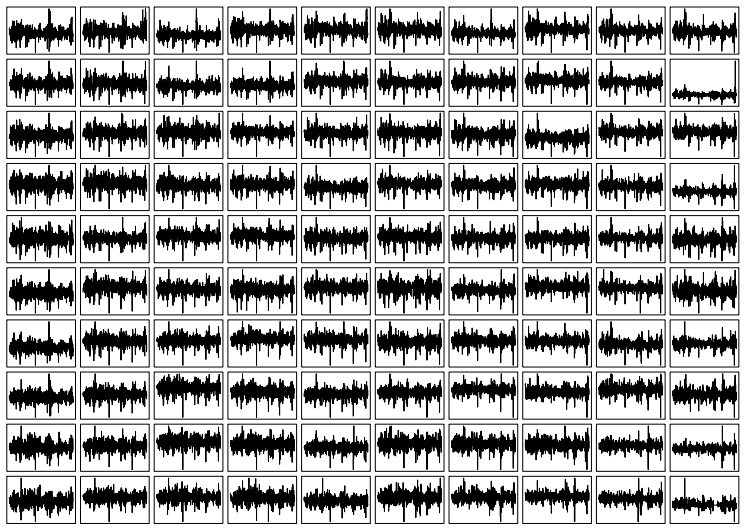

Figures from the paper (2 more)


Forward citations
Cited by 1 Pith paper
-
High-Dimensional Change Point Analysis for Temporally Dependent Data
Adaptive change-point tests combining quadratic and max CUSUM statistics are extended to non-Gaussian temporally dependent high-dimensional data, with validated limiting distributions and multi-change recovery by wild...
Reference graph
Works this paper leans on
-
[1]
Andrews, D. W. K. (1991). Heteroskedasticity and Autocorrelation Consistent Covariance Matrix Estimation. Econometrica, 59(3), 817--858
work page 1991
-
[2]
Aschersleben, P. and Wagner, M. (2016). cointReg : Parameter Estimation and Inference in a Cointegrating Regression . R package version 0.2.0, ://CRAN.R-project.org/package=cointReg
work page 2016
-
[3]
Bai, J. (2003). Inferential Theory for Factor Models of Large Dimensions. Econometrica, 71(1), 135--171
work page 2003
-
[4]
Barigozzi, M., He, Y., Li, L., and Trapani, L. (2023 a ). Robust Tensor Factor Analysis. arXiv 2303.18163, arXiv.org E-Print Archive
work page Pith review arXiv 2023
- [5]
- [6]
-
[7]
Bates, D. and Eddelbuettel, D. (2013). Fast and Elegant Numerical Linear Algebra Using the RcppEigen Package. Journal of Statistical Software, 52(5), 1–24
work page 2013
-
[8]
Box, G. E. P. and Pierce, D. A. (1970). Distribution of Residual Autocorrelations in Autoregressive-Integrated Moving Average Time Series Models. Journal of the American Statistical Association, 65(332), 1509--1526
work page 1970
Show all 59 references
-
[9]
T., Liu, W., and Luo, X
Cai, T. T., Liu, W., and Luo, X. (2022). clime : Constrained L1-minimization for Inverse (Covariance) Matrix Estimation . R package version 0.5.0, ://CRAN.R-project.org/package=clime
2022
-
[10]
Cen, Z. (2024). MEFM : Perform MEFM Estimation on Matrix Time Series . R package version 0.1.1, ://CRAN.R-project.org/package=MEFM
2024
-
[11]
(2022 a )
Chang, J., Cheng, G., and Yao, Q. (2022 a ). Testing for Unit Roots Based on Sample Autocovariances . Biometrika, 109(2), 543--550
2022
-
[12]
(2024 a )
Chang, J., Du, Y., Huang, G., and Yao, Q. (2024 a ). Identification and Estimation for Matrix Time Series CP-Factor Models. arXiv 2410.05634, arXiv.org E-Print Archive
2024 arXiv
-
[13]
Chang, J., Guo, B., and Yao, Q. (2015). High Dimensional Stochastic Regression with Latent factors, Endogeneity and Nonlinearity. Journal of Econometrics, 189(2), 297--312
2015
-
[14]
Chang, J., Guo, B., and Yao, Q. (2018). Principal Component Analysis for Second-Order Stationary Vector Time Series. The Annals of Statistics, 46(5), 2094--2124
2018
-
[15]
(2024 b )
Chang, J., He, J., Lin, C., and Yao, Q. (2024 b ). HDTSA : High Dimensional Time Series Analysis Tools . R package version 1.0.5, ://CRAN.R-project.org/package=HDTSA
2024
-
[16]
(2023 a )
Chang, J., He, J., Yang, L., and Yao, Q. (2023 a ). Modelling Matrix Time Series via a Tensor CP-Decomposition . Journal of the Royal Statistical Society B, 85(1), 127--148
2023
-
[17]
S., and Shao, X
Chang, J., Jiang, Q., McElroy, T. S., and Shao, X. (2022 b ). Statistical Inference for High-Dimensional Spectral Density Matrixs. arXiv 2212.13686, arXiv.org E-Print Archive
2022 arXiv
-
[18]
(2023 b )
Chang, J., Jiang, Q., and Shao, X. (2023 b ). Testing the Martingale Difference Hypothesis in High Dimension. Journal of Econometrics, 235(2), 972--1000
2023
-
[19]
Chang, J., Yao, Q., and Zhou, W. (2017). Testing for High-Dimensional White Noise Using Maximum Cross-Correlations . Biometrika, 104(1), 111--127
2017
-
[20]
Chen, E. Y. and Chen, R. (2022). Modeling Dynamic Transport Network with Matrix Factor Models: An Application to International Trade Flow. Journal of Data Science, 21(3), 490--507
2022
-
[21]
Chen, R., Yang, D., and Zhang, C.-H. (2022). Factor Models for High-Dimensional Tensor Time Series. Journal of the American Statistical Association, 117(537), 94--116
2022
-
[22]
Chen, W. (2023). TensorPreAve : Rank and Factor Loadings Estimation in Time Series Tensor Factor Models . R package version 1.1.0, ://CRAN.R-project.org/package=TensorPreAve
2023
-
[23]
and Lam, C
Chen, W. and Lam, C. (2024). Rank and Factor Loadings Estimation in Time Series Tensor Factor Model by Pre-Averaging . The Annals of Statistics, 52(1), 364--391
2024
-
[24]
Chen, W. W. and Deo, R. S. (2006). The Variance Ratio Statistic at Large Horizons. Econometric Theory, 22(2), 206–234
2006
-
[25]
De Mol , C., Giannone, D., and Reichlin, L. (2008). Forecasting Using a Large Number of Predictors: Is Bayesian Shrinkage a Valid Alternative to Principal Components? Journal of Econometrics, 146(2), 318--328
2008
-
[26]
Eddelbuettel, D., Francois, R., Allaire, J., Ushey, K., Kou, Q., Russell, N., Ucar, I., Bates, D., and Chambers, J. (2024). Rcpp : Seamless R and C++ Integration . R package version 1.0.13-1, ://CRAN.R-project.org/package=Rcpp
2024
-
[27]
Engle, R. F. and Granger, C. W. J. (1987). Co-Integration and Error Correction: Representation, Estimation, and Testing. Econometrica, 55(2), 251--276
1987
-
[28]
L., and Stigler, M
Fabio Di Narzo , A., Aznarte, J. L., and Stigler, M. (2024). tsDyn : Nonlinear Time Series Models with Regime Switching . R package version 11.0.5.2, ://CRAN.R-project.org/package=tsDyn
2024
-
[29]
Fan, J., Lv, J., and Qi, L. (2011). Sparse High-Dimensional Models in Economics. Annual Review of Economics, 3, 291--317
2011
-
[30]
(2024 a )
Han, Y., Chen, R., Yang, D., and Zhang, C.-H. (2024 a ). Tensor Factor Model Estimation by Iterative Projection. arXiv 2006.02611, arXiv.org E-Print Archive
2024 arXiv
-
[31]
(2024 b )
Han, Y., Yang, D., Zhang, C.-H., and Chen, R. (2024 b ). CP Factor Model for Dynamic Tensors . Journal of the Royal Statistical Society B, 86(5), 1383--1413
2024
-
[32]
He, Y., Li, L., Liu, D., and Zhou, W. (2024). HDRFA : High-Dimensional Robust Factor Analysis . R package version 0.1.5, ://CRAN.R-project.org/package=HDRFA
2024
-
[33]
Y., Linton, O., and Zhang, H
Hong, S. Y., Linton, O., and Zhang, H. J. (2017). An Investigation into Multivariate Variance Ratio Statistics and their Application to Stock Market Predictability. Journal of Financial Econometrics, 15(2), 173--222
2017
-
[34]
Hong, Y. (1999). Hypothesis Testing in Time Series via the Empirical Characteristic Function: A Generalized Spectral Density Approach. Journal of the American Statistical Association, 94(448), 1201--1220
1999
-
[35]
Hosking, J. R. M. (1980). The Multivariate Portmanteau Statistic. Journal of the American Statistical Association, 75(371), 602--608
1980
-
[36]
Husson, F., Josse, J., L\^e, S., and Mazet, J. (2024). FactoMineR : Multivariate Exploratory Data Analysis and Data Mining . R package version 2.11, ://CRAN.R-project.org/package=FactoMineR
2024
-
[37]
Johansen, S. (1991). Estimation and Hypothesis Testing of Cointegration Vectors in Gaussian Vector Autoregressive Models. Econometrica, 59(6), 1551--1580
1991
-
[38]
and Cen, Z
Lam, C. and Cen, Z. (2024). Matrix-Valued Factor Model with Time-Varying Main Effects. arXiv 2406.00128, arXiv.org E-Print Archive
2024 arXiv
-
[39]
and Yao, Q
Lam, C. and Yao, Q. (2012). Factor Modeling for High-Dimensional Time Series: Inference for the Number of Factors . The Annals of Statistics, 40(2), 694--726
2012
-
[40]
Lam, C., Yao, Q., and Bathia, N. (2011). Estimation of Latent Factors for High-Dimensional Time Series . Biometrika, 98(4), 901--918
2011
-
[41]
Li, W. K. and McLeod, A. I. (1981). Distribution of the Residual Autocorrelations in Multivariate ARMA Time Series Models. Journal of the Royal Statistical Society B, 43(2), 231--239
1981
-
[42]
Li, Z., Lam, C., Yao, J., and Yao, Q. (2019). On Testing for High-Dimensional White Noise. The Annals of Statistics, 47(6), 3382--3412
2019
-
[43]
Li, Z., Yu, R., Chen, R., Han, Y., Xiao, H., and Yang, D. (2024). tensorTS : Factor and Autoregressive Models for Tensor Time Series . R package version 1.0.2, ://CRAN.R-project.org/package=tensorTS
2024
-
[44]
Ljung, G. M. and Box, G. E. P. (1978). On a Measure of Lack of Fit in Time Series Models. Biometrika, 65(2), 297--303
1978
-
[45]
Lobato, I. N. (2001). Testing that a Dependent Process is Uncorrelated. Journal of the American Statistical Association, 96(455), 1066--1076
2001
-
[46]
Mahdi, E. (2023). portes : Portmanteau Tests for Time Series Models . R package version 6.0, ://CRAN.R-project.org/package=portes
2023
-
[47]
Pfaff, B., Zivot, E., and Stigler, M. (2024). urca : Unit Root and Cointegration Tests for Time Series Data . R package version 1.3-4, ://CRAN.R-project.org/package=urca
2024
-
[48]
Qiu, D. (2024). aTSA : Alternative Time Series Analysis . R package version 3.1.2.1, ://CRAN.R-project.org/package=aTSA
2024
-
[49]
Shao, X. (2011). Testing for White Noise under Unknown Dependence and its Applications to Diagonostic Checking for Time Series Models. Econometric Theory, 27(2), 312–343
2011
-
[50]
Smith, S. M. (2012). The Future of FMRI Connectivity. Neuroimage, 62(2), 1257--1266
2012
-
[51]
Stock, J. H. and Watson, M. W. (2002). Forecasting Using Principal Components From a Large Number of Predictors. Journal of the American Statistical Association, 97(460), 1167--1179
2002
-
[52]
Tsay, R. S. (2014). Multivariate Time Series Analysis: With R and Financial Applications. 1st edition. John Wiley & Sons, New Jersey
2014
-
[53]
S., Wood, D., and Lachmann, J
Tsay, R. S., Wood, D., and Lachmann, J. (2022). MTS : All-Purpose Toolkit for Analyzing Multivariate Time Series (MTS) and Estimating Multivariate Volatility Models . R package version 1.2.1, ://CRAN.R-project.org/package=MTS
2022
-
[54]
Voss, J. (2021). jvcoords : Principal Component Analysis (PCA) and Whitening . R package version 1.0.3, ://CRAN.R-project.org/package=jvcoords
2021
-
[55]
Wang, D., Liu, X., and Chen, R. (2019). Factor Models for Matrix-Valued High-Dimensional Time Series. Journal of Econometrics, 208(1), 231--248
2019
-
[56]
Wang, Z., Han, F., and Liu, H. (2013). Sparse Principal Component Analysis for High Dimensional Multivariate Time Series. In CM Carvalho, P Ravikumar (eds.), Proceedings of the Sixteenth International Conference on Artificial Intelligence and Statistics, volume 31, pp. 48--56....
2013
-
[57]
Zhang, R., Robinson, P., and Yao, Q. (2019). Identifying Cointegration by Eigenanalysis. Journal of the American Statistical Association, 114(526), 916--927
2019
-
[58]
, " * write output.state after.block = add.period write newline
ENTRY address archive author booktitle chapter collaboration doi edition editor eid eprint howpublished institution isbn issn journal key month note number numpages organization pages publisher school series title type url volume year label extra.label sort.label short.list IN...
-
[59]
write newline
" write newline "" before.all 'output.state := FUNCTION n.dashify 't := "" t empty not t #1 #1 substring "-" = t #1 #2 substring "--" = not "--" * t #2 global.max substring 't := t #1 #1 substring "-" = "-" * t #2 global.max substring 't := while if t #1 #1 substring * t #2 gl...
Reviewed August 11, 2026 · model on record in the stance chip above.
Discussion (0). Continue with ORCID to comment.