REVIEW 5 major objections 5 minor 25 references
Bi-Directional Multi-Scale Graph Dataset Condensation via Information Bottleneck
T0 review · 5 major / 5 minor · reviewed 2026-08-11 · deepseek-v4-flash
Pith's one-line read A middle-scale start beats shrink-then-grow graph condensation.
desk verdict Genuinely new meso-scale-first paradigm for multi-scale graph condensation with strong empirical results, but the IB objective is so under-specified that the paper's central claim cannot be checked from the text alone. read the letter →
The pith
A machine-rendered reading of the paper's core claim, the machinery that carries it, and where it could break.
The reading
What carries the argument
The load-bearing object is the meso-scale subgraph $G'_m$, found by a subgraph information bottleneck objective that balances informativeness against compression. The second piece is the Subgraph Condensation Information Bottleneck (SCIB) loss, a variational bound that replaces the two mutual-information terms in the bottleneck with an expectation over an importance-scoring distribution $Q$ and a Bernoulli mask distribution $R$, and is used as the training signal for both the downward (meso-to-small) and upward (meso-to-large) stages. The third piece is eigenbasis matching: the Laplacian eigenbasis of the original graph is matched by the condensed graph's eigenbasis, with a low-frequency basis (first $M$ eigenvectors) for the meso and smaller scales and a wider basis (first $N'$ eigenvectors) for the large scale, so that structural information is carried through the scale changes.
What would settle it
Remove the information-bottleneck term from the loss while keeping the meso-scale and bidirectional training; if accuracy at small scales does not drop, the bottleneck term is not responsible for the reported gains. Alternatively, pick a random middle scale instead of the mutual-information-selected one and rerun the full pipeline; if all middle scales perform the same, the meso-scale selection procedure is not doing the claimed work.
Extended reading notes
Core claim
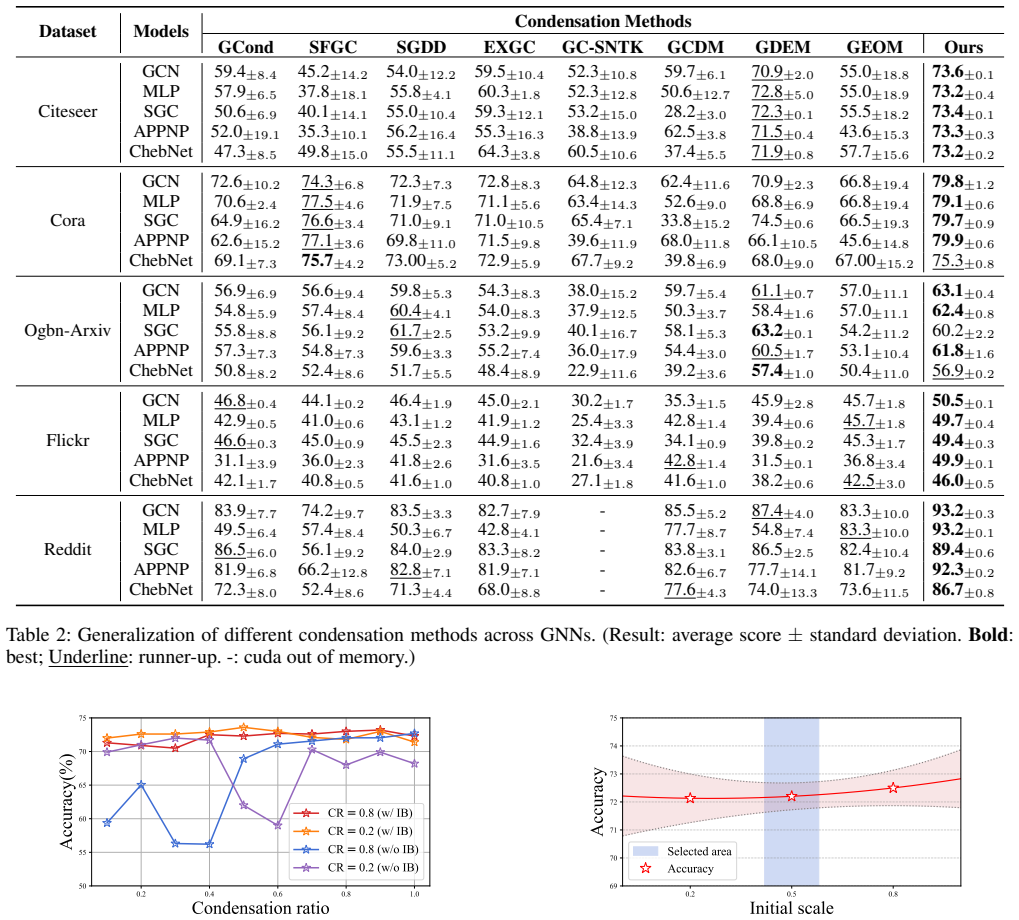
The central claim is that an optimal middle scale exists for any multi-scale graph condensation task, and that anchoring the whole condensation process there avoids the two failure modes of unidirectional scaling. Concretely, the paper proposes to choose the meso-scale graph $G'_m$ by maximizing $I(G'_{\mathrm{sub}}; Y') - \beta I(G'; G'_{\mathrm{sub}})$ (the subgraph information bottleneck), then train it with eigenbasis matching to capture the low-frequency structure of the original graph. From that hub, smaller scales are obtained by pruning nodes from $G'_m$ and larger scales by expanding it, with every step trained under the Subgraph Condensation Information Bottleneck objective $\mathcal{L}_{\mathrm{SCIB}} = \mathbb{E}[\log Q(H(G,Y)|G'_{\mathrm{sub}})] - \beta \mathbb{E}[f(G'_{\mathrm{sub}},G')]$. The paper reports that on Cora, Citeseer, Ogbn-Arxiv, Flickr, and Reddit, BiMSGC improves node-classification accuracy at nearly every tested scale, keeps accuracy nearly lossless even at very small subgraph ratios, generalizes across five GNN architectures, and on Citeseer achieves a $20.85\times$ speedup over re-condensation baselines.
Load-bearing premise
The load-bearing premise is that the implemented training loop actually optimizes the Subgraph Condensation Information Bottleneck objective; the paper describes the importance scores and Bernoulli mask only in words, without giving their concrete functional forms, the loss weight, or the training procedure that connects equation (7) to Algorithm 1.
Editorial extensions
If this is right
- Multi-scale condensation can be run in one pass from a single meso-scale graph instead of re-condensing at every target scale, reducing the time complexity by roughly a factor of the number of scales.
- Very small condensed graphs, useful for low-memory edge devices, should no longer show the sharp accuracy drop that appears when they are sampled from a large condensed graph.
- The condensed graphs should transfer across GNN architectures with low variance, because the eigenbasis matching preserves low-frequency structural information rather than overfitting one model class.
- The information-bottleneck term can act as a denoiser: on some datasets the condensed graphs match or exceed whole-dataset accuracy, suggesting that removing redundant information helps generalization.
Reading between the lines
- The paper leaves the meso-scale estimator unspecified in practice (it suggests a neural mutual-information estimator or a graph information bottleneck but does not detail the training), so a natural test is whether a cheap surrogate—for instance, spectral energy of the Laplacian—locates the same meso-scale.
- The claimed plug-and-play compatibility with any graph condensation method is not demonstrated; only eigenbasis matching is tested, so whether SCIB behaves as advertised with gradient-matching or trajectory-matching backbones is an open empirical question.
- If the information-bottleneck regularizer is what drives the near-lossless small-scale results, then the same objective could be applied to single-scale condensation as a regularizer, not just to multi-scale pipelines.
Signed reviews
Editorial analysis
A structured set of objections, weighed in public.
Referee Report
Summary. The paper proposes BiMSGC, a multi-scale graph dataset condensation framework that selects an intermediate 'meso-scale' condensed graph via an information-bottleneck criterion and then trains condensed graphs at both smaller and larger scales bidirectionally, combining eigenbasis matching with a subgraph condensation information bottleneck (SCIB) objective. The authors report large improvements over existing graph condensation baselines on Cora, Citeseer, Ogbn-Arxiv, Flickr, and Reddit, together with cross-architecture generalization experiments and an ablation study. The central claim is that the IB-guided meso-scale starting point and the SCIB objective preserve useful information across scales and thereby avoid the scaling-down degradation and scaling-up collapse observed in large-to-small and small-to-large paradigms.
Significance. The proposed direction—using information-bottleneck reasoning to choose a meso-scale and then condensing bidirectionally—is conceptually appealing and, if implemented as described, would be a useful contribution to multi-scale graph condensation. The empirical results are consistently strong across five datasets, and the paper improves reproducibility by providing a code repository and following the GC-Bench protocol. However, the manuscript currently does not specify the concrete optimization of the SCIB objective: the variational distributions Q and R, the total training loss, and the combination of Eq. (7) with Eq. (10) are left abstract, and the appendix derivation contains algebraic errors. Because the claimed theoretical motivation rests on this unspecified mechanism, the significance of the work cannot be fully assessed from the current text.
major comments (5)
- [Section 4.1, Step 1, Eq. (3)] Equation (3) defines the meso-scale as argmax over G'_sub in Sub(G'), but at Step 1 no condensed graph G' exists yet; G' is the object being learned in the subsequent bi-directional phase. If G' is intended to be the original graph G, the notation is inconsistent with the rest of the derivation. The text states that the step 'is only a preliminary estimation' and can be approximated with MINE or GIB, but no concrete procedure is given for how the candidate meso-scale sizes are compared or how MINE/GIB are used in practice. This circularity and lack of detail make the meso-scale selection step unverifiable as specified.
- [Section 4.1, Step 3 and Algorithm 1] The SCIB objective in Eq. (7) is never instantiated. Step 3 describes Q only as 'assigning importance score to each node's impact on the training loss' and R as 'a Bernoulli distribution with parameter theta', without functional forms, parameterization, or how the expectation in Eq. (7) is estimated. Algorithm 1 says to train Gs and Gl 'using Eq. (10) and Eq. (7)' but does not specify the total loss (e.g., whether the two terms are summed, weighted, or optimized alternately), the optimization procedure, or how the gradient with respect to theta is computed. In addition, Eq. (10) contains an Ld term that is never defined; the surrounding text defines only Le and Lo. Without a precise, code-consistent specification of the actual loss, the claimed central mechanism cannot be evaluated, and the empirical gains could be attributed to the GDEM backbone or the meso-scale training schedule rather than to the information-bottleneck objective.
- [Appendix A, Eqs. (13)-(14)] The derivation of the lower bound for I(Gsub; nabla_theta) is not correct as written. Equation (13) writes the mutual information as E[log P(Gsub | nabla'_theta) / P(nabla'_theta)], which reverses the conditional direction of the true joint likelihood; the correct factorization uses P(nabla_theta | Gsub). Equation (14) then drops the -E[log P(nabla_theta)] term while claiming a lower bound, and the introduction of Q(nabla_theta | Gsub) in both numerator and denominator changes the quantity being bounded. As written, the claimed inequality I(Gsub; nabla_theta) >= E[log Q(nabla_theta | Gsub)] does not follow from the preceding line. Since this derivation is the theoretical basis for the SCIB objective, the bound must be corrected and stated precisely.
- [Section 4.3, Complexity Analysis] The complexity analysis is not rigorous enough to support the claimed order-of-magnitude improvement. The text first gives O(2(KN'd + Kd^2 + KN'^2)), then immediately says the actual time complexity is O(KN'd + Kd^2 + KN'^2) because 'the first stage training already contains some of the optimization objectives for the second stage', but this reduction is not quantified. The comparison with re-condensation O(N'(KN'd + Kd^2 + KN'^2)) assumes that the meso-scale selection step (which involves MINE or GIB estimation) and the bi-directional phase have negligible or overlapping cost, which is not shown. The analysis also says 'the original image' where it should say 'the original graph'. Please provide a step-by-step cost accounting for meso-scale selection, meso-scale training, and the two bi-directional training branches.
- [Section 5.4, Ablation Study] The ablation for the information bottleneck is not defined. The caption of Figure 4 says results are shown 'with and without IB', but the text never states what 'without IB' means operationally: is Eq. (7) omitted entirely, is the compression term beta*E[f(...)] removed, or is a different objective substituted? The meso-scale sensitivity analysis also only considers pre-set candidates 0.2, 0.5, 0.8 and reports average accuracy; this does not directly test the claim that the IB-based adaptive selection identifies an optimal meso-scale. Please specify the exact configuration of the ablation and, if possible, compare against random or fixed meso-scale choices to isolate the effect of the selection criterion.
minor comments (5)
- [Abstract] The phrase 'when consenting to the primary sub-scale' appears to be a typo for 'when condensing to the primary sub-scale'.
- [Section 3.3] The sentence 'Following the approach of GMI (Peng et al. 2020)., we estimate...' has an extra period before the comma.
- [Section 4.2, Eq. (10)] The regularization loss in Eq. (9) is denoted Lo, but Eq. (10) uses Ld; please clarify whether Ld is a typo for Lo or an additional term.
- [Section 4.3] In the first sentence, 'the K largest eigenvalues of the original image' should read 'of the original graph'.
- [Conclusion] The phrase 'under the guidance of Informational Bottleneck principles' should be 'Information Bottleneck principles' for consistency.
Circularity Check
Eq. (3) defines the meso-scale in terms of the not-yet-existing condensed graph G', making the 'IB-guided optimal meso-scale' formally self-referential; the actual algorithm then substitutes a grid search.
-
self definitional
[Section 4.1, Step 1, Eq. (3); Algorithm 1 initialization]
"G′m = argmax G′sub∈Sub(G′) I (G′sub; Y ′) − βI (G′; G′sub) , (3) ... In practice, the meso-scale is selected by pre-setting several subgraph scales for calculation and then comparing them. Having the meso-scale determined, we obtain the condensed graph G′m by training on this scale."
Equation (3) selects G'_m from Sub(G'), the set of subgraphs of the final condensed graph G'. At initialization time G' and Y' have not been constructed; they are the outputs of the very training that the meso-scale is meant to bootstrap. Thus the 'estimate' of the optimal meso-scale is defined in terms of the target graph, and the paper's practical implementation ('pre-setting several subgraph scales ... comparing them') replaces Eq. (3) with a grid search over {0.2, 0.5, 0.8}, so the claimed IB-guided selection is not an independent first-principles calculation.
full rationale
One formal circular step is present: the meso-scale selection in Eq. (3) is defined as an argmax over subgraphs of the final condensed graph G', which does not exist until after the meso-scale is selected and trained. Algorithm 1 says 'Init a meso-scale GM using Eq (3)', so the initialization explicitly references the output of the optimization. The paper itself retreats from this definition by calling the step 'only a preliminary estimation' and saying that in practice the meso-scale is chosen by comparing several pre-set scales; hence the implemented criterion is a grid comparison rather than the stated IB argmax. This makes the 'optimal meso-scale' claim self-definitional as written, though Figure 5 indicates the choice changes average performance by less than 0.5%, so this circularity does not by itself force the headline accuracy comparisons. The other natural suspicion—that the same IB objective (Eq. 7) is used both to select the meso-scale and to guide later training—is not circular in itself; it is a coherent optimization principle. The genuine weakness there is under-specification: Algorithm 1 says 'Train Gs using Eq (10) and Eq (7)' without defining the combined loss, and Step 3 gives only qualitative descriptions of Q ('importance score') and R ('Bernoulli distribution with parameter θ') with no functional forms or training procedure. Whether LSCIB is actually optimized cannot be checked from the paper; that is a completeness and reproducibility gap, not a circular reduction. The Appendix derivation (Eqs. 13–16) contains typographical and derivation slips (Eq. (13) reverses the conditional direction; Eq. (14) drops the -E[log P(∇θ)] term), but the variational bounds used in the main text are standard for information bottleneck objectives and do not constitute circular reasoning. Because the main performance claims are benchmarked against external baselines and the identified self-reference is confined to the formal statement of the meso-scale initialization, a moderate score of 4 is appropriate rather than a higher score that would indicate that the central results reduce to the inputs by construction.
Assumptions & free parameters
free parameters (5)
- beta (IB trade-off) =
not reported
- alpha, beta, gamma (eigenbasis matching weights) =
not reported
- K (number of eigenvectors) =
not reported
- meso-scale candidates =
{0.2, 0.5, 0.8}
- global masks theta =
optimized
assumptions (4)
- standard math The Laplacian eigenbasis of the original graph can be computed and used to match condensed graphs.
- domain assumption Mutual information is a valid objective for graph condensation, and the variational bounds in Eqs (5)-(6) are tight enough to guide optimization.
- ad hoc to paper The optimal meso-scale exists and can be identified by comparing a small set of candidate scales.
- domain assumption Random subgraph sampling from the largest condensed graph is a valid proxy for condensing to smaller scales.
Cite this review
Pith. "Pith review of Bi-Directional Multi-Scale Graph Dataset Condensation via Information Bottleneck." pith.science (2026). https://pith.science/paper/GW7JASD6
@misc{pith2026241217355,
  author       = {Pith},
  title        = {Pith review of: Bi-Directional Multi-Scale Graph Dataset Condensation via Information Bottleneck},
  year         = {2026},
  howpublished = {\url{https://pith.science/paper/GW7JASD6}},
  note         = {Machine review of arXiv:2412.17355}
}
read the original abstract
Dataset condensation has significantly improved model training efficiency, but its application on devices with different computing power brings new requirements for different data sizes. Thus, condensing multiple scale graphs simultaneously is the core of achieving efficient training in different on-device scenarios. Existing efficient works for multi-scale graph dataset condensation mainly perform efficient approximate computation in scale order (large-to-small or small-to-large scales). However, for non-Euclidean structures of sparse graph data, these two commonly used paradigms for multi-scale graph dataset condensation have serious scaling down degradation and scaling up collapse problems of a graph. The main bottleneck of the above paradigms is whether the effective information of the original graph is fully preserved when consenting to the primary sub-scale (the first of multiple scales), which determines the condensation effect and consistency of all scales. In this paper, we proposed a novel GNN-centric Bi-directional Multi-Scale Graph Dataset Condensation (BiMSGC) framework, to explore unifying paradigms by operating on both large-to-small and small-to-large for multi-scale graph condensation. Based on the mutual information theory, we estimate an optimal ``meso-scale'' to obtain the minimum necessary dense graph preserving the maximum utility information of the original graph, and then we achieve stable and consistent ``bi-directional'' condensation learning by optimizing graph eigenbasis matching with information bottleneck on other scales. Encouraging empirical results on several datasets demonstrates the significant superiority of the proposed framework in graph condensation at different scales.
Figures


Figures from the paper (1 more)
Reference graph
Works this paper leans on
-
[1]
Abdelaleem, E.; Nemenman, I.; and Martini, K. M. 2023. Deep Variational Multivariate Information Bottleneck - A Framework for Variational Losses. Arxiv, abs/2310.03311
arXiv 2023
-
[2]
I.; Baratin, A.; Rajeshwar, S.; Ozair, S.; Bengio, Y.; Courville, A.; and Hjelm, D
Belghazi, M. I.; Baratin, A.; Rajeshwar, S.; Ozair, S.; Bengio, Y.; Courville, A.; and Hjelm, D. 2018. Mutual Information Neural Estimation. In Dy, J.; and Krause, A., eds., ICML 2021, volume 80 of Proceedings of Machine Learning Research, 531--540. PMLR
work page 2018
-
[3]
Fang, J.; Li, X.; Sui, Y.; Gao, Y.; Zhang, G.; Wang, K.; Wang, X.; and He, X. 2024. EXGC: Bridging Efficiency and Explainability in Graph Condensation. In Chua, T.; Ngo, C.; Kumar, R.; Lauw, H. W.; and Lee, R. K., eds., Proceedings of the ACM on Web Conference 2024, WWW 2024, Singapore, May 13-17, 2024 , 721--732. ACM
work page 2024
-
[4]
He, M.; Wei, Z.; and Wen, J. 2022. Convolutional Neural Networks on Graphs with Chebyshev Approximation, Revisited. In Koyejo, S.; Mohamed, S.; Agarwal, A.; Belgrave, D.; Cho, K.; and Oh, A., eds., NeurIPS 2022
work page 2022
-
[5]
He, Y.; Xiao, L.; Zhou, J. T.; and Tsang, I. W. 2024. Multisize Dataset Condensation. In ICLR 2024. OpenReview.net
work page 2024
-
[6]
Hu, W.; Fey, M.; Ren, H.; Nakata, M.; Dong, Y.; and Leskovec, J. 2021 a . OGB-LSC: A Large-Scale Challenge for Machine Learning on Graphs. In Vanschoren, J.; and Yeung, S., eds., NeurIPS Datasets and Benchmarks 2021
work page 2021
-
[7]
Hu, Y.; You, H.; Wang, Z.; Wang, Z.; Zhou, E.; and Gao, Y. 2021 b . Graph-MLP: Node Classification without Message Passing in Graph. Arxiv, abs/2106.04051
arXiv 2021
-
[8]
Jin, W.; Zhao, L.; Zhang, S.; Liu, Y.; Tang, J.; and Shah, N. 2022. Graph Condensation for Graph Neural Networks. In The Tenth International Conference on Learning Representations, ICLR 2022, Virtual Event, April 25-29, 2022 . OpenReview.net
work page 2022
Show all 25 references
-
[9]
N.; and Welling, M
Kipf, T. N.; and Welling, M. 2017. Semi-Supervised Classification with Graph Convolutional Networks. In ICLR 2017,. OpenReview.net
2017
-
[10]
Klicpera, J.; Bojchevski, A.; and G \" u nnemann, S. 2019. Predict then Propagate: Graph Neural Networks meet Personalized PageRank. In ICLR 2019, New Orleans, LA, USA, May 6-9, 2019. OpenReview.net
2019
-
[11]
Lewandowsky, J.; and Bauch, G. 2024. Theory and Application of the Information Bottleneck Method. Entropy, 26(3): 187
2024
-
[12]
Liu, M.; Li, S.; Chen, X.; and Song, L. 2022. Graph Condensation via Receptive Field Distribution Matching. CoRR, abs/2206.13697
2022 arXiv
-
[13]
Liu, Y.; Bo, D.; and Shi, C. 2024. Graph Distillation with Eigenbasis Matching. In Forty-first International Conference on Machine Learning, ICML 2024, Vienna, Austria, July 21-27, 2024 . OpenReview.net
2024
-
[14]
Peng, Z.; Huang, W.; Luo, M.; Zheng, Q.; Rong, Y.; Xu, T.; and Huang, J. 2020. Graph Representation Learning via Graphical Mutual Information Maximization. In Huang, Y.; King, I.; Liu, T.; and van Steen, M., eds., WWW 2020, 259--270. ACM / IW3C2
2020
-
[15]
M.; Bansal, Y.; Dapello, J.; Advani, M.; Kolchinsky, A.; Tracey, B
Saxe, A. M.; Bansal, Y.; Dapello, J.; Advani, M.; Kolchinsky, A.; Tracey, B. D.; and Cox, D. D. 2018. On the Information Bottleneck Theory of Deep Learning. In ICLR 2018. OpenReview.net
2018
-
[16]
Sun, Q.; Chen, Z.; Yang, B.; Ji, C.; Fu, X.; Zhou, S.; Peng, H.; Li, J.; and Philip, S. Y. 2024. GC-Bench: An Open and Unified Benchmark for Graph Condensation. In The Thirty-eight Conference on Neural Information Processing Systems Datasets and Benchmarks Track
2024
-
[17]
Wang, L.; Fan, W.; Li, J.; Ma, Y.; and Li, Q. 2024. Fast Graph Condensation with Structure-based Neural Tangent Kernel. In Chua, T.; Ngo, C.; Kumar, R.; Lauw, H. W.; and Lee, R. K., eds., WWW 2024, 4439--4448. ACM
2024
-
[18]
Wu, F.; Jr., A. H. S.; Zhang, T.; Fifty, C.; Yu, T.; and Weinberger, K. Q. 2019. Simplifying Graph Convolutional Networks. In Chaudhuri, K.; and Salakhutdinov, R., eds., ICML 2019, volume 97 of Proceedings of Machine Learning Research, 6861--6871. PMLR
2019
-
[19]
Wu, T.; Ren, H.; Li, P.; and Leskovec, J. 2020. Graph Information Bottleneck. In Larochelle, H.; Ranzato, M.; Hadsell, R.; Balcan, M.; and Lin, H., eds., NeurIPS 2020
2020
-
[20]
Yang, B.; Wang, K.; Sun, Q.; Ji, C.; Fu, X.; Tang, H.; You, Y.; and Li, J. 2023. Does Graph Distillation See Like Vision Dataset Counterpart? In Oh, A.; Naumann, T.; Globerson, A.; Saenko, K.; Hardt, M.; and Levine, S., eds., Advances in Neural Information Processing Systems 3...
2023
-
[21]
Zeng, H.; Zhou, H.; Srivastava, A.; Kannan, R.; and Prasanna, V. K. 2020. GraphSAINT: Graph Sampling Based Inductive Learning Method. In ICLR 2020. OpenReview.net
2020
-
[22]
Zhang, Y.; Zhang, T.; Wang, K.; Guo, Z.; Liang, Y.; Bresson, X.; Jin, W.; and You, Y. 2024. Navigating Complexity: Toward Lossless Graph Condensation via Expanding Window Matching. In Forty-first International Conference on Machine Learning, ICML 2024, Vienna, Austria, July 21...
2024
-
[23]
Zheng, X.; Zhang, M.; Chen, C.; Nguyen, Q. V. H.; Zhu, X.; and Pan, S. 2023. Structure-free Graph Condensation: From Large-scale Graphs to Condensed Graph-free Data. In Oh, A.; Naumann, T.; Globerson, A.; Saenko, K.; Hardt, M.; and Levine, S., eds., Advances in Neural Informat...
2023
-
[24]
, " * write output.state after.block = add.period write newline
ENTRY address archivePrefix author booktitle chapter edition editor eid eprint howpublished institution isbn journal key month note number organization pages publisher school series title type volume year label extra.label sort.label short.list INTEGERS output.state before.all...
-
[25]
write newline
" write newline "" before.all 'output.state := FUNCTION n.dashify 't := "" t empty not t #1 #1 substring "-" = t #1 #2 substring "--" = not "--" * t #2 global.max substring 't := t #1 #1 substring "-" = "-" * t #2 global.max substring 't := while if t #1 #1 substring * t #2 gl...
Reviewed August 11, 2026 · model on record in the stance chip above.
Discussion (0). Continue with ORCID to comment.