REVIEW 4 major objections 5 minor 84 references
From modelling to understanding: the signals in nerves
T0 review · 4 major / 5 minor · reviewed 2026-08-11 · deepseek-v4-flash
Pith's one-line read Nerve signals are a coupled wave ensemble, not just electricity.
desk verdict A candid review of the authors' own coupled-model program: useful synthesis, but the qualitative-match evidence is too thin to validate the assumed coupling structure. read the letter →
The pith
A machine-rendered reading of the paper's core claim, the machinery that carries it, and where it could break.
The reading
What carries the argument
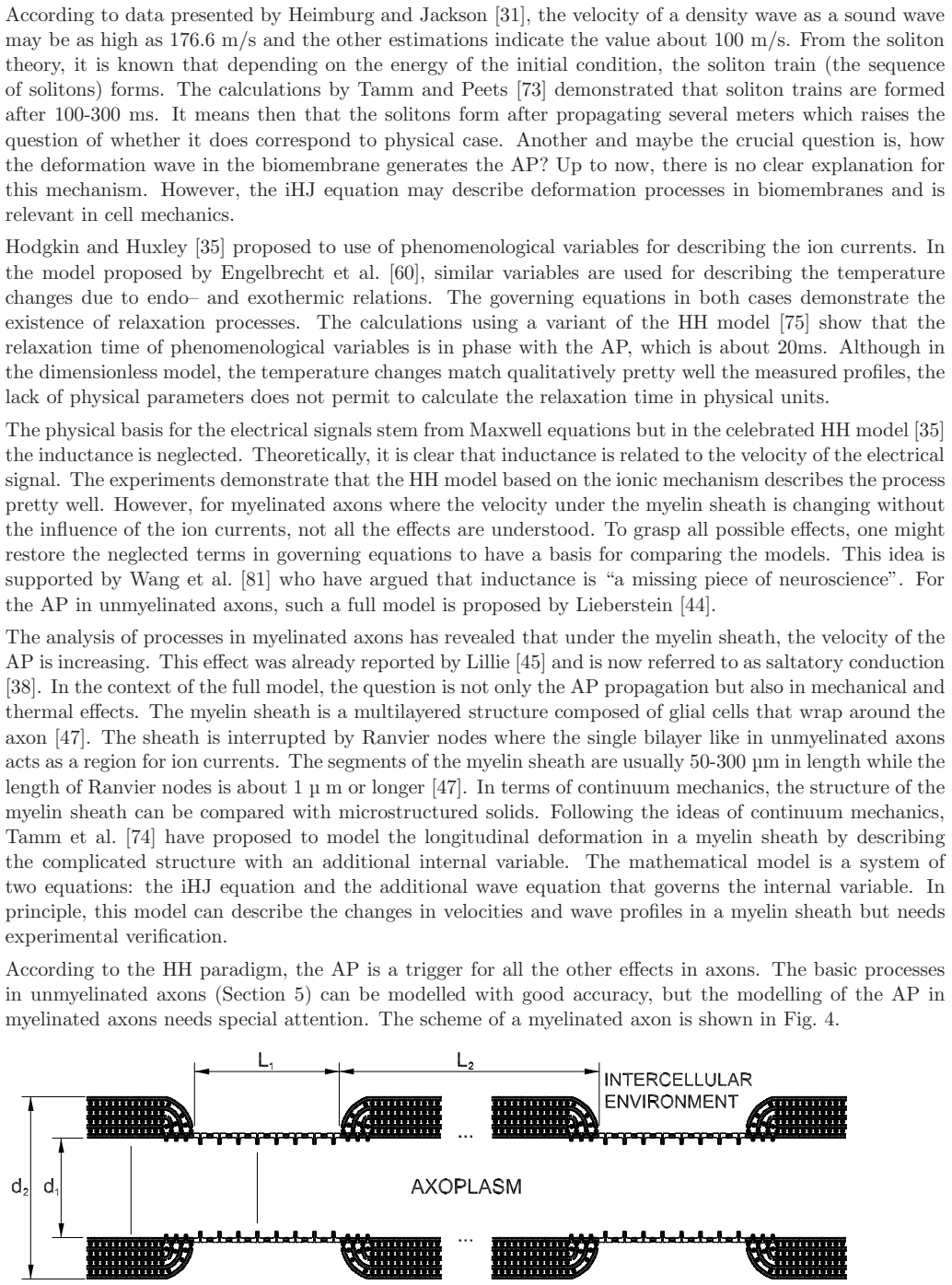
The carrying object is the coupled 'wave ensemble' model: an action-potential block (either the simplified two-variable model or the full ion-current model), a damped wave equation for axoplasmic pressure, an improved density-wave equation for the longitudinal membrane wave, the transverse displacement taken proportional to the longitudinal gradient as in rod theory, and a heat equation with source terms for temperature. Coupling forces F1, F2, F3 enter as linear combinations of derivatives such as ZX, JT, ZT, PT, and UT, with free coefficients; temperature also uses internal variables for exo- and endothermic reactions. For myelinated axons, the machinery is a transmission-line pair derived from electromagnetic equations with inductance retained, and myelination enters through a thickness ratio and a length ratio between myelin segments and nodes of Ranvier.
What would settle it
Record the action potential, membrane displacement, and temperature simultaneously in a single unmyelinated axon and check whether the displacement and temperature waveforms are locked to the derivatives of the electrical signal. If the mechanical peak precedes the electrical peak, or if no choice of the free coupling coefficients reproduces the measured amplitude (about 1 nm transverse displacement) and temperature time course, the central assumption is refuted.
Extended reading notes
Core claim
On the paper's own terms, the central claim is that the propagation of a nerve signal can be described as a wave ensemble whose components obey coupled continuum equations: the action potential, a pressure wave in the axoplasm, a longitudinal density wave and a transverse displacement in the biomembrane, and a temperature field. The electrical variables are the cause; mechanical and thermal responses are driven by coupling forces that are written as linear combinations of space and time derivatives of the field variables, in line with the observation that the rate of change of stimulation, not its absolute value, excites the nerve. The dimensionless proof-of-concept model yields profiles that match experiments qualitatively, and the myelinated-axon extension in physical units, which adds the myelin geometry through length and thickness ratios, raises the predicted action-potential velocity into the 67.7 m/s range. The model is deliberately modular: any block, including the action-potential generator, can be replaced by a more accurate or even experimentally measured description.
Load-bearing premise
The load-bearing premise is that all mechanical and thermal waves are generated by changes in the electrical variables, so the coupling forces can be written as linear combinations of derivatives of the field variables with free coefficients; if the real coupling is not of this form, the qualitative match is a fitting artifact rather than a test of the mechanism.
Editorial extensions
If this is right
- If the ensemble model is correct, mechanical and thermal recordings alongside the electrical one are not side effects but complementary views of the same propagating event, so optical and thermal measurements can be used to constrain the electrical model.
- The modular structure implies that replacing the action-potential block with a measured signal still yields the accompanying waves, at the cost of losing feedback from mechanics and temperature onto the electrical signal.
- Including myelin geometry through length and thickness ratios predicts conduction velocities from about 0.5 m/s for unmyelinated axons up to 67.7 m/s for myelinated ones, consistent with the observed range of 10 to 120 m/s and supporting saltatory conduction as a geometric effect.
- The same building-block strategy can be extended to other excitable tissues once their structural parameters are known.
Reading between the lines
- A reader should treat the qualitative match as a proof of concept, not a quantitative validation: the coupling coefficients in F1, F2, F3 are free parameters, so a direct quantitative comparison of predicted transverse displacement amplitude (about 1 nm) and temperature transient against simultaneous recordings would be the real test.
- The derivative-coupling hypothesis predicts specific phase relationships: the pressure and membrane waves should be locked to the time derivative of the action potential, so simultaneous AP and displacement measurements could distinguish this mechanism from one in which a mechanical wave drives the electrical signal.
- The model suggests a testable extension: if myelination enters through geometry ratios, then varying node length or myelin thickness in computational experiments should change velocity in a predictable way, and the predicted ceiling near 68 m/s could be checked against systematic measurements across axon diameters.
- If the modular framework is portable, it could be applied to cardiac or muscle fibres, where electromechanical and thermal coupling are also observed.
Signed reviews
Editorial analysis
A structured set of objections, weighed in public.
Referee Report
Summary. This review paper consolidates the authors' decade of work on nerve-signal modelling. It argues that a propagating action potential is accompanied by a pressure wave, longitudinal and transverse membrane waves, and temperature changes, and it presents a coupled system of equations in Appendix A (FHN for the AP, wave equation with dissipation for pressure, improved Heimburg-Jackson equation for density, and heat equation for temperature, with coupling forces F1-F3), claiming 'rather good qualitative match' with experimental profiles. It then summarizes a myelinated-axon extension in Appendix B in which inserting inductance and phenomenological myelination parameters gamma and mu into a Lieberstein-type cable model yields conduction velocities up to 67.7 m/s, and it closes with five modelling guidelines.
Significance. If the proposed framework is taken as a modular scaffold, it has value: it places electrical, mechanical, and thermal effects in one explicit set of partial differential equations, it emphasizes physical conservation laws in Section 3, and it is self-consciously modular ('building blocks'). The guidelines in Section 7 are sensible and the review of existing models is useful. However, the significance as a validated model is currently limited: the central comparison to experiments is qualitative, the coupling structure is assumed rather than derived, and most quantitative results are delegated to earlier papers, including an unreviewed preprint. The paper is more a programmatic hypothesis than a validated quantitative model at this stage.
major comments (4)
- [Appendix A (after eq. (d))] The coupling forces F1 = eta1 Z_X + eta2 J_T + eta3 Z_T, F2 = gamma1 P_T + gamma2 J_T - gamma3 Z_T, and F3 = tau1 Z^2 + tau2(P_T + phi2(P)) + tau3(U_T + phi3(U)) - tau4 Omega are asserted as the mathematical implementation of the authors' hypotheses, not derived from the conservation laws discussed in Section 3. Because the coefficients are free and no parameter values are tabulated, the qualitative agreement in Fig. 3 cannot establish that this particular derivative-linear form is the correct coupling structure; a different causal arrangement with similar flexibility could plausibly be tuned to match the same profiles. The manuscript itself lists mechanically sensitive ion channels in Section 5 and cites Rvachev [68] for pressure-driven AP, so the restriction to electrically driven derivative terms is an additional assumption that must either be defended from the physics or explicitly presented as a testable hypothesis.
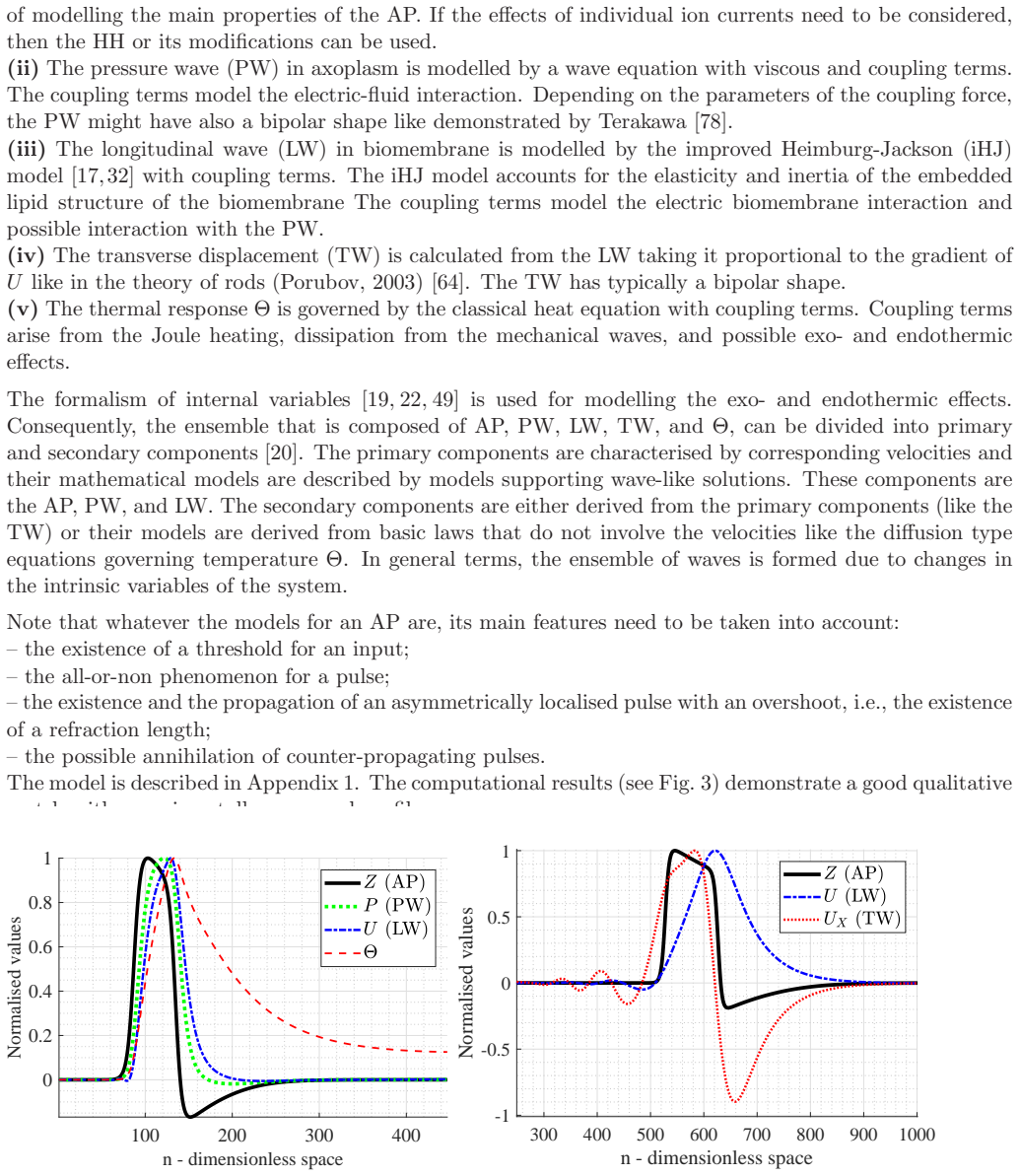
- [Section 5, Fig. 3] The statement that 'the computational results ... demonstrate a good qualitative match with experimentally measured profiles' is not substantiated in this manuscript. No experimental curves are overlaid, no error bars or discrepancy metrics are given, and no list of the dimensionless parameter values used in the simulation is provided. Since the 'proof of concept' claim rests on this match, the paper should report at least one concrete comparison with a published measurement (e.g., Tasaki [76,77] or Terakawa [78]) and specify the parameter set used, including the coupling coefficients.
- [Appendix B / Section 6] The claim that including myelination geometry in physical units yields AP velocities up to 67.7 m/s is presented on the basis of the companion paper [75], which is an arXiv preprint, and the description here leaves several load-bearing choices underspecified. In particular, the physical origin and fitted value of gamma in Eq. (3) are not given, the range of mu-ratio is stated but not connected to the resulting velocities, and the statement in Section 6 that 'a closer match to measurements' is achieved is not quantified. The authors should either report the full parameter set and matching statistics in this paper or restrict the claim to a summary of a peer-reviewed, published result.
- [Section 6, temperature relaxation paragraph] The manuscript itself concedes that 'the lack of physical parameters does not permit to calculate the relaxation time in physical units.' This admission limits the thermal component of the model, which is one of the five components claimed to match experiments. The authors should state whether the dimensionless temperature profile in Fig. 3 is predictive or merely illustrative, and they should indicate which experimental data are needed to close the model.
minor comments (5)
- [Title / running header] The title contains a typo: 'NER VES' should be 'NERVES'.
- [Section 4, bullet list] In the bullet list on axon scales, 'typical neutron' should read 'typical neuron'.
- [Section 1, paragraph citing Hodgkin] The sentence ending with 'and thei [33] mentioned' is incomplete or contains a typo; the citation should be integrated grammatically.
- [Figure 3 caption] The caption should identify which curve corresponds to which component (AP, PW, LW, Theta, TW) and should state the parameter values used; as printed, the two panels are difficult to interpret.
- [Appendix B, Eq. (1)] The capacitance combination (Ca*pi*a^2 + Cm*2*pi*a) mixes per-unit-length and per-area quantities; a sentence explaining the resulting units would prevent confusion.
Circularity Check
Partial circularity: the myelinated-velocity result is produced by a velocity-determining phenomenological parameter and is self-cited from the authors' own preprint, though the unmyelinated proof-of-concept model is explicit and not circular.
-
fitted input called prediction
[Appendix B, around Eqs. (3)-(7), text after Eq. (7)]
"Let us take Lieberstein eqs. (1) and (2), introducing parameters µ and γ characterizing the AP propagation velocity increase from saltatory conduction [5] and other relevant mechanisms. ... parameter γ is a phenomenological coefficient which determines conduction velocity between adjacent nodes of Ranvier. ... Under the considered parameter combinations we can observe the AP propagation velocities up to 67.7 [m/s] [75]"
Equation (3) inserts the factor (1+γ·µ) multiplying the axial-current gradient ∂i_a/∂x, so the propagation velocity is scaled by the very parameters introduced for that purpose, and γ is explicitly described as the phenomenological coefficient 'which determines conduction velocity.' The reported maximum velocity, 67.7 m/s, is therefore not a first-principles prediction from the Maxwell/Lieberstein base alone; it is the output of a parameter introduced to control that output. The numerical evidence is also imported from the authors' own arXiv preprint [75], closing the validation loop inside the same group's modelling chain. This is a fitted input presented as a result, rather than an independent derivation of myelinated conduction velocity.
full rationale
The paper is mostly a transparent review: the unmyelinated model is assembled from explicitly stated hypotheses and building blocks, and the qualitative agreement with experiments is offered as a proof of concept rather than as a parameter-free prediction. The derivative-linear coupling ansatz is underdetermined by a qualitative match, but the paper labels it as a hypothesis rather than deriving it, so that concern is a validation weakness, not circularity. The one place where a claimed output is effectively built into an input is Appendix B: the myelinated velocity increase is inserted through the phenomenological γ and μ parameters, and the resulting velocity range is cited from the authors' own prior preprint [75]. Since Equation (3) scales the propagation term by (1+γμ), the up-to-67.7-m/s velocity is a consequence of the very parameter introduced to produce it, making this step partially circular. The rest of the framework, including the unmyelinated proof-of-concept equations and the discussion of alternative mechanisms such as Rvachev's pressure-wave trigger, retains independent content, so the overall circularity is moderate rather than total.
Assumptions & free parameters
free parameters (8)
- FHN parameters a1, b1, epsilon =
not specified
- mechanical activation coefficient beta_i (b_i = -beta_i U) =
not specified
- pressure coupling coefficients eta_1, eta_2, eta_3 =
not specified
- membrane coupling coefficients gamma_1, gamma_2, gamma_3 =
not specified
- thermal coupling coefficients tau_1..tau_4, plus phi_2, phi_3 and Omega =
not specified
- iHJ coefficients c0, N, M, H1, H2, mu_2 =
not specified
- myelination parameter gamma =
not specified
- mu-ratio L2/L1 =
range 0 to 325 used
assumptions (7)
- standard math Conservation laws (Maxwell equations, Newton's second law, Fourier and Joule laws) govern the electrical, mechanical, and thermal components.
- domain assumption Hodgkin-Huxley paradigm: electrical signals are the primary carriers and trigger all other processes.
- domain assumption The axon can be represented as a tube of viscous fluid with a thin elastic/viscoelastic bilayer wall.
- domain assumption Du Bois-Reymond law: changes, not absolute values, are the stimuli, so coupling forces involve derivatives.
- domain assumption Transverse displacement of the biomembrane is proportional to the gradient of longitudinal displacement, W proportional to U_X.
- ad hoc to paper Coupling forces F1, F2, F3 can be represented as linear combinations of derivative terms with free coefficients.
- domain assumption Internal variables can describe exo- and endothermic reactions and myelin-sheath microstructure.
invented entities (1)
-
abstracted endothermic reaction variable Omega
Cite this review
Pith. "Pith review of From modelling to understanding: the signals in nerves." pith.science (2026). https://pith.science/paper/MLII6GF2
@misc{pith2026241217413,
  author       = {Pith},
  title        = {Pith review of: From modelling to understanding: the signals in nerves},
  year         = {2026},
  howpublished = {\url{https://pith.science/paper/MLII6GF2}},
  note         = {Machine review of arXiv:2412.17413}
}
read the original abstract
This paper attempts to review our studies on the propagation of signals in nerves over the past decade. The need for interdisciplinary studies is stressed that helps to understand the physical mechanisms of coupling the electrical, mechanical, and thermal effects in nerves. Based on the analysis of structural properties of axons and possible mechanisms of interaction between different physical phenomena, a set of assumptions and hypotheses is formulated. As a proof of concept, a rather general mathematical model is presented for describing a wave ensemble in unmyelinated axons. This model is composed of several governing equations ("building blocks") which are coupled by forces describing the interaction between the effects. The numerical simulation using the dimensionless variables demonstrated a rather good qualitative match with experiments. The further generalisation of this model in physical units for the processes in myelinated axons permits a closer match to measurements. Based on modelling and in silico experiments, the guidelines for modelling such a complex electrophysiological process are formulated. These guidelines reflect the importance of following the physical principles in modelling together with interdisciplinary knowledge from continuum mechanics and mathematics.
Figures


Figures from the paper (1 more)
Reference graph
Works this paper leans on
-
[68]
M. M. Rvachev. On axoplasmic pressure waves and their po ssible role in nerve impulse propagation. Biophys. Rev. Lett. , 5(2):73–88, 2010
work page 2010
- [78]
-
[75]
K. Tamm, T. Peets, and J. Engelbrecht. The modelling of t he action potentials in myelinated nerve fibres. arXiv:2406.18590 [physics.bio-ph], 2024
work page Pith review arXiv 2024
-
[1]
M. J. Ablowitz. Nonlinear Dispersive Waves . Cambridge University Press, Cambridge, 2011
2011
-
[2]
S. S. Andersen, A. D. Jackson, and T. Heimburg. Towards a t hermodynamic theory of nerve pulse propagation. Prog. Neurobiol., 88(2):104–113, 2009
2009
-
[3]
J. B. Bassingthwaighte. Toward Modeling the Human Physi onome. pages 331–339. 1995
1995
-
[4]
W. Bialek. Perspectives on theory at the interface of phy sics and biology. Reports Prog. Phys. , 81(1):012601, 2018
2018
-
[5]
P. C. Bressloff. Waves in Neural Media . Lecture Notes on Mathematical Modelling in the Life Scienc es. Springer New York, New York, NY, 2014
work page 2014
Show all 84 references
-
[6]
Carrillo and S
N. Carrillo and S. Mart ´ ınez. Scientific Inquiry: From Me taphors to Abstraction. Perspect. Sci. , 31(2):233–261, 2023
2023
-
[7]
H. Chen, D. Garcia-Gonzalez, and A. J´ erusalem. Computa tional model of the mechanoelectrophysio- logical coupling in axons with application to neuromodulat ion. Phys. Rev. E , 99(3):032406, 2019
2019
-
[8]
J. R. Clay. Axonal excitability revisited. Prog. Biophys. Mol. Biol. , 88(1):59–90, 2005. 15
2005
-
[9]
Debanne, E
D. Debanne, E. Campanac, A. Bialowas, E. Carlier, and G. A lcaraz. Axon physiology. Physiol. Rev. , 91(2):555–602, 2011
2011
-
[10]
M. DeLanda. Intensive Science and Virtual Philosophy . Continuum, London, 2002
2002
-
[11]
B. Deng. Alternative Models to Hodgkin–Huxley Equatio ns. Bull. Math. Biol. , 79(6):1390–1411, 2017
2017
-
[12]
Drukarch, H
B. Drukarch, H. A. Holland, M. Velichkov, J. J. Geurts, P . Voorn, G. Glas, and H. W. de Regt. Thinking about the nerve impulse: A critical analysis of the electric ity-centered conception of nerve excitability. Prog. Neurobiol., 169:172–185, 2018
2018
-
[13]
Drukarch, M
B. Drukarch, M. M. M. Wilhelmus, and S. Shrivastava. The thermodynamic theory of action potential propagation: a sound basis for unification of the physics of n erve impulses. Rev. Neurosci., 33(3):285– 302, 2022
2022
-
[14]
El Hady and B
A. El Hady and B. B. Machta. Mechanical surface waves acc ompany action potential propagation. Nat. Commun., 6:6697, 2015
2015
-
[15]
Engelbrecht, T
J. Engelbrecht, T. Peets, and K. Tamm. Electromechanic al coupling of waves in nerve fibres. Biomech. Model. Mechanobiol., 17(6):1771–1783, 2018
2018
-
[16]
Engelbrecht, T
J. Engelbrecht, T. Peets, K. Tamm, M. Laasmaa, and M. Ven delin. On the complexity of signal propagation in nerve fibres. Proc. Estonian Acad. Sci. , 67(1):28–38, 2018
2018
-
[17]
Engelbrecht, K
J. Engelbrecht, K. Tamm, and T. Peets. On mathematical m odelling of solitary pulses in cylindrical biomembranes. Biomech. Model. Mechanobiol. , 14(1):159–167, 2015
2015
-
[18]
Engelbrecht, K
J. Engelbrecht, K. Tamm, and T. Peets. Modeling of compl ex signals in nerve fibers. Med. Hypotheses, 120:90–95, 2018
2018
-
[19]
Engelbrecht, K
J. Engelbrecht, K. Tamm, and T. Peets. Internal variabl es used for describing the signal propagation in axons. Contin. Mech. Thermodyn. , 32(6):1619–1627, 2020
2020
-
[20]
Engelbrecht, K
J. Engelbrecht, K. Tamm, and T. Peets. Modelling of proc esses in nerve fibres at the interface of physiology and mathematics. Biomech. Model. Mechanobiol. , 19(6):2491–2498, dec 2020
2020
-
[21]
Engelbrecht, K
J. Engelbrecht, K. Tamm, and T. Peets. On mechanisms of e lectromechanophysiological interactions between the components of nerve signals in axons. Proc. Estonian Acad. Sci. , 69(2):81–96, 2020
2020
-
[22]
Engelbrecht, K
J. Engelbrecht, K. Tamm, and T. Peets. Modelling of Complex Signals in Nerves . Springer International Publishing, Cham, 2021
2021
-
[23]
Engelbrecht, K
J. Engelbrecht, K. Tamm, and T. Peets. Physics shapes si gnals in nerves. Eur. Phys. J. Plus , 137(6):696, 2022
2022
-
[24]
Engelbrecht, K
J. Engelbrecht, K. Tamm, and T. Peets. Signals in nerves from the philosophical viewpoint. Proc. Estonian Acad. Sci. , 71(4):369, 2022
2022
-
[25]
Engelbrecht, K
J. Engelbrecht, K. Tamm, and T. Peets. Axons’ Signals. I n A. Costa and E. Villalba, editors, Horizons in Neuroscience Research. Volume 49 , chapter 3, page 223. Nova Science Publishers, Inc., New Yor k, NY, 2023
2023
-
[26]
Engelbrecht, K
J. Engelbrecht, K. Tamm, and T. Peets. On the phenomenol ogical modelling of physical phenomena. Proc. Estonian Acad. Sci. , 73(3):264, 2024
2024
-
[27]
FitzHugh
R. FitzHugh. Impulses and physiological states in theo retical models of nerve membrane. Biophys. J. , 1(6):445–466, 1961
1961
-
[28]
Goldman and J
L. Goldman and J. S. Albus. Computation of Impulse Condu ction in Myelinated Fibers; Theoretical Basis of the Velocity-Diameter Relation. Biophys. J. , 8(5):596–607, 1968
1968
-
[29]
C. W. Hall. Laws and Models: Science, Engineering, and Technology . CRC Press, Boca Raton, 1999. 16
1999
-
[30]
P. A. Heelan. Hermeneutical Phenomenology and the Phil osophy of Science. In H. J. Silverman, editor, Gadamer and Hermeneutics. Science, Culture, Literature. , pages 213–228. Routledge, New York, 1991
1991
-
[31]
Heimburg and A
T. Heimburg and A. Jackson. On the action potential as a p ropagating density pulse and the role of anesthetics. Biophys. Rev. Lett. , 02(01):57–78, 2007
2007
-
[32]
Heimburg and A
T. Heimburg and A. D. Jackson. On soliton propagation in biomembranes and nerves. Proc. Natl. Acad. Sci. USA , 102(28):9790–9795, 2005
2005
-
[33]
A. L. Hodgkin. The Conduction of the Nervous Impulse . Liverpool University Press, 1964
1964
-
[34]
A. L. Hodgkin. The ionic basis of nervous conduction. Science, 145(3637):1148–1154, 1964
1964
-
[35]
A. L. Hodgkin and A. F. Huxley. A quantitative descripti on of membrane current and its application to conduction and excitation in nerve. J. Physiol. , 117(4):500–544, 1952
1952
-
[36]
Holdsworth
D. Holdsworth. Becoming Interdisciplinary: Making Se nse of DeLanda’s Reading of Deleuze. Paragraph, 29(2):139–156, 2006
2006
-
[37]
Holland, H
L. Holland, H. W. de Regt, and B. Drukarch. Thinking Abou t the Nerve Impulse: The Prospects for the Development of a Comprehensive Account of Nerve Impulse Propagation. Front. Cell. Neurosci. , 13(208):1–12, 2019
2019
-
[38]
A. F. Huxley and R. St¨ ampfli. Evidence for saltatory con duction in peripheral myelinated nerve fibres. J. Physiol. , 108(3):315–39, 1949
1949
-
[39]
Iwasa, I
K. Iwasa, I. Tasaki, and R. Gibbons. Swelling of nerve fib ers associated with action potentials. Science, 210(4467):338–339, 1980
1980
-
[40]
Jerusalem, Z
A. Jerusalem, Z. Al-Rekabi, H. Chen, A. Ercole, M. Malbo ubi, M. Tamayo-Elizalde, L. Verhagen, and S. Contera. Electrophysiological-mechanical couplin g in the neuronal membrane and its role in ultrasound neuromodulation and general anaesthesia. Acta Biomater., 97:116–140, 2019
2019
-
[41]
J´ erusalem, J
A. J´ erusalem, J. A. Garc ´ ıa-Grajales, A. Merch´ an-P´erez, and J. M. Pe˜ na. A computational model cou- pling mechanics and electrophysiology in spinal cord injur y. Biomech. Model. Mechanobiol., 13(4):883– 896, 2014
2014
-
[42]
Kaufmann
K. Kaufmann. Action Potentials and Electromechanical Coupling in the Mac roscopic Chiral Phospho- lipid Bilayer . Caruaru, 1989
1989
-
[43]
A. T. Lefebvre, C. L. Rodriguez, E. Bar-Kochba, N. E. Ste iner, M. Mirski, and D. W. Blodgett. High- resolution transcranial optical imaging of in vivo neural a ctivity. Sci. Rep., 14(1):24756, 2024
2024
-
[44]
Lieberstein
H. Lieberstein. On the Hodgkin-Huxley partial different ial equation. Math. Biosci. , 1(1):45–69, 1967
1967
-
[45]
R. S. Lillie. Factors affecting transmission and recover y in the passive iron nerve model. J. Gen. Physiol., 7(4):473–507, 1925
1925
-
[46]
T. Ling, K. C. Boyle, V. Zuckerman, T. Flores, C. Ramakri shnan, K. Deisseroth, and D. Palanker. High- speed interferometric imaging reveals dynamics of neurona l deformation during the action potential. Proc. Natl. Acad. Sci. , page 201920039, 2020
2020
-
[47]
Lodish, A
H. Lodish, A. Berk, P. Matsudaira, C. A. Kaiser, M. Krieg er, and M. P. Scott. Transport of Ions and Small Molecules Across Cell Membranes. Mol. Cell Biol. , pages 245–300, 2004
2004
-
[48]
Malischewsky
P. Malischewsky. Surface waves and discontinuities . Elsevier, Amsterdam, 1987
1987
-
[49]
G. A. Maugin. Internal variables and dissipative struc tures. J. Non-Equilibrium Thermodyn. , 15(2), 1990
1990
-
[50]
A. D. McCulloch and G. Huber. Integrative Biological Mo delling In Silico. In G. Bock and J. A. Goode, editors, ‘In Silico’ Simulation of Biological Processes, pages 4–25. John Wiley & Sons, Chichester, 2002. 17
2002
-
[51]
Melvin Lieberstein and M
H. Melvin Lieberstein and M. A. Mahrous. A source of larg e inductance and concentrated moving magnetic fields on axons. Math. Biosci. , 7(1-2):41–60, 1970
1970
-
[52]
Morris and H
C. Morris and H. Lecar. Voltage oscillations in the barn acle giant muscle fiber. Biophys. J. , 35(1):193– 213, 1981
1981
-
[53]
Morrison
M. Morrison. Models as autonomous agents. In M. Morgan a nd M. Morrison, editors, Models as Mediators, pages 38–65. Cambridge University Press, Cambridge, 1999
1999
-
[54]
J. K. Mueller and W. J. Tyler. A quantitative overview of biophysical forces impinging on neural function. Phys. Biol. , 11(5):051001, 2014
2014
-
[55]
Mussel and M
M. Mussel and M. F. Schneider. Sound pulses in lipid memb ranes and their potential function in biology. Prog. Biophys. Mol. Biol. , 162:101–110, 2021
2021
-
[56]
Nagumo, S
J. Nagumo, S. Arimoto, and S. Yoshizawa. An active pulse transmission line simulating nerve axon. Proc. IRE, 50(10):2061–2070, 1962
1962
-
[57]
Catalyzing Inquiry at the Interface of Computing and Biology
National Research Council. Catalyzing Inquiry at the Interface of Computing and Biology . The National Academies Press, Washington, 2005
2005
-
[58]
D. Noble. Chair’s Introduction. In G. Bock and J. A. Good e, editors, ‘In Silico’ Simulation of Biological Processes: Novartis Foundation Symposium 247, Volume 247 , pages 1–3. Novartis Foundation, 2002
2002
-
[59]
D. Noble. The rise of computational biology. Nat. Rev. Mol. Cell Biol. , 3(6):459–463, 2002
2002
-
[60]
Peets, K
T. Peets, K. Tamm, and J. Engelbrecht. On the Physical Ba ckground of Nerve Pulse Propagation: Heat and Energy. J. Non-Equilibrium Thermodyn. , 46(4):343–353, 2021
2021
-
[61]
Peets, K
T. Peets, K. Tamm, and J. Engelbrecht. On mathematical m odeling of the propagation of a wave ensemble within an individual axon. Front. Cell. Neurosci. , 17, 2023
2023
-
[62]
C. J. Pennycuick. Newton Rules Biology : A Physical Approach to Biological Pro blems. Oxford Uni- versity Press, Oxford, 1992
1992
-
[63]
Portides
D. Portides. Seeking representations of phenomena: Ph enomenological models. Stud. Hist. Philos. Sci. , 42(2):334–341, 2011
2011
-
[64]
A. V. Porubov. Amplification of Nonlinear Strain Waves in Solids . World Scientific, Singapore, 2003
2003
-
[65]
Purves, G
D. Purves, G. J. Augustine, D. Fitzpatrick, W. C. Hall, A .-S. LaMantia, R. D. Mooney, M. L. Platt, and L. E. White. Neuroscience. Sinauer Associates, New York, 6th editio edition, 2017
2017
-
[66]
Robinson
A. Robinson. Did Einstein really say that? Nature, 557(7703):30–30, 2018
2018
-
[67]
C. Rovelli. Helgoland. Penguin Random House, London, 2022
2022
-
[69]
Schmidt and T
H. Schmidt and T. R. Kn¨ osche. Action potential propaga tion and synchronisation in myelinated axons. PLOS Comput. Biol. , 15(10):e1007004, 2019
2019
-
[70]
M. F. Schneider. Living systems approached from physic al principles. Prog. Biophys. Mol. Biol. , 162:2–25, 2021
2021
-
[71]
C. S. Sherrington. The Integrative Action of the Nervou s System. Nature, 76(1962), 1907
1962
-
[72]
K. Tamm, J. Engelbrecht, and T. Peets. Temperature chan ges accompanying signal propagation in axons. J. Non-Equilibrium Thermodyn. , 44(3):277–284, 2019
2019
-
[73]
Tamm and T
K. Tamm and T. Peets. On solitary waves in case of amplitu de-dependent nonlinearity. Chaos, Solitons & Fractals, 73:108–114, 2015. 18
2015
-
[74]
K. Tamm, T. Peets, and J. Engelbrecht. Mechanical waves in myelinated axons. Biomech. Model. Mechanobiol., 21(4):1285–1297, 2022
2022
-
[76]
I. Tasaki. A macromolecular approach to excitation phe nomena: mechanical and thermal changes in nerve during excitation. Physiol. Chem. Phys. Med. NMR , 20(4):251–268, 1988
1988
-
[77]
Tasaki, K
I. Tasaki, K. Kusano, and P. M. Byrne. Rapid mechanical a nd thermal changes in the garfish olfactory nerve associated with a propagated impulse. Biophys. J. , 55(6):1033–1040, 1989
1989
-
[79]
G. S. Tomassy, D. R. Berger, H.-H. Chen, N. Kasthuri, K. J . Hayworth, A. Vercelli, H. S. Seung, J. W. Lichtman, and P. Arlotta. Distinct Profiles of Myelin Distri bution Along Single Axons of Pyramidal Neurons in the Neocortex. Science, 344(6181):319–324, 2014
2014
-
[80]
Truesdell and W
C. Truesdell and W. Noll. The non-linear field theories of mechanics . Springer, Berlin, 1965
1965
-
[81]
H. Wang, J. Wang, G. Cai, Y. Liu, Y. Qu, and T. Wu. A Physica l Perspective to the Inductive Function of Myelin—A Missing Piece of Neuroscience. Front. Neural Circuits, 14:1–23, jan 2021
2021
-
[82]
G. Whitham. Linear and Nonlinear Waves . Wiley-Interscience, New York, 1974
1974
-
[83]
W. Winlow. Editorial: 90th anniversary of the 1932 Sher rington and Adrian Nobel prize: new insights into initiation and propagation of action potentials and be havioural modulation of reflexes. Front. Cell. Neurosci., 18, 2024
1932
-
[84]
Yang, X.-W
Y. Yang, X.-W. Liu, H. Wang, H. Yu, Y. Guan, S. Wang, and N. Tao. Imaging Action Potential in Single Mammalian Neurons by Tracking the Accompanying Sub- Nanometer Mechanical Motion. ACS Nano, 12(5):4186–4193, 2018. 19
2018
Reviewed August 11, 2026 · model on record in the stance chip above.
Discussion (0). Continue with ORCID to comment.