REVIEW 3 major objections 5 minor 113 references
Infrared properties of two-dimensional $\mathrm{SU}(N)/H$ nonlinear $\sigma$ models at nonzero $\theta$ angles
T0 review · 3 major / 5 minor · reviewed 2026-08-11 · deepseek-v4-flash
Pith's one-line read A single OPE sign decides whether theta=pi SU(N)/H sigma models are gapless or gapped
desk verdict A careful Affleck-Haldane extension that makes the sign of the marginal current-current coupling the pivot; the sign is load-bearing and the point-splitting prescription is unproven, but the results align with independent checks and the strategy is worth engaging. read the letter →
The pith
A machine-rendered reading of the paper's core claim, the machinery that carries it, and where it could break.
The reading
What carries the argument
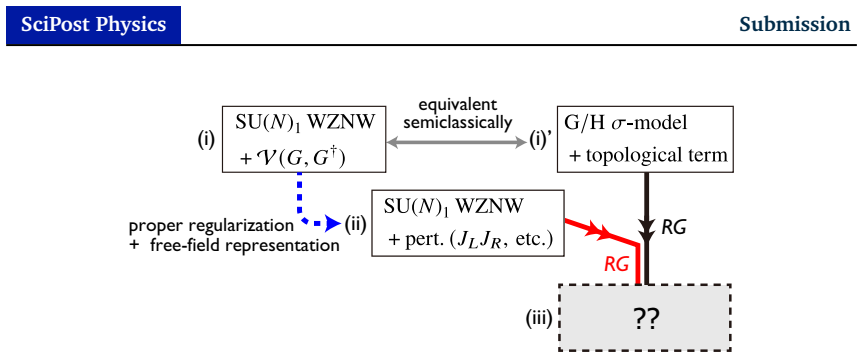
The load-bearing object is the $\mathrm{SU}(N)_1$ WZNW conformal field theory, realized exactly by $N-1$ compactified free bosons on the root lattice. One adds a double-trace potential $\sum_n \lambda_n|\operatorname{Tr}G^n|^2$ (or $\operatorname{Tr}|G-G^T|^2$ for the $\mathrm{SO}(N)$ coset) whose classical minima reproduce the target space; sending $\lambda_n\to\infty$ recovers the nonlinear $\sigma$ model with its $\theta$ terms. The decisive step is a point-splitting regularization of the potential combined with short-distance OPEs in the free-boson representation, which isolates the leading current-current operator and fixes its sign, e.g. $\gamma_{\rm eff}>0$ in the flag case. That sign determines whether the deformation is a marginally irrelevant perturbation flowing back to $\mathrm{SU}(N)_1$, or a relevant perturbation that pins the bosons and produces gapped vacua.
What would settle it
Measure the low-energy central charge of the flag $\mathrm{SU}(4)/\mathrm{U}(1)^3$ $\sigma$ model at $\theta=(\pi/2,\pi,3\pi/2)$ on a lattice realization: finding $c=3$ with gapless excitations would confirm the predicted massless flow to $\mathrm{SU}(4)_1$, while finding a gap or a different central charge would falsify it.
Extended reading notes
Core claim
The paper's central claim is that the infrared phase of each model is controlled by the sign of one operator product expansion: the coefficient of the $\mathrm{SU}(N)_1$ current-current interaction generated when the ultraviolet-regulated potential is expanded at short distances. For the flag-manifold $\mathrm{SU}(N)/\mathrm{U}(1)^{N-1}$ model at $\theta_a=2\pi a/N$ and for $\mathrm{SU}(N)/\mathrm{SO}(N)$ at $\theta=\pi$, this coefficient is positive, the perturbation is marginally irrelevant, and the long-distance limit is the $\mathrm{SU}(N)_1$ fixed point with central charge $c=N-1$. For $\mathbb{C}P^{N-1}$ with $N>2$ and for the Grassmannian $\mathrm{Gr}(2k,k)$ at $\theta=\pi$, the leading perturbation is relevant, the spectrum is fully gapped, and the two degenerate vacua come from spontaneous breaking of the charge-conjugation symmetry. The strategy is presented as a systematic deformation route from a level-1 WZNW theory to any $\mathrm{SU}(N)/H$ $\sigma$ model, and it does not require integrability.
Load-bearing premise
The fragile premise is that the sign of the leading interaction is independent of the detailed shape of the short-distance regulator used to define the potential near coincident points; the paper itself says it has no rigorous proof that this prescription always yields the correct answer.
Editorial extensions
If this is right
- The flag-manifold $\mathrm{SU}(N)/\mathrm{U}(1)^{N-1}$ sigma model at $\theta_a=2\pi a/N$ is massless and flows logarithmically to the $\mathrm{SU}(N)_1$ fixed point.
- The $\mathrm{SU}(N)/\mathrm{SO}(N)$ model at $\theta=\pi$ reaches the same $\mathrm{SU}(N)_1$ criticality, independently of whether the flow is integrable.
- For $N>2$, $\mathbb{C}P^{N-1}$ at $\theta=\pi$ is gapped with a two-fold degenerate ground state from spontaneous charge-conjugation breaking.
- The Grassmannian $\mathrm{Gr}(2k,k)$ at $\theta=\pi$ is likewise gapped and two-fold degenerate.
- Because the argument uses only OPEs and symmetry, it decides the infrared phase without needing the model to be integrable.
Reading between the lines
- The same point-splitting and OPE recipe should decide the infrared phases of real Grassmannian and $\mathrm{Sp}(N)$ sigma models at $\theta=\pi$, which the paper lists as future work.
- If the sign rule survives a rigorous lattice definition, it offers a shortcut for classifying the infrared fate of any symmetric-space sigma model with a level-1 WZNW ancestor.
- The predicted two-fold degeneracy for $\mathbb{C}P^{N-1}$ at $\theta=\pi$ could be probed in cold-atom ladder realizations by measuring dimerization order.
Editorial analysis
A structured set of objections, weighed in public.
Referee Report
Summary. The manuscript proposes a general strategy for determining the infrared properties of two-dimensional SU(N)/H nonlinear sigma models with topological theta terms. The authors start from the SU(N)_1 WZNW CFT and add double-trace deformations designed so that in the strong-coupling limit the classical minima realize the desired target manifolds. The key technical step is a point-splitting regularization of the double-trace operators combined with OPE computations in a free-field representation to extract the leading marginal current-current operator and its sign. For the flag manifold SU(N)/U(1)^{N-1} and the SU(N)/SO(N) model at theta=pi, the extracted sign is such that the current-current perturbation is marginally irrelevant, leading to a massless RG flow back to the SU(N)_1 fixed point. For Gr(2k,k) and CP^{N-1} at theta=pi, the perturbations are relevant and produce a massive two-fold degenerate ground state. The paper also discusses 't Hooft anomaly matching as a consistency constraint.
Significance. If the central sign determination is correct, the paper provides a unified, parameter-free framework that confirms and extends important conjectures: the massless SU(N)_1 flows for flag and SU(N)/SO(N) models, and the gapped two-fold degenerate phases for Grassmannian and CP^{N-1} models. The strength of the paper lies in its explicit OPE computations (Appendices A and B), its consistency with known exact/numerical results (the CP^1 benchmark, the integrable SU(N)/SO(N) results, and lattice spin-chain data), and its broader applicability to non-integrable cases. No free parameters are fitted; the sign of the current-current coupling is derived from CFT data rather than imposed.
major comments (3)
- [Secs. 2.3 and 6] The central conclusion that the flag and SU(N)/SO(N) models flow to the SU(N)_1 fixed point rests on the sign of the marginal current-current coefficient extracted via the point-splitting prescription (19)/(21) and computed in Eqs. (40) and (63). The authors explicitly concede in Sec. 6 that they 'do not have a rigorous proof that this prescription always yields the correct answer.' Positivity and locality of F_epsilon alone do not guarantee that the OPE coefficient c1 equals the physical coupling generated by the double-trace deformation; scheme-dependent normal-ordering or improvement terms could, in principle, alter the sign. Since flipping the sign would change the predicted IR phase from a massless flow to a gapped regime (Secs. 3.2 and 4.3), this assumption is load-bearing. The authors should either provide a sharper justification (e.g., a non-renormalization argument or a comparison with an exact calculation) or clearly state the result as a well-supported conjecture.
- [Sec. 3.2 and Eq. (40)] The OPE computation leading to Eq. (40) is performed in a free-field representation and neglects non-rotation-symmetric terms in the short-distance expansion (see Eq. (B.4) and the sentence preceding Eq. (B.13)). While the point-splitting weight is rotationally symmetric, the regularization of the composite operator |Tr G^n|^2 may introduce scheme-dependent finite parts not fixed by this procedure. The consistency with the classical analysis on the opposite side (lambda_n<0) is reassuring, but it does not establish the scheme independence of the sign on the lambda_n>0 side.
- [Sec. 2.3 and Fig. 1] The equivalence between the deformed WZNW model and the nonlinear sigma model is established only semiclassically, in the lambda -> infinity limit. The inference of the sigma model's IR behavior from the sign of a weak perturbation of the WZNW fixed point assumes that no strong-coupling effects change the direction of the flow. This is a standard limitation of the Affleck-Haldane strategy, but the paper should be explicit that the argument is a controlled conjecture rather than a derivation from the sigma-model action.
minor comments (5)
- [Abstract] The abstract contains a typo: '\text{SU($N$)})/\text{SO($N$)}' has an extra closing parenthesis; it should read '\text{SU($N$)}/\text{SO($N$)}'.
- [Sec. 2.3] The phrase 'the exact details of the weight function would not be important' is an unproven assertion; a brief discussion of the expected scheme independence of the leading OPE coefficient would make the argument more complete.
- [Eq. (24) and footnote 3] The potential is written as a sum over |Tr[G^n]|^2, while the proposed strategy of Sec. 2.3 is formulated for sums over |O|^2 with O a primary operator. The footnote 3 explains the connection, but the main text would benefit from a more direct statement that the two potentials share the same minima.
- [Sec. 4.2] The symmetry group for even N is written as \widetilde{SU(N)}_V \times (Z_N)_L over (Z_2)_{\widetilde V} \times Z_{N/2}; the notation is dense and a brief explanation of the quotient structure would improve readability.
- [Sec. 4.3, Eq. (65)] The beta function is given as \dot g = -N/(4\pi) g^2; it would be helpful to define the RG time l explicitly (e.g., l = \ln(\mu_0/\mu)) to make the direction of the flow unambiguous.
Circularity Check
Derivation is self-contained: the massless/massive distinction follows from explicit OPE signs, not from fitted inputs or load-bearing self-citation.
full rationale
The central claims are not circular. For the flag model, the sign of the current-current coupling is computed by point-splitting (Eq. (37)) and the free-boson OPE (Eq. (40)), giving gamma_eff > 0 in Eq. (42); this is then fed into the known integrable SU(N) Gross-Neveu analysis. For SU(N)/SO(N), the corresponding sign is obtained from Eq. (63) and the one-loop beta function (65), with the marginal direction checked independently by the duality to Eq. (70). No parameter is fitted to the target phase; the OPE computation is parameter-free and does not assume the SU(N)_1 fixed point. The semiclassical identification of the sigma-model target with the strong-coupling limit of the deformed WZNW action is the standard Affleck-Haldane strategy, and the paper explicitly notes this is not a rigorous proof: "While we do not have a rigorous proof that this prescription always yields the correct answer..." (Sec. 6). That is a limitation and a correctness risk, not circularity, because the sign that determines the phase is not imported from the conclusion. The paper also concedes in footnote 5 that the prescription in (21) is UV-cutoff dependent when comparing magnitudes of different deformations, again a limitation rather than a circular step. Self-citations (Refs. [60], [89], [91]) are used for anomaly matching, the one-loop beta function, and a duality transformation; these are parameter-free auxiliary results that do not encode the target massless/massive dichotomy and do not raise the circularity score. The Grassmannian and CP^{N-1} massive results follow from strongly relevant perturbations (Eqs. (83), (91)), again by direct scaling dimension rather than by construction. Accordingly, there are no circular steps.
Assumptions & free parameters
assumptions (5)
- standard math SU(N)_1 WZNW CFT is equivalent to N-1 free compact bosons with the stated periodicity.
- domain assumption The strong-coupling limit lambda to infinity of the deformed WZNW model restricts the field to the classical moduli space of the potential, and the WZNW term becomes the theta term.
- domain assumption Only operators compatible with the discrete chiral symmetry (Z_N)_L can be generated; this forbids relevant scalar primaries, so the current-current term is the leading perturbation.
- standard math The SU(N) Gross-Neveu model is integrable and is gapless for lambda' > 0, gapped for lambda' < 0.
- ad hoc to paper Point-splitting regularization with a positive, local weight function preserves the sign of the potential and yields the leading OPE term.
Cite this review
Pith. "Pith review of Infrared properties of two-dimensional $\mathrm{SU}(N)/H$ nonlinear $\sigma$ models at nonzero $\theta$ angles." pith.science (2026). https://pith.science/paper/AZ735OB7
@misc{pith2026241217493,
  author       = {Pith},
  title        = {Pith review of: Infrared properties of two-dimensional $\mathrmSU(N)/H$ nonlinear $\sigma$ models at nonzero $\theta$ angles},
  year         = {2026},
  howpublished = {\url{https://pith.science/paper/AZ735OB7}},
  note         = {Machine review of arXiv:2412.17493}
}
abstract
A general strategy is proposed to explore the low-energy properties of two-dimensional nonlinear $\sigma$ models with $\theta$ terms. We demonstrate its application to nonlinear $\sigma$ models with the target space $\text{SU($N$)}$/H, which include $\mathbb{C}P^{N-1}$, complex Grassmannian manifolds as well as the flag $\text{SU($N$)}/\text{U(1)}^{N-1}$ and $\text{SU($N$)})/\text{SO($N$)}$ manifolds. By analyzing the symmetry and its anomaly content, we realize these nonlinear $\sigma$ models through perturbations added to the SU(N)$_1$ conformal field theory. For the flag-manifold $\text{SU($N$)}/\text{U(1)}^{N-1}$ and $\text{SU($N$)})/\text{SO($N$)}$ models, those perturbations are shown to correspond to the marginal current-current operator with the specific sign which leads to a massless renormalization group flow to the SU(N)$_1$ fixed point. In contrast, a massive regime with a two-fold ground-state degeneracy is found for the $\mathbb{C}P^{N-1}$ ($N >2$) and Grassmannian nonlinear $\sigma$ models at $\theta=\pi$.
Figures

Reference graph
Works this paper leans on
-
[1]
A. M. Polyakov, Interaction of goldstone particles in two dimensions. applica- tions to ferromagnets and massive yang-mills fields , Phys. Lett. B 59, 79 (1975), doi:https://doi.org/10.1016/0370-2693(75)90161-6
-
[2]
Sachdev, Quantum Phase Transitions, Cambridge University Press (1999)
S. Sachdev, Quantum Phase Transitions, Cambridge University Press (1999)
1999
-
[3]
Tsvelik, Quantum Field Theory in Condensed Matter Physics , Cambridge University Press (1995)
A. Tsvelik, Quantum Field Theory in Condensed Matter Physics , Cambridge University Press (1995)
1995
-
[4]
Fradkin, Field Theories of Condensed Matter Physics , Cambridge University Press, 2 edn., doi:10.1017 /CBO9781139015509 (2013)
E. Fradkin, Field Theories of Condensed Matter Physics , Cambridge University Press, 2 edn., doi:10.1017 /CBO9781139015509 (2013)
2013
-
[5]
Altland and B
A. Altland and B. D. Simons, Condensed Matter Field Theory , Cambridge University Press, Cambridge, 2 edn., doi:10.1017 /cbo9780511789984 (2010)
2010
-
[6]
F . Evers and A. D. Mirlin, Anderson transitions, Rev. Mod. Phys. 80, 1355 (2008), doi:10.1103/RevModPhys.80.1355
-
[7]
M. Fava, L. Piroli, T . Swann, D. Bernard and A. Nahum, Nonlinear sigma mod- els for monitored dynamics of free fermions , Phys. Rev. X 13, 041045 (2023), doi:10.1103/PhysRevX.13.041045
-
[8]
I. Poboiko, P . Pöpperl, I. V . Gornyi and A. D. Mirlin, Theory of free fermions under random projective measurements , Phys. Rev. X 13, 041046 (2023), doi:10.1103/PhysRevX.13.041046
Show all 113 references
-
[9]
C.-M. Jian, H. Shapourian, B. Bauer and A. W . W . Ludwig, Measurement-induced en- tanglement transitions in quantum circuits of non-interacting fermions: Born-rule versus forced measurements (2023), 2302.09094
2023 arXiv
-
[10]
M. Fava, L. Piroli, D. Bernard and A. Nahum, Monitored fermions with conserved U (1) charge, Phys. Rev. Res. 6, 043246 (2024), doi:10.1103 /PhysRevResearch.6.043246
2024
-
[11]
Tiutiakina, H
A. Tiutiakina, H. Lóio, G. Giachetti, J. D. Nardis and A. D. Luca, Field theory for moni- tored Brownian SYK clusters (2024), 2410.08079
2024 arXiv
-
[12]
Haldane, Continuum dynamics of the 1-D Heisenberg antiferromagnet: Identification with the O(3) nonlinear sigma model, Phys
F . Haldane, Continuum dynamics of the 1-D Heisenberg antiferromagnet: Identification with the O(3) nonlinear sigma model, Phys. Lett. A 93, 464 (1983), doi:10.1016/0375- 9601(83)90631-X
1983 doi
-
[13]
F . D. M. Haldane,Nonlinear field theory of large-spin Heisenberg antiferromagnets: Semi- classically quantized solitons of the one-dimensional easy-axis Néel state, Phys. Rev. Lett. 50, 1153 (1983), doi:10.1103 /PhysRevLett.50.1153
1983
-
[14]
S. Ryu, A. P . Schnyder, A. Furusaki and A. W . W . Ludwig,Topological insulators and su- perconductors: tenfold way and dimensional hierarchy, New J. Phys. 12, 065010 (2010), doi:10.1088/1367-2630/12/6/065010
2010 doi
-
[15]
C.-K. Chiu, J. C. Y. Teo, A. P . Schnyder and S. Ryu, Classification of topo- logical quantum matter with symmetries , Rev. Mod. Phys. 88, 035005 (2016), doi:10.1103/RevModPhys.88.035005. 38 SciPost Physics Submission
2016 doi
-
[16]
Z. Bi, A. Rasmussen, K. Slagle and C. Xu, Classification and description of bosonic sym- metry protected topological phases with semiclassical nonlinear sigma models, Phys. Rev. B 91, 134404 (2015), doi:10.1103 /PhysRevB.91.134404
2015
-
[17]
Levine, S
H. Levine, S. B. Libby and A. M. M. Pruisken, Electron delocalization by a magnetic field in two dimensions, Phys. Rev. Lett.51, 1915 (1983), doi:10.1103/PhysRevLett.51.1915
1983 doi
-
[18]
Pruisken, On localization in the theory of the quantized Hall effect: A two-dimensional realization of the θ-vacuum, Nucl
A. Pruisken, On localization in the theory of the quantized Hall effect: A two-dimensional realization of the θ-vacuum, Nucl. Phys. B 235, 277 (1984), doi:10.1016 /0550- 3213(84)90101-9
1984
-
[19]
Tanaka and X
A. Tanaka and X. Hu, Effective field theory with aθ-vacua structure for two-dimensional spin systems, Phys. Rev. B 74, 140407 (2006), doi:10.1103 /PhysRevB.74.140407
2006
-
[20]
Senthil and M
T . Senthil and M. P . A. Fisher, Competing orders, nonlinear sigma models, and topological terms in quantum magnets , Phys. Rev. B 74, 064405 (2006), doi:10.1103/PhysRevB.74.064405
2006 doi
-
[21]
Senthil, A
T . Senthil, A. Vishwanath, L. Balents, S. Sachdev and M. P . A. Fisher,Deconfined quantum critical points, Science 303, 1490 (2004), doi:10.1126/science.1091806, https://www. science.org/doi/pdf/10.1126/science.1091806
2004 doi
-
[22]
Senthil,Deconfined quantum critical points: a review (2023), 2306.12638
T . Senthil,Deconfined quantum critical points: a review (2023), 2306.12638
2023 arXiv
-
[23]
Wiegmann, Exact solution of the O(3) nonlinear σ-model, Phys
P . Wiegmann, Exact solution of the O(3) nonlinear σ-model, Phys. Lett. B 152, 209 (1985), doi:10.1016 /0370-2693(85)91171-2
1985
-
[24]
Gaiotto, A
D. Gaiotto, A. Kapustin, Z. Komargodski and N. Seiberg, Theta, time reversal and tem- perature, JHEP 2017, 91 (2017), doi:10.1007 /JHEP05(2017)091
2017
-
[25]
M. A. Metlitski and R. Thorngren,Intrinsic and emergent anomalies at deconfined critical points, Phys. Rev. B 98, 085140 (2018), doi:10.1103 /PhysRevB.98.085140
2018
-
[26]
’t Hooft,Naturalness, chiral symmetry, and spontaneous chiral symmetry breaking, vol
G. ’t Hooft,Naturalness, chiral symmetry, and spontaneous chiral symmetry breaking, vol. Recent Developments in Gauge Theories. Proceedings of Nato Advanced Study Institute in Cargese of NATO Advanced Study Institutes Series, p. 135, Plenum (1980)
1980
-
[27]
E. Lieb, T . Schultz and D. Mattis,Two soluble models of an antiferromagnetic chain, Ann. Phys. 16, 407 (1961), doi:DOI: 10.1016 /0003-4916(61)90115-4
1961
-
[28]
Affleck and F
I. Affleck and F . D. M. Haldane,Critical theory of quantum spin chains, Phys. Rev. B 36, 5291 (1987), doi:10.1103 /PhysRevB.36.5291
1987
-
[29]
Witten, Non-abelian bosonization in two dimensions , Comm
E. Witten, Non-abelian bosonization in two dimensions , Comm. Math. Phys. 92, 455 (1984), doi:10.1007 /BF01215276
1984
-
[31]
Shankar and N
R. Shankar and N. Read, Theθ =π nonlinear sigma model is massless , Nucl. Phys. B 336, 457 (1990), doi:https: //doi.org/10.1016/0550-3213(90)90437-I
1990 doi
-
[32]
Zamolodchikov and A
A. Zamolodchikov and A. Zamolodchikov, Massless factorized scattering and sigma models with topological terms , Nucl. Phys. B 379, 602 (1992), doi:https://doi.org/10.1016/0550-3213(92)90136-Y. 39 SciPost Physics Submission
1992 doi
-
[33]
Bietenholz, A
W . Bietenholz, A. Pochinsky and U. J. Wiese, Meron-cluster simulation of the θ vacuum in the 2D O(3) model , Phys. Rev. Lett. 75, 4524 (1995), doi:10.1103/PhysRevLett.75.4524
1995 doi
-
[34]
Azcoiti, G
V . Azcoiti, G. Di Carlo, E. Follana and M. Giordano,Critical behavior of the O(3) nonlinear sigma model with topological term atθ =π from numerical simulations, Phys. Rev. D 86, 096009 (2012), doi:10.1103 /PhysRevD.86.096009
2012
-
[35]
Allés, M
B. Allés, M. Giordano and A. Papa, Behavior near θ = π of the mass gap in the two-dimensional O(3) nonlinear sigma model , Phys. Rev. B 90, 184421 (2014), doi:10.1103/PhysRevB.90.184421
2014 doi
-
[36]
Caspar and H
S. Caspar and H. Singh, From asymptotic freedom to θ vacua: Qubit embed- dings of the O(3) nonlinear σ model, Phys. Rev. Lett. 129, 022003 (2022), doi:10.1103/PhysRevLett.129.022003
2022 doi
-
[37]
W . Tang, X. C. Xie, L. Wang and H.-H. Tu, Tensor network simulation of the ( 1 + 1)- dimensional O(3) nonlinearσ-model withθ =π term, Phys. Rev. D104, 114513 (2021), doi:10.1103/PhysRevD.104.114513
2021 doi
-
[38]
J. Y. Araz, S. Schenk and M. Spannowsky , Toward a quantum simulation of non- linear sigma models with a topological term , Phys. Rev. A 107, 032619 (2023), doi:10.1103/PhysRevA.107.032619
2023 doi
-
[39]
Fukushima, T
K. Fukushima, T . Shimazaki and Y. Tanizaki, Exploring the θ-vacuum struc- ture in the functional renormalization group approach , JHEP 2022, 40 (2022), doi:10.1007/JHEP04(2022)040
2022 doi
-
[40]
Haruna, K
J. Haruna, K. Shimizu and M. Yamada, Functional renormalization group analysis of O(3) nonlinear sigma model and non-abelian bosonization duality (2024), 2405.14627
2024 arXiv
-
[41]
M. R. Zirnbauer, On the infrared limit of the O(3) nonlinear σ-model atθ =π (2024), 2408.12215
2024 arXiv
-
[42]
A. J. McRoberts, C. Hooley and A. G. Green,The J1-J2 spin chain and the O(3) non-linear sigma model atθ =π (2024), 2411.08095
2024
-
[44]
Affleck, D
I. Affleck, D. Bykov and K. Wamer, Flag manifold sigma models: Spin chains and inte- grable theories, Phys. Rep. 953, 1 (2022), doi:10.1016 /j.physrep.2021.09.004
2022
-
[45]
Affleck, The quantum hall effects,σ-models atθ =π and quantum spin chains, Nucl
I. Affleck, The quantum hall effects,σ-models atθ =π and quantum spin chains, Nucl. Phys. B 257, 397 (1985), doi:https: //doi.org/10.1016/0550-3213(85)90353-0
1985 doi
-
[46]
Read and S
N. Read and S. Sachdev, Some features of the phase diagram of the square lattice SU(N) antiferromagnets, Nucl. Phys. B 316, 609 (1989), doi:10.1016 /0550-3213(89)90061- 8
1989
-
[47]
S.-Y. Wang, D. Wang and Q.-H. Wang, Critical exponents of the nonlinear sigma model on a grassmann manifold U(n)/U(m)U(n− m) by the 1/n-expansion, Phys. Rev. B 99, 165142 (2019), doi:10.1103 /PhysRevB.99.165142. 40 SciPost Physics Submission
2019
-
[48]
B. B. Beard, M. Pepe, S. Riederer and U.-J. Wiese, Study of CP(n− 1) θ-vacua by cluster simulation of SU(n) quantum spin ladders, Phys. Rev. Lett. 94, 010603 (2005), doi:10.1103/PhysRevLett.94.010603
2005 doi
-
[49]
Laflamme, W
C. Laflamme, W . Evans, M. Dalmonte, U. Gerber, H. Mejía-Díaz, W . Bietenholz, U.-J. Wiese and P . Zoller,CP(N−1) quantum field theories with alkaline-earth atoms in optical lattices, Ann. Phys. 370, 117 (2016), doi:https://doi.org/10.1016/j.aop.2016.03.012
2016 doi
-
[50]
Evans, U
W . Evans, U. Gerber, M. Hornung and U.-J. Wiese,SU(3) quantum spin ladders as a regu- larization of the CP(2) model at non-zero density: From classical to quantum simulation, Ann. Phys. 398, 94 (2018), doi:https: //doi.org/10.1016/j.aop.2018.09.002
2018 doi
-
[51]
Nguyen, Y
M. Nguyen, Y. Tanizaki and M. Ünsal, Windingθ and destructive interference of instan- tons, JHEP 2023, 33 (2023), doi:10.1007 /JHEP09(2023)033
2023
-
[52]
Bykov, Haldane limits via Lagrangian embeddings , Nucl
D. Bykov, Haldane limits via Lagrangian embeddings , Nucl. Phys. B 855, 100 (2012), doi:https://doi.org/10.1016/j.nuclphysb.2011.10.005
2012 doi
-
[53]
Bykov, The geometry of antiferromagnetic spin chains, Comm
D. Bykov, The geometry of antiferromagnetic spin chains, Comm. Math. Phys. 322, 807 (2013), doi:10.1007 /s00220-013-1702-5
2013
-
[54]
Lajkó, K
M. Lajkó, K. Wamer, F . Mila and I. Affleck, Generalization of the Hal- dane conjecture to SU(3) chains , Nucl. Phys. B 924, 508 (2017), doi:https://doi.org/10.1016/j.nuclphysb.2017.09.015
2017 doi
-
[55]
Wamer, M
K. Wamer, M. Lajkó, F . Mila and I. Affleck, Generalization of the Hal- dane conjecture to su(n) chains , Nucl. Phys. B 952, 114932 (2020), doi:https://doi.org/10.1016/j.nuclphysb.2020.114932
2020
-
[56]
Wamer and I
K. Wamer and I. Affleck, Flag manifold sigma models from SU(n) chains, Nucl. Phys. B 959, 115156 (2020), doi:https: //doi.org/10.1016/j.nuclphysb.2020.115156
2020
-
[57]
Fendley ,Integrable sigma models with θ = π, Phys
P . Fendley ,Integrable sigma models with θ = π, Phys. Rev. B 63, 104429 (2001), doi:10.1103/PhysRevB.63.104429
2001 doi
-
[58]
Fendley ,Integrable sigma models and perturbed coset models, JHEP 2001, 050 (2001), doi:10.1088/1126-6708/2001/05/050
P . Fendley ,Integrable sigma models and perturbed coset models, JHEP 2001, 050 (2001), doi:10.1088/1126-6708/2001/05/050
2001 doi
-
[59]
Mariño, R
M. Mariño, R. Miravitllas and T . Reis, Instantons, renormalons and the theta angle in integrable sigma models , SciPost Phys. 15, 184 (2023), doi:10.21468/SciPostPhys.15.5.184
2023 doi
-
[60]
Tanizaki and T
Y. Tanizaki and T . Sulejmanpasic,Anomaly and global inconsistency matching:θ angles, su(3)/u(1)2 nonlinear sigma model, su(3) chains, and generalizations, Phys. Rev. B 98, 115126 (2018), doi:10.1103 /PhysRevB.98.115126
2018
-
[61]
Ohmori, N
K. Ohmori, N. Seiberg and S.-H. Shao, Sigma models on flags , SciPost Phys. 6, 17 (2019), doi:10.21468 /SciPostPhys.6.2.017
2019
-
[62]
Seiberg, Topology in strong coupling , Phys
N. Seiberg, Topology in strong coupling , Phys. Rev. Lett. 53, 637 (1984), doi:10.1103/PhysRevLett.53.637
1984 doi
-
[63]
Andrei and J
N. Andrei and J. H. Lowenstein, Diagonalization of the chiral-invariant gross-neveu hamiltonian, Phys. Rev. Lett. 43, 1698 (1979), doi:10.1103 /PhysRevLett.43.1698. 41 SciPost Physics Submission
1979
-
[65]
Berg and P
B. Berg and P . Weisz,Exact s-matrix of the chiral invariant su(n) thirring model , Nucl. Phys. B 146, 205 (1978), doi:https: //doi.org/10.1016/0550-3213(78)90438-8
1978 doi
-
[66]
Köberle, V
R. Köberle, V . Kurak and J. A. Swieca, Scattering theory and 1 N expansion in the chiral gross-neveu model, Phys. Rev. D 20, 897 (1979), doi:10.1103 /PhysRevD.20.897
1979
-
[67]
Di Francesco, P
P . Di Francesco, P . Mathieu and D. Sénéchal,Conformal Field Theory, Springer Verlag (1996)
1996
-
[68]
S. C. Furuya and M. Oshikawa, Symmetry protection of critical phases and a global anomaly in 1 + 1 dimensions, Phys. Rev. Lett. 118, 021601 (2017), doi:10.1103/PhysRevLett.118.021601
2017 doi
-
[69]
Kutasov, String theory and the non-abelian thirring model , Phys
D. Kutasov, String theory and the non-abelian thirring model , Phys. Lett. B 227, 68 (1989), doi:https: //doi.org/10.1016/0370-2693(89)91285-9
1989 doi
-
[70]
Gerganov, A
B. Gerganov, A. LeClair and M. Moriconi, Beta function for anisotropic current interac- tions in 2d, Phys. Rev. Lett. 86, 4753 (2001), doi:10.1103 /PhysRevLett.86.4753
2001
-
[72]
Johannesson, The structure of low-lying excitations in a new integrable quantum chain model, Nucl
H. Johannesson, The structure of low-lying excitations in a new integrable quantum chain model, Nucl. Phys. B 270, 235 (1986)
1986
-
[73]
Yao, C.-T
Y. Yao, C.-T . Hsieh and M. Oshikawa,Anomaly matching and symmetry-protected critical phases in su(n) spin systems in 1 + 1 dimensions, Phys. Rev. Lett. 123, 180201 (2019), doi:10.1103/PhysRevLett.123.180201
2019 doi
-
[74]
Nataf, S
P . Nataf, S. Gozel and F . Mila, Edge states and universality class of the crit- ical two-box symmetric SU(3) chain , Phys. Rev. B 104, L180411 (2021), doi:10.1103/PhysRevB.104.L180411
2021 doi
-
[75]
Affleck, Exact critical exponents for quantum spin chains, non-linear σ-models at θ = π and the quantum Hall effect , Nucl
I. Affleck, Exact critical exponents for quantum spin chains, non-linear σ-models at θ = π and the quantum Hall effect , Nucl. Phys. B 265, 409 (1986), doi:http://dx.doi.org/10.1016/0550-3213(86)90167-7
1986 doi
-
[76]
Gogolin, A
A. Gogolin, A. Nersesyan and A. Tsvelik, Bosonization and Strongly Correlated Systems, Cambridge University Press (1998)
1998
-
[77]
A. J. A. James, R. M. Konik, P . Lecheminant, N. J. Robinson and A. M. Tsvelik, Non- perturbative methodologies for low-dimensional strongly-correlated systems: From non- Abelian bosonization to truncated spectrum methods , Rep. Prog. Phys. 81, 046002 (2018), doi:10.1088 /1361...
2018
-
[78]
Coleman, J
S. Coleman, J. Wess and B. Zumino,Structure of phenomenological lagrangians. i, Phys. Rev.177, 2239 (1969), doi:10.1103 /PhysRev.177.2239
1969
-
[79]
C. G. Callan, S. Coleman, J. Wess and B. Zumino, Structure of phenomenological la- grangians. ii, Phys. Rev. 177, 2247 (1969), doi:10.1103 /PhysRev.177.2247. 42 SciPost Physics Submission
1969
-
[80]
D. S. Freed and G. W . Moore, Setting the quantum integrand of M-theory , Commun. Math. Phys. 263, 89 (2006), doi:10.1007 /s00220-005-1482-7, hep-th /0409135
2006
-
[81]
D. S. Freed and M. J. Hopkins, Reflection positivity and invertible topological phases , Geom. Topol. 25, 1165 (2021), doi:10.2140 /gt.2021.25.1165, 1604.06527
2021 arXiv
-
[82]
D. S. Freed, Z. Komargodski and N. Seiberg, The Sum Over Topological Sectors and θ in the 2 +1-Dimensional CP1 σ-Model, Comm. Math. Phys. 362, 167 (2018), doi:10.1007/s00220-018-3093-0, 1707.05448
2018 arXiv
-
[83]
Y. Lee, K. Ohmori and Y. Tachikawa,Revisiting Wess-Zumino-Witten terms, SciPost Phys. 10, 061 (2021), doi:10.21468 /SciPostPhys.10.3.061, 2009.00033
2021 arXiv
-
[84]
Kobayashi, Y
R. Kobayashi, Y. Lee, K. Shiozaki and Y. Tanizaki, Topological terms of (2 +1)d flag- manifold sigma models, JHEP 08, 075 (2021), doi:10.1007 /JHEP08(2021)075, 2103. 05035
2021
-
[85]
Wen, Classifying gauge anomalies through symmetry-protected trivial orders and classifying gravitational anomalies through topological orders, Phys
X.-G. Wen, Classifying gauge anomalies through symmetry-protected trivial orders and classifying gravitational anomalies through topological orders, Phys. Rev. D 88, 045013 (2013), doi:10.1103 /PhysRevD.88.045013, 1303.1803
2013 arXiv
-
[86]
Kapustin, Symmetry Protected Topological Phases, Anomalies, and Cobordisms: Beyond Group Cohomology (2014), 1403.1467
A. Kapustin, Symmetry Protected Topological Phases, Anomalies, and Cobordisms: Beyond Group Cohomology (2014), 1403.1467
2014 arXiv
-
[87]
Yonekura, On the cobordism classification of symmetry protected topological phases , Comm
K. Yonekura, On the cobordism classification of symmetry protected topological phases , Comm. Math. Phys. 368, 1121 (2019), doi:10.1007 /s00220-019-03439-y, 1803. 10796
2019
-
[88]
Polyakov and P
A. Polyakov and P . Wiegmann, Goldstone fields in two dimensions with multival- ued actions , Phys. Lett. B 141, 223 (1984), doi:https: //doi.org/10.1016/0370- 2693(84)90206-5
1984 doi
-
[89]
Lecheminant and K
P . Lecheminant and K. Totsuka, The SU(N) self-dual sine-gordon model and competing orders, JSTAT 2006, L12001 (2006), doi:10.1088 /1742-5468/2006/12/L12001
2006
-
[90]
Itoi and M.-H
C. Itoi and M.-H. Kato, Extended massless phase and the Haldane phase in a spin-1 isotropic antiferromagnetic chain , Phys. Rev. B 55, 8295 (1997), doi:10.1103/PhysRevB.55.8295
1997 doi
-
[91]
Boulat, P
E. Boulat, P . Azaria and P . Lecheminant, Duality approach to one- dimensional degenerate electronic systems , Nucl. Phys. B 822, 367 (2009), doi:http://dx.doi.org/10.1016/j.nuclphysb.2009.06.020
2009 doi
-
[92]
Komatsu, R
S. Komatsu, R. Mahajan and S.-H. Shao, An index for quantum integrability , SciPost Phys. 7, 065 (2019), doi:10.21468 /SciPostPhys.7.5.065
2019
-
[93]
Corboz, A
P . Corboz, A. M. Läuchli, K. Totsuka and H. Tsunetsugu, Spontaneous trimeriza- tion in a bilinear-biquadratic s = 1 zig-zag chain, Phys. Rev. B 76, 220404 (2007), doi:10.1103/PhysRevB.76.220404
2007 doi
-
[94]
Babichenko, Quantum integrability ofσ models on aii and cii symmetric spaces, Phys
A. Babichenko, Quantum integrability ofσ models on aii and cii symmetric spaces, Phys. Lett. B 554, 96 (2003), doi:https: //doi.org/10.1016/S0370-2693(02)03268-9
2003 doi
-
[95]
Babichenko and R
A. Babichenko and R. Tateo,Thermodynamic bethe ansatz for the aii sigma-models, Phys. Lett. B 573, 239 (2003), doi:https: //doi.org/10.1016/j.physletb.2003.08.044. 43 SciPost Physics Submission
2003 doi
-
[96]
D’Adda, M
A. D’Adda, M. Lüscher and P . Di Vecchia,A 1/n expandable series of non-linearσ models with instantons, Nucl. Phys. B 146, 63 (1978), doi:10.1016 /0550-3213(78)90432-7
1978
-
[97]
MacFarlane, Generalizations ofσ-models and cpN models, and instantons, Phys
A. MacFarlane, Generalizations ofσ-models and cpN models, and instantons, Phys. Lett. B 82, 239 (1979), doi:https: //doi.org/10.1016/0370-2693(79)90745-7
1979 doi
-
[98]
R. D. Pisarski, Nonlinearσ models of symmetric spaces, Phys. Rev. D 20, 3358 (1979), doi:10.1103/PhysRevD.20.3358
1979 doi
-
[99]
Dubois-Violette and Y
M. Dubois-Violette and Y. Georgelin, Gauge theory in terms of projector valued fields , Phys. Lett. B 82, 251 (1979), doi:https: //doi.org/10.1016/0370-2693(79)90748-2
1979 doi
-
[100]
Brézin, C
E. Brézin, C. Itzykson, J. Zinn-Justin and J.-B. Zuber, Remarks about the exis- tence of non-local charges in two-dimensional models , Phys. Lett. B 82, 442 (1979), doi:https://doi.org/10.1016/0370-2693(79)90263-6
1979 doi
-
[102]
A. M. M. Pruisken, B. Danu and R. Shankar, Superuniversality of dimerized SU(n + m) spin chains, Phys. Rev. B 105, 155111 (2022), doi:10.1103 /PhysRevB.105.155111
2022
-
[103]
Nguyen and H
M. Nguyen and H. Singh,Lattice regularizations ofθ vacua: Anomalies and qubit models, Phys. Rev. D107, 014507 (2023), doi:10.1103 /PhysRevD.107.014507
2023
-
[104]
Sulejmanpasic and Y
T . Sulejmanpasic and Y. Tanizaki, C-P-T anomaly matching in bosonic quantum field theory and spin chains , Phys. Rev. B 97, 144201 (2018), doi:10.1103/PhysRevB.97.144201
2018 doi
-
[105]
Kikuchi and Y
Y. Kikuchi and Y. Tanizaki, Global inconsistency, ’t Hooft anomaly, and level crossing in quantum mechanics, PTEP 2017, 113B05 (2017), doi:10.1093 /ptep/ptx148, https: //academic.oup.com/ptep/article-pdf/2017/11/113B05/22090624/ptx148.pdf
2017
-
[106]
Komargodski, A
Z. Komargodski, A. Sharon, R. Thorngren and X. Zhou,Comments on abelian Higgs mod- els and persistent order, SciPost Phys.6, 003 (2019), doi:10.21468/SciPostPhys.6.1.003
2019 doi
-
[107]
Affleck, Exact results on the dimerisation transition in SU(n) antiferromagnetic chains, J
I. Affleck, Exact results on the dimerisation transition in SU(n) antiferromagnetic chains, J. Phys. Condens. Matter 2, 405 (1990), doi:10.1088 /0953-8984/2/2/016
1990
-
[108]
Klümper, The spectra of q-state vertex models and related antiferromagnetic quantum spin chains, J
A. Klümper, The spectra of q-state vertex models and related antiferromagnetic quantum spin chains, J. Phys. A: Math. Gen.23, 809 (1990), doi:10.1088/0305-4470/23/5/023
1990 doi
-
[109]
G. V . Dunne, Y. Tanizaki and M. Ünsal, Quantum distillation of Hilbert spaces, semi-classics and anomaly matching , JHEP 2018, 68 (2018), doi:10.1007/JHEP08(2018)068
2018 doi
-
[110]
Nonne, P
H. Nonne, P . Lecheminant, S. Capponi, G. Roux and E. Boulat, Competing orders in one-dimensional half-filled multicomponent fermionic cold atoms: The Haldane-charge conjecture, Phys. Rev. B 84, 125123 (2011), doi:10.1103 /PhysRevB.84.125123
2011
-
[111]
Dufour, P
J. Dufour, P . Nataf and F . Mila,Variational monte carlo investigation ofSU(n) Heisenberg chains, Phys. Rev. B 91, 174427 (2015), doi:10.1103 /PhysRevB.91.174427
2015
-
[112]
A. V . Onufriev and J. B. Marston,Enlarged symmetry and coherence in arrays of quantum dots, Phys. Rev. B 59, 12573 (1999), doi:10.1103 /PhysRevB.59.12573. 44 SciPost Physics Submission
1999
-
[113]
Assaraf, P
R. Assaraf, P . Azaria, E. Boulat, M. Caffarel and P . Lecheminant,Dynamical symmetry enlargement versus spin-charge decoupling in the one-dimensional SU(4) Hubbard model, Phys. Rev. Lett.93, 016407 (2004), doi:10.1103 /PhysRevLett.93.016407
2004
-
[114]
Paramekanti and J
A. Paramekanti and J. B. Marston, SU(N) quantum spin models: a variational wave- function study , J. Phys. Condens. Matter 19, 125215 (2007), doi:10.1088 /0953- 8984/19/12/125215
2007
-
[115]
Boyanovsky and R
D. Boyanovsky and R. Holman, Critical behavior and duality in extended sine- Gordon theories, Nucl. Phys. B 358, 619 (1991), doi:https: //doi.org/10.1016/0550- 3213(91)90427-Y
1991 doi
-
[116]
Assaraf, P
R. Assaraf, P . Azaria, M. Caffarel and P . Lecheminant, Metal-insulator transition in the one-dimensional SU(N ) Hubbard model , Phys. Rev. B 60, 2299 (1999), doi:10.1103/PhysRevB.60.2299
1999 doi
-
[117]
S. R. Manmana, K. R. A. Hazzard, G. Chen, A. E. Feiguin and A. M. Rey , SU(N ) mag- netism in chains of ultracold alkaline-earth-metal atoms: Mott transitions and quantum correlations, Phys. Rev. A 84, 043601 (2011), doi:10.1103 /PhysRevA.84.043601
2011
-
[118]
Fuji and P
Y. Fuji and P . Lecheminant,Non-Abelian SU (N−1)-singlet fractional quantum Hall states from coupled wires, Phys. Rev. B95, 125130 (2017), doi:10.1103/PhysRevB.95.125130. 45
2017 doi
Reviewed August 11, 2026 · model on record in the stance chip above.
Discussion (0). Continue with ORCID to comment.