REVIEW 5 major objections 5 minor 1 cited by
Contextual Feedback Loops: Amplifying Deep Reasoning with Iterative Top-Down Feedback
T0 review · 5 major / 5 minor · reviewed 2026-08-11 · deepseek-v4-flash
Pith's one-line read This paper argues that a lightweight top-down feedback loop—mapping a network's own output into a compact context vector and fusing it back into every layer—lets standard vision and language models refine their internal representations…
desk verdict T=1 feedback idea is interesting, but the paper's efficiency claims contradict its own algorithm and parameter counts, so the quantitative results need a major rework. read the letter →
The pith
A machine-rendered reading of the paper's core claim, the machinery that carries it, and where it could break.
The reading
What carries the argument
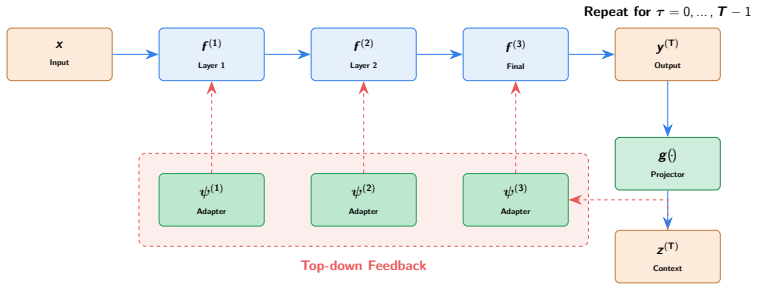
The central object is the CFL update map Φ that takes the current state Sτ = (h(1)τ,...,h(L)τ, y(τ)) and produces the next state by computing a context vector z(τ) = g(y(τ)) and fusing it into each hidden layer via feedback adapters ψ(l), then recomputing the output through f(L+1). The adapters use FiLM-style scale-and-shift operations, and the projector can be compressed with a LoRA-style low-rank factorization; weight tying across layers and per-layer biases keep parameter overhead around 10 percent or less. The argument proceeds by treating Φ as a contraction on the hidden-output space, so the Banach Fixed Point Theorem guarantees convergence to a unique fixed point under strictly contractive Lipschitz constants.
What would settle it
Retrain the base ViT or Transformer with the same parameter count as the CFL version (for example by widening the base) under identical training budgets and compare accuracy and perplexity; if the matched-parameter baseline matches CFL's gains, then the feedback path is not the cause. Also measure T=1 end-to-end latency on the same hardware with raw timing numbers instead of a plotted figure, to verify that the first refinement truly adds negligible compute.
Extended reading notes
Core claim
On its own terms, the paper establishes that CFL—a projector mapping the network's prediction to a compact context vector plus per-layer gating adapters that fuse that context back into hidden states—turns a feed-forward network into an iterative refinement system. Unrolling the loop for T steps and training with backpropagation through time yields consistent improvements: T=1 is the sweet spot, giving up to 1.3 pp higher top-1 accuracy on ImageNet ViTs, a 2.8-point (6.2%) perplexity reduction on PG-19, and about a 3 pp macro-average gain on Long Range Arena, with deeper unrolling giving diminishing returns. Additionally, when the composed Lipschitz constants of the update map are strictly below 1, the CFL iteration is a contraction and converges geometrically to a unique fixed point, providing a theoretical underpinning for stable refinement.
Load-bearing premise
The reported gains are attributed to the feedback mechanism itself, which requires that the base and CFL models are trained identically except for the feedback path; the paper does not report training hyperparameters, seeds, or an equal-parameter feed-forward baseline, and the claim that T=1 latency is essentially unchanged rests on a figure without raw measurements.
Editorial extensions
If this is right
- If CFL works as claimed, any feed-forward architecture can gain a cheap 'self-correction' loop by adding a projector and lightweight adapters, making iterative top-down refinement a general plug-in rather than a bespoke architecture.
- The T=1 result suggests that the main accuracy benefit comes from a single round of global context fusion, implying that very shallow feedback suffices for many tasks and that deeper unrolling is unnecessary in practice.
- The contraction result implies that multiple refinement steps are stable: even without strictly enforcing contractivity, the fixed-point view explains why a few iterations do not diverge and why performance saturates rather than degrades abruptly.
- Because the method only requires the network's own output as feedback, it can be applied to transformers, CNNs, and likely generative or autoregressive models without external conditioning signals, broadening the reach of top-down modulation in deep learning.
Reading between the lines
- A natural testable extension would be to use the confidence of the T=1 prediction as an adaptive stopping criterion, running extra refinement steps only on inputs where the initial pass is uncertain; this could push gains further while keeping average compute low.
- The paper does not compare against a feed-forward baseline with matched parameter count; the implicit claim that feedback itself, rather than extra parameters, drives the gains deserves a direct ablation with a widened base model.
- The fixed-point analysis suggests a connection to deep equilibrium models: if the contraction is enforced, CFL effectively computes a fixed point without needing DEQ-style root finding, potentially offering a simpler route to iterative inference.
- The reported attention-map shifts from broad to salient features over iterations could be quantified with a saliency metric, turning the qualitative Figure 1 claim into a measurable prediction about where later iterations concentrate.
Signed reviews
Editorial analysis
A structured set of objections, weighed in public.
Referee Report
Summary. The paper proposes Contextual Feedback Loops (CFLs), a mechanism that re-injects a compact context vector derived from a network's own output back into earlier layers through lightweight adapters, iterating this refinement T times. The authors claim that a single refinement improves ViT/Transformer accuracy on ImageNet by up to 1.3 pp, reduces PG-19 perplexity by about 6%, and raises Long Range Arena macro-average accuracy by about 3 pp, all with negligible parameter and compute overhead. They also present a Banach fixed-point argument in Appendix A.2 intended to support stable convergence of the iterative update.
Significance. If the empirical claims were substantiated, the CFL idea would be a useful and broadly applicable contribution: a simple, architecture-agnostic feedback path that improves feed-forward models without bespoke recurrent units. The paper also supplies a pseudocode specification and an explicit fixed-point convergence statement, which are helpful for reproducibility and further analysis. However, the reported results are currently not trustworthy because the headline efficiency claims are internally inconsistent with the described algorithm, the parameter accounting contradicts the stated adapter design, and the experimental section omits essentially all training details needed to isolate the effect of the feedback mechanism.
major comments (5)
- [Section 3.3, Algorithm 1, Table 1, Section 4.1] The refinement loop in Algorithm 1 (lines 11-14) updates every hidden state h(l) and then propagates it through f(l+1), so a single refinement T=1 re-executes the full forward pass. Table 1 nevertheless lists identical FLOPs for CFL-ViT at T=1 and the base ViT at all three scales, and Section 4.1 claims latency within ±3% of vanilla ViT. These statements cannot both hold for the described algorithm. The paper must state which layers are actually recomputed or skipped for T=1, and must provide raw FLOP and latency measurements rather than asserted figures.
- [Table 1 and Section B.1] The parameter counts in Table 1 contradict the paper's own '<10%' claim and its stated FiLM adapter budget. CFL-ViT Base adds 12.0M parameters (+13.9%) and Large adds 30.6M (+10.1%), while Section B.1 computes only 2*dz*dh parameters per FiLM layer (about 0.1M per layer for dz=64 and dh=768), which is an order of magnitude below the reported 12M addition for ViT-Base. The evaluated model's parameter breakdown must be reported and reconciled with the method description.
- [Section 4] No training protocol is given: the paper reports no hyperparameters, seeds, epochs, optimizer settings, learning-rate schedules, augmentation policies, context dimension dz, LoRA rank r, or loss weights lambda_tau. Without this information, and without an equal-parameter feed-forward baseline trained under identical conditions, the reported accuracy and perplexity gains cannot be attributed to the feedback mechanism rather than to additional trainable parameters or changed training conditions.
- [Appendix A.2, Theorem 1] Theorem 1 is conditional on an assumed contraction bound L_total < 1 and does not derive this bound from the actual network weights, so it does not establish convergence for the proposed architecture. Moreover, the proof's Steps 2-3 yield an affine coupling between hidden-state differences and output differences through the terms L_psi, L_g, and L_f, not the displayed product L_psi * ... * L_f; no norm or concrete L_total is specified. The theorem should either be stated purely as an existence result under an explicit assumption or be instantiated with a verifiable contraction factor.
- [Section 4.2 and Tables 2-3] The evaluation protocol is under-specified: PG-19 contains full books with long sequences, yet the paper says it evaluates 'single-sentence perplexity,' which is not defined for this benchmark and is inconsistent with the stated average sequence length of over 70,000 tokens. Tables 2 and 3 also report a single run per configuration with no seeds or variance, so the small differences (e.g., 0.2-0.4 pp on LRA) are not statistically supported.
minor comments (5)
- [Abstract] The metadata abstract lists CIFAR-10, SpeechCommands, and GLUE SST-2 as benchmark tasks, but Section 4 does not report experiments on any of these datasets; the abstract and Section 4 should be aligned.
- [Section 4.3] The text says 'four representative tasks' but Table 3 lists five tasks: ListOps, Byte-Level, Text, Pathfinder-32, and CIFAR-10.
- [Section 3.5] The claims that merged adapters 'retain 96-99% of the accuracy boosts' and that the low-rank variant 'loses only 0.2-0.4 pp' are not accompanied by any experimental results in the paper.
- [Section 4.1 and Figure 3] Figure 3 appears to be a schematic bar chart without raw data points, error bars, or a description of measurement methodology, so the asserted ±3% latency statement is not verifiable from the figure.
- [Section 3.8] The architecture-specific notes describe cross-attention adapters for transformers and spatial attention for CNNs, but the experiments do not state which fusion mechanism was actually used; the implementation should be tied to the results.
Circularity Check
No significant circularity: the reported results are measured, and the fixed-point argument is a standard conditional theorem rather than a self-referential derivation.
full rationale
The empirical claims (ImageNet accuracy, PG-19 perplexity, LRA scores) are experimental measurements, not quantities derived from fitted inputs; no parameter is fit to a subset of data and then reported as a prediction of a closely related quantity. The only formal derivation is Theorem 1 in Appendix A.2, which assumes a contraction constant L<1 (quoting 'assume there exists a norm ∥·∥ and a constant L<1 such that ∥Φ(S)−Φ(S′)∥≤L∥S−S′∥') and then applies the Banach Fixed Point Theorem. This is a conditional statement in the sense that the non-trivial premise (contractiveness) is not derived from the network weights, but it is not circular: the conclusion (geometric convergence to a unique fixed point) follows from the premise by a standard theorem rather than being identical to the premise by construction. The Discussion in Appendix A.2 explicitly concedes that strict contractiveness may require normalization or regularizers, which weakens the theoretical support but does not make it circular. The paper contains no load-bearing self-citations, no imported uniqueness theorem from the authors' prior work, and no ansatz smuggled in via citation. The apparent contradiction between Algorithm 1's full second forward pass and Section 4.1's '±3%' latency claim is an internal-consistency or correctness problem, not a circularity, and therefore does not affect the circularity score.
Assumptions & free parameters
free parameters (5)
- Context vector dimension dz
- LoRA rank r
- Refinement steps T =
1 (selected as best after experiments)
- Iteration loss weights lambda_tau =
lambda_T = 1 default
- Early-exit thresholds epsilon and theta
assumptions (4)
- standard math Banach Fixed Point Theorem
- ad hoc to paper The composed Lipschitz constants of the projector, adapters, and output layer are less than 1 in some norm
- domain assumption The components psi(l), g, and f(L+1) are Lipschitz continuous
- domain assumption Backpropagation through time over T unrolled iterations gives useful gradients and stable training
invented entities (2)
-
Context vector z
-
Feedback adapter psi(l)
Cite this review
Pith. "Pith review of Contextual Feedback Loops: Amplifying Deep Reasoning with Iterative Top-Down Feedback." pith.science (2026). https://pith.science/paper/VEB5UKV6
@misc{pith2026241217737,
  author       = {Pith},
  title        = {Pith review of: Contextual Feedback Loops: Amplifying Deep Reasoning with Iterative Top-Down Feedback},
  year         = {2026},
  howpublished = {\url{https://pith.science/paper/VEB5UKV6}},
  note         = {Machine review of arXiv:2412.17737}
}
read the original abstract
Conventional deep networks rely on one-way backpropagation that overlooks reconciling high-level predictions with lower-level representations. We propose \emph{Contextual Feedback Loops} (CFLs), a lightweight mechanism that re-injects top-down context into earlier layers for iterative refinement. Concretely, CFLs map the network's prediction to a compact \emph{context vector}, which is fused back into each layer via gating adapters. Unrolled over multiple feedback steps, CFLs unify feed-forward and feedback-driven inference, letting top-level outputs continually refine lower-level features. Despite minimal overhead, CFLs yield consistent gains on tasks including CIFAR-10, ImageNet-1k, SpeechCommands, and GLUE SST-2. Moreover, by a Banach Fixed Point argument under mild Lipschitz conditions, these updates converge stably. Overall, CFLs show that even modest top-down feedback can substantially improve deep models, aligning with cognitive theories of iterative perception.
Figures


Forward citations
Cited by 1 Pith paper
-
Iterate to Accelerate: A Unified Framework for Iterative Reasoning and Feedback Convergence
The paper claims a unified O(1/t^2) acceleration theorem and a feedback-versus-feedforward separation, but the proof steps are invalid and the main results are false as stated.
Reference graph
Works this paper leans on
-
[1]
Shaojie Bai, Vladlen Koltun, and J. Zico Kolter. Deep equilibrium models. In Advances in Neural Information Processing Systems (NeurIPS), pages 690--701, 2019
work page 2019
-
[2]
Predify: Augmenting deep neural networks with brain-inspired predictive coding dynamics
Bhavin Choksi, Milad Mozafari, Callum Biggs O'May, Benjamin Ador, Andrea Alamia, and Rufin VanRullen. Predify: Augmenting deep neural networks with brain-inspired predictive coding dynamics, 2021. URL https://arxiv.org/abs/2106.02749
work page Pith review arXiv 2021
-
[3]
Jeffrey L. Elman. Finding structure in time. Cognitive Science, 14 0 (2): 0 179--211, 1990. doi:10.1207/s15516709cog1402\_1
-
[4]
The free-energy principle: a unified brain theory? Nature Reviews Neuroscience, 11 0 (2): 0 127--138, 2010
Karl Friston. The free-energy principle: a unified brain theory? Nature Reviews Neuroscience, 11 0 (2): 0 127--138, 2010
2010
-
[5]
Draw: A recurrent neural network for image generation
Karol Gregor, Ivo Danihelka, Alex Graves, and Daan Wierstra. Draw: A recurrent neural network for image generation. In Proceedings of the 32nd International Conference on Machine Learning (ICML), pages 1462--1471, 2015
work page 2015
-
[6]
Stephen Grossberg. Towards solving the hard problem of consciousness: The varieties of brain resonances and the conscious experiences that they support. Neural Networks, 87: 0 38--95, 2017. ISSN 0893-6080. doi:10.1016/j.neunet.2016.11.003. URL https://www.sciencedirect.com/science/article/pii/S0893608016301800
-
[7]
Model-based Iterative Restoration for Binary Document Image Compression with Dictionary Learning
Yandong Guo, Cheng Lu, Jan P. Allebach, and Charles A. Bouman. Model-based iterative restoration for binary document image compression with dictionary learning, 2017. URL https://arxiv.org/abs/1704.07019
work page Pith review arXiv 2017
-
[8]
Hinton, Peter Dayan, Brendan J
Geoffrey E. Hinton, Peter Dayan, Brendan J. Frey, and Radford M. Neal. The `wake-sleep' algorithm for unsupervised neural networks. Science, 268 0 (5214): 0 1158--1161, 1995. doi:10.1126/science.7761831
Show all 23 references
-
[9]
Hu, Yelong Shen, Phillip Wallis, Zeyuan Allen-Zhu, Yuanzhi Li, Shean Wang, Lu Wang, and Weizhu Chen
Edward J. Hu, Yelong Shen, Phillip Wallis, Zeyuan Allen-Zhu, Yuanzhi Li, Shean Wang, Lu Wang, and Weizhu Chen. Lora: Low-rank adaptation of large language models, 2021. URL https://arxiv.org/abs/2106.09685
2021 arXiv
-
[10]
Neural networks with recurrent generative feedback
Yujia Huang, James Gornet, Sihui Dai, Zhiding Yu, Tan Nguyen, Doris Tsao, and Anima Anandkumar. Neural networks with recurrent generative feedback. In H. Larochelle, M. Ranzato, R. Hadsell, M.F. Balcan, and H. Lin, editors, Advances in Neural Information Processing Systems, vo...
2020
-
[11]
Talia Konkle and George A. Alvarez. Cognitive steering in deep neural networks via long-range modulatory feedback connections. In Thirty-seventh Conference on Neural Information Processing Systems, 2023. URL https://openreview.net/forum?id=FCIj5KMn2m
2023
-
[12]
Deep learning
Yann LeCun, Yoshua Bengio, and Geoffrey Hinton. Deep learning. Nature, 521 0 (7553): 0 436--444, 2015. doi:10.1038/nature14539
2015 doi
-
[13]
Deep predictive coding networks for video prediction and unsupervised learning
William Lotter, Gabriel Kreiman, and David Cox. Deep predictive coding networks for video prediction and unsupervised learning. arXiv preprint arXiv:1605.08104, 2016
2016 arXiv
-
[14]
Film: Visual reasoning with a general conditioning layer, 2017
Ethan Perez, Florian Strub, Harm de Vries, Vincent Dumoulin, and Aaron Courville. Film: Visual reasoning with a general conditioning layer, 2017. URL https://arxiv.org/abs/1709.07871
2017 arXiv
-
[15]
Rae, Anna Potapenko, Siddhant M
Jack W. Rae, Anna Potapenko, Siddhant M. Jayakumar, and Timothy P. Lillicrap. Compressive transformers for long-range sequence modelling, 2019. URL https://arxiv.org/abs/1911.05507
2019 arXiv
-
[16]
Predictive coding in the visual cortex: a functional interpretation of some extra-classical receptive-field effects
Rajesh PN Rao and Dana H Ballard. Predictive coding in the visual cortex: a functional interpretation of some extra-classical receptive-field effects. Nature Neuroscience, 2 0 (1): 0 79--87, 1999
1999
-
[17]
U-net: Convolutional networks for biomedical image segmentation
Olaf Ronneberger, Philipp Fischer, and Thomas Brox. U-net: Convolutional networks for biomedical image segmentation. In Medical Image Computing and Computer-Assisted Intervention (MICCAI), pages 234--241, 2015
2015
-
[18]
Dynamic routing between capsules
Sara Sabour, Nicholas Frosst, and Geoffrey E Hinton. Dynamic routing between capsules. In Advances in Neural Information Processing Systems (NeurIPS), pages 3859--3869, 2017
2017
-
[19]
Recurrent convolutional neural networks: A better model of biological object recognition
Courtney J Spoerer, Patrick McClure, and Nikolaus Kriegeskorte. Recurrent convolutional neural networks: A better model of biological object recognition. Frontiers in Psychology, 8: 0 1551, 2017
2017
-
[20]
M. W. Spratling. A review of predictive coding algorithms. Brain and Cognition, 112: 0 92--97, 2017. doi:10.1016/j.bandc.2015.11.003
2017 doi
-
[21]
Long range arena: A benchmark for efficient transformers, 2020
Yi Tay, Mostafa Dehghani, Samira Abnar, Yikang Shen, Dara Bahri, Philip Pham, Jinfeng Rao, Liu Yang, Sebastian Ruder, and Donald Metzler. Long range arena: A benchmark for efficient transformers, 2020. URL https://arxiv.org/abs/2011.04006
2020 arXiv
-
[22]
Recurrent attentive zooming for joint crowd counting and precise localization
Longyin Wen, Dawei Du, Qinghua Cai, Zhen Lei, Tzu-Jui Hung, Andrew Senior, and Siwei Lyu. Recurrent attentive zooming for joint crowd counting and precise localization. In IEEE Conference on Computer Vision and Pattern Recognition (CVPR), pages 1217--1226, 2018
2018
-
[23]
Zamir, Te-Lin Wu, Lin Sun, William B
Amir R. Zamir, Te-Lin Wu, Lin Sun, William B. Shen, Jitendra Malik, and Silvio Savarese. Feedback networks. In Proceedings of the IEEE Conference on Computer Vision and Pattern Recognition (CVPR), pages 1308--1317, 2017
2017
Reviewed August 11, 2026 · model on record in the stance chip above.
Discussion (0). Continue with ORCID to comment.