REVIEW 2 major objections 4 minor 47 references
Sliding Luttinger Liquid and Topological Flat Bands in Symmetry Mismatched Moir\'e Interfaces
T0 review · 2 major / 4 minor · reviewed 2026-08-11 · deepseek-v4-flash
Pith's one-line read A microscopic coupled-valley framework shows that a rectangular substrate can drive a honeycomb monolayer into a Sliding Luttinger Liquid phase, and that a second geometry yields honeycomb and Kagome topological flat bands.
desk verdict Genuinely new formalism plus an honest, well-explored anisotropy model, but the SLL phase is only demonstrated in a phenomenologically tuned parameter set whose physical realization is not established. read the letter →
The pith
A machine-rendered reading of the paper's core claim, the machinery that carries it, and where it could break.
The reading
What carries the argument
The load-bearing object is the coupled-valley continuum Hamiltonian (Eqs. 1–5), whose intravalley ($S_0$, $S_1$, $S_2$) and intervalley ($T_1$\u2013$T_4$) Moiré potential matrices are expressed by Schrieffer-Wolff perturbation theory as sums over substrate states weighted by the inverse substrate Hamiltonian and geometric phase factors. The matrices are then constrained by the discrete symmetries of each geometry and treated as tuning parameters; the argument for the Sliding Luttinger Liquid rests on the 'magic manifold' where the renormalizing term $w_1$ on $\sigma_x$ and the intervalley hopping $T_1$ are tuned so that the conduction band minimum stays at $\Gamma_M$ while the Dirac cones are pushed apart, maximizing the $t_\parallel/t_\perp$ ratio of the effective coupled-wire model, whose Luttinger parameter and crossover temperatures are estimated from a screened Coulomb interaction.
What would settle it
A concrete check is to compute the actual interlayer tunneling amplitudes for a specific rectangular substrate (e.g., from first-principles tight-binding or DFT) and test whether the resulting ($w_1$, $|T_1|$) values fall on the magic manifold where the predicted anisotropy and $t_\perp/t_\parallel$ suppression occur; a band-structure-only version is to compare the first conduction band of the full microscopic model, including higher tunneling matrices beyond those retained in Appendix B, against the flattened band shown in Fig. 2c. At the transport level, a TMD-on-rectangular-substrate device should show the Sliding Luttinger Liquid signature $\sigma_\perp \propto V^{2\eta-1}$ for $eV > k_BT$ (and a $T^{2\eta-1}$ law below), with a crossover at the predicted $T_{2D}$, and a nonlinear Hall response from a Berry curvature dipole of order 0.1–1 Å.
Extended reading notes
Core claim
Working from a tight-binding bilayer description and Schrieffer-Wolff perturbation theory, the paper derives the general coupled-valley moiré Hamiltonian and the microscopic forms of its Moiré potentials in terms of the interlayer tunneling amplitudes and substrate state energies. Applied to two 'symmetry-mismatched' geometries with a rectangular substrate, the framework yields: in the first geometry, an effective spinless time-reversal symmetry ($\tau^2 = 1$) even though the substrate field breaks true time reversal, a regime in which the first conduction band flattens along one direction and the charge density organizes into parallel wires, and a Sliding Luttinger Liquid phase whose crossover temperatures and power-law conductivities are computed from the coupled-wire parameters; and in the second geometry, an emergent $C_3$ rotational symmetry that acts on the four-component valley/orbital states and reduces the model, by a unitary transformation, to the Ref. [1] model known to host honeycomb and Kagome topological flat bands with nonzero spin Chern numbers. The paper concludes that the anisotropy in the first model originates entirely from the specific Brillouin-zone folding induced by the Moiré potential on an otherwise isotropic monolayer, and that the emergent symmetry in the second model survives realistic $C_3$-breaking perturbations at the estimated strength of 5–50 meV.
Load-bearing premise
The Moiré potential matrices $S_0$, $S_1$, $S_2$, $T_1$\u2013$T_4$ are treated as freely tunable parameters, and the Sliding Luttinger Liquid prediction requires that a real rectangular substrate actually realizes interlayer tunneling amplitudes near the 'magic manifold' where the interwire tunneling $t_\perp$ is far smaller than the intrawire tunneling $t_\parallel$; the phase is demonstrated only for selected parameter values (e.g., $w_3 = 70$ meV, $w_1$ near 1.41 times the energy scale, other parameters zero) and for interaction parameters taken from Ref. [24].
Editorial extensions
If this is right
- A substrate with no symmetry in common with the monolayer can still produce moiré bands whose effective symmetry is dictated by the lattice of coupled momentum states rather than by the substrate's own point group.
- The quasi-1D regime is experimentally testable: transverse transport should obey the power law $\sigma_\perp \propto V^{2\eta-1}$ for $eV > k_BT$, longitudinal transport should look like a Luttinger liquid between $T_{2D}$ and $T_{LL}$, and a crossover out of the Sliding Luttinger Liquid should occur below $T_{2D}$.
- The nonzero Berry curvature dipole, of order 0.1–1 Å near the band edge, ties the anisotropy model to the nonlinear Hall effect and gives an electrical probe of the phase.
- The $C_3$ geometry inherits the flat-band phase diagram of the Ref. [1] model, including spin Chern bands with a quantum spin Hall effect, and these bands keep their gap and suppressed bandwidth under $C_3$-breaking perturbations up to roughly 30% of the spin-orbit coupling strength.
Reading between the lines
- The emergent-symmetry mechanism suggests a design principle the author leaves implicit: by choosing a substrate's reciprocal lattice so that the folded valley images form a lattice with a desired point symmetry ($C_3$, $C_4$, or mirror), one could engineer moiré band symmetry on demand, independent of the substrate's own symmetry.
- The Sliding Luttinger Liquid prediction rests on a truncated lowest-order model (mainly the two-k-state approximation used in the phase diagrams of Fig. 3), so a natural test is whether the near-perfect one-directional flattening and the small $t_\perp/t_\parallel$ ratio survive inclusion of higher tunneling matrices and full-band Wannier projections.
- Because the emergent time-reversal symmetry has $\tau^2 = 1$ while the physical system breaks true time reversal, the coexistence of this effective symmetry with a nonzero Berry curvature dipole may produce distinctive transport signatures, such as an anisotropy in the nonlinear Hall response, that distinguish this mechanism from intrinsically anisotropic monolayers.
- The $C_3$-breaking perturbation estimates single out the substrate dispersion around $\Gamma^-$ as the largest symmetry-breaking source (≈25 meV), so a substrate with a flat or nearly flat band near the Fermi level at $\Gamma^-$ would most cleanly realize the topological flat-band regime.
Editorial analysis
A structured set of objections, weighed in public.
Referee Report
Summary. This paper develops a general coupled-valley continuum description for a honeycomb monolayer on an arbitrary substrate, starting from a two-center tight-binding model and a Schrieffer-Wolff elimination of substrate states. The authors derive explicit microscopic expressions for the intravalley and intervalley Moiré potentials, then analyze two rectangular-substrate geometries. In the first ('anisotropy') model, a gapped TMD active layer is coupled through substrate states near Γ and M, leading to an emergent spinless time-reversal symmetry, strongly anisotropic bands, a predicted Sliding Luttinger Liquid phase, and a nonzero Berry curvature dipole. In the second ('C3') model, graphene on a rectangular substrate is shown to inherit an emergent C3 symmetry, reducing to the coupled-valley model of Ref. [1] with topological honeycomb/Kagome flat bands, and the authors study the robustness of those bands against C3-breaking perturbations.
Significance. If the predictions are realized, the paper would establish a general microscopic framework for coupled-valley moiré systems and a new mechanism—substrate symmetry mismatch—for generating quasi-1D SLL physics and topological flat bands from an isotropic monolayer. The formal derivation in Appendix A is coherent and is a genuine generalization of Ref. [1], and the explicit symmetry analysis plus the numerical maps in Figs. 2-3 are useful. The paper also makes falsifiable predictions (quasi-1D transport signatures, Berry curvature dipole/nonlinear Hall, flat-band Chern bands) that could be tested in engineered heterostructures. The main caveat is that the numerical SLL regime is demonstrated for freely tuned Moiré potentials, so the physical reachability of the 'magic manifold' is the key uncertainty.
major comments (2)
- [Section III; Appendix B] The central SLL claim rests on treating the Moiré tunneling matrices S0, S1, S2, T1-T4 as arbitrary tuning parameters, and the numerical evidence is confined to the selected slice specified in Appendix B: in Figs. 2 and 3(d)-(e) only w3=70 meV, w6=40 meV, w9=20 meV, and w13=40 meV are nonzero with w1 varied, while in Figs. 3(a)-(b) all couplings except w1 and w3 are set to zero. Because Eqs. (2)-(3) are never evaluated for a concrete substrate, the abstract's claim that a symmetry-mismatched rectangular substrate yields a broad SLL parameter regime is not yet established. The authors should either compute the microscopic w_i for a specific substrate/twist/field configuration, or explicitly reframe the SLL prediction as a property of the phenomenological parameter manifold rather than of a concrete interface.
- [Section III; Eq. (3)] In the proposed TMD realization the intervalley couplings T_i are generated by the spin-mixing off-diagonal element gμB B in the substrate Hamiltonian H^-_i, so Eq. (3) makes T_i proportional to gμB B / [(U_i^-)^2 - (gμB B)^2]. With gμB B of order 0.1 meV/T for a laboratory field, the value |T1|=70 meV used in Appendix B would require either an extremely large field of order 10^3 T or a near-resonant denominator. The second option would invalidate the Schrieffer-Wolff expansion used in Appendix A. A quantitative scale analysis, or an explicit exchange-field mechanism, is needed before the SLL phase can be attributed to a symmetry-mismatched substrate rather than to the chosen model parameters.
minor comments (4)
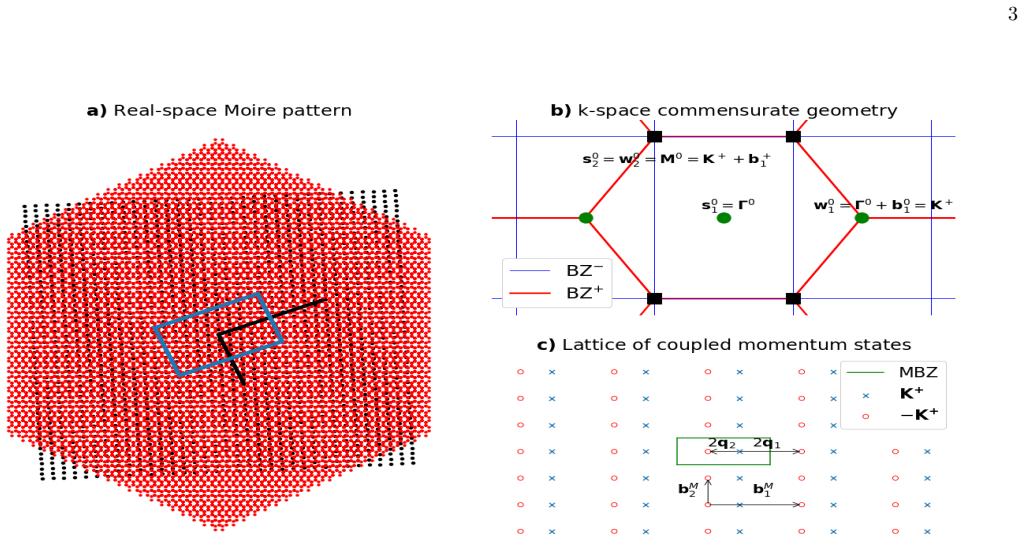
- [Section IV] In the paragraph defining the C3 model, the substrate reciprocal vector b0_1 is written twice; the second occurrence should be b0_2 = (0, 2π/(a√3)).
- [Figures 3(a)-(b)] The white missing points are mentioned in the caption but not discussed in the text; please state the convergence criterion and whether the missing points affect the claimed location and breadth of the magic manifold.
- [Appendix B] The statement that the two-k-point model approximates the first conduction band except near the MBZ edges is important because the anisotropy measures in Figs. 3(a)-(b) are defined along Γ-X and Γ-Y, which include the zone edges; a comparison with the full model for at least one parameter set would make the truncation error quantitative.
- [Introduction; Refs.] Reference [24] is cited as an arXiv e-print; if a published version is available, the citation should be updated.
Circularity Check
No significant circularity: the continuum-model derivation is self-contained, the SLL and flat-band results are computed consequences of an explicitly stated Hamiltonian, and the reduction to Ref. [1] is an external equivalence rather than a self-citation.
full rationale
The paper's central derivation starts from a microscopic tight-binding model and obtains the coupled-valley continuum Hamiltonian through Schrieffer-Wolff perturbation theory (Eqs. 1-3 and Appendix A). The Moiré potential matrices are then treated as arbitrary tuning parameters, which is an explicit model simplification rather than a hidden fit: the paper states 'Save for the symmetries enforced by the microscopic form of the tunneling matrices (Mx and τ), we now treat them as arbitrary tuning parameters,' and the subsequent numerical study scans this parameter space to locate a 'magic manifold' of strong anisotropy. The SLL phase is not used to select those parameters; it is a derived consequence of the computed tight-binding ratio t⊥/t∥ and Luttinger parameter geff, evaluated with interaction parameters taken from the independent work of Ref. [24]. The crossover-temperature formula is likewise imported from Ref. [24], not derived from the target result. The C3-symmetric model is shown to be exactly equivalent to the model of Ref. [1] by an explicit unitary transformation in Appendix C, and Ref. [1] (Scheer and Lian) has no author overlap with the present paper, so there is no load-bearing self-citation or imported 'uniqueness' theorem. The only notable limitation is that the paper does not demonstrate that a specific physical substrate realizes the chosen Moiré potential values; however, that is a question of physical realizability and parameter reachability, not circularity. No equation is equal to its input by construction, and no fitted parameter is renamed as a prediction. The analysis is therefore a self-contained model study with a normal, non-circular structure.
Assumptions & free parameters
free parameters (3)
- Moiré tunneling matrix parameters w0-w24 (anisotropy model) =
w3=70 meV, w6=40 meV, w9=20 meV, w13=40 meV, w1 varied; all others zero in simulations
- Screened interaction parameters UI, r0, EF =
UI=500 meV, r0=100 Å, EF=10 meV
- C3 model hopping matrices =
set to Ref. [1] Figure 3a values
assumptions (8)
- domain assumption Interlayer hopping obeys the two-center approximation: t depends only on real-space separation and orbital character
- domain assumption Substrate Hamiltonian is gapped at the relevant k-points s^-_i relative to the active-layer Fermi level
- domain assumption Only lowest-order tunneling matrices are kept and higher-energy active-layer states are projected out
- domain assumption In the anisotropy model, the active layer is gapped; the substrate has time-reversal symmetry, one active orbital, no spin-orbit coupling, and an in-plane magnetic field mixes spin sectors
- domain assumption The in-plane magnetic field does not alter interlayer tunneling amplitudes at lowest order, giving an emergent spinless time-reversal symmetry with τ^2=1
- domain assumption In the C3 model, the microscopic interlayer tunneling amplitude has no angular dependence and there is one active orbital in the substrate
- domain assumption C3-breaking perturbations are weak enough (at most 50 meV) to be treated perturbatively
- domain assumption Wires are weakly coupled (t⊥/t∥ << 1) and interactions are described by a screened Coulomb potential V(r)=UI e^{-r/r0}
Cite this review
Pith. "Pith review of Sliding Luttinger Liquid and Topological Flat Bands in Symmetry Mismatched Moir\'e Interfaces." pith.science (2026). https://pith.science/paper/XRQSHQJJ
@misc{pith2026241217973,
  author       = {Pith},
  title        = {Pith review of: Sliding Luttinger Liquid and Topological Flat Bands in Symmetry Mismatched Moir\'e Interfaces},
  year         = {2026},
  howpublished = {\url{https://pith.science/paper/XRQSHQJJ}},
  note         = {Machine review of arXiv:2412.17973}
}
abstract
In this work we analyze a class of Moir\'e models consisting of an active honeycomb monolayer such as graphene or a hexagonal transition-metal dichalcogenide (TMD) on top of a substrate, in which the K and K' valleys of the active layer are folded near each other by a suitably chosen substrate geometry. Generalizing the so-called ``coupled-valley'' model of Scheer et al. [1], we start from a microscopic tight-binding description, deriving a continuum model from Schrieffer-Wolff perturbation theory and obtaining an effective description of the low-energy momentum states in either valley as well as the explicit microscopic forms of the Moir\'e potentials. We then consider two explicit symmetry-mismatched Moir\'e geometries with a rectangular substrate, the first of which displays an emergent time-reversal symmetry as well as a broad parameter regime which displays quasi-1D physics characterized by the existence of a Sliding Luttinger Liquid phase. This model also has a nontrivial topological character, captured by the Berry curvature dipole. The second geometry displays an emergent $C_3$ rotational symmetry despite the rectangular substrate, reducing to a continuum model considered in Ref. [1] that was shown to display honeycomb and Kagome topological flat bands.
Figures


Figures from the paper (2 more)


Reference graph
Works this paper leans on
-
[1]
M. G. Scheer and B. Lian, Kagome and honeycomb flat bands in moir´ e graphene, Phys. Rev. B 108, 245136 (2023), arXiv:2303.03352 [cond-mat.mes-hall]
work page Pith review arXiv 2023
-
[24]
X. Du, L. Kang, Y. Y. Lv, J. S. Zhou, X. Gu, R. Z. Xu, Q. Q. Zhang, Z. X. Yin, W. X. Zhao, Y. D. Li, S. M. He, D. Pei, Y. B. Chen, M. X. Wang, Z. K. Liu, Y. L. Chen, and L. X. Yang, Crossed luttinger liquid hidden in a quasi-two-dimensional material, Nature Physics 19, 40–45 (2022)
work page 2022
-
[2]
If the set is nonempty, then it can be written as Lc = Span( bc 1, bc
contains more than just the zero vector. If the set is nonempty, then it can be written as Lc = Span( bc 1, bc
-
[3]
where bc 1, bc 2 are linearly independent and satisfy linear equations bc i =P j Aijb+ j = P j Bijb0 j where Aij, Bij are integers (such a choice of primitive vectors is nonunique). We then de- fine the Moir´ e reciprocal lattice primitive vectorsbM i = (P j Aijb+ j ) − (P j Bijb− j ) = (1 − Rθe−ϵ)bc i . The effect of the substrate layer will be to induce...
-
[4]
R. Bistritzer and A. H. MacDonald, Moir´ e bands in twisted double-layer graphene, Proceedings of the National Academy of Sciences 108, 12233 (2011), https://www.pnas.org/doi/pdf/10.1073/pnas.1108174108
-
[5]
Z. Song, Z. Wang, W. Shi, G. Li, C. Fang, and B. A. Bernevig, All magic angles in twisted bilayer graphene are topological, Physical Review Letters 123, 10.1103/physrevlett.123.036401 (2019)
-
[6]
M. G. Scheer and B. Lian, Twistronics of Kekul´ e Graphene: Honeycomb and Kagome Flat Bands, Phys. Rev. Lett. 131, 266501 (2023), arXiv:2305.19927 [cond- mat.mes-hall]
work page Pith review arXiv 2023
-
[7]
M. G. Scheer, K. Gu, and B. Lian, Magic angles in twisted bilayer graphene near commensuration: Towards a hy- permagic regime, Phys. Rev. B 106, 115418 (2022)
2022
Show all 47 references
-
[8]
Angeli and A
M. Angeli and A. H. MacDonald, γ valley transition metal dichalcogenide moir´ e bands, Proceedings of the National Academy of Sciences 118, e2021826118 (2021), https://www.pnas.org/doi/pdf/10.1073/pnas.2021826118. 10
2021 doi
-
[9]
F. Wu, T. Lovorn, E. Tutuc, I. Martin, and A. H. MacDonald, Topological insulators in twisted transition metal dichalcogenide homobilayers, Phys. Rev. Lett.122, 086402 (2019)
2019
-
[10]
J. Dong, J. Wang, P. J. Ledwith, A. Vishwanath, and D. E. Parker, Composite Fermi Liquid at Zero Magnetic Field in Twisted MoTe 2, Phys. Rev. Lett. 131, 136502 (2023), arXiv:2306.01719 [cond-mat.str-el]
2023 arXiv
-
[11]
Y. Cao, V. Fatemi, A. Demir, S. Fang, S. L. Tomarken, J. Y. Luo, J. D. Sanchez-Yamagishi, K. Watanabe, T. Taniguchi, E. Kaxiras, R. C. Ashoori, and P. Jarillo- Herrero, Correlated insulator behaviour at half-filling in magic-angle graphene superlattices, Nature 556, 80–84 (2018)
2018
-
[12]
K. Kim, A. DaSilva, S. Huang, B. Fallahazad, S. Larentis, T. Taniguchi, K. Watanabe, B. J. LeRoy, A. H. MacDon- ald, and E. Tutuc, Tunable moir´ e bands and strong corre- lations in small-twist-angle bilayer graphene, Proceedings of the National Academy of Sciences 114, 3364 (...
2017 doi
-
[13]
Serlin, C
M. Serlin, C. L. Tschirhart, H. Polshyn, Y. Zhang, J. Zhu, K. Watanabe, T. Taniguchi, L. Balents, and A. F. Young, Intrinsic quantized anomalous hall effect in a moir´ e heterostructure, Science 367, 900 (2020), https://www.science.org/doi/pdf/10.1126/science.aay5533
2020 doi
-
[14]
J. Cai, E. Anderson, C. Wang, X. Zhang, X. Liu, W. Holtzmann, Y. Zhang, F. Fan, T. Taniguchi, K. Watanabe, Y. Ran, T. Cao, L. Fu, D. Xiao, W. Yao, and X. Xu, Signatures of fractional quantum anomalous hall states in twisted mote2, Nature 622, 63–68 (2023)
2023
-
[15]
X. Lu, P. Stepanov, W. Yang, M. Xie, M. A. Aamir, I. Das, C. Urgell, K. Watanabe, T. Taniguchi, G. Zhang, A. Bachtold, A. H. MacDonald, and D. K. Efetov, Su- perconductors, orbital magnets and correlated states in magic-angle bilayer graphene, Nature 574, 653–657 (2019)
2019
-
[16]
Y. Cao, V. Fatemi, S. Fang, K. Watanabe, T. Taniguchi, E. Kaxiras, and P. Jarillo-Herrero, Unconventional super- conductivity in magic-angle graphene superlattices, Na- ture 556, 43–50 (2018)
2018
-
[17]
J. M. Luttinger, An Exactly Soluble Model of a Many-Fermion System, Journal of Mathematical Physics 4, 1154 (1963), https://pubs.aip.org/aip/jmp/article- pdf/4/9/1154/19057386/1154 1 online.pdf
1963
-
[18]
F. D. M. Haldane, ’Luttinger liquid theory’ of one- dimensional quantum fluids. I. Properties of the Lut- tinger model and their extension to the general 1D in- teracting spinless Fermi gas, Journal of Physics C Solid State Physics 14, 2585 (1981)
1981
-
[19]
S.-i. Tomonaga, Remarks on Bloch’s Method of Sound Waves applied to Many-Fermion Prob- lems, Progress of Theoretical Physics 5, 544 (1950), https://academic.oup.com/ptp/article- pdf/5/4/544/5430161/5-4-544.pdf
1950
-
[20]
Giamarchi and A
T. Giamarchi and A. J. Millis, Conductivity of a luttinger liquid, Phys. Rev. B 46, 9325 (1992)
1992
-
[21]
Mukhopadhyay, C
R. Mukhopadhyay, C. L. Kane, and T. C. Lubensky, Slid- ing Luttinger liquid phases, Phys. Rev. B 64, 045120 (2001), arXiv:cond-mat/0102163 [cond-mat.str-el]
2001 arXiv
-
[22]
X. G. Wen, Metallic non-fermi-liquid fixed point in two and higher dimensions, Phys. Rev. B 42, 6623 (1990)
1990
-
[23]
Vishwanath and D
A. Vishwanath and D. Carpentier, Two-dimensional anisotropic non-fermi-liquid phase of coupled luttinger liquids, Phys. Rev. Lett. 86, 676 (2001)
2001
-
[25]
L. Niu, S. Jin, X. Chen, X. Li, and X. Zhou, Observa- tion of a dynamical sliding phase superfluid with p-band bosons, Phys. Rev. Lett. 121, 265301 (2018)
2018
-
[26]
Y. Hu, Y. Xu, and B. Lian, Twisted Coupled Wire Model for moir´ e Sliding Luttinger Liquid, arXiv e-prints , arXiv:2310.04070 (2023), arXiv:2310.04070 [cond- mat.str-el]
2023 arXiv
-
[27]
Y.-M. Wu, C. Murthy, and S. A. Kivelson, Theory of possible sliding regimes in twisted bilayer WTe 2, arXiv e-prints , arXiv:2405.09616 (2024), arXiv:2405.09616 [cond-mat.str-el]
2024 arXiv
-
[28]
P. Wang, G. Yu, Y. H. Kwan, Y. Jia, S. Lei, S. Klemenz, F. A. Cevallos, R. Singha, T. Devakul, K. Watanabe, T. Taniguchi, S. L. Sondhi, R. J. Cava, L. M. Schoop, S. A. Parameswaran, and S. Wu, One-dimensional Lut- tinger liquids in a two-dimensional moir´ e lattice, Na- ture (...
2022 arXiv
-
[29]
H. Wang, Z. Liu, Y. Jiang, and J. Wang, Giant anisotropic band flattening in twisted Γ-valley semicon- ductor bilayers, Phys. Rev. B 108, L201120 (2023)
2023
-
[30]
J. R. Wallbank, M. Mucha-Kruczy´ nski, and V. I. Fal’ko, Moir´ e minibands in graphene heterostructures with al- most commensurate √ 3 × √ 3 hexagonal crystals, Phys. Rev. B 88, 155415 (2013)
2013
-
[31]
Dunbrack and J
A. Dunbrack and J. Cano, Magic angle conditions for twisted three-dimensional topological insulators, Phys. Rev. B 106, 075142 (2022)
2022
-
[32]
Q. Lu, C. Le, X. Zhang, J. Cook, X. He, M. Zarenia, M. Vaninger, P. F. Miceli, D. J. Singh, C. Liu, H. Qin, T.-C. Chiang, C.-K. Chiu, G. Vignale, and G. Bian, Dirac fermion cloning, moir´ e flat bands, and magic lattice con- stants in epitaxial monolayer graphene, Advanced Mat...
2022
-
[33]
C. Wu, Q. Wan, C. Peng, S. Mo, R. Li, K. Zhao, Y. Guo, S. Yuan, F. Wu, C. Zhang, and N. Xu, Tailoring dirac fermions by in-situ tunable high-order moir´ e pattern in graphene-monolayer xenon heterostructure, Phys. Rev. Lett. 129, 176402 (2022)
2022
-
[34]
J. Wang, F. Ma, and M. Sun, Graphene, hexagonal boron nitride, and their heterostructures: properties and appli- cations, RSC Adv. 7, 16801 (2017)
2017
-
[35]
S. Fang, R. Kuate Defo, S. N. Shirodkar, S. Lieu, G. A. Tritsaris, and E. Kaxiras, Ab initio tight-binding hamil- tonian for transition metal dichalcogenides, Phys. Rev. B 92, 205108 (2015)
2015
-
[36]
C.-H. Hsu, P. Stano, Y. Sato, S. Matsuo, S. Tarucha, and D. Loss, Charge transport of a spin-orbit-coupled luttinger liquid, Phys. Rev. B 100, 195423 (2019)
2019
-
[37]
S. Duan, F. Qin, P. Chen, X. Yang, C. Qiu, J. Huang, G. Liu, Z. Li, X. Bi, F. Meng, X. Xi, J. Yao, T. Ideue, B. Lian, Y. Iwasa, and H. Yuan, Berry cur- vature dipole generation and helicity-to-spin conversion at symmetry-mismatched heterointerfaces, Nature Nan- otechnology 18,...
2023
-
[38]
Sinha, P
S. Sinha, P. C. Adak, A. Chakraborty, K. Das, K. Deb- nath, L. D. V. Sangani, K. Watanabe, T. Taniguchi, U. V. Waghmare, A. Agarwal, and M. M. Deshmukh, 11 Berry curvature dipole senses topological transition in a moir´ e superlattice, Nature Physics 18, 765 (2022), arXiv:2204...
2022 arXiv
-
[39]
Z. Z. Du, H.-Z. Lu, and X. C. Xie, Nonlinear hall effects, Nature Reviews Physics 3, 744 (2021)
2021
-
[40]
D. L. Bergman, C. Wu, and L. Balents, Band touching from real-space topology in frustrated hopping models, Phys. Rev. B 78, 125104 (2008)
2008
-
[41]
C. Wu, D. Bergman, L. Balents, and S. Das Sarma, Flat bands and wigner crystallization in the honeycomb opti- cal lattice, Phys. Rev. Lett. 99, 070401 (2007)
2007
-
[42]
L. Xian, M. Claassen, D. Kiese, M. M. Scherer, S. Trebst, D. M. Kennes, and A. Rubio, Realization of nearly dis- persionless bands with strong orbital anisotropy from destructive interference in twisted bilayer mos2, Na- ture Communications 12, 10.1038/s41467-021-25922-8 (2021)
2021 doi
-
[43]
J.-X. Yin, B. Lian, and M. Z. Hasan, Topological kagome magnets and superconductors, Nature 612, 647–657 (2022)
2022
-
[44]
G. Xu, B. Lian, and S.-C. Zhang, Intrinsic quantum anomalous hall effect in the kagome lattice cs 2limn3f12, Phys. Rev. Lett. 115, 186802 (2015)
2015
-
[45]
S. Yan, D. A. Huse, and S. R. White, Spin-liquid ground state of the ¡i¿s¡/i¿ = 1/2 kagome heisen- berg antiferromagnet, Science 332, 1173 (2011), https://www.science.org/doi/pdf/10.1126/science.1201080. Appendix A: Coupled-V alley Continuum Model Construction Recipe We now pr...
2011 doi
-
[46]
We can glean several important pieces of information from this formula
is a reciprocal lattice vector in layer l, and |Ωl| denotes the primitive unit cell area in layer l. We can glean several important pieces of information from this formula. Firstly, the delta function enforces conservation of crystal momentum, so that tunneling be- tween state...
-
[47]
This error near the edges is insignificant compared to the bandwidths, and can thus be neglected
Such a procedure is justified because this min- imal two-k-point model approximates the energetics of the first conduction band well, except for near the MBZ edges where it differs from the full model slightly due to hybridization with other k-point states. This error near the...
Reviewed August 11, 2026 · model on record in the stance chip above.
Discussion (0). Continue with ORCID to comment.