REVIEW 2 major objections 5 minor 20 references
TNNGen: Automated Design of Neuromorphic Sensory Processing Units for Time-Series Clustering
T0 review · 2 major / 5 minor · reviewed 2026-08-11 · deepseek-v4-flash
Pith's one-line read TNNGen is an end-to-end design framework that automatically converts PyTorch temporal neural network models into post-layout chip netlists and hardware metrics, and it can forecast silicon area and leakage from synapse count alone.
desk verdict TNNGen is a real PyTorch-to-layout automation for TNNs with solid post-layout numbers, but its 'forecasting' is an in-sample linear fit with no held-out validation and should be reframed or re-validated. read the letter →
The pith
A machine-rendered reading of the paper's core claim, the machinery that carries it, and where it could break.
The reading
What carries the argument
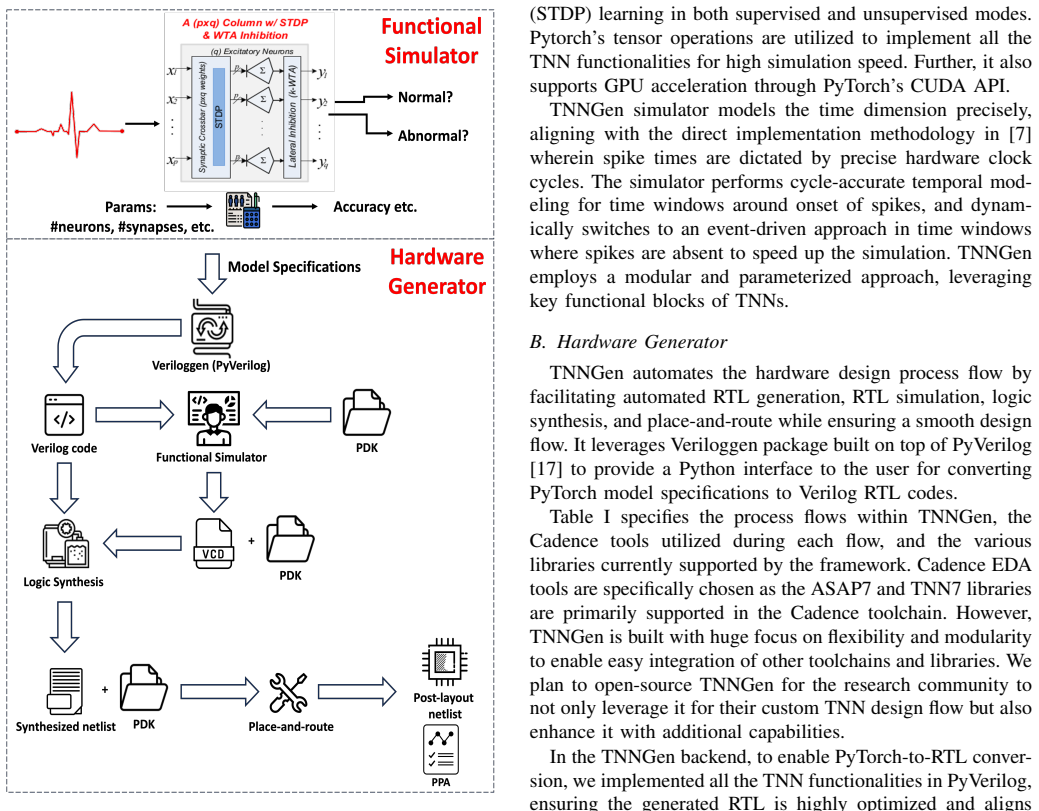
The load-bearing object is the parameterized single-column TNN, defined by $p$ synapses per neuron and $q$ neurons, with total synapse count $p \times q$ serving as the independent variable for hardware forecasting. The toolchain's engine is a two-part pipeline: a PyTorch functional simulator that implements spike-timing behavior (step-no-leak, leaky-integrate-and-fire, winner-take-all inhibition, and STDP) and a Python hardware generator built on a Verilog-processing toolkit that emits RTL, invokes synthesis and place-and-route, and applies tailored TCL scripts for standard and custom cell libraries. The forecasting stage compresses the physical-design outcome into two linear regressions on synapse count, which is what lets users skip the EDA flow entirely.
What would settle it
Run the TNNGen hardware flow on a TNN column with, say, 50 or 75 synapses using the same 7nm library, measure actual post-layout area and leakage, and compare them to $5.56\cdot 50 - 94.9$ and $0.00541\cdot 50 - 0.725$. The leakage formula predicts a negative number, so any positive measured leakage at that size falsifies the forecasting claim as stated; a 100-synapse design would test whether the linear model only needs a cutoff or is wrong outside the fitted range.
Extended reading notes
Core claim
The central claim is that the full design path for a temporal neural network—from a high-level PyTorch model to a placed-and-routed netlist—can be automated in one toolchain, and that the physical results are predictable from a single design parameter. Concretely, TNNGen translates TNN functional blocks into Verilog RTL, drives synthesis and place-and-route through automated scripts, and returns post-layout area, leakage, and latency. The paper reports that the largest benchmark column (270×25, 6,750 synapses) runs inference in 180 ns, fits in 0.035 mm², and dissipates 0.067 mW total power using a 7nm custom-macro library, and that area forecasts from the linear equation $\text{Area} = 5.56\cdot \text{SynapseCount} - 94.9$ match post-layout area to within 0.2% for that design. Leakage forecasts follow $\text{Leakage} = 0.00541\cdot \text{SynapseCount} - 0.725$, coming within 0.52% on the largest design, though the paper does not report leakage forecasts for the two smallest designs.
Load-bearing premise
The load-bearing premise is that post-layout area and leakage power follow straight lines as synapse count grows, so a regression fit from large designs stays valid for all sizes; the paper itself omits leakage forecasts for the two smallest designs because the fitted line would go negative, so the premise is already visibly strained at the small-design end.
Editorial extensions
If this is right
- TNN hardware design becomes a compile-like step: a designer edits a PyTorch model and receives a placed-and-routed netlist without writing RTL by hand.
- Teams without commercial EDA licenses can still get credible silicon estimates: area and leakage forecasts come from synapse count alone, with sub-1% error on large designs.
- The custom TNN7 macro suite provides a 32% place-and-route runtime improvement over a standard 7nm library, and reduces area and leakage by 32.1% and 38.6% respectively.
- The largest demonstrated design (6,750 synapses) is small enough and fast enough for real-time edge sensor processing: 0.035 mm², 0.067 mW total power, 180 ns per-sample latency.
- Automated exploration across sensory modalities becomes practical: seven different time-series clustering designs were generated and evaluated in one flow.
Reading between the lines
- A natural extension the paper leaves implicit is to use the same linear forecasts as a pre-layout design filter: a user with a power or area budget could reject a synapse count before any synthesis or place-and-route run. This extrapolates the model beyond the fitted range and would need validation on small designs.
- Because the simulator already exposes STDP and winner-take-all parameters, the same PyTorch-to-layout pipeline could be pointed at online-learning or classification benchmarks; the present evaluation only exercises unsupervised clustering.
- The reported 32% place-and-route runtime saving with custom macros hints that macro selection, not just synapse count, may drive physical-design cost, so a two-variable forecast adding macro density is a natural extension.
Editorial analysis
A structured set of objections, weighed in public.
Referee Report
Summary. TNNGen is presented as an automated design framework that takes PyTorch Temporal Neural Network (TNN) models through RTL generation, synthesis, and place-and-route to produce post-layout netlists and hardware metrics. The paper describes a PyTorch-based functional simulator and a Python/PyVerilog-based hardware generator integrated with Cadence tools and multiple PDKs (FreePDK45, ASAP7, TNN7). Seven single-column TNN designs from the UCR time-series archive are evaluated for clustering rand index and post-layout area, leakage, latency, and design-flow runtime. The authors also introduce a linear-regression forecasting feature for area and leakage as a function of synapse count, and report forecast errors in Table V.
Significance. If the framework performs as described, it is a useful step toward automating the design of application-specific neuromorphic chips. The paper's strengths include the end-to-end PyTorch-to-layout flow, post-layout (rather than post-synthesis) results across three libraries, runtime comparisons showing TNN7 macro benefits, and a functional simulator that supports multiple TNN configurations. The main flow results appear internally consistent: area and leakage grow with synapse count, and TNN7 shows clear improvements over ASAP7. However, the forecasting claim is a headline contribution and is not currently validated as a predictive tool.
major comments (2)
- [Section III-D, Table V, Fig. 4] The 'accurate forecasting' claim in the abstract and Section III-D is not supported as stated. The text says the regression model is 'trained on many TNNGen runs with varying TNN sizes,' but no training-set size, hold-out set, or cross-validation procedure is reported. Table V then reports forecast errors for the same seven benchmark designs that appear as the 'actual data points' in Fig. 4, and nothing indicates that these designs were excluded from the training runs. The errors are therefore in-sample residuals unless a validation split is documented. Please add a leave-one-out or held-out evaluation, or explicitly reframe the numbers as trendline fits rather than forecasts of unseen designs.
- [Section III-D, leakage equation and Table V] The leakage-prediction equation Leakage = 0.00541*SynapseCount - 0.725 has a negative intercept, so it produces nonphysical negative leakage values for designs below roughly 134 synapses. Consistently, Table V omits the two smallest designs (130 and 192 synapses) from the leakage forecast columns. This is a concrete indication that the linearity assumption fails at the small-design end, which is the range where the forecasting feature would be most useful. The area equation also has a negative intercept and can give nonphysical area for very small synapse counts. Please restrict the claimed validity range, report the small-design errors instead of omitting them, and/or use a model with nonnegative predictions.
minor comments (5)
- [Fig. 3 caption] The caption contains a typo: 'Innvous' should be 'Innovus'.
- [Table V] The abbreviations 'Syn.' and 'FC' are not expanded; please define them in the caption or table notes.
- [Abstract and Section II] The abstract states that 'there is no open-source functional simulation framework for TNNs,' while Section II says the authors plan to open-source TNNGen; consider clarifying that TNNGen is not yet open-sourced to avoid ambiguity about what is currently available.
- [Section II.A] The text uses 'Pytorch' instead of 'PyTorch' in the sentence beginning 'Pytorch's tensor operations'; please correct the capitalization.
- [Section III-B] The statement that TNN7 'achieves better area and leakage than ASAP7' could be made more precise by citing the 32.1% area and 38.6% leakage reductions from Tables III and IV, rather than leaving the reader to compute them.
Circularity Check
Forecasting claim rests on an in-sample linear fit with no held-out validation, so the reported 'forecast errors' are residuals, not predictions.
-
fitted input called prediction
[Section III-D, Table V and Fig. 4]
"This feature leverages the linear trends of area and leakage power with respect to total synapse count to build a linear regression model, which is trained on many TNNGen runs with varying TNN sizes. ... Table V along with Fig. 4 report the forecasting (FC) results for area and leakage power, along with their forecasting errors."
The linear regression coefficients are fitted to actual TNNGen runs, yet Table V reports 'forecast' errors for the same seven UCR benchmark designs whose actual post-layout values appear as data points in Fig. 4. No train/test split, hold-out set, or cross-validation is described anywhere in the paper. As presented, the FC errors in Table V are therefore in-sample residuals of the fitted line, not errors on unseen designs, so the claim that users can 'obtain key hardware results without running the actual process flow' reduces to evaluating the fit on its own training points.
full rationale
The hardware generation flow itself is largely self-contained: TNNGen converts PyTorch models to RTL and layout, and the reported post-layout area, leakage, and runtime values are genuine measurements from Cadence tools. Those measurements are not circular. The circularity is localized to the forecasting feature, which is a headline contribution. The paper states the regression model is 'trained on many TNNGen runs' but never documents a held-out evaluation; Table V then evaluates the fitted equations on the same seven designs used to illustrate the trend in Fig. 4. Because no independent test set is identified, the 'accurate forecasting' claim is currently supported only by in-sample residuals, and the leakage model's negative intercept shows the linearity assumption breaks down at the small-design end. This is a fitted-input-called-prediction pattern for the central forecasting claim. Self-citations to the authors' prior microarchitecture [7] and TNN7 macro suite [8] are used as implementation foundations and as points of comparison, but they are not load-bearing in a way that makes the main hardware measurements circular.
Assumptions & free parameters
free parameters (4)
- Area slope (5.56 um^2 per synapse) =
5.56
- Area intercept (-94.9 um^2) =
-94.9
- Leakage slope (0.00541 uW per synapse) =
0.00541
- Leakage intercept (-0.725 uW) =
-0.725
assumptions (3)
- domain assumption TNN functionality can be faithfully modeled cycle-accurately in PyTorch and translated to RTL via PyVerilog.
- domain assumption Post-layout metrics from Cadence tools with FreePDK45, ASAP7, and TNN7 libraries are accurate estimates of die area, leakage power, and latency.
- ad hoc to paper Area and leakage power are linear functions of synapse count across the tested design range.
Cite this review
Pith. "Pith review of TNNGen: Automated Design of Neuromorphic Sensory Processing Units for Time-Series Clustering." pith.science (2026). https://pith.science/paper/KTY2WTSE
@misc{pith2026241217977,
  author       = {Pith},
  title        = {Pith review of: TNNGen: Automated Design of Neuromorphic Sensory Processing Units for Time-Series Clustering},
  year         = {2026},
  howpublished = {\url{https://pith.science/paper/KTY2WTSE}},
  note         = {Machine review of arXiv:2412.17977}
}
read the original abstract
Temporal Neural Networks (TNNs), a special class of spiking neural networks, draw inspiration from the neocortex in utilizing spike-timings for information processing. Recent works proposed a microarchitecture framework and custom macro suite for designing highly energy-efficient application-specific TNNs. These recent works rely on manual hardware design, a labor-intensive and time-consuming process. Further, there is no open-source functional simulation framework for TNNs. This paper introduces TNNGen, a pioneering effort towards the automated design of TNNs from PyTorch software models to post-layout netlists. TNNGen comprises a novel PyTorch functional simulator (for TNN modeling and application exploration) coupled with a Python-based hardware generator (for PyTorch-to-RTL and RTL-to-Layout conversions). Seven representative TNN designs for time-series signal clustering across diverse sensory modalities are simulated and their post-layout hardware complexity and design runtimes are assessed to demonstrate the effectiveness of TNNGen. We also highlight TNNGen's ability to accurately forecast silicon metrics without running hardware process flow.
Figures


Figures from the paper (1 more)

Reference graph
Works this paper leans on
-
[1]
Time-series clustering–a decade review,
S. Aghabozorgi, A. S. Shirkhorshidi, and T. Y . Wah, “Time-series clustering–a decade review,” Information systems , vol. 53, pp. 16–38, 2015
work page 2015
-
[2]
S. Chaudhari, H. Nair, J. M. Moura, and J. P. Shen, “Unsupervised clustering of time series signals using neuromorphic energy-efficient temporal neural networks,” in ICASSP 2021-2021 IEEE International Conference on Acoustics, Speech and Signal Processing (ICASSP) . IEEE, 2021, pp. 7873–7877
work page 2021
-
[3]
Asap7: A 7-nm finfet predictive process design kit,
L. T. Clark, V . Vashishtha, L. Shifren, A. Gujja, S. Sinha, B. Cline, C. Ramamurthy, and G. Yeric, “Asap7: A 7-nm finfet predictive process design kit,” Microelectronics Journal, vol. 53, pp. 105–115, 2016
work page 2016
-
[4]
The UCR time series classi- fication archive,
H. A. Dau, E. Keogh, K. Kamgar, C.-C. M. Yeh, Y . Zhu, S. Gharghabi, C. A. Ratanamahatana, Yanping, B. Hu, N. Begum, A. Bagnall, A. Mueen, G. Batista, and Hexagon-ML, “The UCR time series classi- fication archive,” October 2018, https://www.cs.ucr.edu/ ∼eamonn/time series data 2018/
work page 2018
-
[5]
Deep learning,
Y . LeCun, Y . Bengio, and G. Hinton, “Deep learning,” nature, vol. 521, no. 7553, pp. 436–444, 2015
2015
-
[6]
Learning representations for time series clustering,
Q. Ma, J. Zheng, S. Li, and G. W. Cottrell, “Learning representations for time series clustering,” Advances in neural information processing systems, vol. 32, 2019
work page 2019
-
[7]
A microarchitecture implementation framework for online learning with temporal neural networks,
H. Nair, J. P. Shen, and J. E. Smith, “A microarchitecture implementation framework for online learning with temporal neural networks,” in 2021 IEEE Computer Society Annual Symposium on VLSI (ISVLSI) . IEEE, 2021, pp. 266–271
work page 2021
-
[8]
Tnn7: A custom macro suite for implementing highly optimized designs of neuromorphic tnns,
H. Nair, P. Vellaisamy, S. Bhasuthkar, and J. P. Shen, “Tnn7: A custom macro suite for implementing highly optimized designs of neuromorphic tnns,” in 2022 IEEE Computer Society Annual Symposium on VLSI (ISVLSI). IEEE, 2022, pp. 152–157
work page 2022
Show all 20 references
-
[9]
(2022) Ai is harming our planet: addressing ai’s staggering energy cost
Numenta. (2022) Ai is harming our planet: addressing ai’s staggering energy cost. [Online]. Available: https://www.numenta.com/blog/2022/ 05/24/ai-is-harming-our-planet/
2022
-
[10]
Ascend-freepdk45: An open source standard cell library for asyn- chronous design,
C. H. Oliveira, M. T. Moreira, R. A. Guazzelli, and N. L. Calazans, “Ascend-freepdk45: An open source standard cell library for asyn- chronous design,” in 2016 IEEE International Conference on Electron- ics, Circuits and Systems (ICECS) . IEEE, 2016, pp. 652–655
2016
-
[11]
(2018) Ai and compute
OpenAI. (2018) Ai and compute. [Online]. Available: https://openai. com/blog/ai-and-compute/
2018
-
[12]
Pytorch: An imperative style, high-performance deep learning library,
A. Paszke, S. Gross, F. Massa, A. Lerer, J. Bradbury, G. Chanan, T. Killeen, Z. Lin, N. Gimelshein, L. Antiga et al. , “Pytorch: An imperative style, high-performance deep learning library,” Advances in neural information processing systems , vol. 32, 2019
2019
-
[13]
Cortical columns computing systems: Microar- chitecture model, functional building blocks, and design tools,
J. P. Shen and H. Nair, “Cortical columns computing systems: Microar- chitecture model, functional building blocks, and design tools,” 2023
2023
-
[14]
Space-time algebra: A model for neocortical computation,
J. Smith, “Space-time algebra: A model for neocortical computation,” in 2018 ACM/IEEE 45th Annual International Symposium on Computer Architecture (ISCA). IEEE, 2018, pp. 289–300
2018
-
[15]
Space-time computing with temporal neural networks,
J. E. Smith, “Space-time computing with temporal neural networks,” Synthesis Lectures on Computer Architecture , vol. 12, no. 2, pp. i–215, 2017
2017
-
[16]
A temporal neural network architecture for online learning,
J. E. Smith, “A temporal neural network architecture for online learning,” arXiv preprint arXiv:2011.13844 , 2020
2011 arXiv
-
[17]
Pyverilog: A python-based hardware design processing toolkit for verilog hdl,
S. Takamaeda-Yamazaki, “Pyverilog: A python-based hardware design processing toolkit for verilog hdl,” in Applied Reconfigurable Computing, ser. Lecture Notes in Computer Science, vol. 9040. Springer International Publishing, Apr 2015, pp. 451–460. [Online]. Available: http://...
2015 doi
-
[18]
The com- putational limits of deep learning,
N. C. Thompson, K. Greenewald, K. Lee, and G. F. Manso, “The com- putational limits of deep learning,” arXiv preprint arXiv:2007.05558 , 2020
2007 arXiv
-
[19]
Towards a design framework for tnn-based neuromorphic sensory processing units,
P. Vellaisamy and J. P. Shen, “Towards a design framework for tnn-based neuromorphic sensory processing units,” arXiv preprint arXiv:2205.14248, 2022
2022 arXiv
-
[20]
Salient subsequence learning for time series clustering,
Q. Zhang, J. Wu, P. Zhang, G. Long, and C. Zhang, “Salient subsequence learning for time series clustering,” IEEE transactions on pattern anal- ysis and machine intelligence , vol. 41, no. 9, pp. 2193–2207, 2018
2018
Reviewed August 11, 2026 · model on record in the stance chip above.
Discussion (0). Continue with ORCID to comment.