REVIEW 4 major objections 4 minor 41 references
Data-driven Modeling of Parameterized Nonlinear Fluid Dynamical Systems with a Dynamics-embedded Conditional Generative Adversarial Network
T0 review · 4 major / 4 minor · reviewed 2026-08-11 · deepseek-v4-flash
Pith's one-line read A conditional GAN with an embedded dynamics block predicts unsteady flow fields from system parameters.
desk verdict Plausible surrogate architecture with one solid empirical nugget (T ≈ 25), but the evaluation as written doesn't support the parameter-generalization claim. read the letter →
The pith
A machine-rendered reading of the paper's core claim, the machinery that carries it, and where it could break.
The reading
What carries the argument
The central object is the dynamics block: a multilayer perceptron that approximates the latent state-transition map $A$ in $\phi_{t+1} = A(\phi_t)$. It sits inside the generator of a conditional GAN, where system parameters are dense-mapped to the initial latent vector $\phi_0$, and the same map $A$ is applied recursively for $T$ steps before the decoder reconstructs the flow fields. This component forces the network to represent the flow's temporal evolution explicitly in a low-dimensional space, rather than learning a pure black-box mapping from parameters to output fields, and it turns the prediction horizon $T$ into a central training hyperparameter.
What would settle it
Train Dyn-cGAN for flow over a cylinder on Reynolds numbers between 400 and 3500, then evaluate its recursive 50-step predictions at Re = 4000, outside the training range; if the transverse-velocity error grows by an order of magnitude relative to in-range test errors, the single-map latent-dynamics assumption is violated.
Extended reading notes
Core claim
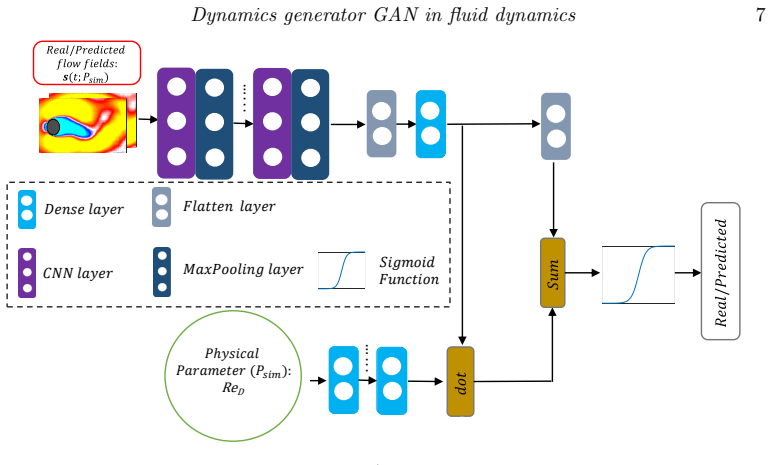
The central claim is that a generator with an embedded dynamics block can simultaneously identify a parameterized nonlinear system's temporal dynamics and their dependence on system parameters from data alone. The generator maps the physical parameters (Reynolds number) through dense layers to an initial latent vector $\phi_0$, then recursively applies a learned nonlinear transition $A$ so that $\phi_{t+1} = A(\phi_t)$ for a specified number of steps, and decodes the resulting sequence to full flow fields. A discriminator conditioned on the same parameters supplies an adversarial loss, which is combined with a mean-squared-error prediction loss to make the generator produce fields that are both pointwise close to and distributionally similar to the ground truth. The paper reports that this Dyn-cGAN predicts flow over a cylinder and in a lid-driven cavity for Reynolds numbers in ranges such as 400 to 3500 and 1000 to 10000, with accuracy decreasing at higher Reynolds numbers.
Load-bearing premise
The model assumes that all parameter effects on the flow can be captured by the initial latent state, so that one fixed transition rule $A$ works for every Reynolds number.
Editorial extensions
If this is right
- Within the tested parameter ranges, the trained network can produce flow-field sequences for Reynolds numbers it has not seen, without rerunning a CFD solver.
- Because the dynamics live in a low-dimensional latent space, the latent trajectories may double as a reduced-order model of the flow, speeding up parameter exploration during design.
- The observed optimal training horizon (near $T = 25$) indicates that recursive training with a moderate unrolled length is a practical recipe for obtaining long-horizon surrogate predictions.
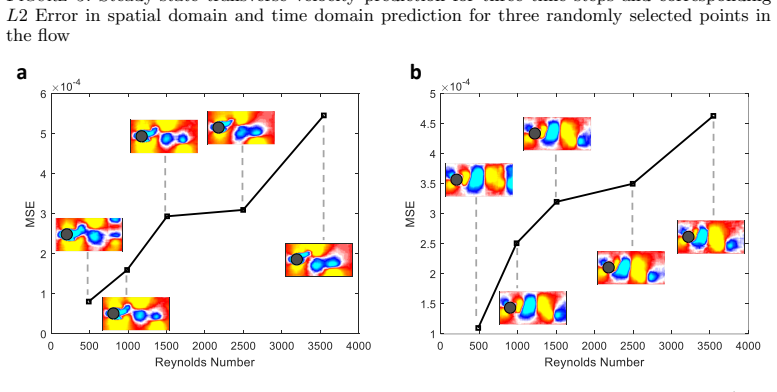
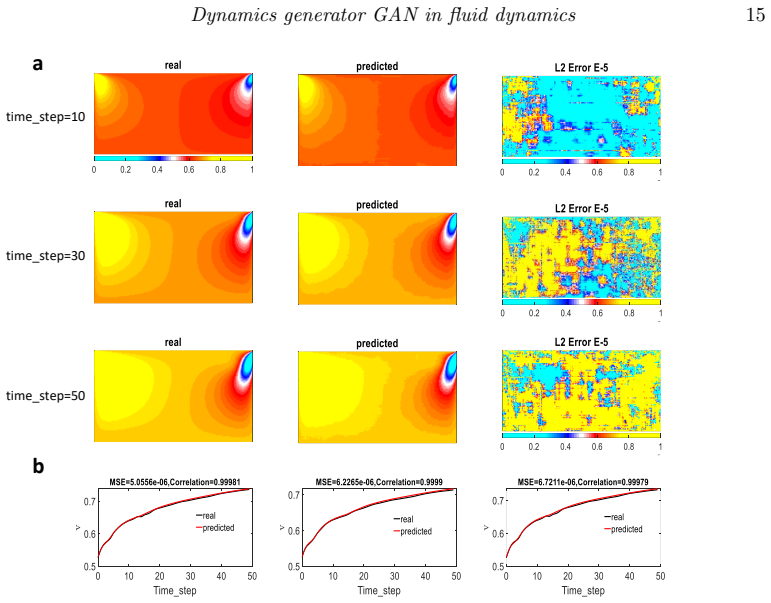
- Prediction accuracy degrades as the Reynolds number increases, mapping the practical envelope of the surrogate for both the cylinder and cavity cases.
Reading between the lines
- The architecture implicitly assumes that every Reynolds-number effect can be absorbed into the initial latent state $\phi_0$; a natural test is whether latent trajectories for different Reynolds numbers are related by a smooth, time-independent coordinate change, as in Koopman-style embeddings.
- The reported optimal horizon of about 25 steps is likely connected to the flow's predictability time; estimating the Lyapunov time of the latent dynamics could turn horizon selection from a hyperparameter sweep into a first-principles choice.
- The single-map assumption will break where a small parameter change crosses a qualitative transition, such as the onset of vortex shedding or turbulence; the paper does not test this regime, so extrapolation beyond the training range is the clearest vulnerability.
Editorial analysis
A structured set of objections, weighed in public.
Referee Report
Summary. The manuscript proposes Dyn-cGAN, a conditional generative adversarial network augmented with an explicit dynamics block, for data-driven surrogate modeling of parameterized nonlinear fluid flows. The generator maps a physical parameter (Reynolds number) to a latent initial condition, evolves it with a learned transition map phi_{t+1}=A(phi_t), and decodes the latent trajectory into flow-field sequences. The method is evaluated on flow over a cylinder (steady and transient) and a 2-D lid-driven cavity, with qualitative field plots, L2/spatial errors, and per-point time-series metrics. The paper also studies the effect of the training prediction horizon T and reports an optimal value around T=25.
Significance. If the central claim holds, the architecture offers a interpretable, parameter-conditioned surrogate where temporal dynamics are explicitly separated from parameter dependence, which would be a useful step beyond black-box conditional GANs for CFD. The paper's strengths are the explicit dynamics block, the evaluation on two canonical flow problems, and the investigation of the prediction-horizon trade-off. However, the evidence is currently insufficient: there are no baseline comparisons, no error bars from repeated runs, no held-out Reynolds-number split, and the parameter-invariance of the latent map A is asserted rather than tested. These gaps directly affect the validity of the central claim of accurate parameterized prediction.
major comments (4)
- [§4.1.2, §4.2.2] The central claim that Dyn-cGAN predicts flow fields for a range of Reynolds numbers is not supported by a held-out parameter split. The text states that training sets include Re ranges (e.g., 400–3500 in §4.1.2), but it never states whether the reported predictions and errors are for Reynolds numbers excluded from training. If all 100 samples are used for training, the low errors could reflect memorization rather than generalization to new parameters. Please specify the train/test split by Reynolds number and report errors separately for held-out Re values.
- [§4.3] The optimal prediction horizon T=25 is selected using the test period. Figure 12 and the accompanying text report MSE and mutual information between predictions and ground truths to identify the best T, but these metrics are computed on the testing predictions. Selecting hyperparameters on the test set leads to optimistic performance estimates and compromises the validity of the reported T=25 result. Please use a separate validation set to choose T and report the test-set performance only for the final selected model.
- [Eq. (2.4), §3.2] The model assumes that a single time-invariant transition map A in latent space represents the dynamics for all parameter values, with parameter dependence entering only through the initial latent vector phi_0. This is a strong representational assumption: it presumes that Reynolds-number dependence is fully absorbed by a coordinate transformation in latent space. The paper does not test this assumption, e.g., by examining latent trajectories for different Re, by checking whether the learned A is consistent across parameters, or by extrapolating to Re values outside the training range. Without such a test, the claimed parameterized generalization is unverified.
- [§4] The quantitative evaluation lacks baseline comparisons and error bars. No comparison is made to a standard conditional GAN without the dynamics block, to other surrogate models, or to classical reduced-order methods, so the reader cannot judge whether the dynamics block provides any benefit. In addition, all reported errors appear to come from a single training run; without multiple independent runs or error bars, it is impossible to assess the significance of the reported differences, including the optimal-T claim in §4.3.
minor comments (4)
- [Eq. (3.3)] There is a typo in the text: 'where beta1 and beta1 are loss weights' should read 'beta1 and beta2'.
- [§4.1.1] The figure reference for the streamlines appears to be misnumbered: 'Fig. 10 displays the streamlines' should likely be Fig. 11, since the streamlines figure is captioned as Figure 11 in the manuscript.
- [Fig. 12(a)] The panels in Fig. 12(a) are referenced in the text (T=5, 10, 25, 50, 100, 200), but the figure as printed is difficult to read; please enlarge the panels and ensure the time-series and phase-portrait axes are legible.
- [§3.2] The notation lambda_G_pred in Eq. (3.1) uses nonstandard punctuation (a comma inside the norm), and the definition of the MSE norm is not given; please clarify the vector norm used for the flow-field comparison.
Circularity Check
No circularity: the Dyn-cGAN model is an empirical surrogate trained on data, and its dynamics-block ansatz and parameter conditioning are modeling choices rather than predictions derived from their own inputs.
full rationale
The paper makes no first-principles derivation claim; it is an empirical surrogate-modeling study. The latent transition phi_{t+1}=A(phi_t) (Eq. 2.4) is presented as the chosen architecture, not as a consequence of the Navier-Stokes equations or of any prior result. The parameters Psim are inputs to the generator, and the network weights are fit by the MSE and adversarial losses (Eqs. 3.1-3.4); the reported quantities (L2 error, MSE, correlation, mutual information) are comparisons of generated sequences with ground-truth data on samples, not quantities that were minimized and then re-reported. No fitted parameter is renamed as a prediction, and no uniqueness theorem or load-bearing self-citation is invoked. The self-citations (Li & Yang 2021a,b; Li et al. 2019) appear only in the related-work survey and as an activation-function reference, and the data sets are generated from external CFD references (Peng et al. 2003; Bruneau & Saad 2006). The absence of a held-out Reynolds-number split and the use of test error to select T=25 are validity/robustness concerns, not circularity; the paper does not define its target in terms of its inputs. Acknowledged limitations (long-horizon error accumulation, need for turbulent/3D/PIV validation) further show the claims are empirical and falsifiable. Therefore no circular step can be identified.
Assumptions & free parameters
free parameters (6)
- beta1 (prediction loss weight) =
100
- beta2 (adversarial loss weight for generator) =
10 or 1
- gamma (discriminator adversarial loss weight) =
10
- learning rate alpha =
0.00001
- dynamics-block prediction horizon T =
25 (optimal for one case)
- network layer widths and latent dimension =
not reported
assumptions (5)
- domain assumption The incompressible Navier-Stokes equations govern the flows and the CFD data are accurate ground truth.
- domain assumption A single Reynolds number is a sufficient conditioning variable for the flow systems studied.
- ad hoc to paper There exists a low-dimensional latent space in which the flow dynamics are autonomous and can be represented by a single map A.
- domain assumption The chosen neural network architecture can approximate the solution operator F for the parameter range.
- standard math MSE and mutual information computed with scikit-learn are valid measures of prediction quality.
Cite this review
Pith. "Pith review of Data-driven Modeling of Parameterized Nonlinear Fluid Dynamical Systems with a Dynamics-embedded Conditional Generative Adversarial Network." pith.science (2026). https://pith.science/paper/AG22PFHY
@misc{pith2026241217978,
  author       = {Pith},
  title        = {Pith review of: Data-driven Modeling of Parameterized Nonlinear Fluid Dynamical Systems with a Dynamics-embedded Conditional Generative Adversarial Network},
  year         = {2026},
  howpublished = {\url{https://pith.science/paper/AG22PFHY}},
  note         = {Machine review of arXiv:2412.17978}
}
read the original abstract
This work presents a data-driven solution to accurately predict parameterized nonlinear fluid dynamical systems using a dynamics-generator conditional GAN (Dyn-cGAN) as a surrogate model. The Dyn-cGAN includes a dynamics block within a modified conditional GAN, enabling the simultaneous identification of temporal dynamics and their dependence on system parameters. The learned Dyn-cGAN model takes into account the system parameters to predict the flow fields of the system accurately. We evaluate the effectiveness and limitations of the developed Dyn-cGAN through numerical studies of various parameterized nonlinear fluid dynamical systems, including flow over a cylinder and a 2-D cavity problem, with different Reynolds numbers. Furthermore, we examine how Reynolds number affects the accuracy of the predictions for both case studies. Additionally, we investigate the impact of the number of time steps involved in the process of dynamics block training on the accuracy of predictions, and we find that an optimal value exists based on errors and mutual information relative to the ground truth.
Figures


Figures from the paper (9 more)






Reference graph
Works this paper leans on
-
[1]
, " * write output.state after.block = add.period write newline
ENTRY address author booktitle chapter edition editor howpublished institution journal key month note number organization pages publisher school series title type volume year eprint label extra.label sort.label short.list INTEGERS output.state before.all mid.sentence after.sentence after.block FUNCTION init.state.consts #0 'before.all := #1 'mid.sentence ...
-
[2]
write newline
" write newline "" before.all 'output.state := FUNCTION n.dashify 't := "" t empty not t #1 #1 substring "-" = t #1 #2 substring "--" = not "--" * t #2 global.max substring 't := t #1 #1 substring "-" = "-" * t #2 global.max substring 't := while if t #1 #1 substring * t #2 global.max substring 't := if while FUNCTION word.in bbl.in capitalize " " * FUNCT...
-
[3]
Structural Control and Health Monitoring 24 (3), e1889
Bao, Yuequan , Shi, Zuoqiang , Beck, James L , Li, Hui & Hou, Thomas Y 2017 Identification of time-varying cable tension forces based on adaptive sparse time-frequency analysis of cable vibrations . Structural Control and Health Monitoring 24 (3), e1889
work page 2017
-
[4]
Computational Mechanics 64 (2), 525--545
Bhatnagar, Saakaar , Afshar, Yaser , Pan, Shaowu , Duraisamy, Karthik & Kaushik, Shailendra 2019 Prediction of aerodynamic flow fields using convolutional neural networks . Computational Mechanics 64 (2), 525--545
work page 2019
-
[5]
Computers & fluids 35 (3), 326--348
Bruneau, Charles-Henri & Saad, Mazen 2006 The 2d lid-driven cavity problem revisited . Computers & fluids 35 (3), 326--348
work page 2006
-
[6]
Proceedings of the national academy of sciences 113 (15), 3932--3937
Brunton, Steven L , Proctor, Joshua L & Kutz, J Nathan 2016 Discovering governing equations from data by sparse identification of nonlinear dynamical systems . Proceedings of the national academy of sciences 113 (15), 3932--3937
work page 2016
-
[7]
IEEE Transactions on Power Systems
Cai, Yaojie , Wang, Xiaozhe , Joos, Geza & Kamwa, Innocent 2022 An online data-driven method to locate forced oscillation sources from power plants based on sparse identification of nonlinear dynamics (sindy) . IEEE Transactions on Power Systems
work page 2022
-
[8]
In 2020 IEEE 32nd International Conference on Tools with Artificial Intelligence (ICTAI)\/ , pp
Chen, Donglin , Gao, Xiang , Xu, Chuanfu , Chen, Shizhao , Fang, Jianbin , Wang, Zhenghua & Wang, Zheng 2020 Flowgan: a conditional generative adversarial network for flow prediction in various conditions. In 2020 IEEE 32nd International Conference on Tools with Artificial Intelligence (ICTAI)\/ , pp. 315--322 . IEEE
work page 2020
Show all 41 references
-
[9]
Computer Methods in Applied Mechanics and Engineering 365 , 113000
Cheng, M , Fang, Fangxin , Pain, Christopher C & Navon, IM 2020 Data-driven modelling of nonlinear spatio-temporal fluid flows using a deep convolutional generative adversarial network . Computer Methods in Applied Mechanics and Engineering 365 , 113000
2020
-
[10]
The Annals of Statistics pp
Csiszar, Imre 1989 A geometric interpretation of darroch and ratcliff's generalized iterative scaling . The Annals of Statistics pp. 1409--1413
1989
-
[11]
Physics of Fluids 31 (12), 125111
Deng, Zhiwen , He, Chuangxin , Liu, Yingzheng & Kim, Kyung Chun 2019 Super-resolution reconstruction of turbulent velocity fields using a generative adversarial network-based artificial intelligence framework . Physics of Fluids 31 (12), 125111
2019
-
[12]
Strain 55 (1), e12297
Dervilis, Nikolaos , Simpson, Thomas E , Wagg, David J & Worden, Keith 2019 Nonlinear modal analysis via non-parametric machine learning tools . Strain 55 (1), e12297
2019
-
[13]
arXiv preprint arXiv:1709.02432
Farimani, Amir Barati , Gomes, Joseph & Pande, Vijay S 2017 Deep learning the physics of transport phenomena . arXiv preprint arXiv:1709.02432
2017 arXiv
-
[14]
arXiv preprint arXiv:2006.04731
Geneva, Nicholas & Zabaras, Nicholas 2020 Multi-fidelity generative deep learning turbulent flows . arXiv preprint arXiv:2006.04731
2020 arXiv
-
[15]
In Proceedings of the thirteenth international conference on artificial intelligence and statistics\/ , pp
Glorot, Xavier & Bengio, Yoshua 2010 Understanding the difficulty of training deep feedforward neural networks. In Proceedings of the thirteenth international conference on artificial intelligence and statistics\/ , pp. 249--256 . JMLR Workshop and Conference Proceedings
2010
-
[16]
Communications of the ACM 63 (11), 139--144
Goodfellow, Ian , Pouget-Abadie, Jean , Mirza, Mehdi , Xu, Bing , Warde-Farley, David , Ozair, Sherjil , Courville, Aaron & Bengio, Yoshua 2020 Generative adversarial networks . Communications of the ACM 63 (11), 139--144
2020
-
[17]
In Proceedings of the 22nd ACM SIGKDD international conference on knowledge discovery and data mining\/ , pp
Guo, Xiaoxiao , Li, Wei & Iorio, Francesco 2016 Convolutional neural networks for steady flow approximation. In Proceedings of the 22nd ACM SIGKDD international conference on knowledge discovery and data mining\/ , pp. 481--490
2016
-
[18]
Computer Methods in Applied Mechanics and Engineering 318 , 382--411
Huang, Yong , Beck, James L & Li, Hui 2017 Bayesian system identification based on hierarchical sparse bayesian learning and gibbs sampling with application to structural damage assessment . Computer Methods in Applied Mechanics and Engineering 318 , 382--411
2017
-
[19]
In 2020 IEEE/RSJ International Conference on Intelligent Robots and Systems (IROS)\/ , pp
Jegorova, Marija , Smith, Joshua , Mistry, Michael & Hospedales, Timothy 2020 Adversarial generation of informative trajectories for dynamics system identification. In 2020 IEEE/RSJ International Conference on Intelligent Robots and Systems (IROS)\/ , pp. 7109--7115 . IEEE
2020
-
[20]
Proceedings of the Royal Society A 476 (2242), 20200279
Kaheman, Kadierdan , Kutz, J Nathan & Brunton, Steven L 2020 Sindy-pi: a robust algorithm for parallel implicit sparse identification of nonlinear dynamics . Proceedings of the Royal Society A 476 (2242), 20200279
2020
-
[21]
arXiv preprint arXiv:1312.6114
Kingma, Diederik P & Welling, Max 2013 Auto-encoding variational bayes . arXiv preprint arXiv:1312.6114
2013 arXiv
-
[22]
Physical Review E 100 (2), 022220
Li, Shanwu , Kaiser, Eurika , Laima, Shujin , Li, Hui , Brunton, Steven L & Kutz, J Nathan 2019 Discovering time-varying aerodynamics of a prototype bridge by sparse identification of nonlinear dynamical systems . Physical Review E 100 (2), 022220
2019
-
[23]
Journal of Wind Engineering and Industrial Aerodynamics 172 , 196--211
Li, Shanwu , Laima, Shujin & Li, Hui 2018 a\/ Data-driven modeling of vortex-induced vibration of a long-span suspension bridge using decision tree learning and support vector regression . Journal of Wind Engineering and Industrial Aerodynamics 172 , 196--211
2018
-
[24]
Engineering Structures 155 , 1--15
Li, Shunlong , Wei, Shiyin , Bao, Yuequan & Li, Hui 2018 b\/ Condition assessment of cables by pattern recognition of vehicle-induced cable tension ratio . Engineering Structures 155 , 1--15
2018
-
[25]
Nonlinear Dynamics 106 (4), 3231--3246
Li, Shanwu & Yang, Yongchao 2021 a\/ Data-driven identification of nonlinear normal modes via physics-integrated deep learning . Nonlinear Dynamics 106 (4), 3231--3246
2021
-
[26]
Nonlinear Dynamics 105 (4), 3409--3422
Li, Shanwu & Yang, Yongchao 2021 b\/ Hierarchical deep learning for data-driven identification of reduced-order models of nonlinear dynamical systems . Nonlinear Dynamics 105 (4), 3409--3422
2021
-
[27]
Nature communications 9 (1), 1--10
Lusch, Bethany , Kutz, J Nathan & Brunton, Steven L 2018 Deep learning for universal linear embeddings of nonlinear dynamics . Nature communications 9 (1), 1--10
2018
-
[28]
arXiv preprint arXiv:2002.00470
Maulik, Romit , Lusch, Bethany & Balaprakash, Prasanna 2020 Reduced-order modeling of advection-dominated systems with recurrent neural networks and convolutional autoencoders . arXiv preprint arXiv:2002.00470
2020 arXiv
-
[29]
Computers & Fluids 32 (3), 337--352
Peng, Yih-Ferng , Shiau, Yuo-Hsien & Hwang, Robert R 2003 Transition in a 2-d lid-driven cavity flow . Computers & Fluids 32 (3), 337--352
2003
-
[30]
Chaos: An Interdisciplinary Journal of Nonlinear Science 28 (6), 063116
Quade, Markus , Abel, Markus , Nathan Kutz, J & Brunton, Steven L 2018 Sparse identification of nonlinear dynamics for rapid model recovery . Chaos: An Interdisciplinary Journal of Nonlinear Science 28 (6), 063116
2018
-
[31]
Science 367 (6481), 1026--1030
Raissi, Maziar , Yazdani, Alireza & Karniadakis, George Em 2020 Hidden fluid mechanics: Learning velocity and pressure fields from flow visualizations . Science 367 (6481), 1026--1030
2020
-
[32]
IEEE Transactions on Power Systems 34 (6), 5044--5052
Ren, Chao & Xu, Yan 2019 A fully data-driven method based on generative adversarial networks for power system dynamic security assessment with missing data . IEEE Transactions on Power Systems 34 (6), 5044--5052
2019
-
[33]
Robotics and Autonomous Systems 124 , 103386
Ren, Hailin & Ben-Tzvi, Pinhas 2020 Learning inverse kinematics and dynamics of a robotic manipulator using generative adversarial networks . Robotics and Autonomous Systems 124 , 103386
2020
-
[34]
Journal of Design Studio 6 (2), 325--335
Shafa, Seyedehzahra 2024 a\/ Ranking of smart building design factors with efficient energy management systems and renewable resources . Journal of Design Studio 6 (2), 325--335
2024
-
[35]
Journal of Design Studio 6 (2), 383--395
Shafa, Seyedehzahra 2024 b\/ Smart materials in green architecture: The role of etfe and phase change materials in sustainable building design . Journal of Design Studio 6 (2), 383--395
2024
-
[36]
arXiv preprint arXiv:2109.11213
Simpson, Thomas , Dervilis, Nikolaos & Chatzi, Eleni 2021 Machine learning approach to model order reduction of nonlinear systems via autoencoder and lstm networks . arXiv preprint arXiv:2109.11213
2021 arXiv
-
[37]
arXiv preprint arXiv:1802.00775
Str \"o fer, Carlos Michel \'e n , Wu, Jinlong , Xiao, Heng & Paterson, Eric 2018 Data-driven, physics-based feature extraction from fluid flow fields . arXiv preprint arXiv:1802.00775
2018 arXiv
-
[38]
Mechanical Systems and Signal Processing 166 , 108473
Tsialiamanis, George , Champneys, MD , Dervilis, Nikolaos , Wagg, David J & Worden, Keith 2022 On the application of generative adversarial networks for nonlinear modal analysis . Mechanical Systems and Signal Processing 166 , 108473
2022
-
[39]
In Proceedings of the 26th ACM SIGKDD International Conference on Knowledge Discovery & Data Mining\/ , pp
Wang, Rui , Kashinath, Karthik , Mustafa, Mustafa , Albert, Adrian & Yu, Rose 2020 Towards physics-informed deep learning for turbulent flow prediction. In Proceedings of the 26th ACM SIGKDD International Conference on Knowledge Discovery & Data Mining\/ , pp. 1457--1466
2020
-
[40]
Mechanical Systems and Signal Processing 84 , 34--53
Worden, K & Green, PL 2017 A machine learning approach to nonlinear modal analysis . Mechanical Systems and Signal Processing 84 , 34--53
2017
-
[41]
ACM Transactions on Graphics (TOG) 37 (4), 1--15
Xie, You , Franz, Erik , Chu, Mengyu & Thuerey, Nils 2018 tempogan: A temporally coherent, volumetric gan for super-resolution fluid flow . ACM Transactions on Graphics (TOG) 37 (4), 1--15
2018
Reviewed August 11, 2026 · model on record in the stance chip above.
Discussion (0). Continue with ORCID to comment.