REVIEW 4 major objections 7 minor 3 cited by
AIGT: AI Generative Table Based on Prompt
T0 review · 4 major / 7 minor · reviewed 2026-08-11 · deepseek-v4-flash
Pith's one-line read Prompt-enhanced LLMs can generate synthetic tables that beat GAN, VAE, and diffusion baselines on most benchmarks.
desk verdict AIGT's partition algorithm and prompt design are worth attention, but the re-labeling step confounds the headline ML-efficiency results, so the SOTA claim needs an ablation without re-labeling. read the letter →
The pith
A machine-rendered reading of the paper's core claim, the machinery that carries it, and where it could break.
The reading
What carries the argument
The load-bearing mechanism is the prompt-enhanced textual encoding: a fixed metadata prompt is prepended to each serialized row, with the label column fixed first and all other columns randomly shuffled, while the loss ignores prompt tokens. This teaches the language model the semantic role of each column instead of just the token statistics. The second mechanism is the long-token partitioning algorithm, which splits wide tables into overlapping column partitions, trains them jointly, and generates partitions from the last to the first, using each partition's overlap as the conditioning context; this is what removes the token-limit barrier for LLM-based synthesizers.
What would settle it
Generate AIGT synthetic data with the re-labeling step disabled and rerun Table 3's ML-efficiency protocol on the same 20 datasets plus the two Alipay tables; if AIGT no longer matches or exceeds state-of-the-art on a majority of datasets, the headline advantage rests on the surrogate label imputer rather than on prompt-enhanced generation.
Extended reading notes
Core claim
AIGT's central claim is that synthetic tabular data of high machine-learning efficiency can be produced by prompting an auto-regressive language model with semantic metadata about the table. Each row is serialized as sentences of the form '[Feature] is [Value]', with the label fixed in first position and the other features randomly shuffled; the sequence is prefixed by a prompt describing the dataset and the meaning of each column, and the loss is computed only on the data tokens, not the prompt tokens. After pre-training on 978 cleaned OpenML tables and fine-tuning on a target table, rows are sampled autoregressively, and the generated label is replaced by the prediction of a LightGBM trained on the original data (re-labeling). For wide tables, columns are split into overlapping partitions that are trained jointly and generated back-to-front using the overlap as a starting column, enabling tables of arbitrary width. On ML efficiency measured with a tuned LightGBM, AIGT matches or exceeds the previous state of the art on 14 of 20 public datasets and on both Alipay datasets, and it also improves data augmentation and lowers correlation distance to the original data.
Load-bearing premise
The re-labeling step assumes that replacing model-generated labels with predictions from a LightGBM trained on the original table preserves or improves synthetic-data quality without biasing the reported machine-learning-efficiency gains, and the paper does not isolate this effect.
Editorial extensions
If this is right
- LLM-based table generators can now handle arbitrarily wide tables, since the partitioning algorithm removes the token-limit constraint.
- Metadata prompts improve generation enough to move a DistilGPT-2 backbone past GAN-, VAE-, and diffusion-based synthesizers on most of the tested benchmarks.
- Pre-training on a large corpus of named, semantically meaningful tables (STABS) transfers to downstream tables, so a single pre-trained synthesizer can be fine-tuned per table.
- Synthetic data from AIGT is useful both as a replacement for original training data and as an augmentation set, improving tuned LightGBM performance on most of the 20 datasets.
Reading between the lines
- The re-labeling step (Section 4.4) may carry part of the ML-efficiency advantage: since the downstream evaluator is also LightGBM, replacing generated labels with LightGBM predictions imprints original-label information, and the paper reports no ablation without re-labeling; a fair test would generate labels directly from the LLM and compare.
- The partition algorithm introduces a design choice—how many overlapping cover columns to keep—and the paper fixes it at 1 for industry tables without a sensitivity analysis on the overlap width; the loss of cross-partition correlations likely grows as partition count increases, unless the overlap is widened.
- The prompt construction relies on a GPT-3.5 call to expand metadata; this means the method depends on an external model for prompt quality, and the same table could produce different prompts across calls, so prompt robustness is a testable extension.
- A natural extension is to apply the same metadata-prompt recipe to other backbone LLMs (e.g., larger instruction-tuned models) and to other downstream metrics such as privacy and leakage, since the paper's DCR and discriminator results suggest low copying but not formal privacy guarantees.
Signed reviews
Editorial analysis
A structured set of objections, weighed in public.
Referee Report
Summary. The paper proposes AIGT, a prompt-enhanced autoregressive language model for tabular data synthesis. It uses table metadata (captions and column meanings) as a fixed prompt, serializes each row into text, fine-tunes a language model on the downstream table, and generates synthetic rows. To handle wide tables, it introduces a long-token partitioning algorithm with overlapping columns. The experimental evaluation covers 20 public datasets and two Alipay risk-control datasets, using machine-learning efficiency, DCR, data augmentation, and ablations as metrics, with a claim of state-of-the-art performance on 14 of 20 public datasets and both industry datasets.
Significance. If the reported results are valid, the paper makes a useful contribution: it demonstrates that metadata prompts improve LLM-based tabular synthesis and provides a partitioning scheme that scales to hundreds of columns, along with an open-source pre-training corpus. The evaluation is extensive (10 seeds, tuned LightGBM, multiple metrics, and ablation studies). However, the validity of the headline ML-efficiency comparison is undermined by the re-labeling procedure described in Section 4.4, so the significance of the SOTA claim cannot be assessed without a corrected protocol.
major comments (4)
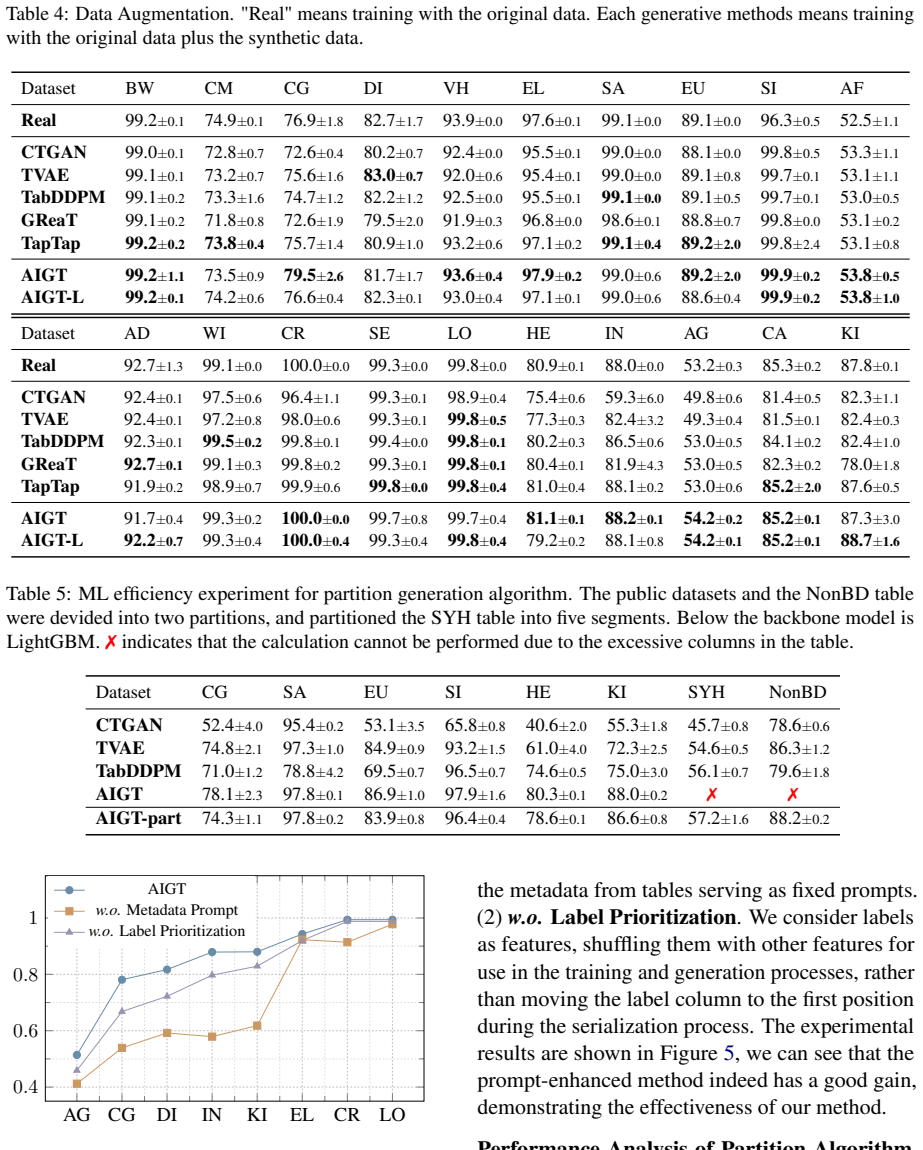
- [Section 4.4 and Section 5.2, Table 3] The main ML-efficiency evidence in Table 3 is computed on synthetic tables whose label column has been replaced by y'_i = P(x'_i), where P is a LightGBM trained on the original training data. Because the downstream evaluator is also a tuned LightGBM, the reported AUC/R2 values can be inflated by the surrogate predictor's access to the original labels, and they do not measure AIGT's joint generative distribution. The manuscript does not state whether CTGAN, TVAE, TabDDPM, and GReaT were also re-labeled; if they were not, Table 3 is not a fair comparison of generative quality. Please report the ML-efficiency results without re-labeling for AIGT and all baselines, and specify the re-labeling status of each method.
- [Table 3, Credit-g row] AIGT (78.1±2.3) exceeds the Real row (76.9±1.8) on Credit-g. Under the standard ML-efficiency protocol, a model trained on synthetic data should not systematically outperform a model trained on real data unless the synthetic labels are produced by a supervised model that already incorporates the real labels. This observation is consistent with the re-labeling confound described above and should be explained or removed by an ablation.
- [Section 4.4 and Table 5] In the partition-experiment comparison (Table 5), AIGT-part is compared with CTGAN, TVAE, and TabDDPM on the Alipay datasets SYH and NonBD, but the AIGT rows for those datasets are marked as not computable because the tables are too wide for the unpartitioned model. Since the re-labeling procedure is described only for AIGT in Section 4.4, it is unclear whether the baseline rows in Table 5 received any re-labeling. The reported gains (e.g., 57.2 vs 45.7 on SYH) could reflect the surrogate labeler rather than the partitioning algorithm; please clarify the protocol for each method in this table.
- [Limitations section] The stated limitations (processing speed and numerical value encoding) do not mention the re-labeling step's effect on the evaluation. Given that the main SOTA claim rests on the re-labeled ML-efficiency metric, the paper should either justify that the re-labeling is applied identically to all methods and report an ablation, or reframe the claim as one about a specific label-refinement pipeline rather than about generative fidelity.
minor comments (7)
- [Table 2 title] The heading contains a typo: "Ailpay Dataset" should be "Alipay Dataset".
- [Section 5.1] The typo "diff-sion method" should be "diffusion method".
- [Appendix B, Listing 1] The provided code uses the deprecated davinci-codex engine and an HTTP endpoint that is no longer the standard OpenAI API; the code should be updated to a working gpt-3.5-turbo example.
- [Table 7] The discriminator table lists two rows labeled "CR": the first appears to refer to the Car dataset and the second to California Housing; rename the second row to "CA" for clarity.
- [Abstract and Section 5.2] The abstract claims AIGT "achieves state-of-the-art performance on 14 out of 20 public datasets," while Section 5.2 says AIGT "match[es] or exceed[s] state-of-the-art on 14 out of 20 datasets." These are different claims and should be reconciled.
- [Figure 5] The y-axis label "average metric values" is vague; specify that it is the average AUC or R2 across the selected datasets.
- [References] The reference list contains duplicate entries for Xu et al. (2019a,b); both entries cite the same paper with the same title and should be merged.
Circularity Check
Re-labeling with a data-trained LightGBM means AIGT's headline ML-efficiency scores largely measure the fitted labeler, not the generative model.
-
fitted input called prediction
[Section 4.4 (Generation, Re-Labeling); Section 5.2 (Machine Learning Efficiency)]
"Then, a tabular predictor P , e.g., LightGBM, is trained to fit D, and then the synthesis label y′ i can be replaced by y′ i = P (x′ i). ... This synthetic data is then used to train a classification/regression model, which is then evaluated using the real test set."
The re-labeling step makes the label column of the synthetic table an output of a supervised fit rather than a sample from AIGT's learned joint distribution: y'_i = P(x'_i), with P a LightGBM fitted to the original D. The headline MLE protocol then trains a second LightGBM on that relabeled table and reports test AUC/R2. The reported score therefore largely measures how well P's learned label function transfers to AIGT-generated features; the generative model's joint label distribution is bypassed. Any generator that produces plausible x' can inherit P's performance, and since both the surrogate labeler and the downstream evaluator are tuned LightGBMs, part of the 'SOTA on 14/20' result reduces to the fitted input rather than to the generative model.
full rationale
The only substantial circularity is the re-labeling step. The paper is otherwise self-contained: it compares against external baselines, reports DCR, augmentation, discriminator, and partition experiments, and does not rest on self-citations or uniqueness theorems. The prompt and partition claims are not derived from their own conclusions. However, because the headline ML-efficiency table is computed on synthetic data whose labels were replaced by a LightGBM trained on the original labels, the central SOTA claim is partially built from a fitted input. The step is disclosed, which reduces the severity, but no ablation isolates the generative model's contribution, so it is not merely a presentational issue. Score 6 reflects a partial, load-bearing reduction by construction, not full equivalence or self-citation.
Assumptions & free parameters
free parameters (3)
- Sampling temperature T =
0.7
- Overlap columns in partition algorithm =
1
- STABS semantic relevance threshold =
50%
assumptions (4)
- domain assumption Representing tabular rows as natural-language sentences preserves the joint feature distribution and lets an autoregressive language model model it.
- domain assumption Metadata prompts generated by GPT-3.5 provide conditioning that improves generation quality.
- domain assumption Partitioning columns into overlapping groups and generating groups back-to-front preserves the correlations that matter for downstream ML performance.
- domain assumption Treating numbers as text tokens captures enough information for synthetic data quality.
Cite this review
Pith. "Pith review of AIGT: AI Generative Table Based on Prompt." pith.science (2026). https://pith.science/paper/5UULQZ6X
@misc{pith2026241218111,
  author       = {Pith},
  title        = {Pith review of: AIGT: AI Generative Table Based on Prompt},
  year         = {2026},
  howpublished = {\url{https://pith.science/paper/5UULQZ6X}},
  note         = {Machine review of arXiv:2412.18111}
}
read the original abstract
Tabular data, which accounts for over 80% of enterprise data assets, is vital in various fields. With growing concerns about privacy protection and data-sharing restrictions, generating high-quality synthetic tabular data has become essential. Recent advancements show that large language models (LLMs) can effectively gener-ate realistic tabular data by leveraging semantic information and overcoming the challenges of high-dimensional data that arise from one-hot encoding. However, current methods do not fully utilize the rich information available in tables. To address this, we introduce AI Generative Table (AIGT) based on prompt enhancement, a novel approach that utilizes meta data information, such as table descriptions and schemas, as prompts to generate ultra-high quality synthetic data. To overcome the token limit constraints of LLMs, we propose long-token partitioning algorithms that enable AIGT to model tables of any scale. AIGT achieves state-of-the-art performance on 14 out of 20 public datasets and two real industry datasets within the Alipay risk control system.
Figures


Figures from the paper (4 more)



Forward citations
Cited by 3 Pith papers
-
A Survey on Evaluating Quality and Trustworthiness in LLM-Generated Data
A metric-oriented survey that classifies intrinsic quality and trustworthiness metrics for LLM-generated data across six modalities and documents systematic evaluation gaps in the current literature.
-
A Note on Statistically Accurate Tabular Data Generation Using Large Language Models
A probability-driven prompting method, where an LLM estimates conditional categorical distributions and rows are sampled from them, outperforms table-wide and cell-by-cell generation on a California demographics dataset.
-
A Comprehensive Survey of Synthetic Tabular Data Generation
A structured survey that categorizes synthetic tabular data generation into traditional, diffusion, and LLM-based methods, with a comparative benchmark and a taxonomy of post-processing and evaluation.
Reference graph
Works this paper leans on
-
[1]
Takuya Akiba, Shotaro Sano, Toshihiko Yanase, Takeru Ohta, and Masanori Koyama. 2019. https://doi.org/10.1145/3292500.3330701 Optuna: A next-generation hyperparameter optimization framework . In Proceedings of the 25th ACM SIGKDD International Conference on Knowledge Discovery & Data Mining, KDD '19, page 2623–2631, New York, NY, USA. Association for Comp...
arXiv 2019
-
[2]
Karim Armanious, Chenming Jiang, Marc Fischer, Thomas K \"u stner, Tobias Hepp, Konstantin Nikolaou, Sergios Gatidis, and Bin Yang. 2020. Medgan: Medical image translation using gans. Computerized medical imaging and graphics, 79:101684
work page 2020
-
[3]
Laura Avi \ n \'o , Matteo Ruffini, and Ricard Gavald \`a . 2018. Generating synthetic but plausible healthcare record datasets. arXiv preprint arXiv:1807.01514
arXiv 2018
-
[4]
Vadim Borisov, Tobias Leemann, Kathrin Se ler, Johannes Haug, Martin Pawelczyk, and Gjergji Kasneci. 2022. Deep neural networks and tabular data: A survey. IEEE Transactions on Neural Networks and Learning Systems
work page 2022
-
[5]
Vadim Borisov, Kathrin Seßler, Tobias Leemann, Martin Pawelczyk, and Gjergji Kasneci. 2023. https://arxiv.org/abs/2210.06280 Language models are realistic tabular data generators . Preprint, arXiv:2210.06280
arXiv 2023
-
[6]
Tom Brown, Benjamin Mann, Nick Ryder, Melanie Subbiah, Jared D Kaplan, Prafulla Dhariwal, Arvind Neelakantan, Pranav Shyam, Girish Sastry, Amanda Askell, Sandhini Agarwal, Ariel Herbert-Voss, Gretchen Krueger, Tom Henighan, Rewon Child, Aditya Ramesh, Daniel Ziegler, Jeffrey Wu, Clemens Winter, Chris Hesse, Mark Chen, Eric Sigler, Mateusz Litwin, Scott Gr...
2020
-
[7]
Zhengping Che, Yu Cheng, Shuangfei Zhai, Zhaonan Sun, and Yan Liu. 2017. Boosting deep learning risk prediction with generative adversarial networks for electronic health records. In 2017 IEEE International Conference on Data Mining (ICDM), pages 787--792. IEEE
work page 2017
-
[8]
Edward Choi, Siddharth Biswal, Bradley Malin, Jon Duke, Walter F Stewart, and Jimeng Sun. 2017. Generating multi-label discrete patient records using generative adversarial networks. In Machine learning for healthcare conference, pages 286--305. PMLR
work page 2017
Show all 33 references
-
[9]
Antonia Creswell, Tom White, Vincent Dumoulin, Kai Arulkumaran, Biswa Sengupta, and Anil A Bharath. 2018. Generative adversarial networks: An overview. IEEE signal processing magazine, 35(1):53--65
2018
-
[10]
Jacob Devlin, Ming-Wei Chang, Kenton Lee, and Kristina Toutanova. 2018. Bert: Pre-training of deep bidirectional transformers for language understanding. arXiv preprint arXiv:1810.04805
2018 arXiv
-
[11]
Crist \'o bal Esteban, Stephanie L Hyland, and Gunnar R \"a tsch. 2017. Real-valued (medical) time series generation with recurrent conditional gans. arXiv preprint arXiv:1706.02633
2017 arXiv
-
[12]
Heng Gong, Yawei Sun, Xiaocheng Feng, Bing Qin, Wei Bi, Xiaojiang Liu, and Ting Liu. 2020. Tablegpt: Few-shot table-to-text generation with table structure reconstruction and content matching. In Proceedings of the 28th International Conference on Computational Linguistics, pa...
2020
-
[13]
Yury Gorishniy, Ivan Rubachev, Valentin Khrulkov, and Artem Babenko. 2021. Revisiting deep learning models for tabular data. Advances in Neural Information Processing Systems, 34:18932--18943
2021
-
[14]
Xu, Jun Araki, and Graham Neubig
Zhengbao Jiang, Frank F. Xu, Jun Araki, and Graham Neubig. 2020. https://doi.org/10.1162/tacl_a_00324 How can we know what language models know? Transactions of the Association for Computational Linguistics, 8:423--438
2020 doi
-
[15]
James Jordon, Jinsung Yoon, and Mihaela Van Der Schaar. 2018. Pate-gan: Generating synthetic data with differential privacy guarantees. In International conference on learning representations
2018
-
[16]
Jayoung Kim, Chaejeong Lee, Yehjin Shin, Sewon Park, Minjung Kim, Noseong Park, and Jihoon Cho. 2022. Sos: Score-based oversampling for tabular data. In Proceedings of the 28th ACM SIGKDD Conference on Knowledge Discovery and Data Mining, pages 762--772
2022
-
[17]
Akim Kotelnikov, Dmitry Baranchuk, Ivan Rubachev, and Artem Babenko. 2023. Tabddpm: modelling tabular data with diffusion models. In Proceedings of the 40th International Conference on Machine Learning, ICML'23. JMLR.org
2023
-
[18]
Zhenzhong Lan, Mingda Chen, Sebastian Goodman, Kevin Gimpel, Piyush Sharma, and Radu Soricut. 2020. https://arxiv.org/abs/1909.11942 Albert: A lite bert for self-supervised learning of language representations . Preprint, arXiv:1909.11942
2020 arXiv
-
[19]
Brian Lester, Rami Al-Rfou, and Noah Constant. 2021. The power of scale for parameter-efficient prompt tuning. arXiv preprint arXiv:2104.08691
2021 arXiv
-
[20]
Pengfei Liu, Weizhe Yuan, Jinlan Fu, Zhengbao Jiang, Hiroaki Hayashi, and Graham Neubig. 2023. https://doi.org/10.1145/3560815 Pre-train, prompt, and predict: A systematic survey of prompting methods in natural language processing . ACM Comput. Surv., 55(9)
2023 doi
-
[21]
Gautier Marti. 2020. Corrgan: Sampling realistic financial correlation matrices using generative adversarial networks. In ICASSP 2020-2020 IEEE International Conference on Acoustics, Speech and Signal Processing (ICASSP), pages 8459--8463. IEEE
2020
-
[22]
Noseong Park, Mahmoud Mohammadi, Kshitij Gorde, Sushil Jajodia, Hongkyu Park, and Youngmin Kim. 2018. Data synthesis based on generative adversarial networks. arXiv preprint arXiv:1806.03384
2018 arXiv
-
[23]
Neha Patki, Roy Wedge, and Kalyan Veeramachaneni. 2016. The synthetic data vault. In 2016 IEEE International Conference on Data Science and Advanced Analytics (DSAA), pages 399--410. IEEE
2016
-
[24]
Alec Radford, Jeffrey Wu, Rewon Child, David Luan, Dario Amodei, Ilya Sutskever, et al. 2019. Language models are unsupervised multitask learners. OpenAI blog, 1(8):9
2019
-
[25]
Colin Raffel, Noam Shazeer, Adam Roberts, Katherine Lee, Sharan Narang, Michael Matena, Yanqi Zhou, Wei Li, and Peter J Liu. 2020. Exploring the limits of transfer learning with a unified text-to-text transformer. The Journal of Machine Learning Research, 21(1):5485--5551
2020
-
[26]
Nan Tang, Ju Fan, Fangyi Li, Jianhong Tu, Xiaoyong Du, Guoliang Li, Sam Madden, and Mourad Ouzzani. 2020. Rpt: relational pre-trained transformer is almost all you need towards democratizing data preparation. arXiv preprint arXiv:2012.02469
2020 arXiv
-
[27]
Ashish Vaswani, Noam Shazeer, Niki Parmar, Jakob Uszkoreit, Llion Jones, Aidan N Gomez, ukasz Kaiser, and Illia Polosukhin. 2017. Attention is all you need. Advances in neural information processing systems, 30
2017
-
[28]
Lei Xu, Maria Skoularidou, Alfredo Cuesta-Infante, and Kalyan Veeramachaneni. 2019 a . Modeling tabular data using conditional gan. Advances in neural information processing systems, 32
2019
-
[29]
Lei Xu, Maria Skoularidou, Alfredo Cuesta-Infante, and Kalyan Veeramachaneni. 2019 b . Modeling tabular data using conditional gan. Advances in neural information processing systems, 32
2019
-
[30]
Jun Zhang, Graham Cormode, Cecilia M Procopiuc, Divesh Srivastava, and Xiaokui Xiao. 2017. Privbayes: Private data release via bayesian networks. ACM Transactions on Database Systems (TODS), 42(4):1--41
2017
-
[31]
Tianping Zhang, Shaowen Wang, Shuicheng Yan, Jian Li, and Qian Liu. 2023. https://arxiv.org/abs/2305.09696 Generative table pre-training empowers models for tabular prediction . Preprint, arXiv:2305.09696
2023 arXiv
-
[32]
online" 'onlinestring :=
ENTRY address archivePrefix author booktitle chapter edition editor eid eprint eprinttype howpublished institution journal key month note number organization pages publisher school series title type volume year doi pubmed url lastchecked label extra.label sort.label short.list...
-
[33]
write newline
" write newline "" before.all 'output.state := FUNCTION n.dashify 't := "" t empty not t #1 #1 substring "-" = t #1 #2 substring "--" = not "--" * t #2 global.max substring 't := t #1 #1 substring "-" = "-" * t #2 global.max substring 't := while if t #1 #1 substring * t #2 gl...
Reviewed August 11, 2026 · model on record in the stance chip above.
Discussion (0). Continue with ORCID to comment.