REVIEW 5 major objections 4 minor 54 references
HELPNet: Hierarchical Perturbations Consistency and Entropy-guided Ensemble for Scribble Supervised Medical Image Segmentation
T0 review · 5 major / 4 minor · reviewed 2026-08-11 · deepseek-v4-flash
Pith's one-line read The paper claims that scribble-only supervision, powered by hierarchical jigsaw consistency and entropy-guided pseudo-label ensembling, nearly matches fully supervised cardiac MRI segmentation.
desk verdict HELPNet is a solid scribble-supervision method with strong results, but the near-nnUNet claim rests on protocol details that need to be pinned down. read the letter →
The pith
A machine-rendered reading of the paper's core claim, the machinery that carries it, and where it could break.
The reading
What carries the argument
The central mechanism is the entropy-guided pseudo-label ensemble built on a three-view hierarchical perturbation scheme. The three views are the original image, a 2×2 jigsaw, and a 4×4 jigsaw; after the jigsaw views are unshuffled, a cosine similarity loss (Eq. 3) forces all three predictions to agree. Per-pixel entropy (Eq. 7) acts as a confidence meter for each view, and a temperature-scaled softmax (Eq. 8) converts negative entropies into weights that bias the ensemble toward the most confident view at each location (Eq. 5). This pseudo-label supervises all three views through a Dice loss (Eq. 9), while the SPR module applies connected-component filtering and PiDiNet edge alignment (Eq. 10–11) as a final denoising step.
What would settle it
Train HELPNet and two ablations on the same datasets and scribbles: one with equal weights instead of entropy weights in Eq. 6, one with random weights. If the entropy-weighted version does not beat both on average Dice across MSCMRseg, ACDC, and CHAOS, the entropy mechanism is not what carries the gain; a further ablation using oracle weights derived from the ground-truth labels would bound the best possible improvement from confidence weighting.
Extended reading notes
Core claim
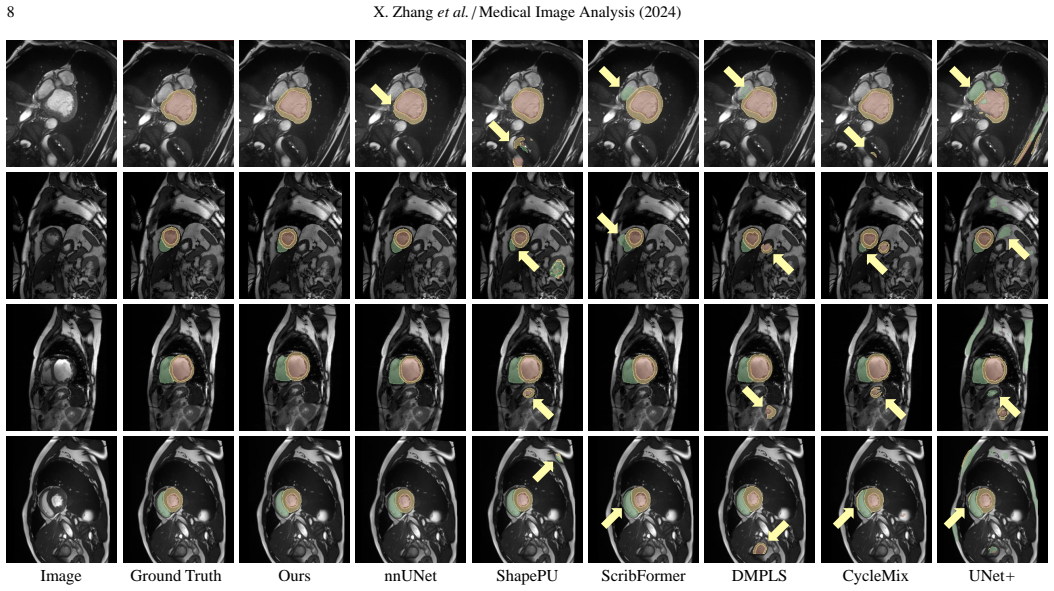
On the paper's own terms, the central discovery is that hierarchical jigsaw perturbations make a single weight-shared segmenter attend to a target organ at three complementary granularities, and that entropy-weighted ensembling of the three views yields pseudo-labels strong enough to supervise most of the image. The entropy weights upweight whichever view is most confident at each pixel (Eq. 6), the cosine consistency loss ties the views together (Eq. 3), and the structural-prior refinement cleans the label with connected-component analysis and PiDiNet edges (Eq. 10–11). The experimental core is the reported 89.6% mean Dice on MSCMRseg with scribble labels, 4.4 points above the best prior weakly supervised method, ShapePU, and 0.6 points below fully supervised nnUNet; the same pattern appears on ACDC and CHAOS. The authors conclude that scribble annotations, augmented with multi-scale consistency and entropy-guided pseudo-labeling, offer a viable alternative to full annotation.
Load-bearing premise
The pipeline assumes that low-entropy predictions are trustworthy predictions, so the entropy-weighted pseudo-labels are reliable enough to supervise regions far from the scribbles without amplifying errors.
Editorial extensions
If this is right
- Scribble annotations could replace dense masks for cardiac MRI segmentation in clinical pipelines without a substantial drop in Dice.
- Hierarchical jigsaw consistency can serve as a generic regularization strategy for other scribble- or point-supervised segmentation tasks.
- Entropy-weighted ensembling of multiple prediction views may improve pseudo-label quality beyond medical imaging, in any weakly supervised setting where several perturbed views exist.
- The reported margins on ACDC, MSCMRseg, and CHAOS suggest the method transfers across cardiac and abdominal organs and across MRI sequences.
Reading between the lines
- If entropy is not a calibrated confidence signal, the method's edge could shrink or reverse on low-contrast or out-of-distribution images; a reliability-diagram study on a held-out imaging site would test this directly.
- The 0.6-point gap to fully supervised nnUNet on MSCMRseg could widen on more anatomically variable or pathology-rich cohorts, since parity is demonstrated only on three public benchmarks.
- A natural extension is to learn the confidence weights with a small network instead of using raw entropy, and to search the jigsaw densities per organ; both changes could push scribble performance closer to full supervision.
Editorial analysis
A structured set of objections, weighed in public.
Referee Report
Summary. HELPNet is a scribble-supervised medical image segmentation framework combining three modules: a hierarchical perturbation consistency (HPC) module that applies intensity augmentation and two densities of jigsaw puzzles (2x2 and 4x4) to create global, local, and focal views and enforces cosine-similarity consistency between their predictions; an entropy-guided pseudo-label ensemble (EGPL) that weights the three prediction maps by softmaxed negative entropy to generate pseudo-labels and supervises all branches with Dice loss; and a structural prior refinement (SPR) module that filters pseudo-labels via connected-component analysis and refines boundaries using a pretrained edge detector (PiDiNet). The model is trained with partial cross-entropy on scribbles plus the three auxiliary losses. The authors report Dice scores on MSCMRseg, ACDC, and CHAOS T1/T2, claiming state-of-the-art performance among scribble-supervised methods and performance comparable to fully supervised nnUNet.
Significance. If the reported results are protocol-sound, the paper provides valuable evidence that scribble supervision can approach full supervision on cardiac MRI: on MSCMRseg the method reaches 89.6% average Dice versus 90.2% for nnUNet, and on ACDC it reaches 90.6% versus 91.7%. The framework is modular, the three components are clearly motivated, and the authors have made the code publicly available, which strengthens reproducibility. However, the significance of the central claim depends on the evaluation being apples-to-apples with the fully supervised baseline and on the hyperparameter-selection protocol not leaking test information; those points are not yet established in the manuscript.
major comments (5)
- [§4.3, Table 1] The central comparison with nnUNet is not apples-to-apples as reported. In Table 1, nnUNet is a bare point estimate (0.902 average) with no standard deviation, while all other rows report mean ± std, and the text does not state that nnUNet was re-run on the same 25/5/15 split and preprocessing pipeline. If the nnUNet number is quoted from prior literature, the 0.6-point gap is not evidence that the weakly supervised method is comparable to full supervision. Please either re-run nnUNet under the identical protocol or explicitly soften the claim to 'comparable to published nnUNet results.'
- [§4.2 and §4.6.2, Tables 5–6] The hyperparameters λ1, λ2, λ3 and τ were selected by ablations described as performed 'on the MSCMRseg dataset,' without stating that only the 5-case validation split was used. Since the headline 89.6% is measured on the 15-case test split, selecting hyperparameters on the test set would introduce optimistic bias, and this bias is large relative to the 0.6% gap to nnUNet. Please clarify explicitly that the test split was never used for model selection, or re-run the ablation on the validation split and report the corresponding test results for the chosen configuration.
- [§4.3, Tables 1–3] The main tables are not accompanied by significance tests. The phrase 'significantly outperformed' in §4.3 and §4.5 is not supported by paired tests or confidence intervals; the only Wilcoxon tests appear in the ablation study (Table 4). Please add paired significance tests or confidence intervals against the strongest baselines on each dataset, and report standard deviations for all quoted baselines, including those currently given as bare numbers.
- [§3.2 and Table 4] The core motivation of EGPL is that entropy-weighted ensembling yields better pseudo-labels than equal-weight averaging, but this specific design choice is never tested. The ablation shows EGPL on/off, yet does not compare entropy weighting against uniform weighting or random weighting of the same three prediction maps. Without that comparison, the 'entropy-guided' contribution is not empirically validated, and the improvement attributed to EGPL could come from ensembling itself. Please add such an ablation.
- [§3.3, Eq. (10)] The structural prior loss is written as LSPR = Lcos(yPL, yCCA) + LEdge(ŷPL, ye), but yPL is defined in Eq. (5) as an argmax label map, while Lcos in Eq. (4) is a cosine similarity between probability vectors. Cosine similarity on hard label maps is not well defined. Please clarify whether yPL in this loss is the soft probability map before argmax, or provide the appropriate loss formulation for label maps.
minor comments (4)
- [§4.5, Table 3] The text in the T1 paragraph says 'Compared to PacingPseudo, HELPNet shows superior performance in terms of the average Dice score,' but on T2 PacingPseudo achieves 0.737 average versus 0.735 for HELPNet. Please restrict the claim to T1 or report a combined average across modalities.
- [§3.1, Eq. (1)] The sentence 'Perturbed images can be enhanced as follows' is misleading because xS2 and xS4 are jigsaw-perturbed, not intensity-enhanced. Please rephrase to distinguish the intensity augmentation of xS1 from the jigsaw perturbations of xS2 and xS4.
- [Tables 1–3] The statement 'Except for some unreported experimental results, other methods are presented as mean ± standard deviation' is vague. Please mark in the tables which numbers are re-run in this paper and which are quoted from prior publications, so that the reader can judge protocol comparability.
- [Abstract and §4.4] There are minor wording issues: the abstract contains 'enhance the precision and reliability and pseudo-labels' (likely 'of pseudo-labels'), and §4.4 says 'Our method achieved the best results in RV and Myo segmentation, ranks second in RV segmentation,' which is self-contradictory and should be corrected.
Circularity Check
No significant circularity: the central claim is an empirical benchmark evaluation against external ground truth, and the only self-referential training mechanism is a standard pseudo-label self-training loop that is not used in the evaluation.
full rationale
HELPNet makes no formal derivation claim; its reported results are empirical Dice scores against held-out ground truth on three public datasets (MSCMRseg, ACDC, CHAOS). The only self-referential mechanism is the EGPL self-training loop: Eq. 5 constructs pseudo-labels yPL from the model's own predictions yS1, yS2, and yS4, Eq. 6 weights those predictions by their own entropies, and Eq. 9 supervises the same prediction maps with yPL. This is a standard self-training/consistency objective rather than a circular prediction, because the final reported numbers in Tables 1-3 are measured against gold-standard annotations, not against yPL, and the ablation study in Table 4 shows that adding or removing each module changes the external Dice score. The HPC consistency loss compares jigsaw-restored predictions with the unperturbed prediction, and the SPR module uses PiDiNet pretrained on the external BSDS500 dataset; neither of these reduces by construction to the claim being evaluated. The only self-citations (e.g., Zhang et al. 2024a in the introduction) are background performance citations and are not load-bearing for the scribble-supervision result. The paper does not demonstrate that entropy is a calibrated confidence signal, and it does not explicitly state that the loss-weight and temperature ablations in Section 4.6.2 used only the validation split; these are robustness and protocol concerns, not circularity-by-construction, because no equation equates the final test score to a fitted parameter, to the pseudo-labels, or to a self-citation chain.
Assumptions & free parameters
free parameters (4)
- Loss weights lambda_1, lambda_2, lambda_3 =
0.3, 0.1, 0.3
- Softmax temperature tau =
0.4
- Edge threshold alpha =
0.5
- Jigsaw patch densities =
2x2 and 4x4
assumptions (5)
- domain assumption Public scribble and ground-truth annotations across ACDC, MSCMRseg, and CHAOS are consistent with the splits and labels used in prior work.
- domain assumption Jigsaw perturbation preserves semantic content while disrupting spatial structure, so pixel-level consistency between restored predictions is a valid training signal.
- domain assumption Lower softmax entropy indicates higher prediction confidence, making entropy weights in Eq. 6 a reliable ensemble strategy.
- domain assumption Connected-component size filtering and PiDiNet edge maps, pretrained on BSDS500, are valid structural priors for medical organ boundaries.
- domain assumption Partial cross-entropy on scribble pixels plus pseudo-label dice loss gives sufficient supervision for unlabeled pixels.
Cite this review
Pith. "Pith review of HELPNet: Hierarchical Perturbations Consistency and Entropy-guided Ensemble for Scribble Supervised Medical Image Segmentation." pith.science (2026). https://pith.science/paper/MCVS4XOJ
@misc{pith2026241218738,
  author       = {Pith},
  title        = {Pith review of: HELPNet: Hierarchical Perturbations Consistency and Entropy-guided Ensemble for Scribble Supervised Medical Image Segmentation},
  year         = {2026},
  howpublished = {\url{https://pith.science/paper/MCVS4XOJ}},
  note         = {Machine review of arXiv:2412.18738}
}
read the original abstract
Creating fully annotated labels for medical image segmentation is prohibitively time-intensive and costly, emphasizing the necessity for innovative approaches that minimize reliance on detailed annotations. Scribble annotations offer a more cost-effective alternative, significantly reducing the expenses associated with full annotations. However, scribble annotations offer limited and imprecise information, failing to capture the detailed structural and boundary characteristics necessary for accurate organ delineation. To address these challenges, we propose HELPNet, a novel scribble-based weakly supervised segmentation framework, designed to bridge the gap between annotation efficiency and segmentation performance. HELPNet integrates three modules. The Hierarchical perturbations consistency (HPC) module enhances feature learning by employing density-controlled jigsaw perturbations across global, local, and focal views, enabling robust modeling of multi-scale structural representations. Building on this, the Entropy-guided pseudo-label (EGPL) module evaluates the confidence of segmentation predictions using entropy, generating high-quality pseudo-labels. Finally, the structural prior refinement (SPR) module incorporates connectivity and bounded priors to enhance the precision and reliability and pseudo-labels. Experimental results on three public datasets ACDC, MSCMRseg, and CHAOS show that HELPNet significantly outperforms state-of-the-art methods for scribble-based weakly supervised segmentation and achieves performance comparable to fully supervised methods. The code is available at https://github.com/IPMI-NWU/HELPNet.
Figures


Figures from the paper (3 more)


Reference graph
Works this paper leans on
-
[1]
author Arbeláez, P. , author Maire, M. , author Fowlkes, C. , author Malik, J. , year 2011 . title Contour detection and hierarchical image segmentation . journal IEEE Transactions on Pattern Analysis and Machine Intelligence volume 33 , pages 898--916
work page 2011
-
[2]
author Bernard, O. , author Lalande, A. , author Zotti, C. , author Cervenansky, F. , author Yang, X. , author Heng, P.A. , author Cetin, I. , author Lekadir, K. , author Camara, O. , author Gonzalez Ballester, M.A. , author Sanroma, G. , author Napel, S. , author Petersen, S. , author Tziritas, G. , author Grinias, E. , author Khened, M. , author Kollera...
work page 2018
-
[3]
author Bortsova, G. , author Dubost, F. , author Hogeweg, L. , author Katramados, I. , author de Bruijne, M. , year 2019 . title Semi-supervised medical image segmentation via learning consistency under transformations , in: booktitle Medical Image Computing and Computer Assisted Intervention , publisher Springer . pp. pages 810--818
work page 2019
-
[4]
author Bucci, S. , author D’Innocente, A. , author Liao, Y. , author Carlucci, F.M. , author Caputo, B. , author Tommasi, T. , year 2022 . title Self-supervised learning across domains . journal IEEE Transactions on Pattern Analysis and Machine Intelligence volume 44 , pages 5516--5528
work page 2022
-
[5]
author Cao, H. , author Wang, Y. , author Chen, J. , author Jiang, D. , author Zhang, X. , author Tian, Q. , author Wang, M. , year 2022 . title Swin-Unet : Unet-like pure transformer for medical image segmentation , in: booktitle European Conference on Computer Vision 2022 Workshops , organization Springer . pp. pages 205--218
work page 2022
-
[6]
author Chen, J. , author Chen, C. , author Huang, W. , author Zhang, J. , author Debattista, K. , author Han, J. , year 2024 . title Dynamic contrastive learning guided by class confidence and confusion degree for medical image segmentation . journal Pattern Recognition volume 145 , pages 109881
work page 2024
-
[7]
author Chen, J. , author Zhang, J. , author Debattista, K. , author Han, J. , year 2023 . title Semi-supervised unpaired medical image segmentation through task-affinity consistency . journal IEEE Transactions on Medical Imaging volume 42 , pages 594--605
work page 2023
-
[8]
author Chen, X. , author Wang, X. , author Zhang, K. , author Fung, K.M. , author Thai, T.C. , author Moore, K. , author Mannel, R.S. , author Liu, H. , author Zheng, B. , author Qiu, Y. , year 2022 a. title Recent advances and clinical applications of deep learning in medical image analysis . journal Medical Image Analysis volume 79 , pages 102444
work page 2022
Show all 54 references
-
[9]
, author Tian, Z
author Chen, Z. , author Tian, Z. , author Zhu, J. , author Li, C. , author Du, S. , year 2022 b. title C-CAM : Causal CAM for weakly supervised semantic segmentation on medical image , in: booktitle Proceedings of the IEEE/CVF Conference on Computer Vision and Pattern Recogni...
2022
-
[10]
, author Taylor, G.W
author DeVries, T. , author Taylor, G.W. , year 2017 . title Improved regularization of convolutional neural networks with cutout . journal arXiv preprint arXiv:1708.04552
2017 arXiv
-
[11]
, author Luo, X
author Han, M. , author Luo, X. , author Liao, W. , author Zhang, S. , author Zhang, S. , author Wang, G. , year 2023 . title Scribble-based 3D multiple abdominal organ segmentation via triple-branch multi-dilated network with pixel- and class-wise consistency , in: booktitle ...
2023
-
[12]
, author Luo, X
author Han, M. , author Luo, X. , author Xie, X. , author Liao, W. , author Zhang, S. , author Song, T. , author Wang, G. , author Zhang, S. , year 2024 . title DMSPS : Dynamically mixed soft pseudo-label supervision for scribble-supervised medical image segmentation . journal...
2024
-
[13]
, author Tang, Y
author Hatamizadeh, A. , author Tang, Y. , author Nath, V. , author Yang, D. , author Myronenko, A. , author Landman, B. , author Roth, H.R. , author Xu, D. , year 2022 . title UNETR : Transformers for 3D medical image segmentation , in: booktitle Proceedings of the IEEE/CVF W...
2022
-
[14]
, author Jaeger, P.F
author Isensee, F. , author Jaeger, P.F. , author Kohl, S.A. , author Petersen, J. , author Maier-Hein, K.H. , year 2021 . title nnU-Net : A self-configuring method for deep learning-based biomedical image segmentation . journal Nature Methods volume 18 , pages 203--211
2021
-
[15]
, author Shen, Y
author Ji, Z. , author Shen, Y. , author Ma, C. , author Gao, M. , year 2019 . title Scribble-based hierarchical weakly supervised learning for brain tumor segmentation , in: booktitle Medical Image Computing and Computer Assisted Intervention , publisher Springer Internationa...
2019
-
[16]
, author Gezer, N.S
author Kavur, A.E. , author Gezer, N.S. , author Barış, M. , author Aslan, S. , author Conze, P.H. , author Groza, V. , author Pham, D.D. , author Chatterjee, S. , author Ernst, P. , author Özkan, S. , author Baydar, B. , author Lachinov, D. , author Han, S. , author Pauli, J....
2021
-
[17]
, author Choo, W
author Kim, J.H. , author Choo, W. , author Jeong, H. , author Song, H.O. , year 2021 . title Co-mixup: Saliency guided joint mixup with supermodular diversity . journal arXiv preprint arXiv:2102.03065
2021 arXiv
-
[18]
, author Choo, W
author Kim, J.H. , author Choo, W. , author Song, H.O. , year 2020 . title Puzzle mix: Exploiting saliency and local statistics for optimal mixup , in: booktitle Proceedings of the 37th International Conference on Machine Learning , publisher PMLR . pp. pages 5275--5285
2020
-
[19]
, author Yan, Z
author Kuang, Z. , author Yan, Z. , author Zhou, H. , author Yu, L. , year 2023 . title Cluster-Re-Supervision : Bridging the gap between image-level and pixel-wise labels for weakly supervised medical image segmentation . journal IEEE Journal of Biomedical and Health Informat...
2023
-
[20]
, author Martínez, C
author Larrazabal, A.J. , author Martínez, C. , author Glocker, B. , author Ferrante, E. , year 2020 . title Post-DAE : Anatomically plausible segmentation via post-processing with denoising autoencoders . journal IEEE Transactions on Medical Imaging volume 39 , pages 3813--3820
2020
-
[21]
, author Jeong, W.K
author Lee, H. , author Jeong, W.K. , year 2020 . title Scribble2Label : Scribble-supervised cell segmentation via self-generating pseudo-labels with consistency , in: booktitle Medical Image Computing and Computer Assisted Intervention , publisher Springer . pp. pages 14--23
2020
-
[22]
, author Luo, H
author Lei, Y. , author Luo, H. , author Wang, L. , author Zhang, Z. , author Zhang, L. , year 2024 . title PCLMix : Weakly supervised medical image segmentation via pixel-level contrastive learning and dynamic mix augmentation . journal arXiv preprint arXiv:2405.06288
2024 arXiv
-
[23]
, author Yu, L
author Li, X. , author Yu, L. , author Chen, H. , author Fu, C.W. , author Xing, L. , author Heng, P.A. , year 2021 . title Transformation-consistent self-ensembling model for semisupervised medical image segmentation . journal IEEE Transactions on Neural Networks and Learning...
2021
-
[24]
, author Zheng, Y
author Li, Z. , author Zheng, Y. , author Shan, D. , author Yang, S. , author Li, Q. , author Wang, B. , author Zhang, Y. , author Hong, Q. , author Shen, D. , year 2024 . title Scribformer: Transformer makes CNN work better for scribble-based medical image segmentation . jour...
2024
-
[25]
, author Yuan, Q
author Liu, X. , author Yuan, Q. , author Gao, Y. , author He, K. , author Wang, S. , author Tang, X. , author Tang, J. , author Shen, D. , year 2022 . title Weakly supervised segmentation of COVID19 infection with scribble annotation on CT images . journal Pattern Recognition...
2022
-
[26]
, author Hu, M
author Luo, X. , author Hu, M. , author Liao, W. , author Zhai, S. , author Song, T. , author Wang, G. , author Zhang, S. , year 2022 . title Scribble-supervised medical image segmentation via dual-branch network and dynamically mixed pseudo labels supervision , in: booktitle ...
2022
-
[27]
, author Li, R
author Mahani, G.K. , author Li, R. , author Evangelou, N. , author Sotiropolous, S. , author Morgan, P.S. , author French, A.P. , author Chen, X. , year 2022 . title Bounding box based weakly supervised deep convolutional neural network for medical image segmentation using an...
2022
-
[28]
, author Maaten, L.v.d
author Misra, I. , author Maaten, L.v.d. , year 2020 . title Self-supervised learning of pretext-invariant representations , in: booktitle Proceedings of the IEEE/CVF Conference on Computer Vision and Pattern Recognition (CVPR) , pp. pages 6707--6717
2020
-
[29]
, author Favaro, P
author Noroozi, M. , author Favaro, P. , year 2016 . title Unsupervised learning of visual representations by solving jigsaw puzzles , in: booktitle European Conference on Computer Vision , publisher Springer . pp. pages 69--84
2016
-
[30]
, author Ryu, J
author Park, W. , author Ryu, J. , year 2024 . title Fine-grained self-supervised learning with jigsaw puzzles for medical image classification . journal Computers in Biology and Medicine volume 174 , pages 108460
2024
-
[31]
, author Fischer, P
author Ronneberger, O. , author Fischer, P. , author Brox, T. , year 2015 . title U-Net : Convolutional networks for biomedical image segmentation , in: booktitle Medical Image Computing and Computer-Assisted Intervention , publisher Springer . pp. pages 234--241
2015
-
[32]
, author Luo, Z
author Su, J. , author Luo, Z. , author Lian, S. , author Lin, D. , author Li, S. , year 2024 . title Mutual learning with reliable pseudo label for semi-supervised medical image segmentation . journal Medical Image Analysis volume 94 , pages 103111
2024
-
[33]
, author Liu, W
author Su, Z. , author Liu, W. , author Yu, Z. , author Hu, D. , author Liao, Q. , author Tian, Q. , author Pietik\"ainen, M. , author Liu, L. , year 2021 . title Pixel difference networks for efficient edge detection , in: booktitle Proceedings of the IEEE/CVF International C...
2021
-
[34]
, author Jeyaseelan, L
author Tajbakhsh, N. , author Jeyaseelan, L. , author Li, Q. , author Chiang, J.N. , author Wu, Z. , author Ding, X. , year 2020 . title Embracing imperfect datasets: A review of deep learning solutions for medical image segmentation . journal Medical Image Analysis volume 63 ...
2020
-
[35]
, author Djelouah, A
author Tang, M. , author Djelouah, A. , author Perazzi, F. , author Boykov, Y. , author Schroers, C. , year 2018 . title Normalized cut loss for weakly-supervised CNN segmentation , in: booktitle Proceedings of the IEEE Conference on Computer Vision and Pattern Recognition (CV...
2018
-
[36]
, author Leo, A
author Valvano, G. , author Leo, A. , author Tsaftaris, S.A. , year 2021 . title Learning to segment from scribbles using multi-scale adversarial attention gates . journal IEEE Transactions on Medical Imaging volume 40 , pages 1990--2001
2021
-
[37]
, author Xu, M
author Wang, A. , author Xu, M. , author Zhang, Y. , author Islam, M. , author Ren, H. , year 2023 . title S ^2 ME : Spatial-spectral mutual teaching and ensemble learning for scribble-supervised polyp segmentation , in: booktitle Medical Image Computing and Computer Assisted ...
2023
-
[38]
, author Peng, J
author Wang, Y. , author Peng, J. , author Zhang, Z. , year 2021 . title Uncertainty-aware pseudo label refinery for domain adaptive semantic segmentation , in: booktitle Proceedings of the IEEE/CVF International Conference on Computer Vision , pp. pages 9092--9101
2021
-
[39]
, author Hu, Y
author Wei, J. , author Hu, Y. , author Cui, S. , author Zhou, S.K. , author Li, Z. , year 2023 . title WeakPolyp : You only look bounding box for polyp segmentation , in: booktitle Medical Image Computing and Computer Assisted Intervention , publisher Springer . pp. pages 757--766
2023
-
[40]
, author Li, X
author Wu, H. , author Li, X. , author Lin, Y. , author Cheng, K.T. , year 2023 . title Compete to win: Enhancing pseudo labels for barely-supervised medical image segmentation . journal IEEE Transactions on Medical Imaging volume 42 , pages 3244--3255
2023
-
[41]
, author Lin, D
author Yang, Z. , author Lin, D. , author Ni, D. , author Wang, Y. , year 2024 . title Non-iterative scribble-supervised learning with pacing pseudo-masks for medical image segmentation . journal Expert Systems with Applications volume 238 , pages 122024
2024
-
[42]
, author Han, D
author Yun, S. , author Han, D. , author Oh, S.J. , author Chun, S. , author Choe, J. , author Yoo, Y. , year 2019 . title CutMix : Regularization strategy to train strong classifiers with localizable features , in: booktitle Proceedings of the IEEE/CVF International Conferenc...
2019
-
[43]
, author Wang, G
author Zhai, S. , author Wang, G. , author Luo, X. , author Yue, Q. , author Li, K. , author Zhang, S. , year 2023 . title PA-Seg : Learning from point annotations for 3D medical image segmentation using contextual regularization and cross knowledge distillation . journal IEEE...
2023
-
[44]
, author Cisse, M
author Zhang, H. , author Cisse, M. , author Dauphin, Y.N. , author Lopez-Paz, D. , year 2018 . title mixup: Beyond empirical risk minimization , in: booktitle International Conference on Learning Representations
2018
-
[45]
, author Zhuang, X
author Zhang, K. , author Zhuang, X. , year 2022 a. title CycleMix: A holistic strategy for medical image segmentation from scribble supervision , in: booktitle CVPR , pp. pages 11646--11655
2022
-
[46]
, author Zhuang, X
author Zhang, K. , author Zhuang, X. , year 2022 b. title ShapePU : A new PU learning framework regularized by global consistency for scribble supervised cardiac segmentation , in: booktitle Medical Image Computing and Computer Assisted Intervention , publisher Springer . pp. ...
2022
-
[47]
, author Zhong, Y
author Zhang, P. , author Zhong, Y. , author Li, X. , year 2020 . title ACCL : Adversarial constrained- CNN loss for weakly supervised medical image segmentation . journal arXiv preprint arXiv:2005.00328
2020 arXiv
-
[48]
, author Sun, K
author Zhang, X. , author Sun, K. , author Wu, D. , author Xiong, X. , author Liu, J. , author Yao, L. , author Li, S. , author Wang, Y. , author Feng, J. , author Shen, D. , year 2024 a. title An anatomy- and topology-preserving framework for coronary artery segmentation . jo...
2024
-
[49]
, author Zhu, L
author Zhang, X. , author Zhu, L. , author He, H. , author Jin, L. , author Lu, Y. , year 2024 b. title Scribble hides class: Promoting scribble-based weakly-supervised semantic segmentation with its class label , in: booktitle Proceedings of the AAAI Conference on Artificial ...
2024
-
[50]
, author Jayasumana, S
author Zheng, S. , author Jayasumana, S. , author Romera-Paredes, B. , author Vineet, V. , author Su, Z. , author Du, D. , author Huang, C. , author Torr, P.H.S. , year 2015 . title Conditional random fields as recurrent neural networks , in: booktitle Proceedings of the IEEE ...
2015
-
[51]
, author Rahman Siddiquee, M.M
author Zhou, Z. , author Rahman Siddiquee, M.M. , author Tajbakhsh, N. , author Liang, J. , year 2018 . title UNet++ : A nested U-Net architecture for medical image segmentation , in: booktitle Deep Learning in Medical Image Analysis and Multimodal Learning for Clinical Decisi...
2018
-
[52]
, year 2016
author Zhuang, X. , year 2016 . title Multivariate mixture model for cardiac segmentation from multi-sequence MRI , in: booktitle Medical Image Computing and Computer-Assisted Intervention , publisher Springer International Publishing , address Cham . pp. pages 581--588
2016
-
[53]
, year 2019
author Zhuang, X. , year 2019 . title Multivariate mixture model for myocardial segmentation combining multi-source images . journal IEEE Transactions on Pattern Analysis and Machine Intelligence volume 41 , pages 2933--2946
2019
-
[54]
write newline
" write newline "" before.all 'output.state := FUNCTION n.dashify 't := "" t empty not t #1 #1 substring "-" = t #1 #2 substring "--" = not "--" * t #2 global.max substring 't := t #1 #1 substring "-" = "-" * t #2 global.max substring 't := while if t #1 #1 substring * t #2 gl...
Reviewed August 11, 2026 · model on record in the stance chip above.
Discussion (0). Continue with ORCID to comment.