REVIEW 4 major objections 4 minor 56 references
ArtNVG: Content-Style Separated Artistic Neighboring-View Gaussian Stylization
T0 review · 4 major / 4 minor · reviewed 2026-08-11 · deepseek-v4-flash
Pith's one-line read ArtNVG stylizes 3D scenes in 20 minutes by separating content and style controls and sharing attention across nearby views.
desk verdict A genuine, moderately novel 3DGS stylization system whose central claim holds, but the local-consistency evidence is thinner than the tables suggest and its key mechanism has an untested divergent-view regime. read the letter →
The pith
A machine-rendered reading of the paper's core claim, the machinery that carries it, and where it could break.
The reading
What carries the argument
The load-bearing mechanism is the Attention-based Neighboring-View Alignment layer: for N views, the keys and values are concatenated as $K_{\mathrm{NV}} = [K_1, \ldots, K_N]^T$ and $V_{\mathrm{NV}} = [V_1, \ldots, V_N]^T$, and each view's query attends to all neighboring keys and values, with $\mathrm{NVAttn}_i = \mathrm{Attn}(Q_i, K_{\mathrm{NV}}, V_{\mathrm{NV}})$. This replaces every self-attention layer in the UNet and the content control, so the denoising of each view sees shared local features. Paired with Content-Style Separated Control (the CSGO style projection for style and the CSGO content projection plus Tile ControlNet for content), the diffusion process keeps content and style on separate channels, reducing information leakage.
What would settle it
Run the pipeline on a scene captured with wide-baseline cameras, so neighboring camera centers are far apart and overlapping content is small, then measure CFSD and CLIP-DC against the no-NV-attention variant; if consistency scores do not improve, or if visible seams appear where clusters meet, the key-value consistency assumption fails.
Extended reading notes
Core claim
The paper's central discovery is a zero-shot 3D stylization method built on 3D Gaussian Splatting that avoids two known failure modes: information leakage between content and style, and local inconsistency among neighboring views. Content and style are injected through separate cross-attention controls, and self-attention layers in both the UNet and the content control module are replaced by NV attention, which concatenates the keys and values of N camera-center-close views into one attention computation. The stylized renderings then finetune the original 3DGS scene, with an added NNFM loss to preserve high-frequency texture details. On the Tanks and Temples dataset with WikiArt styles, the method reportedly outperforms both baselines on content fidelity, style similarity, and consistency metrics.
Load-bearing premise
The method assumes that the self-attention key and value features from camera-center-close views are mutually consistent in the diffusion latent space, so that concatenating them reinforces shared details instead of injecting conflicting content.
Editorial extensions
If this is right
- Stylization of an existing 3DGS scene takes about 20 minutes total, with no extra pre-training of new networks.
- Content and style are controlled through separate cross-attention inputs, reducing content leakage from the style image and style leakage from the content images.
- Neighboring views are denoised jointly rather than independently, improving local color and texture consistency.
- Quantitative evaluation over eight scenes shows improvements on CFSD, CSD, and CLIP-DC relative to both baselines, and a user study favors ArtNVG on content fidelity, style alignment, and visual quality.
- The number of neighboring views N trades off cluster fragmentation against inter-cluster continuity, with N = 15 yielding the best consistency in their experiments.
Reading between the lines
- An extension beyond the paper: the NV-attention principle should transfer to other diffusion-based 3D editing tasks such as text-guided editing or relighting, since it only swaps self-attention layers.
- An extension beyond the paper: the view-grouping criterion based on camera-center distance could be made content-aware, for example by grouping views with high visual overlap or similar depth maps, which may improve robustness on large-baseline captures.
- An extension beyond the paper: separating content and style controls could combine with other ControlNet variants to add user interaction such as object removal or addition, which the paper lists as a limitation.
- A testable extension beyond the paper: measuring local consistency with pixel-level correspondences or optical flow across neighboring stylized views would provide a more direct check than the CLIP-DC metric reported.
Editorial analysis
A structured set of objections, weighed in public.
Referee Report
Summary. The paper proposes ArtNVG, a 3D Gaussian Splatting (3DGS) stylization framework that applies the style of a reference image to an existing 3D scene. The method combines two main ideas: (1) Content-Style Separated Control, which uses the CSGO projection modules and a Tile ControlNet to inject content and style controls separately into cross-attention layers, and (2) Attention-based Neighboring-View Alignment, which replaces self-attention layers in the UNet and ControlNet with an attention mechanism that concatenates keys and values from nearby views (Eq. 7-8) to improve local color and texture consistency. Stylized renderings are used to finetune the original 3DGS scene with an L1 plus NNFM loss (Eq. 10). The authors report qualitative comparisons, a user study, and quantitative metrics (CFSD, CSD, CLIP-DC) against StyleGaussian and InstantStyleGaussian, claiming superior content preservation, style alignment, and local consistency.
Significance. If the claims are substantiated, ArtNVG would be a useful system for fast, reference-guided 3D stylization, a task with growing demand in film and games. The main technical novelty is the Neighboring-View Attention mechanism, which is simple and intuitively plausible, and the use of CSGO/Tile ControlNet for separated content and style control is a sensible application of externally validated components rather than a fundamentally new model. The paper's strengths include a clear system description, a user study, supplementary extended results, and an ablation that isolates the contribution of Neighboring-View Attention to local consistency. However, the quantitative evaluation is thin and does not yet establish the central consistency claim: the grouping mechanism is underspecified, the evaluation metrics are aggregated without error bars or significance tests, and the Content-Style Separated Control contribution is never ablated. These issues require further evidence before the paper's claims can be accepted.
major comments (4)
- [Sec. 3.2.3, Eq. (7)-(8)] The Neighboring-View Attention mechanism selects neighbors solely by camera-center distance ('camera centers are closer'), but in unbounded 360-degree scenes, cameras with close centers can point in divergent directions and thus have little or no visual overlap. In such cases, concatenating K and V from different views (Eq. 7) mixes tokens that correspond to different 3D content, which can blur details or inject conflicting content into the attention output. The paper does not add any relative-pose conditioning, positional encoding, epipolar constraint, or overlap validation to the attention mechanism, nor does it specify whether the neighboring-view groups are disjoint or overlapping and how the groups are reconciled. This is load-bearing because the central claim of improved local consistency relies on mutual compatibility of K/V features across views. Please specify the grouping algorithm precisely, validate compatibility for views with large baselines and divergent orientations, and report consistency metrics at group boundaries and across randomly selected view pairs rather than only along adjacent frames that likely fall in the same group.
- [Sec. 4.4, Table 1] The quantitative comparison reports only three aggregate metrics averaged over eight scenes, with no per-scene breakdown, no standard deviations, and no significance tests. The reported differences are small in several cases (e.g., CLIP-DC 0.81 vs. 0.79), so it is unclear whether the claimed superiority is robust or within run-to-run variation. Please provide per-scene results, error bars or confidence intervals, and, ideally, paired significance tests across scenes and styles. This is necessary to support the abstract and Section 4 claim that ArtNVG 'surpasses existing methods' on all three metrics.
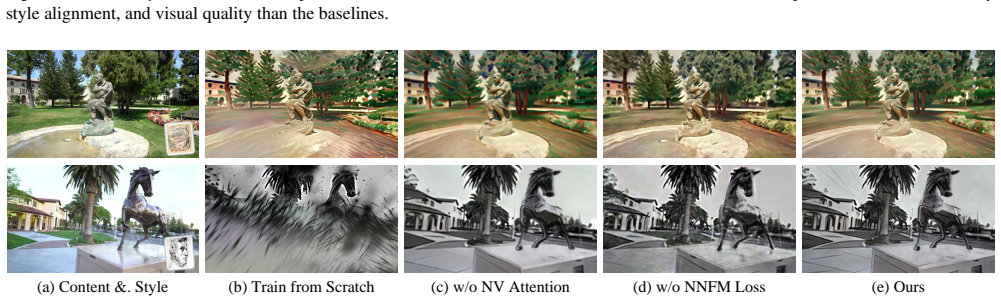
- [Sec. 4.5, Table 2] The ablation study validates the Neighboring-View Attention and the NNFM loss, but it does not ablate the Content-Style Separated Control, which is listed as Contribution 2 and is central to the claimed reduction of 'information leakage.' Without a variant that replaces the CSGO/Tile ControlNet content and style controls with an inversion-based content preservation approach, the experiments do not directly support the claim that separated control reduces leakage or improves content fidelity. The 'Train from Scratch' variant ablates the pre-trained scene geometry, not this proposed component. Please add an ablation that isolates the effect of Content-Style Separated Control.
- [Sec. 3.2.3 and Sec. 4.4] The CLIP-DC metric in Eq. (16) measures the consistency of CLIP edit directions between adjacent frames on a rendered camera path. The paper does not specify the camera path used, and it is likely that adjacent frames on such a path are precisely the views that are clustered together in the same neighboring-view group. As a result, CLIP-DC may not detect discontinuities at group boundaries or between views with larger baselines. Please describe the path and, more importantly, evaluate consistency across group boundaries and across pairs of views that are not in the same group, since those are the cases where the proposed alignment mechanism is most at risk.
minor comments (4)
- [Eq. (6)] Equation (6) uses the predicted noise epsilon_t as the added noise in the DDIM update, which is not the standard DDIM sampling or inversion step and appears to be a typo; please clarify the actual sampling/inversion procedure used.
- [Sec. 3.2.3 and Fig. 2] The notation around Neighboring-View features is difficult to follow: K_NV and V_NV are defined as concatenations of K_i and V_i for N views, but the figure does not clearly indicate whether the query comes from a single view and whether the same group is used for all self-attention layers; please clarify with a concise formal description of the grouping and attention shapes.
- [Sec. 4.4 and Sec. 4.5] The 'Ours' row in Table 2 (CFSD 0.12, CSD 0.15, CLIP-DC 0.80) differs from the 'Ours' row in Table 1 (CFSD 0.14, CSD 0.13, CLIP-DC 0.81), which is confusing because the reader may expect identical numbers; please state explicitly that the tables report averages over different scene subsets.
- [Supplementary, Eq. (4)] In the NNFM loss definition, the min operation is written as 'min Dcos(Fr(i,j), Fs(i,j))' without specifying the index over which the minimum is taken; please write the index explicitly, following the ARF formulation.
Circularity Check
No significant circularity: ArtNVG's reported gains are empirical comparisons against external baselines, and no evaluation metric is an input to the method's optimization or defined in terms of its outputs.
full rationale
ArtNVG's derivation chain is self-contained in the sense that its central claims are empirical rather than definitional. The method renders content images from an existing 3DGS scene, injects content and style controls using externally validated CSGO projection modules and a Tile ControlNet, replaces self-attention with the Neighboring-View attention of Eqs. (7)-(8), and finetunes the scene with an L1 plus NNFM loss. None of the evaluation metrics (CFSD, CSD, CLIP-DC) is used as a training loss, and none is defined in terms of the method's own parameters, so the reported metric improvements are measurements rather than identities. The attention concatenation in Eq. (7) is an architectural mechanism, not a fitted prediction: it does not by construction guarantee low CFSD, high CSD, or high CLIP-DC, and the ablations show that the mechanism changes measured scores. The paper cites no prior work by the present authors, so there is no self-citation chain carrying the argument. Hyperparameters such as N=15 and the CSGO scales are disclosed as design choices; selecting N by inspecting the CLIP-DC curve in Fig. 7 is a model-selection step that could make the reported consistency numbers optimistic, but it is disclosed and does not make the claim reduce to its inputs. The skeptic concern that camera-center-close views need not share content in 360-degree scenes is an assumption-validity and robustness issue, not a circularity reduction, and the Limitations section openly notes that geometric transformations are out of scope. Overall, no load-bearing step equates an output to an input by construction.
Assumptions & free parameters
free parameters (4)
- Neighboring view count N =
15
- content scale =
1.0
- style scale =
0.6
- control scale =
1.0
assumptions (4)
- domain assumption The original 3DGS reconstruction provides faithful content images whose geometry is preserved during finetuning.
- domain assumption CSGO projection modules and the CLIP image encoder separate content and style as intended when applied to rendered 3DGS views.
- ad hoc to paper Self-attention key/value features of neighboring views are mutually compatible in the diffusion latent space and concatenating them improves consistency without adding conflicting content.
- domain assumption Metrics CFSD, CSD, and CLIP-DC adequately capture content preservation, style alignment, and cross-view consistency for stylization quality.
Cite this review
Pith. "Pith review of ArtNVG: Content-Style Separated Artistic Neighboring-View Gaussian Stylization." pith.science (2026). https://pith.science/paper/PZMUVYWF
@misc{pith2026241218783,
  author       = {Pith},
  title        = {Pith review of: ArtNVG: Content-Style Separated Artistic Neighboring-View Gaussian Stylization},
  year         = {2026},
  howpublished = {\url{https://pith.science/paper/PZMUVYWF}},
  note         = {Machine review of arXiv:2412.18783}
}
read the original abstract
As demand from the film and gaming industries for 3D scenes with target styles grows, the importance of advanced 3D stylization techniques increases. However, recent methods often struggle to maintain local consistency in color and texture throughout stylized scenes, which is essential for maintaining aesthetic coherence. To solve this problem, this paper introduces ArtNVG, an innovative 3D stylization framework that efficiently generates stylized 3D scenes by leveraging reference style images. Built on 3D Gaussian Splatting (3DGS), ArtNVG achieves rapid optimization and rendering while upholding high reconstruction quality. Our framework realizes high-quality 3D stylization by incorporating two pivotal techniques: Content-Style Separated Control and Attention-based Neighboring-View Alignment. Content-Style Separated Control uses the CSGO model and the Tile ControlNet to decouple the content and style control, reducing risks of information leakage. Concurrently, Attention-based Neighboring-View Alignment ensures consistency of local colors and textures across neighboring views, significantly improving visual quality. Extensive experiments validate that ArtNVG surpasses existing methods, delivering superior results in content preservation, style alignment, and local consistency.
Figures


Figures from the paper (7 more)




Reference graph
Works this paper leans on
- [1]
-
[2]
Mip-nerf: A multiscale representation for anti-aliasing neural radiance fields
Jonathan T Barron, Ben Mildenhall, Matthew Tancik, Peter Hedman, Ricardo Martin-Brualla, and Pratul P Srinivasan. Mip-nerf: A multiscale representation for anti-aliasing neural radiance fields. In Proceedings of the IEEE/CVF international conference on computer vision, pages 5855–5864, 2021. 2
2021
-
[3]
Mip-nerf 360: Unbounded anti-aliased neural radiance fields
Jonathan T Barron, Ben Mildenhall, Dor Verbin, Pratul P Srinivasan, and Peter Hedman. Mip-nerf 360: Unbounded anti-aliased neural radiance fields. In Proceedings of the IEEE/CVF conference on computer vision and pattern recog- nition, pages 5470–5479, 2022. 2
work page 2022
-
[4]
Efficient geometry-aware 3d generative adversarial networks
Eric R Chan, Connor Z Lin, Matthew A Chan, Koki Nagano, Boxiao Pan, Shalini De Mello, Orazio Gallo, Leonidas J Guibas, Jonathan Tremblay, Sameh Khamis, et al. Efficient geometry-aware 3d generative adversarial networks. In Pro- ceedings of the IEEE/CVF conference on computer vision and pattern recognition, pages 16123–16133, 2022. 2
2022
-
[5]
Tensorf: Tensorial radiance fields
Anpei Chen, Zexiang Xu, Andreas Geiger, Jingyi Yu, and Hao Su. Tensorf: Tensorial radiance fields. In European conference on computer vision , pages 333–350. Springer,
-
[6]
Text-to-3d using gaussian splatting
Zilong Chen, Feng Wang, Yikai Wang, and Huaping Liu. Text-to-3d using gaussian splatting. In Proceedings of the IEEE/CVF Conference on Computer Vision and Pattern Recognition, pages 21401–21412, 2024. 2
2024
-
[7]
Jiwoo Chung, Sangeek Hyun, and Jae-Pil Heo. Style in- jection in diffusion: A training-free approach for adapting large-scale diffusion models for style transfer. In Proceedings of the IEEE/CVF Conference on Computer Vision and Pattern Recognition, pages 8795–8805, 2024. 5, 12 9
work page 2024
-
[8]
Vica-nerf: View- consistency-aware 3d editing of neural radiance fields
Jiahua Dong and Yu-Xiong Wang. Vica-nerf: View- consistency-aware 3d editing of neural radiance fields. Ad- vances in Neural Information Processing Systems, 36, 2024. 2, 3, 6
work page 2024
Show all 56 references
-
[9]
Plenoxels: Radiance fields without neural networks
Sara Fridovich-Keil, Alex Yu, Matthew Tancik, Qinhong Chen, Benjamin Recht, and Angjoo Kanazawa. Plenoxels: Radiance fields without neural networks. In Proceedings of the IEEE/CVF conference on computer vision and pattern recognition, pages 5501–5510, 2022. 2
2022
-
[10]
K-planes: Explicit radiance fields in space, time, and appearance
Sara Fridovich-Keil, Giacomo Meanti, Frederik Rahbæk War- burg, Benjamin Recht, and Angjoo Kanazawa. K-planes: Explicit radiance fields in space, time, and appearance. In Proceedings of the IEEE/CVF Conference on Computer Vi- sion and Pattern Recognition, pages 12479–12488, 2023. 2
2023
-
[11]
Style- nerf2nerf: 3d style transfer from style-aligned multi-view images
Haruo Fujiwara, Yusuke Mukuta, and Tatsuya Harada. Style- nerf2nerf: 3d style transfer from style-aligned multi-view images. arXiv preprint arXiv:2406.13393, 2024. 2, 3, 4, 5, 6
2024 arXiv
-
[12]
Stylenerf: A style-based 3d-aware generator for high- resolution image synthesis
Jiatao Gu, Lingjie Liu, Peng Wang, and Christian Theobalt. Stylenerf: A style-based 3d-aware generator for high- resolution image synthesis. arXiv preprint arXiv:2110.08985,
-
[13]
Instruct-nerf2nerf: Editing 3d scenes with instructions
Ayaan Haque, Matthew Tancik, Alexei A Efros, Aleksander Holynski, and Angjoo Kanazawa. Instruct-nerf2nerf: Editing 3d scenes with instructions. In Proceedings of the IEEE/CVF International Conference on Computer Vision, pages 19740– 19750, 2023. 2, 3, 5, 6, 12
2023
-
[14]
Learning to stylize novel views
Hsin-Ping Huang, Hung-Yu Tseng, Saurabh Saini, Maneesh Singh, and Ming-Hsuan Yang. Learning to stylize novel views. In Proceedings of the IEEE/CVF International Conference on Computer Vision, pages 13869–13878, 2021. 3
2021
-
[15]
Stylizednerf: consistent 3d scene stylization as styl- ized nerf via 2d-3d mutual learning
Yi-Hua Huang, Yue He, Yu-Jie Yuan, Yu-Kun Lai, and Lin Gao. Stylizednerf: consistent 3d scene stylization as styl- ized nerf via 2d-3d mutual learning. In Proceedings of the IEEE/CVF Conference on Computer Vision and Pattern Recognition, pages 18342–18352, 2022. 3
2022
-
[16]
Stylesplat: 3d object style transfer with gaussian splatting
Sahil Jain, Avik Kuthiala, Prabhdeep Singh Sethi, and Prakan- shul Saxena. Stylesplat: 3d object style transfer with gaussian splatting. arXiv preprint arXiv:2407.09473, 2024. 2, 3
2024 arXiv
-
[17]
A style-based generator architecture for generative adversarial networks
Tero Karras, Samuli Laine, and Timo Aila. A style-based generator architecture for generative adversarial networks. In Proceedings of the IEEE/CVF conference on computer vision and pattern recognition, pages 4401–4410, 2019. 3
2019
-
[18]
Neu- ral 3d mesh renderer
Hiroharu Kato, Yoshitaka Ushiku, and Tatsuya Harada. Neu- ral 3d mesh renderer. In Proceedings of the IEEE confer- ence on computer vision and pattern recognition, pages 3907– 3916, 2018. 3
2018
-
[19]
3d gaussian splatting for real-time radiance field rendering
Bernhard Kerbl, Georgios Kopanas, Thomas Leimk¨uhler, and George Drettakis. 3d gaussian splatting for real-time radiance field rendering. ACM Trans. Graph., 42(4):139–1, 2023. 2, 3
2023
-
[20]
Segment any- thing
Alexander Kirillov, Eric Mintun, Nikhila Ravi, Hanzi Mao, Chloe Rolland, Laura Gustafson, Tete Xiao, Spencer White- head, Alexander C Berg, Wan-Yen Lo, et al. Segment any- thing. In Proceedings of the IEEE/CVF International Confer- ence on Computer Vision, pages 4015–4026, 2023. 3
2023
-
[21]
Tanks and temples: Benchmarking large-scale scene reconstruction
Arno Knapitsch, Jaesik Park, Qian-Yi Zhou, and Vladlen Koltun. Tanks and temples: Benchmarking large-scale scene reconstruction. ACM Transactions on Graphics, 36(4), 2017. 5
2017
-
[22]
Stylerf: Zero-shot 3d style transfer of neural radiance fields
Kunhao Liu, Fangneng Zhan, Yiwen Chen, Jiahui Zhang, Yingchen Yu, Abdulmotaleb El Saddik, Shijian Lu, and Eric P Xing. Stylerf: Zero-shot 3d style transfer of neural radiance fields. In Proceedings of the IEEE/CVF Conference on Com- puter Vision and Pattern Recognition, pages ...
2023
-
[23]
Stylegaussian: Instant 3d style transfer with gaussian splatting
Kunhao Liu, Fangneng Zhan, Muyu Xu, Christian Theobalt, Ling Shao, and Shijian Lu. Stylegaussian: Instant 3d style transfer with gaussian splatting. arXiv preprint arXiv:2403.07807, 2024. 2, 3, 5
2024 arXiv
-
[24]
Text-guided texturing by synchronized multi-view diffusion
Yuxin Liu, Minshan Xie, Hanyuan Liu, and Tien-Tsin Wong. Text-guided texturing by synchronized multi-view diffusion. arXiv preprint arXiv:2311.12891, 2023. 5
2023 arXiv
-
[25]
Sdedit: Guided image synthesis and editing with stochastic differential equations
Chenlin Meng, Yutong He, Yang Song, Jiaming Song, Jiajun Wu, Jun-Yan Zhu, and Stefano Ermon. Sdedit: Guided image synthesis and editing with stochastic differential equations. In International Conference on Learning Representations. 2
-
[26]
Text2mesh: Text-driven neural stylization for meshes
Oscar Michel, Roi Bar-On, Richard Liu, Sagie Benaim, and Rana Hanocka. Text2mesh: Text-driven neural stylization for meshes. In Proceedings of the IEEE/CVF Conference on Computer Vision and Pattern Recognition, pages 13492– 13502, 2022. 3
2022
-
[27]
Nerf: Representing scenes as neural radiance fields for view syn- thesis
Ben Mildenhall, Pratul P Srinivasan, Matthew Tancik, Jonathan T Barron, Ravi Ramamoorthi, and Ren Ng. Nerf: Representing scenes as neural radiance fields for view syn- thesis. Communications of the ACM , 65(1):99–106, 2021. 2
2021
-
[28]
Instant neural graphics primitives with a multiresolu- tion hash encoding
Thomas M¨uller, Alex Evans, Christoph Schied, and Alexander Keller. Instant neural graphics primitives with a multiresolu- tion hash encoding. ACM transactions on graphics (TOG), 41(4):1–15, 2022. 2
2022
-
[29]
Snerf: stylized neural implicit representations for 3d scenes
Thu Nguyen-Phuoc, Feng Liu, and Lei Xiao. Snerf: stylized neural implicit representations for 3d scenes. ACM Transac- tions on Graphics (TOG), 41(4):1–11, 2022. 3
2022
-
[30]
Giraffe: Represent- ing scenes as compositional generative neural feature fields
Michael Niemeyer and Andreas Geiger. Giraffe: Represent- ing scenes as compositional generative neural feature fields. In Proceedings of the IEEE/CVF Conference on Computer Vision and Pattern Recognition, pages 11453–11464, 2021. 2
2021
-
[31]
D-nerf: Neural radiance fields for dynamic scenes
Albert Pumarola, Enric Corona, Gerard Pons-Moll, and Francesc Moreno-Noguer. D-nerf: Neural radiance fields for dynamic scenes. In Proceedings of the IEEE/CVF Con- ference on Computer Vision and Pattern Recognition, pages 10318–10327, 2021. 2
2021
-
[32]
High-resolution image synthesis with latent diffusion models
Robin Rombach, Andreas Blattmann, Dominik Lorenz, Patrick Esser, and Bj ¨orn Ommer. High-resolution image synthesis with latent diffusion models. In Proceedings of the IEEE/CVF conference on computer vision and pattern recognition, pages 10684–10695, 2022. 3
2022
-
[33]
Gaussian splatting in style
Abhishek Saroha, Mariia Gladkova, Cecilia Curreli, Dominik Muhle, Tarun Yenamandra, and Daniel Cremers. Gaussian splatting in style. arXiv preprint arXiv:2403.08498, 2024. 3
2024 arXiv
-
[34]
Structure-from-motion revisited
Johannes Lutz Sch ¨onberger and Jan-Michael Frahm. Structure-from-motion revisited. In Conference on Computer Vision and Pattern Recognition (CVPR), 2016. 2
2016
-
[35]
Graf: Generative radiance fields for 3d-aware im- age synthesis
Katja Schwarz, Yiyi Liao, Michael Niemeyer, and Andreas Geiger. Graf: Generative radiance fields for 3d-aware im- age synthesis. Advances in Neural Information Processing Systems, 33:20154–20166, 2020. 2 10
2020
-
[36]
Very deep convolutional networks for large- scale image recognition
Karen Simonyan. Very deep convolutional networks for large- scale image recognition. arXiv preprint arXiv:1409.1556 ,
-
[37]
Measuring style similarity in diffusion models
Gowthami Somepalli, Anubhav Gupta, Kamal Gupta, Shra- may Palta, Micah Goldblum, Jonas Geiping, Abhinav Shri- vastava, and Tom Goldstein. Measuring style similarity in diffusion models. arXiv preprint arXiv:2404.01292, 2024. 5, 12
2024 arXiv
-
[38]
Direct voxel grid optimization: Super-fast convergence for radiance fields reconstruction
Cheng Sun, Min Sun, and Hwann-Tzong Chen. Direct voxel grid optimization: Super-fast convergence for radiance fields reconstruction. In Proceedings of the IEEE/CVF conference on computer vision and pattern recognition , pages 5459– 5469, 2022. 2
2022
-
[39]
Nerfstudio: A modular framework for neural radiance field development
Matthew Tancik, Ethan Weber, Evonne Ng, Ruilong Li, Brent Yi, Terrance Wang, Alexander Kristoffersen, Jake Austin, Kamyar Salahi, Abhik Ahuja, et al. Nerfstudio: A modular framework for neural radiance field development. In ACM SIGGRAPH 2023 Conference Proceedings, pages 1–12,...
2023
-
[40]
Instruct-gs2gs: Editing 3d gaussian splats with instructions, 2024
Cyrus Vachha and Ayaan Haque. Instruct-gs2gs: Editing 3d gaussian splats with instructions, 2024. 2, 3, 6
2024
-
[41]
Diffusers: State-of-the-art diffusion models
Patrick von Platen, Suraj Patil, Anton Lozhkov, Pedro Cuenca, Nathan Lambert, Kashif Rasul, Mishig Davaadorj, Dhruv Nair, Sayak Paul, William Berman, Yiyi Xu, Steven Liu, and Thomas Wolf. Diffusers: State-of-the-art diffusion models. https://github.com/huggingface/diffusers,
-
[42]
Nerf-art: Text-driven neural radiance fields stylization
Can Wang, Ruixiang Jiang, Menglei Chai, Mingming He, Dongdong Chen, and Jing Liao. Nerf-art: Text-driven neural radiance fields stylization. IEEE Transactions on Visualiza- tion and Computer Graphics, 2023. 3
2023
-
[43]
Gaussianeditor: Editing 3d gaussians delicately with text instructions
Junjie Wang, Jiemin Fang, Xiaopeng Zhang, Lingxi Xie, and Qi Tian. Gaussianeditor: Editing 3d gaussians delicately with text instructions. In Proceedings of the IEEE/CVF Conference on Computer Vision and Pattern Recognition, pages 20902– 20911, 2024. 2
2024
-
[44]
Neus: Learning neural implicit surfaces by volume rendering for multi-view reconstruction
Peng Wang, Lingjie Liu, Yuan Liu, Christian Theobalt, Taku Komura, and Wenping Wang. Neus: Learning neural implicit surfaces by volume rendering for multi-view reconstruction. arXiv preprint arXiv:2106.10689, 2021. 2
2021 arXiv
-
[45]
Neus2: Fast learning of neural implicit surfaces for multi-view reconstruction
Yiming Wang, Qin Han, Marc Habermann, Kostas Daniilidis, Christian Theobalt, and Lingjie Liu. Neus2: Fast learning of neural implicit surfaces for multi-view reconstruction. In Proceedings of the IEEE/CVF International Conference on Computer Vision, pages 3295–3306, 2023. 2
2023
-
[46]
Gaussctrl: multi-view consistent text-driven 3d gaussian splatting editing
Jing Wu, Jia-Wang Bian, Xinghui Li, Guangrun Wang, Ian Reid, Philip Torr, and Victor Adrian Prisacariu. Gaussctrl: multi-view consistent text-driven 3d gaussian splatting editing. arXiv preprint arXiv:2403.08733, 2024. 2, 3, 5, 6
2024 arXiv
-
[47]
Csgo: Content- style composition in text-to-image generation
Peng Xing, Haofan Wang, Yanpeng Sun, Qixun Wang, Xu Bai, Hao Ai, Renyuan Huang, and Zechao Li. Csgo: Content- style composition in text-to-image generation. arXiv preprint arXiv:2408.16766, 2024. 2, 3, 4, 5, 12
2024 arXiv
-
[48]
Desrf: Deformable stylized radiance field
Shiyao Xu, Lingzhi Li, Li Shen, and Zhouhui Lian. Desrf: Deformable stylized radiance field. In Proceedings of the IEEE/CVF Conference on Computer Vision and Pattern Recognition, pages 709–718, 2023. 3
2023
-
[49]
Ip- adapter: Text compatible image prompt adapter for text-to- image diffusion models
Hu Ye, Jun Zhang, Sibo Liu, Xiao Han, and Wei Yang. Ip- adapter: Text compatible image prompt adapter for text-to- image diffusion models. 2023. 12
2023
-
[50]
Gaussian- dreamer: Fast generation from text to 3d gaussian splatting with point cloud priors
Taoran Yi, Jiemin Fang, Guanjun Wu, Lingxi Xie, Xiaopeng Zhang, Wenyu Liu, Qi Tian, and Xinggang Wang. Gaussian- dreamer: Fast generation from text to 3d gaussian splatting with point cloud priors. arXiv preprint arXiv:2310.08529,
-
[51]
3dstylenet: Creating 3d shapes with geometric and texture style variations
Kangxue Yin, Jun Gao, Maria Shugrina, Sameh Khamis, and Sanja Fidler. 3dstylenet: Creating 3d shapes with geometric and texture style variations. In Proceedings of the IEEE/CVF International Conference on Computer Vision, pages 12456– 12465, 2021. 3
2021
-
[52]
Instantstylegaussian: Efficient art style transfer with 3d gaussian splatting
Xin-Yi Yu, Jun-Xin Yu, Li-Bo Zhou, Yan Wei, and Lin-Lin Ou. Instantstylegaussian: Efficient art style transfer with 3d gaussian splatting. arXiv preprint arXiv:2408.04249, 2024. 2, 3, 4, 5
2024 arXiv
-
[53]
Coarf: Controllable 3d artistic style transfer for radiance fields
Deheng Zhang, Clara Fernandez-Labrador, and Christopher Schroers. Coarf: Controllable 3d artistic style transfer for radiance fields. In 2024 International Conference on 3D Vision (3DV), pages 612–622. IEEE, 2024. 2
2024
-
[54]
Stylizedgs: Con- trollable stylization for 3d gaussian splatting
Dingxi Zhang, Yu-Jie Yuan, Zhuoxun Chen, Fang-Lue Zhang, Zhenliang He, Shiguang Shan, and Lin Gao. Stylizedgs: Con- trollable stylization for 3d gaussian splatting. arXiv preprint arXiv:2404.05220, 2024. 3
2024 arXiv
-
[55]
Arf: Artistic radiance fields
Kai Zhang, Nick Kolkin, Sai Bi, Fujun Luan, Zexiang Xu, Eli Shechtman, and Noah Snavely. Arf: Artistic radiance fields. In European Conference on Computer Vision, pages 717–733. Springer, 2022. 2, 3, 4, 12
2022
-
[56]
splatfacto
Lvmin Zhang, Anyi Rao, and Maneesh Agrawala. Adding conditional control to text-to-image diffusion models. In Proceedings of the IEEE/CVF International Conference on Computer Vision, pages 3836–3847, 2023. 4 11 ArtNVG: Content-Style Separated Artistic Neighboring-View Gaussian...
2023
Reviewed August 11, 2026 · model on record in the stance chip above.
Discussion (0). Continue with ORCID to comment.