REVIEW 4 major objections 4 minor 33 references
On the convergence of fictitious play algorithm in repeated games via the geometrical approach
T0 review · 4 major / 4 minor · reviewed 2026-08-11 · deepseek-v4-flash
Pith's one-line read The paper proves that continuous-time fictitious play converges to a Nash equilibrium from every starting point in every $3\times3$ game whose indifference point lies outside both players' simplices, using a projection that reduces the…
desk verdict The paper's own Example 4.2 contradicts Theorem 3.1, but the projection method and the class comparison are genuinely useful and deserve referee attention. read the letter →
The pith
A machine-rendered reading of the paper's core claim, the machinery that carries it, and where it could break.
The reading
What carries the argument
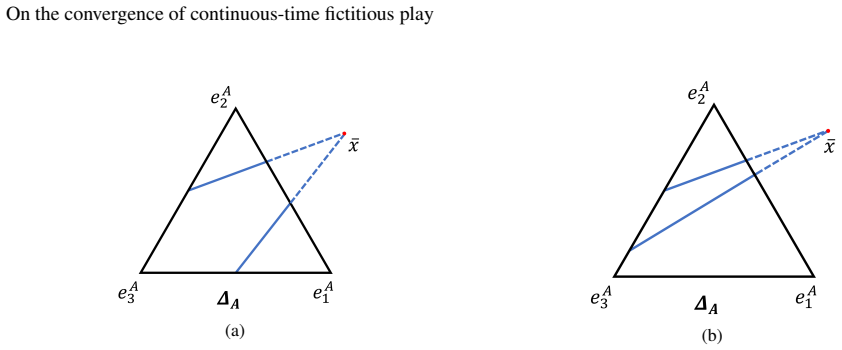
The central object is the projection mapping $\varphi = \varphi_A \times \varphi_B$, which sends each player's strategy simplex to an edge by drawing the line through a point and the game's indifferent point and recording its intersection with the chosen edge; when the indifferent point is absent, the projection runs parallel to the now-parallel indifference lines. On the resulting unit square, the image of the best-response dynamics is a planar piecewise-linear system (PBRD) with nine labeled cells, and the key identity is the return map $f$ on the entry edge, composed of eight fractional-linear maps that can be written down explicitly from similar triangles. The derivative of $f$ factors into ratios of cell widths and heights and is strictly less than 1, which is the contraction that rules out the endless eight-cell loop that would otherwise allow non-convergence. The paper also introduces geometric redefinitions of saddle and sink Nash equilibria tailored to the nonsmooth vector field, and proves these always exist when equilibria are multiple.
What would settle it
Numerically integrate the continuous-time fictitious play equations (2) for any $3\times3$ game whose indifferent point lies outside both simplices, starting from a point whose projection lands on the eight-cell loop; if the projection's return distance shrinks to zero but the original four-dimensional trajectory's distance to the unique Nash equilibrium does not (for instance, the trajectory keeps switching among all three actions), then Proposition 3.3(2) and Theorem 3.1 are false.
Extended reading notes
Core claim
On the paper's own terms, the discovery is Theorem 3.1: every continuous-time fictitious play process approaches a Nash equilibrium in every $3\times3$ game without an internal indifferent point (IIP), the unique (possibly negative-probability) strategy profile at which all of a player's pure actions give equal payoff. Since that point lies outside both players' simplices, each player's strategy triangle contains at most two indifference lines, making the new projection mapping well-defined. The projected best-response dynamics live on a unit square divided into nine cells; the paper proves that any trajectory either enters a four- or six-cell path where a known $2\times n$ convergence result forces convergence, or it follows an eight-cell loop controlled by a return map. The map's derivative factors as a product of ratios of cell widths and is strictly less than 1, so the return map is contractive and eventually pushes the trajectory into the convergent regime. For games with multiple equilibria, the paper defines saddle and sink equilibria geometrically, proves a saddle and a sink always coexist, and uses the saddle's separating lines to partition the square so that no trajectory can visit all three actions of both players forever.
Load-bearing premise
The load-bearing premise is that convergence of the projected planar dynamics forces convergence of the original four-dimensional dynamics, even though the projection identifies many different original states with a single point on the plane.
Editorial extensions
If this is right
- The paper's Theorem 3.1 adds the entire class of $3\times3$ games without an internal indifferent point to the known class of games with the fictitious play property, and Example 4.1 shows this class is not contained in the quasi-supermodular games previously identified.
- Corollary 3.1 turns the long-run pattern of action profiles into a classification of the limit equilibrium: one action profile repeated means a pure Nash equilibrium, two switching profiles mean a saddle, and four switching profiles mean a sink.
- Because CFP and BRD follow the same trajectory shapes and differ only in time scaling, the contraction of the return map on the projected square transfers to the original dynamics, giving convergence from every initial condition in the no-IIP class.
- The projection method also applies outside the convergent setting: it reproduces a known $4\times4$ non-convergent example and reveals regime shifts in one-parameter families of games, where a continuum of Nash equilibria can emerge and the dynamics may approach the continuum without converging to any point of it.
Reading between the lines
- Editorial inference: the derivative bound on the return map is quantitative, so the same proof should yield a rate at which trajectories on the eight-cell path approach the contractive regime; a natural extension is an explicit bound on the number of returns needed for $\epsilon$-convergence in games without IIP.
- Editorial inference: Proposition 3.3(2) is the step most worth probing, because $\varphi$ identifies whole line segments with single points, so convergence on the projected square does not formally rule out motion along those fibers; simulating the original CFP for several initial conditions with the same projection would test whether the reduction hides any non-convergent behavior.
- Editorial inference: the regime-shift examples suggest that the connectivity structure of the Nash equilibrium set can change abruptly along a payoff path while the dynamics remain tame; if pursued further, this connects to the difficulty of homotopy methods for equilibrium computation rather than to fictitious play itself.
Signed reviews
Editorial analysis
A structured set of objections, weighed in public.
Referee Report
Summary. The paper studies continuous-time fictitious play (CFP) in two-player 3x3 games without an internal indifferent point (IIP). It introduces a projection from the four-dimensional strategy space to a planar system, defines saddle and sink Nash equilibria for the resulting non-smooth best-response dynamics, and claims Theorem 3.1: every CFP approaches equilibrium in every 3x3 game without IIP. The paper also claims that the projection method extends to degenerate games and to some higher-dimensional games, and it compares the proposed class with quasi-supermodular games.
Significance. If the main theorem were correct, the paper would identify a substantial new class of games with the fictitious play property and would offer a geometric reduction that could be useful for other game classes. The paper contains concrete examples and simulations, and the geometric projection idea is genuinely interesting. However, the central theorem is contradicted by the paper's own degenerate Example 4.2, and key proof steps are only sketched for a 'typical case' or handled by assertion of similarity. The contribution is therefore not established as it stands.
major comments (4)
- [Section 2.2 and Section 4.2, Example 4.2] Section 2.2 defines convergence of CFP as pointwise convergence to a strategy profile (x*, y*). Theorem 3.1 asserts convergence in every 3x3 game without IIP. Example 4.2 with k = -2/3 is presented as a 3x3 game without IIP (payoff matrices (13)), and Section 4.2 states that 'for 3 x 3 games without IIP, degeneracy does not affect the convergency of FP.' Yet the same section and Figure 9 state that the CFP trajectory 'surrounds and approaches the set of NEs, but will never converge to any point in the set.' Approaching a continuum is not pointwise convergence under the paper's own definition. Thus Theorem 3.1 as stated is internally inconsistent with the example. If the theorem is meant only for nondegenerate games, the abstract, Theorem 3.1, and Section 4.2 must be revised; if it is meant as stated, the example must converge pointwise, which the text denies.
- [Section 3.3, proof of Theorem 3.2] The proof of Theorem 3.2 is given only for 'the following typical case illustrated by Figure 4', with the statement that 'all the other cases are just similar.' Theorem 3.1 covers all 3x3 games without IIP, and Appendix D only lists possible cases without proving convergence for each one. Since the vector field and the Poincare map depend on the arrangement of best-response regions and indifferent lines, convergence in one configuration does not imply convergence in the others. The same issue appears in Theorem 3.3 ('the proof for case (2) is similar') and in Proposition 3.4, where cases (2) and (3) are deferred to Appendix F. This leaves the main theorem unproven even setting aside the degenerate counterexample.
- [Section 3.2, Proposition 3.3(2)] The reduction from PBRD to BRD is not justified. The projection mapping phi is non-injective: each point of the projected edge corresponds to a line segment in the original strategy simplex. The two-sentence proof says only that after PBRD converges, the BRD trajectory 'eventually belongs to the 4 cells around NE' and then invokes Lemma 2.2. It does not rule out persistent non-convergent motion along the fibers of phi within those cells. Because all subsequent contraction arguments are carried out in the projected plane, this step is load-bearing: if the reduction fails, the planar convergence results do not transfer to the original CFP dynamics.
- [Section 3.4, Proposition 3.4] Proposition 3.4 asserts the existence of a saddle NE and a sink NE for games with multiple NEs. The proof of the sink part states: 'The existence of sink NE is a straightforward corollary of our main results Theorem 3.1, whose proof only relies on the existence of saddle NE.' But Theorem 3.1 is the statement being proved, and its proof uses Proposition 3.4. Even if the convergence argument uses only the saddle part, the proposition as stated invokes the main theorem in its own proof. The sink existence must be proved independently or removed from the proposition.
minor comments (4)
- [Abstract and Section 1] The manuscript uses 'IP' and 'IIP' inconsistently, and contains the typo 'Internal Indiffernt Point'; these should be unified to 'IIP' and 'Indifferent Point'.
- [Section 2.1] The definition of the edge of Delta_A writes 'x1 <= 0, x2 <= 0'; the inequalities should be 'xi >= 0' for a probability simplex edge.
- [Section 3.2, Proposition 3.3(1)] Proposition 3.3(1) states that phi(x,y) belongs to Z^B_j x Z^B_k if and only if (x,y) belongs to Z^B_j x Z^B_k; the second factor should be Z^A_k, not Z^B_k.
- [Throughout] There are numerous grammatical and typographical errors (e.g., 'convergency', 'have being receiving', 'the trajectory approach the continuum') that should be corrected before publication.
Circularity Check
Proposition 3.4's sink-existence claim is derived from the still-unproved Theorem 3.1, an explicit circular dependency; the main convergence proof's saddle-existence branch is otherwise independent.
-
other
[Section 3.4, Proposition 3.4, final paragraph of proof]
"The existence of sink NE is a straightforward corollary of our main results Theorem 3.1, whose proof only relies on the existence of saddle NE. Hence this does not lead to circular argument."
Proposition 3.4 is the lemma used to prove Theorem 3.3 for multiple-NE games, and Theorem 3.1 is the theorem being assembled in this very section. Thus, at the point Proposition 3.4 is proved, Theorem 3.1 has not been established. Deriving the existence of a sink NE as 'a straightforward corollary of our main results Theorem 3.1' makes the proposition's sink-existence assertion depend on the very theorem that Proposition 3.4 is being used to support. The sentence 'whose proof only relies on the existence of saddle NE' does not break the cycle: it only indicates that the saddle half is independently usable, while no independent proof of the sink half is supplied and the proposition's own statement requires it.
full rationale
The paper's central derivation is mostly self-contained: the projection mapping, the planar PBRD analysis, the Poincaré-map contraction in Theorem 3.2, and the combinatorial contradiction for saddle NE in Proposition 3.4 do not fit parameters to the data they claim to predict and do not rely on self-citations. Proposition 3.3(2), which transfers PBRD convergence back to BRD convergence, is under-proved because the projection is non-injective, but that is a proof gap rather than a circular reduction and is not counted as circularity here. The genuine circular step is the final paragraph of Proposition 3.4, where the existence of a sink NE is asserted as a corollary of Theorem 3.1 before Theorem 3.1 is proven. Since Theorem 3.3 uses only the saddle-existence half of Proposition 3.4, the main convergence claim retains independent content despite this circular sub-claim. Separately, and outside the circularity score, Section 4.2's Example 4.2 describes a game without IIP whose projected dynamics 'surrounds and approaches the set of NEs, but will never converge to any point in the set,' which appears to contradict the pointwise convergence asserted by Theorem 3.1; this is an important correctness concern but not itself a circularity, so it is flagged here without increasing the circularity score beyond 4.
Assumptions & free parameters
assumptions (4)
- domain assumption The game is nondegenerate and all best response regions have positive measure.
- ad hoc to paper Convergence of the projected best-response dynamics implies convergence of the original dynamics (Proposition 3.3(2)).
- ad hoc to paper The 'typical case' analyzed in Theorem 3.2, plus 'all the other cases are just similar', covers every geometric configuration of games without IIP.
- standard math The indifferent point exists and is unique for almost all games, and for 3x3 games with no indifferent point the indifferent lines are parallel (Lemma 3.1).
invented entities (1)
-
Indifferent point
independent evidence
Cite this review
Pith. "Pith review of On the convergence of fictitious play algorithm in repeated games via the geometrical approach." pith.science (2026). https://pith.science/paper/VEN5R5XX
@misc{pith2026241219216,
  author       = {Pith},
  title        = {Pith review of: On the convergence of fictitious play algorithm in repeated games via the geometrical approach},
  year         = {2026},
  howpublished = {\url{https://pith.science/paper/VEN5R5XX}},
  note         = {Machine review of arXiv:2412.19216}
}
abstract
As the earliest and one of the most fundamental learning dynamics for computing NE, fictitious play (FP) has being receiving incessant research attention and finding games where FP would converge (games with FPP) is one central question in related fields. In this paper, we identify a new class of games with FPP, i.e., $3\times3$ games without IIP, based on the geometrical approach by leveraging the location of NE and the partition of best response region. During the process, we devise a new projection mapping to reduce a high-dimensional dynamical system to a planar system. And to overcome the non-smoothness of the systems, we redefine the concepts of saddle and sink NE, which are proven to exist and help prove the convergence of CFP by separating the projected space into two parts. Furthermore, we show that our projection mapping can be extended to higher-dimensional and degenerate games.
Figures


Figures from the paper (14 more)




Reference graph
Works this paper leans on
-
[1]
Equilibrium points in n-person games
John F Nash. Equilibrium points in n-person games. Proceedings of the National Academy of Sciences, 36(1):48– 49, 1950
work page 1950
-
[2]
Iterative solution of games by fictitious play
George W Brown. Iterative solution of games by fictitious play. Act. Anal. Prod Allocation, 13(1):374, 1951
work page 1951
-
[3]
The Theory of Learning in Games
Drew Fudenberg and David K Levine. The Theory of Learning in Games. MIT press, 1998
work page 1998
-
[4]
On the convergence of fictitious play
Vijay Krishna and Tomas Sjöström. On the convergence of fictitious play. Mathematics of Operations Research, 23(2):479–511, 1998
work page 1998
-
[5]
Fictitious self-play in extensive-form games
Johannes Heinrich, Marc Lanctot, and David Silver. Fictitious self-play in extensive-form games. In Francis Bach and David Blei, editors, Proceedings of the 32nd International Conference on Machine Learning, volume 37 of Proceedings of Machine Learning Research, pages 805–813, Lille, France, 07–09 Jul 2015. PMLR
work page 2015
-
[6]
Deep reinforcement learning from self-play in imperfect-information games
Johannes Heinrich and David Silver. Deep reinforcement learning from self-play in imperfect-information games. arXiv preprint arXiv:1603.01121, 2016
arXiv 2016
-
[7]
Fictitious play in zero-sum stochastic games
Muhammed O Sayin, Francesca Parise, and Asuman Ozdaglar. Fictitious play in zero-sum stochastic games. SIAM Journal on Control and Optimization, 60(4):2095–2114, 2022
work page 2022
-
[8]
Fictitious play in markov games with single controller
Muhammed O Sayin, Kaiqing Zhang, and Asuman Ozdaglar. Fictitious play in markov games with single controller. In Proceedings of the 23rd ACM Conference on Economics and Computation, pages 919–936, 2022. 22 On the convergence of continuous-time fictitious play
work page 2022
Show all 33 references
-
[9]
An iterative method of solving a game
Julia Robinson. An iterative method of solving a game. Annals of Mathematics, 54(2):296–301, 1951
1951
-
[10]
On the convergence of learning processes in a 2x2 non-zero-person game
Koichi Miyasawa. On the convergence of learning processes in a 2x2 non-zero-person game. Research Memo 33. 1961
1961
-
[11]
Fictitious play property for games with identical interests
Dov Monderer and Lloyd S Shapley. Fictitious play property for games with identical interests. Journal of Economic Theory, 68(1):258–265, 1996
1996
-
[12]
Fictitious play in 2×n games
Ulrich Berger. Fictitious play in 2×n games. Journal of Economic Theory, 120(2):139–154, 2005
2005
-
[13]
evolutionary
John H Nachbar. “evolutionary” selection dynamics in games: Convergence and limit properties. International Journal of Game Theory, 19:59–89, 1990
1990
-
[14]
Two more classes of games with the continuous-time fictitious play property.Games and Economic Behavior, 60(2):247–261, 2007
Ulrich Berger. Two more classes of games with the continuous-time fictitious play property.Games and Economic Behavior, 60(2):247–261, 2007
2007
-
[15]
Some topics in two-person games
Lloyd S Shapley. Some topics in two-person games. Advances in game theory, 52:1–29, 1964
1964
-
[16]
Shapley Polygons in 4 x 4 Games
Martin Hahn. Shapley Polygons in 4 x 4 Games. Games, 1(3):189–220, 2010
2010
-
[17]
Three problems in learning mixed-strategy nash equilibria
James S Jordan. Three problems in learning mixed-strategy nash equilibria. Games and Economic Behavior, 5(3):368–386, 1993
1993
-
[18]
Fictitious play in 3×3 games: The transition between periodic and chaotic behaviour
Colin Sparrow, Sebastian van Strien, and Christopher Harris. Fictitious play in 3×3 games: The transition between periodic and chaotic behaviour. Games and Economic Behavior, 63(1):259–291, 2008
2008
-
[19]
Fictitious play in 3×3 games: Chaos and dithering behaviour
Sebastian van Strien and Colin Sparrow. Fictitious play in 3×3 games: Chaos and dithering behaviour. Games and Economic Behavior, 73(1):262–286, 2011
2011
-
[20]
Cycles in adversarial regularized learning
Panayotis Mertikopoulos, Christos Papadimitriou, and Georgios Piliouras. Cycles in adversarial regularized learning. In Proceedings of the 2018 Annual ACM-SIAM Symposium on Discrete Algorithms, pages 2703–2717. SIAM, 2018
2018
-
[21]
On the impossibility of convergence of mixed strategies with optimal no-regret learning
Vidya Muthukumar, Soham Phade, and Anant Sahai. On the impossibility of convergence of mixed strategies with optimal no-regret learning. Mathematics of Operations Research, 0(0), 2024
2024
-
[22]
Andrade, Rafael Frongillo, and Georgios Piliouras
Gabriel P. Andrade, Rafael Frongillo, and Georgios Piliouras. Learning in matrix games can be arbitrarily complex. In Mikhail Belkin and Samory Kpotufe, editors, Proceedings of Thirty Fourth Conference on Learning Theory, volume 134 of Proceedings of Machine Learning Research,...
2021
-
[23]
An impossibility theorem in game dynamics
Jason Milionis, Christos Papadimitriou, Georgios Piliouras, and Kelly Spendlove. An impossibility theorem in game dynamics. Proceedings of the National Academy of Sciences, 120(41):e2305349120, 2023
2023
-
[24]
On the convergence of fictitious play: A decompo- sition approach
Y Chen, X Deng, C Li, D Mguni, J Wang, X Yan, and Y Yang. On the convergence of fictitious play: A decompo- sition approach. In Proceedings of the Thirty-First International Joint Conference on Artificial Intelligence, pages 179–185, 2022
2022
-
[25]
Fictitious play in 2 × 2 games: a geometric proof of convergence
Andrew Metrick and Ben Polak. Fictitious play in 2 × 2 games: a geometric proof of convergence. Economic Theory, 4:923–933, 1994
1994
-
[26]
Hamiltonian flows with random-walk behaviour originating from zero-sum games and fictitious play
Sebastian Van Strien. Hamiltonian flows with random-walk behaviour originating from zero-sum games and fictitious play. Nonlinearity, 24(6):1715, 2011
2011
-
[27]
Non-algebraic convergence proofs for continuous-time fictitious play
Ulrich Berger. Non-algebraic convergence proofs for continuous-time fictitious play. Dynamic Games and Applications, 2:4–17, 2012
2012
-
[28]
Periodic orbits in piecewise riccati vector fields
Rodrigo D Euzébio and Bruno R Freitas. Periodic orbits in piecewise riccati vector fields. Discrete & Continuous Dynamical Systems-Series B, 28(8), 2023
2023
-
[29]
Game Theory, Alive
Anna R Karlin and Yuval Peres. Game Theory, Alive. American Mathematical Soc., 2017
2017
-
[30]
Game Theory and Mechanism Design
Yadati Narahari. Game Theory and Mechanism Design. World Scientific, 2014
2014
-
[31]
Computing equilibria of n-person games
Robert Wilson. Computing equilibria of n-person games. SIAM Journal on Applied Mathematics, 21(1):80–87, 1971
1971
-
[32]
J. C. Harsanyi. Oddness of the number of equilibrium points: A new proof. International Journal of Game Theory, 2(1):235–250, 1973
1973
-
[33]
Payoff performance of fictitious play
Georg Ostrovski and Sebastian van Strien. Payoff performance of fictitious play. Journal of Dynamics and Games, 1(4):621–638, 2014. 23
2014
Reviewed August 11, 2026 · model on record in the stance chip above.
Discussion (0). Continue with ORCID to comment.