REVIEW 3 major objections 5 minor 25 references
Experimental search potential for sbottom via $\tilde\chi^{\pm}_1$ decays at the LHC Run-3 and HL-LHC, in final states with same-sign leptons and multiple jets
T0 review · 3 major / 5 minor · reviewed 2026-08-11 · deepseek-v4-flash
Pith's one-line read Projection: LHC Run-3 sbottom searches can exclude masses up to 1050 GeV.
desk verdict Transparent projection of an existing ATLAS sbottom search to Run-3 and HL-LHC; the reach numbers are conditional on untested background scaling assumptions, but the paper is honest about them. read the letter →
The pith
A machine-rendered reading of the paper's core claim, the machinery that carries it, and where it could break.
The reading
What carries the argument
The machinery is the pair of ATLAS signal regions Rpc2L1b and Rpc2L2b (final states with at least two same-sign leptons, at least one or two $b$-tagged jets, at least six jets, and cuts on $E_T^{\text{miss}}/m_\text{eff}$), implemented in the SimpleAnalysis framework on DELPHES fast-simulated events. The reach estimate then comes from the signal significance formula of Eq. (1), with background counts taken from the ATLAS publication and scaled linearly with luminosity and by factors of 1.1 (13.6 TeV) and 1.2 (14 TeV) for energy, while background uncertainties are assumed to shrink from 25--30% to 20--10% at higher luminosity.
What would settle it
Run the same Rpc2L1b and Rpc2L2b selections on the first 300 fb$^{-1}$ of real 13.6 TeV ATLAS data: if the observed background exceeds the scaled prediction, or if the resulting 95% CL exclusion contour fails to reach $\tilde b_1$ masses near 1050 GeV in the boosted region, the projection is falsified. A second check is to measure whether the background uncertainty actually drops from 25--30% to about 20% at 300 fb$^{-1}$.
Extended reading notes
Core claim
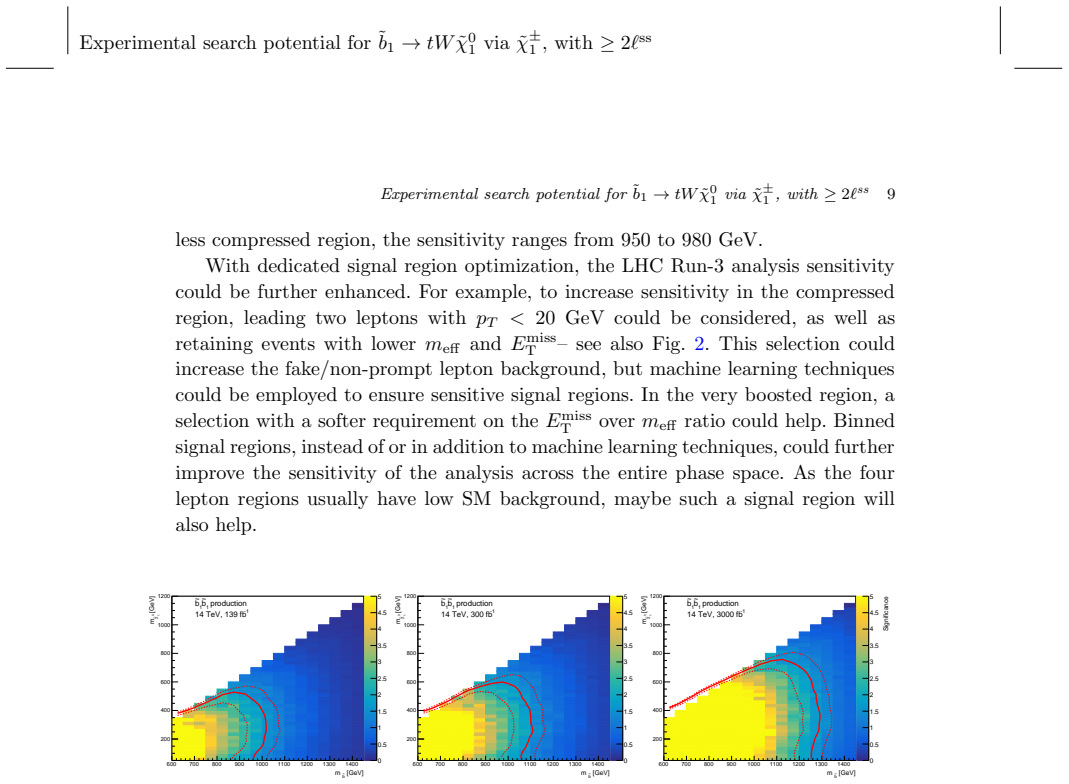
The paper's central claim is that the existing ATLAS Rpc2L1b and Rpc2L2b signal regions retain enough sensitivity that the upcoming runs can substantially extend sbottom exclusion without redesign. Concretely, at $\sqrt{s}=13.6$ TeV with 300 fb$^{-1}$, the boosted region could exclude $\tilde b_1$ masses up to 1050 GeV, the compressed region up to 850 GeV, and the intermediate region from 950 to 980 GeV. At $\sqrt{s}=14$ TeV, the Run-2 exclusion limits could generally increase by 100 GeV, and signal significances around 5 or above in the 950--1050 GeV sbottom mass window would make discovery possible if the model is realized in nature.
Load-bearing premise
The projected limits rely on the assumption that the ATLAS background counts of 6.5 and 7.8 events scale linearly with luminosity and with the simple 1.1 and 1.2 energy factors, while their relative uncertainties fall as assumed; if background composition or systematics change with pileup and energy, the limits shift.
Editorial extensions
If this is right
- At 13.6 TeV with 300 fb$^{-1}$, without changing the ATLAS signal regions, the boosted-region sbottom exclusion could reach 1050 GeV.
- At the HL-LHC, the Run-2 sbottom exclusion limits could rise by about 100 GeV, with additional sensitivity coming from reduced background uncertainties.
- If the sbottom-to-chargino decay chain is real, HL-LHC data could yield discovery-level significance ($Z \ge 5$) for sbottom masses between 950 and 1050 GeV.
- Dedicated optimization of the signal regions (softer leptons, 4-lepton channels, binned or machine-learning selections) could extend reach beyond these unmodified-region projections.
Reading between the lines
- The linear background scaling and simplified energy factors are the fragile part of the extrapolation; a direct data-driven background estimate at 13.6 TeV early in Run-3 would provide a much firmer projection.
- The same projection recipe could be applied to stop or gluino simplified models with chargino-mediated decays, giving quick first estimates of their Run-3 and HL-LHC reach.
- If pileup degrades $b$-tagging or lepton isolation more than assumed, the balance between the one-$b$-tag and two-$b$-tag regions would shift, changing which region drives the limit.
- The paper's sensitivity maps suggest that a binned fit in $E_T^{\text{miss}}/m_\text{eff}$, rather than a single cut, is the most promising cheap upgrade for the boosted region.
Editorial analysis
A structured set of objections, weighed in public.
Referee Report
Summary. The paper presents a fast-simulation projection of the LHC search sensitivity for sbottom pair production in an R-parity-conserving simplified model with the decay chain b~1 -> t chi~1^+/- -> t W chi~1^0, using the ATLAS Rpc2L1b and Rpc2L2b same-sign-lepton signal regions defined in JHEP 06 (2020) 046. Signal samples are generated with MadGraph+Pythia at 13, 13.6, and 14 TeV, passed through DELPHES with ATLAS-like object definitions, and analyzed with the SimpleAnalysis framework. Projected exclusion and discovery significances are shown in the (m_b~1, m_chi~1^0) plane for integrated luminosities of 139, 300, and 3000 fb^-1. The headline claims are that at 13.6 TeV with 300 fb^-1 the boosted region could exclude b~1 masses up to 1050 GeV, and that at 14 TeV the Run-2 exclusion limits could generally increase by 100 GeV. The background model is taken from the ATLAS measurement and extrapolated to higher luminosity and energy by multiplicative rescaling, with reduced relative uncertainties by assumption.
Significance. If the projected reaches are robust, the paper provides a useful, quickly reproducible estimate of what the existing ATLAS signal regions could achieve at Run-3 and HL-LHC for this specific simplified model, without new signal-region optimization. The work is transparent about its simplifications, documents acceptance tables and selection step-by-step, and uses standard public tools (MadGraph, Pythia, DELPHES, SimpleAnalysis) and official cross sections. Its main value is as a phenomenological benchmark: it identifies compressed and boosted regions where the current analysis choices are suboptimal and suggests concrete directions for improvement, such as softer lepton thresholds, binned E_T^miss/m_eff fits, and four-lepton channels. The central numerical claims, however, are conditional on an unvalidated background extrapolation and on an assumption about future uncertainty reduction, so the absolute mass reaches should be interpreted with caution rather than as definitive predictions.
major comments (3)
- [Section 2, background extrapolation paragraph] The projected limits depend directly on the treatment of the background. The paper multiplies the ATLAS Run-2 background counts by 2.16 (21.60) for luminosity and by 1.1 (1.2) for energy, and reduces the relative background uncertainties from 25%/30% to 20%/10% at 300/3000 fb^-1. These choices enter Eq. (1) through both b and sigma, so any error in them propagates directly into the exclusion contours. The paper is explicit that these are assumptions, but it does not justify the energy factors from the dominant background components (fake/non-prompt leptons, charge flips, VV, ttV), whose production and fake-rate scalings are different. I request a robustness study: repeat the limit calculation with the Run-2 relative uncertainties unchanged, with energy factors varied over a plausible range, and with an alternative luminosity scaling that does not assume the background is fully statistical. If the headline 1050 GeV and +100 GeV changes are stable under these variations, that should be shown; if they are not, the conclusions should be reworded accordingly.
- [Section 3, Fig. 6 and surrounding text] The 14 TeV projections are obtained from 13.6 TeV event samples normalized to 14 TeV production cross sections, with the justification that 'this is a reasonable approach, as confirmed with the 13 TeV and 13.6 TeV samples.' No quantitative comparison of acceptance or kinematic distributions between 13 and 13.6 TeV samples is shown anywhere in the paper. Since the visible energy available in the sbottom decay chain shifts with centre-of-mass energy, acceptance differences in the high-m_eff, high-E_T^miss signal regions are not guaranteed to be negligible. Please provide a validation plot or table comparing acceptance and signal yields at 13 and 13.6 TeV for representative mass points, and estimate the systematic uncertainty introduced by using 13.6 TeV samples for 14 TeV projections.
- [Section 3, best-signal-region choice] The statement that the limits are obtained 'without optimization' is slightly misleading, because the best signal region (Rpc2L1b or Rpc2L2b) is chosen per mass point based on the largest significance Z. This is a mild form of optimization, and while it is conventional in such projection studies, it should be acknowledged explicitly as such, since it can inflate the apparent reach compared to a fixed signal-region strategy. The effect is likely small because only two regions are considered, but the text should clarify this.
minor comments (5)
- [General] The manuscript contains several typographical and grammatical errors, including 'the exclusion limits in the boosted could reach' (conclusions) and 'the discovery potential' used without a clear object. The text should be carefully proofread.
- [Section 1, Eq. (1)] The sign in Eq. (1) is written with a leading '+/-' in front of the square root, which is unconventional; the standard asymptotic significance formula has no leading sign ambiguity. Clarify that Z is taken as positive for an excess and negative for a deficit, or cite the exact equation from Ref. [21].
- [Section 2, signal region definitions] The two pre-selection lists for Rpc2L1b and Rpc2L2b are presented with bullets that are visually identical; please add labels or separate them more clearly, as in the current format the reader must infer which list belongs to which signal region.
- [Figure captions] The captions of Figs. 4-6 state that the z axis shows signal significance but do not explain how the exclusion contour is extracted from the significance map, beyond mentioning Z=1.64 in the text. A sentence on the contour-finding procedure would improve reproducibility.
- [References] Reference [15] cites an online manual for MLM matching rather than the original MLM publication; consider adding the canonical reference for completeness.
Circularity Check
No significant circularity: the projected limits combine independent signal MC with external ATLAS background estimates under explicitly stated extrapolation assumptions.
full rationale
The paper's derivation chain is self-contained rather than circular. Signal acceptances are obtained from newly generated MadGraph+Pythia samples processed through Delphes with ATLAS-like object definitions, and the background inputs (6.5 and 7.8 events in Rpc2L1b and Rpc2L2b) are taken from the external ATLAS Run-2 measurement (Ref. 1). No parameter is fitted to the projected reach; the claimed exclusion limits are computed from the standard significance formula (Eq. 1) using these independent ingredients. The luminosity and energy scaling factors (2.16, 21.60, 1.1, 1.2) and the reduced background uncertainties (20% and 10%) are explicit, transparent extrapolation assumptions, not quantities defined in terms of the outputs. The per-mass-point choice of the signal region with the best significance can inflate sensitivity, but it is a selection effect rather than a circular reduction. The citation to ATLAS Ref. 1 is an external, data-anchored result, not an unverified self-citation, and no uniqueness theorem or ansatz is imported from the author's prior work. The study therefore makes no claim that reduces by construction to its own inputs.
Assumptions & free parameters
free parameters (5)
- Background uncertainty schedule =
25% to 20% to 10% (Rpc2L1b), 30% to 20% to 10% (Rpc2L2b) for 139, 300, 3000 fb^-1
- Energy scaling of backgrounds =
1.1 (13.6 TeV), 1.2 (14 TeV)
- Luminosity scaling of backgrounds =
2.16 (300 fb^-1), 21.60 (3000 fb^-1)
- Overall 5% background uncertainty scenario =
5%
- Chargino mass offset =
m_chargino = m_LSP + 100 GeV
assumptions (4)
- domain assumption ATLAS background yields in Rpc2L1b (6.5 events) and Rpc2L2b (7.8 events) are correct and representative when scaled.
- domain assumption DELPHES with the modified ATLAS card reproduces the key efficiencies of the full ATLAS simulation for this topology.
- domain assumption Signal samples generated at 13.6 TeV can be reweighted to 14 TeV cross-sections.
- standard math Cowan et al. significance formula (Eq. 1) is the correct statistical procedure for these counts.
Cite this review
Pith. "Pith review of Experimental search potential for sbottom via $\tilde\chi^{\pm}_1$ decays at the LHC Run-3 and HL-LHC, in final states with same-sign leptons and multiple jets." pith.science (2026). https://pith.science/paper/R7OPR6JN
@misc{pith2026241219327,
  author       = {Pith},
  title        = {Pith review of: Experimental search potential for sbottom via $\tilde\chi^\pm_1$ decays at the LHC Run-3 and HL-LHC, in final states with same-sign leptons and multiple jets},
  year         = {2026},
  howpublished = {\url{https://pith.science/paper/R7OPR6JN}},
  note         = {Machine review of arXiv:2412.19327}
}
abstract
This paper explores the experimental search potential for sbottom pair production in an R-parity conserving scenario at the LHC Run-3 and HL-LHC. The sbottom decays with a 100% BR via a chargino, $\tilde{b}_1 \to t \tilde{\chi}_1^\pm$, which subsequently decays to a $W$ boson and a neutralino, $\tilde{\chi}_1^\pm \to W \tilde{\chi}_1^0$, also with a 100% BR. The study follows the ATLAS object definitions and event selection criteria from Ref. JHEP06(2020)046, focusing on Rpc2L1b and Rpc2L2b signal regions defined with same-sign leptons and at least one $b$-tagged jet. Projected exclusion limits are presented in the $\tilde{b}_1$ - $\tilde{\chi}_1^0$ mass plane for three center-of-mass energies (13 TeV, 13.6 TeV, and 14 TeV) and three integrated luminosity scenarios (139 fb$^{-1}$, 300 fb$^{-1}$, and 3000 fb$^{-1}$). keywords: sbottom pair production, same-sign leptons, multi-leptons
Figures


Figures from the paper (3 more)


Reference graph
Works this paper leans on
-
[1]
A TLASCollaboration, A. Collaboration, “Search for squarks and gluinos in final states with same-sign leptons and jets using 139 fb −1 of data collected with the ATLAS detector,” JHEP 06 (2020) 046, arXiv:1909.08457 [hep-ex]
arXiv 2020
-
[2]
S. P. Martin, “A Supersymmetry primer,” Adv. Ser. Direct. High Energy Phys.18 (1998) 1–98, arXiv:hep-ph/9709356
arXiv 1998
- [3]
-
[4]
The ATLAS Experiment at the CERN Large Hadron Collider,
A. Collaboration, “The ATLAS Experiment at the CERN Large Hadron Collider,” JINST 3 (2008) S08003
work page 2008
-
[5]
The CMS Experiment at the CERN LHC,
CMS Collaboration, C. Collaboration, “The CMS Experiment at the CERN LHC,” JINST 3 (2008) S08004
work page 2008
-
[6]
ATLAS Collaboration, “Supersymmetry searches,” 2024. https: //twiki.cern.ch/twiki/bin/view/AtlasPublic/SupersymmetryPublicResults
work page 2024
-
[7]
CMS Collaboration, “Supersymmetry searches,” 2024. https://twiki.cern.ch/twiki/bin/view/CMSPublic/PhysicsResultsSUS
work page 2024
-
[8]
LHC SUSY Cross Section Working Group, “LHC SUSY Cross Sections,” 2024. https://twiki.cern.ch/twiki/bin/view/LHCPhysics/SUSYCrossSections
work page 2024
Show all 25 references
-
[9]
Squark and gluino production cross sections in pp collisions at √s = 13, 14, 33 and 100 TeV,
C. Borschensky, M. Kr¨ amer, A. Kulesza, M. Mangano, S. Padhi, T. Plehn, and X. Portell, “Squark and gluino production cross sections in pp collisions at √s = 13, 14, 33 and 100 TeV,” Eur. Phys. J. C74 no. 12, (2014) 3174, arXiv:1407.5066 [hep-ph]
2014 arXiv
-
[10]
Phenomenology of the production, decay, and detection of new hadronic states associated with supersymmetry,
G. R. Farrar and P. Fayet, “Phenomenology of the production, decay, and detection of new hadronic states associated with supersymmetry,” Physics Letters B76 no. 5, (1978) 575–579
1978
-
[11]
Search for physics beyond the standard model in events with jets and two same-sign or at least three charged leptons in proton-proton collisions at√s = 13 TeV,
C. Collaboration, “Search for physics beyond the standard model in events with jets and two same-sign or at least three charged leptons in proton-proton collisions at√s = 13 TeV,” Eur. Phys. J. C80 no. 8, (2020) 752, arXiv:2001.10086 [hep-ex]
2020 arXiv
-
[12]
The automated computation of tree-level and next-to-leading order differential cross sections, and their matching to parton shower simulations,
J. Alwall, R. Frederix, S. Frixione, V. Hirschi, F. Maltoni, O. Mattelaer, H. S. Shao, T. Stelzer, P. Torrielli, and M. Zaro, “The automated computation of tree-level and next-to-leading order differential cross sections, and their matching to parton shower simulations,” JHEP ...
2014 arXiv
-
[13]
A comprehensive guide to the physics and usage of PYTHIA 8.3
C. Bierlich et al., “A comprehensive guide to the physics and usage of PYTHIA 8.3” SciPost Phys. Codeb.2022 (2022) 8, arXiv:2203.11601 [hep-ph]
2022 arXiv
-
[14]
An introduction to PYTHIA 8.2
T. Sj¨ ostrand, S. Ask, J. R. Christiansen, R. Corke, N. Desai, P. Ilten, S. Mrenna, S. Prestel, C. O. Rasmussen, and P. Z. Skands, “An introduction to PYTHIA 8.2” Comput. Phys. Commun.191 (2015) 159–177, arXiv:1410.3012 [hep-ph]
2015 arXiv
-
[15]
Pythia online manual: MLM jet merging,
A. Javira et al., “Pythia online manual: MLM jet merging,” 2024. https://pythia.org/latest-manual/JetMatching.html
2024
-
[16]
DELPHES 3, A modular framework for fast simulation of a generic collider experiment,
DELPHES 3 Collaboration, “DELPHES 3, A modular framework for fast simulation of a generic collider experiment,” JHEP 02 (2014) 057, arXiv:1307.6346 [hep-ex]. Experimental search potential for ˜b1 → tW ˜χ0 1 via ˜χ± 1 , with ≥ 2ℓss 12 Otilia Ducu
2014 arXiv
-
[17]
The anti- kt jet clustering algorithm,
M. Cacciari, G. P. Salam, and G. Soyez, “The anti- kt jet clustering algorithm,” JHEP 04 (2008) 063, arXiv:0802.1189 [hep-ph]
2008 arXiv
-
[18]
Electron and photon efficiencies in LHC Run 2 with the ATLAS experiment,
ATLAS Collaboration, “Electron and photon efficiencies in LHC Run 2 with the ATLAS experiment,” JHEP 05 (2024) 162, arXiv:2308.13362 [hep-ex]
2024 arXiv
-
[19]
Muon reconstruction and identification efficiency in ATLAS using the full Run 2 pp collision data set at √s = 13 TeV,
ATLAS Collaboration, “Muon reconstruction and identification efficiency in ATLAS using the full Run 2 pp collision data set at √s = 13 TeV,” Eur. Phys. J. C81 no. 7, (2021) 578, arXiv:2012.00578 [hep-ex]
2021 arXiv
-
[20]
SimpleAnalysis: Truth-level Analysis Framework
ATLAS Collaboration, “SimpleAnalysis: Truth-level Analysis Framework.” ATL-PHYS-PUB-2022-017, 2022. https://cds.cern.ch/record/2805991
2022
-
[21]
Asymptotic formulae for likelihood-based tests of new physics,
G. Cowan, K. Cranmer, E. Gross, and O. Vitells, “Asymptotic formulae for likelihood-based tests of new physics,” Eur. Phys. J. C71 (2011) 1554, arXiv:1007.1727 [physics.data-an]. [Erratum: Eur.Phys.J.C 73, 2501 (2013)]
2011 arXiv
-
[22]
Standard Model Summary Plots
ATLAS Collaboration, “Standard Model Summary Plots.” ATL-PHYS-PUB-2024-011, June 2024. https://cds.cern.ch/record/2903866
2024
-
[23]
ATLAS b-jet identification performance and efficiency measurement with t¯t events in pp collisions at √s = 13 TeV,
ATLAS Collaboration, “ATLAS b-jet identification performance and efficiency measurement with t¯t events in pp collisions at √s = 13 TeV,” Eur. Phys. J. C79 no. 11, (2019) 970, arXiv:1907.05120 [hep-ex]
2019 arXiv
-
[24]
Figures: Search for squarks and gluinos in final states with same-sign leptons and jets using 139 fb −1 of data collected with the ATLAS detector,
ATLAS Collaboration, “Figures: Search for squarks and gluinos in final states with same-sign leptons and jets using 139 fb −1 of data collected with the ATLAS detector,” 2019. https://atlas.web.cern.ch/Atlas/GROUPS/PHYSICS/PAPERS/ SUSY-2018-09/figaux_06.pdf
2019
-
[25]
Addendum to the report on the physics at the HL-LHC, and perspectives for the HE-LHC: Collection of notes from ATLAS and CMS,
ATLAS and C. Collaborations, “Addendum to the report on the physics at the HL-LHC, and perspectives for the HE-LHC: Collection of notes from ATLAS and CMS,” CERN Yellow Rep. Monogr.7 (2019) Addendum, arXiv:1902.10229 [hep-ex]
2019 arXiv
Reviewed August 11, 2026 · model on record in the stance chip above.
Discussion (0). Continue with ORCID to comment.