REVIEW 5 major objections 5 minor 56 references
Safeguard Fine-Tuned LLMs Through Pre- and Post-Tuning Model Merging
T0 review · 5 major / 5 minor · reviewed 2026-08-11 · deepseek-v4-flash
Pith's one-line read Linearly merging an aligned model with its fine-tuned successor restores lost safety without extra data or training.
desk verdict A cheap and plausible safety-preserving trick for fine-tuned LLMs, but the paper's universal claims outrun its own Table 1. read the letter →
The pith
A machine-rendered reading of the paper's core claim, the machinery that carries it, and where it could break.
The reading
What carries the argument
The load-bearing mechanism is linear weight interpolation (Eq. 2), θ_merged = (1−λ)θ_base + λθ_t, between the aligned base model and the fine-tuned model. The paper's argument is that safety alignment survives along this one-dimensional path in weight space, so a suitable λ can move the model back into a region where both the original refusal behavior and the new task skills are present. λ is chosen on a validation set, and the method is instantiated with the standard linear merge; ablations test SLERP and DARE as alternative merge geometries.
What would settle it
Run the same merge procedure on models fine-tuned without LoRA (full fine-tuning) or on a task whose data distribution is far from the alignment mix, then check whether there exists any λ in [0,1] that simultaneously keeps ASR near the aligned model's level and task performance at or above the fine-tuned model; finding a setting where every λ either fails safety or fails performance would disprove the claimed universality. Also, a per-category HEx-PHI analysis that surfaces categories where merging never reduces ASR (the paper already notes some categories do not improve) would bound the method's scope.
Extended reading notes
Core claim
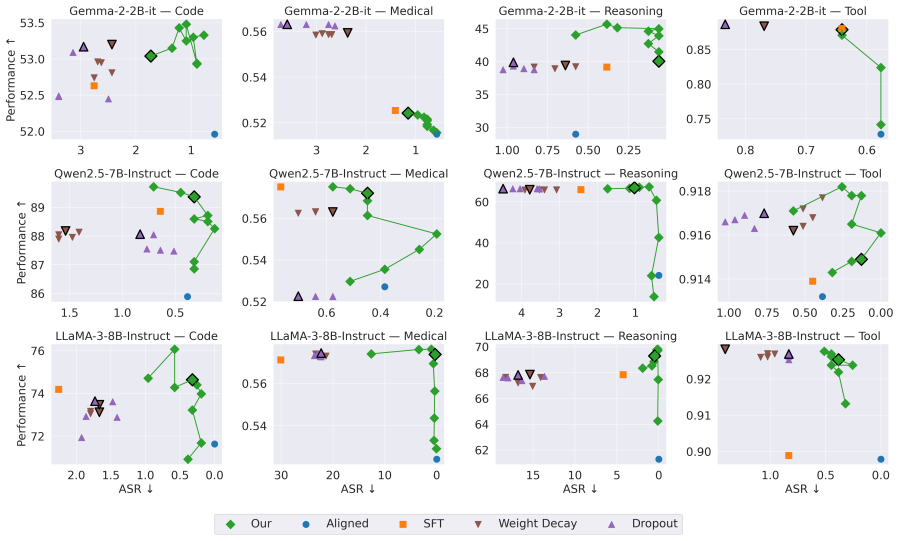
The central discovery is that a straight line in parameter space between a safety-aligned model and its fine-tuned successor passes through models that are both safer and more task-competent than the fine-tuned endpoint alone. The paper demonstrates empirically that θ_merged = (1−λ)θ_base + λθ_t, with λ tuned on a validation grid, yields lower ASR on AdvBench and HEx-PHI than the fine-tuned checkpoints, often nearly matching the aligned model, while matching or exceeding the fine-tuned model's accuracy on reasoning, code generation, medical dialogue, and API-call tasks. The same interpolation also restores instruction-following ability measured by IFEval. The authors frame this as a form of catastrophic-forgetting mitigation that requires no safety data, no auxiliary models, and no extra training.
Load-bearing premise
The method assumes that the straight line in parameter space between the aligned and fine-tuned models crosses a region where safety and task skill coexist; if that geometric assumption fails for other tasks, scales, or full fine-tuning, the safety benefit may disappear.
Editorial extensions
If this is right
- A post-hoc safety restoration step can be added to any existing fine-tuning pipeline at near-zero cost: keep the aligned checkpoint, interpolate, and pick λ on a small validation set.
- Merging can substitute for or complement safety-data mixing during fine-tuning, which matters when the original alignment data are proprietary or unavailable.
- The same interpolation preserves other aligned-model capabilities (e.g., instruction following), so merging may serve as a general anti-forgetting tool, not only a safety fix.
- Because λ controls the safety–performance trade-off smoothly, practitioners can dial in an acceptable ASR without retraining.
- The method applies across model families and scales from 1.5B to 9B, suggesting it may transfer to larger models, though that is untested.
Reading between the lines
- If the linear path is robust, merging could be composed: after each incremental fine-tuning step, re-interpolating with the original aligned model could bound safety drift across a long chain of task adaptations.
- The mechanism suggests a testable prediction: the safety benefit should shrink when fine-tuning moves the weights far from the aligned region (e.g., full fine-tuning or very high learning rates, where linear mode connectivity is known to degrade).
- A natural extension is to choose λ per layer or per task-vector direction rather than one scalar, potentially recovering more task performance at the same ASR.
Editorial analysis
A structured set of objections, weighed in public.
Referee Report
Summary. The paper proposes a simple post-hoc method to mitigate safety degradation of aligned LLMs after fine-tuning: interpolate the weights of the original aligned model θ_base and the fine-tuned model θ_t via θ_merged = (1−λ)θ_base + λθ_t, with λ selected on the downstream validation set. The authors evaluate this on three instruct-tuned models (LLaMA-3-8B, Gemma-2-2B, Qwen2.5-7B), four tasks (reasoning, medical, code, tool use), and two safety benchmarks (AdvBench, HEx-PHI) using WildGuard ASR. They also apply SLERP and DARE variants and report that the merging approach 'consistently' improves task performance while restoring safety, compared with SFT and with Dropout/Weight Decay baselines. The manuscript includes a limitations section and substantial appendix material.
Significance. The proposed method is attractive for practical deployment because it requires no safety data and no additional training, only one interpolation pass over parameters, and it scales to different model families. The authors provide unusually thorough experimental details and a candid limitations section. However, the central claim of consistency is not supported by the paper's own Table 1, and the empirical evaluation lacks variance reporting and any classifier-independent robustness check. The method is closely related to WiSE-FT and model soups, so the incremental novelty is mainly the safety-oriented application; the paper does not sufficiently position the contribution. If the claims are revised to a probabilistic or 'mostly' setting and the evidence is strengthened with variance statistics and at least one alternative safety classifier, the method could be a useful baseline for safe fine-tuning.
major comments (5)
- [Abstract, §1, §5.1, Table 1] The universal claim of 'consistently' improving safety and performance is contradicted by Table 1. Specifically, for Qwen2.5-7B-Instruct Tool Using, Linear merging has HEx-PHI ASR 9.39% versus SFT's 8.08%, so merging is less safe than SFT in this setting. Similarly, Gemma-2-2B-It Medical shows Linear merging's downstream performance (0.5243) slightly below SFT (0.5254). Thus the best-validation merged checkpoint is not always better or safer than SFT. The authors should either remove 'consistently', calibrate the claim to 'in most tested settings', and explicitly analyze the counterexamples.
- [§4, Table 1, Figures 2-5] The paper reports averages over three random seeds but gives no standard deviations, confidence intervals, or significance tests. Several key differences are small (e.g., Qwen2.5 Code HEx-PHI: Linear 7.88% vs SFT 7.98%; LLaMA-3 Tool Using HEx-PHI: Linear 2.44% vs SFT 3.45%) and may fall within run-to-run variability. Please report per-seed results or error bars in Figures 2-5 and Table 1, and, where applicable, provide paired bootstrap or statistical tests over the three seeds.
- [§B.2, §7 (Safety Classifier)] The entire safety conclusion rests on a single classifier, WildGuard. The limitations section correctly notes the potential for false positives and negatives, but this is still the load-bearing measurement. To make the ASR reductions credible, the authors should verify a random subset of responses with an alternative safety classifier (e.g., Llama Guard or GPT-4) or human annotation. Without such a check, the magnitude of the claimed safety improvement may be partly an artifact of one classifier.
- [§5.2, Figure 3] Figure 3 presents 'average changes ... across all downstream tasks' for model sizes. Averaging can hide per-task counterexamples, such as the Qwen2.5-7B Tool Using HEx-PHI result where merging is worse than SFT. To support the claim that merging mitigates safety degradation across scales, report per-task values for each model size (e.g., in an appendix) and show that the average is not driven by a single task.
- [§2.2, §5] The proposed method is essentially WiSE-FT applied to LLM safety, yet the comparison set includes only Dropout and Weight Decay as non-merging baselines. This does not isolate the benefit of interpolation. Please add at least one existing weight-interpolation or task-vector baseline (e.g., adding a tuned task vector to the aligned model) and explicitly discuss the relationship to WiSE-FT and model soups, stating what new non-obvious insight the paper provides beyond transferring those methods to LLM safety.
minor comments (5)
- [Appendix A (Medical Assistance)] There is a typo: 'calculat similarity' should be 'calculate similarity'.
- [Title of Appendix E and Table 1] The phrasing 'Tool Using Proficiency' is inconsistent; elsewhere it is 'tool usage proficiency'. Please unify.
- [Table 1 caption] The caption says 'Bold indicates the best score per metric', but for ASR lower is better, so bold should mean the lowest ASR. This should be stated explicitly.
- [§D.1 (DARE)] The description says DARE 'randomly dropping parameters', but in MergeKit it typically drops and rescales the delta (task vector) parameters. Please clarify the precise mechanism.
- [§C.1 (Prompt Template)] The prompt examples concatenate 'You are a helpful assistant.' directly with '{Instruction}' for Gemma-2 and Qwen2.5, which may be an intentional formatting choice; if so, a brief note would help reproducibility.
Circularity Check
No circularity: the safety benefit is an empirical measurement of Eq. 2, not forced by construction or by a self-citation chain.
full rationale
The paper's method is a two-step empirical procedure: supervised fine-tuning (Eq. 1) followed by linear interpolation of the aligned and fine-tuned weights (Eq. 2). The claimed outcome—lower attack success rate on AdvBench and HEx-PHI while maintaining task performance—is measured on held-out benchmarks, not derived from the definition of the merged weights. The interpolation factor λ is selected on downstream validation performance ('we merge each fine-tuned model with the aligned model using an interpolation factor λ selected based on validation set performance'), not on safety, so the safety result is not an artifact of fitting the safety metric. The method is explicitly positioned against external prior work (WiSE-FT, model soups, task vectors), and the only self-citations (Huang et al. 2024a; Su et al. 2024) appear in a non-load-bearing related-work list rather than as justification for the central claim. No uniqueness theorem, ansatz smuggled via citation, or renamed fitted parameter is used. Whether Table 1 fully supports the word 'consistently' is an empirical-correctness concern, not a circularity concern. Verdict: no significant circularity.
Assumptions & free parameters
free parameters (2)
- Interpolation factor λ =
grid 0.1 to 0.9, selected per task/model by downstream validation performance
- Training checkpoint (steps) =
500 steps for reasoning/medical/code; 200 for tool usage
assumptions (4)
- domain assumption Linear interpolation of model weights produces a coherent model (Eq. 2)
- domain assumption WildGuard classifier provides a valid estimate of attack success rate
- domain assumption Direct harmful-instruction benchmarks (AdvBench, HEx-PHI) are the relevant safety test
- domain assumption LoRA fine-tuning behaves like fine-tuning for safety degradation
Cite this review
Pith. "Pith review of Safeguard Fine-Tuned LLMs Through Pre- and Post-Tuning Model Merging." pith.science (2026). https://pith.science/paper/XZRSKUGO
@misc{pith2026241219512,
  author       = {Pith},
  title        = {Pith review of: Safeguard Fine-Tuned LLMs Through Pre- and Post-Tuning Model Merging},
  year         = {2026},
  howpublished = {\url{https://pith.science/paper/XZRSKUGO}},
  note         = {Machine review of arXiv:2412.19512}
}
read the original abstract
Fine-tuning large language models (LLMs) for downstream tasks often leads to catastrophic forgetting, notably degrading the safety of originally aligned models. While some existing methods attempt to restore safety by incorporating additional safety data, the quality of such data typically falls short of that used in the original alignment process. Moreover, these high-quality safety datasets are generally inaccessible, making it difficult to fully recover the model's original safety. We ask: How can we preserve safety while improving downstream task performance without additional safety data? We show that simply merging the weights of pre- and post-fine-tuned models effectively mitigates safety degradation while enhancing performance. Experiments across different downstream tasks and models validate the method's practicality and effectiveness.
Figures


Figures from the paper (2 more)


Reference graph
Works this paper leans on
-
[1]
online" 'onlinestring :=
ENTRY address archivePrefix author booktitle chapter edition editor eid eprint eprinttype howpublished institution journal key month note number organization pages publisher school series title type volume year doi pubmed url lastchecked label extra.label sort.label short.list INTEGERS output.state before.all mid.sentence after.sentence after.block STRING...
-
[2]
write newline
" write newline "" before.all 'output.state := FUNCTION n.dashify 't := "" t empty not t #1 #1 substring "-" = t #1 #2 substring "--" = not "--" * t #2 global.max substring 't := t #1 #1 substring "-" = "-" * t #2 global.max substring 't := while if t #1 #1 substring * t #2 global.max substring 't := if while FUNCTION word.in bbl.in capitalize " " * FUNCT...
-
[3]
Rishabh Bhardwaj, Duc Anh Do, and Soujanya Poria. 2024. https://doi.org/10.18653/v1/2024.acl-long.762 Language models are H omer simpson! safety re-alignment of fine-tuned language models through task arithmetic . In Proceedings of the 62nd Annual Meeting of the Association for Computational Linguistics (Volume 1: Long Papers), pages 14138--14149, Bangkok...
-
[4]
Federico Bianchi, Mirac Suzgun, Giuseppe Attanasio, Paul Rottger, Dan Jurafsky, Tatsunori Hashimoto, and James Zou. 2024. https://openreview.net/forum?id=gT5hALch9z Safety-tuned LL a MA s: Lessons from improving the safety of large language models that follow instructions . In The Twelfth International Conference on Learning Representations
2024
-
[5]
Mark Chen, Jerry Tworek, Heewoo Jun, Qiming Yuan, Henrique Ponde De Oliveira Pinto, Jared Kaplan, Harri Edwards, Yuri Burda, Nicholas Joseph, Greg Brockman, and 1 others. 2021. Evaluating large language models trained on code. arXiv preprint arXiv:2107.03374
arXiv 2021
-
[6]
Yangyi Chen, Hongcheng Gao, Ganqu Cui, Fanchao Qi, Longtao Huang, Zhiyuan Liu, and Maosong Sun. 2022. https://doi.org/10.18653/v1/2022.emnlp-main.771 Why should adversarial perturbations be imperceptible? rethink the research paradigm in adversarial NLP . In Proceedings of the 2022 Conference on Empirical Methods in Natural Language Processing, pages 1122...
-
[7]
Cheng-Han Chiang and Hung-yi Lee. 2023. https://doi.org/10.18653/v1/2023.acl-long.870 Can large language models be an alternative to human evaluations? In Proceedings of the 61st Annual Meeting of the Association for Computational Linguistics (Volume 1: Long Papers), pages 15607--15631, Toronto, Canada. Association for Computational Linguistics
-
[8]
Hyung Won Chung, Le Hou, Shayne Longpre, Barret Zoph, Yi Tay, William Fedus, Yunxuan Li, Xuezhi Wang, Mostafa Dehghani, Siddhartha Brahma, Albert Webson, Shixiang Shane Gu, Zhuyun Dai, Mirac Suzgun, Xinyun Chen, Aakanksha Chowdhery, Alex Castro-Ros, Marie Pellat, Kevin Robinson, and 16 others. 2024. https://jmlr.org/papers/v25/23-0870.html Scaling instruc...
work page 2024
Show all 56 references
-
[9]
Leo Gao, Jonathan Tow, Baber Abbasi, Stella Biderman, Sid Black, Anthony DiPofi, Charles Foster, Laurence Golding, Jeffrey Hsu, Alain Le Noac'h, Haonan Li, Kyle McDonell, Niklas Muennighoff, Chris Ociepa, Jason Phang, Laria Reynolds, Hailey Schoelkopf, Aviya Skowron, Lintang S...
2024 doi
-
[10]
Charles Goddard, Shamane Siriwardhana, Malikeh Ehghaghi, Luke Meyers, Vladimir Karpukhin, Brian Benedict, Mark McQuade, and Jacob Solawetz. 2024. https://doi.org/10.18653/v1/2024.emnlp-industry.36 Arcee ' s M erge K it: A toolkit for merging large language models . In Proceedi...
2024 doi
-
[11]
Aaron Grattafiori, Abhimanyu Dubey, Abhinav Jauhri, Abhinav Pandey, Abhishek Kadian, Ahmad Al-Dahle, Aiesha Letman, Akhil Mathur, Alan Schelten, Alex Vaughan, Amy Yang, Angela Fan, Anirudh Goyal, Anthony Hartshorn, Aobo Yang, Archi Mitra, Archie Sravankumar, Artem Korenev, Art...
2024 arXiv
-
[12]
Seungju Han, Kavel Rao, Allyson Ettinger, Liwei Jiang, Bill Yuchen Lin, Nathan Lambert, Yejin Choi, and Nouha Dziri. 2024. https://openreview.net/forum?id=Ich4tv4202 Wildguard: Open one-stop moderation tools for safety risks, jailbreaks, and refusals of LLM s . In The Thirty-e...
2024
-
[13]
Rima Hazra, Sayan Layek, Somnath Banerjee, and Soujanya Poria. 2024. https://doi.org/10.18653/v1/2024.emnlp-main.1212 Safety arithmetic: A framework for test-time safety alignment of language models by steering parameters and activations . In Proceedings of the 2024 Conference...
2024 doi
-
[14]
Chia-Yi Hsu, Yu-Lin Tsai, Chih-Hsun Lin, Pin-Yu Chen, Chia-Mu Yu, and Chun-Ying Huang. 2024. https://openreview.net/forum?id=HcifdQZFZV Safe lo RA : The silver lining of reducing safety risks when finetuning large language models . In The Thirty-eighth Annual Conference on Neu...
2024
-
[15]
Edward J Hu, yelong shen, Phillip Wallis, Zeyuan Allen-Zhu, Yuanzhi Li, Shean Wang, Lu Wang, and Weizhu Chen. 2022. https://openreview.net/forum?id=nZeVKeeFYf9 Lo RA : Low-rank adaptation of large language models . In International Conference on Learning Representations
2022
-
[16]
Shih-Cheng Huang, Pin-Zu Li, Yu-Chi Hsu, Kuang-Ming Chen, Yu Tung Lin, Shih-Kai Hsiao, Richard Tzong-Han Tsai, and Hung yi Lee. 2024 a . https://arxiv.org/abs/2310.04799 Chat vector: A simple approach to equip llms with instruction following and model alignment in new language...
2024 arXiv
-
[17]
Tiansheng Huang, Gautam Bhattacharya, Pratik Joshi, Josh Kimball, and Ling Liu. 2024 b . https://arxiv.org/abs/2408.09600 Antidote: Post-fine-tuning safety alignment for large language models against harmful fine-tuning . Preprint, arXiv:2408.09600
2024 arXiv
-
[18]
Tiansheng Huang, Sihao Hu, Fatih Ilhan, Selim Furkan Tekin, and Ling Liu. 2024 c . https://openreview.net/forum?id=RPChapuXlC Lisa: Lazy safety alignment for large language models against harmful fine-tuning attack . In The Thirty-eighth Annual Conference on Neural Information...
2024
-
[19]
Tiansheng Huang, Sihao Hu, and Ling Liu. 2024 d . https://openreview.net/forum?id=lpXDZKiAnt Vaccine: Perturbation-aware alignment for large language models against harmful fine-tuning attack . In The Thirty-eighth Annual Conference on Neural Information Processing Systems
2024
-
[20]
Xiaowei Huang, Wenjie Ruan, Wei Huang, Gaojie Jin, Yi Dong, Changshun Wu, Saddek Bensalem, Ronghui Mu, Yi Qi, Xingyu Zhao, Kaiwen Cai, Yanghao Zhang, Sihao Wu, Peipei Xu, Dengyu Wu, Andre Freitas, and Mustafa A. Mustafa. 2023. https://arxiv.org/abs/2305.11391 A survey of safet...
2023 arXiv
-
[21]
Gabriel Ilharco, Marco Tulio Ribeiro, Mitchell Wortsman, Ludwig Schmidt, Hannaneh Hajishirzi, and Ali Farhadi. 2023. https://openreview.net/forum?id=6t0Kwf8-jrj Editing models with task arithmetic . In The Eleventh International Conference on Learning Representations
2023
-
[22]
Rusu, Kieran Milan, John Quan, Tiago Ramalho, Agnieszka Grabska-Barwinska, Demis Hassabis, Claudia Clopath, Dharshan Kumaran, and Raia Hadsell
James Kirkpatrick, Razvan Pascanu, Neil Rabinowitz, Joel Veness, Guillaume Desjardins, Andrei A. Rusu, Kieran Milan, John Quan, Tiago Ramalho, Agnieszka Grabska-Barwinska, Demis Hassabis, Claudia Clopath, Dharshan Kumaran, and Raia Hadsell. 2017. https://doi.org/10.1073/pnas.1...
2017 doi
-
[23]
Gonzalez, Hao Zhang, and Ion Stoica
Woosuk Kwon, Zhuohan Li, Siyuan Zhuang, Ying Sheng, Lianmin Zheng, Cody Hao Yu, Joseph E. Gonzalez, Hao Zhang, and Ion Stoica. 2023. Efficient memory management for large language model serving with pagedattention. In Proceedings of the ACM SIGOPS 29th Symposium on Operating S...
2023
-
[24]
Chen-An Li and Hung-Yi Lee. 2024. https://arxiv.org/abs/2401.03129 Examining forgetting in continual pre-training of aligned large language models . Preprint, arXiv:2401.03129
2024 arXiv
-
[25]
Yunxiang Li, Zihan Li, Kai Zhang, Ruilong Dan, Steve Jiang, and You Zhang. 2023. https://arxiv.org/abs/2303.14070 Chatdoctor: A medical chat model fine-tuned on a large language model meta-ai (llama) using medical domain knowledge . Preprint, arXiv:2303.14070
2023 arXiv
-
[26]
Yang Liu, Dan Iter, Yichong Xu, Shuohang Wang, Ruochen Xu, and Chenguang Zhu. 2023. https://doi.org/10.18653/v1/2023.emnlp-main.153 G -eval: NLG evaluation using gpt-4 with better human alignment . In Proceedings of the 2023 Conference on Empirical Methods in Natural Language ...
2023 doi
-
[27]
Le, Barret Zoph, Jason Wei, and Adam Roberts
Shayne Longpre, Le Hou, Tu Vu, Albert Webson, Hyung Won Chung, Yi Tay, Denny Zhou, Quoc V. Le, Barret Zoph, Jason Wei, and Adam Roberts. 2023. https://arxiv.org/abs/2301.13688 The flan collection: Designing data and methods for effective instruction tuning . Preprint, arXiv:2301.13688
2023 arXiv
-
[28]
Ilya Loshchilov and Frank Hutter. 2019. https://openreview.net/forum?id=Bkg6RiCqY7 Decoupled weight decay regularization . In International Conference on Learning Representations
2019
-
[29]
Yun Luo, Zhen Yang, Fandong Meng, Yafu Li, Jie Zhou, and Yue Zhang. 2025. https://arxiv.org/abs/2308.08747 An empirical study of catastrophic forgetting in large language models during continual fine-tuning . Preprint, arXiv:2308.08747
2025 arXiv
-
[30]
Kyle O'Brien, David Majercak, Xavier Fernandes, Richard Edgar, Jingya Chen, Harsha Nori, Dean Carignan, Eric Horvitz, and Forough Poursabzi-Sangde. 2024. https://arxiv.org/abs/2411.11296 Steering language model refusal with sparse autoencoders . Preprint, arXiv:2411.11296
2024 arXiv
-
[31]
OpenAI, Josh Achiam, Steven Adler, Sandhini Agarwal, Lama Ahmad, Ilge Akkaya, Florencia Leoni Aleman, Diogo Almeida, Janko Altenschmidt, Sam Altman, Shyamal Anadkat, Red Avila, Igor Babuschkin, Suchir Balaji, Valerie Balcom, Paul Baltescu, Haiming Bao, Mohammad Bavarian, Jeff ...
2024 arXiv
-
[32]
Long Ouyang, Jeff Wu, Xu Jiang, Diogo Almeida, Carroll L. Wainwright, Pamela Mishkin, Chong Zhang, Sandhini Agarwal, Katarina Slama, Alex Ray, John Schulman, Jacob Hilton, Fraser Kelton, Luke Miller, Maddie Simens, Amanda Askell, Peter Welinder, Paul Christiano, Jan Leike, and...
2022 arXiv
-
[33]
Patil, Tianjun Zhang, Xin Wang, and Joseph E
Shishir G. Patil, Tianjun Zhang, Xin Wang, and Joseph E. Gonzalez. 2023. Gorilla: Large language model connected with massive apis
2023
-
[34]
Xiangyu Qi, Yi Zeng, Tinghao Xie, Pin-Yu Chen, Ruoxi Jia, Prateek Mittal, and Peter Henderson. 2024. https://openreview.net/forum?id=hTEGyKf0dZ Fine-tuning aligned language models compromises safety, even when users do not intend to! In The Twelfth International Conference on ...
2024
-
[35]
Rafael Rafailov, Archit Sharma, Eric Mitchell, Christopher D Manning, Stefano Ermon, and Chelsea Finn. 2023. https://openreview.net/forum?id=HPuSIXJaa9 Direct preference optimization: Your language model is secretly a reward model . In Thirty-seventh Conference on Neural Infor...
2023
-
[36]
Nitish Srivastava, Geoffrey Hinton, Alex Krizhevsky, Ilya Sutskever, and Ruslan Salakhutdinov. 2014. http://jmlr.org/papers/v15/srivastava14a.html Dropout: A simple way to prevent neural networks from overfitting . Journal of Machine Learning Research, 15(56):1929--1958
2014
-
[37]
Hsuan Su, Hua Farn, Fan-Yun Sun, Shang-Tse Chen, and Hung-yi Lee. 2024. https://doi.org/10.18653/v1/2024.emnlp-main.503 Task arithmetic can mitigate synthetic-to-real gap in automatic speech recognition . In Proceedings of the 2024 Conference on Empirical Methods in Natural La...
2024 doi
-
[38]
Mirac Suzgun, Nathan Scales, Nathanael Sch \"a rli, Sebastian Gehrmann, Yi Tay, Hyung Won Chung, Aakanksha Chowdhery, Quoc Le, Ed Chi, Denny Zhou, and Jason Wei. 2023. https://doi.org/10.18653/v1/2023.findings-acl.824 Challenging BIG -bench tasks and whether chain-of-thought c...
2023 doi
-
[39]
Gemma Team, Thomas Mesnard, Cassidy Hardin, Robert Dadashi, Surya Bhupatiraju, Shreya Pathak, Laurent Sifre, Morgane Rivière, Mihir Sanjay Kale, Juliette Love, Pouya Tafti, Léonard Hussenot, Pier Giuseppe Sessa, Aakanksha Chowdhery, Adam Roberts, Aditya Barua, Alex Botev, Alex...
2024 arXiv
-
[40]
Qwen Team. 2024. https://qwenlm.github.io/blog/qwen2.5/ Qwen2.5: A party of foundation models
2024
-
[41]
Yuxiang Wei, Zhe Wang, Jiawei Liu, Yifeng Ding, and Lingming Zhang. 2024. https://proceedings.mlr.press/v235/wei24h.html Magicoder: Empowering code generation with OSS -instruct . In Proceedings of the 41st International Conference on Machine Learning, volume 235 of Proceeding...
2024
-
[42]
Tom White. 2017. https://openreview.net/forum?id=SypU81Ole Sampling generative networks
2017
-
[43]
Mitchell Wortsman, Gabriel Ilharco, Samir Ya Gadre, Rebecca Roelofs, Raphael Gontijo-Lopes, Ari S Morcos, Hongseok Namkoong, Ali Farhadi, Yair Carmon, Simon Kornblith, and Ludwig Schmidt. 2022 a . https://proceedings.mlr.press/v162/wortsman22a.html Model soups: averaging weigh...
2022
-
[44]
Mitchell Wortsman, Gabriel Ilharco, Jong Wook Kim, Mike Li, Hanna Hajishirzi, Ali Farhadi, Hongseok Namkoong, and Ludwig Schmidt. 2022 b . https://openreview.net/forum?id=yrbF6ekqQ9w Robust fine-tuning of zero-shot models
2022
-
[45]
Di Wu, Xin Lu, Yanyan Zhao, and Bing Qin. 2025. https://doi.org/10.18653/v1/2025.findings-acl.66 Separate the wheat from the chaff: A post-hoc approach to safety re-alignment for fine-tuned language models . In Findings of the Association for Computational Linguistics: ACL 202...
2025 doi
-
[46]
Tinghao Xie, Xiangyu Qi, Yi Zeng, Yangsibo Huang, Udari Madhushani Sehwag, Kaixuan Huang, Luxi He, Boyi Wei, Dacheng Li, Ying Sheng, Ruoxi Jia, Bo Li, Kai Li, Danqi Chen, Peter Henderson, and Prateek Mittal. 2025. https://openreview.net/forum?id=YfKNaRktan SORRY -bench: System...
2025
-
[47]
Zihao Xu, Yi Liu, Gelei Deng, Yuekang Li, and Stjepan Picek. 2024. https://doi.org/10.18653/v1/2024.findings-acl.443 A comprehensive study of jailbreak attack versus defense for large language models . In Findings of the Association for Computational Linguistics: ACL 2024, pag...
2024 doi
-
[48]
Xianjun Yang, Xiao Wang, Qi Zhang, Linda Petzold, William Yang Wang, Xun Zhao, and Dahua Lin. 2023. https://arxiv.org/abs/2310.02949 Shadow alignment: The ease of subverting safely-aligned language models . Preprint, arXiv:2310.02949
2023 arXiv
-
[49]
Zhaorui Yang, Tianyu Pang, Haozhe Feng, Han Wang, Wei Chen, Minfeng Zhu, and Qian Liu. 2024. https://doi.org/10.18653/v1/2024.acl-long.58 Self-distillation bridges distribution gap in language model fine-tuning . In Proceedings of the 62nd Annual Meeting of the Association for...
2024 doi
-
[50]
Xin Yi, Shunfan Zheng, Linlin Wang, Xiaoling Wang, and Liang He. 2024. https://arxiv.org/abs/2405.09055 A safety realignment framework via subspace-oriented model fusion for large language models . Preprint, arXiv:2405.09055
2024 arXiv
-
[51]
Le Yu, Bowen Yu, Haiyang Yu, Fei Huang, and Yongbin Li. 2024. https://openreview.net/forum?id=fq0NaiU8Ex Language models are super mario: Absorbing abilities from homologous models as a free lunch . In Forty-first International Conference on Machine Learning
2024
-
[52]
Qiusi Zhan, Richard Fang, Rohan Bindu, Akul Gupta, Tatsunori Hashimoto, and Daniel Kang. 2024. https://doi.org/10.18653/v1/2024.naacl-short.59 Removing RLHF protections in GPT -4 via fine-tuning . In Proceedings of the 2024 Conference of the North American Chapter of the Assoc...
2024 doi
-
[53]
Weinberger, and Yoav Artzi
Tianyi Zhang*, Varsha Kishore*, Felix Wu*, Kilian Q. Weinberger, and Yoav Artzi. 2020. https://openreview.net/forum?id=SkeHuCVFDr Bertscore: Evaluating text generation with bert . In International Conference on Learning Representations
2020
-
[54]
Yaowei Zheng, Richong Zhang, Junhao Zhang, Yanhan Ye, Zheyan Luo, Zhangchi Feng, and Yongqiang Ma. 2024. http://arxiv.org/abs/2403.13372 Llamafactory: Unified efficient fine-tuning of 100+ language models . In Proceedings of the 62nd Annual Meeting of the Association for Compu...
2024 arXiv
-
[55]
Jeffrey Zhou, Tianjian Lu, Swaroop Mishra, Siddhartha Brahma, Sujoy Basu, Yi Luan, Denny Zhou, and Le Hou. 2023. https://arxiv.org/abs/2311.07911 Instruction-following evaluation for large language models . Preprint, arXiv:2311.07911
2023 arXiv
-
[56]
Yongshuo Zong, Ondrej Bohdal, Tingyang Yu, Yongxin Yang, and Hospedales Timothy. 2024. Safety fine-tuning at (almost) no cost: A baseline for vision large language models. arXiv preprint arXiv:2402.02207
2024 arXiv
Reviewed August 11, 2026 · model on record in the stance chip above.
Discussion (0). Continue with ORCID to comment.