REVIEW 3 major objections 6 minor 1 cited by
SocRATES: Towards Automated Scenario-based Testing of Social Navigation Algorithms
T0 review · 3 major / 6 minor · reviewed 2026-08-11 · deepseek-v4-flash
Pith's one-line read SocRATES proposes an LLM pipeline that turns scenario metadata into simulated social navigation tests, claiming 73% first-pass success with structured prompts.
desk verdict A genuinely useful pipeline for automated social navigation scenario generation, but the headline reliability numbers rest on author-rated evaluation and need stronger validation before being quoted. read the letter →
The pith
A machine-rendered reading of the paper's core claim, the machinery that carries it, and where it could break.
The reading
What carries the argument
The load-bearing mechanism is the five-module pipeline: map annotation as a 2D semantic scene graph, scenario proposal via a vision-language model, path generation constrained by the scene graph, pedestrian behavior generation as behavior trees (task-oriented programs for each simulated human), and simulation orchestration with a scenario manager that synchronizes pedestrian motion with the robot. Most failures come from the behavior-tree module, where the LLM selects or orders nodes incorrectly, and from trajectories that are too short or inaccurate for the scenario. Structured prompts containing handcrafted examples and the scene graph, plus automatic detection of discontinuous paths with re-querying, are what lift the success rate far above naive prompting.
What would settle it
Re-run the same guided and unguided generation prompts through the SocRATES pipeline and have a blinded group of social navigation researchers independently rate each generated scenario for simulability, contextual appropriateness, and alignment; if the success rates do not exceed the naive baselines or inter-rater agreement is low, the central claim is undermined.
Extended reading notes
Core claim
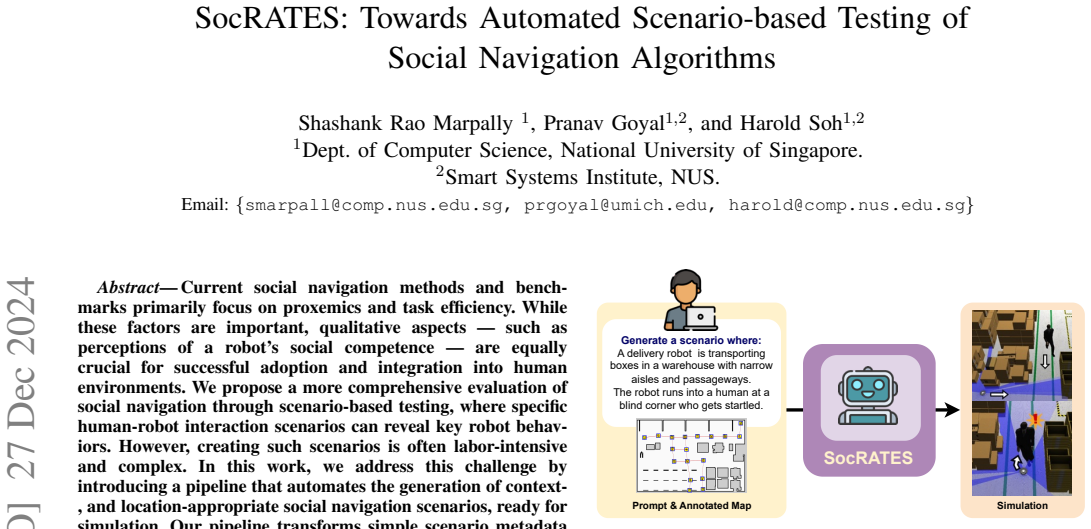
SocRATES is, to the authors' knowledge, the first system to integrate LLM-driven scenario generation with simulation for comprehensive social navigation testing. Given an annotated map and simple textual metadata, the system proposes a detailed scenario, infers pedestrian and robot paths on a semantic scene graph, generates pedestrian behavior trees, and orchestrates a Gazebo simulation via ROS2. The paper's central quantitative finding is that structured prompts and error-handling re-queries raise first-pass generation success from 30% to 73% (guided) and from 10% to 55% (unguided). A case study with 40 participants per scenario further suggests that different navigation algorithms may be preferred in different social contexts, demonstrating the practical utility of scenario-based evaluation.
Load-bearing premise
The claimed reliability advantage rests on the authors' manual ratings of 'simulability, contextual appropriateness, and alignment' being objective and repeatable, with no reported inter-rater reliability or confidence intervals.
Editorial extensions
If this is right
- Social navigation benchmarks can move beyond proxemics and task efficiency to include context-dependent principles such as contextual appropriateness and proactivity.
- Researchers could generate edge cases and specific human-robot interaction scenarios on demand instead of hand-coding them, lowering the barrier to controlled evaluation studies.
- The interactive path module, which lets users accept, reject, or edit paths through natural language commands, is a direct response to observed failure modes and becomes a standard part of using the system.
- The case study indicates that algorithm preference is context-dependent—MPPI scored higher in a corridor scenario while Nav2Can performed better in a warehouse scenario—so scenario-based evaluation can reveal trade-offs that single-metric benchmarks miss.
Reading between the lines
- The gap between guided (73%) and unguided (55%) generation suggests the bottleneck is not the LLM's ability to imagine scenarios but its ability to ground them in a specific map; map-conditioned fine-tuning or retrieval could narrow this gap further.
- If scenario generation becomes reliably cheap and fast, social navigation evaluation could adopt coverage metrics and scenario libraries analogous to those used in automated driving test suites.
- The paper's quantitative claim rests on the authors' own manual ratings of simulability, contextual appropriateness, and alignment; a blinded multi-annotator replication would directly test whether those rates are reproducible.
- The scenario manager that times pedestrian arrivals relative to the robot is a partial solution; a fully closed-loop simulator that lets pedestrians react online to the robot's actual motion would better approximate real-world social dynamics.
Editorial analysis
A structured set of objections, weighed in public.
Referee Report
Summary. The paper presents SocRATES, a pipeline that uses large vision-language models to generate social navigation simulation scenarios from high-level textual and image inputs. The pipeline decomposes scenario generation into map annotation, scenario proposal, pedestrian/robot path generation, pedestrian behavior-tree generation, and simulation execution in Gazebo/HuNavSim, with an interactive correction mechanism. The authors report that guided generation succeeds in 73% of cases and unguided generation in 55%, compared to 30% and 10% for a naive prompting baseline. They also report a usability study with five researchers and a persona-based case study in which three navigation algorithms were compared using videos generated by the pipeline.
Significance. If the reliability claims are substantiated, SocRATES would be a useful contribution to automated scenario-based testing for social navigation, addressing a real bottleneck: scenario creation is labor-intensive and current tools offer limited control over user-defined scenarios. The system design is thoughtful, combining scene graphs for spatial grounding, structured prompts for path and behavior generation, and a scenario manager for synchronization. The paper also benefits from being a concrete, end-to-end system with cost and speed measurements. However, the central quantitative claims are currently supported mainly by non-blinded author ratings with no inter-rater reliability or statistical analysis, and it is unclear whether the rated outputs were actually executed in simulation. The significance therefore remains conditional until the evaluation protocol is strengthened.
major comments (3)
- [IV-A, Reliability] The central claim that SocRATES improves scenario translation over naive prompting (73% vs 30% guided; 55% vs 10% unguided) rests entirely on the authors' own manual ratings of 'simulability, contextual appropriateness, and alignment.' The paper provides no rubric, no second rater, no inter-rater reliability, no blinding to condition, and no confidence intervals or statistical test; the word 'significantly' in the abstract is therefore unsupported. This is load-bearing because the paper's contribution is precisely that structured generation is reliable enough to use for testing. Please provide a pre-specified rating rubric, independent raters blind to generation condition, agreement statistics, and inferential comparisons with effect sizes.
- [IV-A, Reliability] It is not stated whether any of the rated scenarios were actually executed in the Gazebo/HuNavSim simulation. The reported failure modes (incorrect behavior trees, 'poor trajectories that are too short or inaccurate') are properties of the generated artifacts, not of a simulation run; if the scenarios were not run end-to-end, the 'simulability' criterion and the claim that outputs are 'ready for simulation' are not validated. Please report an execution protocol: how many scenarios were run, what counted as a successful execution, and how execution outcomes related to the manual ratings.
- [IV-C, Persona-based Assessment] The persona case study claims 'significant differences between the algorithms in the scenarios,' but Fig. 3 displays only group means with no error bars, no per-item test statistics, and no correction for multiple comparisons across the eight rated dimensions and four scenarios. Since the case study is offered as a demonstration of SocRATES' utility, this claim should be either backed by appropriate inferential statistics or explicitly labeled as illustrative. The same overstatement applies to the usability study in Sec. IV-B, where n=5 and one participant's run failed; the summary statement that the system was 'validated' is too strong.
minor comments (6)
- [III-B, Scenario Proposal] The statement that including handcrafted examples 'significantly improves the quality' is presented without supporting data; either report the ablation or rephrase as a design observation.
- [IV-A, Cost] The cost estimate should state the model version and pricing date used, and should clarify whether the 15k input tokens include image tokens from the map input.
- [IV-A, Structured Prompting] The description of the naive baseline is too terse; provide the actual naive prompt template so readers can assess whether the comparison is a fair ablation of the structured prompts and error-handling mechanisms.
- [III-D, Pedestrian Behavior Generation] The newly implemented gesture-based behavior nodes are not separately validated; a short validation of these nodes would strengthen the claim that interactive scenarios can be generated.
- [General] The manuscript refers to a repository 'available after review' but gives no URL; for reproducibility, a public link should be provided in the final version.
- [I, Introduction] The claim of being 'the first system to integrate LLM-driven scenario generation with simulation for comprehensive testing' is strong; a more precise comparison with SEAN 2.0 and language-guided traffic simulation would help contextualize the novelty.
Circularity Check
No circularity: SocRATES' reliability claims rest on external human ratings and third-party simulators, not on tautological reuse of its own outputs.
full rationale
The paper makes no mathematical derivation that reduces to its own inputs. SocRATES is an LLM-based scenario-generation pipeline, and its central quantitative claims (73% vs. 30% guided reliability, 55% vs. 10% unguided reliability) are obtained by manually rating generated scenarios for simulability, contextual appropriateness, and alignment with the input. These ratings are external judgments about outputs, not quantities computed from the same outputs by construction. The evaluation additionally relies on third-party simulators (HuNavSim, Gazebo, Nav2) and, in the persona study, on independent participant ratings using the PSI scale, so the algorithm-comparison results are not self-referential. The 'expected robot behavior' extracted by the VLM is described as serving as ground truth in Sec. III-B, but the experimental comparisons of navigation algorithms in Sec. IV-C score algorithms with human participant ratings rather than against that LLM-generated expectation, so no fitted or generated value is renamed as a prediction. Reference [17] (Arena 3.0) includes a coauthor of this paper, but it is cited only as related work illustrating that prior tools focus on human-simulation fidelity; none of the paper's load-bearing claims depend on it. The genuine weakness — that success at the 73%/30% comparison is judged by the authors without a published rubric, inter-rater reliability, blinding, or confidence intervals, and that the paper does not state that every rated output was actually executed — is an objectivity and validation limitation, not circular reasoning. The authors themselves concede this gap in Sec. V, planning 'a validation module to ensure that the generated scenarios accurately reflect the user's input,' and users request 'a method to objectively evaluate the fidelity of generated scenarios.' Accordingly, no circular step is identified.
Assumptions & free parameters
assumptions (3)
- domain assumption HuNavSim pedestrian behavior trees faithfully simulate socially realistic human behavior.
- domain assumption LLM and VLM commonsense reasoning produces valid behavior trees and paths after error handling.
- domain assumption Scene graph annotation captures enough spatial and semantic context for path generation.
Cite this review
Pith. "Pith review of SocRATES: Towards Automated Scenario-based Testing of Social Navigation Algorithms." pith.science (2026). https://pith.science/paper/WIXLG5NQ
@misc{pith2026241219595,
  author       = {Pith},
  title        = {Pith review of: SocRATES: Towards Automated Scenario-based Testing of Social Navigation Algorithms},
  year         = {2026},
  howpublished = {\url{https://pith.science/paper/WIXLG5NQ}},
  note         = {Machine review of arXiv:2412.19595}
}
read the original abstract
Current social navigation methods and benchmarks primarily focus on proxemics and task efficiency. While these factors are important, qualitative aspects such as perceptions of a robot's social competence are equally crucial for successful adoption and integration into human environments. We propose a more comprehensive evaluation of social navigation through scenario-based testing, where specific human-robot interaction scenarios can reveal key robot behaviors. However, creating such scenarios is often labor-intensive and complex. In this work, we address this challenge by introducing a pipeline that automates the generation of context-, and location-appropriate social navigation scenarios, ready for simulation. Our pipeline transforms simple scenario metadata into detailed textual scenarios, infers pedestrian and robot trajectories, and simulates pedestrian behaviors, which enables more controlled evaluation. We leverage the social reasoning and code-generation capabilities of Large Language Models (LLMs) to streamline scenario generation and translation. Our experiments show that our pipeline produces realistic scenarios and significantly improves scenario translation over naive LLM prompting. Additionally, we present initial feedback from a usability study with social navigation experts and a case-study demonstrating a scenario-based evaluation of three navigation algorithms.
Figures


Figures from the paper (1 more)

Forward citations
Cited by 1 Pith paper
-
HuNavSim 2.0: An Enhanced Human Navigation Simulator for Human-Aware Robot Navigation
HuNavSim 2.0 is a ROS 2 based simulator that lets users script rich, varied human behaviors with behavior trees and noise-injected crowd models across several robot simulation platforms.
Reference graph
Works this paper leans on
-
[1]
Sean 2.0: Formalizing and generating social situations for robot navigation,
N. Tsoi, A. Xiang, P. Yu, S. S. Sohn, G. Schwartz, S. Ramesh, M. Hussein, A. W. Gupta, M. Kapadia, and M. V ´azquez, “Sean 2.0: Formalizing and generating social situations for robot navigation,” IEEE Robotics and Automation Letters , vol. 7, no. 4, pp. 11 047– 11 054, 2022. [Online]. Available: https://ieeexplore.ieee.org/abstract/ document/9851501
arXiv 2022
-
[2]
Hunavsim: A ros 2 human navigation simulator for benchmarking human-aware robot navigation,
N. P ´erez-Higueras, R. Otero, F. Caballero, and L. Merino, “Hunavsim: A ros 2 human navigation simulator for benchmarking human-aware robot navigation,” IEEE Robotics and Automation Letters, 2023. [Online]. Available: https://ieeexplore.ieee.org/abstract/ document/10252030/
arXiv 2023
-
[3]
Core challenges of social robot navigation: A survey,
C. Mavrogiannis, F. Baldini, A. Wang, D. Zhao, P. Trautman, A. Stein- feld, and J. Oh, “Core challenges of social robot navigation: A survey,” ACM Transactions on Human-Robot Interaction, vol. 12, no. 3, pp. 1– 39, 2023
2023
-
[4]
Principles and guidelines for evaluating social robot navigation algorithms,
A. Francis, C. P ´erez-D’Arpino, C. Li, F. Xia, A. Alahi, R. Alami, A. Bera, A. Biswas, J. Biswas, R. Chandra, H.-T. L. Chiang, M. Everett, S. Ha, J. W. Hart, J. P. How, H. Karnan, T.-W. E. Lee, L. J. Manso, R. Mirksy, S. Pirk, P. T. Singamaneni, P. Stone, A. V . Taylor, P. Trautman, N. Tsoi, M. V ´azquez, X. Xiao, P. Xu, N. Yokoyama, A. Toshev, R. M.-M. ...
arXiv 2023
-
[5]
The hidden dimension,
E. T. Hall, “The hidden dimension,” Garden City, 1966
1966
-
[6]
Formalizing normative robot behavior,
B. Okal and K. O. Arras, “Formalizing normative robot behavior,” in Social Robotics: 8th International Conference, ICSR 2016, Kansas City, MO, USA, November 1-3, 2016 Proceedings 8 . Springer, 2016, pp. 62–71
work page 2016
-
[7]
Teaching robot navigation behaviors to optimal rrt planners,
N. P ´erez-Higueras, F. Caballero, and L. Merino, “Teaching robot navigation behaviors to optimal rrt planners,” International Journal of Social Robotics , vol. 10, pp. 235–249, 2018
work page 2018
-
[8]
Legibility and predictability of robot motion,
A. D. Dragan, K. C. Lee, and S. S. Srinivasa, “Legibility and predictability of robot motion,” in 2013 8th ACM/IEEE International Conference on Human-Robot Interaction (HRI) . IEEE, 2013, pp. 301–308
2013
Show all 22 references
-
[9]
Observer-aware legibility for social navigation,
A. V . Taylor, E. Mamantov, and H. Admoni, “Observer-aware legibility for social navigation,” in 2022 31st IEEE International Conference on Robot and Human Interactive Communication (RO-MAN) . IEEE, 2022, pp. 1115–1122
2022
-
[10]
Perceived social intelligence as evaluation of socially navigation,
A. Honour, S. B. Banisetty, and D. Feil-Seifer, “Perceived social intelligence as evaluation of socially navigation,” in Companion of the 2021 ACM/IEEE International Conference on Human-Robot In- teraction, 2021, pp. 519–523
2021
-
[11]
Measuring the perceived social intelligence of robots,
K. A. Barchard, L. Lapping-Carr, R. S. Westfall, A. Fink-Armold, S. B. Banisetty, and D. Feil-Seifer, “Measuring the perceived social intelligence of robots,” ACM Transactions on Human-Robot Interac- tion (THRI), vol. 9, no. 4, pp. 1–29, 2020
2020
-
[12]
Traffic scenarios for automated vehicle testing: A review of description languages and systems,
J. Ma, X. Che, Y . Li, and E. M.-K. Lai, “Traffic scenarios for automated vehicle testing: A review of description languages and systems,” Machines, vol. 9, no. 12, p. 342, 2021
2021
-
[13]
A scenario generation pipeline for autonomous vehicle simulators,
M. Wen, J. Park, and K. Cho, “A scenario generation pipeline for autonomous vehicle simulators,” Human-centric Computing and Information Sciences, vol. 10, no. 1, p. 24, 2020
2020
-
[14]
Language-guided traffic simulation via scene-level diffu- sion,
Z. Zhong, D. Rempe, Y . Chen, B. Ivanovic, Y . Cao, D. Xu, M. Pavone, and B. Ray, “Language-guided traffic simulation via scene-level diffu- sion,” in Conference on Robot Learning. PMLR, 2023, pp. 144–177
2023
-
[15]
Evaluating human–robot interaction algorithms in shared autonomy via quality diversity scenario generation,
M. C. Fontaine and S. Nikolaidis, “Evaluating human–robot interaction algorithms in shared autonomy via quality diversity scenario generation,” J. Hum.-Robot Interact. , vol. 11, no. 3, sep
-
[16]
Surrogate assisted generation of human-robot interaction scenarios,
V . Bhatt, H. Nemlekar, M. C. Fontaine, B. Tjanaka, H. Zhang, Y .-C. Hsu, and S. Nikolaidis, “Surrogate assisted generation of human-robot interaction scenarios,” arXiv preprint arXiv:2304.13787 , 2023
2023 arXiv
-
[17]
Arena 3.0: Advancing social navigation in collaborative and highly dynamic environments,
L. K ¨astner, V . Shcherbyna, H. Zeng, T. A. Le, M. H.-K. Schreff, H. Osmaev, N. T. Tran, D. Diaz, J. Golebiowski, H. Soh, and J. Lambrecht, “Arena 3.0: Advancing social navigation in collaborative and highly dynamic environments,” 2024. [Online]. Available: https://www.arxiv....
2024 arXiv
-
[18]
Soc- navbench: A grounded simulation testing framework for evaluating social navigation,
A. Biswas, A. Wang, G. Silvera, A. Steinfeld, and H. Admoni, “Soc- navbench: A grounded simulation testing framework for evaluating social navigation,” ACM Transactions on Human-Robot Interaction (THRI), vol. 11, no. 3, pp. 1–24, 2022
2022
-
[19]
Persona cases: a technique for grounding personas,
S. Faily and I. Flechais, “Persona cases: a technique for grounding personas,” in Proceedings of the SIGCHI conference on human factors in computing systems , 2011, pp. 2267–2270
2011
-
[20]
Layered costmaps for context-sensitive navigation,
D. V . Lu, D. Hershberger, and W. D. Smart, “Layered costmaps for context-sensitive navigation,” in 2014 IEEE/RSJ International Conference on Intelligent Robots and Systems . IEEE, 2014, pp. 709– 715
2014
-
[21]
Nav2can: Achiev- ing context aware navigation in ros2 using nav2 and rgb-d sensing,
T. Schw ¨orer, J. E. Schmidt, and D. Chrysostomou, “Nav2can: Achiev- ing context aware navigation in ros2 using nav2 and rgb-d sensing,” in 2023 IEEE International Conference on Imaging Systems and Techniques (IST). IEEE, 2023, pp. 1–6
2023
- [2022]
Reviewed August 11, 2026 · model on record in the stance chip above.
Discussion (0). Continue with ORCID to comment.