REVIEW 4 major objections 5 minor 2 cited by
High precision spectroscopy of trilobite Rydberg molecules
T0 review · 4 major / 5 minor · reviewed 2026-08-10 · deepseek-v4-flash
Pith's one-line read High-precision spectra of pure trilobite Rydberg molecules across $n=22$–$27$ benchmark theory and extract the low-energy $^3S_1$ electron–rubidium scattering phase shift.
desk verdict Solid new spectra and an honest but unvalidated phase-shift extraction; the 'unprecedented accuracy' claim outruns the model-dependent analysis. read the letter →
The pith
A machine-rendered reading of the paper's core claim, the machinery that carries it, and where it could break.
The reading
What carries the argument
The key machinery is a non-perturbative Green's function formulation of the Rydberg-molecule Hamiltonian in which the Coulomb Green's function replaces the truncated basis used in earlier diagonalization schemes. The scattering interaction of the Rydberg electron with the ground-state atom is encoded through the standard contact pseudopotentials for $S$-wave and $P$-wave channels, and the electronic Hamiltonian includes fine structure, hyperfine structure, and all six scattering channels ($^1S_0$, $^3S_1$, $^1P_1$, $^3P_{0,1,2}$). Because the Green's function avoids the unphysical basis-size dependence and diverging $^3P_J$ scattering volumes of the diagonalization method, the resulting Born-Oppenheimer potential curves are stable enough for high-precision comparison. The S-wave phase shift is then parameterized as a ninth-order polynomial added to the phase shifts of a previous precision spectroscopy study and fitted by simultaneously minimizing deviations of all measured vibrational binding energies across $n$.
What would settle it
Recompute the spectra with a more complete Hamiltonian (adding non-adiabatic couplings and higher-order scattering terms) while keeping the electron-atom phase shifts at their independently calculated values; if all binding energies across $n=22$–$27$ then agree within the stated error bars, the fitted polynomial phase shift is not the true scattering phase shift.
Extended reading notes
Core claim
The central discovery is that pure trilobite photoassociation spectroscopy at relative resolution $10^{-4}$, combined with the Green's function treatment of the full spin-dependent molecular Hamiltonian, makes the trilobite potential energy curves accurate enough to benchmark theory and to isolate the $S$-wave electron-atom scattering contribution. For the five principal quantum numbers, the calculated binding energies of the outer-well vibrational states agree with experiment to 0.4% or better and the inner-well states to 0.8%, with vibrational splittings reproduced to within 10% for the inner well and 2.7% for the outer well. The measured permanent dipole moments, reaching almost 3000 debye, identify which vibrational states belong to which potential well in the double-well geometries for $n\ge24$. The paper claims this permits extraction of the $^3S_1$ electron–Rb phase shift in the range $k\in[0.01,0.018]$ a.u., then adjusted together with the $^3P_J$ phase shifts for inner-well states, from a ninth-order polynomial fit that updates previous phase-shift determinations. It states that the residual inability to match all $n$ simultaneously within error bars points to limitations in the molecular Hamiltonian rather than in the spectroscopic method.
Load-bearing premise
The load-bearing premise is that the molecular Hamiltonian is complete enough that any remaining mismatch can be assigned to the fitted scattering phase shift rather than to missing physics such as couplings between electronic and nuclear motion.
Editorial extensions
If this is right
- The spectra provide a fixed benchmark: any future electronic-structure model of ultralong-range Rydberg molecules must reproduce the measured binding energies within about 1% across five principal quantum numbers.
- The extracted $^3S_1$ phase shift supplies low-energy electron–rubidium scattering data in the range $k\simeq0.01$–$0.018$ a.u., a regime free-electron scattering experiments do not currently resolve.
- The dipole-moment assignments show that multi-well trilobite potentials can be mapped unambiguously, so the technique transfers to other high-$\ell$ Rydberg molecules.
- The residual theory-experiment mismatch, at the tens-of-MHz level for the ground states, sets the size of the next terms that a more complete Hamiltonian must add.
Reading between the lines
- A consequence the authors leave implicit is that the fitted phase shift should be read as an effective quantity: if the Hamiltonian is missing non-adiabatic couplings, the polynomial absorbs their effect, so the 'true' scattering phase shift may differ beyond the quoted 0.7% uncertainty.
- The same fitting protocol applied to another isotope (e.g., $^{85}$Rb) or another alkali species would show whether the extracted deviations from ab initio phase shifts track atomic properties or are common to the Hamiltonian approximation.
- Because outer-well states are almost purely S-wave, measuring additional n-values with deeper wells could extend the fitted k-window downward and sharpen the low-energy constraint.
- A dedicated study of the avoided-crossing region could turn the inner-well state counts into a quantitative probe of the $^3P_J$ phase shifts, which the current data constrain only loosely.
Editorial analysis
A structured set of objections, weighed in public.
Referee Report
Summary. The paper reports three-photon photoassociation spectra of pure trilobite 87Rb Rydberg molecules for principal quantum numbers n = 22, 24, 25, 26, and 27. Using a Green's function method for the Born-Oppenheimer potentials, the authors assign vibrational states in the triplet and mixed trilobite potential wells, including a double-well region for n ≥ 24, and use permanent dipole moment measurements to aid assignment. They then fit a ninth-order polynomial extension of a previously published 3S1 electron-Rb scattering phase shift so that the calculated binding energies match the measured spectra, and claim that this yields the 3S1 phase shift at low momenta with 'unprecedented accuracy'. The paper also reports relative errors below 0.8% for binding energies and below 10% for vibrational splittings, while acknowledging that residual discrepancies indicate limitations in the molecular Hamiltonian.
Significance. The experimental data are a valuable resource: they provide high-resolution spectra of the most extensive set of pure trilobite Rydberg molecules to date, and the Green's function framework is a clear methodological improvement over earlier basis-truncation approaches. The explicit frequency calibration, the use of zero-momentum ion detection, and the dipole-moment-based state assignment are careful and reproducible in spirit. If the extracted phase shift were independently validated, the claimed accuracy would be of genuine interest for low-energy electron-atom scattering physics. However, as presented, the central phase-shift extraction is an in-sample fit, so the 'unprecedented accuracy' claim is not yet supported; the paper itself flags the possibility of missing Hamiltonian physics, which is exactly the risk that the fitting procedure cannot exclude.
major comments (4)
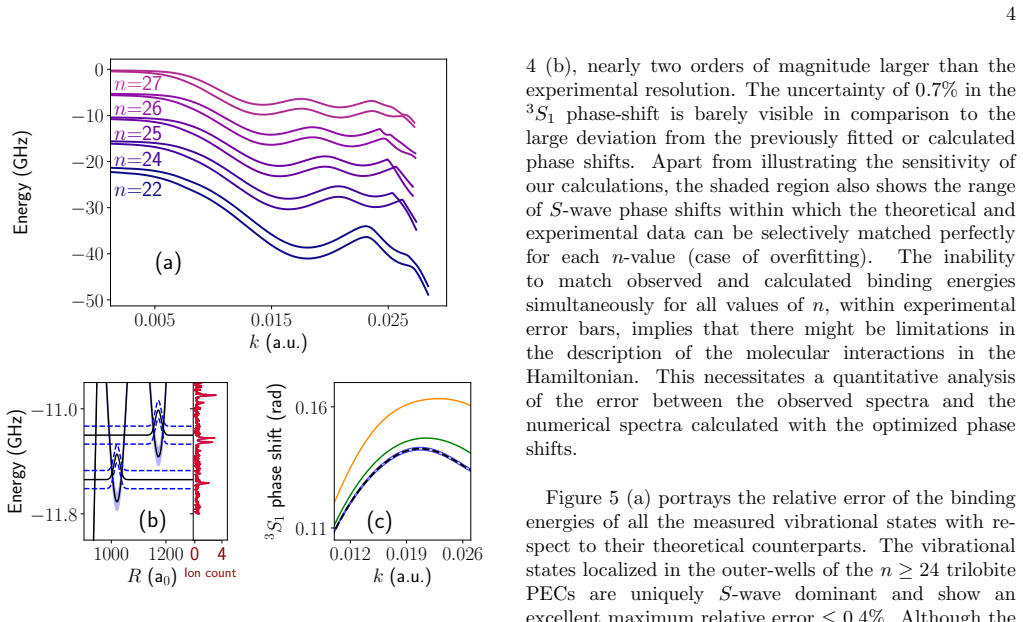
- [Phase shift extraction, Fig. 4(c)] The 3S1 phase shift is obtained by fitting a ninth-order polynomial to the same measured spectra that are later used to demonstrate agreement in Fig. 5. This is an in-sample fit, so the reported agreement does not establish predictive power or 'unprecedented accuracy'. The manuscript needs an out-of-sample validation, for example by holding out one principal quantum number or one vibrational state from the fit and predicting its position, or by comparing the extracted phase shift against an independent low-energy scattering constraint.
- [Phase shift extraction, Conclusion] The paper states that 'the inability to match observed and calculated binding energies simultaneously for all values of n, within experimental error bars, implies that there might be limitations in the description of the molecular interactions in the Hamiltonian.' Since the phase-shift coefficients are free parameters varied to minimize that same mismatch, they can absorb missing physics such as non-adiabatic couplings, higher-order scattering terms, or inaccuracies in the P-wave crossing positions. The claim that the fitted curve is the true e−-Rb 3S1 scattering phase shift therefore requires either a demonstration that the Hamiltonian is complete enough for the residual errors to be attributed solely to the phase shift, or a model-error estimate that propagates Hamiltonian uncertainty into the extracted phase shift.
- [Fig. 4(c), End Matter] The shaded uncertainty region labeled as a 0.7% uncertainty in the 3S1 phase shift represents the range over which individual n-values can be matched, not a statistical or systematic uncertainty of the extraction. It does not include the dominant uncertainty arising from the incomplete Hamiltonian, and the statement 'avoiding any unphysical oscillatory behavior' is not a quantitative constraint. The error bars shown in Fig. 4(c) are therefore understated, and the large deviation from the previously fitted and ab initio phase shifts cannot be interpreted as evidence of improved accuracy without a more complete error budget.
- [End Matter, phase-shift fitting procedure] The two-step fitting procedure, in which the 3S1 phase shift is first fit for k ∈ [0.01, 0.018] and then simultaneously adjusted with the 3PJ phase shifts for the inner-well states, is not guaranteed to yield a unique or physically meaningful result. The paper notes that the exact form of the 3PJ phase shifts has limited accuracy, but it does not quantify how much variation in the 3S1 phase shift is induced by the simultaneous re-fitting in the second step. This coupling should be analyzed, for instance by reporting the sensitivity of the final 3S1 curve to the chosen form of the 3PJ phase shifts over a plausible range.
minor comments (5)
- [Abstract] The phrase 'The relatively large molecular binding energy are primarily determined' contains a subject-verb agreement error; it should read 'binding energies are'.
- [Interactions and methodology] The expression k(R) = sqrt(2U_n(R) + 1/R) in the caption of Fig. 4(a) should specify that all quantities are in atomic units; as written, the units are ambiguous for a reader not familiar with the convention.
- [Experimental setup] The claim of a 'relative spectroscopic resolution of 10^-4' should be explicitly defined with the reference value used for the ratio, since the binding energy varies by more than an order of magnitude across the measured n-values.
- [Figure 7 caption] The caption says 'from n=22 to 27 plotted in panels (a) to (e)', but n=23 is not measured; the list should be explicit: n=22, 24, 25, 26, and 27.
- [Data availability] The statement that data are 'available from the corresponding author upon reasonable request' is weaker than the modern standard of archiving in a public repository; given the importance of this dataset as a benchmark, depositing the spectra and fit parameters would increase confidence in the extracted phase shift.
Circularity Check
The 'unprecedented accuracy' of the extracted 3S1 phase shift is an in-sample fit quality, not an independently validated prediction.
-
fitted input called prediction
[Phase shift extraction; Conclusion]
"For this, we added a ninth order polynomial to the phase shifts fitted in [21] and treated the coefficients as fit parameters. These were varied until the total difference between the theoretical and experimental bound state spectra from all n were simultaneously minimized ... This allowed the binding energies and vibrational splittings to be theoretically reproduced with a relative error less than 0.8 % and 10 % respectively, providing us with an accurate estimate of the depth and shape of the potential energy curves. ..."
The reported agreement is the same quantity minimized in the fit: the polynomial coefficients are adjusted to minimize the difference between theoretical and experimental binding energies, and those same residuals are then presented as 'reproduced with a relative error less than 0.8%'. This is an in-sample fit statistic, not an independent test. The extracted phase shift is operationally defined as the minimizer of these residuals, so using the residuals to certify 'unprecedented accuracy' is circular unless an independent check links the fitted curve to the true electron-Rb phase shift.
full rationale
The paper contains new, high-resolution experimental spectra and applies an independently published Green's function framework [29]; the data themselves are not circular, and the method citation is not load-bearing in a problematic way. However, the central quantitative claim—extraction of the 3S1 scattering phase shift 'with unprecedented accuracy'—is supported only by the quality of an in-sample fit. The phase-shift extraction section explicitly describes fitting a ninth-order polynomial to minimize residuals against the same bound-state spectra that are later quoted as reproduced to ≤0.8%. Because the Hamiltonian is acknowledged to have limitations, the fitted polynomial may compensate for missing non-adiabatic or higher-order scattering physics, so the claimed accuracy is not independently established. The paper is honest about the fitting procedure and about the Hamiltonian limitations, which prevents a score of 8 or 10, but the central extraction claim does reduce to fit quality rather than a validated prediction.
Assumptions & free parameters
free parameters (2)
- 3S1 phase-shift polynomial coefficients (ninth-order added to Ref [21] fit) =
not listed in paper
- 3PJ phase-shift adjustments for inner-well states =
not listed in paper
assumptions (4)
- domain assumption Born-Oppenheimer separation of electronic and nuclear motion in ultralong-range Rydberg molecules
- domain assumption Fermi/Omont pseudopotential with six spin channels (1S0, 3S1, 1P1, 3P0,1,2) describes electron-atom scattering
- domain assumption The Green's function framework of Ref [29] correctly accounts for all spin interactions and removes basis-size convergence issues
- ad hoc to paper The 3S1 phase shift can be represented as a smooth ninth-order polynomial extension of the Ref [21] fit without unphysical oscillations
Cite this review
Pith. "Pith review of High precision spectroscopy of trilobite Rydberg molecules." pith.science (2026). https://pith.science/paper/4CZPF6OQ
@misc{pith2026241219710,
  author       = {Pith},
  title        = {Pith review of: High precision spectroscopy of trilobite Rydberg molecules},
  year         = {2026},
  howpublished = {\url{https://pith.science/paper/4CZPF6OQ}},
  note         = {Machine review of arXiv:2412.19710}
}
abstract
We perform three-photon photoassociation to obtain high resolution spectra of $^{87}$Rb trilobite dimers for the principal quantum numbers $n = 22,24,25,26$, and $27$. The large binding energy of the molecules in combination with a relative spectroscopic resolution of $10^{-4}$ provides a rigorous benchmark for existing theoretical models. A recently developed Green's function framework, which circumvents the convergence issues that afflicted previous studies,, is employed to theoretically reproduce the vibrational spectrum of the molecule with high accuracy. The relatively large molecular binding energy are primarily determined by the low energy $S$-wave electron-atom scattering length, thereby allowing us to extract the $^3S_1$ scattering phase shift with unprecedented accuracy, at low energy regimes inaccessible to free electrons.
Figures


Figures from the paper (4 more)


Forward citations
Cited by 2 Pith papers
-
Tunable pairing with local spin-dependent Rydberg molecule potentials in an atomic Fermi superfluid
Spin-dependent Rydberg molecule potentials can locally imbalance an atomic Fermi superfluid, producing YSR and FFLO-like states with a sign change in the pairing gap.
-
Diatomic and Polyatomic Heteronuclear Ultralong-Range Rydberg Molecules
The paper predicts the vibrational spectra and binding energies of heteronuclear Rb-Cs ultralong-range Rydberg molecules, including polyatomic versions, using the Fermi pseudopotential model.
Reference graph
Works this paper leans on
-
[29]
C. H. Greene, und M. T. Eiles, Green’s-function treat- ment of Rydberg molecules with spins, Phys. Rev. A108, 042805 (2023)
work page 2023
- [21]
-
[1]
C. H. Greene, A. S. Dickinson, und H. R. Sadeghpour, Creation of polar and nonpolar ultra-long-range Rydberg molecules, Phys. Rev. Lett. 85, 2458 (2000)
work page 2000
-
[2]
J. A. Fern´ andez, H. R Sadeghpour, P. Schmelcher, und R. G F´ erez, Ultralong-Range Rb-KRb Rydberg Molecules: Selected Aspects of Electronic Structure, Ori- entation and Alignment, Journal of Physics: Conference Series 635, 012023 (2015)
work page 2015
- [3]
-
[4]
J. Zeiher, und S. Hollerith, Rydberg Macrodimers: Di- atomic Molecules on the Micrometer Scale, J. Phys. Chem. A 127, 3925 (2023)
work page 2023
-
[5]
A. Duspayev, X. Han, M. A. Viray, L. Ma, L. Zhao, und G. Raithel, Long-range Rydberg-atom–ion molecules of Rb and Cs, Phys. Rev. Res. 3, 023114 (2021)
work page 2021
- [6]
Show all 42 references
-
[7]
Bosworth, F
D. Bosworth, F. Hummel, und P. Schmelcher, Charged ultralong-range Rydberg trimers, Physics. Rev. A 107, 022807 (2023)
2023
-
[8]
M. T. Eiles, Trilobites, butterflies, and other exotic specimens of long-range Rydberg molecules, Journal of Physics B: Atomic, Molecular and Optical Physics 52, 113001 (2019)
2019
-
[9]
C. Fey, F. Hummel, und P. Schmelcher, Ultralong-range Rydberg molecules, Mol. Phys. 118, e1679401 (2020)
2020
-
[10]
F. B. Dunning, S. K. Kanungo, S. und Yoshida, Ultralong-range Rydberg molecules, J. Phys. B: At. Mol. Opt. Phys. 57, 212002 (2024)
2024
-
[11]
E. L. Hamilton, C. H. Greene, und H. R. Sadeghpour, Shape-resonance-induced long-range molecular Rydberg states, Journal of Physics B: Atomic, Molecular and Op- tical Physics 35, L199 (2002)
2002
-
[12]
W. Li, T. Pohl, J. M. Rost, Seth T. Ritten- house, H. R. Sadeghpour, J. Nipper, B. Butscher, J. B. Balewski, V. Bendkowsky, R. L¨ ow, und T. Pfau, A Homonuclear Molecule with a Permanent Electric Dipole Moment, Science 334, 1110–1114 (2011)
2011
-
[13]
M. I. Chibisov, A. A. Khuskivadze, und I. I. Fabrikant, Energies and dipole moments of long-range molecular Rydberg states, J. Phys. B: At. Mol. Opt. Phys.35, L193 (2002)
2002
-
[14]
Booth, S
D. Booth, S. T. Rittenhouse, J. Yang, H. R. Sadegh- pour, und J. P. Shaffer, Production of trilobite Ryd- berg molecule dimers with kilo-Debye permanent electric dipole moments, Science 348, 99–102 (2015)
2015
-
[15]
Alth¨ on, M
M. Alth¨ on, M. Exner, R. Bl¨ attner, und H. Ott, Exploring the vibrational series of pure trilobite Rydberg molecules, Nature Communications 14, 8108 (2023)
2023
-
[16]
Engel, S
F. Engel, S. K. Tiwari, T. Pfau, S. W¨ uster, und F. Meinert, In situ observation of chemistry in Ryd- berg molecules within a coherent solvent, arXiv preprint 6 arXiv:2308.13762 (2023)
2023 arXiv
-
[17]
Hummel, K
F. Hummel, K. Keiler, und P. Schmelcher, Electric- field-induced wave-packet dynamics and geometrical re- arrangement of trilobite Rydberg molecules, Phys. Rev. A 103, 022827 (2021)
2021
-
[18]
Srikumar, S
R. Srikumar, S. T. Rittenhouse, und P. Schmelcher, In- ternal diffraction dynamics of trilobite molecules, arXiv preprint arXiv:2408.02134 (2024)
2024 arXiv
-
[19]
K. S. Kleinbach, F. Meinert, F. Engel, W. J. Kwon, R. L¨ ow, T. Pfau, und G. Raithel, Photoassociation of Trilobite Rydberg Molecules via Resonant Spin-Orbit Coupling, Phys. Rev. Lett. 118, 223001 (2017)
2017
-
[20]
Bendkowsky, B
V. Bendkowsky, B. Butscher, J. Nipper, J. P. Shaffer, R. L¨ ow, und T. Pfau, Observation of ultralong-range Rydberg molecules, Nature 458, 1005–1008 (2009)
2009
-
[22]
Niederpr¨ um, O
T. Niederpr¨ um, O. Thomas, T. Eichert, und H. Ott, Ryd- berg Molecule-Induced Remote Spin Flips, Phys. Rev. Lett. 117, 123002 (2016)
2016
-
[23]
Niederpr¨ um, O
T. Niederpr¨ um, O. Thomas, T. Eichert, C. Lippe, J. P´ erez-R ´ ıos, C. H. Greene, und H. Ott, Observation of pendular butterfly Rydberg molecules, Nature Com- munications 7, 12820 (2016)
2016
-
[24]
M. Deiß, S. Haze, J. Wolf, L. Wang, F. Meinert, C. Fey, F. Hummel, P. Schmelcher, und J. H. Denschlag, Obser- vation of spin-orbit-dependent electron scattering using long-range Rydberg molecules, Phys. Rev. Res. 2, 013047 (2020)
2020
-
[25]
Saßmannshausen, F
H. Saßmannshausen, F. Merkt, und J. Deiglmayr, Exper- imental Characterization of Singlet Scattering Channels in Long-Range Rydberg Molecules, Phys. Rev. Lett.114, 133201 (2015)
2015
-
[26]
Peper und J
M. Peper und J. Deiglmayr, Photodissociation of long- range Rydberg molecules, Phys. Rev. A 102, 062819 (2020)
2020
-
[27]
Peper und J
M. Peper und J. Deiglmayr, Heteronuclear Long-Range Rydberg Molecules, Phys. Rev. Lett. 126, 013001 (2021)
2021
-
[28]
J. L. MacLennan, Y.-J. Chen, und G. Raithel, Deeply bound (24DJ + 5S1/2) 87Rb and 85Rb molecules for eight spin couplings, Phys. Rev. A 99, 033407 (2019)
2019
-
[30]
Hummel, P
F. Hummel, P. Schmelcher, und M. T. Eiles, Vibronic interactions in trilobite and butterfly Rydberg molecules, Phys. Rev. Res. 5, 013114 (2023)
2023
-
[31]
Srikumar, F
R. Srikumar, F. Hummel, und P. Schmelcher, Nonadia- batic interaction effects in the spectra of ultralong-range Rydberg molecules, Phys. Rev. A 108, 012809 (2023)
2023
-
[32]
M. T. Eiles, und F. Hummel, Kato’s theorem and ultralong-range Rydberg molecules, Phys. Rev. A 109, 022811 (2024)
2024
-
[33]
M. T. Eiles, und C. H. Greene, Hamiltonian for the in- clusion of spin effects in long-range Rydberg molecules, Phys. Rev. A 95, 042515 (2017)
2017
-
[34]
Fermi, Sopra lo Spostamento per Pressione delle Righe Elevate delle Serie Spettrali, Nuovo Cim
E. Fermi, Sopra lo Spostamento per Pressione delle Righe Elevate delle Serie Spettrali, Nuovo Cim. 11, 157 (1934)
1934
-
[35]
Omont, On the theory of collisions of atoms in rydberg states with neutral particles, J
A. Omont, On the theory of collisions of atoms in rydberg states with neutral particles, J. Phys. France 38, 1343 (1977)
1977
-
[36]
C. Fey, M. Kurz, P. Schmelcher, S. T. Rittenhouse, und H. R. Sadeghpour, A comparative analysis of binding in ultralong-range Rydberg molecules, New Journal of Physics 17, 055010 (2015)
2015
-
[37]
Tarana, Long-range Rydberg molecule Rb 2: Two- electron R-matrix calculations at intermediate internu- clear distances, Phys
M. Tarana, Long-range Rydberg molecule Rb 2: Two- electron R-matrix calculations at intermediate internu- clear distances, Phys. Rev. A 102, 062802 (2020)
2020
-
[38]
Giannakeas, M
P. Giannakeas, M. T. Eiles, F. Robicheaux, und J. M. Rost, Generalized local frame-transformation the- ory for ultralong-range Rydberg molecules, Phys. Rev. A 102, 033315 (2020)
2020
-
[39]
Geppert, M
P. Geppert, M. Alth¨ on, D. Fichtner, and H. Ott, Diffusive-like redistribution in state-changing collisions between Rydberg atoms and ground state atoms, Nature Communications 12, 3900 (2021)
2021
-
[40]
Bahrim, U
C. Bahrim, U. Thumm, Low-lying 3P o and 3Se states of Rb−, Cs−, and Fr−, Phys. Rev. A 61, 022722 (2000)
2000
-
[41]
Bahrim, U
C. Bahrim, U. Thumm, I. I. Fabrikant, Negative-ion res- onances in cross sections for slow-electron–heavy-alkali- metal-atom scattering, Phys. Rev. A 63, 042710 (2001)
2001
-
[42]
A. A. Khuskivadze, M. I. Chibisov, I. I. Fabrikant, Adi- abatic energy levels and electric dipole moments of Ryd- berg states of Rb 2 and Cs 2 dimers, Phys. Rev. A 66, 042709 (2002). End Matter All bound states localized in the trilobite potential energy curves are predominant...
2002
Reviewed August 10, 2026 · model on record in the stance chip above.
Discussion (0). Continue with ORCID to comment.