REVIEW 4 major objections 4 minor 1 cited by
From Elements to Design: A Layered Approach for Automatic Graphic Design Composition
T0 review · 4 major / 4 minor · reviewed 2026-08-10 · deepseek-v4-flash
Pith's one-line read LaDeCo is a layered approach to automatic graphic design composition: it first assigns input elements to semantic layers, then generates each layer's attributes in order, using the rendered image of already-completed layers as context…
desk verdict A credible, clearly written empirical pipeline for layered graphic design composition; the semantic layer-planning step is unvalidated and train/inference mismatched, but the core sequential-rendering idea survives and the paper deserves a serious referee. read the letter →
The pith
A machine-rendered reading of the paper's core claim, the machinery that carries it, and where it could break.
The reading
What carries the argument
The layer planning module is a GPT-4o-based zero-shot classifier that maps each input element to one of five semantic layers (background, underlay, logo/image, text, embellishment), using the element image and, for training samples, the full design and canvas/element sizes. The layered design composition process is an autoregressive prediction over these layers: at each step the LMM (Llama-3.1-8B with CLIP vision encoder and LoRA) predicts the JSON attributes of the current layer's elements conditioned on the visual embeddings of the element images and of the rendered composite image of all previous layers. The mechanism carries the argument because it converts an intractable single-shot mapping from element set to design into a chain of simpler, visually grounded steps; the rendered image is what lets the model coordinate new elements with already-placed ones, and the layer ordering is what encodes the design principle.
What would settle it
Manually label a held-out sample of Crello elements with the five layer categories, run the paper's GPT-4o element-labeling prompt on those same elements, and measure classification accuracy; if accuracy on non-text elements is near chance, the foundation of LaDeCo is unreliable and the reported quality gain would need to be re-derived without the assumption.
Extended reading notes
Core claim
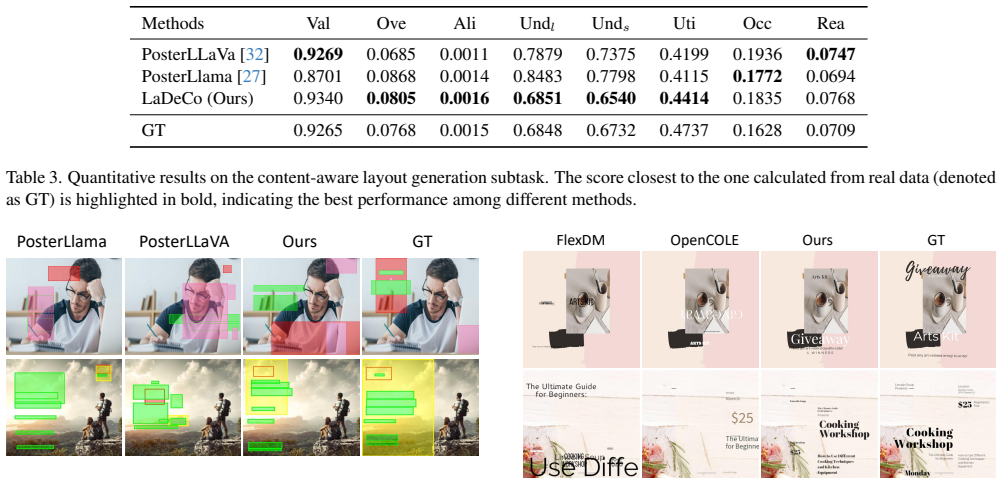
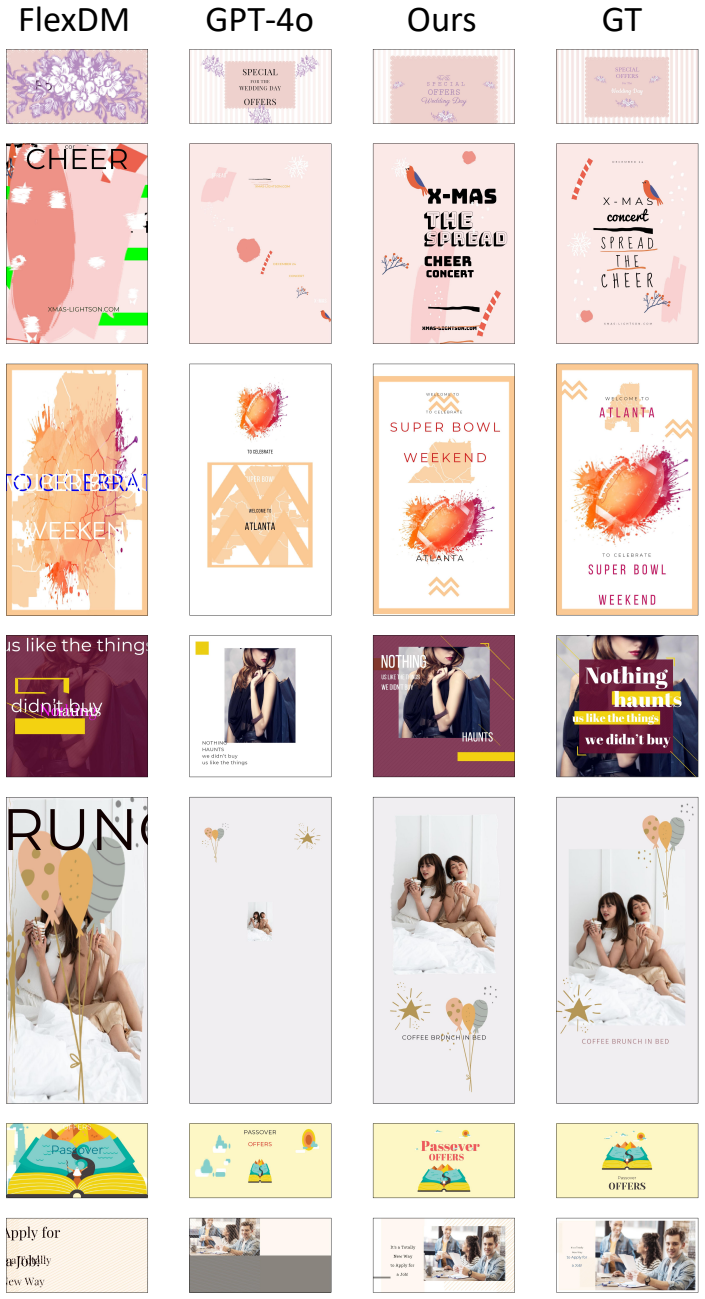
LaDeCo introduces the layered design principle into large multimodal models (LMMs). It divides the design composition task into two stages: layer planning, where GPT-4o assigns each input element a semantic label (background, underlay, logo/image, text, embellishment), and layered design composition, where the model predicts the position/size/typography attributes of each layer's elements in order, rendering each completed layer and feeding that image back as context for the next layer. The paper reports that on Crello-v4, LaDeCo's generated designs receive LLaVA-OV scores closer to ground-truth designs than FlexDM and a GPT-4o prompt baseline on the full composition task, and it outperforms PosterLLaVA and PosterLlama on content-aware layout and FlexDM and OpenCOLE on typography without being trained for those subtasks. The central claim is that the layered decomposition itself—not more data or a bigger model—is what makes holistic design composition tractable for LMMs, and the evidence is the ablation where removing either the layer planning or the layered generation degrades all metrics.
Load-bearing premise
The whole pipeline assumes GPT-4o assigns every input element to the correct one of five semantic layers; if it mislabels elements, the training data itself is corrupted and every later prediction inherits the error.
Editorial extensions
If this is right
- A single LaDeCo model can perform content-aware layout generation and typography generation by supplying ground-truth prefix layers at inference, so the same checkpoint serves multiple design tasks without retraining.
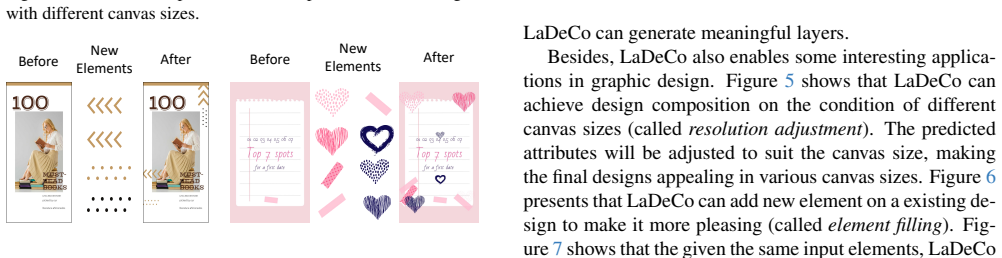
- The system adapts to new canvas sizes, can insert new elements into an existing design, and can produce multiple layout variations of the same element set, which are concrete practical uses for real design tools.
- Performance improves when training on a larger commercial dataset (LargeCrello), showing the layered approach scales with data rather than plateauing.
- Ablations show both the layer planning and the layered generation are necessary: removing either lowers all overall quality scores and the underlay effectiveness metrics, supporting the claim that the hierarchical structure is the source of the gain.
Reading between the lines
- The reliance on an external GPT-4o labeling step is never validated in the paper; a straightforward next experiment is to measure its accuracy against human layer labels, since systematic labeling errors would corrupt the training set and explain part of the improvement.
- The rendered-feedback mechanism suggests a general recipe for LMMs in spatial arrangement tasks: feed the model the actual visual state of the artifact at each step rather than only the requested tokens; this could transfer to UI layout, document layout, or slide design with minimal changes.
- The reported advantage over specialized models is measured with proxy metrics and proximity to ground truth; a direct human preference study would test whether the advantage holds for working designers, who may value aspects these metrics miss.
Editorial analysis
A structured set of objections, weighed in public.
Referee Report
Summary. The paper proposes LaDeCo, a method for automatic graphic design composition from a set of multimodal elements. LaDeCo first uses GPT-4o to assign each input element to one of five predefined semantic layers (background, underlay, logo/image, text, embellishment). It then fine-tunes an LMM (Llama-3.1-8B with a CLIP vision encoder) to predict per-element attributes layer by layer, feeding the rendered image of previously generated layers back into the model as context. The method is evaluated on the Crello-v4 dataset against FlexDM and GPT-4o for full design composition, and against specialized baselines (PosterLLaVA, PosterLlama, FlexDM, OpenCOLE) on layout and typography subtasks. Quantitative results are reported as LLaVA-OV-7B quality scores and geometric metrics (validity, overlap, alignment, underlay effectiveness), with the claimed outcome that LaDeCo outperforms baselines on overall quality and matches or beats specialized models on subtasks without task-specific training.
Significance. If the reported results hold, LaDeCo would be a practical demonstration that decomposing design composition into semantic layers improves the output quality of an LMM-based generator, and that the same model can handle multiple design subtasks zero-shot. The idea of rendering intermediate layers back into the model context is simple and potentially useful, and the applications (resolution adjustment, element filling, design variation) show the flexibility of the approach. The paper also re-trains baselines on the same split and provides ablations, which are positive methodological choices. However, the central mechanism of the method—layer planning via GPT-4o—is not directly evaluated, and the main quality metric is an unvalidated LMM proxy with no statistical uncertainty. These gaps currently prevent the paper from fully establishing that semantic layer planning, rather than ordered generation, is responsible for the reported gains.
major comments (4)
- [Section 3.3, Appendix A] The layer planning module is a load-bearing component of LaDeCo, but the paper provides no quantitative evaluation of its accuracy. Section 3.3 states that GPT-4o generates semantic labels for input elements, and Appendix A describes the prompts; however, no classification accuracy, confusion matrix, or human agreement study is reported. Because these labels determine the ordering of layers and the rendered intermediate contexts G_i used in training, systematic misclassification could corrupt the supervision signal and affect all downstream predictions. Additionally, there is a train/inference mismatch: for training samples, GPT-4o is given the full design image, canvas size, and element size (Appendix A), while at inference it receives only the element image. This mismatch is not analyzed. I request an evaluation of layer planning accuracy on a labeled subset and an experiment that compares training with predicted labels versus ground-truth labels to quantify the impact of label noise.
- [Section 4.2, Table 1] The claim that LaDeCo "significantly outperforms" baselines is not backed by statistical testing or uncertainty estimates. Table 1 reports point estimates to two decimal places for the LLaVA-OV-7B scores and the geometric metrics, but no error bars, confidence intervals, or significance tests are provided. Moreover, the primary quality metric is an LMM proxy (LLaVA-OV-7B) using prompts from COLE; the paper does not validate this proxy against human judgments on the Crello dataset. Since the central claim rests on these numbers, I ask for variance estimates (e.g., bootstrap or multiple runs) and a human evaluation on a subset, or at least a calibration of the proxy against human ratings.
- [Table 2, ablation studies] The ablation for layer planning ('w/o LP, w/o LDC') replaces the learned layer order with a random element order, but this does not isolate the effect of semantic understanding. A plausible alternative explanation for the observed gain is that any fixed order from background to embellishment—or even a simple rule based on element size—would produce similar improvements, because the method always benefits from a consistent generation order and rendered context. The paper does not include an ablation with a fixed, non-semantic order or with deliberately incorrect layer labels. Such an experiment would directly test whether the content-based planning performed by GPT-4o is what improves performance, rather than merely the sequential structure.
- [Section 3.5, Training and Inference] The training procedure conditions on ground-truth intermediate canvases G_i (rendered from ground truth attributes), while at inference the model conditions on its own previously generated layers. This is a classic exposure-bias setting for autoregressive generation, and the paper does not discuss or mitigate the resulting error accumulation across the five layers. Since the rendered context is claimed to guide subsequent layers, a systematic error in early layers may propagate and degrade final designs. The authors should analyze this effect, for example by training with predicted contexts or by measuring per-layer error propagation, to confirm that the layerwise approach is robust in the intended inference setting.
minor comments (4)
- [Figure 2] The label 'undelay' in the prompt text is a typo; it should read 'underlay'.
- [Table 1 caption] The Roman numeral enumerations in the caption are inconsistent: the list reads '(i) design and layout, (ii) content relevance, (iii) typography and color, (vi) graphics and images, and (v) innovation and originality.' The '(vi)' should be '(iv)'.
- [Section 4.5] In the typography generation paragraph, 'Figure 9 shows the resutls' contains a typo; it should be 'results'.
- [Section 4.2] The qualitative comparison in Figure 3 is described as showing that baselines 'suffer from some serious problems,' but the figure selection may be cherry-picked. It would be helpful to state how the examples were chosen and whether a random or systematic selection was used.
Circularity Check
No significant circularity: LaDeCo is an empirical pipeline with held-out evaluation; only a minor non-load-bearing self-citation in the evaluation protocol.
full rationale
LaDeCo's contribution is an empirical system rather than a formal derivation, and its central claims are validated on held-out Crello test data rather than by construction. The pipeline predicts element attributes layer by layer, conditioned on GPT-4o-assigned semantic labels and rendered intermediate canvases; the training objective is the standard autoregressive likelihood L = ∑ log P(Y_i | Y_<i, X_≤i, G_<i), which is a learning objective, not a definitional shortcut. The layer labels are produced by an external model (GPT-4o) and are not fitted to the test attributes, so the 'fitted input called prediction' pattern does not apply. The evaluation uses an external LMM judge (LLaVA-OV) and standard geometric metrics, with scores compared to ground-truth designs on the test split; no equation in the paper defines a predicted quantity in terms of the same quantity, and no ablation reports a metric that is a restatement of the method's own inputs. The main self-referential element is that GPT-4o is used both as a layer-labeling component and as a comparison baseline, but the baseline is asked to predict element attributes, not layer labels, so the comparison is not circular. The evaluation protocol is borrowed from COLE [12, 13], and COLE [13] has overlapping authorship (Ji Li); this is a minor self-citation for a prompt/proxy model, not a load-bearing theorem or uniqueness argument, and the actual scores are computed from test renders rather than asserted by citation. A genuine empirical weakness is visible in Appendix A: training-time layer labels are generated with access to the complete design, canvas size, and element size, while inference uses only the element image, and no accuracy or confusion analysis for layer planning is reported. This is a missing evaluation and a potential train/inference mismatch, but it does not make the final prediction equivalent to its inputs; the predicted attributes are still evaluated against ground-truth designs on held-out data. Overall, the paper's central claims have independent empirical content, so the circularity score is low.
Assumptions & free parameters
assumptions (5)
- domain assumption The five-layer decomposition (background, underlay, logo/image, text, embellishment) is a sufficient and appropriate structure for graphic design composition.
- domain assumption GPT-4o can perform accurate zero-shot semantic labeling of graphic elements into the five layer categories.
- domain assumption The 12 predicted attributes (4 bounding box, 8 text attributes) are sufficient to describe a high-quality design.
- domain assumption LLaVA-OV-7B's proxy scores are a valid measure of design quality.
- domain assumption Crello-v4 dataset and its splits are representative of graphic design tasks.
Cite this review
Pith. "Pith review of From Elements to Design: A Layered Approach for Automatic Graphic Design Composition." pith.science (2026). https://pith.science/paper/5ZOIDW4D
@misc{pith2026241219712,
  author       = {Pith},
  title        = {Pith review of: From Elements to Design: A Layered Approach for Automatic Graphic Design Composition},
  year         = {2026},
  howpublished = {\url{https://pith.science/paper/5ZOIDW4D}},
  note         = {Machine review of arXiv:2412.19712}
}
read the original abstract
In this work, we investigate automatic design composition from multimodal graphic elements. Although recent studies have developed various generative models for graphic design, they usually face the following limitations: they only focus on certain subtasks and are far from achieving the design composition task; they do not consider the hierarchical information of graphic designs during the generation process. To tackle these issues, we introduce the layered design principle into Large Multimodal Models (LMMs) and propose a novel approach, called LaDeCo, to accomplish this challenging task. Specifically, LaDeCo first performs layer planning for a given element set, dividing the input elements into different semantic layers according to their contents. Based on the planning results, it subsequently predicts element attributes that control the design composition in a layer-wise manner, and includes the rendered image of previously generated layers into the context. With this insightful design, LaDeCo decomposes the difficult task into smaller manageable steps, making the generation process smoother and clearer. The experimental results demonstrate the effectiveness of LaDeCo in design composition. Furthermore, we show that LaDeCo enables some interesting applications in graphic design, such as resolution adjustment, element filling, design variation, etc. In addition, it even outperforms the specialized models in some design subtasks without any task-specific training.
Figures


Figures from the paper (11 more)





Forward citations
Cited by 1 Pith paper
-
Graphic-Design-Bench: A Comprehensive Benchmark for Evaluating AI on Graphic Design Tasks
A 49-task layered-design benchmark shows frontier AI models leave most precision-heavy graphic design tasks unsolved, with only two tasks mostly solved.
Reference graph
Works this paper leans on
-
[1]
https://openai.com/index/hello-gpt- 4o/. [Accessed 04-11-2024]. 2, 3, 4, 5, 11
work page 2024
-
[2]
Josh Achiam, Steven Adler, Sandhini Agarwal, Lama Ahmad, Ilge Akkaya, Florencia Leoni Aleman, Diogo Almeida, Janko Altenschmidt, Sam Altman, Shyamal Anadkat, et al. Gpt-4 technical report. arXiv preprint arXiv:2303.08774, 2023. 2, 3
arXiv 2023
-
[3]
Internvl: Scal- ing up vision foundation models and aligning for generic visual-linguistic tasks
Zhe Chen, Jiannan Wu, Wenhai Wang, Weijie Su, Guo Chen, Sen Xing, Muyan Zhong, Qinglong Zhang, Xizhou Zhu, Lewei Lu, et al. Internvl: Scal- ing up vision foundation models and aligning for generic visual-linguistic tasks. In Proceedings of the IEEE/CVF Conference on Computer Vision and Pat- tern Recognition, pages 24185–24198, 2024. 2
work page 2024
-
[4]
Graphic design with large multimodal model
Yutao Cheng, Zhao Zhang, Maoke Yang, Hui Nie, Chunyuan Li, Xinglong Wu, and Jie Shao. Graphic design with large multimodal model. arXiv preprint arXiv:2404.14368, 2024. 2
arXiv 2024
-
[5]
Yifan Gao, Jinpeng Lin, Min Zhou, Chuanbin Liu, Hongtao Xie, Tiezheng Ge, and Yuning Jiang. Textpainter: Multimodal text image generation with visual-harmony and text-comprehension for poster de- sign. In Proceedings of the 31st ACM International Conference on Multimedia , pages 7236–7246, 2023. 2, 3
work page 2023
-
[6]
Gaussian error lin- ear units (gelus)
Dan Hendrycks and Kevin Gimpel. Gaussian error lin- ear units (gelus). arXiv preprint arXiv:1606.08415 ,
-
[7]
Retrieval-augmented layout transformer for content-aware layout genera- tion
Daichi Horita, Naoto Inoue, Kotaro Kikuchi, Kota Ya- maguchi, and Kiyoharu Aizawa. Retrieval-augmented layout transformer for content-aware layout genera- tion. In Proceedings of the IEEE/CVF Conference on Computer Vision and Pattern Recognition, pages 67– 76, 2024. 2
work page 2024
-
[8]
Posterlayout: A new bench- mark and approach for content-aware visual-textual presentation layout
Hsiao Yuan Hsu, Xiangteng He, Yuxin Peng, Hao Kong, and Qing Zhang. Posterlayout: A new bench- mark and approach for content-aware visual-textual presentation layout. In Proceedings of the IEEE/CVF Conference on Computer Vision and Pattern Recogni- tion, pages 6018–6026, 2023. 2, 6, 8
work page 2023
Show all 38 references
-
[9]
Lora: Low-rank adaptation of large language models
Edward J Hu, Yelong Shen, Phillip Wallis, Zeyuan Allen-Zhu, Yuanzhi Li, Shean Wang, Lu Wang, and Weizhu Chen. Lora: Low-rank adaptation of large language models. arXiv preprint arXiv:2106.09685 ,
-
[10]
LayoutDM: Dis- crete Diffusion Model for Controllable Layout Gen- eration
Naoto Inoue, Kotaro Kikuchi, Edgar Simo-Serra, Mayu Otani, and Kota Yamaguchi. LayoutDM: Dis- crete Diffusion Model for Controllable Layout Gen- eration. In Proceedings of the IEEE/CVF Conference on Computer Vision and Pattern Recognition (CVPR), pages 10167–10176, 2023. 3
2023
-
[11]
Towards flexible multi-modal document models
Naoto Inoue, Kotaro Kikuchi, Edgar Simo-Serra, Mayu Otani, and Kota Yamaguchi. Towards flexible multi-modal document models. In Proceedings of the IEEE/CVF Conference on Computer Vision and Pat- tern Recognition, pages 14287–14296, 2023. 2, 3, 5, 8
2023
-
[12]
Opencole: Towards reproducible automatic graphic design generation
Naoto Inoue, Kento Masui, Wataru Shimoda, and Kota Yamaguchi. Opencole: Towards reproducible automatic graphic design generation. arXiv preprint arXiv:2406.08232, 2024. 3, 4, 5, 8
2024 arXiv
-
[13]
Cole: A hierarchi- cal generation framework for graphic design
Peidong Jia, Chenxuan Li, Zeyu Liu, Yichao Shen, Xingru Chen, Yuhui Yuan, Yinglin Zheng, Dong Chen, Ji Li, Xiaodong Xie, et al. Cole: A hierarchi- cal generation framework for graphic design. arXiv preprint arXiv:2311.16974, 2023. 2, 3, 5, 6
2023 arXiv
-
[14]
Layout- former++: Conditional graphic layout generation via constraint serialization and decoding space restriction
Zhaoyun Jiang, Jiaqi Guo, Shizhao Sun, Huayu Deng, Zhongkai Wu, Vuksan Mijovic, Zijiang James Yang, Jian-Guang Lou, and Dongmei Zhang. Layout- former++: Conditional graphic layout generation via constraint serialization and decoding space restriction. In Proceedings of the IEE...
2023
-
[15]
Multimodal markup document models for graphic design comple- tion
Kotaro Kikuchi, Naoto Inoue, Mayu Otani, Edgar Simo-Serra, and Kota Yamaguchi. Multimodal markup document models for graphic design comple- tion. arXiv preprint arXiv:2409.19051, 2024. 3
2024
-
[16]
Constrained graphic layout genera- tion via latent optimization
Kotaro Kikuchi, Edgar Simo-Serra, Mayu Otani, and Kota Yamaguchi. Constrained graphic layout genera- tion via latent optimization. InProceedings of the 29th ACM International Conference on Multimedia, pages 88–96, 2021. 3
2021
-
[17]
Blt: Bidi- rectional layout transformer for controllable layout generation
Xiang Kong, Lu Jiang, Huiwen Chang, Han Zhang, Yuan Hao, Haifeng Gong, and Irfan Essa. Blt: Bidi- rectional layout transformer for controllable layout generation. In European Conference on Computer Vi- sion, pages 474–490. Springer, 2022. 3
2022
-
[18]
Neural design network: Graphic layout generation with constraints
Hsin-Ying Lee, Lu Jiang, Irfan Essa, Phuong B Le, Haifeng Gong, Ming-Hsuan Yang, and Weilong Yang. Neural design network: Graphic layout generation with constraints. In Computer Vision–ECCV 2020: 16th European Conference, Glasgow, UK, August 23– 28, 2020, Proceedings, Part III...
2020
-
[19]
Llava-onevision: Easy vi- sual task transfer
Bo Li, Yuanhan Zhang, Dong Guo, Renrui Zhang, Feng Li, Hao Zhang, Kaichen Zhang, Yanwei Li, Zi- wei Liu, and Chunyuan Li. Llava-onevision: Easy vi- sual task transfer. arXiv preprint arXiv:2408.03326 ,
-
[20]
Attribute-conditioned layout gan for automatic graphic design
Jianan Li, Jimei Yang, Jianming Zhang, Chang Liu, Christina Wang, and Tingfa Xu. Attribute-conditioned layout gan for automatic graphic design. IEEE Transactions on Visualization and Computer Graph- ics, 27(10):4039–4048, 2020. 3
2020
-
[21]
A parse-then-place approach for generating graphic lay- outs from textual descriptions
Jiawei Lin, Jiaqi Guo, Shizhao Sun, Weijiang Xu, Ting Liu, Jian-Guang Lou, and Dongmei Zhang. A parse-then-place approach for generating graphic lay- outs from textual descriptions. In Proceedings of the IEEE/CVF International Conference on Computer Vi- sion, pages 23622–23631...
2023
-
[22]
Layout- prompter: Awaken the design ability of large language models
Jiawei Lin, Jiaqi Guo, Shizhao Sun, Zijiang Yang, Jian-Guang Lou, and Dongmei Zhang. Layout- prompter: Awaken the design ability of large language models. Advances in Neural Information Processing Systems, 36, 2024. 2, 3, 4, 6
2024
-
[23]
Decoupled weight decay regularization
I Loshchilov. Decoupled weight decay regularization. arXiv preprint arXiv:1711.05101, 2017. 5
2017 arXiv
-
[24]
Video-chatgpt: Towards detailed video understanding via large vision and lan- guage models
Muhammad Maaz, Hanoona Rasheed, Salman Khan, and Fahad Shahbaz Khan. Video-chatgpt: Towards detailed video understanding via large vision and lan- guage models. arXiv preprint arXiv:2306.05424 ,
-
[25]
Compositional chain-of-thought prompting for large multimodal models
Chancharik Mitra, Brandon Huang, Trevor Darrell, and Roei Herzig. Compositional chain-of-thought prompting for large multimodal models. In Proceed- ings of the IEEE/CVF Conference on Computer Vision and Pattern Recognition, pages 14420–14431, 2024. 3
2024
-
[26]
Typographic text generation with off-the-shelf diffusion model
KhayTze Peong, Seiichi Uchida, and Daichi Haraguchi. Typographic text generation with off-the-shelf diffusion model. In International Conference on Document Analysis and Recognition , pages 52–69. Springer, 2024. 2, 3
2024
-
[27]
Poster- llama: Bridging design ability of langauge model to contents-aware layout generation
Jaejung Seol, Seojun Kim, and Jaejun Yoo. Poster- llama: Bridging design ability of langauge model to contents-aware layout generation. arXiv preprint arXiv:2404.00995, 2024. 2, 4, 6, 8
2024 arXiv
-
[28]
Towards diverse and con- sistent typography generation
Wataru Shimoda, Daichi Haraguchi, Seiichi Uchida, and Kota Yamaguchi. Towards diverse and con- sistent typography generation. In Proceedings of the IEEE/CVF Winter Conference on Applications of Computer Vision, pages 7296–7305, 2024. 2
2024
-
[29]
Gemini: a family of highly capable mul- timodal models
Gemini Team, Rohan Anil, Sebastian Borgeaud, Jean- Baptiste Alayrac, Jiahui Yu, Radu Soricut, Johan Schalkwyk, Andrew M Dai, Anja Hauth, Katie Milli- can, et al. Gemini: a family of highly capable mul- timodal models. arXiv preprint arXiv:2312.11805 ,
-
[30]
Chain-of-thought prompting elicits reasoning in large language models
Jason Wei, Xuezhi Wang, Dale Schuurmans, Maarten Bosma, Fei Xia, Ed Chi, Quoc V Le, Denny Zhou, et al. Chain-of-thought prompting elicits reasoning in large language models. Advances in neural informa- tion processing systems, 35:24824–24837, 2022. 3
2022
-
[31]
Canvasvae: Learning to generate vector graphic documents
Kota Yamaguchi. Canvasvae: Learning to generate vector graphic documents. ICCV, 2021. 2, 5
2021
-
[32]
Posterllava: Con- structing a unified multi-modal layout generator with llm
Tao Yang, Yingmin Luo, Zhongang Qi, Yang Wu, Ying Shan, and Chang Wen Chen. Posterllava: Con- structing a unified multi-modal layout generator with llm. arXiv preprint arXiv:2406.02884, 2024. 2, 8
2024 arXiv
-
[33]
mplug-docowl: Modular- ized multimodal large language model for document understanding
Jiabo Ye, Anwen Hu, Haiyang Xu, Qinghao Ye, Ming Yan, Yuhao Dan, Chenlin Zhao, Guohai Xu, Chen- liang Li, Junfeng Tian, et al. mplug-docowl: Modular- ized multimodal large language model for document understanding. arXiv preprint arXiv:2307.02499 ,
-
[34]
Layoutdiffusion: Improv- ing graphic layout generation by discrete diffusion probabilistic models
Junyi Zhang, Jiaqi Guo, Shizhao Sun, Jian-Guang Lou, and Dongmei Zhang. Layoutdiffusion: Improv- ing graphic layout generation by discrete diffusion probabilistic models. In Proceedings of the IEEE/CVF International Conference on Computer Vision , pages 7226–7236, 2023. 3
2023
-
[35]
Improved baselines with visual instruction tun- ing
Haotian Liu, Chunyuan Li, Yuheng Li, and Yong Jae Lee. Improved baselines with visual instruction tun- ing. In Proceedings of the IEEE/CVF Conference on Computer Vision and Pattern Recognition , pages 26296–26306, 2024. 2, 3
2024
-
[36]
Multimodal chain- of-thought reasoning in language models
Zhuosheng Zhang, Aston Zhang, Mu Li, Hai Zhao, George Karypis, and Alex Smola. Multimodal chain- of-thought reasoning in language models. arXiv preprint arXiv:2302.00923, 2023. 3
2023 arXiv
-
[37]
Composition-aware graphic layout gan for visual-textual presentation de- signs
Min Zhou, Chenchen Xu, Ye Ma, Tiezheng Ge, Yuning Jiang, and Weiwei Xu. Composition-aware graphic layout gan for visual-textual presentation de- signs. arXiv preprint arXiv:2205.00303, 2022. 2
2022 arXiv
-
[38]
index": 0,
Deyao Zhu, Jun Chen, Xiaoqian Shen, Xiang Li, and Mohamed Elhoseiny. Minigpt-4: Enhancing vision- language understanding with advanced large language models. arXiv preprint arXiv:2304.10592, 2023. 2, 3 From Elements to Design: A Layered Approach for Automatic Graphic Design Co...
2023 arXiv
Reviewed August 10, 2026 · model on record in the stance chip above.
Discussion (0). Continue with ORCID to comment.