REVIEW 3 major objections 5 minor 1 cited by
Position: Theory of Mind Benchmarks are Broken for Large Language Models
T0 review · 3 major / 5 minor · reviewed 2026-08-10 · deepseek-v4-flash
Pith's one-line read Current LLM theory-of-mind benchmarks mostly measure whether a model can predict another agent's actions; this paper argues they miss whether the model acts on those predictions, and shows the two can diverge sharply.
desk verdict Useful literal–functional ToM distinction and clean game results, but the title overclaims and Definition 2.2 is a general decision-quality metric, not a ToM-specific one. read the letter →
The pith
A machine-rendered reading of the paper's core claim, the machinery that carries it, and where it could break.
The reading
What carries the argument
The machinery is the paired definitions in Section 2. Definition 2.1 measures literal theory of mind as a loss $\mathbb{D}(\phi(\mathbf{a}_{-i}^{1},\ldots,\mathbf{a}_{-i}^{T}),\phi(\hat{\mathbf{a}}_{-i}^{1},\ldots,\hat{\mathbf{a}}_{-i}^{T}))$ between predicted and actual partner actions under an abstraction mapping $\phi$. Definition 2.2 measures functional theory of mind as $\sum_{t=1}^{T}(r^{i*}_t - r^i_t)$, the cumulative reward forgone compared with the optimal $T$-step response to the actual partner policy. The load-bearing comparison is between $\Delta_{\mathrm{ToM}}/T$, the regret of a rational policy that faithfully follows the literal model, and $\Delta_{\mathrm{Functional}}/T$, the regret the LLM actually incurs; the gap between them isolates the failure to convert predictions into decisions. A derived interesting-task score computes the expected regret of an optimal responder to one partner policy when played against another, giving benchmark designers a quantitative criterion for whether a task tests adaptation at all.
What would settle it
Replace the social partner with a non-social stochastic process that generates the same sequence of actions (for example, a fixed pseudo-random schedule), holding prompt length, payoff table, and interaction history identical; if functional regret stays at the same high level, the deficit is general long-context reasoning, while a large drop would confirm the theory-of-mind-specific account.
Extended reading notes
Core claim
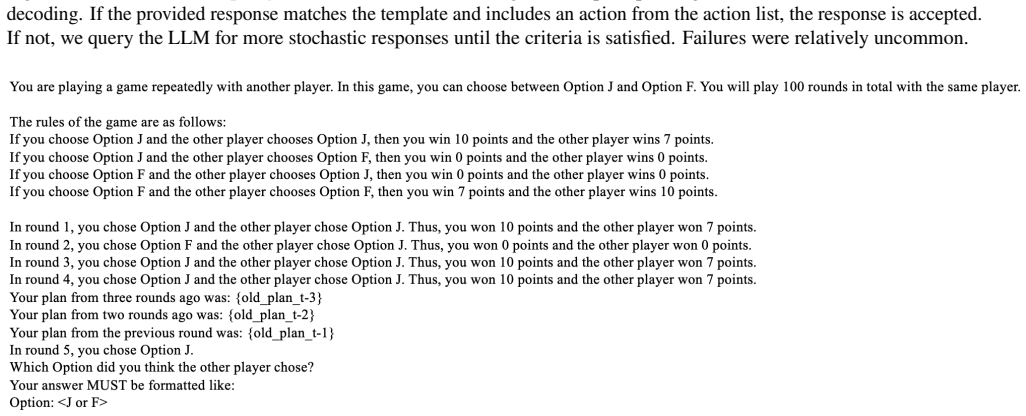
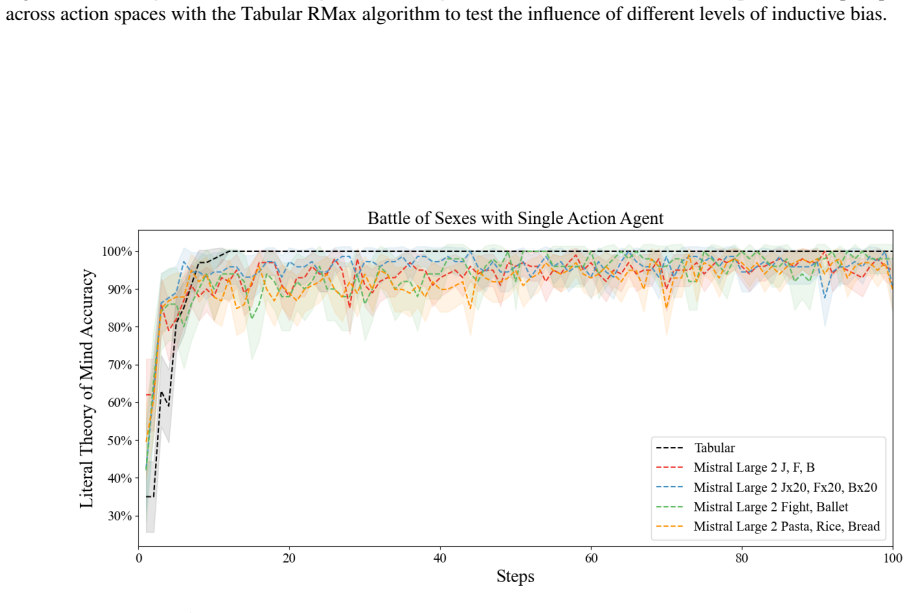
On the paper's own terms, literal theory of mind is the $T$-step loss between the partner actions an agent predicts and the actions the partner actually takes (Definition 2.1), and functional theory of mind is the $T$-step regret of the agent's policy relative to the optimal response to the partner's real policy (Definition 2.2). The central discovery is that these two quantities decouple in current LLMs: across Rock-Paper-Scissors, Iterated Battle of the Sexes, and Iterated Prisoner's Dilemma, models reach 90 percent or higher literal prediction accuracy while incurring large functional regret against partners that play one fixed action for 100 rounds. The gap persists even when the partner's actual next action is provided as oracle input, and in the opposite direction a trained reasoning model can match a tabular near-optimal baseline on functional regret while its literal predictions are relatively weak. The pith is that theory-of-mind capability, defined as adapting one's own behavior to another agent, is not implied by prediction accuracy.
Load-bearing premise
The load-bearing premise is that the gap is a theory-of-mind-specific failure rather than a general weakness in reasoning over long interaction histories or following complex instructions; the authors' own oracle and payoff-ablation results show how much weight this assumption carries.
Editorial extensions
If this is right
- Existing theory-of-mind benchmark scores overstate agent readiness for multi-agent interaction, since high literal accuracy can coexist with near-maximal functional regret.
- Meaningful LLM theory-of-mind evaluation should report both ToM% and $\Delta_{\mathrm{Functional}}/T$ (or accumulated reward) and the gap between them.
- Supplying the partner's true action as oracle input does not fix the functional deficit, so improvements cannot come from better prediction alone.
- The two capabilities are not ordered: a trained reasoning model can show strong functional theory of mind with weak literal theory of mind, and vice versa.
- Simple repeated matrix games with single-action or tit-for-tat partners are a sufficient minimal testbed to expose the failure.
Reading between the lines
- The paper's own ablations point to a confound the theory-of-mind framing does not resolve: removing the payoff table from the oracle prompt nearly closes the Rock-Paper-Scissors regret, so long-context payoff reasoning may be the true bottleneck.
- A direct extension would run the same prompts with a non-social stochastic partner matched for action statistics; if regret stays high, functional theory of mind is not a distinct capability.
- The definitions should transfer to non-game deployments: for a tutoring or coding assistant, the metric that matters is whether the interaction improves, not whether the next user action is predicted.
- Because the game-theoretic and theory-of-mind solutions diverge in adversarial settings, evaluation suites should separate cooperative, mixed, and adversarial partners rather than averaging them together.
Editorial analysis
A structured set of objections, weighed in public.
Referee Report
Summary. This position paper argues that most existing theory of mind (ToM) benchmarks for large language models are "broken" because they measure only literal ToM—the ability to predict another agent's behavior—and not functional ToM—the ability to adapt one's own behavior rationally to a partner. The authors formalize both notions: literal ToM as a prediction loss (Definition 2.1) and functional ToM as T-step regret against the optimal response to the partner's policy (Definition 2.2). They then report experiments in Rock-Paper-Scissors, Iterated Battle of the Sexes, and Iterated Prisoner's Dilemma against simple single-action and tit-for-tat partners, using several prompting strategies and open-source LLMs. The empirical pattern is that LLMs often show high literal prediction accuracy (ToM %) while incurring large functional regret, with a tabular RMax baseline achieving much lower regret. The paper concludes that strong literal ToM performance does not imply strong functional ToM performance, and that benchmarks should include interactive, functional evaluations.
Significance. If the position is accepted, it would reshape how the community evaluates ToM in LLMs: instead of passive question-answering tests, benchmarks would need interactive tasks in which the agent's decisions, not just its predictions, are scored. The formal definitions and the regret-based metric are clean and reusable, and the empirical study is careful in several respects: results are reported with confidence intervals, a tabular RMax baseline anchors the comparison, and the prompting ablations are extensive. The finding that high literal ToM accuracy coexists with poor functional performance in simple games is a useful cautionary result. However, the central claim is broader than the evidence: the experiments demonstrate a gap in three matrix games, but the ablations suggest that much of the gap may be due to general long-context reasoning or instruction-following rather than ToM-specific reasoning. The paper therefore makes a strong case for including decision-oriented social benchmarks, but the specific assertion that existing ToM benchmarks are broken because they omit functional ToM needs additional support or a narrower framing.
major comments (3)
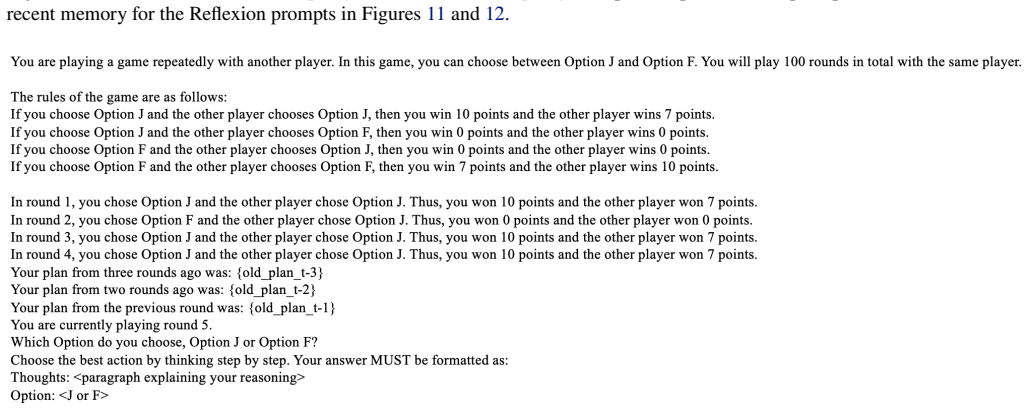
- [Section 4.2 / Table 3] The paper's own ablations undermine the ToM-specific attribution of the functional gap. For LLAMA-3 70B Instruct on RPS, regret per step drops from 0.444 under QA prompting to 0.103 under Oracle + Max -Payoffs and to 0.121 under CoT + 3-Shot, close to the tabular RMax baseline of 0.083. These interventions supply no additional information about the partner's mental state; they change payoff salience, instruction emphasis, and reasoning format. The text itself states that "reasoning over long contexts is at the core of the issue." This suggests the observed failure may be a general long-context reasoning or instruction-following deficit rather than a specifically theory-of-mind deficit. Since the central claim is that ToM benchmarks are broken because they omit functional ToM, the manuscript should either decompose the gap (for example, with non-social control tasks matched in context length and payoff reasoning) or explicitly reframe the claim as advocating for social decision-making benchmarks more broadly.
- [Abstract and Section 1] The claim that "the majority" of existing ToM benchmarks are broken is not directly supported by the evidence. No standard ToM benchmark (for example, Sally-Anne, FANToM, or the tasks used by Bubeck et al., Kosinski, or Strachan et al.) is run through the proposed functional metric; the empirical support consists of three matrix games with single-action or tit-for-tat partners. A case study can motivate a position, but the title-level claim requires either a systematic mapping of benchmark item types to Definitions 2.1 and 2.2 or a stated narrowing of the claim to "benchmarks that report only literal ToM should not be used to infer functional competence." As written, the paper overgeneralizes from its own game-based setup to the entire benchmark literature.
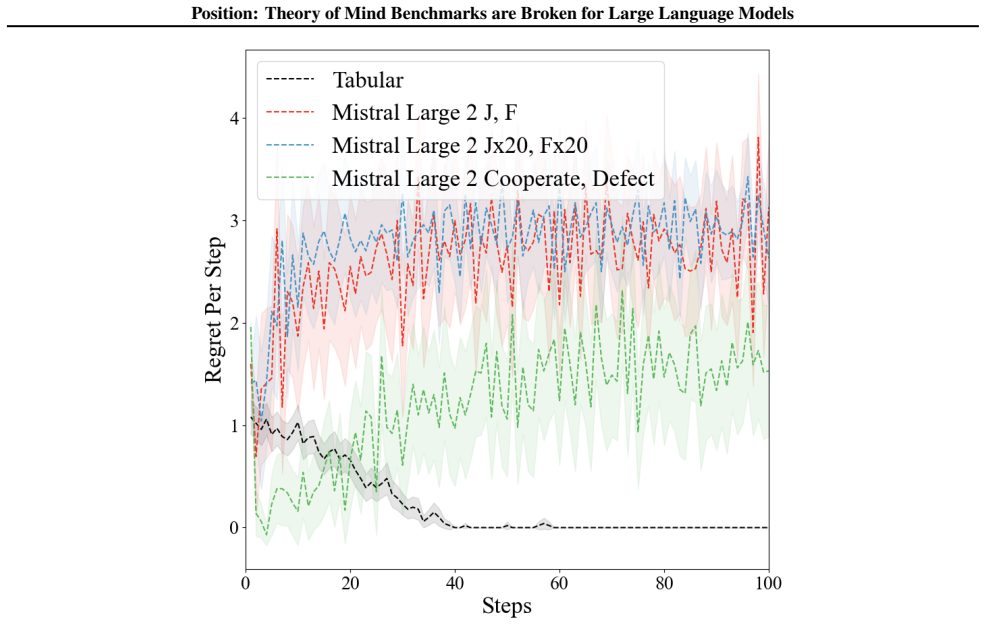
- [Definition 2.2 and Appendix C.4] Definition 2.2 defines functional ToM as T-step regret against the optimal response to the partner's policy, with no term that references the partner's beliefs, intentions, or mental state. As the authors note in Section 1, this makes the metric satisfiable by model-free policies. Consequently, high ΔFunctional can arise from non-ToM causes: failure to parse the payoff table, failure to follow the reward-maximization instruction, action-label biases, or inability to reason over the history. Appendix C.4 documents that action-label inductive bias systematically changes regret, and Table 3 shows that removing payoffs while providing oracle actions can almost close the gap. The metric may still be a valuable measure of partner-adaptive behavior, but calling it "theory of mind" without further justification conflates social cognition with general decision-making. The paper should either justify the terminological choice or weaken the inference from high regret to a ToM deficit.
minor comments (5)
- [Section 4.1] The authors state that for Reflexion they "always report the best value" over memory sizes 1 to 3. This is a mild optimistic selection bias; it is disclosed, but the tables would be clearer if the selected memory size appeared alongside the Reflexion rows rather than only in Appendix C.2.
- [Table 6 caption] The caption reads "Iterated Batte of Sexes" and should be "Iterated Battle of Sexes."
- [Section 4.2] The sentence containing "the LLM must struggle" is misspelled as "strugle"; please correct this typo.
- [Figure 15 caption] The caption says "The only difference with Figure 15 in the emphasis on maximizing reward," but the comparison should be with Figure 14 (Oracle Prompting), not with itself.
- [Definition 2.1] The sentence introducing the literal ToM loss is grammatically incomplete ("The loss from start state s1 with respect to a joint policy ..."). Rewriting it as a proper definition would improve readability.
Circularity Check
No significant circularity: literal and functional ToM are independently operationalized and measured directly; the paper's central claim is a normative position supported by self-contained experiments, not a reduction to its own inputs.
full rationale
The derivation chain is self-contained. Definition 2.1 (literal ToM loss) is prediction error over the partner's actions; Definition 2.2 (functional ToM regret) is the T-step reward gap against the optimal response to the partner's policy. Both quantities are measured directly from LLM rollouts (ToM %, ΔFunctional/T, ΔToM/T), so the observed dissociation between high literal accuracy and high functional regret is an empirical result, not a fitted parameter renamed as a prediction. The only tuning choice is the per-game Reflexion memory size ('we always report the best value', Section 4.1), which is an evaluation-protocol hyperparameter and does not determine the central comparison. Self-citations (e.g., Kim et al. 2022a, Khetarpal et al. 2020, Riemer et al. 2024a) appear in related-work and appendix framing, but the definitions, experiments, and ablations do not load-bear on them. The paper's own Table 3 ablations (Oracle + Max -Payoffs RPS 0.103; CoT + 3-Shot RPS 0.121) weaken the attribution of the gap to theory-of-mind-specific failure, suggesting long-context reasoning or instruction-following may be involved; this is a construct-validity limitation rather than circularity. The 'broken benchmarks' conclusion follows from the normative premise that functional ToM is what matters for deployed agents, which is a position, not a self-justifying derivation. No equation reduces to its own input and no cited result is doing unseen load-bearing work.
Assumptions & free parameters
free parameters (1)
- Reflexion memory size =
1 for RPS and IBS, 3 for IPD in Table 3
assumptions (4)
- domain assumption Agent interaction can be modeled as a partially observable stochastic game with text-encoded histories for LLM policies.
- domain assumption Existing LLM theory-of-mind benchmarks are accurately characterized as measuring only literal theory of mind and lacking an interactive functional component.
- domain assumption Regret against the optimal response to the partner's policy is the right normative standard for functional theory of mind.
- domain assumption Stochastic sampling from next-token probabilities is a faithful way to obtain the LLM's action policy.
Cite this review
Pith. "Pith review of Position: Theory of Mind Benchmarks are Broken for Large Language Models." pith.science (2026). https://pith.science/paper/YE257MR6
@misc{pith2026241219726,
  author       = {Pith},
  title        = {Pith review of: Position: Theory of Mind Benchmarks are Broken for Large Language Models},
  year         = {2026},
  howpublished = {\url{https://pith.science/paper/YE257MR6}},
  note         = {Machine review of arXiv:2412.19726}
}
read the original abstract
Our paper argues that the majority of theory of mind benchmarks are broken because of their inability to directly test how large language models (LLMs) adapt to new partners. This problem stems from the fact that theory of mind benchmarks for LLMs are overwhelmingly inspired by the methods used to test theory of mind in humans and fall victim to a fallacy of attributing human-like qualities to AI agents. We expect that humans will engage in a consistent reasoning process across various questions about a situation, but this is known to not be the case for current LLMs. Most theory of mind benchmarks only measure what we call literal theory of mind: the ability to predict the behavior of others. However, this type of metric is only informative when agents exhibit self-consistent reasoning. Thus, we introduce the concept of functional theory of mind: the ability to adapt to agents in-context following a rational response to their behavior. We find that many open source LLMs are capable of displaying strong literal theory of mind capabilities, but seem to struggle with functional theory of mind -- even with exceedingly simple partner policies. Simply put, strong literal theory of mind performance does not necessarily imply strong functional theory of mind performance or vice versa. Achieving functional theory of mind, particularly over long interaction horizons with a partner, is a significant challenge deserving a prominent role in any meaningful LLM theory of mind evaluation.
Figures


Figures from the paper (40 more)








Forward citations
Cited by 1 Pith paper
-
MeetingToM: Evaluating Multimodal LLMs on Theory-of-Mind Reasoning in Multi-Party Meetings
A new benchmark shows MLLMs underperform humans on meeting Theory-of-Mind tasks, especially detecting pseudo-consensus and hidden dissent.
Reference graph
Works this paper leans on
-
[1]
write newline
" write newline "" before.all 'output.state := FUNCTION n.dashify 't := "" t empty not t #1 #1 substring "-" = t #1 #2 substring "--" = not "--" * t #2 global.max substring 't := t #1 #1 substring "-" = "-" * t #2 global.max substring 't := while if t #1 #1 substring * t #2 global.max substring 't := if while FUNCTION format.date year duplicate empty "emp...
-
[2]
Abdulhai, M., Kim, D.-K., Riemer, M., Liu, M., Tesauro, G., and How, J. P. Context-specific representation abstraction for deep option learning. arXiv preprint arXiv:2109.09876, 2021
work page Pith review arXiv 2021
-
[3]
Akata, E., Schulz, L., Coda-Forno, J., Oh, S. J., Bethge, M., and Schulz, E. Playing repeated games with large language models. arXiv preprint arXiv:2305.16867, 2023
arXiv 2023
-
[4]
Evolutionary optimization of model merging recipes
Akiba, T., Shing, M., Tang, Y., Sun, Q., and Ha, D. Evolutionary optimization of model merging recipes. arXiv preprint arXiv:2403.13187, 2024
arXiv 2024
-
[5]
Efficient black-box planning using macro-actions with focused effects
Allen, C., Katz, M., Klinger, T., Konidaris, G., Riemer, M., and Tesauro, G. Efficient black-box planning using macro-actions with focused effects. arXiv preprint arXiv:2004.13242, 2020
arXiv 2004
-
[6]
The falcon series of open language models
Almazrouei, E., Alobeidli, H., Alshamsi, A., Cappelli, A., Cojocaru, R., Debbah, M., Goffinet, \'E ., Hesslow, D., Launay, J., Malartic, Q., et al. The falcon series of open language models. arXiv preprint arXiv:2311.16867, 2023
arXiv 2023
-
[7]
Hindsight experience replay
Andrychowicz, M., Wolski, F., Ray, A., Schneider, J., Fong, R., Welinder, P., McGrew, B., Tobin, J., Pieter Abbeel, O., and Zaremba, W. Hindsight experience replay. Advances in neural information processing systems, 30, 2017
2017
-
[8]
V., Dugan, C., Johnson, J., Pan, Q., Zhang, W., Kumaravel, S., and Campbell, M
Ashktorab, Z., Liao, Q. V., Dugan, C., Johnson, J., Pan, Q., Zhang, W., Kumaravel, S., and Campbell, M. Human-ai collaboration in a cooperative game setting: Measuring social perception and outcomes. Proceedings of the ACM on Human-Computer Interaction, 4 0 (CSCW2): 0 1--20, 2020
2020
Show all 124 references
-
[9]
More effective choice in the prisoner's dilemma
Axelrod, R. More effective choice in the prisoner's dilemma. Journal of conflict resolution, 24 0 (3): 0 379--403, 1980
1980
-
[10]
The option-critic architecture
Bacon, P.-L., Harb, J., and Precup, D. The option-critic architecture. In Thirty-First AAAI Conference on Artificial Intelligence, 2017
2017
-
[11]
N., Chandar, S., Burch, N., Lanctot, M., Song, H
Bard, N., Foerster, J. N., Chandar, S., Burch, N., Lanctot, M., Song, H. F., Parisotto, E., Dumoulin, V., Moitra, S., Hughes, E., et al. The hanabi challenge: A new frontier for ai research. Artificial Intelligence, 280: 0 103216, 2020
2020
-
[12]
theory of mind
Baron-Cohen, S., Leslie, A. M., and Frith, U. Does the autistic child have a “theory of mind”? Cognition, 21 0 (1): 0 37--46, 1985
1985
-
[13]
Barto, A. G. and Dietterich, T. G. Reinforcement learning and its relationship to supervised learning. Handbook of Learning and Approximate Dynamic Programming, pp.\ 45--63, 2004
2004
-
[14]
Continual learning with self-organizing maps
Bashivan, P., Schrimpf, M., Ajemian, R., Rish, I., Riemer, M., and Tu, Y. Continual learning with self-organizing maps. arXiv preprint arXiv:1904.09330, 2019
1904 arXiv
-
[15]
Improving cooperation in language games with bayesian inference and the cognitive hierarchy
Bills, J., Archibald, C., and Blaylock, D. Improving cooperation in language games with bayesian inference and the cognitive hierarchy. In Proceedings of the AAAI Conference on Artificial Intelligence, volume 39, pp.\ 13658--13666, 2025
2025
-
[16]
and Schulz, E
Binz, M. and Schulz, E. Using cognitive psychology to understand gpt-3. Proceedings of the National Academy of Sciences, 120 0 (6): 0 e2218523120, 2023
2023
-
[17]
Brafman, R. I. and Tennenholtz, M. R-max-a general polynomial time algorithm for near-optimal reinforcement learning. Journal of Machine Learning Research, 3 0 (Oct): 0 213--231, 2002
2002
-
[18]
and Sandholm, T
Brown, N. and Sandholm, T. Superhuman ai for multiplayer poker. Science, 365 0 (6456): 0 885--890, 2019
2019
-
[19]
T., Li, Y., Lundberg, S., et al
Bubeck, S., Chandrasekaran, V., Eldan, R., Gehrke, J., Horvitz, E., Kamar, E., Lee, P., Lee, Y. T., Li, Y., Lundberg, S., et al. Sparks of artificial general intelligence: Early experiments with gpt-4. arXiv preprint arXiv:2303.12712, 2023
2023 arXiv
-
[20]
D., Jurafsky, D., et al
Cases, I., Rosenbaum, C., Riemer, M., Geiger, A., Klinger, T., Tamkin, A., Li, O., Agarwal, S., Greene, J. D., Jurafsky, D., et al. Recursive routing networks: Learning to compose modules for language understanding. In Proceedings of the 2019 Conference of the North American C...
2019
-
[21]
B., Gupta, A., Levine, S., and Griffiths, T
Chang, M. B., Gupta, A., Levine, S., and Griffiths, T. L. Automatically composing representation transformations as a means for generalization. 2019
2019
-
[22]
Colman, A. M. Cooperation, psychological game theory, and limitations of rationality in social interaction. Behavioral and brain sciences, 26 0 (2): 0 139--153, 2003
2003
-
[23]
D., Riemer, M., Chenthamarakshan, V., Padhi, I., and Mojsilovic, A
Das, P., Wadhawan, K., Chang, O., Sercu, T., Santos, C. D., Riemer, M., Chenthamarakshan, V., Padhi, I., and Mojsilovic, A. Pepcvae: Semi-supervised targeted design of antimicrobial peptide sequences. arXiv preprint arXiv:1810.07743, 2018
-
[24]
Qlora: Efficient finetuning of quantized llms
Dettmers, T., Pagnoni, A., Holtzman, A., and Zettlemoyer, L. Qlora: Efficient finetuning of quantized llms. Advances in Neural Information Processing Systems, 36, 2024
2024
-
[25]
D., Liu, M., Sattigeri, P., Nagireddy, M., Varshney, K
Dognin, P., Rios, J., Luss, R., Padhi, I., Riemer, M. D., Liu, M., Sattigeri, P., Nagireddy, M., Varshney, K. R., and Bouneffouf, D. Contextual moral value alignment through context-based aggregation. arXiv preprint arXiv:2403.12805, 2024
2024 arXiv
-
[26]
The llama 3 herd of models
Dubey, A., Jauhri, A., Pandey, A., Kadian, A., Al-Dahle, A., Letman, A., Mathur, A., Schelten, A., Yang, A., Fan, A., et al. The llama 3 herd of models. arXiv preprint arXiv:2407.21783, 2024
2024 arXiv
-
[27]
predict, then optimize
Elmachtoub, A. N. and Grigas, P. Smart “predict, then optimize”. Management Science, 68 0 (1): 0 9--26, 2022
2022
-
[28]
Can large language models serve as rational players in game theory? a systematic analysis
Fan, C., Chen, J., Jin, Y., and He, H. Can large language models serve as rational players in game theory? a systematic analysis. In Proceedings of the AAAI Conference on Artificial Intelligence, volume 38, pp.\ 17960--17967, 2024
2024
-
[29]
A., and Shorrer, R
Fish, S., Gonczarowski, Y. A., and Shorrer, R. I. Algorithmic collusion by large language models. arXiv preprint arXiv:2404.00806, 2024
2024
-
[30]
and Sandholm, T
Ganzfried, S. and Sandholm, T. Safe opponent exploitation. ACM Transactions on Economics and Computation (TEAC), 3 0 (2): 0 1--28, 2015
2015
-
[31]
Correlated q-learning
Greenwald, A., Hall, K., Serrano, R., et al. Correlated q-learning. In ICML, volume 3, pp.\ 242--249, 2003
2003
-
[32]
Clochat: Understanding how people customize, interact, and experience personas in large language models
Ha, J., Jeon, H., Han, D., Seo, J., and Oh, C. Clochat: Understanding how people customize, interact, and experience personas in large language models. In Proceedings of the CHI Conference on Human Factors in Computing Systems, pp.\ 1--24, 2024
2024
-
[33]
F., Hull, R., Khabiri, E., Riemer, M., Sukaviriya, N., and Vacul \' n, R
Heath, F. F., Hull, R., Khabiri, E., Riemer, M., Sukaviriya, N., and Vacul \' n, R. Alexandria: Extensible framework for rapid exploration of social media. In 2015 IEEE International Congress on Big Data, pp.\ 483--490. IEEE, 2015
2015
-
[34]
J., Shen, Y., Wallis, P., Allen-Zhu, Z., Li, Y., Wang, S., Wang, L., and Chen, W
Hu, E. J., Shen, Y., Wallis, P., Allen-Zhu, Z., Li, Y., Wang, S., Wang, L., and Chen, W. Lora: Low-rank adaptation of large language models. arXiv preprint arXiv:2106.09685, 2021
2021 arXiv
-
[35]
T., Wortsman, M., Gururangan, S., Schmidt, L., Hajishirzi, H., and Farhadi, A
Ilharco, G., Ribeiro, M. T., Wortsman, M., Gururangan, S., Schmidt, L., Hajishirzi, H., and Farhadi, A. Editing models with task arithmetic. arXiv preprint arXiv:2212.04089, 2022
2022 arXiv
-
[36]
Q., Sablayrolles, A., Roux, A., Mensch, A., Savary, B., Bamford, C., Chaplot, D
Jiang, A. Q., Sablayrolles, A., Roux, A., Mensch, A., Savary, B., Bamford, C., Chaplot, D. S., Casas, D. d. l., Hanna, E. B., Bressand, F., et al. Mixtral of experts. arXiv preprint arXiv:2401.04088, 2024
2024 arXiv
-
[37]
P., Littman, M
Kaelbling, L. P., Littman, M. L., and Cassandra, A. R. Planning and acting in partially observable stochastic domains. Artificial intelligence, 101 0 (1-2): 0 99--134, 1998
1998
-
[38]
B., Chess, B., Child, R., Gray, S., Radford, A., Wu, J., and Amodei, D
Kaplan, J., McCandlish, S., Henighan, T., Brown, T. B., Chess, B., Child, R., Gray, S., Radford, A., Wu, J., and Amodei, D. Scaling laws for neural language models. arXiv preprint arXiv:2001.08361, 2020
2001 arXiv
-
[39]
F., and Hull, R
Khabiri, E., Riemer, M., Heath III, F. F., and Hull, R. Domain scoping for subject matter experts. In 2015 AAAI Fall Symposium Series, 2015
2015
-
[40]
Towards continual reinforcement learning: A review and perspectives
Khetarpal, K., Riemer, M., Rish, I., and Precup, D. Towards continual reinforcement learning: A review and perspectives. arXiv preprint arXiv:2012.13490, 2020
2012 arXiv
-
[41]
Kim, D.-K., Liu, M., Omidshafiei, S., Lopez-Cot, S., Riemer, M., Habibi, G., Tesauro, G., Mourad, S., Campbell, M., and How, J. P. Learning hierarchical teaching policies for cooperative agents. arXiv preprint arXiv:1903.03216, 2019 a
1903 arXiv
-
[42]
Kim, D.-K., Liu, M., Omidshafiei, S., Lopez-Cot, S., Riemer, M., Tesauro, G., Campbell, M., Mourad, S., Habibi, G., and How, J. P. Heterogeneous knowledge transfer via hierarchical teaching in cooperative multiagent reinforcement learning. 2019 b
2019
-
[43]
K., Liu, M., Riemer, M
Kim, D. K., Liu, M., Riemer, M. D., Sun, C., Abdulhai, M., Habibi, G., Lopez-Cot, S., Tesauro, G., and How, J. A policy gradient algorithm for learning to learn in multiagent reinforcement learning. In International Conference on Machine Learning, pp.\ 5541--5550. PMLR, 2021
2021
-
[44]
Kim, D.-K., Riemer, M., Liu, M., Foerster, J., Everett, M., Sun, C., Tesauro, G., and How, J. P. Influencing long-term behavior in multiagent reinforcement learning. Advances in Neural Information Processing Systems, 35: 0 18808--18821, 2022 a
2022
-
[45]
N., Tesauro, G., and How, J
Kim, D.-K., Riemer, M., Liu, M., Foerster, J. N., Tesauro, G., and How, J. P. Game-theoretical perspectives on active equilibria: A preferred solution concept over nash equilibria. arXiv preprint arXiv:2210.16175, 2022 b
2022 arXiv
-
[46]
L., Kim, G., Choi, Y., and Sap, M
Kim, H., Sclar, M., Zhou, X., Bras, R. L., Kim, G., Choi, Y., and Sap, M. Fantom: A benchmark for stress-testing machine theory of mind in interactions. arXiv preprint arXiv:2310.15421, 2023
2023 arXiv
-
[47]
A., Milan, K., Quan, J., Ramalho, T., Grabska-Barwinska, A., et al
Kirkpatrick, J., Pascanu, R., Rabinowitz, N., Veness, J., Desjardins, G., Rusu, A. A., Milan, K., Quan, J., Ramalho, T., Grabska-Barwinska, A., et al. Overcoming catastrophic forgetting in neural networks. Proceedings of the national academy of sciences, 114 0 (13): 0 3521--3526, 2017
2017
-
[48]
S., and Campbell, M
Klinger, T., Adjodah, D., Marois, V., Joseph, J., Riemer, M., Pentland, A. S., and Campbell, M. A study of compositional generalization in neural models, 2020. URL https://arxiv.org/abs/2006.09437
2020 arXiv
-
[49]
Theory of mind may have spontaneously emerged in large language models
Kosinski, M. Theory of mind may have spontaneously emerged in large language models. arXiv preprint arXiv:2302.02083, 4: 0 169, 2023
2023 arXiv
-
[50]
Asynchronous coagent networks
Kostas, J., Nota, C., and Thomas, P. Asynchronous coagent networks. In III, H. D. and Singh, A. (eds.), Proceedings of the 37th International Conference on Machine Learning, volume 119 of Proceedings of Machine Learning Research, pp.\ 5426--5435. PMLR, 13--18 Jul 2020. URL htt...
2020
-
[51]
Kuhn, H. W. Extensive games and the problem of information. Contributions to the Theory of Games, 2 0 (28): 0 193--216, 1953
1953
-
[52]
Mechanism design for computationally limited agents
Larson, K. Mechanism design for computationally limited agents. Carnegie Mellon University, 2004
2004
-
[53]
and Yuan, Y
Leng, Y. and Yuan, Y. Do llm agents exhibit social behavior? arXiv preprint arXiv:2312.15198, 2023
2023 arXiv
-
[54]
Large language model-empowered agents for simulating macroeconomic activities
Li, N., Gao, C., Li, Y., and Liao, Q. Large language model-empowered agents for simulating macroeconomic activities. Available at SSRN 4606937, 2023
2023
-
[55]
and Hoiem, D
Li, Z. and Hoiem, D. Learning without forgetting. IEEE transactions on pattern analysis and machine intelligence, 40 0 (12): 0 2935--2947, 2017
2017
-
[56]
Littman, M. L. Markov games as a framework for multi-agent reinforcement learning. In Proceedings of the Eleventh International Conference on International Conference on Machine Learning, ICML'94, pp.\ 157--163. Morgan Kaufmann Publishers Inc., 1994. ISBN 1-55860-335-2. URL ht...
1994
-
[57]
Littman, M. L. et al. Friend-or-foe q-learning in general-sum games. In ICML, volume 1, pp.\ 322--328, 2001
2001
-
[58]
and Heydari, B
Lor \`e , N. and Heydari, B. Strategic behavior of large language models: Game structure vs. contextual framing. arXiv preprint arXiv:2309.05898, 2023
2023 arXiv
-
[59]
Multi-agent actor-critic for mixed cooperative-competitive environments
Lowe, R., Tamar, A., Harb, J., Pieter Abbeel, O., and Mordatch, I. Multi-agent actor-critic for mixed cooperative-competitive environments. Advances in neural information processing systems, 30, 2017
2017
-
[60]
Towards a holistic landscape of situated theory of mind in large language models
Ma, Z., Sansom, J., Peng, R., and Chai, J. Towards a holistic landscape of situated theory of mind in large language models. arXiv preprint arXiv:2310.19619, 2023
2023 arXiv
-
[61]
Malloy, T., Klinger, T., Liu, M., Riemer, M., Tesauro, G., and Sims, C. R. Consolidation via policy information regularization in deep rl for multi-agent games. arXiv preprint arXiv:2011.11517, 2020 a
2011 arXiv
-
[62]
R., Klinger, T., Liu, M., Riemer, M., and Tesauro, G
Malloy, T., Sims, C. R., Klinger, T., Liu, M., Riemer, M., and Tesauro, G. Deep rl with information constrained policies: Generalization in continuous control. arXiv preprint arXiv:2010.04646, 2020 b
2010 arXiv
-
[63]
Malloy, T., Klinger, T., Liu, M., Tesauro, G., Riemer, M., and Sims, C. R. Rl generalization in a theory of mind game through a sleep metaphor (student abstract). In Proceedings of the AAAI Conference on Artificial Intelligence, volume 35, pp.\ 15841--15842, 2021 a
2021
-
[64]
R., Klinger, T., Liu, M., Riemer, M., and Tesauro, G
Malloy, T., Sims, C. R., Klinger, T., Liu, M., Riemer, M., and Tesauro, G. Capacity-limited decentralized actor-critic for multi-agent games. In 2021 IEEE Conference on Games (CoG), pp.\ 1--8. IEEE, 2021 b
2021
-
[65]
D., Klinger, T., Tesauro, G., and Sims, C
Malloy, T., Liu, M., Riemer, M. D., Klinger, T., Tesauro, G., and Sims, C. R. Learning in factored domains with information-constrained visual representations. arXiv preprint arXiv:2303.17508, 2023
2023 arXiv
-
[66]
P., Riemer, M., Bhati, R., and Rish, I
Memarian, A., Touzel, M. P., Riemer, M., Bhati, R., and Rish, I. Summarizing societies: Agent abstraction in multi-agent reinforcement learning. In From Cells to Societies: Collective Learning across Scales, 2022
2022
-
[67]
R., Pires, B
Moreno, P., Hughes, E., McKee, K. R., Pires, B. A., and Weber, T. Neural recursive belief states in multi-agent reinforcement learning. arXiv preprint arXiv:2102.02274, 2021
2021 arXiv
-
[68]
E., Bouneffouf, D., and Weisz, J
Morrison, K., Ashktorab, Z., Gonzalez, G. E., Bouneffouf, D., and Weisz, J. Establishing the cooperative game wavelength as a testbed to explore mutual theory of mind. In AAAI Conference on Artificial Intelligence, 2025
2025
-
[69]
Continuous coordination as a realistic scenario for lifelong learning
Nekoei, H., Badrinaaraayanan, A., Courville, A., and Chandar, S. Continuous coordination as a realistic scenario for lifelong learning. In International Conference on Machine Learning, pp.\ 8016--8024. PMLR, 2021
2021
-
[70]
Towards few-shot coordination: Revisiting ad-hoc teamplay challenge in the game of hanabi
Nekoei, H., Zhao, X., Rajendran, J., Liu, M., and Chandar, S. Towards few-shot coordination: Revisiting ad-hoc teamplay challenge in the game of hanabi. In Conference on Lifelong Learning Agents, pp.\ 861--877. PMLR, 2023
2023
-
[71]
M., Zi, Y., Guha, A., Anderson, C
Nguyen, S., Babe, H. M., Zi, Y., Guha, A., Anderson, C. J., and Feldman, M. Q. How beginning programmers and code llms (mis) read each other. In Proceedings of the CHI Conference on Human Factors in Computing Systems, pp.\ 1--26, 2024
2024
-
[72]
D., Hurtado, J., Khetarpal, K., Lindeborg, R., Cecchi, L., Lesort, T., et al
Normandin, F., Golemo, F., Ostapenko, O., Rodriguez, P., Riemer, M. D., Hurtado, J., Khetarpal, K., Lindeborg, R., Cecchi, L., Lesort, T., et al. Sequoia: A software framework to unify continual learning research. arXiv preprint arXiv:2108.01005, 2021
2021 arXiv
-
[73]
Omidshafiei, S., Kim, D.-K., Liu, M., Tesauro, G., Riemer, M., Amato, C., Campbell, M., and How, J. P. Learning to teach in cooperative multiagent reinforcement learning. In Proceedings of the AAAI conference on artificial intelligence, volume 33, pp.\ 6128--6136, 2019
2019
-
[74]
Game theory
Owen, G. Game theory. Emerald Group Publishing, 2013
2013
-
[75]
R., et al
Padhi, I., Dognin, P., Rios, J., Luss, R., Achintalwar, S., Riemer, M., Liu, M., Sattigeri, P., Nagireddy, M., Varshney, K. R., et al. Comvas: Contextual moral values alignment system. Proceedings of the International Joint Conference on Artificial Intelligence, 2024
2024
-
[76]
S., Zou, C
Park, J. S., Zou, C. Q., Shaw, A., Hill, B. M., Cai, C., Morris, M. R., Willer, R., Liang, P., and Bernstein, M. S. Generative agent simulations of 1,000 people. arXiv preprint arXiv:2411.10109, 2024
2024 arXiv
-
[77]
Markov decision processes
Puterman, M. Markov decision processes. 1994. Jhon Wiley & Sons, New Jersey, 1994
1994
-
[78]
A., and Botvinick, M
Rabinowitz, N., Perbet, F., Song, F., Zhang, C., Eslami, S. A., and Botvinick, M. Machine theory of mind. In International conference on machine learning, pp.\ 4218--4227. PMLR, 2018
2018
-
[79]
Distributed computing in social media analytics
Riemer, M. Distributed computing in social media analytics. Distributed Computing in Big Data Analytics: Concepts, Technologies and Applications, pp.\ 121--135, 2017
2017
-
[80]
A deep learning and knowledge transfer based architecture for social media user characteristic determination
Riemer, M., Krasikov, S., and Srinivasan, H. A deep learning and knowledge transfer based architecture for social media user characteristic determination. In Proceedings of the third International Workshop on Natural Language Processing for Social Media, pp.\ 39--47, 2015
2015
-
[81]
Correcting forecasts with multifactor neural attention
Riemer, M., Vempaty, A., Calmon, F., Heath, F., Hull, R., and Khabiri, E. Correcting forecasts with multifactor neural attention. In International Conference on Machine Learning, pp.\ 3010--3019. PMLR, 2016
2016
-
[82]
Generative knowledge distillation for general purpose function compression
Riemer, M., Franceschini, M., Bouneffouf, D., and Klinger, T. Generative knowledge distillation for general purpose function compression. NIPS 2017 Workshop on Teaching Machines, Robots, and Humans, 5: 0 30, 2017 a
2017
-
[83]
Representation stability as a regularizer for improved text analytics transfer learning
Riemer, M., Khabiri, E., and Goodwin, R. Representation stability as a regularizer for improved text analytics transfer learning. arXiv preprint arXiv:1704.03617, 2017 b
2017 arXiv
-
[84]
Learning to learn without forgetting by maximizing transfer and minimizing interference
Riemer, M., Cases, I., Ajemian, R., Liu, M., Rish, I., Tu, Y., and Tesauro, G. Learning to learn without forgetting by maximizing transfer and minimizing interference. arXiv preprint arXiv:1810.11910, 2018 a
2018 arXiv
-
[85]
Learning abstract options
Riemer, M., Liu, M., and Tesauro, G. Learning abstract options. Advances in neural information processing systems, 31, 2018 b
2018
-
[86]
Scalable recollections for continual lifelong learning
Riemer, M., Klinger, T., Bouneffouf, D., and Franceschini, M. Scalable recollections for continual lifelong learning. In Proceedings of the AAAI Conference on Artificial Intelligence, volume 33, pp.\ 1352--1359, 2019
2019
-
[87]
On the role of weight sharing during deep option learning
Riemer, M., Cases, I., Rosenbaum, C., Liu, M., and Tesauro, G. On the role of weight sharing during deep option learning. In Proceedings of the AAAI Conference on Artificial Intelligence, volume 34, pp.\ 5519--5526, 2020
2020
-
[88]
C., Cases, I., Subbaraj, G., Touzel, M
Riemer, M., Raparthy, S. C., Cases, I., Subbaraj, G., Touzel, M. P., and Rish, I. Continual learning in environments with polynomial mixing times. Advances in Neural Information Processing Systems, 2022
2022
-
[89]
Balancing context length and mixing times for reinforcement learning at scale
Riemer, M., Khetarpal, K., Rajendran, J., and Chandar, S. Balancing context length and mixing times for reinforcement learning at scale. In The Thirty-eighth Annual Conference on Neural Information Processing Systems, 2024 a
2024
-
[90]
Enabling realtime reinforcement learning at scale with staggered asynchronous inference, 2024 b
Riemer, M., Subbaraj, G., Berseth, G., and Rish, I. Enabling realtime reinforcement learning at scale with staggered asynchronous inference, 2024 b . URL https://arxiv.org/abs/2412.14355
2024 arXiv
-
[91]
Realtime reinforcement learning: Towards rapid asynchronous deployment of large models
Riemer, M., Subbaraj, G., Berseth, G., and Rish, I. Realtime reinforcement learning: Towards rapid asynchronous deployment of large models. In ICML 2024 Workshop: Aligning Reinforcement Learning Experimentalists and Theorists, 2024 c
2024
-
[92]
C., and Hovy, D
Rooein, D., Curry, A. C., and Hovy, D. Know your audience: Do llms adapt to different age and education levels? arXiv preprint arXiv:2312.02065, 2023
2023 arXiv
-
[93]
Routing networks: Adaptive selection of non-linear functions for multi-task learning
Rosenbaum, C., Klinger, T., and Riemer, M. Routing networks: Adaptive selection of non-linear functions for multi-task learning. In International Conference on Learning Representations. International Conference on Learning Representations, ICLR, 2018
2018
-
[94]
D., Jurafsky, D., and Potts, C
Rosenbaum, C., Cases, I., Riemer, M., Geiger, A., Karttunen, L., Greene, J. D., Jurafsky, D., and Potts, C. Dispatched routing networks. Technical report, 2019 a
2019
-
[95]
Routing networks and the challenges of modular and compositional computation
Rosenbaum, C., Cases, I., Riemer, M., and Klinger, T. Routing networks and the challenges of modular and compositional computation. arXiv preprint arXiv:1904.12774, 2019 b
1904 arXiv
-
[96]
Universal value function approximators
Schaul, T., Horgan, D., Gregor, K., and Silver, D. Universal value function approximators. In International conference on machine learning, pp.\ 1312--1320. PMLR, 2015
2015
-
[97]
Mastering atari, go, chess and shogi by planning with a learned model
Schrittwieser, J., Antonoglou, I., Hubert, T., Simonyan, K., Sifre, L., Schmitt, S., Guez, A., Lockhart, E., Hassabis, D., Graepel, T., et al. Mastering atari, go, chess and shogi by planning with a learned model. Nature, 588 0 (7839): 0 604--609, 2020
2020
-
[98]
Deepseekmath: Pushing the limits of mathematical reasoning in open language models
Shao, Z., Wang, P., Zhu, Q., Xu, R., Song, J., Bi, X., Zhang, H., Zhang, M., Li, Y., Wu, Y., et al. Deepseekmath: Pushing the limits of mathematical reasoning in open language models. arXiv preprint arXiv:2402.03300, 2024
2024 arXiv
-
[99]
Shapley, L. S. Stochastic games. Proceedings of the National Academy of Sciences, 39 0 (10): 0 1095--1100, 1953. ISSN 0027-8424. doi:10.1073/pnas.39.10.1095. URL https://www.pnas.org/content/39/10/1095
1953 doi
-
[100]
Practices for governing agentic ai systems
Shavit, Y., Agarwal, S., Brundage, M., Adler, S., O’Keefe, C., Campbell, R., Lee, T., Mishkin, P., Eloundou, T., Hickey, A., et al. Practices for governing agentic ai systems. arXiv preprint, 2023
2023
-
[101]
Reflexion: Language agents with verbal reinforcement learning
Shinn, N., Cassano, F., Gopinath, A., Narasimhan, K., and Yao, S. Reflexion: Language agents with verbal reinforcement learning. Advances in Neural Information Processing Systems, 36, 2024
2024
-
[102]
W., Albergo, D., Borghini, G., Pansardi, O., Scaliti, E., Gupta, S., Saxena, K., Rufo, A., Panzeri, S., Manzi, G., et al
Strachan, J. W., Albergo, D., Borghini, G., Pansardi, O., Scaliti, E., Gupta, S., Saxena, K., Rufo, A., Panzeri, S., Manzi, G., et al. Testing theory of mind in large language models and humans. Nature Human Behaviour, pp.\ 1--11, 2024
2024
-
[103]
O., Keeling, G., Baranes, A., Barnett, B., McKibben, M., Kanyere, T., Lentz, A., Dunbar, R
Street, W., Siy, J. O., Keeling, G., Baranes, A., Barnett, B., McKibben, M., Kanyere, T., Lentz, A., Dunbar, R. I., et al. Llms achieve adult human performance on higher-order theory of mind tasks. arXiv preprint arXiv:2405.18870, 2024
2024 arXiv
-
[104]
Sutton, R. S. Dyna, an integrated architecture for learning, planning, and reacting. ACM Sigart Bulletin, 2 0 (4): 0 160--163, 1991
1991
-
[105]
Sutton, R. S. and Barto, A. G. Reinforcement learning: An introduction. 2018
2018
-
[106]
S., Precup, D., and Singh, S
Sutton, R. S., Precup, D., and Singh, S. Between mdps and semi-mdps: A framework for temporal abstraction in reinforcement learning. Artificial intelligence, 112 0 (1-2): 0 181--211, 1999
1999
-
[107]
D., Chen, P.-Y., Zouaq, A., Das, P., and Chandar, S
Thakkar, M., Fournier, Q., Riemer, M. D., Chen, P.-Y., Zouaq, A., Das, P., and Chandar, S. A deep dive into the trade-offs of parameter-efficient preference alignment techniques, 2024 a . URL https://arxiv.org/abs/2406.04879
2024 arXiv
-
[108]
Combining domain and alignment vectors to achieve better knowledge-safety trade-offs in llms
Thakkar, M., More, Y., Fournier, Q., Riemer, M., Chen, P.-Y., Zouaq, A., Das, P., and Chandar, S. Combining domain and alignment vectors to achieve better knowledge-safety trade-offs in llms. arXiv preprint arXiv:2411.06824, 2024 b
2024 arXiv
-
[109]
Thomas, P. S. Policy gradient coagent networks. In Shawe-Taylor, J., Zemel, R., Bartlett, P., Pereira, F., and Weinberger, K. (eds.), Advances in Neural Information Processing Systems, volume 24. Curran Associates, Inc., 2011. URL https://proceedings.neurips.cc/paper_files/pap...
2011
-
[110]
Llama 2: Open foundation and fine-tuned chat models
Touvron, H., Martin, L., Stone, K., Albert, P., Almahairi, A., Babaei, Y., Bashlykov, N., Batra, S., Bhargava, P., Bhosale, S., et al. Llama 2: Open foundation and fine-tuned chat models. arXiv preprint arXiv:2307.09288, 2023
2023 arXiv
-
[111]
P., Memarian, A., Riemer, M., Mircea, A., Williams, A
Touzel, M. P., Memarian, A., Riemer, M., Mircea, A., Williams, A. R., Ahlstrand, E., Lehnert, L., Bhati, R., Dumas, G., and Rish, I. Scalable approaches for a theory of many minds. In Agentic Markets Workshop at ICML 2024, 2024
2024
-
[112]
and Goel, A
Wang, Q. and Goel, A. K. Mutual theory of mind for human-ai communication. arXiv preprint arXiv:2210.03842, 2022
2022 arXiv
-
[113]
and Sandholm, T
Wang, X. and Sandholm, T. Reinforcement learning to play an optimal nash equilibrium in team markov games. Advances in neural information processing systems, 15, 2002
2002
-
[114]
Watkins, C. J. C. H. Learning from delayed rewards. 1989
1989
-
[115]
V., Zhou, D., et al
Wei, J., Wang, X., Schuurmans, D., Bosma, M., Xia, F., Chi, E., Le, Q. V., Zhou, D., et al. Chain-of-thought prompting elicits reasoning in large language models. Advances in neural information processing systems, 35: 0 24824--24837, 2022
2022
-
[116]
and Sukhbaatar, S
Weston, J. and Sukhbaatar, S. System 2 attention (is something you might need too). arXiv preprint arXiv:2311.11829, 2023
2023 arXiv
-
[117]
Can large language model agents simulate human trust behaviors? arXiv preprint arXiv:2402.04559, 2024
Xie, C., Chen, C., Jia, F., Ye, Z., Shu, K., Bibi, A., Hu, Z., Torr, P., Ghanem, B., and Li, G. Can large language model agents simulate human trust behaviors? arXiv preprint arXiv:2402.04559, 2024
2024 arXiv
-
[118]
Walking in others' shoes: How perspective-taking guides large language models in reducing toxicity and bias
Xu, R., Zhou, Z., Zhang, T., Qi, Z., Yao, S., Xu, K., Xu, W., and Qiu, H. Walking in others' shoes: How perspective-taking guides large language models in reducing toxicity and bias. arXiv preprint arXiv:2407.15366, 2024
2024 arXiv
-
[119]
A., and Bansal, M
Yadav, P., Tam, D., Choshen, L., Raffel, C. A., and Bansal, M. Ties-merging: Resolving interference when merging models. Advances in Neural Information Processing Systems, 36, 2024
2024
-
[120]
Cm3: Cooperative multi-goal multi-stage multi-agent reinforcement learning
Yang, J., Nakhaei, A., Isele, D., Fujimura, K., and Zha, H. Cm3: Cooperative multi-goal multi-stage multi-agent reinforcement learning. arXiv preprint arXiv:1809.05188, 2018
2018 arXiv
-
[121]
Mutual theory of mind in human-ai collaboration: An empirical study with llm-driven ai agents in a real-time shared workspace task
Zhang, S., Wang, X., Zhang, W., Chen, Y., Gao, L., Wang, D., Zhang, W., Wang, X., and Wen, Y. Mutual theory of mind in human-ai collaboration: An empirical study with llm-driven ai agents in a real-time shared workspace task. arXiv preprint arXiv:2409.08811, 2024
2024 arXiv
-
[122]
S., Pedramfar, M., Riemer, M., Moradipari, A., and Liu, M
Zini, M. S., Pedramfar, M., Riemer, M., Moradipari, A., and Liu, M. Coagent networks revisited. arXiv preprint arXiv:2001.10474, 2020
2001 arXiv
-
[123]
Cyclic equilibria in markov games
Zinkevich, M., Greenwald, A., and Littman, M. Cyclic equilibria in markov games. Advances in neural information processing systems, 18, 2005
2005
-
[124]
Regret minimization in games with incomplete information
Zinkevich, M., Johanson, M., Bowling, M., and Piccione, C. Regret minimization in games with incomplete information. Advances in neural information processing systems, 20, 2007
2007
Reviewed August 10, 2026 · model on record in the stance chip above.
Discussion (0). Continue with ORCID to comment.