REVIEW 3 major objections 4 minor 23 references
FashionFAE: Fine-grained Attributes Enhanced Fashion Vision-Language Pre-training
T0 review · 3 major / 4 minor · reviewed 2026-08-10 · deepseek-v4-flash
Pith's one-line read Two attribute pre-training tasks lift fashion retrieval by up to 5.2% on FashionGen.
desk verdict The headline gains are real in the tables but probably not caused by the proposed pre-training objectives alone—they are confounded with test-time input augmentation. read the letter →
The pith
A machine-rendered reading of the paper's core claim, the machinery that carries it, and where it could break.
The reading
What carries the argument
The load-bearing mechanism is the pair of attribute-focused pre-training losses, AETP and APIR, added to the usual contrastive, masked-language, and image-text matching losses. AETP forces the fusion encoder to predict masked attribute values from structured statements, creating a direct textual hook for fine-grained distinctions. APIR forces the model to reconstruct masked image patches from a fusion token that mixes text and image summaries, so the visual side is trained to recover patch-level attributes with textual guidance. The two tasks share parameters with the standard pre-training heads, so the attribute supervision is folded into a single set of representations rather than a separate module.
What would settle it
Run the strongest baseline listed in the paper's tables on the FashionGen test set using the same attribute statements appended to each query text. If the mean retrieval gap between FashionFAE and that baseline shrinks to roughly zero, the improvement is attributable to the input format, not to the AETP and APIR pre-training tasks.
Extended reading notes
Core claim
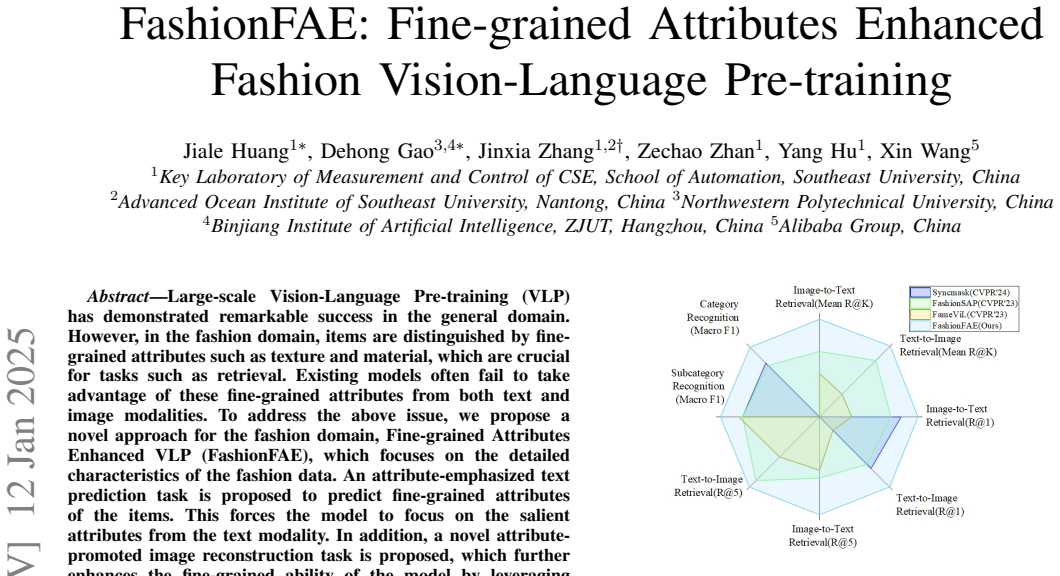
The central claim is that fine-grained fashion attributes can be turned into explicit pre-training supervision in both modalities, and that doing so produces a model that outperforms prior fashion vision-language models. On the text side, the AETP task converts six attributes (title, category, subcategory, gender, composition, season) into statements of the form 'The image [attribute] is [value]', appends them to the description, randomly masks a subset of attribute values, and trains the fusion encoder to predict the masked values from the remaining text and the image. On the image side, the APIR task masks 25% of image patches, replaces them with a fusion token computed from the text and image summary embeddings, and trains the model to predict the discrete tokenized labels of the masked patches. The paper reports that adding AETP alone lifts mean retrieval on the sub-test set from 81.17 to 89.14, and adding APIR further lifts it to 89.75, with corresponding gains on the full test set and on recognition tasks.
Load-bearing premise
The comparison assumes that the baseline models were tested with the same attribute-appended text input that FashionFAE receives; if the baselines were evaluated with only the original description, part of the reported improvement may come from the extra test-time information rather than from the proposed pre-training tasks.
Editorial extensions
If this is right
- If the reported gains hold, fashion retrieval systems can expect substantially better ranking by pre-training on structured attribute statements rather than free-form descriptions alone.
- The AETP task gives a recipe for exploiting tabular or metadata-rich fashion annotations, turning six common attributes into natural-language supervision.
- The APIR task demonstrates a way to inject textual information into masked image reconstruction, a recipe that may extend to other domains where images are patch-wise similar but attribute-wise distinct.
- The reported 1.6% average gain in category and subcategory recognition suggests the same pre-training improves classification, not just retrieval.
- Because all tasks share parameters, the approach adds no new inference-time module; the gains come from pre-training only.
Reading between the lines
- One implicit consequence the paper does not test is that the attribute statements at inference time are themselves the cheapest part of the recipe; a test that strips the statements from FashionFAE's own inputs would quantify how much of the gain is pre-training versus input formatting.
- The same attribute-statement trick could transfer to other e-commerce domains with structured metadata, such as electronics or furniture, where attributes like material and connectivity play the role that texture and composition play in fashion.
- A testable extension is to vary the number of masked title sub-attributes in AETP; the paper fixes it at two, and the optimal number may trade off task difficulty against learning signal.
- The fusion token in APIR could alternatively be built from an attention-weighted pooling of text tokens instead of a single summary token, potentially recovering finer textual guidance for reconstruction.
Signed reviews
Editorial analysis
A structured set of objections, weighed in public.
Referee Report
Summary. The paper proposes FashionFAE, a fashion-domain vision-language pre-training approach. The text input is formed by appending structured attribute statements (e.g., "The image category is shirts") to the item description, and two new pre-training objectives are introduced: Attribute-Emphasized Text Prediction (AETP), which masks and predicts attribute values, and Attribute-Promoted Image Reconstruction (APIR), which reconstructs masked image patches with the help of a fusion token derived from text and image embeddings. The model is pre-trained on FashionGen and evaluated on image-to-text retrieval, text-to-image retrieval, and category/subcategory recognition, reporting state-of-the-art results over prior fashion VLP methods.
Significance. If the reported gains are real and caused by the proposed pre-training tasks, the paper would make a useful contribution to fashion-specific vision-language pre-training, particularly in combining attribute-aware text prediction with attribute-guided image reconstruction. The experimental scope is broad, with comparisons to many recent fashion VLP methods and ablations of individual pre-training tasks. However, the paper does not provide code, checkpoints, or detailed reproducibility artifacts, and the central attribution of the gains to AETP is currently confounded with a change in test-time input. The comparison to baselines also leaves unspecified whether the baselines received the same attribute-augmented text. These issues prevent full confidence in the headline improvements until controlled experiments are provided.
major comments (3)
- [Section III-C (Tables I-II)] The test-time text input used for the baseline methods is not specified. Section II-A defines FashionFAE's input as the description with appended attribute statements such as "The image category is shirts", but Tables I and II do not state whether FashionBERT, KaleidoBERT, FashionViL, FashionSAP, and the other baselines received the same attribute-augmented text. If they did not, the reported 2.9% and 5.2% average retrieval improvements could come from extra information provided at inference rather than from the proposed pre-training tasks. Please report the exact test-time inputs for every method and, if they differ, rerun the baselines with the same augmented input.
- [Section III-D (Tables IV-V)] The ablation in Tables IV and V does not isolate the AETP pre-training objective from the change in test-time input. The first row of Table V ("without additional attributes") exactly reproduces the ITC+ITM+MLM row of Table IV (sub-test I2T 83.23 / T2I 79.11; full test 63.70 / 70.45), and the large improvement to 91.33/88.17 appears only after attribute statements are appended to the input. No control is run in which the attribute statements are present in the input but the AETP loss is disabled, so the gain attributed to AETP may be due to the model simply reading values such as "category is shirts" at inference. Please add this control, and/or evaluate the AETP-pretrained model without attribute statements at test time.
- [Section III-B and Tables I-III] No statistical reliability information is provided. All results are single-run numbers without error bars or multiple seeds, and the headline improvements are modest (2.9% average on the sub-test retrieval set). Without variance estimates, the claim that FashionFAE "significantly outperforms" prior methods cannot be assessed. Please report means and standard deviations over at least three independent pre-training runs, or otherwise justify that the differences exceed run-to-run variation.
minor comments (4)
- [Section III-B vs. Eq. (8)] Section III-B states that "the MLM task and the AETP task are optimized simultaneously," while Eq. (8) says one task is randomly sampled per iteration with probability P_task. Please clarify the actual optimization schedule.
- [Fig. 3 caption] The caption says that black shirts, black sweaters, and black pants "are indistinguishable by showing similarities in the visual space," which is missing a word; the intended meaning is probably "are indistinguishable despite showing similarities in the visual space." Please revise.
- [Section II-A] The example attribute statement "The image category is shirts" reads unnaturally; consider "The category of the image is shirts" or similar.
- [General] No code, model checkpoints, or data splits are released, which limits reproducibility of the reported numbers; please add a statement on code availability.
Circularity Check
No circularity; the ablation confound is a correctness risk, not a circular reduction.
full rationale
The paper's central claim is that the AETP and APIR pre-training tasks improve fashion vision-language retrieval and recognition. These are self-supervised objectives (masked attribute prediction and masked image patch reconstruction) whose losses, given in Eqs. (1), (3), and (8), do not incorporate the downstream retrieval or recognition labels. The reported results are external benchmark numbers on a held-out test split of FashionGen, and no fitted parameter is later renamed as a prediction. The main weakness is an experimental confound: adding the AETP task also changes the textual input by appending attribute statements such as "The image category is shirts," and Tables IV and V do not include a control that appends these statements without the AETP loss. This means the observed gains could partly come from richer test-time input rather than from the pre-training objective itself. That is a validity concern about causal attribution, but it is not circular reasoning: the reported numbers do not reduce by construction to the inputs, and no load-bearing premise is supported only by self-citation. Therefore the derivation chain is not circular, and the appropriate circularity score is 0.
Assumptions & free parameters
free parameters (3)
- N (number of masked title sub-attributes in AETP) =
2
- APIR image patch masking ratio =
25%
- Pre-training task sampling probabilities P_task =
not specified
assumptions (4)
- domain assumption Structured attributes (title, category, subcategory, gender, composition, season) are available in FashionGen and are the right granularity for fashion understanding.
- domain assumption A VQ-VAE pretrained on the fashion dataset provides a valid discrete label space for image patches.
- standard math Transformer-based VLP architectures (ViT image encoder, BERT text encoder, MMF framework) are taken as given.
- ad hoc to paper The fusion token F = LN(MLP(v_cls + w_cls) + v_cls + w_cls) usefully injects text information into image reconstruction.
Cite this review
Pith. "Pith review of FashionFAE: Fine-grained Attributes Enhanced Fashion Vision-Language Pre-training." pith.science (2026). https://pith.science/paper/POECXX4F
@misc{pith2026241219997,
  author       = {Pith},
  title        = {Pith review of: FashionFAE: Fine-grained Attributes Enhanced Fashion Vision-Language Pre-training},
  year         = {2026},
  howpublished = {\url{https://pith.science/paper/POECXX4F}},
  note         = {Machine review of arXiv:2412.19997}
}
read the original abstract
Large-scale Vision-Language Pre-training (VLP) has demonstrated remarkable success in the general domain. However, in the fashion domain, items are distinguished by fine-grained attributes like texture and material, which are crucial for tasks such as retrieval. Existing models often fail to leverage these fine-grained attributes from both text and image modalities. To address the above issues, we propose a novel approach for the fashion domain, Fine-grained Attributes Enhanced VLP (FashionFAE), which focuses on the detailed characteristics of fashion data. An attribute-emphasized text prediction task is proposed to predict fine-grained attributes of the items. This forces the model to focus on the salient attributes from the text modality. Additionally, a novel attribute-promoted image reconstruction task is proposed, which further enhances the fine-grained ability of the model by leveraging the representative attributes from the image modality. Extensive experiments show that FashionFAE significantly outperforms State-Of-The-Art (SOTA) methods, achieving 2.9% and 5.2% improvements in retrieval on sub-test and full test sets, respectively, and a 1.6% average improvement in recognition tasks.
Figures


Reference graph
Works this paper leans on
-
[1]
Visualbert: A simple and performant baseline for vision and language,
L. H. Li, M. Yatskar, D. Yin, C.-J. Hsieh, and K.-W. Chang, “Visualbert: A simple and performant baseline for vision and language,” arXiv preprint arXiv:1908.03557, 2019
arXiv 1908
-
[2]
Vl-bert: Pre-training of generic visual-linguistic representations,
W. Su, X. Zhu, Y . Cao, B. Li, L. Lu, F. Wei, and J. Dai, “Vl-bert: Pre-training of generic visual-linguistic representations,” International Conference on Learning Representations , 2020
work page 2020
-
[3]
Oscar: Object-semantics aligned pre-training for vision-language tasks,
X. Li, X. Yin, C. Li, P. Zhang, X. Hu, L. Zhang, L. Wang, H. Hu, L. Dong, F. Wei et al. , “Oscar: Object-semantics aligned pre-training for vision-language tasks,” in European Conference on Computer Vision. Springer, 2020, pp. 121–137
work page 2020
-
[4]
Vilt: Vision-and-language transformer without convolution or region supervision,
W. Kim, B. Son, and I. Kim, “Vilt: Vision-and-language transformer without convolution or region supervision,” in International Conference on Machine Learning . PMLR, 2021, pp. 5583–5594
work page 2021
-
[5]
Vilbert: Pretraining task-agnostic visiolinguistic representations for vision-and-language tasks,
J. Lu, D. Batra, D. Parikh, and S. Lee, “Vilbert: Pretraining task-agnostic visiolinguistic representations for vision-and-language tasks,” Advances in Neural Information Processing Systems , vol. 32, 2019
work page 2019
-
[6]
Align before fuse: Vision and language representation learning with momentum distillation,
J. Li, R. Selvaraju, A. Gotmare, S. Joty, C. Xiong, and S. C. H. Hoi, “Align before fuse: Vision and language representation learning with momentum distillation,” Advances in neural Information Processing Systems, vol. 34, pp. 9694–9705, 2021
work page 2021
-
[7]
Self-distilled dynamic fusion network for language-based fashion retrieval,
Y . Wu, H. Li, F. Wang, Y . Zhang, and R. Liang, “Self-distilled dynamic fusion network for language-based fashion retrieval,” in ICASSP 2024- 2024 IEEE International Conference on Acoustics, Speech and Signal Processing (ICASSP). IEEE, 2024, pp. 3260–3264
work page 2024
-
[8]
Fashionvil: Fashion-focused vision-and-language representation learning,
X. Han, L. Yu, X. Zhu, L. Zhang, Y .-Z. Song, and T. Xiang, “Fashionvil: Fashion-focused vision-and-language representation learning,” in Euro- pean Conference on Computer Vision . Springer, 2022, pp. 634–651
work page 2022
Show all 23 references
-
[9]
Fash- ionsap: Symbols and attributes prompt for fine-grained fashion vision- language pre-training,
Y . Han, L. Zhang, Q. Chen, Z. Chen, Z. Li, J. Yang, and Z. Cao, “Fash- ionsap: Symbols and attributes prompt for fine-grained fashion vision- language pre-training,” in Proceedings of the IEEE/CVF Conference on Computer Vision and Pattern Recognition , 2023, pp. 15 028–15 038
2023
-
[10]
An image is worth 16x16 words: Transformers for image recognition at scale,
A. Dosovitskiy, L. Beyer, A. Kolesnikov, D. Weissenborn, X. Zhai, T. Unterthiner, M. Dehghani, M. Minderer, G. Heigold, S. Gelly et al., “An image is worth 16x16 words: Transformers for image recognition at scale,” International Conference on Learning Representations , 2021
2021
-
[11]
Bert: Pre-training of deep bidirectional transformers for language understanding,
J. Devlin, M.-W. Chang, K. Lee, and K. Toutanova, “Bert: Pre-training of deep bidirectional transformers for language understanding,”Proceed- ings of the Conference of North American Chapter of Association for Computational Linguistics, 2019
2019
-
[12]
Fashion-gen: The generative fashion dataset and challenge,
N. Rostamzadeh, S. Hosseini, T. Boquet, W. Stokowiec, Y . Zhang, C. Jauvin, and C. Pal, “Fashion-gen: The generative fashion dataset and challenge,” arXiv preprint arXiv:1806.08317 , 2018
2018 arXiv
-
[13]
Mmf: A multimodal framework for vision and language research,
A. Singh, V . Goswami, V . Natarajan, Y . Jiang, X. Chen, M. Shah, M. Rohrbach, D. Batra, and D. Parikh, “Mmf: A multimodal framework for vision and language research,” MMF: A multimodal framework for vision and language research , 2020
2020
-
[14]
Pytorch: An imperative style, high-performance deep learning library,
A. Paszke, S. Gross, F. Massa, A. Lerer, J. Bradbury, G. Chanan, T. Killeen, Z. Lin, N. Gimelshein, L. Antiga et al. , “Pytorch: An imperative style, high-performance deep learning library,” Advances in Neural Information Processing Systems , vol. 32, 2019
2019
-
[15]
Fashionbert: Text and image matching with adaptive loss for cross- modal retrieval,
D. Gao, L. Jin, B. Chen, M. Qiu, P. Li, Y . Wei, Y . Hu, and H. Wang, “Fashionbert: Text and image matching with adaptive loss for cross- modal retrieval,” in Proceedings of the International ACM SIGIR Con- ference on Research and Development in Information Retrieval , 2020, p...
2020
-
[16]
Kaleido-bert: Vision-language pre-training on fashion domain,
M. Zhuge, D. Gao, D.-P. Fan, L. Jin, B. Chen, H. Zhou, M. Qiu, and L. Shao, “Kaleido-bert: Vision-language pre-training on fashion domain,” in Proceedings of the IEEE/CVF Conference on Computer Vision and Pattern Recognition , 2021, pp. 12 647–12 657
2021
-
[17]
Commercemm: Large-scale commerce multimodal represen- tation learning with omni retrieval,
L. Yu, J. Chen, A. Sinha, M. Wang, Y . Chen, T. L. Berg, and N. Zhang, “Commercemm: Large-scale commerce multimodal represen- tation learning with omni retrieval,” inProceedings of the ACM SIGKDD Conference on Knowledge Discovery and Data Mining, 2022, pp. 4433– 4442
2022
-
[18]
Ei-clip: Entity-aware interventional contrastive learning for e-commerce cross-modal retrieval,
H. Ma, H. Zhao, Z. Lin, A. Kale, Z. Wang, T. Yu, J. Gu, S. Choudhary, and X. Xie, “Ei-clip: Entity-aware interventional contrastive learning for e-commerce cross-modal retrieval,” in Proceedings of the IEEE/CVF Conference on Computer Vision and Pattern Recognition , 2022, pp. ...
2022
-
[19]
Masked vision-language transformer in fashion,
G.-P. Ji, M. Zhuge, D. Gao, D.-P. Fan, C. Sakaridis, and L. V . Gool, “Masked vision-language transformer in fashion,” Machine Intelligence Research, vol. 20, no. 3, pp. 421–434, 2023
2023
-
[20]
Fashionklip: Enhancing e-commerce image-text retrieval with fashion multi-modal conceptual knowledge graph,
X. Wang, C. Wang, L. Li, Z. Li, B. Chen, L. Jin, J. Huang, Y . Xiao, and M. Gao, “Fashionklip: Enhancing e-commerce image-text retrieval with fashion multi-modal conceptual knowledge graph,” in Proceedings of the Conference on Association for Computational Linguistics , 2023, ...
2023
-
[21]
Fad-vlp: Fashion vision-and-language pre-training towards unified retrieval and captioning,
S. Mirchandani, L. Yu, M. Wang, A. Sinha, W. Jiang, T. Xiang, and N. Zhang, “Fad-vlp: Fashion vision-and-language pre-training towards unified retrieval and captioning,” Proceedings of the Conference on Empirical Methods in Natural Language Processing , 2022
2022
-
[22]
Fame-vil: Multi-tasking vision-language model for heterogeneous fashion tasks,
X. Han, X. Zhu, L. Yu, L. Zhang, Y .-Z. Song, and T. Xiang, “Fame-vil: Multi-tasking vision-language model for heterogeneous fashion tasks,” in Proceedings of the IEEE/CVF Conference on Computer Vision and Pattern Recognition, 2023, pp. 2669–2680
2023
-
[23]
Syncmask: Synchronized attentional masking for fashion-centric vision-language pretraining,
C. H. Song, T. Hwang, J. Yoon, S. Choi, and Y . H. Gu, “Syncmask: Synchronized attentional masking for fashion-centric vision-language pretraining,” Proceedings of the IEEE/CVF Conference on Computer Vision and Pattern Recognition , 2024
2024
Reviewed August 10, 2026 · model on record in the stance chip above.
Discussion (0). Continue with ORCID to comment.