REVIEW 4 major objections 3 minor 70 references
Kinetic coupled tachyon: A dynamical system analysis
T0 review · 4 major / 3 minor · reviewed 2026-08-10 · deepseek-v4-flash
Pith's one-line read Kinetic coupling adds a scaling attractor to tachyon dark energy.
desk verdict New scaling attractor D in kinetically coupled tachyon is a real find, but the numerical runs use lambda-values where D does not exist, and the coincidence claim ignores the competing stable point B. read the letter →
The pith
A machine-rendered reading of the paper's core claim, the machinery that carries it, and where it could break.
The reading
What carries the argument
The load-bearing object is the two-dimensional autonomous system (39)--(40) obtained from the dimensionless variables $x$, $y$, $z$, with $z$ eliminated by the Friedmann constraint $y^2\sqrt{1-x^2}+z^2=1$. The machinery carries the argument by turning cosmology into a phase-space flow: fixed points of $(x',y')=(0,0)$ represent asymptotic cosmological solutions, and the signs of the eigenvalues of the linearization matrix decide stability. The new point $D$ is created by the coupling $f(X)=(1-2X)^{\alpha/2}$, which changes the numerator and denominator of the $x'$ equation and introduces the closed forms $y_{s,\pm}$ from Eq. (45). The stability of $D$, together with its coexistence with the uncoupled attractor $B$, is what makes the scaling solution an attractor of the full system.
What would settle it
Rebuild the autonomous system using the Schutz-Sorkin matter action (as in [42]) while keeping $f(X)=(1-2X)^{\alpha/2}$; if the point $(1/\sqrt{1+\alpha},\,y_{s,-})$ is no longer a fixed point, or is not stable for $\lambda$ in $0<\lambda<2[\alpha(1+\alpha)]^{1/4}$, the paper's central claim is refuted.
Extended reading notes
Core claim
The paper's claim is that a tachyon field with inverse-square potential $V(\phi)=V_0^2/\phi^2$, coupled to cold dark matter by $f(X)=(1-2X)^{\alpha/2}$ at the level of the action, possesses a stable scaling fixed point not present in the uncoupled theory. In the dimensionless variables $x=\dot{\phi}/M^2$ and $y=\sqrt{V}/(\sqrt{3}H M_{\mathrm{Pl}})$, the point is $(x,y)=(1/\sqrt{1+\alpha},\,y_{s,-})$, with $y_{s,-}$ given by Eq. (45); it exists for $\lambda\geq \sqrt{3}/[\alpha(1+\alpha)]^{1/4}$ and accelerates for $0<\lambda<2[\alpha(1+\alpha)]^{1/4}$. Near this attractor the field energy fraction $\Omega_\phi=\sqrt{(1+\alpha)/\alpha}\,y_{s,-}^2$ is constant in time, so dark energy tracks matter during the scaling era; later the field takes over and drives accelerated expansion. The authors further show that at $\alpha=0.55$, $\lambda=1.8$ the new point merges with the standard tachyon attractor $B$ and becomes the global attractor, and that for $\alpha>0$ energy flows from matter to the tachyon.
Load-bearing premise
The whole construction rests on writing pressureless dark matter as the perfect-fluid Lagrangian $L_m=-\rho_m$ and multiplying it by $f(X)=(1-2X)^{\alpha/2}$; with a different matter action or coupling function, the autonomous system closes differently and critical point $D$ need not exist.
Editorial extensions
If this is right
- If the model is correct, a kinetically coupled tachyon can produce an early matter-scaling era with constant $\Omega_\phi$, followed by late accelerated expansion, without fine-tuned initial conditions.
- The coincidence problem is alleviated because the observed $\Omega_\phi\approx 0.7$ can be obtained for a wide range of initial conditions, not only near the present epoch.
- The uncoupled constraint that the potential mass scale exceed roughly $1.1\,M_{\mathrm{Pl}}$ is evaded; $\lambda$ may take any value in $0<\lambda<2[\alpha(1+\alpha)]^{1/4}$ provided $\alpha$ is large enough.
- For $\alpha=0$ the system reduces to the standard tachyon behavior with point $B$ as the only attractor, so the new phenomenology is a genuine interaction effect.
- Because matter sources the tachyon near $D$ for $\alpha>0$, dark matter is slowly converted into dark energy during the scaling regime, affecting the expansion history before dark-energy domination.
Reading between the lines
- A natural next test is to compute linear density perturbations around the scaling solution; if the growth index or effective sound speed is observationally excluded, the background attractor alone will not save the model. The paper states that this perturbation analysis is underway.
- The existence of point $D$ likely depends on the perfect-fluid Lagrangian $L_m=-\rho_m$; repeating the reduction with the Schutz-Sorkin matter action may alter $Q$ and could destroy or move the point, so robustness across matter actions is the first extension to check.
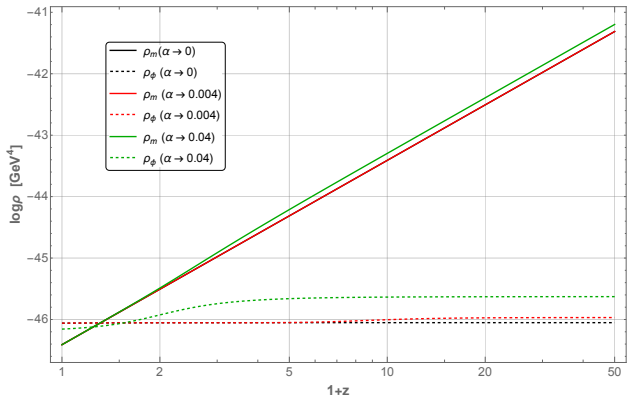
- The early-dark-energy signature visible in $\Omega_\phi$ for $\alpha=0.04$ suggests the model could shift CMB peak positions; a parameter-space scan of $(\alpha,\lambda)$ against cosmic-microwave-background and Hubble data would quantify the allowed coupling strength.
- The same kinetic-coupling construction could be applied to other potentials, such as $V(\phi)\propto \cosh^{-2}(\beta\phi)$ or exponential forms; the inverse-square choice is what makes $\lambda$ constant and the autonomous system close.
Editorial analysis
A structured set of objections, weighed in public.
Referee Report
Summary. This paper constructs a coupled dark-energy model in which a tachyon scalar field with inverse-square potential V(ϕ)∝ϕ^{-2} is kinetically coupled to pressureless dark matter through f(X)=(1-2X)^{α/2}. The authors derive the background equations, introduce dimensionless variables (x,y,z), reduce the system to a two-dimensional autonomous system, and identify four fixed points. The new point D, which exists only for α≠0 and λ≥√3/[α(1+α)]^{1/4}, is reported to be stable and to provide a scaling solution with constant Ω_ϕ and accelerated expansion for 0<λ<2[α(1+α)]^{1/4}. The paper claims that this scaling solution alleviates the coincidence problem.
Significance. If the fixed-point and stability analysis is correct, the model is a useful contribution to the interacting-dark-energy literature: the new point is derived from the action rather than imposed by hand, it is absent in the uncoupled α=0 limit, and it offers a genuine scaling branch with a possible accelerated region. The paper also states its modeling assumptions clearly and connects to existing matter Lagrangians (e.g., the Schutz-Sorkin action in Ref. [42]). However, the headline coincidence claim is not established in the present manuscript: the phase space has at least two stable attractors whenever D exists, the numerical examples do not enter the D regime, and the definition of Ω_ϕ contains an inconsistency that propagates into the reduced system. These issues are technical and fixable, but they require substantial re-analysis rather than minor editing.
major comments (4)
- [Eqs. (30), (32), (43), Table 2] The definition of the tachyonic density parameter is internally inconsistent. Equation (30) states Ω_ϕ=y²√(1−x²), but Eq. (20) together with y=√V/(√3 H M_Pl) gives Ω_ϕ=y²/√(1−x²). The phase-space bound in Eq. (43), x²+y⁴≤1, and the Ω_ϕ column of Table 2 (e.g., √((1+α)/α)y² at point D) are consistent only with the latter expression. Because Eq. (32) is used to eliminate z and reduce Eqs. (34)–(36) to (39)–(40), this discrepancy propagates into the central dynamical-system calculation. Please correct the relation and re-derive the autonomous system, and state which density-parameter formula is used in the figures and tables.
- [Table 1, Table 2, Point D, Fig. 1] The stability analysis does not support the claim that the scaling solution is reached 'irrespective of how we set the initial conditions.' Table 1 reports both B and D as stable; whenever D exists and accelerates (Eqs. (50) and (51)), B is also present and stable, and for λ⁴<12 it is also an accelerated solution. Thus the phase space generically contains two stable late-time attractors, and the Fig. 1 caption itself states that orbits connect A to either B or D. The Point D paragraph asserts that Ω_ϕ≈0.7 is obtained irrespective of initial conditions, while the same paragraph ends with 'the final state of the Universe will be attained when Ω_ϕ=1'; these statements are mutually incompatible unless a basin-of-attraction separation is demonstrated. Please compute the basin boundaries, the separatrices, and the relative measure of initial conditions that end at D versus B.
- [Fig. 4, Eq. (50), Figs. 2-3] The numerical examples do not exercise the new point. Fig. 4 is described with λ=0.1, and Figs. 2–3 use λ=0.3; for the coupling values shown there (α up to 0.04), the existence condition Eq. (50) requires λ≳3.8, so D is not present in those runs. The statement that Fig. 4 shows the 'appearance of a new critical point (D)' as α is increased is therefore not supported by the stated parameter choices. Please re-run the illustrations with parameter pairs satisfying Eqs. (50) and (51), state the α values used in every panel, and show the corresponding evolution of Ω_ϕ, w_ϕ, and w_eff, together with the basin portrait.
- [Table 1, Eq. (26), Appendix A] The paper's main technical results are not fully verifiable from the text. The eigenvalues in Table 1 are quoted without the Jacobian matrix or the intermediate eigendecomposition, and Eq. (26) is introduced with 'we arrive at' after a long computation. Given that Table 2 and the stability classification are the central results, please provide the full derivation in an appendix or supplementary material, including the substitution that leads from Eq. (33) to Eqs. (39)–(40). In addition, point A has μ₁=0, so the statement that all fixed points are hyperbolic is not correct; the critical line A should be classified as a non-hyperbolic set and its stability treated accordingly.
minor comments (3)
- [Table 2, Point C] Point C is said to be stable for every λ and α, but it exists only for λ≤−√3/[α(1+α)]^{1/4}; since the paper assumes λ>0, this point is not part of the physical model, and the sentence should be qualified to avoid confusion.
- [Point B paragraph] The term 'global attractor' is used imprecisely once α≠0: B is the global attractor in the uncoupled case, but when D exists both B and D are stable, so neither is global. Please reserve 'global' for the α=0 case or for the merging point at equality in Eq. (50).
- [Conclusions, Point D] The wording 'an early scaling regime, followed by a period with accelerated expansion, with a late time attractor' conflates the trajectory with the fixed point itself: at the fixed point D, the solution does not leave the scaling regime. Please rephrase to describe the approach to D and the resulting asymptotic behavior.
Circularity Check
No significant circularity: the scaling attractor D is a derived fixed point of the stated autonomous system, not a fitted or self-citation-backed input.
full rationale
The derivation of the central result—the existence and stability of the novel critical point D and its parameter ranges for acceleration—is self-contained. Starting from the action Eq. (16) with tachyon Lagrangian P=-V√(1-2X), inverse-square potential V=V0^2/φ^2, matter Lagrangian Lm=-ρm, and kinetic coupling f=(1-2X)^{α/2}, the authors derive the autonomous system Eqs. (34)–(36), solve the fixed-point equations to obtain Table 2, and perform a linear stability analysis in Table 1. The parameters α and λ are free; the allowed ranges for existence and acceleration are derived inequalities, not fits to data. The remark that Ωφ≈0.7 'can be obtained irrespective of how we set the initial conditions' refers to the constant value of Ωφ at the stable point D, which is a function of α and λ; the numerical initial conditions are illustrative and do not enter the derivation. No load-bearing self-citation is present: references to prior work establish the model setup or the uncoupled limit, not the new point D. A separate concern, not a circularity, is that the illustrative parameters (e.g., λ=0.3, α=0.04) do not satisfy D's existence condition λ≥√3/[α(1+α)]^{1/4} of Table 2, and point B remains stable, so the 'irrespective of initial conditions' claim would require a basin-of-attraction analysis; this is an internal-consistency issue, not a reduction of the result to its inputs.
Assumptions & free parameters
free parameters (3)
- alpha (kinetic coupling strength) =
free, positive; example values 0, 0.004, 0.04, 0.55, 1.8 used in figures
- lambda (potential stiffness) =
free; example values 0.3, 0.1, 1.8 used in figures
- Initial condition for y in numerical runs =
found by root-finding
assumptions (6)
- domain assumption FLRW background with flat spatial sections is imposed.
- domain assumption Dark matter is a pressureless perfect fluid with Lagrangian L_m = -rho_m.
- ad hoc to paper The tachyon potential is V(phi) = V0^2/phi^2 with constant lambda.
- ad hoc to paper The kinetic coupling function f(X) = (1-2X)^{alpha/2}.
- domain assumption Couplings to baryons and radiation are ignored; only dark matter interacts with the tachyon.
- ad hoc to paper alpha >= 0 is assumed; negative alpha makes the phase space divergent.
Cite this review
Pith. "Pith review of Kinetic coupled tachyon: A dynamical system analysis." pith.science (2026). https://pith.science/paper/GL7TVTSN
@misc{pith2026241220118,
  author       = {Pith},
  title        = {Pith review of: Kinetic coupled tachyon: A dynamical system analysis},
  year         = {2026},
  howpublished = {\url{https://pith.science/paper/GL7TVTSN}},
  note         = {Machine review of arXiv:2412.20118}
}
read the original abstract
We present and examine a kinetically coupled tachyon dark energy model, where a tachyon scalar field interacts with the matter sector. More specifically, we deduce this cosmological setting from a generalised interacting dark energy model that allows for the kinetic term of the scalar field to couple to the matter species a priori in the action. A thorough dynamical system analysis and its cosmological implications unveil the appearance of a scaling solution which is also an attractor of the system, thanks to a novel critical point, with a period of accelerated expansion thereafter. This new solution, not present in the uncoupled case, has the enticing consequence of alleviating the coincidence problem.
Figures


Figures from the paper (1 more)

Reference graph
Works this paper leans on
-
[42]
R. Kase, S. Tsujikawa, Scalar-field dark energy nonminimally and kinet- ically coupled to dark matter, Phys. Rev. D 101 (2020) 063511. doi: 10. 1103/PhysRevD.101.063511. arXiv:1910.02699
arXiv 2020
-
[1]
N. Aghanim, et al. (Planck), Planck 2018 results. VI. Cosmological param- eters, Astron. Astrophys. 641 (2020) A6. doi: 10.1051/0004-6361/ 201833910. arXiv:1807.06209, [Erratum: Astron.Astrophys. 652, C4 (2021)]
arXiv 2020
-
[2]
S. M. Carroll, The Cosmological constant, Living Rev. Rel. 4 (2001) 1. doi:10.12942/lrr-2001-1. arXiv:astro-ph/0004075
arXiv 2001
-
[3]
Padmanabhan, Cosmological constant: The Weight of the vacuum, Phys
T. Padmanabhan, Cosmological constant: The Weight of the vacuum, Phys. Rept. 380 (2003) 235–320. doi:10.1016/S0370-1573(03)00120-0. arXiv:hep-th/0212290
arXiv 2003
-
[4]
V . L. Fitch, D. R. Marlow, M. A. E. Dementi (Eds.), Critical problems in physics. Proceedings, Conference celebrating the 250th Anniversary of Princeton University, Princeton, USA, October 31-November 2, 1996, 1997
work page 1996
-
[5]
Weinberg, The Cosmological Constant Problem, Rev
S. Weinberg, The Cosmological Constant Problem, Rev. Mod. Phys. 61 (1989) 1–23. doi:10.1103/RevModPhys.61.1
-
[6]
Padilla, Lectures on the Cosmological Constant Problem (2015)
A. Padilla, Lectures on the Cosmological Constant Problem (2015). arXiv:1502.05296
arXiv 2015
-
[7]
J. S. Bagla, H. K. Jassal, T. Padmanabhan, Cosmology with tachyon field as dark energy, Phys. Rev. D 67 (2003) 063504. doi: 10.1103/PhysRevD. 67.063504. arXiv:astro-ph/0212198
arXiv 2003
Show all 70 references
-
[8]
Padmanabhan, Accelerated expansion of the universe driven by tachyonic matter, Phys
T. Padmanabhan, Accelerated expansion of the universe driven by tachyonic matter, Phys. Rev. D 66 (2002) 021301. doi: 10.1103/PhysRevD.66. 021301. arXiv:hep-th/0204150
2002 arXiv
-
[9]
G. W. Gibbons, Cosmological evolution of the rolling tachyon, Phys. Lett. B 537 (2002) 1–4. doi: 10.1016/S0370-2693(02)01881-6. arXiv:hep-th/0204008
2002 arXiv
-
[10]
A. V . Frolov, L. Kofman, A. A. Starobinsky, Prospects and problems of tachyon matter cosmology, Phys. Lett. B 545 (2002) 8–16. doi: 10.1016/ S0370-2693(02)02582-0. arXiv:hep-th/0204187. 25
2002 arXiv
-
[11]
E. J. Copeland, M. R. Garousi, M. Sami, S. Tsujikawa, What is needed of a tachyon if it is to be the dark energy?, Phys. Rev. D 71 (2005) 043003. doi:10.1103/PhysRevD.71.043003. arXiv:hep-th/0411192
2005 arXiv
-
[12]
Calcagni, A
G. Calcagni, A. R. Liddle, Tachyon dark energy models: dynamics and constraints, Phys. Rev. D 74 (2006) 043528. doi: 10.1103/PhysRevD. 74.043528. arXiv:astro-ph/0606003
2006 arXiv
-
[13]
Shao, Y .-X
Y . Shao, Y .-X. Gui, W. Wang, Parametrization of tachyon field, Mod. Phys. Lett. A 22 (2007) 1175–1182. doi: 10.1142/S0217732307021809. arXiv:gr-qc/0703112
2007 arXiv
-
[14]
Fang, H.-Q
W. Fang, H.-Q. Lu, Dynamics of tachyon and phantom field beyond the in- verse square potentials, Eur. Phys. J. C 68 (2010) 567–572. doi:10.1140/ epjc/s10052-010-1352-0. arXiv:1007.2330
2010 arXiv
-
[15]
J. M. Aguirregabiria, R. Lazkoz, Tracking solutions in tachyon cosmology, Phys. Rev. D 69 (2004) 123502. doi:10.1103/PhysRevD.69.123502. arXiv:hep-th/0402190
2004 arXiv
-
[16]
Guo, Y .-S
Z.-K. Guo, Y .-S. Piao, R.-G. Cai, Y .-Z. Zhang, Inflationary attractor from tachyonic matter, Phys. Rev. D 68 (2003) 043508. doi: 10.1103/ PhysRevD.68.043508. arXiv:hep-ph/0304236
2003 arXiv
-
[17]
Quiros, T
I. Quiros, T. Gonzalez, D. Gonzalez, Y . Napoles, Study Of Tachyon Dynam- ics For Broad Classes of Potentials, Class. Quant. Grav. 27 (2010) 215021. doi:10.1088/0264-9381/27/21/215021. arXiv:0906.2617
2010 arXiv
-
[18]
Herrera, D
R. Herrera, D. Pavon, W. Zimdahl, Exact solutions for the in- teracting tachyonic - dark matter system, Gen. Rel. Grav. 36 (2004) 2161–2169. doi: 10.1023/B:GERG.0000038630.55301.ca. arXiv:astro-ph/0404086
2004
-
[19]
Gumjudpai, T
B. Gumjudpai, T. Naskar, M. Sami, S. Tsujikawa, Coupled dark energy: To- wards a general description of the dynamics, JCAP 06 (2005) 007. doi: 10. 1088/1475-7516/2005/06/007. arXiv:hep-th/0502191
2005 arXiv
-
[21]
Farajollahi, A
H. Farajollahi, A. Salehi, F. Tayebi, A. Ravanpak, Stability Analysis in Tachyonic Potential Chameleon cosmology, JCAP 05 (2011) 017. doi: 10. 1088/1475-7516/2011/05/017. arXiv:1105.4045
2011 arXiv
-
[22]
R. C. G. Landim, Coupled tachyonic dark energy: a dynamical analysis, Int. J. Mod. Phys. D 24 (2015) 1550085. doi: 10.1142/ S0218271815500856. arXiv:1505.03243
2015 arXiv
-
[23]
Ahmad, N
S. Ahmad, N. Myrzakulov, R. Myrzakulov, Tachyon field non-minimally coupled to massive neutrino matter, JCAP 07 (2016) 032. doi: 10.1088/ 1475-7516/2016/07/032. arXiv:1510.04795
2016 arXiv
-
[25]
E. M. Teixeira, A. Nunes, N. J. Nunes, Conformally Coupled Tachy- onic Dark Energy, Phys. Rev. D 100 (2019) 043539. doi: 10.1103/ PhysRevD.100.043539. arXiv:1903.06028
2019 arXiv
-
[26]
B. J. Barros, Kinetically coupled dark energy, Phys. Rev. D 99 (2019) 064051. doi: 10.1103/PhysRevD.99.064051. arXiv:1901.03972
2019 arXiv
-
[27]
Baldi, Multiple dark matter as a self-regulating mechanism for dark sector interactions, Annalen Phys
M. Baldi, Multiple dark matter as a self-regulating mechanism for dark sector interactions, Annalen Phys. 524 (2012) 602–617. doi: 10.1002/ andp.201200073. arXiv:1204.0514
2012 arXiv
-
[28]
Amendola, D
L. Amendola, D. Tocchini-Valentini, Stationary dark energy: The present universe as a global attractor, Phys. Rev. D 64 (2001) 043509. doi: 10. 1103/PhysRevD.64.043509. arXiv:astro-ph/0011243
2001 arXiv
-
[29]
Olivares, F
G. Olivares, F. Atrio-Barandela, D. Pavon, Matter density perturbations in interacting quintessence models, Phys. Rev. D 74 (2006) 043521. doi: 10. 1103/PhysRevD.74.043521. arXiv:astro-ph/0607604
2006 arXiv
-
[30]
S. Chen, B. Wang, J. Jing, Dynamics of interacting dark energy model in einstein and loop quantum cosmology, Phys. Rev. D 78 (2008) 123503. doi:10.1103/PhysRevD.78.123503. arXiv:0808.3482. 27
2008 arXiv
-
[31]
Quercellini, M
C. Quercellini, M. Bruni, A. Balbi, D. Pietrobon, Late universe dynamics with scale-independent linear couplings in the dark sector, Phys. Rev. D 78 (2008) 063527. doi:10.1103/PhysRevD.78.063527. arXiv:0803.1976
2008 arXiv
-
[32]
Szydłowski, A
M. Szydłowski, A. Stachowski, Does the diffusion dark matter- dark energy interaction model solve cosmological puzzles?, Phys. Rev. D 94 (2016) 043521. doi: 10.1103/PhysRevD.94.043521. arXiv:1605.02325
2016 arXiv
-
[33]
Arevalo, A
F. Arevalo, A. P. R. Bacalhau, W. Zimdahl, Cosmological dynamics with non-linear interactions, Class. Quant. Grav. 29 (2012) 235001. doi: 10. 1088/0264-9381/29/23/235001. arXiv:1112.5095
2012 arXiv
-
[34]
Nunes, J
A. Nunes, J. P. Mimoso, T. C. Charters, Scaling solutions from interacting fluids, Phys. Rev. D 63 (2001) 083506. doi: 10.1103/PhysRevD.63. 083506. arXiv:gr-qc/0011073
2001 arXiv
-
[35]
Chiba, A
T. Chiba, A. De Felice, S. Tsujikawa, Cosmological scaling solutions for multiple scalar fields, Phys. Rev. D 90 (2014) 023516. doi: 10.1103/ PhysRevD.90.023516. arXiv:1403.7604
2014 arXiv
-
[36]
Shahalam, S
M. Shahalam, S. D. Pathak, S. Li, R. Myrzakulov, A. Wang, Dynamics of coupled phantom and tachyon fields, Eur. Phys. J. C 77 (2017) 686. doi:10.1140/epjc/s10052-017-5255-1. arXiv:1702.04720
2017 arXiv
-
[37]
S. Das, A. Al Mamon, Cosmic acceleration in non-canonical scalar field model - an interacting scenario, Astrophys. Space Sci. 355 (2015) 371–380. doi:10.1007/s10509-014-2168-4. arXiv:1407.1666
2015 arXiv
-
[38]
Tamanini, Phenomenological models of dark energy interacting with dark matter, Phys
N. Tamanini, Phenomenological models of dark energy interacting with dark matter, Phys. Rev. D 92 (2015) 043524. doi: 10.1103/PhysRevD.92. 043524. arXiv:1504.07397
2015 arXiv
-
[39]
Valiviita, E
J. Valiviita, E. Majerotto, R. Maartens, Instability in interacting dark energy and dark matter fluids, JCAP 07 (2008) 020. doi:10.1088/1475-7516/ 2008/07/020. arXiv:0804.0232
2008 arXiv
-
[40]
Koivisto, Growth of perturbations in dark matter coupled with quintessence, Phys
T. Koivisto, Growth of perturbations in dark matter coupled with quintessence, Phys. Rev. D 72 (2005) 043516. doi:10.1103/PhysRevD. 72.043516. arXiv:astro-ph/0504571. 28
2005 arXiv
-
[41]
Farajollahi, A
H. Farajollahi, A. Salehi, A new approach in stability analysis: case study: tachyon cosmology with non-minimally coupled scalar field-matter, Phys. Rev. D 83 (2011) 124042. doi:10.1103/PhysRevD.83.124042. arXiv:1106.0091
2011 arXiv
-
[43]
R. Kase, S. Tsujikawa, Weak cosmic growth in coupled dark energy with a lagrangian formulation, Phys. Lett. B 804 (2020) 135400. doi: 10.1016/ j.physletb.2020.135400. arXiv:1911.02179
2020
-
[44]
L. G. Gomez, Y . Rodriguez, Coupled multi-proca vector dark energy, Phys. Dark Univ. 31 (2021) 100759. doi: 10.1016/j.dark.2020.100759. arXiv:2004.06466
2021
-
[45]
P. K. S. Dunsby, O. Luongo, M. Muccino, Unifying the dark sector through a single matter fluid with nonzero pressure, Phys. Rev. D 109 (2024) 023510. doi:10.1103/PhysRevD.109.023510. arXiv:2308.15776
2024 arXiv
-
[46]
Armendariz-Picon, V
C. Armendariz-Picon, V . F. Mukhanov, P. J. Steinhardt, Essentials of k essence, Phys. Rev. D 63 (2001) 103510. doi:10.1103/PhysRevD.63. 103510. arXiv:astro-ph/0006373
2001 arXiv
-
[47]
P. F. Gonzalez-Diaz, K-essential phantom energy: Doomsday around the corner?, Phys. Lett. B 586 (2004) 1–4. doi: 10.1016/j.physletb. 2003.12.077. arXiv:astro-ph/0312579
2004 arXiv
-
[48]
R. J. Scherrer, Purely kinetic k-essence as unified dark matter, Phys. Rev. Lett. 93 (2004) 011301. doi: 10.1103/PhysRevLett.93.011301. arXiv:astro-ph/0402316
2004 arXiv
-
[49]
Babichev, V
E. Babichev, V . Mukhanov, A. Vikman, k-Essence, superluminal propaga- tion, causality and emergent geometry, JHEP 02 (2008) 101. doi:10.1088/ 1126-6708/2008/02/101. arXiv:0708.0561
2008 arXiv
-
[50]
L. P. Chimento, Extended tachyon field, Chaplygin gas and solvable k- essence cosmologies, Phys. Rev. D 69 (2004) 123517. doi: 10.1103/ PhysRevD.69.123517. arXiv:astro-ph/0311613. 29
2004 arXiv
-
[51]
de Putter, E
R. de Putter, E. V . Linder, Kinetic k-essence and Quintessence, Astropart. Phys. 28 (2007) 263–272. doi: 10.1016/j.astropartphys.2007. 05.011. arXiv:0705.0400
2007 arXiv
-
[52]
Minazzoli, T
O. Minazzoli, T. Harko, New derivation of the Lagrangian of a perfect fluid with a barotropic equation of state, Phys. Rev. D 86 (2012) 087502. doi:10. 1103/PhysRevD.86.087502. arXiv:1209.2754
2012 arXiv
-
[53]
Harko, The matter Lagrangian and the energy-momentum tensor in modified gravity with non-minimal coupling between matter and geometry, Phys
T. Harko, The matter Lagrangian and the energy-momentum tensor in modified gravity with non-minimal coupling between matter and geometry, Phys. Rev. D 81 (2010) 044021. doi:10.1103/PhysRevD.81.044021. arXiv:1001.5349
2010 arXiv
-
[54]
Anderson, N
D. Anderson, N. Yunes, Solar System constraints on massless scalar-tensor gravity with positive coupling constant upon cosmological evolution of the scalar field, Phys. Rev. D 96 (2017) 064037. doi: 10.1103/PhysRevD. 96.064037. arXiv:1705.06351
2017 arXiv
-
[55]
S. M. Carroll, Quintessence and the rest of the world, Phys. Rev. Lett. 81 (1998) 3067–3070. doi: 10.1103/PhysRevLett.81.3067. arXiv:astro-ph/9806099
1998 arXiv
-
[56]
N. C. Devi, S. Panda, A. A. Sen, Solar System Constraints on Scalar Ten- sor Theories with Non-Standard Action, Phys. Rev. D 84 (2011) 063521. doi:10.1103/PhysRevD.84.063521. arXiv:1104.0152
2011 arXiv
-
[57]
Bertolami, R
O. Bertolami, R. March, J. Páramos, Solar System constraints to nonmin- imally coupled gravity, Phys. Rev. D 88 (2013) 064019. doi: 10.1103/ PhysRevD.88.064019. arXiv:1306.1176
2013 arXiv
-
[58]
Faraoni, N
V . Faraoni, N. Lanahan-Tremblay, Comments on ’Solar System constraints to general f(R) gravity’, Phys. Rev. D 77 (2008) 108501. doi: 10.1103/ PhysRevD.77.108501. arXiv:0712.3252
2008 arXiv
-
[59]
Bahamonde, C
S. Bahamonde, C. G. Böhmer, S. Carloni, E. J. Copeland, W. Fang, N. Tamanini, Dynamical systems applied to cosmology: dark energy and modified gravity, Phys. Rept. 775-777 (2018) 1–122. doi: 10.1016/j. physrep.2018.09.001. arXiv:1712.03107
2018 arXiv
-
[60]
Amendola, S
L. Amendola, S. Tsujikawa, Dark Energy: Theory and Observations, Cam- bridge University Press, 2015. 30
2015
-
[61]
E. J. Copeland, A. R. Liddle, D. Wands, Exponential potentials and cos- mological scaling solutions, Phys. Rev. D 57 (1998) 4686–4690. doi: 10. 1103/PhysRevD.57.4686. arXiv:gr-qc/9711068
1998 arXiv
-
[62]
Wainwright, G
J. Wainwright, G. F. R. Ellis, Dynamical Systems in Cosmology, Cambridge University Press, 2005
2005
-
[63]
Wetterich, Phenomenological parameterization of quintessence, Phys
C. Wetterich, Phenomenological parameterization of quintessence, Phys. Lett. B 594 (2004) 17–22. doi:10.1016/j.physletb.2004.05.008. arXiv:astro-ph/0403289
2004 arXiv
-
[64]
P. A. R. Ade, et al. (Planck), Planck 2015 results. XIV . Dark energy and modified gravity, Astron. Astrophys. 594 (2016) A14. doi: 10.1051/ 0004-6361/201525814. arXiv:1502.01590
2016 arXiv
-
[65]
Karwal, M
T. Karwal, M. Kamionkowski, Dark energy at early times, the Hub- ble parameter, and the string axiverse, Phys. Rev. D 94 (2016) 103523. doi:10.1103/PhysRevD.94.103523. arXiv:1608.01309
2016 arXiv
-
[66]
Poulin, T
V . Poulin, T. L. Smith, T. Karwal, M. Kamionkowski, Early Dark Energy Can Resolve The Hubble Tension, Phys. Rev. Lett. 122 (2019) 221301. doi:10.1103/PhysRevLett.122.221301. arXiv:1811.04083
2019 arXiv
-
[67]
E. J. Copeland, M. Sami, S. Tsujikawa, Dynamics of dark en- ergy, Int. J. Mod. Phys. D 15 (2006) 1753–1936. doi: 10.1142/ S021827180600942X. arXiv:hep-th/0603057
2006 arXiv
-
[68]
Carloni, O
Y . Carloni, O. Luongo, Stability of non-minimally coupled dark energy in the geometrical trinity of gravity (2024). arXiv:2410.10935
2024 arXiv
-
[69]
A. G. Adame, et al. (DESI), DESI 2024 VI: Cosmological Con- straints from the Measurements of Baryon Acoustic Oscillations (2024). arXiv:2404.03002
2024 arXiv
-
[70]
Kutasov, V
D. Kutasov, V . Niarchos, Tachyon effective actions in open string the- ory, Nucl. Phys. B 666 (2003) 56–70. doi: 10.1016/S0550-3213(03) 00498-X. arXiv:hep-th/0304045
2003 arXiv
-
[71]
L. R. W. Abramo, F. Finelli, Cosmological dynamics of the tachyon with an inverse power-law potential, Phys. Lett. B 575 (2003) 165–171. doi:10. 1016/j.physletb.2003.09.065. arXiv:astro-ph/0307208. 31
2003 arXiv
-
[72]
M. R. Garousi, M. Sami, S. Tsujikawa, Cosmology from a rolling massive scalar field on the anti-D3 brane of de Sitter vacua, Phys. Rev. D 70 (2004) 043536. doi: 10.1103/PhysRevD.70.043536. arXiv:hep-th/0402075. 32
2004 arXiv
Reviewed August 10, 2026 · model on record in the stance chip above.
Discussion (0). Continue with ORCID to comment.