REVIEW 4 major objections 5 minor 2 cited by
A Slowly Flattening Milky Way Stellar Disk: Investigating Galactic Warping through Dynamical Orbital Inclinations of Open Clusters
T0 review · 4 major / 5 minor · reviewed 2026-08-10 · deepseek-v4-flash
Pith's one-line read This paper argues that the Milky Way's warp precession has been systematically overestimated, and that the warp is actually flattening, once the Sun's vertical motion relative to the Galactic mid-plane is corrected to 9.43 ± 0.16 km/s.
desk verdict The OC–CC cross-check is solid and the local-tilt idea is worth taking seriously, but the Vz_sun = 9.43 ± 0.16 result rests on an under-specified likelihood and the flattening conclusion is built on that same fitted value, so the headline should stay tentative. read the letter →
The pith
A machine-rendered reading of the paper's core claim, the machinery that carries it, and where it could break.
The reading
What carries the argument
The central object is the instantaneous angular momentum vector L = r × v of each open cluster, whose direction defines the orbital plane. The angle θi between L and the Galactic Z-axis gives the dynamical inclination; comparing this to the geometric inclination from He (2023) exposes the systematic offset. The offset is absorbed by a modified solar vertical velocity, Vz_sun = W_sun + Vz_LSR, where Vz_LSR is a systematic vertical motion of the local standard of rest induced by the local disk tilt of about 0.6 degrees. A maximum-likelihood fit over radial bins yields the best-fit value of 9.43 km/s.
What would settle it
Measure the Sun's vertical velocity relative to the mid-plane by an independent method, such as the vertical motion of solar-neighborhood stars with well-measured distances, and check whether it is indeed ~9.4 km/s. Alternatively, if a tracer whose geometric warp is largely immune to extinction or selection effects still yields a precession rate of roughly 10 km/s/kpc at 12 to 14 kpc, the flattening conclusion would be contradicted.
Extended reading notes
Core claim
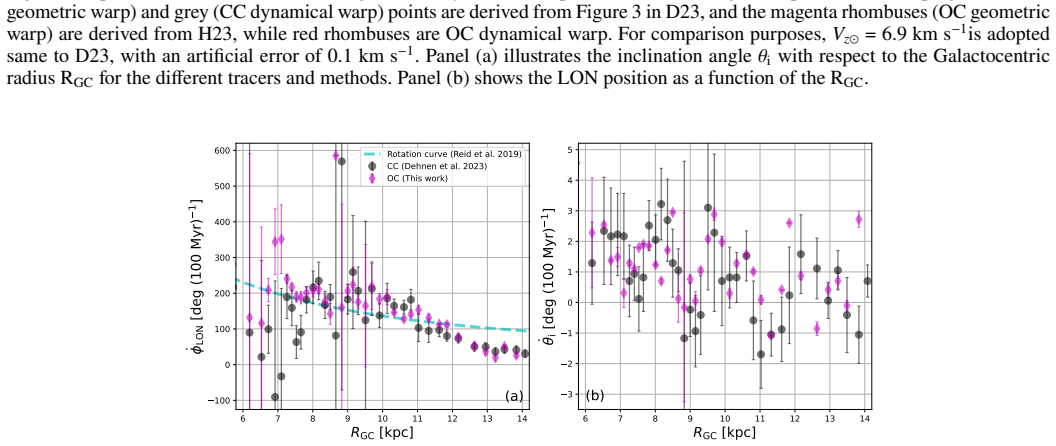
Using the angular momentum directions of 3991 open clusters, the paper derives dynamical orbital inclinations and compares them with the geometric warp traced by the same clusters. It finds a systematic deviation: the geometric warp is systematically more inclined than the dynamical one. The paper attributes this to a vertical systematic motion of the local standard of rest caused by the disk tilt near the Sun. Fitting the two sets of inclinations with maximum likelihood yields Vz_sun = 9.43 ± 0.16 km/s, which is approximately 2 km/s higher than the classical solar vertical peculiar motion W_sun. As a result, previous estimates of the warp precession rate—such as ~10.9 and ~13.6 km/s/kpc—are revised downward to an average 1.8 ± 3.3 km/s/kpc over 12 to 14 kpc, indicating that the warp's precession oscillates around zero and the disk is progressively flattening.
Load-bearing premise
The entire systematic difference between the geometric and dynamical warp inclinations is attributed to the Sun's vertical motion; if the geometric warp from He (2023) carries its own systematic error from distance or selection effects, the inferred Vz_sun and the flattening conclusion would change.
Editorial extensions
If this is right
- Previous warp precession rates, such as ~10.9 km/s/kpc from Poggio et al. (2020) and ~13.6 km/s/kpc from Cheng et al. (2020), are overestimates because they adopt the smaller W_sun and ignore the local disk tilt.
- The corrected precession is near zero at large radii, implying the warp is not winding up but flattening over time.
- The line of nodes at different Galactocentric radii tends to converge within 100 to 200 million years, suggesting the twisted disk is gradually recovering toward a more coherent configuration.
- Older open clusters show larger warp inclinations than younger ones, especially in the inner and outer disk, indicating a real age-dependent warp amplitude.
Reading between the lines
- If the local tilt is real, other kinematic studies that rely on the local standard of rest may carry the same hidden vertical bias; for example, measurements of the vertical gravitational potential or local dark matter density could be slightly shifted.
- The method could be cross-checked with other tracers that have independent distance and velocity measurements, such as red giants or masers; a different best-fit Vz_sun would indicate that the geometric warp reference is itself biased.
- The flattening trend, if confirmed by future Gaia data releases, would argue against steady-state warp models and favor transient perturbations, like satellite galaxy encounters, as the warp's origin.
Editorial analysis
A structured set of objections, weighed in public.
Referee Report
Summary. The paper uses 3991 open clusters (OCs) with precise vertical and tangential velocity uncertainties to compute instantaneous orbital angular momentum directions in Galactocentric radial bins. By comparing these dynamical inclinations with the geometric warp inclinations from He (2023, H23), and scanning over the assumed solar vertical velocity relative to the mid-plane, Vz_sun, the authors find best agreement at Vz_sun = 9.43 ± 0.16 km/s. They interpret the excess over the standard vertical solar peculiar motion W_sun as the effect of a roughly 0.6-degree local disk tilt, and use the fitted Vz_sun to re-derive warp precession rates. The paper concludes that the warp precession in the outer disk is considerably lower than previous estimates and that the Galactic warp is slowly flattening.
Significance. If the fitted Vz_sun and its interpretation are correct, the paper resolves a systematic offset between dynamical and geometric warp inclinations and revises the inferred warp precession rate, which would be a meaningful result for models of the Milky Way's disk. The cross-check between classical Cepheid and open-cluster tracers, and the reproduction of the D23 precession pattern under the standard W_sun, are valuable and suggest the measurement pipeline is not trivially wrong. The paper also makes its modified code available upon request. However, the central numerical result rests on an underspecified likelihood, an error-free geometric reference, and a single-cause systematic model, so the flattening claim is not yet supported at the level claimed.
major comments (4)
- [§4, Fig. 4 (right panel)] The maximum likelihood step is not specified. The text says the authors used the 'average probability of similarity' per 0.05 km/s bin, but no likelihood function, data points, error model, or goodness-of-fit statistic is given. Because a change in Vz_sun shifts all dynamical inclination curves coherently across R_GC, the residuals in different radial bins are strongly correlated; evaluating per-bin probabilities as independent will overstate the constraining power and artificially narrow the quoted uncertainty. The H23 geometric reference is also treated as noiseless in this comparison. Please provide the full likelihood (or an equivalent explicit statistical model), account for bin-to-bin covariance (for example by bootstrap resampling over clusters and Vz_sun), propagate the H23 inclination errors, and report residuals; otherwise the 0.16 km/s error and the significance of the 2 km/s offset cannot be audited.
- [§4, model definition] The model assumes that the entire systematic difference between dynamical and geometric inclinations is attributable to a single vertical velocity of the solar system relative to the mid-plane, Vz_sun = W_sun + Vz_LSR. The paper discusses other sources, such as distance-scale uncertainties, sample selection, and systematics in the H23 geometric warp, only qualitatively and does not quantify how they would shift the fitted Vz_sun. This assumption is load-bearing because the precession and flattening conclusions in §5 inherit the fitted value. Please add explicit sensitivity tests: perturb the H23 geometric inclinations by their quoted errors and by a plausible systematic (for example, a distance-scale shift or a 0.1-degree inclination offset), re-fit Vz_sun, and state how the 2 km/s offset and the derived precession rates change.
- [§5, precession averages] The quoted average precession rate of 1.8 ± 3.3 km/s/kpc over 12 to 14 kpc, and the claimed reduction of 12.3 km/s/kpc relative to earlier estimates, are reported without a definition of how the radial-bin precession rates are averaged or how uncertainties are propagated. Since these numbers are a central conclusion of the paper, please provide the exact averaging procedure, the individual per-bin rates and their covariance, and the formula for the quoted error. This will also make clear whether the 'oscillates around zero' and 'flattening' statements follow from the data or from the adopted Vz_sun.
- [§3 and §4, W_sun context] The comparison in §3 is made with W_sun = 6.9 km/s from D23, while later the paper uses W_sun = 8.59 km/s from Gaia Collaboration et al. (2023) for the Zhou et al. (2024) comparison. The abstract and conclusions state that Vz_sun is 'approximately 2 km/s higher than the historically estimated W_sun', but Table B.1 shows W_sun values ranging from 4.5 to 9.3 km/s, and the recent Gaia value of 8.59 km/s leaves only about 0.8 km/s of the claimed offset. Please state the adopted reference W_sun explicitly, define the offset relative to that value, and show how the fitted Vz_sun and the derived precession rates depend on W_sun over its plausible range.
minor comments (5)
- [§4, LON discussion] In the sentence describing the LON at 9.5 kpc, 'appoach' should be 'approach'.
- [Fig. 6 and §5] The caption of Figure 6 and the text use units such as 'deg yr^{-1}' for precession rates, but the paper considers rates per 100 Myr; the units should be 'deg (100 Myr)^{-1}' throughout.
- [Figs. 2 and 3 captions] The captions state that Vz_sun = 6.9 km/s was adopted 'with an artificial error of 0.1 km/s'; this phrase is unexplained and should either be removed or justified.
- [References] The reference to Dehnen et al. (2023) is given as 'MNRAS[arXiv:2305.09343]' without volume or page; please update to the published version.
- [Notation] The text and figures shift between Vz_sun, Vz⊙, and Vz_sun for the same quantity; please use a single symbol consistently.
Circularity Check
No significant circularity: Vz⊙ is calibrated against an external geometric reference, and the precession/flattening results are post-fit inferences rather than fitted inputs presented as predictions.
full rationale
The paper's central parameter Vz⊙ is obtained by a maximum-likelihood comparison of OC dynamical inclinations to the geometric warp from He (2023), an external prior measurement with published data and code. The subsequent precession rates and flattening interpretation are computed using this calibrated value; they are consequences of the model after fitting, not independent predictions of the fitted quantity. No equation in the paper reduces the precession result to the fitted Vz⊙ by construction, and the geometric reference is not an ansatz or a self-citation invoked to forbid alternatives. The maximum-likelihood step is under-documented and treats radial bins as independent while neglecting H23's inclination errors, which is a statistical robustness/auditability concern rather than circularity. The self-citation to H23 is load-bearing but constitutes a real external measurement, so it does not raise the circularity score.
Assumptions & free parameters
free parameters (4)
- Vz_sun (solar vertical velocity relative to mid-plane) =
9.43 ± 0.16 km/s
- theta_i (local disk tilt) =
~0.6 degrees
- W_sun (solar peculiar motion, vertical) =
6.9 km/s (D23) for the flat-disk comparison; other values in literature
- Sample velocity-error cuts =
v_z uncertainty < 1 km/s, tangential < 20 km/s
assumptions (4)
- domain assumption The instantaneous angular momentum of a cluster is a valid estimator of its orbital plane inclination.
- domain assumption The mean angular momentum of OCs in a radial bin traces the local warp of the Galactic disk.
- domain assumption The geometric warp from He (2023) is an unbiased reference for the warp inclination.
- ad hoc to paper The systematic difference between dynamic and geometric warp is entirely attributable to the solar vertical motion correction.
Cite this review
Pith. "Pith review of A Slowly Flattening Milky Way Stellar Disk: Investigating Galactic Warping through Dynamical Orbital Inclinations of Open Clusters." pith.science (2026). https://pith.science/paper/U7RPMR7V
@misc{pith2026241220344,
  author       = {Pith},
  title        = {Pith review of: A Slowly Flattening Milky Way Stellar Disk: Investigating Galactic Warping through Dynamical Orbital Inclinations of Open Clusters},
  year         = {2026},
  howpublished = {\url{https://pith.science/paper/U7RPMR7V}},
  note         = {Machine review of arXiv:2412.20344}
}
read the original abstract
By evaluating angular momentum directions of open cluster (OC) samples across various Galactocentric radii, we assessed their orbital plane inclinations. Our findings reveal that, without considering the local tilt of the Galactic disk near the sun, our results are consistent with previous studies on Classical Cepheids (CCs). Notably, the warp precession derived from OCs closely mirror those of CCs. Nonetheless, we observed a systematic deviation between the geometric and dynamic warps, attributable to the tilt of the local disk. We identified a systematic vertical motion in the local region, associated with the warping feature near the solar vicinity. Ignoring this motion leads to underestimates of orbital plane inclinations compared to those derived from geometric positions. Our study indicates consistency between the inclinations derived from orbital dynamics and geometric positions at a vertical velocity of the sun relative to the Galactic mid-plane of Vz_sun = 9.4(0.2) km/s. This value is approximately 2 km/s higher than the historically estimated solar peculiar motion, W_sun, primarily due to an approximately 0.6-degree tilt of the local plane. Analysis suggests that previous estimates of the Galactic disk's warping precession rate may have been overestimated due to local warping influences. The findings indicate that the precession oscillates around zero and that the Galactic warp is progressively flattening. Additionally, the line of nodes tends to become consistent across various Galactocentric radii over a timescale of 100-200 million years.
Figures


Figures from the paper (3 more)


Forward citations
Cited by 2 Pith papers
-
A Detailed Analysis of the Milky Way Warp Based on Classical Cepheids
The Milky Way warp is described by a power-law height with a twisting line of nodes and a slow prograde precession rate of 4.86 ± 2.3 km/s/kpc, unified into one time-dependent model.
-
Space Astrometry with Gaia: Advances in Understanding our Galaxy
A comprehensive review of the Gaia mission's measurement principles and its scientific impact on stellar, Galactic, and cosmological astronomy.
Reference graph
Works this paper leans on
-
[1]
& Binney, J
Aumer, M. & Binney, J. J. 2009, MNRAS, 397, 1286
2009
- [2]
-
[3]
Bobylev, V. V. 2017, Astronomy Letters, 43, 152
work page 2017
-
[4]
Bobylev, V. V. & Bajkova, A. T. 2007, Astronomy Reports, 51, 372
work page 2007
-
[5]
Bobylev, V. V. & Bajkova, A. T. 2010, MNRAS, 408, 1788
work page 2010
-
[6]
Bobylev, V. V. & Bajkova, A. T. 2014, MNRAS, 441, 142
work page 2014
-
[7]
Bobylev, V. V. & Bajkova, A. T. 2016, Astronomy Letters, 42, 90
work page 2016
-
[8]
Bobylev, V. V. & Bajkova, A. T. 2017, Astronomy Letters, 43, 159
work page 2017
Show all 40 references
-
[9]
A., Smith, M
Breddels, M. A., Smith, M. C., Helmi, A., et al. 2010, A&A, 511, A90
2010
-
[10]
2020, A&A, 640, A1
Cantat-Gaudin, T., Anders, F., Castro-Ginard, A., et al. 2020, A&A, 640, A1
2020
-
[11]
2012, MNRAS, 420, 3490
Ceverino, D., Dekel, A., Mandelker, N., et al. 2012, MNRAS, 420, 3490
2012
-
[12]
2019, Nature Astronomy, 3, 320
Chen, X., Wang, S., Deng, L., et al. 2019, Nature Astronomy, 3, 320
2019
-
[13]
2018, ApJS, 237, 28
Chen, X., Wang, S., Deng, L., de Grijs, R., & Yang, M. 2018, ApJS, 237, 28
2018
-
[14]
R., et al
Cheng, X., Anguiano, B., Majewski, S. R., et al. 2020, ApJ, 905, 49 Chrobáková, Ž. & López-Corredoira, M. 2021, ApJ, 912, 130 Chrobáková, Ž., Nagy, R., & López-Corredoira, M. 2020, A&A, 637, A96 Coşkunoˇglu, B., Ak, S., Bilir, S., et al. 2011, MNRAS, 412, 1237
2020
-
[15]
2023, MN- RAS[arXiv:2305.09343] Ding,P.-J.,Zhu,Z.,&Liu,J.-C.2019,ResearchinAstronomyandAstrophysics, 19, 068
Dehnen, W., Semczuk, M., & Schönrich, R. 2023, MN- RAS[arXiv:2305.09343] Ding,P.-J.,Zhu,Z.,&Liu,J.-C.2019,ResearchinAstronomyandAstrophysics, 19, 068
2023 arXiv
-
[16]
2023, A&A, 670, A10
Drimmel, R., Khanna, S., D’Onghia, E., et al. 2023, A&A, 670, A10
2023
-
[17]
& Anderson, E
Francis, C. & Anderson, E. 2009, Proceedings of the Royal Society of London Series A, 465, 3425 Gaia Collaboration, Brown, A. G. A., Vallenari, A., et al. 2018, A&A, 616, A1 Gaia Collaboration, Brown, A. G. A., Vallenari, A., et al. 2021, A&A, 649, A1 Gaia Collaboration, Drimm...
2009 arXiv
-
[18]
2013, A&A, 557, A92
Golubov, O., Just, A., Bienaymé, O., et al. 2013, A&A, 557, A92
2013
-
[19]
Guo, S. & Qi, Z. 2023, Universe, 9, 252
2023
-
[20]
J., Conroy, C., & Hernquist, L
Han, J. J., Conroy, C., & Hernquist, L. 2023, Nature Astronomy, 7, 1481
2023
-
[21]
2024, Nature Astronomy, 8, 1294
Huang, Y., Feng, Q., Khachaturyants, T., et al. 2024, Nature Astronomy, 8, 1294
2024
-
[22]
W., Yuan, H
Huang, Y., Liu, X. W., Yuan, H. B., et al. 2015, MNRAS, 449, 162
2015
-
[23]
Kobulnicky, H. A. & Chick, W. T. 2022, AJ, 164, 86
2022
-
[24]
N., Kovtyukh, V., et al
Lemasle, B., Lala, H. N., Kovtyukh, V., et al. 2022, A&A, 668, A40
2022
-
[25]
Nelson, R. W. & Tremaine, S. 1995, MNRAS, 275, 897
1995
-
[26]
2020, Nature Astronomy, 4, 590
Poggio, E., Drimmel, R., Andrae, R., et al. 2020, Nature Astronomy, 4, 590
2020
-
[27]
G., et al
Poggio, E., Drimmel, R., Lattanzi, M. G., et al. 2018, MNRAS, 481, L21
2018
-
[28]
J., Menten, K
Reid, M. J., Menten, K. M., Brunthaler, A., et al. 2019, ApJ, 885, 131
2019
-
[29]
J., Menten, K
Reid, M. J., Menten, K. M., Brunthaler, A., et al. 2014, ApJ, 783, 130
2014
-
[30]
J., Menten, K
Reid, M. J., Menten, K. M., Zheng, X. W., et al. 2009, ApJ, 700, 137 Romero-Gómez, M., Mateu, C., Aguilar, L., Figueras, F., & Castro-Ginard, A. 2019, A&A, 627, A150 Roškar, R., Debattista, V. P., Brooks, A. M., et al. 2010, MNRAS, 408, 783 Schönrich, R., Binney, J., & Dehnen,...
2009
-
[31]
2023, MNRAS, 519, 902
Semczuk, M., Dehnen, W., Schönrich, R., & Athanassoula, E. 2023, MNRAS, 519, 902
2023
-
[32]
1998, ApJ, 504, L23
Shang, Z., Zheng, Z., Brinks, E., et al. 1998, ApJ, 504, L23
1998
-
[33]
2014, ApJ, 793, 51
Sharma, S., Bland-Hawthorn, J., Binney, J., et al. 2014, ApJ, 793, 51
2014
-
[34]
Sparke, L. S. & Casertano, S. 1988, MNRAS, 234, 873
1988
-
[35]
L., et al
Tian, H.-J., Liu, C., Carlin, J. L., et al. 2015, ApJ, 809, 145
2015
-
[36]
2018, Acta Astron., 68, 315
Udalski, A., Soszyński, I., Pietrukowicz, P., et al. 2018, Acta Astron., 68, 315
2018
-
[37]
W., Huang, Y., et al
Wang, F., Zhang, H. W., Huang, Y., et al. 2021, MNRAS, 504, 199
2021
-
[38]
Weinberg, M. D. & Blitz, L. 2006, ApJ, 641, L33
2006
-
[39]
2024, ApJ, 965, 132
Zhou, X., Chen, X., Deng, L., & Wang, S. 2024, ApJ, 965, 132
2024
-
[40]
Zhu, Z. 2009, Research in Astronomy and Astrophysics, 9, 1285 Article number, page 8 of 10 Peng &He: Galactic OC warp and precession Appendix A: Sketch map of dynamic warping We conducted a sketch map of the warping disk traced by OC orbit angular momentum, as shown in Figure ...
2019
Reviewed August 10, 2026 · model on record in the stance chip above.
Discussion (0). Continue with ORCID to comment.