REVIEW 4 major objections 4 minor 52 references
Recurrence-based Vanishing Point Detection
T0 review · 4 major / 4 minor · reviewed 2026-08-10 · deepseek-v4-flash
Pith's one-line read Recurring patterns alone, without straight lines or training data, can locate vanishing points in images.
desk verdict Genuinely new unsupervised VPD idea and two useful datasets, but the benchmark leans on the method's own geometric prior and the significance claims need tighter statistics. read the letter →
The pith
A machine-rendered reading of the paper's core claim, the machinery that carries it, and where it could break.
The reading
What carries the argument
The load-bearing object is the implicit line: a straight line fit to corresponding SIFT keypoints that repeat across two or more instances of a recurring pattern, with direction fixed by keypoint scale so the vector runs from larger to smaller features, i.e., toward the vanishing point. These correspondences are obtained without labeled data by hierarchical clustering of 128-dimensional SIFT descriptors, forward feature selection using linearity, angle, and scale scores (composite $S_C = S_L \exp(S_A+S_S)/N^2$), and an optimization-inspired search over visual-word/instance groupings. The implicit lines are then fused with explicit lines in a weighted RANSAC where each line's weight starts at $w_i = \sum_{j\ne i} e^{-\theta_{ij}}$ for acute angle $\theta_{ij}$ and is updated by multiplying inliers by $\alpha=1.2$ and outliers by $\beta=0.8$; the winning intersection is refined by least squares and eigenvalue decomposition. This machinery is what lets a vanishing point emerge from texture repetition when no long straight edges exist.
What would settle it
Render a controlled set of images exactly like RPVP-Synthetic but with the repeated objects arranged along straight 3D lines that are parallel to the image plane, so their projected size does not decrease and the projected lines do not converge; if R-VPD still reports a finite, confident vanishing point on most of these images, the scale-and-collinearity prior is generating the VP rather than measuring one.
Extended reading notes
Core claim
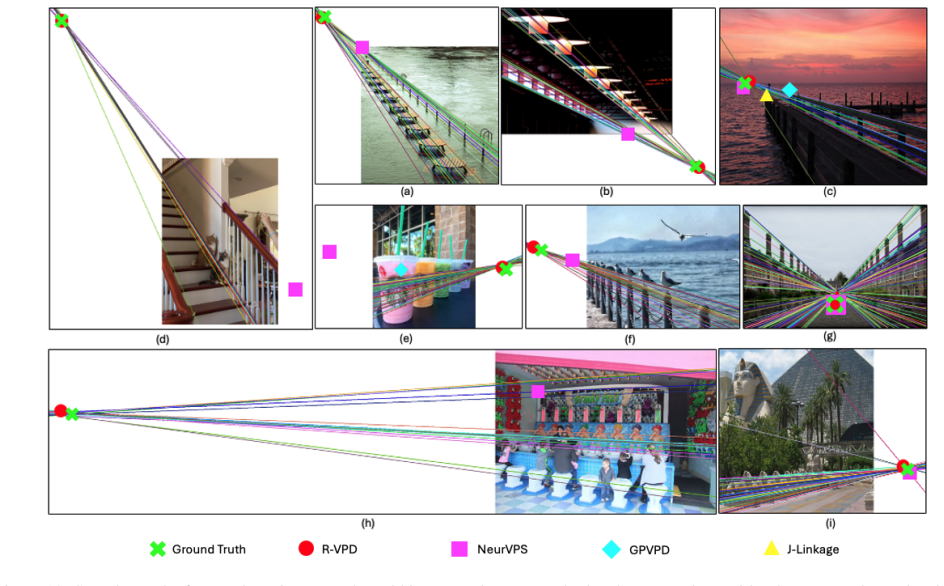
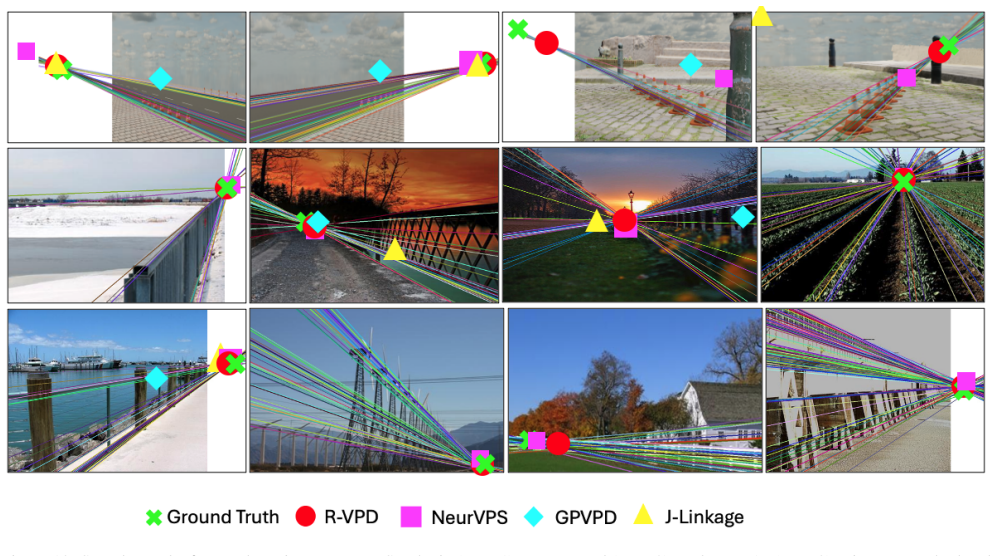
The paper's central claim is that vanishing points can be recovered from recurring patterns without any supervised training and without requiring explicit straight lines. Corresponding SIFT features across instances of a recurring pattern define implicit lines; because pattern instances project smaller as they recede, the fitted line is oriented from larger-scale to smaller-scale features, pointing toward the vanishing point. R-VPD then combines these implicit lines with any explicit line segments and uses a weighted RANSAC to vote on the intersection, refining weights so near-parallel lines dominate the consensus. The paper reports that on RPVP-Synthetic (3,200 rendered images with known camera parameters) R-VPD outperforms all four compared methods; on RPVP-Real (1,400 human-annotated images) it outperforms the classical baselines; and on the 416-image RPVP-Real-Exclusive subset it is statistically on par with NeurVPS, a supervised deep-learning method, with p = 0.58. The intended scope is single-dominant-VP natural scenes, and the paper positions the result as evidence that perspective geometry is readable from things that recur rather than only from edges.
Load-bearing premise
Recurring pattern instances lie along straight 3D lines that project through the vanishing point, and the matched SIFT keypoints shrink monotonically in scale along those lines toward the VP, so "from larger to smaller scale" reliably orients the implicit lines toward the VP.
Editorial extensions
If this is right
- Vanishing-point detection no longer needs scenes with long straight edges; images of periodic texture, facades, or repeated objects become usable inputs.
- A no-training pipeline can reach the accuracy of a supervised deep network on real recurring-pattern imagery, so vanishing-point detection can be applied to new image domains without collecting labels.
- The RPVP-Synthetic and RPVP-Real datasets give the community a benchmark where perspective information is carried by recurrence, isolating that cue from the explicit-line cue.
- The recovered single vanishing point supports downstream affine rectification of one-point-perspective images, as demonstrated in the paper's frontal-view example.
- Because the method's complexity is $O(n^2)$ in the number of SIFT features, scaling the descriptor extraction stage is the path to practical speed rather than dataset collection.
Reading between the lines
- A natural extension the paper leaves implicit is multi-VP detection: running the same implicit-line voting in a multi-model RANSAC over implicit lines could recover Manhattan or Atlanta-world vanishing points from texture repetition alone.
- The scale-orientation rule could be tested independently by ablating it: randomize the SIFT scales of matched keypoints while keeping their positions; if accuracy on RPVP-Real collapses, monotone scale decrease is the real carrier of the signal, not just collinearity.
- Because the real-world ground truth is drawn as lines through recurring patterns rather than through long architectural edges, an independent comparison on a dataset whose ground truth comes from explicit straight lines would show whether recurrence-derived and edge-derived vanishing points agree in general scenes.
- A practical derivative is a faster, feature-light variant: replace SIFT with a cheaper keypoint detector and descriptor while keeping the weighted-RANSAC fusion, which could bring the unsupervised advantage to real-time and memory-constrained platforms.
Signed reviews
Editorial analysis
A structured set of objections, weighed in public.
Referee Report
Summary. The manuscript proposes R-VPD, an unsupervised vanishing point detector that augments explicit line segments with implicit lines obtained from corresponding SIFT keypoints across recurring pattern instances. It contributes two benchmarks, RPVP-Synthetic (3,200 Blender-rendered images) and RPVP-Real (1,400 annotated images), and reports comparisons against LSD, J-Linkage, NeurVPS, and GPVPD using angle-accuracy AUC values and p-values. The central claims are that R-VPD outperforms all methods on synthetic images, outperforms classical methods and matches supervised deep learning methods on real-world images.
Significance. The core idea is original and potentially useful: detecting vanishing points from recurring patterns without training data and without relying on explicit straight lines. If the results generalize, the contribution is significant for scenes with repeated patterns and few line segments. The two RPVP datasets are a further contribution, and the authors state that code and data will be released. The stress test in Appendix D is a useful robustness check. However, the benchmark design and the statistical reporting currently leave the main generalization claim under-supported: the synthetic data are generated from exactly the geometric prior the method assumes, and the real-world ground truth is annotated by drawing lines through recurring patterns, which is the same construction R-VPD is designed to recover.
major comments (4)
- [Section 4.1.1 and Appendix B.1.1 versus Section 3.4] The synthetic benchmark is generated from the method's own prior. Objects are placed along L(t)=O+tD and oriented toward the vanishing point, so every recurring pattern instance forms a receding line with monotonically decreasing projected scale. This is exactly the assumption used in Section 3.4, where 'vectors from larger to smaller scale features' are regarded as pointing toward the vanishing point. Consequently, Table 1 demonstrates that R-VPD works when its prior is exactly satisfied, but it does not establish performance on images where recurring patterns do not recede to the VP, such as fronto-parallel brick or tile patterns. I request an evaluation on an independent benchmark, or on a constructed control set where repeated instances are arranged without a common vanishing line, with VP accuracy reported in both settings.
- [Section 5.1] The p-value test is under-specified. The manuscript does not state what test statistic is used, whether the comparison is paired across images, how the entire AUC curve is reduced to a single test, or how multiple comparisons across the eight methods are controlled. Without this information, statements such as 'p-value << 0.001' in Section 5.1 and the claim in Section 5.3 that p=0.003 (>0.001) means NeurVPS does not significantly outperform R-VPD are not verifiable. Please define the test, justify the 0.001 threshold, and report effect sizes or confidence intervals in addition to p-values.
- [Section 4.2] The angle accuracy metric uses an arbitrary nominal focal length f=(W+H)/4 for computing VP unit vectors. Since all angular errors depend on f, method rankings can change under different focal-length assumptions. Please provide a sensitivity analysis across plausible values of f, or use ground-truth camera intrinsics on RPVP-Synthetic where they are available, and state clearly whether any of the reported conclusions are robust to this choice.
- [Section 4.1.2 and Appendix B.2] The ground truth for RPVP-Real is computed as the intersection of lines that are manually drawn through recurring patterns. This is the same implicit-line construction that R-VPD is designed to recover, which makes the real-world benchmark partially self-confirming. I ask for an assessment of annotation variability, a comparison with an independent ground-truth source (for example, vanishing points derived from 3D structure or from line annotations not tied to recurrence), and a quantification of how strongly the reported rankings depend on the annotation convention.
minor comments (4)
- [Section 3.3] The composite score SC = SL × exp(SA + SS)/N^2 mixes quantities with different units (pixels, radians, and dimensionless values), and the paper does not explain why the exponential of the summed angle and scale scores is preferable to a weighted sum or product. A brief rationale or an ablation would clarify the design.
- [Table 5 and Appendix C] There are inconsistencies in the reported processing times: Appendix C states 0.86 and 0.48 seconds for NeurVPS and GPVPD on real-world images and 0.86 and 0.58 seconds on synthetic images, while Table 5 lists 0.86 and 0.52 seconds for RPVP-Real and 0.52 and 0.52 seconds for RPVP-Synth. Please correct these numbers.
- [Figure 17 caption] The caption labels two stages with the same letter, '(c) Line Fit' and '(c) Inliers', which makes the pipeline stages hard to follow. Please renumber the subfigures.
- [Section 2 and Section 4.2] The closest prior work on using repeated patterns for geometric rectification, namely the methods of Pritts et al. [34-36], is cited but not included as a baseline. A comparison with at least one such method would help position R-VPD relative to existing recurrence-based geometric estimation approaches.
Circularity Check
RPVP benchmarks are built from R-VPD's own implicit-line/scale-reduction prior, making the headline synthetic and real-world comparisons partially self-fulfilling; TMM17-Test is the only partly independent check.
-
self definitional
[Appendix B.1.1 and Section 3.4]
""the positioning of the objects is governed by the equation of a line in three-dimensional space, represented as L(t) = O + tD ... The objects are placed such that their distances from the observer increase incrementally, causing them to appear smaller and smaller due to the perspective effect" (App. B.1.1); "vectors from larger to smaller scale features regarded as pointing toward the vanishing point" (Sec. 3.4)."
R-VPD's orientation model assumes corresponding SIFT features lie on receding lines and that scale decreases monotonically toward the VP. RPVP-Synthetic is generated by placing duplicated objects exactly along L(t)=O+tD, with perspective shrinking them along that line, and the GT VP is computed as the intersection of those constructed parallel lines (App. B.1.2). Every synthetic image is therefore built from the very prior the algorithm uses to vote for a VP; the benchmark measures the method's ability to invert its own data-generation model. The Table 1 'outperforms all methods' result is thus partly self-fulfilling, though TMM17-Test provides an independent countercheck.
-
self definitional
[Section 4.1.2 and Appendix B.2]
""The ground truth vanishing point is then calculated as the intersection of these annotated lines" (Sec. 4.1.2); "the vanishing point for these images is calculated by finding the intersection of lines that pass through the recurring patterns ... the two lines are drawn manually on the image over the recurring patterns" (App. B.2)."
R-VPD's output is the weighted-RANSAC intersection of implicit lines fitted to recurring SIFT correspondences (Secs. 3.1 and 3.4). RPVP-Real's ground truth is defined as the intersection of human-drawn lines placed over recurring patterns. Thus the target and the prediction are instances of the same construction: lines through recurring pattern instances. Agreement on RPVP-Real and RPVP-Real-Exclusive (Tables 2 and 3) mostly shows that annotators and algorithm used the same cue, not that the cue has been validated on an independently defined VP for arbitrary scenes. The 'on par with supervised learning' claim rests mainly on this aligned benchmark.
full rationale
The paper's geometric derivation chain is internally consistent: SIFT correspondences are grouped, implicit lines are fitted, and a weighted RANSAC finds their intersection. No parameter is fitted to the RPVP ground-truth labels, so there is no classic fitted-input-called-prediction circularity, and the self-citations to GRASP [26] and RP discovery [44] are algorithm references, not load-bearing uniqueness claims. The circularity is at the evaluation-construction level: both RPVP datasets define the VP by lines through recurring patterns, which is exactly the cue R-VPD is designed to exploit, and RPVP-Synthetic is generated by arranging objects on L(t)=O+tD with monotonically shrinking scale. Consequently the headline outperformance on RPVP-Synthetic and the parity claim on RPVP-Real/RPVP-Real-Exclusive are partially forced by the benchmark's construction. The TMM17-Test result (Table 4), where R-VPD is second best rather than best, is the only substantially independent evidence and keeps the paper from being fully circular. The p=0.003 vs 0.001 threshold argument is a statistical judgment, not a circularity.
Assumptions & free parameters
free parameters (4)
- alpha (RANSAC inlier weight multiplier) =
1.2
- beta (RANSAC outlier weight multiplier) =
0.8
- nominal focal length f for angle accuracy metric =
(image width + image height)/4
- Composite feature selection score form =
SC = SL * exp(SA+SS) / N^2
assumptions (3)
- domain assumption Recurring pattern instances lie along straight 3D lines that converge to the VP.
- domain assumption SIFT keypoint scale decreases monotonically toward the VP, so the direction from larger to smaller scale features indicates the VP.
- domain assumption The GRASP optimization and hierarchical clustering identify true corresponding visual words across RP instances without supervision.
Cite this review
Pith. "Pith review of Recurrence-based Vanishing Point Detection." pith.science (2026). https://pith.science/paper/B72RWW4F
@misc{pith2026241220666,
  author       = {Pith},
  title        = {Pith review of: Recurrence-based Vanishing Point Detection},
  year         = {2026},
  howpublished = {\url{https://pith.science/paper/B72RWW4F}},
  note         = {Machine review of arXiv:2412.20666}
}
read the original abstract
Classical approaches to Vanishing Point Detection (VPD) rely solely on the presence of explicit straight lines in images, while recent supervised deep learning approaches need labeled datasets for training. We propose an alternative unsupervised approach: Recurrence-based Vanishing Point Detection (R-VPD) that uses implicit lines discovered from recurring correspondences in addition to explicit lines. Furthermore, we contribute two Recurring-Pattern-for-Vanishing-Point (RPVP) datasets: 1) a Synthetic Image dataset with 3,200 ground truth vanishing points and camera parameters, and 2) a Real-World Image dataset with 1,400 human annotated vanishing points. We compare our method with two classical methods and two state-of-the-art deep learning-based VPD methods. We demonstrate that our unsupervised approach outperforms all the methods on the synthetic images dataset, outperforms the classical methods, and is on par with the supervised learning approaches on real-world images.
Figures


Figures from the paper (15 more)





Reference graph
Works this paper leans on
-
[1]
Blender - a 3d modelling and rendering package. https: //www.blender.org. 5, 11
-
[2]
Stephen T. Barnard. Interpreting perspective images. Artifi- cial Intelligence, 21(4):435–462, 1983. 2
work page 1983
-
[3]
Globally optimal line clustering and vanishing point estimation in manhattan world
Jean-Charles Bazin, Yongduek Seo, C ´edric Demonceaux, Pascal Vasseur, Katsushi Ikeuchi, Inso Kweon, and Marc Pollefeys. Globally optimal line clustering and vanishing point estimation in manhattan world. In 2012 IEEE Con- ference on Computer Vision and Pattern Recognition, pages 638–645. IEEE, 2012. 1
work page 2012
-
[4]
Globally optimal consensus set maximization through rota- tion search
Jean-Charles Bazin, Yongduek Seo, and Marc Pollefeys. Globally optimal consensus set maximization through rota- tion search. In Computer Vision–ACCV 2012: 11th Asian Conference on Computer Vision, Daejeon, Korea, November 5-9, 2012, Revised Selected Papers, Part II 11 , pages 539–
work page 2012
-
[5]
Vanishing point detection with convolutional neural networks
Ali Borji. Vanishing point detection with convolutional neu- ral networks. arXiv preprint arXiv:1609.00967, 2016. 1
work page Pith review arXiv 2016
-
[6]
Using vanishing points for camera calibration
Bruno Caprile and Vincent Torre. Using vanishing points for camera calibration. International journal of computer vision, 4(2):127–139, 1990. 1
work page 1990
-
[7]
Deepvp: Deep learning for vanishing point detection on 1 million street view images
Chin-Kai Chang, Jiaping Zhao, and Laurent Itti. Deepvp: Deep learning for vanishing point detection on 1 million street view images. In 2018 IEEE International Confer- ence on Robotics and Automation (ICRA), pages 4496–4503. IEEE, 2018. 1, 2
work page 2018
-
[8]
Planar affine rectification from change of scale
Ond ˇrej Chum and Jiˇr´ı Matas. Planar affine rectification from change of scale. In Ron Kimmel, Reinhard Klette, and Akihiro Sugimoto, editors, Computer Vision – ACCV 2010, pages 347–360, Berlin, Heidelberg, 2011. Springer Berlin Heidelberg. 2
work page 2010
Show all 52 references
-
[9]
Camera calibration from vanishing points in image of archi- tectural scenes
Roberto Cipolla, Tom Drummond, and Duncan P Robertson. Camera calibration from vanishing points in image of archi- tectural scenes. In BMVC, volume 99, pages 382–391, 1999. 1
1999
-
[10]
Vanishing point cal- culation as a statistical inference on the unit sphere
Robert T Collins and Richard S Weiss. Vanishing point cal- culation as a statistical inference on the unit sphere. InICCV, volume 90, pages 400–403, 1990. 1, 2
1990
-
[11]
Manhattan world: Compass direction from a single image by bayesian infer- ence
James M Coughlan and Alan L Yuille. Manhattan world: Compass direction from a single image by bayesian infer- ence. In Proceedings of the seventh IEEE international con- ference on computer vision, volume 2, pages 941–947. IEEE,
-
[12]
Scannet: Richly-annotated 3d reconstructions of indoor scenes
Angela Dai, Angel X Chang, Manolis Savva, Maciej Hal- ber, Thomas Funkhouser, and Matthias Nießner. Scannet: Richly-annotated 3d reconstructions of indoor scenes. In Proceedings of the IEEE conference on computer vision and pattern recognition, pages 5828–5839, 2017. 6
2017
-
[13]
Ef- ficient edge-based methods for estimating manhattan frames in urban imagery
Patrick Denis, James H Elder, and Francisco J Estrada. Ef- ficient edge-based methods for estimating manhattan frames in urban imagery. InComputer Vision–ECCV 2008: 10th Eu- ropean Conference on Computer Vision, Marseille, France, October 12-18, 2008, Proceedings, Part II 10 ,...
2008
-
[14]
Manhattan scene understanding using monocular, stereo, and 3d features
Alex Flint, David Murray, and Ian Reid. Manhattan scene understanding using monocular, stereo, and 3d features. In 2011 International Conference on Computer Vision , pages 2228–2235. IEEE, 2011. 1
2011
-
[15]
Van- ishing point detection by a voting scheme
Paolo Gamba, Alessandro Mecocci, and U Salvatore. Van- ishing point detection by a voting scheme. In Proceedings of 3rd IEEE International Conference on Image Processing, volume 2, pages 301–304. IEEE, 1996. 1, 2
1996
-
[16]
Exploiting symmetry and/or manhattan properties for 3d object structure estimation from single and multiple images
Yuan Gao and Alan L Yuille. Exploiting symmetry and/or manhattan properties for 3d object structure estimation from single and multiple images. InProceedings of the IEEE Con- ference on Computer Vision and Pattern Recognition, pages 7408–7417, 2017. 1
2017
-
[17]
Using vanishing points for camera calibration and coarse 3d reconstruction from a single image.The Visual Computer, 16:396–410, 2000
Erwan Guillou, Daniel Meneveaux, Eric Maisel, and Kadi Bouatouch. Using vanishing points for camera calibration and coarse 3d reconstruction from a single image.The Visual Computer, 16:396–410, 2000. 1
2000
-
[18]
Large-scale video classification with convolutional neural networks
Andrej Karpathy, George Toderici, Sanketh Shetty, Thomas Leung, Rahul Sukthankar, and Li Fei-Fei. Large-scale video classification with convolutional neural networks. In Pro- ceedings of the IEEE conference on Computer Vision and Pattern Recognition, pages 1725–1732, 2014. 1
2014
-
[19]
Imagenet classification with deep convolutional neural net- works
Alex Krizhevsky, Ilya Sutskever, and Geoffrey E Hinton. Imagenet classification with deep convolutional neural net- works. Advances in neural information processing systems , 25, 2012. 1
2012
-
[20]
Vpgnet: Vanishing point guided network for lane and road marking detection and recognition
Seokju Lee, Junsik Kim, Jae Shin Yoon, Seunghak Shin, Oleksandr Bailo, Namil Kim, Tae-Hee Lee, Hyun Seok Hong, Seung-Hoon Han, and In So Kweon. Vpgnet: Vanishing point guided network for lane and road marking detection and recognition. In Proceedings of the IEEE inter- nationa...
1947
-
[21]
Leveraging structural regularity of at- lanta world for monocular slam
Haoang Li, Yazhou Xing, Ji Zhao, Jean-Charles Bazin, Zhe Liu, and Yun-Hui Liu. Leveraging structural regularity of at- lanta world for monocular slam. In 2019 International Con- ference on Robotics and Automation (ICRA) , pages 2412–
2019
-
[22]
A monocular slam system leveraging structural regularity in manhattan world
Haoang Li, Jian Yao, Jean-Charles Bazin, Xiaohu Lu, Yazhou Xing, and Kang Liu. A monocular slam system leveraging structural regularity in manhattan world. In 2018 IEEE International Conference on Robotics and Automation (ICRA), pages 2518–2525. IEEE, 2018. 1
2018
-
[23]
Line-based absolute and relative camera pose estimation in structured environments
Haoang Li, Ji Zhao, Jean-Charles Bazin, Wen Chen, Kai Chen, and Yun-Hui Liu. Line-based absolute and relative camera pose estimation in structured environments. In 2019 IEEE/RSJ International Conference on Intelligent Robots and Systems (IROS), pages 6914–6920. IEEE, 2019. 1
2019
-
[24]
Quasi-globally optimal and near/true real-time vanishing point estimation in manhattan world
Haoang Li, Ji Zhao, Jean-Charles Bazin, and Yun-Hui Liu. Quasi-globally optimal and near/true real-time vanishing point estimation in manhattan world. IEEE Transactions on Pattern Analysis and Machine Intelligence , 44(3):1503– 1518, 2020. 1, 2
2020
-
[25]
Deep van- ishing point detection: Geometric priors make dataset vari- ations vanish
Yancong Lin, Ruben Wiersma, Silvia L Pintea, Klaus Hilde- brandt, Elmar Eisemann, and Jan C van Gemert. Deep van- ishing point detection: Geometric priors make dataset vari- ations vanish. In Proceedings of the IEEE/CVF Conference on Computer Vision and Pattern Recognition , p...
2022
-
[26]
Grasp recurring patterns from a single view
Jingchen Liu and Yanxi Liu. Grasp recurring patterns from a single view. In Proceedings of the IEEE conference on computer vision and pattern recognition, pages 2003–2010,
2003
-
[27]
Local regularity-driven city- scale facade detection from aerial images
Jingchen Liu and Yanxi Liu. Local regularity-driven city- scale facade detection from aerial images. In Proceedings of the IEEE conference on computer vision and pattern recog- nition, pages 3778–3785, 2014. 1
2014
-
[28]
Vapid: A rapid vanishing point detector via learned optimizers
Shichen Liu, Yichao Zhou, and Yajie Zhao. Vapid: A rapid vanishing point detector via learned optimizers. In Proceed- ings of the IEEE/CVF International Conference on Com- puter Vision, pages 12859–12868, 2021. 1
2021
-
[29]
Con- tribution to the determination of vanishing points using hough transform
Evelyne Lutton, Henri Maitre, and Jaime Lopez-Krahe. Con- tribution to the determination of vanishing points using hough transform. IEEE transactions on pattern analysis and machine intelligence, 16(4):430–438, 1994. 2
1994
-
[30]
Determining van- ishing points from perspective images
Michael J Magee and Jake K Aggarwal. Determining van- ishing points from perspective images. Computer Vision, Graphics, and Image Processing, 26(2):256–267, 1984. 1
1984
-
[31]
Vanishing point detection by line clustering
Gerard F McLean and D Kotturi. Vanishing point detection by line clustering. IEEE Transactions on pattern analysis and machine intelligence, 17(11):1090–1095, 1995. 1, 2
1995
-
[32]
Mundy and Andrew Zisserman, editors
Joseph L. Mundy and Andrew Zisserman, editors. Geometric Invariance in Computer Vision. MIT Press, Cambridge, MA, USA, 1992. 1
1992
-
[33]
Stacked hour- glass networks for human pose estimation
Alejandro Newell, Kaiyu Yang, and Jia Deng. Stacked hour- glass networks for human pose estimation. In Computer Vision–ECCV 2016: 14th European Conference, Amster- dam, The Netherlands, October 11-14, 2016, Proceedings, Part VIII 14, pages 483–499. Springer, 2016. 2
2016
-
[34]
Rectification, and segmentation of coplanar repeated patterns
James Pritts, Ondrej Chum, and Jir ´ı Matas. Rectification, and segmentation of coplanar repeated patterns. In 2014 IEEE Conference on Computer Vision and Pattern Recog- nition, pages 2973–2980, 2014. 2
2014
-
[35]
Minimal solvers for rectifying from radially-distorted scales and change of scales
James Pritts, Zuzana Kukelova, Viktor Larsson, Yaroslava Lochman, and Ondrej Chum. Minimal solvers for rectifying from radially-distorted scales and change of scales. Int. J. Comput. Vis., 128(4):950–968, 2020. 2
2020
-
[36]
Pritts, Z
J. Pritts, Z. Kukelova, V . Larsson, Y . Lochman, and O. Chum. Minimal solvers for rectifying from radially-distorted conju- gate translations. IEEE Transactions on Pattern Analysis and Machine Intelligence, 43(11):3931–3948, Nov 2021. 2
2021
-
[37]
Determining perspective struc- tures using hierarchical hough transform
Long Quan and Roger Mohr. Determining perspective struc- tures using hierarchical hough transform. Pattern Recogni- tion Letters, 9(4):279–286, 1989. 2
1989
-
[38]
Russell, Antonio Torralba, Kevin P
Bryan C. Russell, Antonio Torralba, Kevin P. Murphy, and William T. Freeman. LabelMe: A database and web-based tool for image annotation. International journal of computer vision, 77(1):157–173, 2008. 2, 5, 12
2008
-
[39]
Planar group- ing for automatic detection of vanishing lines and points.Im- age and Vision Computing, 18(9):647–658, 2000
Frederik Schaffalitzky and Andrew Zisserman. Planar group- ing for automatic detection of vanishing lines and points.Im- age and Vision Computing, 18(9):647–658, 2000. 1, 2
2000
-
[40]
Indoor segmentation and support inference from rgbd images
Nathan Silberman, Derek Hoiem, Pushmeet Kohli, and Rob Fergus. Indoor segmentation and support inference from rgbd images. In Computer Vision–ECCV 2012: 12th Eu- ropean Conference on Computer Vision, Florence, Italy, Oc- tober 7-13, 2012, Proceedings, Part V 12 , pages 746–760...
2012
-
[41]
Piecewise planar stereo for image-based rendering
Sudipta Sinha, Drew Steedly, and Rick Szeliski. Piecewise planar stereo for image-based rendering. In 2009 Interna- tional Conference on Computer Vision , pages 1881–1888,
2009
-
[42]
Robust multiple struc- tures estimation with j-linkage
Roberto Toldo and Andrea Fusiello. Robust multiple struc- tures estimation with j-linkage. In European Conference on Computer Vision, 2008. 1, 2, 5, 6, 7, 8
2008
-
[43]
Transformer based line segment classifier with image context for real-time vanishing point detection in man- hattan world
Xin Tong, Xianghua Ying, Yongjie Shi, Ruibin Wang, and Jinfa Yang. Transformer based line segment classifier with image context for real-time vanishing point detection in man- hattan world. In Proceedings of the IEEE/CVF Conference on Computer Vision and Pattern Recognition , ...
2022
-
[44]
Novel 3d scene understanding applications from recur- rence in a single image
Shimian Zhang, Skanda Bharadwaj, Keaton Kraiger, Yashasvi Asthana, Hong Zhang, Robert Collins, and Yanxi Liu. Novel 3d scene understanding applications from recur- rence in a single image. arXiv preprint arXiv:2210.07991 ,
-
[45]
Structslam: Visual slam with building structure lines
Huizhong Zhou, Danping Zou, Ling Pei, Rendong Ying, Peilin Liu, and Wenxian Yu. Structslam: Visual slam with building structure lines. IEEE Transactions on Vehicular Technology, 64(4):1364–1375, 2015. 1
2015
-
[46]
Neurvps: Neural vanishing point scanning via conic convo- lution
Yichao Zhou, Haozhi Qi, Jingwei Huang, and Yi Ma. Neurvps: Neural vanishing point scanning via conic convo- lution. Advances in Neural Information Processing Systems, 32, 2019. 1, 2, 3, 4, 5, 6, 7, 8
2019
-
[47]
Learning to reconstruct 3d manhat- tan wireframes from a single image
Yichao Zhou, Haozhi Qi, Yuexiang Zhai, Qi Sun, Zhili Chen, Li-Yi Wei, and Yi Ma. Learning to reconstruct 3d manhat- tan wireframes from a single image. In Proceedings of the IEEE/CVF International Conference on Computer Vision , pages 7698–7707, 2019. 1, 6
2019
-
[48]
Detecting dominant vanishing points in natural scenes with application to composition-sensitive image retrieval
Zihan Zhou, Farshid Farhat, and James Z Wang. Detecting dominant vanishing points in natural scenes with application to composition-sensitive image retrieval. IEEE Transactions on Multimedia, 19(12):2651–2665, 2017. 1, 2, 4, 5, 6 10 Appendix A. Scores for Forward Feature Selec...
2017
-
[49]
The point of intersec- tion of these two lines in the 2D plane is computed, locating the vanishing point in the image for the pair of original par- allel lines in 3D space
These (implicit) lines represent the perspective projec- tions of the original 3D parallel lines. The point of intersec- tion of these two lines in the 2D plane is computed, locating the vanishing point in the image for the pair of original par- allel lines in 3D space. While ...
1920
-
[50]
B.2.1 RPVP-Real Dataset Files: As a part of the publication, we intend to provide the fol- lowing files: 1) images, and 2) ground truth VP for each frame as a text file
and the corresponding images (Row 2) with the calcu- lated ground truth vanishing point. B.2.1 RPVP-Real Dataset Files: As a part of the publication, we intend to provide the fol- lowing files: 1) images, and 2) ground truth VP for each frame as a text file. This dataset consi...
-
[51]
Impact of Optimization and GPU Utilization: NeurVPS and GPVPD benefit from GPU usage and optimized deep learning libraries, resulting in faster processing, whereas R-VPD and J-Link, relying on CPUs and less optimization, have longer times
-
[52]
Trade-off Between Time and Space: NeurVPS and GPVPD’s speed advantage comes with high mem- ory demands ( 400 MB per model), which can be limiting in memory-constrained environments where lightweight models might be preferred despite slower processing times. The comparison high...
Reviewed August 10, 2026 · model on record in the stance chip above.
Discussion (0). Continue with ORCID to comment.