REVIEW 5 major objections 5 minor 36 references
Accelerating Energy-Efficient Federated Learning in Cell-Free Networks with Adaptive Quantization
T0 review · 5 major / 5 minor · reviewed 2026-08-10 · deepseek-v4-flash
Pith's one-line read An element-wise exponent-mantissa quantization scheme for cell-free massive MIMO federated learning, combined with adaptive local iterations and uplink power allocation, is claimed to raise test accuracy by up to 36% over…
desk verdict EMQ is a concrete, useful compression scheme with solid numerical support, but the convergence proofs are not there yet; the paper deserves review on the engineering for a major revision. read the letter →
The pith
A machine-rendered reading of the paper's core claim, the machinery that carries it, and where it could break.
The reading
What carries the argument
The central object is EMQ (Exponent-Mantissa Quantization), an element-wise quantization scheme that writes every entry of an update vector as sign times mantissa times 10^exponent, with a single vector-wide exponent u_j^k = floor(log10 ||δw_j^k||_infinity) and mantissas rounded to the nearest integer in {0,...,9} encoded by a prefix-free bit table. This encoding concentrates bits on the few large gradient entries while spending almost nothing on the many near-zero entries, and Lemma 1 bounds the induced quantization error by roughly 5*$10^{{u_j^k-1}}$ per element. The second load-bearing piece is the adaptive local-iteration rule from Proposition 1 and Remark 1: clients run local AdaDelta iterations until the update exponent stops increasing (u_j^k <= $u_j^{{k-1}}$), which jointly controls local effort and quantization error. The third piece is the per-iteration power-allocation subproblem P2, solved by SQP with BFGS Hessian approximation and Armijo line search, which converts the bit counts and channel conditions into uplink powers that minimize a weighted sum of straggler latency and energy consumption.
What would settle it
Track, on a non-convex CNN such as the paper's CIFAR-10 setup, the per-client exponent u_{l,k}^j = floor(log10 ||Δw_{l,k}^j||_infinity) through local AdaDelta iterations: if any client's exponent increases between consecutive checked local iterations, or exceeds the previous global iteration's exponent while the adaptive stopping rule is active, then the monotonicity claim that carries Proposition 1 and Remark 1 is empirically false.
Extended reading notes
Core claim
The paper's central claim is that each element of a client's local model update can be quantized according to its own magnitude — one shared exponent for the whole vector, one sign bit per entry, and a small prefix-free code for the rounded mantissa — yet the quantized training still converges to accuracy close to that of full-precision FedAvg with the maximum number of local iterations, while saving at least 49–56% of computation. The mechanism is that local AdaDelta updates make the order of magnitude of each update, u_j^k = floor(log10 ||δw_j^k||_infinity), non-increasing as training progresses, so an adaptive stopping rule can reduce the number of local iterations while also shrinking the quantization error. On top of this, a per-iteration sequential quadratic programming (SQP) power-allocation scheme minimizes a weighted sum of straggler latency and total uplink energy, and the remaining energy and latency budgets determine the number of global iterations K. Because EMQ shrinks the bit counts b_j^k, the same energy and latency budget buys more global iterations, which is the mechanism behind the reported test-accuracy gains of up to 7% and 19% over Dinkelbach and max-sum-rate power allocation, and up to 36% and 35% over AQUILA and LAQ quantization baselines.
Load-bearing premise
The adaptive stopping rule and the convergence bound rely on the assumption that consecutive local gradients point in the same general direction as training proceeds, a monotonicity property that is guaranteed for convex losses but not established for the general smooth, possibly non-convex loss functions the paper says it is analyzing.
Editorial extensions
If this is right
- Under equal energy and latency budgets, the proposed power-allocation scheme is claimed to beat Dinkelbach by up to 7% test accuracy and max-sum-rate allocation by up to 19%, purely by converting saved resources into more global iterations.
- Across all three power-allocation methods, EMQ is claimed to raise test accuracy by up to 36% over AQUILA and up to 35% over LAQ, showing that the element-wise adaptive bit allocation itself, not the power control, is the main source of the quantization gain.
- FedAvg+EMQ with adaptive local iterations reaches test accuracy comparable to full-precision FedAvg with the maximum number of local iterations, while saving at least 49% of computation in the IID case and 56% in the non-IID case.
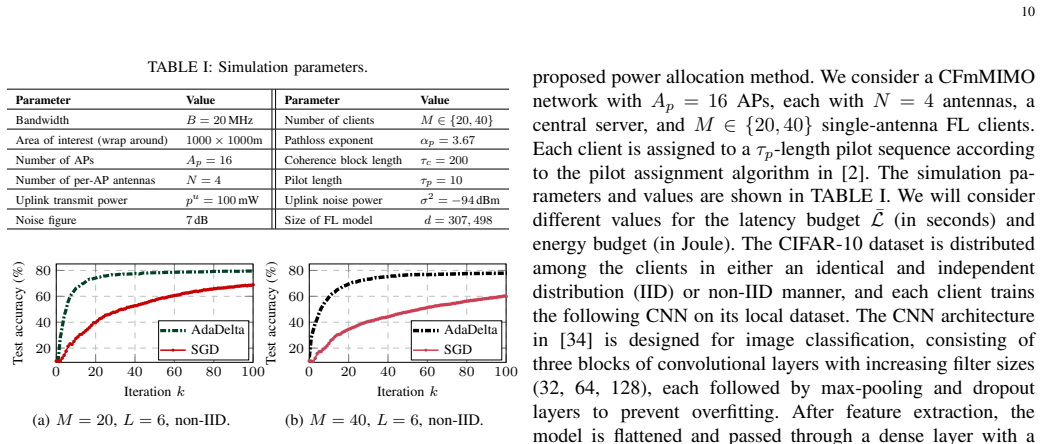
- FedAvg with local AdaDelta updates reaches about 78% test accuracy in fewer than 39 iterations in the paper's CIFAR-10 setup, roughly three times faster than local SGD, which underpins the benefit of pairing AdaDelta with adaptive quantization.
- The convergence analysis claims that, for a sufficiently small step size alpha, the expected loss increment satisfies E{f(w_{k+1})} - f(w_k) <= O(1/(k+1)), so the quantized adaptive scheme converges in the sense that the expected per-round improvement vanishes as k grows.
Reading between the lines
- The same exponent-mantissa encoding applies naturally to the downlink broadcast of the global model, not just uplink gradient updates, so the scheme could be extended to shrink both directions of communication with only minor changes to the bit-count accounting.
- Because the gain mechanism is "fewer bits per update buys more global iterations," the accuracy advantage over uniform-quantization baselines should grow with the model dimension d, since longer gradient vectors make the sparsity that EMQ exploits more pronounced.
- If the prefix-free code in Fig. 2 were re-estimated online from the empirical distribution of rounded mantissas, the average bit count per update would likely drop further without changing the convergence analysis, since Lemma 1's error bound depends only on rounding to the nearest integer, not on the code's exact lengths.
- The paper compares methods at the number of global iterations allowed by the same budget, so a reader should treat the reported percentage gains as combined gains in both accuracy and iteration count, not as accuracy gains at a fixed number of iterations.
Signed reviews
Editorial analysis
A structured set of objections, weighed in public.
Referee Report
Summary. The paper proposes EFCAQ, a federated learning framework over cell-free massive MIMO networks in which clients use local AdaDelta updates with an adaptive number of local iterations, quantize local updates with the proposed exponent-mantissa quantization (EMQ) scheme, and transmit under uplink power coefficients obtained from an SQP-based solution of a weighted energy-latency optimization problem. The authors provide a quantization error analysis, a convergence analysis of FedAvg with local AdaDelta updates, and CIFAR-10 simulations comparing against Dinkelbach and max-sum rate power allocation and AQUILA/LAQ quantization baselines under equal energy and latency budgets.
Significance. If the numerical results are taken at face value, the paper demonstrates a practically useful combination of techniques: adaptive element-wise EMQ quantization together with per-iteration power allocation increases both test accuracy and the number of completed global iterations under identical energy and latency budgets. The system model is detailed, the comparisons in Tables II and III are extensive across IID/non-IID settings and multiple budgets, and the reported gains are consistent with the proposed mechanisms. The paper also contributes an explicit quantization error analysis and a first analysis of FedAvg with local AdaDelta updates, though the theoretical parts currently contain gaps that need to be fixed before the convergence claims can be accepted.
major comments (5)
- [§IV, Eq. (33)] Proposition 2's bound (33) is not a convergence statement. The inequality E_k{f(w_{k+1})} ≤ f(w_k) + [1+G^2+σ_k^2+(1-ρ^{L-1})^{-1}]/(k+1) only bounds the expected one-step increase by O(1/k); a sequence such as f(w_k)=log k satisfies this bound while diverging. The sentence after (33), stating that E{f(w_{k+1})}-f(w_k)→0, only shows that the per-step increments vanish, not that f(w_k) converges or that the gradient norms are summable. No descent lemma or gradient-norm bound is derived, so the claimed convergence rate of FedAvg with AdaDelta is unsupported.
- [§IV, Eq. (32)] The step-size condition in Eq. (32) depends on the total number of global iterations K, both through α1 and α2. However, K is not known when training begins; it is computed at run time from the energy and latency budgets via Eqs. (29)-(31). Thus the theorem cannot be applied a priori, and the step-size constraint is not verifiable before the training trajectory is known. This is a load-bearing gap because the convergence argument relies on choosing α according to this condition.
- [Appendix C, Eq. (41)] The proof of Proposition 1 invokes the monotone mapping inequality (g_l - g_{l-1})^T (w_l - w_{l-1}) ≥ 0 at Eq. (41), citing reference [36], a convex optimization textbook. This inequality holds for convex functions or monotone gradients, but the paper only assumes L-smoothness (Assumption 2) and uses a nonconvex CNN in Section V. For L-smooth nonconvex losses the inequality is generally false, so the chain of inequalities (41)-(45) collapses. This invalidates Proposition 1 and consequently Remark 1 and the stopping rule in Algorithm 1, which are part of the claimed acceleration mechanism.
- [Appendix A, Eq. (34)] Lemma 1's error bound ∥ε_j^k∥∞ ≤ 5·10^{u_j^k-1} assumes round-to-nearest with error at most 0.5. But the EMQ scheme encodes only mantissa values in {0,1,...,9} (Fig. 2), while the mantissa interval is [0,10). A value such as 9.7 has nearest integer 10, which is not representable, so the actual rounding rule must saturate or truncate, and the error can exceed 0.5 near the upper boundary. The quantization error analysis needs an explicit boundary condition or a modified rounding rule for this gap to be closed.
- [Remark 2] Remark 2 asserts without proof that solving sub-problems P1 and P2 at each iteration yields a sub-optimal solution to the original problem (13). No argument is provided that the per-iteration decomposition preserves feasibility of the global energy and latency budgets, or that the online policy approximates the solution of the offline joint problem. Moreover, Proposition 2 analyzes unquantized FedAvg with AdaDelta, not the full EFCAQ algorithm with EMQ; Lemma 2's error bound is not integrated into the convergence analysis. The theoretical link between the proposed framework and the convergence result is therefore missing.
minor comments (5)
- [Section V-B] The text refers to 'Figs. 5(c), and 5(c)' and later 'Figs. 6(c), and 6(c)', but the intended references are to panels (c) and (d) of the respective figures; please correct the duplicated labels.
- [Remark 1] Remark 1 states that Proposition 1 demonstrates 'a non-increasing sequence of l_j^k w.r.t. k' leads to a non-increasing sequence of u_j^k, but Proposition 1 and the rule in (15) use a non-decreasing sequence of l_j^k. This is a typo that should be fixed because the direction of monotonicity is central to the adaptive stopping rule.
- [Algorithm 1] Algorithm 1 uses l_j^{k-1} in line 11, but for k=1 no initial value l_j^0 is defined in the inputs. Please specify the initialization of l_j^0 for the first global iteration.
- [Tables II and III] The text says that rows corresponding to Algorithm 2 are 'highlighted', but the tables as typeset contain no highlighting; please add a visual marker or remove the reference to highlighting.
- [Section V] The numerical tables report single accuracy values without standard deviations or the number of random seeds; since the CNN training is stochastic, please add error bars or at least state the number of independent runs used for the reported numbers.
Circularity Check
One self-definitional element: the adaptive stop rule in Remark 1 defines u_j^k as non-increasing, so the 'decreasing quantization error' narrative is true by construction; the numerical accuracy comparisons remain independent.
-
self definitional
[Section III, Remark 1 (Eq. 15) and Algorithm 1, line 11; Proposition 1 in Appendix C]
"Based on Proposition 1, which demonstrates that for each client j ∈ [M], a non-increasing sequence of l_j^k w.r.t. k leads to a non-increasing sequence of u_j^k, we obtain: l_j^k := The first l | l ≥ l_j^{k-1}, and u_j,l,k ≤ u_j^{k-1}, and obtain u_j^k := u_j,l_j^k,k. ... if l ≥ l_j^{k-1}, and u_j,l,k ≤ u_j^{k-1} then ... Set l_j^k = l, u_j^k = u_j,l,k"
The stopping rule is defined by the exact inequality that Proposition 1 and the following text present as a derived property. Algorithm 1 stops local training at the first l with u_j,l,k ≤ u_j^{k-1}; therefore u_j^k ≤ u_j^{k-1} is guaranteed by construction for every stopped iteration, not established by the convergence argument. The only genuinely derived content would be existence of such an l, and the Appendix C proof of that existence invokes the monotone-gradient inequality (g_j,l,k − g_j,l−1,k)^T(w_j,l,k − w_j,l−1,k) ≥ 0 at Eq. (41), which is not implied by the stated L-smoothness (Assumption 2) for the nonconvex CNN used in Section V.
full rationale
The paper's central advertised results — EMQ vs AQUILA/LAQ and the proposed power allocation vs Dinkelbach/max-sum rate — are obtained from the simulations in Section V under equal energy/latency budgets and are not fitted to the theory, so they are not circular. The convergence analysis of Proposition 2 is a standard per-step bound (with correctness concerns about Eq. (41) and the K-dependent step size), but those are mathematical gaps, not circular reductions. The one identifiable circular-by-construction element is the adaptive local-iteration rule: Remark 1 and Algorithm 1 define l_j^k as the first local iteration satisfying u_j,l,k ≤ u_j^{k-1}, so the non-increasing exponent (and hence the narrative that EMQ quantization error decreases over iterations) is true by definition whenever the stopping condition fires, rather than being a prediction derived from Proposition 1. Since this supporting claim is not the main empirical deliverable, the overall score is modest rather than severe. Self-citations ([14], [17], [23]) are used for standard methodology or literature context and are not load-bearing uniqueness claims.
Assumptions & free parameters
free parameters (5)
- AdaDelta primary step size alpha =
not reported in paper
- AdaDelta decay constant rho =
not reported in paper
- AdaDelta numerical constant epsilon_a =
not reported in paper
- Scalarization weights theta_E and theta_l =
theta_E = 0.5, theta_l = 1 or 0.5 in experiments
- SQP termination tolerance epsilon_x and maximum rounds I_max =
not reported in paper
assumptions (4)
- domain assumption The loss functions satisfy Assumptions 1-5: unbiased gradients, L-smoothness, bounded local variance, bounded global variance, and bounded gradients.
- ad hoc to paper Client losses are convex or gradients are monotone, so that (g_l - g_{l-1})^T (w_l - w_{l-1}) >= 0.
- ad hoc to paper Mantissa rounding to the nearest integer has error at most 0.5 even though the EMQ code supports only rounded values 0 to 9.
- domain assumption The total number of global iterations K is known before training when the step size alpha is set.
Cite this review
Pith. "Pith review of Accelerating Energy-Efficient Federated Learning in Cell-Free Networks with Adaptive Quantization." pith.science (2026). https://pith.science/paper/JLZETU4J
@misc{pith2026241220785,
  author       = {Pith},
  title        = {Pith review of: Accelerating Energy-Efficient Federated Learning in Cell-Free Networks with Adaptive Quantization},
  year         = {2026},
  howpublished = {\url{https://pith.science/paper/JLZETU4J}},
  note         = {Machine review of arXiv:2412.20785}
}
abstract
Federated Learning (FL) enables clients to share learning parameters instead of local data, reducing communication overhead. Traditional wireless networks face latency challenges with FL. In contrast, Cell-Free Massive MIMO (CFmMIMO) can serve multiple clients on shared resources, boosting spectral efficiency and reducing latency for large-scale FL. However, clients' communication resource limitations can hinder the completion of the FL training. To address this challenge, we propose an energy-efficient, low-latency FL framework featuring optimized uplink power allocation for seamless client-server collaboration. Our framework employs an adaptive quantization scheme, dynamically adjusting bit allocation for local gradient updates to reduce communication costs. We formulate a joint optimization problem covering FL model updates, local iterations, and power allocation, solved using sequential quadratic programming (SQP) to balance energy and latency. Additionally, clients use the AdaDelta method for local FL model updates, enhancing local model convergence compared to standard SGD, and we provide a comprehensive analysis of FL convergence with AdaDelta local updates. Numerical results show that, within the same energy and latency budgets, our power allocation scheme outperforms the Dinkelbach and max-sum rate methods by increasing the test accuracy up to $7$\% and $19$\%, respectively. Moreover, for the three power allocation methods, our proposed quantization scheme outperforms AQUILA and LAQ by increasing test accuracy by up to $36$\% and $35$\%, respectively.
Figures


Figures from the paper (3 more)


Reference graph
Works this paper leans on
-
[36]
Boyd et al., Convex Optimization
S. Boyd et al., Convex Optimization. USA: Cambridge University Press, 2004
work page 2004
-
[1]
Federated learning: Strategies for improving com- munication efficiency,
J. Kone ˇcn`y et al. , “Federated learning: Strategies for improving com- munication efficiency,” arXiv preprint arXiv:1610.05492 , 2016
arXiv 2016
-
[2]
Foundations of user-centric cell-free Massive MIMO,
O. T. Demir et al. , “Foundations of user-centric cell-free Massive MIMO,” Foundations and Trends in Signal Processing, vol. 14, no. 3-4, pp. 162–472, 2021
work page 2021
-
[3]
Wireless communications for collaborative Federated Learning,
M. Chen et al. , “Wireless communications for collaborative Federated Learning,” IEEE Communications Magazine , vol. 58, pp. 48–54, 2020
work page 2020
-
[4]
Communication-efficient Federated Learning with adaptive quantization,
Y . Mao et al. , “Communication-efficient Federated Learning with adaptive quantization,” ACM Transactions on Intelligent Systems and Technology (TIST), vol. 13, no. 4, pp. 1–26, 2022
work page 2022
-
[5]
Adaptive quantization of model updates for communication-efficient Federated Learning,
D. Jhunjhunwala et al. , “Adaptive quantization of model updates for communication-efficient Federated Learning,” in 2021 IEEE ICASSP , pp. 3110–3114
work page 2021
-
[6]
Joint compression and deadline optimization for wireless Federated Learning,
M. Zhang et al. , “Joint compression and deadline optimization for wireless Federated Learning,” IEEE Transactions on Mobile Computing, vol. 23, no. 7, pp. 7939–7951, 2024
work page 2024
-
[7]
FedDQ: Communication-efficient Federated Learning with descending quantization,
L. Qu et al., “FedDQ: Communication-efficient Federated Learning with descending quantization,” in 2022 IEEE GLOBECOM , pp. 281–286
work page 2022
Show all 36 references
-
[8]
AQUILA: Communication efficient Federated Learning with adaptive quantization in device selection strategy,
Z. Zhao et al., “AQUILA: Communication efficient Federated Learning with adaptive quantization in device selection strategy,” IEEE Transac- tions on Mobile Computing , vol. 23, no. 6, pp. 7363–7376, 2024
2024
-
[9]
DAdaQuant: Doubly-adaptive quantization for communication-efficient Federated Learning,
R. H ¨onig et al. , “DAdaQuant: Doubly-adaptive quantization for communication-efficient Federated Learning,” in ICML, 2022, pp. 8852– 8866
2022
-
[10]
Lazily Aggregated Quantized Gradient (LAQ) innovation for communication-efficient Federated Learning,
J. Sun et al., “Lazily Aggregated Quantized Gradient (LAQ) innovation for communication-efficient Federated Learning,” IEEE Transactions on Pattern Analysis and Machine Intelligence , 2022
2022
-
[11]
A-LAQ: Adaptive Lazily Aggregated Quantized Gradient,
A. Mahmoudi et al. , “A-LAQ: Adaptive Lazily Aggregated Quantized Gradient,” in 2022 IEEE Globecom Workshops (GC Wkshps) , 2022
2022
-
[12]
Cell-free Massive MIMO for wireless Federated Learning,
T. T. Vu et al. , “Cell-free Massive MIMO for wireless Federated Learning,” IEEE Transactions on Wireless Communications , vol. 19, no. 10, pp. 6377–6392, 2020
2020
-
[13]
FedAQ: Communication-efficient Federated Edge Learning via joint uplink and downlink adaptive quantization,
L. Qu et al., “FedAQ: Communication-efficient Federated Edge Learning via joint uplink and downlink adaptive quantization,” arXiv preprint arXiv:2406.18156, 2024
2024 arXiv
-
[14]
Joint energy and latency optimization in Feder- ated Learning over cell-free massive MIMO networks,
A. Mahmoudi et al. , “Joint energy and latency optimization in Feder- ated Learning over cell-free massive MIMO networks,” in 2024 IEEE Wireless Communications and Networking Conference (WCNC) , 2024
2024
-
[15]
Energy efficient Federated Learning over wireless com- munication networks,
Z. Yang et al., “Energy efficient Federated Learning over wireless com- munication networks,” IEEE Transactions on Wireless Communications, 2021
2021
-
[16]
Distributed Federated Learning for ultra-reliable low-latency vehicular communications,
S. Samarakoon et al., “Distributed Federated Learning for ultra-reliable low-latency vehicular communications,” IEEE Transactions on Commu- nications, 2020
2020
-
[17]
Fedcau: A proactive stop policy for communica- tion and computation efficient Federated Learning,
A. Mahmoudi et al., “Fedcau: A proactive stop policy for communica- tion and computation efficient Federated Learning,” IEEE Transactions on Wireless Communications, 2024
2024
-
[18]
FedCPF: An efficient-communication Federated Learning approach for vehicular edge computing in 6g communication networks,
S. Liu et al., “FedCPF: An efficient-communication Federated Learning approach for vehicular edge computing in 6g communication networks,” IEEE Transactions on Intelligent Transportation Systems , 2022
2022
-
[19]
Communication-efficient Federated Learning: A variance-reduced stochastic approach with adaptive sparsification,
B. Wang et al. , “Communication-efficient Federated Learning: A variance-reduced stochastic approach with adaptive sparsification,”IEEE Transactions on Signal Processing , 2023
2023
-
[20]
FLAS: Computation and communication efficient Feder- ated Learning via adaptive sampling,
J. Shu et al., “FLAS: Computation and communication efficient Feder- ated Learning via adaptive sampling,” IEEE Transactions on Network Science and Engineering , 2022
2022
-
[21]
ARFL: Adaptive and robust Federated Learning,
M. P. Uddin et al. , “ARFL: Adaptive and robust Federated Learning,” IEEE Transactions on Mobile Computing , 2023
2023
-
[22]
Efficient Federated Learning via local adaptive amended optimizer with linear speedup,
Y . Sun et al., “Efficient Federated Learning via local adaptive amended optimizer with linear speedup,” IEEE Transactions on Pattern Analysis and Machine Intelligence , 2023
2023
-
[23]
Adaptive quantization resolution and power control for Federated Learning over cell-free networks,
A. Mahmoudi and E. Bj ¨ornson, “Adaptive quantization resolution and power control for Federated Learning over cell-free networks,” 2024. [Online]. Available: https://arxiv.org/abs/2412.10878
2024 arXiv
-
[24]
SAFARI: Sparsity-enabled Federated Learning with limited and unreliable communications,
Y . Mao et al. , “SAFARI: Sparsity-enabled Federated Learning with limited and unreliable communications,” IEEE Transactions on Mobile Computing, vol. 23, no. 5, pp. 4819–4831, 2024
2024
-
[25]
Machine learning at the wireless edge: Distributed stochastic gradient descent Over-the-Air,
M. M. Amiri et al., “Machine learning at the wireless edge: Distributed stochastic gradient descent Over-the-Air,” in 2019 IEEE ISIT, pp. 1432– 1436
2019
-
[26]
More communication does not result in smaller general- ization error in Federated Learning,
R. Chor et al., “More communication does not result in smaller general- ization error in Federated Learning,” arXiv preprint arXiv:2304.12216 , 2023
2023 arXiv
-
[27]
Adadelta: An adaptive learning rate method,
M. D. Zeiler, “Adadelta: An adaptive learning rate method,” arXiv preprint arXiv:1212.5701, 2012
2012 arXiv
-
[28]
On the convergence of FedAvg on non-iid data,
X. Li et al. , “On the convergence of FedAvg on non-iid data,” arXiv preprint arXiv:1907.02189, 2019
1907 arXiv
-
[29]
Widrow et al
B. Widrow et al. , Quantization noise: roundoff error in digital com- putation, signal processing, control, and communications . Cambridge University Press, 2008
2008
-
[30]
Cell-free Massive MIMO versus small cells,
H. Q. Ngo et al., “Cell-free Massive MIMO versus small cells,” IEEE Transactions on Wireless Communications , 2017
2017
-
[31]
Nocedal et al., Numerical optimization
J. Nocedal et al., Numerical optimization. Springer, 1999
1999
-
[32]
Adaptive federated optimization,
S. Reddi et al. , “Adaptive federated optimization,” arXiv preprint arXiv:2003.00295, 2020
2003 arXiv
-
[33]
Decentralized federated averaging,
T. Sun et al. , “Decentralized federated averaging,” IEEE Transactions on Pattern Analysis and Machine Intelligence , vol. 45, no. 4, pp. 4289– 4301, 2022
2022
-
[34]
Over-the-air federated learning over scalable cell- free massive mimo,
H. Sifaou et al. , “Over-the-air federated learning over scalable cell- free massive mimo,” IEEE Transactions on Wireless Communications , vol. 23, no. 5, 2024
2024
-
[35]
Energy-efficient power control: A look at 5G wireless technologies,
A. Zappone et al., “Energy-efficient power control: A look at 5G wireless technologies,” IEEE Transactions on Signal Processing , vol. 64, pp. 1668–1683, 2015
2015
Reviewed August 10, 2026 · model on record in the stance chip above.
Discussion (0). Continue with ORCID to comment.