REVIEW 3 major objections 4 minor 40 references
SoftPatch+: Fully Unsupervised Anomaly Classification and Segmentation
T0 review · 3 major / 4 minor · reviewed 2026-08-10 · deepseek-v4-flash
Pith's one-line read SoftPatch+ claims that fully unsupervised industrial anomaly detection with up to 40% noisy training data is practical: patch-level outlier scoring removes defective patches before coreset construction, and the stored outlier scores…
desk verdict Patch-level denoising for contaminated training data is a good idea, but the paper's headline robustness claim only holds in the overlap protocol, which leaks test anomalies into training; in the cleaner no-overlap setting, SoftPatch+ actually trails PatchCore. read the letter →
The pith
A machine-rendered reading of the paper's core claim, the machinery that carries it, and where it could break.
The reading
What carries the argument
The central object is the position-grouped patch feature stack φ_i(h,w), where each patch's outlier score is computed per spatial location across all training images. Three discriminators supply these scores: nearest-neighbor distance W_nn, Mahalanobis distance W_mvg under a per-position multivariate Gaussian, and Local Outlier Factor W_LOF, which measures a patch's local density relative to its k-nearest neighbors. SoftPatch+ rank-normalizes each score and averages them into a fused vote W_vote, then removes the top τ% of patches by fused score before greedy coreset sampling. The remaining scores are stored as soft weights W_{m*} in the memory bank, and each test patch's anomaly score is computed as s_{h,w} = W_{m*} ||p - m*||_2, which re-weights the nearest-neighbor distance by the noise level of the matched memory patch.
What would settle it
Build a training set where defects are large, dense, and visually close to normal texture (e.g., roughness variations covering most of a machined part), inject 40% such noisy images, and measure the denoiser's patch-level outlier AUROC against ground-truth defect maps; if the denoiser ranks defective patches near chance, the memory bank becomes corrupted and SoftPatch+ should fall to the PatchCore baseline. Extending the overlap setting to 45-50% noise on MVTecAD would also test the declared ceiling.
Extended reading notes
Core claim
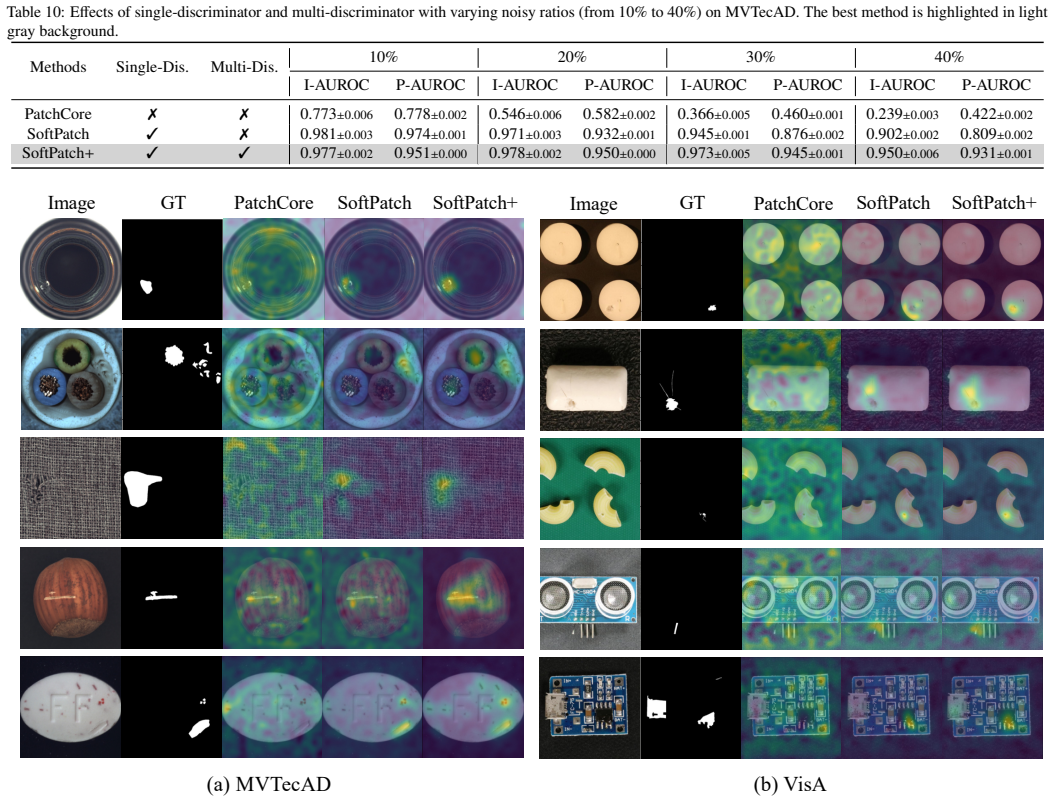
The paper's central claim is that noisy training data in unsupervised anomaly detection is best handled at the patch level, not the image level, because defects typically occupy only a tiny image region. The proposed SoftPatch+ method groups patch features by position, computes outlier scores for every training patch using nearest-neighbor distance, per-position multivariate Gaussian Mahalanobis distance, and Local Outlier Factor, removes the top τ% of patches before coreset sampling, and stores the remaining outlier scores as soft weights in the memory bank. At inference, the nearest-neighbor anomaly score of each test patch is multiplied by the stored soft weight of its matched memory patch, softening the decision boundary. The paper reports that SoftPatch and SoftPatch+ outperform previous state-of-the-art methods on MVTecAD, VisA, and BTAD under noise ratios from 10% to 40%, and that SoftPatch+ remains close to the clean-training upper bound in both overlap and no-overlap settings.
Load-bearing premise
Defective patches are statistical outliers in the per-position feature distribution of the noisy training set, so LOF, Mahalanobis, or nearest-neighbor scores can rank them before coreset construction, and if defective patches are densely clustered or highly similar to normal patches, the denoiser will retain noise and remove normal patches, breaking the memory bank.
Editorial extensions
If this is right
- A memory-bank detector can be trained on unfiltered production-line images containing up to roughly 40% defective samples and still localize defects at test time.
- Patch-level denoising outperforms image-level denoising because normal regions of defective images are retained and contribute to the coreset.
- Fusing LOF with Gaussian (Mahalanobis) discriminators is more robust at high noise ratios than either alone, since LOF degrades with heavy contamination while Gaussian stays stable.
- With no added noise, SoftPatch and SoftPatch+ match conventional clean-data performance, so adopting them does not sacrifice standard-setting results.
- Using separate removal thresholds for classification (τ = 0.15) and segmentation (τ = 0.50) improves both image-level and pixel-level AUROC.
Reading between the lines
- The per-position outlier assumption implies the method would struggle on whole-surface defects that cover most of the image, where few normal patches remain to anchor the feature distribution; this failure mode is not covered by the paper's benchmarks.
- The patch-level denoising and soft-weighting scheme could be ported to other nearest-neighbor memory methods, such as graph-based or transformer-based detectors, as a preprocessing step independent of the coreset algorithm.
- A natural testable extension is to use the stored soft weights as confidence values for active learning, requesting human labels only for the lowest-weight patches in the memory bank.
- Because the paper keeps τ and LOF-K constant across all noise ratios, an adaptive threshold estimator that infers the noise level from the outlier-score distribution could push robustness beyond the reported 40% ceiling.
Editorial analysis
A structured set of objections, weighed in public.
Referee Report
Summary. The paper addresses unsupervised anomaly detection when the training set itself contains anomalous (noisy) samples, a setting it calls fully unsupervised industrial AD. The proposed methods, SoftPatch and SoftPatch+, build on PatchCore. Features from a pretrained backbone are grouped by spatial position; per-position outlier scores are computed with nearest-neighbor distance, multivariate Gaussian/Mahalanobis distance, or LOF; the top tau percent of patches are removed before coreset construction; and the remaining patches are stored with soft outlier weights that re-weight the PatchCore nearest-neighbor anomaly score. SoftPatch+ fuses rank-normalized LOF and Gaussian scores. Experiments on MVTecAD, VisA, and BTAD are reported under two protocols, no-overlap and overlap, with noise ratios up to 10-40%. The paper claims that both methods outperform state-of-the-art AD methods under noisy training data and remain competitive in the clean setting.
Significance. If the claims are validated, the patch-level denoising and soft-weighting mechanism would be a practically useful contribution, since production-line training data cannot always be guaranteed clean. The methods are clearly specified, the code is released, and the experiments include repeated runs with standard deviations, which aids reproducibility. The ablation study supports the value of patch-level rather than image-level denoising. However, the evaluation protocol leaves the headline claim conditional: the high-noise results are obtained only in the overlap protocol, where test anomalies have near-duplicates in the training noise, and in no-overlap classification the method does not surpass PatchCore. The significance of the work therefore depends on whether the authors can validate robustness to unseen anomaly instances or anomaly types.
major comments (3)
- [Sec. 5.2, Tables 1 and 3] The abstract claims that both SoftPatch and SoftPatch+ outperform state-of-the-art AD methods on MVTecAD and VisA, but the no-overlap classification results do not support this for SoftPatch+. On MVTecAD at 10% noise, SoftPatch+ obtains 0.982 image-level AUROC versus 0.984 for PatchCore; on VisA at 8% noise, SoftPatch+ obtains 0.933 and SoftPatch-LOF obtains 0.937, both below PatchCore's 0.944. The no-overlap setting is the only protocol that evaluates anomaly instances not present in the training noise, so the claimed superiority in robustness is not established for unseen defects. Please either restrict the claim to the overlap protocol, or add no-overlap evaluations at higher noise ratios, for example by holding out entire anomaly types rather than individual instances.
- [Sec. 4, Overlap protocol and Fig. 4] The high-noise curves in Fig. 4 and the headline 10-40% results are generated only under the overlap protocol, where the training noise consists of augmented copies of the test anomaly images. The Discussion in Sec. 4 asserts that fully unsupervised anomaly detection does not face overfitting issues with overlap settings, but no analysis is provided to support this assertion. Because each test anomaly has a near-duplicate (rotation/translation) in the training set, the overlap protocol largely measures the method's ability to filter or recognize the specific injected defect instances, not its ability to generalize to unseen anomaly appearances. The Limitations section itself concedes that the current evaluation method may be related to the specific dataset distribution. Please provide evidence from a protocol with strictly disjoint anomaly instances or anomaly types before claiming robust performance under 10-40% noise.
- [Sec. 5.1 and Sec. 5.3.2] The removal thresholds tau_cls=0.15 and tau_seg=0.50 are described as fixed constants, but Fig. 5 shows that these values were selected by sweeping the threshold and measuring AUROC on the evaluation benchmark. In a fully unsupervised setting, no labels are available for such selection, so benchmark-tuned thresholds can inflate the reported gains. Please demonstrate that the conclusions are robust across a plausible range of thresholds, or propose an unsupervised criterion for setting tau_cls and tau_seg.
minor comments (4)
- [Tables 2 and 10] Tables 2 and 10 report different pixel-level AUROC for SoftPatch+ at 10% noise on MVTecAD (0.978 in Table 2 Overlap versus 0.951 in Table 10); please reconcile these numbers.
- [Sec. 3.3, Eq. (8)] The indicator variables s_m are defined only as elements of {0,1}; the text should state the rule for setting them, for example which discriminators are included in SoftPatch+.
- [Fig. 4] Figure 4 has no legend or line labels in the caption, making it difficult to identify which curve corresponds to which method.
- [Throughout] There are several typographical errors, including 'SoftPach' in Sec. 5.2 and 'articularly' in the Abstract; a careful proofread is needed.
Circularity Check
The central high-noise robustness claim (10-40%) is established only under the Overlap protocol, where test anomalies are augmented copies of the very anomalous images injected into the training set; the No-Overlap tables show SoftPatch+ actually trailing PatchCore.
-
other
[Sec. 4 (Overlap setting; see also Sec. 5.2, Fig. 4)]
"Overlap: To evaluate the effectiveness of our method with high noisy ratios, we construct the Overlap mode where those selected anomalous samples are still included in the testing set. ... we perform appropriate data augmentation on the sampled noisy images ... In short, the Overlap mode can ensure that we build noisy anomaly detection experiments with high noise ratios (such as 10%-40%)."
The headline robustness claim at 10-40% noise is measured only in the Overlap protocol, where every test anomaly is an augmented copy (rotation within [-3,3] degrees, translation within [-0.03,0.03]) of an anomalous image placed into the training set. The training input therefore contains the very test targets that are later "predicted", so the high-noise AUROC in Fig. 4 measures recognition of seen (or near-duplicate) anomaly instances rather than generalization to unseen defects. The Discussion asserts that overlap introduces no overfitting issue, but provides no evidence; the No-Overlap tables in the same paper show SoftPatch+ slightly below PatchCore (0.982 vs 0.984 on MVTecAD classification; 0.937 vs 0.944 on VisA classification).
full rationale
The method-level derivation is self-contained: Eqs. 1-10 define per-position outlier scores and a reweighted nearest-neighbor anomaly score, with no parameter fitted to test labels and no rank-normalized fusion quantity that is secretly the prediction target. Self-citation [16] is only a pointer to the preliminary conference version and is not load-bearing. The circularity burden therefore lies not in the equations but in the evaluation protocol supporting the central claim: at 10-40% noise the comparison runs only under the Overlap setting, whose test anomalies are augmented copies of training noise, making the advertised high-noise superiority partly a consequence of the protocol construction rather than an independent prediction. Secondary concerns, such as choosing tau and LOF-K from Fig. 5 on the reported benchmark and observing that No-Overlap results do not favor the method, are model-selection and generalization risks rather than derivation-level circularity. Overall, the circularity is partial: it affects the empirical claim of high-noise robustness, not the algorithmic derivation itself.
Assumptions & free parameters
free parameters (4)
- LOF-K =
6
- tau_cls =
0.15
- tau_seg =
0.50
- coreset_sampling_ratio =
10%
assumptions (4)
- domain assumption Pre-trained Wide-ResNet50 features provide a suitable patch-level representation for industrial anomaly detection.
- domain assumption Noisy (anomalous) patches are outliers in the per-position feature distribution of the training set, so nearest-neighbor, Mahalanobis, and LOF scores can rank them.
- domain assumption A noisy image is mostly normal patches, so patch-level removal retains useful training information.
- ad hoc to paper The constructed overlap and no-overlap noise settings approximate real-world production-line noise.
Cite this review
Pith. "Pith review of SoftPatch+: Fully Unsupervised Anomaly Classification and Segmentation." pith.science (2026). https://pith.science/paper/NJEHVGKX
@misc{pith2026241220870,
  author       = {Pith},
  title        = {Pith review of: SoftPatch+: Fully Unsupervised Anomaly Classification and Segmentation},
  year         = {2026},
  howpublished = {\url{https://pith.science/paper/NJEHVGKX}},
  note         = {Machine review of arXiv:2412.20870}
}
read the original abstract
Although mainstream unsupervised anomaly detection (AD) (including image-level classification and pixel-level segmentation)algorithms perform well in academic datasets, their performance is limited in practical application due to the ideal experimental setting of clean training data. Training with noisy data is an inevitable problem in real-world anomaly detection but is seldom discussed. This paper is the first to consider fully unsupervised industrial anomaly detection (i.e., unsupervised AD with noisy data). To solve this problem, we proposed memory-based unsupervised AD methods, SoftPatch and SoftPatch+, which efficiently denoise the data at the patch level. Noise discriminators are utilized to generate outlier scores for patch-level noise elimination before coreset construction. The scores are then stored in the memory bank to soften the anomaly detection boundary. Compared with existing methods, SoftPatch maintains a strong modeling ability of normal data and alleviates the overconfidence problem in coreset, and SoftPatch+ has more robust performance which is articularly useful in real-world industrial inspection scenarios with high levels of noise (from 10% to 40%). Comprehensive experiments conducted in diverse noise scenarios demonstrate that both SoftPatch and SoftPatch+ outperform the state-of-the-art AD methods on the MVTecAD, ViSA, and BTAD benchmarks. Furthermore, the performance of SoftPatch and SoftPatch+ is comparable to that of the noise-free methods in conventional unsupervised AD setting. The code of the proposed methods can be found at https://github.com/TencentYoutuResearch/AnomalyDetection-SoftPatch.
Figures


Figures from the paper (3 more)


Reference graph
Works this paper leans on
-
[1]
V . Zavrtanik, M. Kristan, D. Skoˇcaj, Dsr–a dual subspace re-projection net- work for surface anomaly detection, in: European conference on computer vision, Springer, 2022, pp. 539–554
work page 2022
-
[2]
C. Ding, G. Pang, C. Shen, Catching both gray and black swans: Open-set supervised anomaly detection, in: Proceedings of the IEEE/CVF Confer- ence on Computer Vision and Pattern Recognition, 2022, pp. 7388–7398
work page 2022
-
[3]
Z. Hu, Z. Yang, X. Hu, R. Nevatia, Simple: Similar pseudo label exploita- tion for semi-supervised classification, in: Proceedings of the IEEE/CVF Conference on Computer Vision and Pattern Recognition (CVPR), 2021, pp. 15099–15108
work page 2021
-
[4]
K. Sohn, D. Berthelot, N. Carlini, Z. Zhang, H. Zhang, C. A. Raffel, E. D. Cubuk, A. Kurakin, C.-L. Li, Fixmatch: Simplifying semi-supervised learning with consistency and confidence, Advances in Neural Information Processing Systems 33 (2020) 596–608
work page 2020
-
[5]
J. Li, R. Socher, S. C. Hoi, Dividemix: Learning with noisy labels as semi-supervised learning, in: International Conference on Learning Repre- sentations, 2020
work page 2020
-
[6]
M. Xu, Z. Zhang, H. Hu, J. Wang, L. Wang, F. Wei, X. Bai, Z. Liu, End- to-end semi-supervised object detection with soft teacher, in: Proceedings of the IEEE/CVF International Conference on Computer Vision, 2021, pp. 3060–3069
work page 2021
- [7]
-
[8]
F. Yang, K. Wu, S. Zhang, G. Jiang, Y . Liu, F. Zheng, W. Zhang, C. Wang, L. Zeng, Class-aware contrastive semi-supervised learning, in: Proceed- ings of the IEEE/CVF Conference on Computer Vision and Pattern Recog- nition, 2022, pp. 14421–14430
work page 2022
Show all 40 references
-
[9]
H. Song, M. Kim, D. Park, Y . Shin, J.-G. Lee, Learning from noisy labels with deep neural networks: A survey, IEEE Transactions on Neural Networks and Learning Systems (2022)
2022
-
[10]
K. Roth, L. Pemula, J. Zepeda, B. Sch ¨olkopf, T. Brox, P. Gehler, To- wards total recall in industrial anomaly detection, in: Proceedings of the IEEE/CVF Conference on Computer Vision and Pattern Recognition, 2022, pp. 14318–14328
2022
-
[11]
Gudovskiy, S
D. Gudovskiy, S. Ishizaka, K. Kozuka, Cflow-ad: Real-time unsupervised anomaly detection with localization via conditional normalizing flows, in: Proceedings of the IEEE/CVF Winter Conference on Applications of Computer Vision, 2022, pp. 98–107
2022
-
[12]
Zheng, X
Y . Zheng, X. Wang, R. Deng, T. Bao, R. Zhao, L. Wu, Focus your distribu- tion: Coarse-to-fine non-contrastive learning for anomaly detection and localization, in: 2022 IEEE International Conference on Multimedia and Expo (ICME), IEEE, 2022, pp. 1–6
2022
-
[13]
Bergmann, M
P. Bergmann, M. Fauser, D. Sattlegger, C. Steger, Mvtec ad–a compre- hensive real-world dataset for unsupervised anomaly detection, in: Pro- ceedings of the IEEE/CVF Conference on Computer Vision and Pattern Recognition, 2019, pp. 9592–9600
2019
-
[14]
Y . Zou, J. Jeong, L. Pemula, D. Zhang, O. Dabeer, Spot-the-difference self-supervised pre-training for anomaly detection and segmentation, in: 14 Table 10: Effects of single-discriminator and multi-discriminator with varying noisy ratios (from 10% to 40%) on MVTecAD. The best...
2022
-
[15]
Mishra, R
P. Mishra, R. Verk, D. Fornasier, C. Piciarelli, G. L. Foresti, Vt-adl: A vision transformer network for image anomaly detection and localization, in: 2021 IEEE 30th International Symposium on Industrial Electronics (ISIE), IEEE, 2021, pp. 01–06
2021
-
[16]
J. Xi, J. Liu, J. Wang, Q. Nie, K. WU, Y . Liu, C. Wang, F. Zheng, Softpatch: Unsupervised anomaly detection with noisy data, in: A. H. Oh, A. Agarwal, D. Belgrave, K. Cho (Eds.), Advances in Neural Information Processing Systems, 2022
2022
-
[17]
Sheynin, S
S. Sheynin, S. Benaim, L. Wolf, A hierarchical transformation- discriminating generative model for few shot anomaly detection, in: Pro- ceedings of the IEEE/CVF International Conference on Computer Vision (ICCV), 2021, pp. 8495–8504
2021
-
[18]
C.-L. Li, K. Sohn, J. Yoon, T. Pfister, Cutpaste: Self-supervised learning for anomaly detection and localization, in: Proceedings of the IEEE/CVF Conference on Computer Vision and Pattern Recognition, 2021, pp. 9664– 9674
2021
-
[19]
Zavrtanik, M
V . Zavrtanik, M. Kristan, D. Skoˇcaj, Draem-a discriminatively trained reconstruction embedding for surface anomaly detection, in: Proceedings of the IEEE/CVF International Conference on Computer Vision, 2021, pp. 8330–8339
2021
-
[20]
J. Ye, Y . Hu, X. Yang, Q.-F. Wang, C. Huang, K. Huang, Saliencycut: Aug- menting plausible anomalies for anomaly detection, Pattern Recognition 153 (2024) 110508
2024
-
[21]
Bergmann, M
P. Bergmann, M. Fauser, D. Sattlegger, C. Steger, Uninformed students: Student-teacher anomaly detection with discriminative latent embeddings, in: Proceedings of the IEEE /CVF Conference on Computer Vision and Pattern Recognition, 2020, pp. 4183–4192
2020
-
[22]
Salehi, N
M. Salehi, N. Sadjadi, S. Baselizadeh, M. H. Rohban, H. R. Rabiee, Mul- tiresolution knowledge distillation for anomaly detection, in: Proceedings of the IEEE/CVF Conference on Computer Vision and Pattern Recognition, 2021, pp. 14902–14912
2021
-
[23]
J. Zhu, F. Deng, J. Zhao, J. Chen, Adaptive aggregation-distillation autoen- coder for unsupervised anomaly detection, Pattern Recognition 131 (2022) 108897
2022
-
[24]
H. Deng, X. Li, Anomaly detection via reverse distillation from one-class embedding, in: Proceedings of the IEEE/CVF Conference on Computer Vision and Pattern Recognition, 2022, pp. 9737–9746
2022
-
[25]
J. Yang, Y . Shi, Z. Qi, Learning deep feature correspondence for unsu- pervised anomaly detection and segmentation, Pattern Recognition 132 (2022) 108874
2022
-
[26]
Zavrtanik, M
V . Zavrtanik, M. Kristan, D. Sko ˇcaj, Reconstruction by inpainting for visual anomaly detection, Pattern Recognition 112 (2021) 107706. 15
2021
-
[27]
Liang, J
Y . Liang, J. Zhang, S. Zhao, R. Wu, Y . Liu, S. Pan, Omni-frequency channel-selection representations for unsupervised anomaly detection, IEEE Transactions on Image Processing (2023)
2023
-
[28]
Zhang, H
W. Zhang, H. Liu, J. Xie, Y . Huang, Y . Zhang, Y . Li, R. Ramachandra, Y . Zheng, Anomaly detection via gating highway connection for retinal fundus images, Pattern Recognition 148 (2024) 110167
2024
-
[29]
Defard, A
T. Defard, A. Setkov, A. Loesch, R. Audigier, Padim: a patch distribution modeling framework for anomaly detection and localization, in: Interna- tional Conference on Pattern Recognition, Springer, 2021, pp. 475–489
2021
-
[30]
Rudolph, B
M. Rudolph, B. Wandt, B. Rosenhahn, Same same but di ffernet: Semi- supervised defect detection with normalizing flows, in: Proceedings of the IEEE/CVF Winter Conference on Applications of Computer Vision, 2021, pp. 1907–1916
2021
-
[31]
Zhang, S
F. Zhang, S. Kan, D. Zhang, Y . Cen, L. Zhang, V . Mladenovic, A graph model-based multiscale feature fitting method for unsupervised anomaly detection, Pattern Recognition 138 (2023) 109373
2023
-
[32]
S. Lee, S. Lee, B. C. Song, Cfa: Coupled-hypersphere-based feature adaptation for target-oriented anomaly localization, IEEE Access 10 (2022) 78446–78454
2022
-
[33]
J. Hou, Y . Zhang, Q. Zhong, D. Xie, S. Pu, H. Zhou, Divide-and-assemble: Learning block-wise memory for unsupervised anomaly detection, in: Proceedings of the IEEE /CVF International Conference on Computer Vision, 2021, pp. 8791–8800
2021
-
[34]
S. Han, X. Hu, H. Huang, M. Jiang, Y . Zhao, Adbench: Anomaly detection benchmark, Advances in Neural Information Processing Systems 35 (2022) 32142–32159
2022
-
[35]
G. Pang, C. Yan, C. Shen, A. v. d. Hengel, X. Bai, Self-trained deep ordinal regression for end-to-end video anomaly detection, in: Proceedings of the IEEE/CVF conference on computer vision and pattern recognition, 2020, pp. 12173–12182
2020
-
[36]
B. Liu, D. Wang, K. Lin, P.-N. Tan, J. Zhou, Rca: A deep collaborative autoencoder approach for anomaly detection., in: IJCAI, 2021, pp. 1505– 1511
2021
-
[37]
J. Yang, K. Zhou, Y . Li, Z. Liu, Generalized out-of-distribution detection: A survey, International Journal of Computer Vision (2024) 1–28
2024
-
[38]
Y . Chen, Y . Tian, G. Pang, G. Carneiro, Deep one-class classification via interpolated gaussian descriptor, in: Proceedings of the AAAI Conference on Artificial Intelligence, V ol. 36, 2022, pp. 383–392
2022
-
[39]
L. E. Peterson, K-nearest neighbor, Scholarpedia 4 (2) (2009) 1883
2009
-
[40]
M. M. Breunig, H.-P. Kriegel, R. T. Ng, J. Sander, Lof: identifying density- based local outliers, in: Proceedings of the 2000 ACM SIGMOD interna- tional conference on Management of data, 2000, pp. 93–104. 16
2000
Reviewed August 10, 2026 · model on record in the stance chip above.
Discussion (0). Continue with ORCID to comment.