REVIEW 3 major objections 4 minor 2 cited by
Timelike and gravitational anomalous entanglement from the inner horizon
T0 review · 3 major / 4 minor · reviewed 2026-08-10 · deepseek-v4-flash
Pith's one-line read The paper argues that the inner horizon of Rindler AdS3 maps to a bulk geodesic—the inner RT surface—that simultaneously reproduces the real part of holographic timelike entanglement entropy and the Chern-Simons correction to holographic…
desk verdict A genuinely new geometric object (the inner RT surface) with real explanatory payoff, but the key algebraic bridge to the twist description and the replica interpretation are asserted rather than proven. read the letter →
The pith
A machine-rendered reading of the paper's core claim, the machinery that carries it, and where it could break.
The reading
What carries the argument
The load-bearing object is the inner RT surface $\widehat E$, defined as the inverse Rindler image of the inner horizon $\tilde\rho=-T_{\tilde U}T_{\tilde V}$ of Rindler $\widetilde{\mathrm{AdS}}_3$. It is an extremal surface, the fixed-point set of the modular momentum flow $k_t^{\beta,\text{bulk}}$, and its length parameter $\hat\tau$ organizes geodesic chords whose lengths reproduce partial entanglement entropies. The argument works by mapping the interval to a thermal state, computing thermal entropy on the outer and inner horizons, and then mapping back; because the inner horizon length is already known to give the Chern-Simons entropy correction in topologically massive gravity, the IRT chord length inherits that role for arbitrary boundary intervals.
What would settle it
Compute the anomalous part of the entanglement entropy for a boundary interval using the normal-frame worldline action (100) under two different but equally valid smooth normal-frame configurations along the RT surface; if the result is frame-dependent and not equal to the regulated inner-RT chord length (113), the claimed equivalence between twist and IRT descriptions fails. A second check would be to test whether the inner-EWCS saddle (148) still equals the twist-based correction when the balance conditions (116) are violated; the equality should break precisely there.
Extended reading notes
Core claim
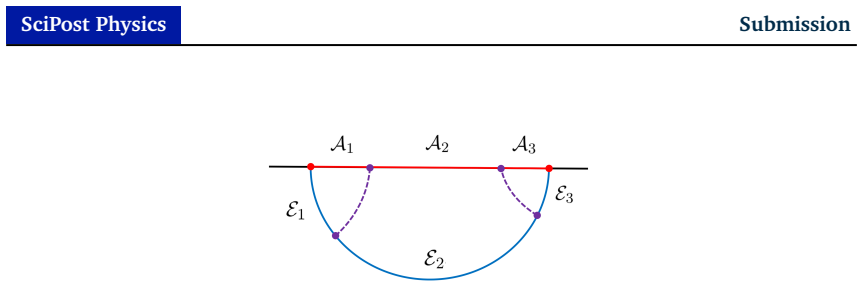
On the paper's own terms, the central discovery is that the pre-image of the inner horizon of the Rindler $\widetilde{\mathrm{AdS}}_3$ in the original Poincaré AdS3, denoted $\widehat E$, is exactly the spacelike geodesic used in the holographic description of the timelike entanglement entropy of the partner interval, and moreover that with a suitable cutoff this same surface computes the Chern-Simons correction to entanglement entropy. In formulas, for an interval $A: (-l_U/2,-l_V/2)\to(l_U/2,l_V/2)$, the inner RT surface is $\widehat E:\ \rho=-2l_V/(l_U(l_V^2-4V^2)),\ U=-(l_U/l_V)V$, anchored at the two tips of the causal development $D_A$. The regulated chord on $\widehat E$ gives the anomalous entropy $S^a_A=\frac{1}{4\mu G}\log(l_U\varepsilon_V/(l_V\varepsilon_U))$, matching both the replica-method result and the twist-description result. The paper further claims that the mixed-state correlation dual to the entanglement wedge cross section receives an anomalous part equal to the length of a saddle geodesic connecting the two components of the inner RT surface of the mixed state, called the inner EWCS, and that the twist description of [50] and [51] is equivalent to this purely geometric description.
Load-bearing premise
The argument depends on the known result that the Chern-Simons correction to black hole entropy in topologically massive gravity equals the inner-horizon length, together with the assumption that this relation transfers, via the Rindler map, to arbitrary boundary intervals; it also assumes the replica argument applies to the inner RT surface so that timelike entanglement entropy has a von Neumann entropy interpretation.
Editorial extensions
If this is right
- The real part of holographic timelike entanglement entropy is given by the length of the inner RT surface, and the imaginary part by the timelike geodesic at the boundary of the extended entanglement wedge.
- The Chern-Simons correction to entanglement entropy in TMG/CFT with gravitational anomaly is a regulated geodesic length on the inner RT surface, not a normal-frame-dependent quantity.
- The anomalous part of the balanced partial entanglement entropy equals the length of the inner EWCS, a saddle geodesic connecting pieces of the inner RT surface.
- The twist description and the IRT description agree because the normal-frame boundary data along the RT surface encode the same point-to-point partnership as the modular momentum slices.
- In the flat limit, the IRT picture reduces to the swing-surface picture of holographic entanglement entropy in flat-space holography.
Reading between the lines
- The paper does not draw this, but if the replica argument for the inner RT surface is valid, timelike entanglement entropy would be a genuine von Neumann entropy generated by the modular momentum, not merely an analytic continuation of the spacelike formula.
- The paper leaves implicit that the equivalence between twist and inner-RT length turns the twist observable in pure AdS3 into a timelike-entanglement diagnostic; a direct test would be to compare twist fluctuations along the RT surface with fluctuations of IRT chord lengths under boundary perturbations.
- The construction is specific to three bulk dimensions and locally AdS3 spacetimes; a speculative extension would ask whether an inner-horizon pre-image plays a similar role for gravitational-anomaly corrections in higher-dimensional holography, where no chord-length formula is currently known.
Editorial analysis
A structured set of objections, weighed in public.
Referee Report
Summary. The paper studies the pre-image of the inner horizon of the Rindler AdS3 obtained by the bulk Rindler transformation for a spacelike interval A, calling it the inner RT (IRT) surface. It argues that the IRT surface is exactly the spacelike geodesic representing the real part of the holographic timelike entanglement entropy for the partner timelike interval, with the timelike geodesic at the boundary of the extended entanglement wedge representing the imaginary part. In the context of topologically massive gravity, it proposes that the Chern-Simons correction to the holographic entanglement entropy is the regulated length of a geodesic chord on the IRT surface, and that the anomalous part of the balanced partial entanglement entropy is the length of a saddle geodesic chord (the "inner EWCS") connecting the two pieces of the IRT surface. Section 6 attempts to prove the equivalence between the twist description of [50] and the IRT length via Eq. (156).
Significance. If established, the paper's central claim would be a genuinely useful result: the anomalous correction to holographic entanglement entropy, previously encoded in a normal-frame "twist" along the RT surface, would become the length of a purely geometric geodesic chord on the inner RT surface, and the inner EWCS would give a geometric picture for the anomalous mixed-state correlation. The paper contains many explicit analytic computations, including the Rindler mapping, the fine structure of modular momentum slices, the explicit IRT surface equations, and a flat-limit comparison with the swing surface prescription. The derivation in Section 6 is a genuine attempt to connect the twist and IRT descriptions, and the appendices provide useful technical detail. However, the central equivalence rests on an unproved algebraic identity, and the transfer of the BTZ inner-horizon entropy formula to Rindler intervals is assumed; these gaps must be closed before the main claim can be regarded as established.
major comments (3)
- [Section 6, Eq. (156)] The equivalence between the twist description and the IRT length rests entirely on the identity log((q - \tilde{q})|_H \cdot n|_H) = \hat{\tau}_{\hat{H}}, stated in Eq. (156). This identity is asserted without derivation, and it is the bridge between the twist integral in Eqs. (154)-(155) and the IRT length parameter defined in Eq. (32). Since Eq. (157) and the claimed equivalence in Section 6, as well as the appendix-G explanation of Eq. (125), all depend on this identity, the paper should provide a proof. If the identity fails for a generic interval, the central anomaly-reproduction claim loses its derivation, and the earlier argument via Eq. (93) remains only an analogy from compact BTZ black holes to Rindler intervals.
- [Section 4.3, Eqs. (93), (95), (107)] The derivation of the anomalous holographic entanglement entropy (95) starts from the known BTZ inner-horizon entropy formula (93) and the modular Hamiltonian correction (107), and then transfers this result through the Rindler mapping to arbitrary boundary intervals. The text explicitly calls these "our starting points." This transfer is load-bearing: without it, the claim that the IRT geodesic chord computes the anomalous part of the entropy for general intervals is not established. The authors should either justify the transfer from compact BTZ horizons to the non-compact Rindler black string with the regulated cutoffs, or clearly state this step as an assumption whose failure would leave the reproduction claim heuristic.
- [Section 2.2, around Eqs. (36)-(40)] The paper proposes that the timelike entanglement entropy can be interpreted as a holographic von Neumann entropy by applying the Lewkowycz-Maldacena replica prescription to the IRT surface. The text itself later acknowledges that this replica interpretation is incomplete, stating that the role of the timelike geodesic in the analog replica story is "unclear" and that the point will be revisited in the future. Because the abstract and summary present the timelike-entanglement interpretation as one of the paper's main results, this limitation should be stated more prominently. If this replica interpretation is not needed for the anomaly-reproduction claim, the paper should say so explicitly; if it is part of the claim, it needs a concrete derivation or a clear relegation to conjecture.
minor comments (4)
- [Section 2.1, text after Eq. (10)] The sentence "where T~U and T~U are the parameters" should read "T~U and T~V"; as printed, the second symbol repeats the first.
- [Section 5.1] "One the other hand" should be "On the other hand".
- [Section 5.2.2] "were we also take L(...)" should be "where we also take L(...)".
- [Sections 2.2 and 3.2.2] The phrase "interaction line" should be "intersection line" in the sentences following Eqs. (30) and (31), and in the related discussion of M_\pm and the IRT surface.
Circularity Check
The anomalous-entropy 'reproduction' via the inner RT surface re-expresses the known TMG inner-horizon formula (93) in new coordinates, but the paper's independent geometric identifications and the twist/IRT bridge are not fitted; overall partial, not pervasive, circularity.
-
renaming known result
[Sec. 2.2 (definition of bE, Eq. (31)) and Sec. 4.3 (Eqs. (93)-(95), (113))]
"their interaction line is bE which we refer to as the inner Ryu-Takayanagi (IRT) surface ... the correction of the thermal entropy of a BTZ black hole from the CS term is proportional to the length of the inner horizon. Then it is natural to think that, the CS correction to the holographic entanglement entropy for intervals should be represented via the inner horizon in the Rindler AdS3, as well as its pre-image, the IRT surface bE."
The IRT surface is defined as the pre-image of the inner horizon under the inverse Rindler map, so its regulated length coincides with the inner-horizon length appearing in Eq. (93). Eq. (93) already states that the CS correction to the outer-horizon entropy is proportional to that inner-horizon length, and substituting the Rindler interval lengths (94) into (93) yields the anomalous part (95). Eq. (113) then re-labels the same quantity as Length(bE_reg)/(4Gµ). The 'reproduction' is therefore the input formula (93) expressed in the new bE coordinates, rather than an independent derivation of the CS correction.
full rationale
Most of the paper is a self-contained coordinate/geometric analysis: the IRT surface is constructed as the pre-image of the Rindler inner horizon; the HTEE identification is an equality between the IRT surface and the known spacelike geodesic of timelike entanglement; the modular-momentum slicing and partner-point construction are explicit; and the IEWCS length is computed directly and matched to an independent ALC evaluation of BPEa. No parameters are fitted, and the main external benchmarks ([50] and the replica result (84)) are genuinely independent of the paper's own fitted values. The one circular-looking move is the anomaly 'reproduction' in Sec. 4.3: because bE is defined as the pre-image of the inner horizon, Length(bE_reg) is the inner-horizon length of Eq. (93) by construction, so Eq. (113) restates the input TMG formula in new coordinates. This reduces the novelty of the anomaly-reproduction claim, but it does not undermine the HTEE identification or the IEWCS construction. Separately, the twist/IRT equivalence in Sec. 6 rests on the unproved algebraic identity (156), which equates the normal-frame integral primitive with the IRT length parameter; this is a completeness or correctness risk rather than a circularity, since the identity, if verified, would be a genuine algebraic bridge rather than a restatement of the conclusion.
Assumptions & free parameters
free parameters (1)
- UV cutoffs epsilon_U and epsilon_V =
not fitted; infinitesimal regulators, often set equal
assumptions (7)
- domain assumption AdS3/CFT2 duality and the Ryu-Takayanagi formula are valid for the geometries considered.
- domain assumption The Rindler transformation maps the causal development of any boundary interval to a thermal CFT and the entanglement wedge to Rindler AdS3, preserving entropies.
- domain assumption In topologically massive gravity, the Chern-Simons correction to black hole entropy equals the inner horizon length divided by 4 mu G (Eq 93), and the modular Hamiltonian receives the correction (107).
- domain assumption The worldline action with normal frame (100) from [50] correctly describes holographic entanglement entropy with gravitational anomaly.
- domain assumption The balanced partial entanglement entropy (BPE) is dual to the entanglement wedge cross section, with balance conditions (117) applied separately to normal and anomalous parts.
- domain assumption Timelike entanglement entropy is defined by analytical continuation of the spacelike entropy formula (Eq 35), and its geometric picture involves spacelike and timelike geodesics.
- ad hoc to paper The Lewkowycz-Maldacena replica prescription can be applied to the IRT surface for a timelike interval, making timelike entanglement entropy a holographic von Neumann entropy.
Cite this review
Pith. "Pith review of Timelike and gravitational anomalous entanglement from the inner horizon." pith.science (2026). https://pith.science/paper/YAOQTPUI
@misc{pith2026241221058,
  author       = {Pith},
  title        = {Pith review of: Timelike and gravitational anomalous entanglement from the inner horizon},
  year         = {2026},
  howpublished = {\url{https://pith.science/paper/YAOQTPUI}},
  note         = {Machine review of arXiv:2412.21058}
}
abstract
In the context of the AdS$_3$/CFT$_2$, the boundary causal development and the entanglement wedge of any boundary spacelike interval can be mapped to a thermal CFT$_2$ and a Rindler $\widetilde{\text{AdS}_3}$ respectively via certain boundary and bulk Rindler transformations. Nevertheless, the Rindler mapping is not confined in the entanglement wedges. While the outer horizon of the Rindler $\widetilde{\text{AdS}_3}$ is mapped to the RT surface, we also identify the pre-image of the inner horizon in the original AdS$_3$, which we call the inner RT surface. In this paper we give some new physical interpretation for the inner RT surface. First, the inner RT surface breaks into two pieces which anchor on the two tips of the causal development. Furthermore, we can take the two tips as the endpoints of a certain timelike interval and the inner RT surface is exactly the spacelike geodesic that represents the real part of the so-called holographic timelike entanglement entropy (HTEE). We also identify a timelike geodesic at boundary of the extended entanglement wedge, which represents the imaginary part of the HTEE. Second, in the duality between the topological massive gravity (TMG) and gravitational anomalous CFT$_2$, the entanglement entropy and the mixed state correlation that is dual to the entanglement wedge cross section (EWCS) receive correction from the Chern-Simons term in the TMG. We find that, the correction to the holographic entanglement entropy can be reproduced by the area of the inner RT surface with a proper regulation, while the mixed state correlation can be represented by the saddle geodesic chord connecting the two pieces of the inner RT surface of the mixed state we consider, which we call the inner EWCS. The equivalence between the twist on the RT surface and the length of inner RT surface is also discussed.
Figures


Figures from the paper (13 more)



Forward citations
Cited by 2 Pith papers
-
Temporal Entanglement from Twist Correlators in 2d Conformal Field Theory and Holography
Timelike entanglement entropy in 2d CFT is defined by time-ordered twist correlators, whose holographic saddles are complex geodesics with smallest real length, and whose imaginary part counts causal-diamond crossings...
-
Linear Growth of Holographic Time-like Entanglement Entropy and Kasner exponents
Late-time TEE growth in asymptotically AdS black holes with space-like singularities is governed by a critical extremal surface inside the horizon, with real/imaginary growth rates bounded by Schwarzschild-AdS under e...
Reference graph
Works this paper leans on
- [50]
-
[1]
J. D. Bekenstein, Black holes and the second law , Lett. Nuovo Cim. 4, 737 (1972), doi:10.1007/BF02757029
-
[2]
J. M. Bardeen, B. Carter and S. W . Hawking, The Four laws of black hole mechanics , Commun. Math. Phys. 31, 161 (1973), doi:10.1007 /BF01645742
1973
-
[3]
S. W . Hawking,Particle Creation by Black Holes, Commun. Math. Phys. 43, 199 (1975), doi:10.1007/BF02345020, [Erratum: Commun.Math.Phys. 46, 206 (1976)]
-
[4]
Strominger and C
A. Strominger and C. Vafa, Microscopic origin of the Bekenstein-Hawking entropy, Phys. Lett. B 379, 99 (1996), doi:10.1016 /0370-2693(96)00345-0, hep-th /9601029
1996
-
[5]
Sen, Extremal black holes and elementary string states, Mod
A. Sen, Extremal black holes and elementary string states, Mod. Phys. Lett. A 10, 2081 (1995), doi:10.1142 /S0217732395002234, hep-th /9504147
1995
-
[6]
A. Strominger, Black hole entropy from near horizon microstates, JHEP 02, 009 (1998), doi:10.1088/1126-6708/1998/02/009, hep-th /9712251
-
[7]
J. M. Maldacena,The Large N limit of superconformal field theories and supergravity, Adv. Theor. Math. Phys.2, 231 (1998), doi:10.4310/ATMP .1998.v2.n2.a1, hep-th/9711200
arXiv 1998
Show all 113 references
-
[8]
S. S. Gubser, I. R. Klebanov and A. M. Polyakov,Gauge theory correlators from noncritical string theory, Phys. Lett. B 428, 105 (1998), doi:10.1016 /S0370-2693(98)00377-3, hep-th/9802109
1998 arXiv
-
[9]
Witten, Anti-de Sitter space and holography, Adv
E. Witten, Anti-de Sitter space and holography, Adv. Theor. Math. Phys. 2, 253 (1998), doi:10.4310/ATMP .1998.v2.n2.a2, hep-th/9802150. 50 SciPost Physics Submission
1998 arXiv
-
[10]
Ryu and T
S. Ryu and T . Takayanagi,Holographic derivation of entanglement entropy from AdS/CFT, Phys. Rev. Lett. 96, 181602 (2006), doi:10.1103 /PhysRevLett.96.181602, hep-th / 0603001
2006
-
[11]
Ryu and T
S. Ryu and T . Takayanagi,Aspects of Holographic Entanglement Entropy, JHEP 08, 045 (2006), doi:10.1088 /1126-6708/2006/08/045, hep-th /0605073
2006
-
[12]
V . E. Hubeny , M. Rangamani and T . Takayanagi,A Covariant holographic entanglement entropy proposal, JHEP 07, 062 (2007), doi:10.1088/1126-6708/2007/07/062, 0705. 0016
2007 doi
-
[13]
Casini, M
H. Casini, M. Huerta and R. C. Myers,Towards a derivation of holographic entanglement entropy, JHEP 05, 036 (2011), doi:10.1007 /JHEP05(2011)036, 1102.0440
2011 arXiv
-
[14]
Castro, D
A. Castro, D. M. Hofman and N. Iqbal,Entanglement Entropy in Warped Conformal Field Theories, JHEP 02, 033 (2016), doi:10.1007 /JHEP02(2016)033, 1511.00707
2016 arXiv
-
[15]
W . Song, Q. Wen and J. Xu, Modifications to Holographic Entanglement Entropy in Warped CFT, JHEP 02, 067 (2017), doi:10.1007 /JHEP02(2017)067, 1610.00727
2017 arXiv
-
[16]
Jiang, W
H. Jiang, W . Song and Q. Wen,Entanglement Entropy in Flat Holography, JHEP 07, 142 (2017), doi:10.1007 /JHEP07(2017)142, 1706.07552
2017 arXiv
-
[17]
Lewkowycz and J
A. Lewkowycz and J. Maldacena, Generalized gravitational entropy , JHEP 08, 090 (2013), doi:10.1007 /JHEP08(2013)090, 1304.4926
2013 arXiv
-
[18]
Castro and M
A. Castro and M. J. Rodriguez, Universal properties and the first law of black hole inner mechanics, Phys. Rev. D86, 024008 (2012), doi:10.1103/PhysRevD.86.024008, 1204. 1284
2012 doi
-
[19]
Cvetic and F
M. Cvetic and F . Larsen, Grey body factors for rotating black holes in four-dimensions , Nucl. Phys. B 506, 107 (1997), doi:10.1016 /S0550-3213(97)00541-5, hep-th / 9706071
1997
-
[20]
Cvetic and F
M. Cvetic and F . Larsen,General rotating black holes in string theory: Grey body factors and event horizons , Phys. Rev. D 56, 4994 (1997), doi:10.1103 /PhysRevD.56.4994, hep-th/9705192
1997 arXiv
-
[21]
Cvetic, G
M. Cvetic, G. W . Gibbons and C. N. Pope,Universal Area Product Formulae for Rotating and Charged Black Holes in Four and Higher Dimensions , Phys. Rev. Lett. 106, 121301 (2011), doi:10.1103 /PhysRevLett.106.121301, 1011.0008
2011 arXiv
-
[22]
Castro and F
A. Castro and F . Larsen, Near Extremal Kerr Entropy from AdS(2) Quantum Gravity , JHEP 12, 037 (2009), doi:10.1088 /1126-6708/2009/12/037, 0908.1121
2009 arXiv
-
[23]
Ansorg and J
M. Ansorg and J. Hennig, The Inner Cauchy horizon of axisymmetric and station- ary black holes with surrounding matter , Class. Quant. Grav. 25, 222001 (2008), doi:10.1088/0264-9381/25/22/222001, 0810.3998
2008 arXiv
-
[24]
Ansorg and J
M. Ansorg and J. Hennig,The Inner Cauchy horizon of axisymmetric and stationary black holes with surrounding matter in Einstein-Maxwell theory, Phys. Rev. Lett. 102, 221102 (2009), doi:10.1103 /PhysRevLett.102.221102, 0903.5405
2009 arXiv
-
[25]
Detournay ,Inner Mechanics of 3d Black Holes, Phys
S. Detournay ,Inner Mechanics of 3d Black Holes, Phys. Rev. Lett. 109, 031101 (2012), doi:10.1103/PhysRevLett.109.031101, 1204.6088. 51 SciPost Physics Submission
2012 arXiv
-
[27]
Deser, R
S. Deser, R. Jackiw and S. Templeton,Three-Dimensional Massive Gauge Theories, Phys. Rev. Lett.48, 975 (1982), doi:10.1103 /PhysRevLett.48.975
1982
-
[28]
S. N. Solodukhin, Holography with gravitational Chern-Simons, Phys. Rev. D74, 024015 (2006), doi:10.1103 /PhysRevD.74.024015, hep-th /0509148
2006
-
[29]
Park, BTZ black hole with gravitational Chern-Simons: Thermodynamics and sta- tistical entropy, Phys
M.-I. Park, BTZ black hole with gravitational Chern-Simons: Thermodynamics and sta- tistical entropy, Phys. Rev. D 77, 026011 (2008), doi:10.1103 /PhysRevD.77.026011, hep-th/0608165
2008 arXiv
-
[30]
Sahoo and A
B. Sahoo and A. Sen, BTZ black hole with Chern-Simons and higher derivative terms , JHEP 07, 008 (2006), doi:10.1088 /1126-6708/2006/07/008, hep-th /0601228
2006
-
[31]
Tachikawa, Black hole entropy in the presence of Chern-Simons terms , Class
Y. Tachikawa, Black hole entropy in the presence of Chern-Simons terms , Class. Quant. Grav. 24, 737 (2007), doi:10.1088 /0264-9381/24/3/014, hep-th /0611141
2007
-
[32]
Bagchi, Correspondence between asymptotically flat spacetimes and non- relativistic conformal field theories , Phys
A. Bagchi, Correspondence between asymptotically flat spacetimes and non- relativistic conformal field theories , Phys. Rev. Lett. 105, 171601 (2010), doi:10.1103/PhysRevLett.105.171601
2010 doi
-
[33]
Bagchi and R
A. Bagchi and R. Fareghbal, BMS/GCA Redux: Towards Flatspace Holography from Non- Relativistic Symmetries, JHEP 10, 092 (2012), doi:10.1007 /JHEP10(2012)092, 1203. 5795
2012
-
[34]
Bagchi, S
A. Bagchi, S. Detournay , R. Fareghbal and J. Simón, Holography of 3D Flat Cosmological Horizons , Phys. Rev. Lett. 110(14), 141302 (2013), doi:10.1103/PhysRevLett.110.141302, 1208.4372
2013 arXiv
-
[35]
Barnich, Entropy of three-dimensional asymptotically flat cosmological solutions, JHEP 10, 095 (2012), doi:10.1007 /JHEP10(2012)095, 1208.4371
G. Barnich, Entropy of three-dimensional asymptotically flat cosmological solutions, JHEP 10, 095 (2012), doi:10.1007 /JHEP10(2012)095, 1208.4371
2012 arXiv
-
[36]
Bagchi, R
A. Bagchi, R. Basu, D. Grumiller and M. Riegler, Entanglement entropy in Galilean conformal field theories and flat holography, Phys. Rev. Lett. 114(11), 111602 (2015), doi:10.1103/PhysRevLett.114.111602, 1410.4089
2015 arXiv
-
[37]
K. Doi, J. Harper, A. Mollabashi, T . Takayanagi and Y. Taki,Timelike entanglement en- tropy, JHEP 05, 052 (2023), doi:10.1007 /JHEP05(2023)052, 2302.11695
2023 arXiv
-
[38]
K. Doi, J. Harper, A. Mollabashi, T . Takayanagi and Y. Taki, Pseudoentropy in dS/CFT and Timelike Entanglement Entropy , Phys. Rev. Lett. 130(3), 031601 (2023), doi:10.1103/PhysRevLett.130.031601, 2210.09457
2023 arXiv
-
[39]
Li, Z.-Q
Z. Li, Z.-Q. Xiao and R.-Q. Yang, On holographic time-like entanglement entropy, JHEP 04, 004 (2023), doi:10.1007 /JHEP04(2023)004, 2211.14883
2023 arXiv
-
[40]
Afrasiar, J
M. Afrasiar, J. K. Basak and D. Giataganas, Timelike entanglement en- tropy and phase transitions in non-conformal theories , JHEP 07, 243 (2024), doi:10.1007/JHEP07(2024)243, 2404.01393
2024 arXiv
-
[41]
Afrasiar, J
M. Afrasiar, J. K. Basak and D. Giataganas, Holographic Timelike Entanglement Entropy in Non-relativistic Theories (2024), 2411.18514. 52 SciPost Physics Submission
2024 arXiv
-
[42]
M. P . Heller, F . Ori and A. Serantes,Geometric interpretation of timelike entanglement entropy (2024), 2408.15752
2024 arXiv
-
[43]
Guo and J
W .-z. Guo and J. Xu, Imaginary part of timelike entanglement entropy (2024), 2410. 22684
2024
-
[44]
W .-z. Guo, S. He and Y.-X. Zhang,Relation between timelike and spacelike entanglement entropy (2024), 2402.00268
2024
-
[45]
Narayan, de Sitter space, extremal surfaces, and time entanglement , Phys
K. Narayan, de Sitter space, extremal surfaces, and time entanglement , Phys. Rev. D 107(12), 126004 (2023), doi:10.1103 /PhysRevD.107.126004, 2210.12963
2023 arXiv
-
[46]
S. S. Jena and S. Mahapatra, A note on the holographic time-like entanglement entropy in Lifshitz theory (2024), 2410.00384
2024 arXiv
-
[47]
P . Wang, H. Wu and H. Yang,Fix the dual geometries of T ¯T deformed CFT 2 and highly excited states of CFT2, Eur. Phys. J. C 80(12), 1117 (2020), doi:10.1140 /epjc/s10052- 020-08680-7, 1811.07758
2020 arXiv
-
[48]
Jiang, P
X. Jiang, P . Wang, H. Wu and H. Yang, Timelike entanglement entropy and TT ¯ defor- mation, Phys. Rev. D 108(4), 046004 (2023), doi:10.1103 /PhysRevD.108.046004, 2302.13872
2023 arXiv
-
[49]
D. G. Boulware and S. Deser,String Generated Gravity Models, Phys. Rev. Lett.55, 2656 (1985), doi:10.1103 /PhysRevLett.55.2656
1985
-
[51]
Wen and H
Q. Wen and H. Zhong, Covariant entanglement wedge cross-section, balanced par- tial entanglement and gravitational anomalies , SciPost Physics 13(3), 056 (2022), doi:10.21468/SciPostPhys.13.3.056, 2205.10858
2022 arXiv
-
[52]
Wen, Towards the generalized gravitational entropy for spacetimes with non-Lorentz invariant duals, JHEP 01, 220 (2019), doi:10.1007 /JHEP01(2019)220, 1810.11756
Q. Wen, Towards the generalized gravitational entropy for spacetimes with non-Lorentz invariant duals, JHEP 01, 220 (2019), doi:10.1007 /JHEP01(2019)220, 1810.11756
2019 arXiv
-
[53]
Apolo, H
L. Apolo, H. Jiang, W . Song and Y. Zhong,Swing surfaces and holographic entanglement beyond AdS/CFT, JHEP 12, 064 (2020), doi:10.1007/JHEP12(2020)064, 2006.10740
2020 arXiv
-
[54]
J. L. Cardy ,Operator Content of Two-Dimensional Conformally Invariant Theories, Nucl. Phys. B 270, 186 (1986), doi:10.1016 /0550-3213(86)90552-3
1986
-
[55]
Hartman, C
T . Hartman, C. A. Keller and B. Stoica,Universal Spectrum of 2d Conformal Field Theory in the Large c Limit, JHEP 09, 118 (2014), doi:10.1007/JHEP09(2014)118, 1405.5137
2014 arXiv
-
[56]
Mukhametzhanov and A
B. Mukhametzhanov and A. Zhiboedov, Modular invariance, tauberian theorems and microcanonical entropy, JHEP 10, 261 (2019), doi:10.1007/JHEP10(2019)261, 1904. 06359
2019 doi
-
[57]
Pal and J
S. Pal and J. Qiao, Lightcone Modular Bootstrap and Tauberian Theory: A Cardy-Like Formula for Near-Extremal Black Holes , Annales Henri Poincare 26(3), 787 (2025), doi:10.1007/s00023-024-01441-2, 2307.02587
2025 arXiv
-
[58]
I. Dey , S. Pal and J. Qiao,A universal inequality on the unitary 2D CFT partition function (2024), 2410.18174. 53 SciPost Physics Submission
2024 arXiv
-
[59]
Wen, Fine structure in holographic entanglement and entanglement contour , Phys
Q. Wen, Fine structure in holographic entanglement and entanglement contour , Phys. Rev. D98(10), 106004 (2018), doi:10.1103 /PhysRevD.98.106004, 1803.05552
2018 arXiv
-
[60]
Czech, J
B. Czech, J. L. Karczmarek, F . Nogueira and M. Van Raamsdonk, The Gravity Dual of a Density Matrix , Class. Quant. Grav. 29, 155009 (2012), doi:10.1088 /0264- 9381/29/15/155009, 1204.1330
2012 arXiv
-
[61]
A. Das, S. Sachdeva and D. Sarkar, Bulk reconstruction using timelike entanglement in (A)dS, Phys. Rev. D 109(6), 066007 (2024), doi:10.1103 /PhysRevD.109.066007, 2312.16056
2024 arXiv
-
[62]
J. K. Basak, A. Chakraborty , C.-S. Chu, D. Giataganas and H. Parihar, Massless Lifshitz field theory for arbitrary z , JHEP 05, 284 (2024), doi:10.1007 /JHEP05(2024)284, 2312.16284
2024 arXiv
-
[63]
Milekhin, Z
A. Milekhin, Z. Adamska and J. Preskill, Observable and computable entanglement in time (2025), 2502.12240
2025
-
[64]
Jiang, H
X. Jiang, H. Wu and H. Yang, Timelike entanglement entropy Revisited (2025), 2503. 19342
2025
-
[65]
Vidal and Y
G. Vidal and Y. Chen, Entanglement contour, J. Stat. Mech. 2014(10), P10011 (2014), doi:10.1088/1742-5468/2014/10/P10011, 1406.1471
2014 arXiv
-
[66]
Wen, Formulas for Partial Entanglement Entropy , Phys
Q. Wen, Formulas for Partial Entanglement Entropy , Phys. Rev. Res. 2(2), 023170 (2020), doi:10.1103 /PhysRevResearch.2.023170, 1910.10978
2020 arXiv
-
[67]
Wen, Entanglement contour and modular flow from subset entanglement entropies , JHEP 05, 018 (2020), doi:10.1007 /JHEP05(2020)018, 1902.06905
Q. Wen, Entanglement contour and modular flow from subset entanglement entropies , JHEP 05, 018 (2020), doi:10.1007 /JHEP05(2020)018, 1902.06905
2020 arXiv
-
[68]
Han and Q
M. Han and Q. Wen, Entanglement entropy from entanglement contour: higher di- mensions, SciPost Phys. Core 5, 020 (2022), doi:10.21468 /SciPostPhysCore.5.2.020, 1905.05522
2022 arXiv
-
[69]
Han and Q
M. Han and Q. Wen, First law and quantum correction for holographic entanglement contour, SciPost Physics11(3), 058 (2021), doi:10.21468/SciPostPhys.11.3.058, 2106. 12397
2021 doi
-
[70]
Kudler-Flam, I
J. Kudler-Flam, I. MacCormack and S. Ryu, Holographic entanglement contour, bit threads, and the entanglement tsunami , Journal of Physics A Mathematical General 52(32), 325401 (2019), doi:10.1088 /1751-8121/ab2dae, 1902.04654
2019 arXiv
-
[71]
D. Basu, J. Lin, Y. Lu and Q. Wen, Ownerless island and partial entanglement entropy in island phases, SciPost Physics 15(6), 227 (2023), doi:10.21468/SciPostPhys.15.6.227, 2305.04259
2023 arXiv
-
[72]
Rolph, Local measures of entanglement in black holes and CFTs, SciPost Physics 12(3), 079 (2022), doi:10.21468 /SciPostPhys.12.3.079, 2107.11385
A. Rolph, Local measures of entanglement in black holes and CFTs, SciPost Physics 12(3), 079 (2022), doi:10.21468 /SciPostPhys.12.3.079, 2107.11385
2022 arXiv
-
[73]
Lin, J.-R
Y.-Y. Lin, J.-R. Sun, Y. Sun and J.-C. Jin,The PEE aspects of entanglement islands from bit threads, JHEP 07, 009 (2022), doi:10.1007 /JHEP07(2022)009, 2203.03111
2022 arXiv
-
[74]
Lin, Distilled density matrices of holographic partial entanglement en- tropy from thread-state correspondence , Phys
Y.-Y. Lin, Distilled density matrices of holographic partial entanglement en- tropy from thread-state correspondence , Phys. Rev. D 108(10), 106010 (2023), doi:10.1103/PhysRevD.108.106010, 2305.02895. 54 SciPost Physics Submission
2023 arXiv
-
[75]
Wen, Balanced Partial Entanglement and the Entanglement Wedge Cross Section, JHEP 04, 301 (2021), doi:10.1007 /JHEP04(2021)301, 2103.00415
Q. Wen, Balanced Partial Entanglement and the Entanglement Wedge Cross Section, JHEP 04, 301 (2021), doi:10.1007 /JHEP04(2021)301, 2103.00415
2021 arXiv
-
[76]
H. A. Camargo, P . Nandy, Q. Wen and H. Zhong, Balanced partial en- tanglement and mixed state correlations , SciPost Physics 12(4), 137 (2022), doi:10.21468/SciPostPhys.12.4.137, 2201.13362
2022 arXiv
-
[77]
D. S. Ageev, Shaping contours of entanglement islands in BCFT , JHEP 03, 033 (2022), doi:10.1007/JHEP03(2022)033, 2107.09083
2022 arXiv
-
[78]
Q. Wen, M. Xu and H. Zhong, Partial entanglement entropy threads in island phase (2024), 2408.13535
2024 arXiv
-
[79]
Chandra, Z
A. Chandra, Z. Li and Q. Wen,Entanglement islands and cutoff branes from path-integral optimization, JHEP 07, 069 (2024), doi:10.1007 /JHEP07(2024)069, 2402.15836
2024 arXiv
-
[80]
J. Lin, Y. Lu, Q. Wen and Y. Zhong,Weaving the (AdS) spaces with partial entanglement entropy threads (2024), 2401.07471
2024
-
[81]
J. Lin, Y. Lu and Q. Wen, Cutoff brane vs the Karch-Randall brane: the fluctuating case , JHEP 06, 017 (2024), doi:10.1007 /JHEP06(2024)017, 2312.03531
2024 arXiv
-
[82]
J. Lin, Y. Lu and Q. Wen, Geometrizing the partial entanglement entropy: from PEE threads to bit threads, JHEP 2024(02), 191 (2024), doi:10.1007 /JHEP02(2024)191, 2311.02301
2024 arXiv
-
[83]
Kudler-Flam, H
J. Kudler-Flam, H. Shapourian and S. Ryu, The negativity contour: a quasi- local measure of entanglement for mixed states , SciPost Physics 8(4), 063 (2020), doi:10.21468/SciPostPhys.8.4.063, 1908.07540
2020 arXiv
-
[84]
Alvarez-Gaume and E
L. Alvarez-Gaume and E. Witten, Gravitational Anomalies, Nucl. Phys. B 234, 269 (1984), doi:10.1016 /0550-3213(84)90066-X
1984
-
[85]
Deser, R
S. Deser, R. Jackiw and S. Templeton, Topologically massive gauge theories, Annals of Physics 140(2), 372 (1982), doi:https: //doi.org/10.1016/0003-4916(82)90164-6
1982 doi
-
[86]
Kraus and F
P . Kraus and F . Larsen, Holographic gravitational anomalies , JHEP 01, 022 (2006), doi:10.1088/1126-6708/2006/01/022, hep-th /0508218
2006 doi
-
[87]
K. A. Moussa, G. Clement and C. Leygnac, The Black holes of topologically massive gravity, Class. Quant. Grav. 20, L277 (2003), doi:10.1088 /0264-9381/20/24/L01, gr-qc/0303042
2003 arXiv
-
[88]
R. M. Wald, Black hole entropy is the Noether charge, Phys. Rev. D48(8), R3427 (1993), doi:10.1103/PhysRevD.48.R3427, gr-qc /9307038
1993 doi
-
[89]
Jacobson, G
T . Jacobson, G. Kang and R. C. Myers, On black hole entropy , Phys. Rev. D 49, 6587 (1994), doi:10.1103 /PhysRevD.49.6587, gr-qc /9312023
1994
-
[90]
Iyer and R
V . Iyer and R. M. Wald,Some properties of Noether charge and a proposal for dynamical black hole entropy, Phys. Rev. D50, 846 (1994), doi:10.1103/PhysRevD.50.846, gr-qc/ 9403028
1994 doi
-
[91]
Jiang, Anomalous Gravitation and its Positivity from Entanglement , JHEP 10, 283 (2019), doi:10.1007 /JHEP10(2019)283, 1906.04142
H. Jiang, Anomalous Gravitation and its Positivity from Entanglement , JHEP 10, 283 (2019), doi:10.1007 /JHEP10(2019)283, 1906.04142. 55 SciPost Physics Submission
2019 arXiv
-
[92]
Gao and J
B. Gao and J. Xu, Holographic entanglement entropy in AdS3/WCFT, Phys. Lett. B 822, 136647 (2021), doi:10.1016 /j.physletb.2021.136647, 1912.00562
2021
-
[93]
Cheng, L.-Y
L. Cheng, L.-Y. Hung, S.-N. Liu and H.-Z. Zhou, First law of entanglement entropy in topologically massive gravity , Phys. Rev. D 94(6), 064063 (2016), doi:10.1103/PhysRevD.94.064063, 1511.03844
2016 arXiv
-
[94]
Basu, Balanced Partial Entanglement in Flat Holography (2022), 2203.05491
D. Basu, Balanced Partial Entanglement in Flat Holography (2022), 2203.05491
2022 arXiv
-
[95]
Dutta and T
S. Dutta and T . Faulkner, A canonical purification for the entanglement wedge cross- section, JHEP 03, 178 (2021), doi:10.1007 /JHEP03(2021)178, 1905.00577
2021 arXiv
-
[96]
D. Basu, H. Parihar, V . Raj and G. Sengupta, Entanglement negativity, re- flected entropy, and anomalous gravitation , Phys. Rev. D 105(8), 086013 (2022), doi:10.1103/PhysRevD.105.086013, [Erratum: Phys.Rev.D 105, 129902 (2022) ], 2202.00683
2022 arXiv
-
[97]
Hijano and C
E. Hijano and C. Rabideau, Holographic entanglement and Poincaré blocks in three- dimensional flat space, JHEP 05, 068 (2018), doi:10.1007 /JHEP05(2018)068, 1712. 07131
2018
-
[98]
Bagchi, Correspondence between Asymptotically Flat Spacetimes and Non- relativistic Conformal Field Theories , Phys
A. Bagchi, Correspondence between Asymptotically Flat Spacetimes and Non- relativistic Conformal Field Theories , Phys. Rev. Lett. 105, 171601 (2010), doi:10.1103/PhysRevLett.105.171601, 1006.3354
2010 arXiv
-
[99]
Bagchi, Topologically Massive Gravity and Galilean Conformal Algebra: A Study of Correlation Functions, JHEP 02, 091 (2011), doi:10.1007 /JHEP02(2011)091, 1012
A. Bagchi, Topologically Massive Gravity and Galilean Conformal Algebra: A Study of Correlation Functions, JHEP 02, 091 (2011), doi:10.1007 /JHEP02(2011)091, 1012. 3316
2011
-
[100]
Hotta, T
K. Hotta, T . Kubota and T . Nishinaka, Galilean Conformal Algebra in Two Dimen- sions and Cosmological Topologically Massive Gravity , Nucl. Phys. B 838, 358 (2010), doi:10.1016/j.nuclphysb.2010.05.015, 1003.1203
2010 arXiv
-
[101]
Wang and J.-q
X.-S. Wang and J.-q. Wu, An observable in Classical Pure AdS3 Gravity: the twist along a geodesic, JHEP 05, 111 (2024), doi:10.1007 /JHEP05(2024)111, 2312.10751
2024 arXiv
-
[102]
Anegawa and K
T . Anegawa and K. Tamaoka, Black hole singularity and timelike entanglement , JHEP 10, 182 (2024), doi:10.1007 /JHEP10(2024)182, 2406.10968
2024 arXiv
-
[103]
M. Nath, S. Sahoo and D. Sarkar, Revisiting subregion holography using OPE blocks (2024), 2406.09027
2024 arXiv
-
[104]
Grieninger, K
S. Grieninger, K. Ikeda and D. E. Kharzeev, Temporal entanglement entropy as a probe of renormalization group flow, JHEP 05, 030 (2024), doi:10.1007 /JHEP05(2024)030, 2312.08534
2024 arXiv
-
[105]
Calabrese and J
P . Calabrese and J. L. Cardy ,Entanglement entropy and quantum field theory , J. Stat. Mech. 0406, P06002 (2004), doi:10.1088 /1742-5468/2004/06/P06002, hep-th / 0405152
2004
-
[106]
Calabrese and J
P . Calabrese and J. Cardy ,Entanglement entropy and conformal field theory , J. Phys. A 42, 504005 (2009), doi:10.1088 /1751-8113/42/50/504005, 0905.4013
2009 arXiv
-
[107]
Fareghbal, M
R. Fareghbal, M. Hakami Shalamzari and P . Karimi, Flat-space limit of extremal curves, Phys. Rev. D 102(6), 066002 (2020), doi:10.1103 /PhysRevD.102.066002, 2006.16122. 56 SciPost Physics Submission
2020 arXiv
-
[108]
Barnich and G
G. Barnich and G. Compere, Classical central extension for asymptotic symmetries at null infinity in three spacetime dimensions , Class. Quant. Grav. 24, F15 (2007), doi:10.1088/0264-9381/24/5/F01, gr-qc /0610130
2007 doi
-
[109]
Ashtekar, J
A. Ashtekar, J. Bicak and B. G. Schmidt, Asymptotic structure of symmetry reduced general relativity , Phys. Rev. D 55, 669 (1997), doi:10.1103 /PhysRevD.55.669, gr-qc/9608042
1997 arXiv
-
[110]
Barnich and C
G. Barnich and C. Troessaert, Aspects of the BMS /CFT correspondence, JHEP 05, 062 (2010), doi:10.1007 /JHEP05(2010)062, 1001.1541
2010 arXiv
-
[111]
R. K. Sachs, Gravitational waves in general relativity. 8. Waves in asymptotically flat space-times, Proc. Roy . Soc. Lond. A270, 103 (1962), doi:10.1098 /rspa.1962.0206
1962
-
[112]
Bondi, M
H. Bondi, M. G. J. van der Burg and A. W . K. Metzner, Gravitational waves in general relativity. 7. Waves from axisymmetric isolated systems, Proc. Roy . Soc. Lond. A269, 21 (1962), doi:10.1098 /rspa.1962.0161
1962
-
[113]
Barnich, A
G. Barnich, A. Gomberoff and H. A. Gonzalez, The Flat limit of three dimen- sional asymptotically anti-de Sitter spacetimes , Phys. Rev. D 86, 024020 (2012), doi:10.1103/PhysRevD.86.024020, 1204.3288
2012 arXiv
-
[114]
D. Basu, A. Chandra, V . Raj and G. Sengupta, Entanglement wedge in flat holography and entanglement negativity , SciPost Phys. Core 5, 013 (2022), doi:10.21468/SciPostPhysCore.5.1.013, 2106.14896. 57
2022 arXiv
Reviewed August 10, 2026 · model on record in the stance chip above.
Discussion (0). Continue with ORCID to comment.