REVIEW 4 major objections 7 minor 61 references
Positional information trade-offs in boundary-driven reaction-diffusion systems
T0 review · 4 major / 7 minor · reviewed 2026-08-10 · deepseek-v4-flash
Pith's one-line read This paper claims that in boundary-driven exclusion processes with position-dependent Langmuir kinetics, the Pareto-optimal trade-offs among positional information, dissipation, and reaction current are non-trivial, with a clustered…
desk verdict A mostly clean analytic Pareto-front paper whose strongest new claim—first-order switching in the uniform-profile optimum—rests on a concave segment that the submitted text and missing SM do not yet make checkable. read the letter →
The pith
A machine-rendered reading of the paper's core claim, the machinery that carries it, and where it could break.
The reading
What carries the argument
The load-bearing object is the steady-state density equation $\rho''(\kappa)=\alpha^2 e(\kappa)(\rho(\kappa)-\gamma)$, where $\alpha^2=(\omega_{\rm on}+\omega_{\rm off})/p$ is the second Damkohler number measuring reaction relative to diffusion, $\gamma=\omega_{\rm on}/(\omega_{\rm on}+\omega_{\rm off})$ is the Langmuir isotherm, and $e(\kappa)$ is the spatial profile of reaction sites. From the solution of this equation one computes the positional information $I$ (mutual information between occupancy and position), the rescaled entropy production $\Sigma$, and the global reaction current $J$. The search over boundary densities is converted into a one-parameter problem through the scalarized objective $\Omega=-\lambda I+(1-\lambda)\Sigma$; as $\lambda$ increases from 0 to 1, the optimizer moves along the Pareto front, and kinks, linear segments, and concave parts of that front are interpreted as phase transitions in the optimal protocol.
What would settle it
Enumerate all nondominated $(I,\Sigma)$ pairs for the uniform profile in the dark phase (for example, $\gamma=0.1$, $\alpha=9$) by dense grid search over $(\rho_L,\rho_R)$ in $[0,1]^2$. If the concave section near $\lambda_{c,2}$ contains no point that is truly Pareto-optimal, meaning every candidate there is dominated by another profile, then the first-order transition and the thermodynamically suboptimal zone are not real features of the model.
Extended reading notes
Core claim
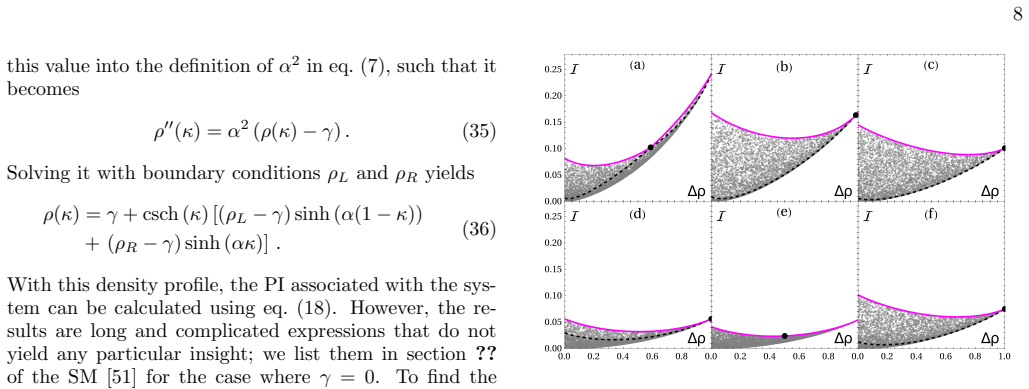
The central claim is that the steady-state density profile of a boundary-driven simple symmetric exclusion process with Langmuir kinetics determines a Pareto front among positional information $I$, rescaled entropy production $\Sigma$, and global reaction current $J$ that is generically not a simple curve: it has kinks, cusps, convex and concave pieces, and the optimizing boundary densities $(\rho_L,\rho_R)$ switch between distinct branches. For the clustered profile $e(\kappa)=E_T\delta(\kappa-\kappa_0)$ the paper finds the exact upper bound $I_m=\log_2((1+e)/e)\approx 0.452$ bits, attained at $\rho_L=1$, $\rho_R=0$, $\gamma\to 0$, $\alpha\to\infty$, $\kappa_0=1-\tanh(1/2)$, exceeding the no-Langmuir value $\log_2(2/\sqrt{e})\approx 0.278$ bits. For the uniform profile, the $I$-$\Sigma$ front is convex in one region of the $(\gamma,\alpha)$ phase diagram, giving a second-order-like transition in the optimal protocol as the weight $\lambda$ increases, while in the other region the front contains a linear segment where multiple profiles coexist at $\lambda_{c,1}\approx 0.728$ and a concave segment near $\lambda_{c,2}\approx 0.967$ where the global optimum jumps from monotonic to non-monotonic profiles, with metastable hysteretic profiles and a thermodynamically suboptimal zone.
Load-bearing premise
The load-bearing premise is that changing the single weight $\lambda$ in the combined objective $\Omega=-\lambda I+(1-\lambda)\Sigma$ visits every genuinely optimal trade-off between information and dissipation; if the curved-inward segment of the trade-off curve is missed or is an artifact of the search, the claimed abrupt switch in optimal protocol and the 'suboptimal zone' would not be established.
Editorial extensions
If this is right
- A single localized reaction site can raise the maximum positional information of a one-bit occupancy readout by about 60% relative to a purely diffusive boundary-driven channel (0.452 vs 0.278 bits), so position-dependent reaction kinetics can act as an information resource, not only as a dissipative cost.
- On convex parts of the Pareto front, diminishing returns are exact in the sense that moving near the information maximum requires diverging entropy production; the last fractions of a bit are thermodynamically expensive.
- In the uniform-profile dark phase, the optimal boundary protocol exhibits phase-coexistence-like behavior: at $\lambda_{c,1}$ several monotonic profiles yield the same scalarized cost, and at $\lambda_{c,2}$ the global optimum jumps discontinuously to non-monotonic profiles.
- The concave (non-convex) section of the front marks a thermodynamically suboptimal zone: intermediate profiles there are never globally optimal, so a system in that zone can improve both information and dissipation by moving to either bounding branch.
- The WKB approximation reproduces the exact trade-offs qualitatively for slowly varying enzyme profiles, so the same kinks and non-convexities should appear for general position-dependent Langmuir kinetics, not only the two exactly solvable profiles.
Reading between the lines
- Beyond the paper, the 0.452-bit ceiling implies that a single binary occupancy readout along one axis cannot provide multi-bit positional information; multi-bit readouts would require multiple molecular species, non-binary variables, or multidimensional decoding.
- This suggests a direct experimental test: in a microfluidic channel with immobilized enzymes and controllable reservoir densities, cyclically sweeping the boundary densities near the predicted first-order transition should produce hysteresis in the measured density profile.
- The exact clustered-profile bound also offers a design benchmark: any proposed enzyme arrangement or active-transport scheme can be compared against $\approx 0.452$ bits for the same one-bit readout, and operating near the continuous transition $\lambda_c$ maximizes bits per unit dissipation.
- If the concave front is taken at face value, it predicts bistability: for a range of dissipation budgets, monotonic and non-monotonic density profiles are both locally optimal, so small perturbations could flip a system between qualitatively different morphogen profiles.
Signed reviews
Editorial analysis
A structured set of objections, weighed in public.
Referee Report
Summary. The paper studies a one-dimensional boundary-driven symmetric simple exclusion process (SSEP) with position-dependent Langmuir kinetics, in the hydrodynamic limit. It derives exact steady-state density profiles for clustered (delta-function) and uniform enzyme profiles, and uses them to compute the positional information I (mutual information between site index and occupancy), the rescaled entropy production rate Σ, and the global reaction current J. The authors then analyze Pareto-optimal trade-offs among these quantities when the boundary reservoir densities ρL, ρR are tuned. For the clustered profile, they report a maximum positional information Im = log2((1+e)/e) ≈ 0.452 bits, exceeding the previous no-Langmuir bound of 0.278 bits. For the uniform profile, they identify two regimes in the (γ, α) parameter space: a 'light' regime with a convex I–Σ Pareto front and a second-order transition in the optimal protocol, and a 'dark' regime with a concave segment of the front, a first-order transition at λc,2, and a claimed 'thermodynamically suboptimal zone.' They also present a WKB approximation for general slowly varying enzyme profiles. The central claims are that non-trivial Pareto-optimal trade-offs exist among I, Σ, and J, and that optimal protocols exhibit phase transitions analogous to liquid-gas coexistence.
Significance. If the results hold, this paper provides a concrete, exactly solvable statistical-mechanics model connecting positional information, dissipation, and reaction flux, extending earlier work on information-thermodynamics trade-offs in boundary-driven systems. The exact closed-form expressions for the Σ–J Pareto fronts (Eqs. 33 and 41) and the explicit maximum for the clustered profile are valuable, as is the WKB treatment for general profiles. The model is cleanly defined, and the derivations of the density equation and the observables are transparent and do not rely on free parameters or fitted data. The paper also makes contact with recent ideas on thermodynamic costs of communication and on inverse multiplexing. However, the central phase-transition claim in the dark region of the uniform-profile case currently rests on a concave Pareto segment that is inferred rather than directly computed, and several load-bearing derivations are relegated to a Supplemental Material that is missing from the submitted source. These issues are significant but appear fixable, so the paper is a candidate for major revision rather than rejection.
major comments (4)
- [§IV A, Eq. (30)] The first-order phase transition and the 'thermodynamically suboptimal zone' in the dark region are not established by the method used. The authors minimize the scalarized objective Ω = −λI + (1−λ)Σ (Eq. 34) and sweep λ. Linear scalarization only returns supported points on the convex hull of the feasible objective set; it cannot produce points on a concave (non-convex) segment of the true Pareto front. The paper itself states that at λc,2 the front 'becomes locally concave' and that the transition is inferred from the optimizer jumping from monotonic to non-monotonic profiles plus 'metastable' profiles, rather than from a direct computation of the lower envelope. The exact expression for the cusp is deferred to Eq. (??) of the SM, which is absent. As written, the existence of the first-order branch in Fig. 8 and the suboptimal-zone claim are unsupported. To make this load-bearing claim, the authors should compute the Pareto front directly in the concave region (e.g., by minimizing Σ for fixed I, or by a normal-boundary/ε-constraint method) and show that the inferred segment is indeed non-dominated.
- [§II, Eq. (7) through §IV B] The headline result for the clustered profile, Im = log2((1+e)/e) ≈ 0.452 bits, is stated without a derivation in the main text; the derivation is said to be in 'section ?? of the SM,' which is missing from the submitted source. The heuristic argument that follows (ρL=1, ρR=0, γ→0, α→∞, κ0=1−tanh(1/2)) is plausible, but the limit involves a singular perturbation of Eq. (7) with a delta-function source, and the order of limits matters. The result should be either derived in the main text or provided in a complete, accessible SM. This is a central quantitative claim of the paper and must be independently checkable.
- [§IV C, Eq. (44) and Fig. 9] The manuscript is not self-contained: multiple key expressions are referenced as 'eq. (??)' or 'section ?? of the SM [51]' (e.g., the exact PI for the clustered profile, the derivation of Im, the cusp solution in the dark region, and the boundary-derivative formulas for general profiles). The Supplemental Material is not present in the source. Since several of these omitted items are load-bearing for the main claims, this is a major completeness issue, not merely a typographical one. The authors must supply the SM and fill in all placeholder references before the paper can be evaluated.
- [§IV A, Eq. (30)] The WKB approximation is advertised as yielding 'qualitatively accurate trade-offs for general Langmuir density profiles,' but the only quantitative comparison is the fractional change of the maximal PI (inset of Fig. 9) for a linear profile, for three values of α. It is not shown that the full Pareto front (not just the maximum) is reproduced within the stated O(α^{-1}) error. This is a lesser point, but the comparison should be extended to the whole front or the statement should be restricted to the maximum PI.
minor comments (7)
- [§IV B, around Fig. 7(b)] The sentence 'any solution that minimises eq. (34) is on the Pareto optimal front' is only true for supported Pareto points; for non-convex fronts it is false. Since the paper later discusses a concave front, this statement should be qualified accordingly.
- [§II, before Eq. (7)] The term 'metastable' is applied to optimal density profiles that are not global minima of Ω. In this steady-state optimization, hysteresis in the optimizer as λ is swept does not by itself imply physical metastability; the terminology should be justified or replaced with 'locally optimal' or 'suboptimal branches.'
- [§III, Eq. (25)] The rescaling of Langmuir rates (kon = ωon/N^2, koff = ωoff/N^2) is introduced in prose, but Eq. (7) then uses α^2 = (ωon+ωoff)/p without recalling the definition; restating it directly after Eq. (7) would improve readability.
- [§IV C] In Eq. (25), the same symbol J is used for the rescaled and unrescaled reaction flux; the text says 'J = J N/(ωon+ωoff)' but the equation then writes J on both sides. This notation collision should be cleaned up.
- [Conclusion and Data availability] The WKB solution (44) uses the notation csch(F(0,1)) and F(s,t) = α∫_s^t dq sqrt(e(q)); ensure that the argument of csch is dimensionless and that the approximation is stated for e(κ) strictly positive, since the square root requires it.
- [Throughout] The data availability statement says all data are in the article and any supplementary files, but the SM is currently missing; this statement should be updated once the SM is provided.
- [Throughout] There are numerous '??' placeholders for equation numbers and SM section references (e.g., after Eqs. (29), (32), (39), (44)). These must be resolved before publication.
Circularity Check
No circularity: all reported trade-offs and maxima are derived from the model equations via exact solutions or numerical Pareto optimization, with the only self-citation used as a non-load-bearing consistency check.
full rationale
The derivation chain is self-contained. The density profile is obtained by solving Eq. (7) with boundary conditions for the clustered and uniform enzyme profiles, and the observables — positional information I (Eq. 18), rescaled entropy production Σ (Eq. 23), and reaction current J (Eq. 25) — are explicit functionals of that density. The Pareto fronts are computed from these equations, either analytically, as in Eqs. (33) and (41), or by numerical multi-objective optimization over the boundary densities (ρL, ρR). No parameter is fitted to data, and no claimed result is fed back into the calculation. The only self-citation is Ref. [23], used as the α=0, no-Langmuir limit and as a comparison value Im = log2(2/√e) ≈ 0.278; that limit is re-derived from the present equations (e.g., Eq. (36) with α=0), so the citation is not load-bearing. The concave Pareto segment and first-order transition at λc,2 in the uniform dark region are not circular: they are properties of the model's feasible (I,Σ) set, even though linear scalarization via Eq. (34) cannot itself resolve concave segments and the SM placeholders mean the cusp expression is not independently checkable in the submitted source. Those are verifiability/completeness concerns, not a reduction of the prediction to its inputs.
Assumptions & free parameters
assumptions (5)
- domain assumption The prior distribution over positions is uniform, Pi(i)=1/N, in the definition of positional information.
- domain assumption Langmuir rates are scaled as kon=ωon/N^2 and koff=ωoff/N^2 so that diffusion and reaction timescales coincide, leading to the hydrodynamic equation (7) in the N→∞ limit.
- domain assumption Entropy production is computed via local detailed balance with reservoir chemical potentials μL=ln(αL/βL), μR=ln(αR/βR), μB=ln(koff/kon).
- domain assumption The Pareto front between I and Σ is explored by minimizing the linear scalarization Ω=-λI+(1-λ)Σ for λ∈[0,1], and the resulting solutions are assumed to represent the front.
- domain assumption The WKB approximation for general Langmuir profiles assumes slowly varying e(κ) and α≫1.
Cite this review
Pith. "Pith review of Positional information trade-offs in boundary-driven reaction-diffusion systems." pith.science (2026). https://pith.science/paper/C4SATQAT
@misc{pith2026241221113,
  author       = {Pith},
  title        = {Pith review of: Positional information trade-offs in boundary-driven reaction-diffusion systems},
  year         = {2026},
  howpublished = {\url{https://pith.science/paper/C4SATQAT}},
  note         = {Machine review of arXiv:2412.21113}
}
read the original abstract
Individual components such as cells, particles, or agents within a larger system often require detailed understanding of their relative position to act accordingly, enabling the system as a whole to function in an organised and efficient manner. Through the concept of positional information, such components are able to specify their position in order to, e.g., create robust spatial patterns or coordinate specific functionality. Such complex behaviour generally occurs far from thermodynamic equilibrium and thus requires the dissipation of free energy to sustain functionality. We show that in boundary-driven simple exclusion systems with position-dependent Langmuir kinetics, non-trivial Pareto-optimal trade-offs exist between the positional information, rescaled entropy production rate and global reaction current. Phase transitions in the optimal protocols that tune the densities of the system boundaries emerge as a result, showing that distinct protocols are able to exchange global optimality similar to phase coexistence in liquid-gas phase transitions, and that increasing the positional information can lead to diminishing returns when considering increased dissipation.
Figures


Figures from the paper (5 more)


Reference graph
Works this paper leans on
-
[23]
W.-C. Lo, S. Zhou, F. Y.-M. Wan, A. D. Lander, and Q. Nie, J. R. Soc. Interface. 12, 20141041 (2015)
work page 2015
-
[51]
K. Deb, Multi-Objective Optimization using Evolution- ary Algorithms, Wiley Interscience Series in Systems and Optimization (Wiley-Blackwell, Hoboken, NJ, 2008)
work page 2008
-
[1]
The coloured circles indicate the parameter combinations we use for further analysis: γ = 0.75, α = 5 (magenta), and γ = 0.1, α = 9 (cyan). Σ − Jtrade-off – As in the clustered enzyme case, the relatively simple form of the global reaction flux allows us to determine the Pareto-optimal trade-off between the flux and the rescaled entropy production exactly...
work page 2020
-
[2]
Meinhardt, Models of biological pattern formation (Academic Press, San Diego, CA, 1982)
H. Meinhardt, Models of biological pattern formation (Academic Press, San Diego, CA, 1982)
work page 1982
-
[3]
A. M. Turing, Philos. Trans. R. Soc. Lond. B Biol. Sci. 237, 37 (1952)
work page 1952
-
[4]
Wolpert, J
L. Wolpert, J. Theor. Biol. 25, 1 (1969)
1969
- [5]
-
[6]
A. Zadorin, Y. Rondelez, G. Gines, V. Dilhas, A. Zam- brano, J.-C. Galas, and A. Estevez-Torres, Nat. Chem. 9, 990 (2017)
work page 2017
Show all 61 references
-
[7]
Baccouche, K
A. Baccouche, K. Montagne, A. Padirac, T. Fujii, and Y. Rondelez, Methods 67, 234 (2014)
2014
-
[8]
S. Toda, W. L. McKeithan, T. J. Hakkinen, P. Lopez, O. D. Klein, and W. A. Lim, Science 370, 327 (2020)
2020
-
[9]
Dupin, L
A. Dupin, L. Aufinger, I. Styazhkin, F. Rothfischer, B. K. Kaufmann, S. Schwarz, N. Galensowske, H. Clausen- Schaumann, and F. C. Simmel, Sci. Adv. 8, eabl9228 (2022)
2022
-
[10]
J. O. Dubuis, G. Tkaˇ cik, E. F. Wieschaus, T. Gregor, and W. Bialek, PNAS 110, 16301 (2013)
2013
-
[11]
Tkaˇ cik, J
G. Tkaˇ cik, J. O. Dubuis, M. D. Petkova, and T. Gregor, Genetics 199, 39 (2014)
2014
-
[12]
Cover and J
Thomas M. Cover and J. A. Thomas, Elements of Infor- mation Theory, 2nd ed. (John Wiley & Sons, 2006)
2006
-
[13]
Gregor, D
T. Gregor, D. Tank, E. Wieschaus, and W. Bialek, Cell 130, 153 (2007)
2007
-
[14]
K. S. Iyer, C. Prabhakara, S. Mayor, and M. Rao, eLife 12, e79257 (2023)
2023
-
[15]
McGough, H
L. McGough, H. Casademunt, M. c. v. Nikoli´ c, Z. Aridor, M. D. Petkova, T. Gregor, and W. Bialek, PRX Life 2, 013016 (2024)
2024
-
[16]
Tkaˇ cik and T
G. Tkaˇ cik and T. Gregor, Development148, dev176065 (2021)
2021
-
[17]
Bialek, Biophysics: Searching for Principles(Prince- ton University Press, Princeton, NJ, 2012)
W. Bialek, Biophysics: Searching for Principles(Prince- ton University Press, Princeton, NJ, 2012)
2012
-
[18]
Falasco, R
G. Falasco, R. Rao, and M. Esposito, Phys. Rev. Lett. 121, 108301 (2018)
2018
-
[19]
Rana and A
S. Rana and A. C. Barato, Phys. Rev. E 102, 032135 (2020)
2020
-
[20]
Song and C
Y. Song and C. Hyeon, eLife 10, e70034 (2021)
2021
-
[21]
Tostevin, P
F. Tostevin, P. R. ten Wolde, and M. Howard, PLoS Comput. Biol. 3, 1 (2007)
2007
-
[22]
Emberly, Phys
E. Emberly, Phys. Rev. E 77, 041903 (2008)
2008
-
[24]
Singh and K
P. Singh and K. Proesmans, Limits to positional information in boundary-driven systems (2024), arXiv:2405.04381 [cond-mat.stat-mech]
2024 arXiv
-
[25]
Seifert, Rep
U. Seifert, Rep. Prog. Phys. 75, 126001 (2012)
2012
-
[26]
Van den Broeck and M
C. Van den Broeck and M. Esposito, Physica A 418, 6 (2015)
2015
-
[27]
Seifert, Phys
U. Seifert, Phys. Rev. Lett. 95, 040602 (2005)
2005
-
[28]
A. C. Barato and U. Seifert, Phys. Rev. Lett.114, 158101 (2015)
2015
-
[29]
T. R. Gingrich, J. M. Horowitz, N. Perunov, and J. L. England, Phys. Rev. Lett. 116, 120601 (2016)
2016
-
[30]
Derrida, J
B. Derrida, J. L. Lebowitz, and E. R. Speer, Phys. Rev. Lett. 87, 150601 (2001)
2001
-
[31]
Derrida, J
B. Derrida, J. L. Lebowitz, and E. R. Speer, J. Stat. Phys. 107, 599 (2002)
2002
-
[32]
Derrida, J
B. Derrida, J. Stat. Mech.: Theory Exp. 2007 (07), P07023
2007
-
[33]
Parmeggiani, T
A. Parmeggiani, T. Franosch, and E. Frey, Phys. Rev. E 70, 046101 (2004)
2004
-
[34]
Pietak, J
A. Pietak, J. Bischof, J. LaPalme, J. Morokuma, and M. Levin, PLOS Comput. Biol. 15, 1 (2019)
2019
-
[35]
Agata, J
K. Agata, J. Tasaki, E. Nakajima, and Y. Umesono, Zo- ology 117, 161 (2014)
2014
-
[36]
P. Li, J. S. Markson, S. Wang, S. Chen, V. Vachharajani, and M. B. Elowitz, Science 360, 543 (2018)
2018
-
[37]
Grieneisen, B
V. Grieneisen, B. Scheres, P. Hogeweg, and A. Maree, BMC Syst. Biol. 6, 37 (2012)
2012
-
[38]
Buchner, F
A. Buchner, F. Tostevin, and U. Gerland, Phys. Rev. Lett. 110, 208104 (2013)
2013
-
[39]
Buchner, F
A. Buchner, F. Tostevin, F. Hinzpeter, and U. Gerland, J. Chem. Phys. 139, 135101 (2013)
2013
-
[40]
Ochoa-Espinosa, G
A. Ochoa-Espinosa, G. Yucel, L. Kaplan, A. Pare, 13 N. Pura, A. Oberstein, D. Papatsenko, and S. Small, PNAS 102, 4960 (2005)
2005
-
[41]
M. Mir, A. Reimer, J. E. Haines, X.-Y. Li, M. Stadler, H. Garcia, M. B. Eisen, and X. Darzacq, Genes Dev. 31, 1784 (2017)
2017
-
[42]
Heinrich, S
R. Heinrich, S. Schuster, and H.-G. Holzh¨ utter, Eur. J. Biochem. 201, 1 (1991)
1991
-
[43]
Hinzpeter, F
F. Hinzpeter, F. Tostevin, and U. Gerland, J. R. Soc. Interface. 16, 20190444 (2019)
2019
-
[44]
Hinzpeter, F
F. Hinzpeter, F. Tostevin, A. Buchner, and U. Gerland, Nat. Phys. 18, 203 (2022)
2022
-
[45]
J. S. MacCready, J. L. Basalla, and A. G. Vecchiarelli, Mol. Biol. Evol. 37, 1434 (2020)
2020
-
[46]
J. S. MacCready and A. G. Vecchiarelli, mBio 12, 10.1128/mbio.02519 (2021)
2021 doi
-
[47]
G¨ oppel, V
T. G¨ oppel, V. V. Palyulin, and U. Gerland, Phys. Chem. Chem. Phys. 18, 20135 (2016)
2016
-
[48]
Almarcha, P
C. Almarcha, P. M. J. Trevelyan, P. Grosfils, and A. De Wit, Phys. Rev. Lett. 104, 044501 (2010)
2010
-
[49]
E. A. Jorswieck, A. I. Reppas, and H. Hatzikirou, in 2014 Information Theory and Applications Workshop (ITA) (2014) pp. 1–8
2014
-
[50]
Miettinen, Nonlinear Multiobjective Optimization, In- ternational series in operations research & management science (Springer, New York, NY, 2012)
K. Miettinen, Nonlinear Multiobjective Optimization, In- ternational series in operations research & management science (Springer, New York, NY, 2012)
2012
-
[52]
See Supplemental Material at URL
-
[53]
Tasnim, N
F. Tasnim, N. Freitas, and D. H. Wolpert, Phys. Rev. E 110, 034101 (2024)
2024
-
[54]
Yadav and D
A. Yadav and D. Wolpert, Minimal thermodynamic cost of communication (2024), arXiv:2410.14920 [cond- mat.stat-mech]
2024
-
[55]
Balasubramanian, Proc
V. Balasubramanian, Proc. IEEE 103, 1346 (2015)
2015
-
[56]
O. P. Tabbaa and C. Jayaprakash, Phys. Biol.11, 046004 (2014)
2014
-
[57]
Mora and W
T. Mora and W. Bialek, J. Stat. Phys. 144, 268 (2011)
2011
-
[58]
Tkaˇ cik, T
G. Tkaˇ cik, T. Mora, O. Marre, D. Amodei, S. E. Palmer, M. J. Berry, and W. Bialek, PNAS 112, 11508 (2015)
2015
-
[59]
L. F. Seoane and R. Sol´ e, Systems poised to criticality through pareto selective forces (2016), arXiv:1510.08697 [cond-mat.stat-mech]
2016 arXiv
-
[60]
C. M. Bender and S. A. Orszag, Advanced mathematical methods for scientists and engineers I (Springer, New York, NY, 2010)
2010
-
[61]
Tischer, P
C. Tischer, P. R. ten Wolde, and M. Dogterom, Biophys. J. 99, 726 (2010)
2010
Reviewed August 10, 2026 · model on record in the stance chip above.
Discussion (0). Continue with ORCID to comment.