REVIEW 3 major objections 4 minor 40 references
Flow in small systems in the EPOS4 approach for high-energy scatterings
T0 review · 3 major / 4 minor · reviewed 2026-08-05 · deepseek-v4-flash
Pith's one-line read A high-energy proton has a persistent dipole parton structure, shared by all parallel scatterings in an event, which is required to explain the measured flat elliptic flow in proton-proton collisions.
desk verdict Clean qualitative mechanism, honest limitations, but the 'dipole proton is needed' conclusion goes beyond what one hand-tuned parameter in one generator can support. read the letter →
The pith
A machine-rendered reading of the paper's core claim, the machinery that carries it, and where it could break.
The reading
What carries the argument
The dipole scenario of Eq. (2): partons are placed around two centers with a common orientation angle $\phi_{\rm dipole}$ shared by all subscatterings in an event. This is the load-bearing mechanism because it converts the randomness of multiple scattering into a persistent elliptic initial shape; combined with the core-corona prescription and a viscous hydrodynamic expansion, that shape is what produces the flat flow signal at high multiplicity.
What would settle it
Measure $v_2\{2, |\Delta\eta|>2\}$ in proton-proton collisions at multiplicities above $N_{\rm ch}=180$; the dipole scenario predicts a continuing flat curve, so a rise with multiplicity would falsify it. Alternatively, reconstruct the common dipole angle $\phi_{\rm dipole}$ from the initial parton positions of high-multiplicity events and test whether the final elliptic-flow plane stays aligned with it; if the flow persists without such alignment, the dipole geometry is not the mechanism doing the work.
Extended reading notes
Core claim
The central claim is that reproducing the measured flat elliptic flow in proton-proton collisions requires an initial-state geometric asymmetry with a fixed orientation, and the paper proposes the 'dipole scenario' as the concrete mechanism: the transverse positions $\vec b_i$ of the partons are generated around two centers, $\vec b_i = b_i(\cos\phi_i,\sin\phi_i) \pm \frac{b_{\rm dipole}}{2}(\cos\phi_{\rm dipole},\sin\phi_{\rm dipole})$, with the same dipole angle $\phi_{\rm dipole}$ for all multiple scatterings in an event. Because the orientation is shared, adding more scatterings does not wash out the ellipticity of the initial core; the hydrodynamic expansion then converts this elliptici
Load-bearing premise
The load-bearing premise is that viscous hydrodynamics can be applied to tiny proton-proton systems, converting the dipole-shaped initial core into the measured flow; the author himself notes this remains an open question, because the supporting attractor arguments rely on boost invariance, conformal symmetry, and a relaxation-time approximation, and if some non-hydro mechanism produces the correlations the dipole conclusion collapses.
Editorial extensions
If this is right
- A flat $v_2$ versus $N_{\rm ch}$ in pp is not a statistical accident: the model traces it to a fixed geometric axis in the proton that survives arbitrarily many parallel scatterings.
- A symmetric initialization of parton positions cannot reproduce the pp flow data within this multiple-scattering-plus-hydro framework; a geometric source of asymmetry is required.
- The dipole size is a physical handle: with shear viscosity $\eta/s=0.08$, a dipole size of $1.5$ fm reproduces the magnitude of the pp flow, while larger viscosity would need a larger dipole.
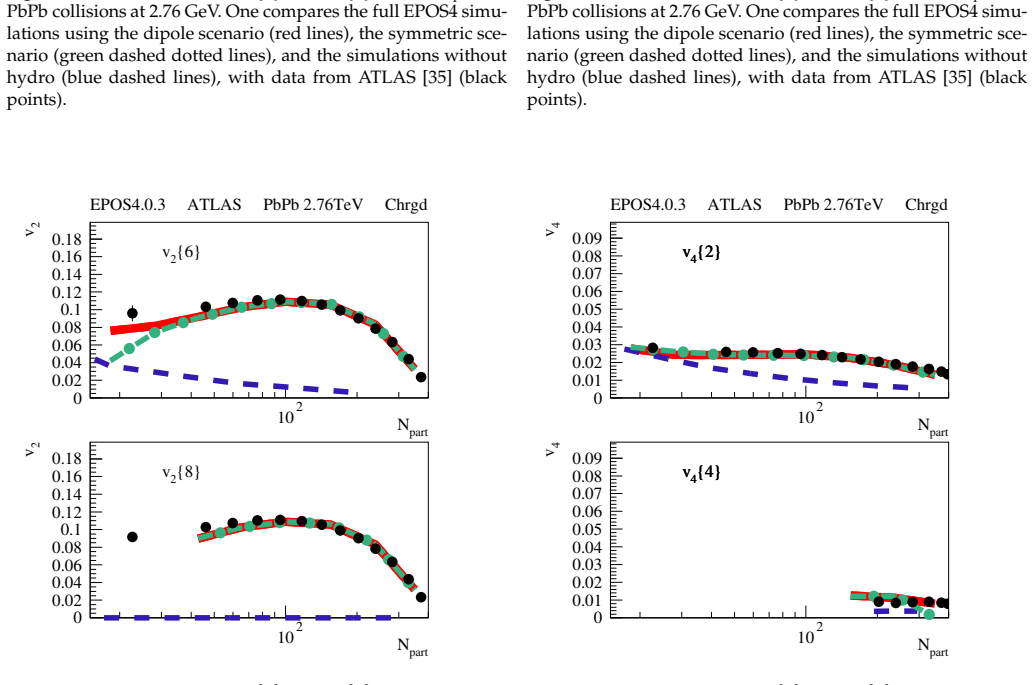
- The same dipole size describes flow harmonics in PbPb collisions, where many nucleon pairs average out the dipole effect, so the approach offers a unified description of small and large systems.
- The reported exceptions—very low pp multiplicity and high-$p_T$ PbPb—define the current limits of the coherent picture rather than undermining it.
Reading between the lines
- An event-level test follows: the final elliptic-flow plane in high-multiplicity pp events should be correlated with a fixed direction shared across widely separated rapidity intervals, something existing long-range ridge analyses could be scanned for.
- If a non-hydro mechanism, such as color-field or string dynamics, can independently reproduce the flat $v_2$, then the conclusion 'a dipole proton is needed' would weaken to 'some persistent initial asymmetry is needed'; the hydrodynamic conversion is the unproven link in that chain.
- The dipole scenario could be constrained by other proton-structure observables, such as exclusive vector meson production or deeply virtual Compton scattering, which are sensitive to the transverse shape of the proton, tying high-energy flow data to proton imaging.
- A direct extension would be to measure $v_3$ at very high multiplicity: the dipole does not create triangular shapes, so the triangular component remains purely random, making a clean test of the model's geometric versus random contributions.
Editorial analysis
A structured set of objections, weighed in public.
Referee Report
Summary. The paper studies the multiplicity dependence of multi-particle cumulants and flow harmonics in pp at 13 TeV and PbPb at 2.76 TeV within the EPOS4 event generator. In the 'symmetric scenario', where parton transverse positions are sampled from a symmetric distribution, the full simulation yields a v2{2,|Δη|>2} that decreases with multiplicity and lies below ATLAS data. In the 'dipole scenario' of Eq. (2), partons are generated around two centers whose orientation is common to all parallel sub-scatterings in an event; the resulting v2 is flat beyond Nch≈100 and the cumulants c3{2} and c2{4} follow the data trends. The paper also compares PbPb results and finds little difference between the symmetric and dipole scenarios, with both approximating ATLAS data. The main claim is that a dipole form of the high-energy proton is needed to explain small-system flow.
Significance. If the central claim is accepted, this is a concrete geometric explanation for the flat v2 versus multiplicity in pp collisions, embedded in a full Monte Carlo framework that also describes a wide range of PbPb flow observables. The paper is valuable as a multi-observable test of EPOS4 and for its transparent discussion of nonflow contributions, the core-corona procedure, and the role of the dipole parameter. It provides a falsifiable statement: within EPOS4's hydro-based description, the symmetric scenario cannot reproduce the flat ATLAS curve, while the dipole scenario can. However, the inference from data to 'a dipole proton is needed' is conditional on two load-bearing assumptions: the applicability of viscous hydrodynamics to tiny few-parton systems, and the specific mechanism of a shared dipole orientation. These limitations are acknowledged in the text but not incorporated into the strength of the final conclusion.
major comments (3)
- [Section 6 (and Section 1)] The central conclusion that 'a dipole form of a high-energy proton is needed' is stronger than the evidence supports. The argument chain is dipole initial geometry (Eq. 2) → viscous hydro → v2{2,|Δη|>2}; the paper itself states in Sec. 1 that the applicability of viscous hydrodynamics to pp remains an open question and that the attractor justification relies on boost invariance, conformal symmetry, and relaxation-time approximation. If the flat v2 is produced by a non-hydro mechanism (e.g., color-field dynamics or string fragmentation), the ATLAS cumulants carry no implication about a dipole proton. The conclusion should be reworded as a conditional statement ('within EPOS4's hydro-based framework') or the hydro link should be cross-checked by comparing with a non-hydro initial-state/final-state mechanism using the same dipole initial conditions.
- [Section 3, Eq. (2), Fig. 7] The plateau height is not a prediction. The text states 'its value depends on the parameter b_dipole' and b_dipole is set to 1.5 fm; Fig. 7 shows that increasing η/s to 0.24 lowers the curves, requiring a larger dipole size. Thus the quantitative agreement at Nch>100 is partly purchased by a tuned parameter, and the abstract's assertion that the model is 'not particularly tuned for flow results' is misleading. To support the coherent-picture claim, the authors should show a sensitivity scan over b_dipole and η/s and identify the allowed parameter combination, rather than presenting one hand-picked choice.
- [Eq. (2), Section 3] The key new assumption—that all parallel scatterings in one event share the same dipole orientation angle—is introduced without independent motivation or cross-check. It is exactly the ingredient that produces the flat v2, so the paper's conclusion restates this axiom in physical terms. A more convincing test would vary this assumption (e.g., independent orientations per Pomeron, or partially correlated angles) and show that ATLAS data discriminate between these variants, or provide an independent observable sensitive to the shared orientation.
minor comments (4)
- [Section 2, after Eq. (1)] Typo: 'randon angles' should be 'random angles'.
- [Figures 4–8] The curves are broken lines composed of pieces from different trigger conditions (minimum bias and NPom>12). Marking the trigger boundary (e.g., Nch=100) on the figures or in the captions would make the comparison easier to follow.
- [Section 5, Figs. 16–17] The statement that the high-pT region is not well described ('simulations are too low') would benefit from a quantitative pT threshold and an estimate of the deviation, rather than only a visual impression.
- [Figures 9–13] The claim that the PbPb results are 'close to the data' is based on visual inspection. Including experimental uncertainties and, ideally, a simple chi-square or similar measure would strengthen this statement.
Circularity Check
The dipole-vs-symmetric shape argument is independent, but the quantitative v2 plateau height is set by hand-picking b_dipole, so part of the advertised agreement is a fit, not a prediction.
-
fitted input called prediction
[Section 3, discussion of Fig. 7 (after Eq. 2)]
"Whereas the flatness of the curve for large multiplicities is a real feature of the approach, its value depends on the parameter bdipole. I take a dipole size bdipole of 1.5 fm."
The quantitative agreement with ATLAS shown in Fig. 7 (v2{2,|Δη|>2}, c3{2}, c2{4} beyond Nch=100) is used to support the conclusion that a dipole proton is needed. But the vertical position of those curves depends on b_dipole, which is chosen by hand ('I take a dipole size bdipole of 1.5 fm') rather than derived or independently constrained. The paper also states that increasing η/s to 0.24 would require a larger b_dipole to stay close to the data, so the comparison constrains a degenerate (b_dipole, η/s) combination, not the proton's substructure alone. The flat shape is a structural consequence of Eq. (2) and is not circular, but the claimed quantitative reproduction of the measured magnitudes is partly an input.
full rationale
The central structural argument is not circular: the symmetric scenario (Eq. 1) gives randomized parton positions whose azimuthal asymmetry is washed out as the number of scatterings grows, so hydro produces a falling v2, whereas the dipole scenario (Eq. 2) keeps one dipole angle common to all scatterings, giving a persistent eccentricity and hence a flat v2. These are internal model consequences tested against external ATLAS data, so the main comparison has independent content. The main circularity is limited to the plateau height and related cumulant magnitudes in Fig. 7: the paper explicitly says the value depends on b_dipole and then simply chooses b_dipole=1.5 fm. This undercuts the abstract's claim that the model is 'not particularly tuned for flow results' and makes part of the agreement a fit rather than a prediction. The paper's own caveat in Section 1 that 'the applicability of viscous hydrodynamics remains an open question' is a genuine limitation for the inference that a dipole proton is needed, but it is an external-validity concern, not a circular reduction. Self-citations [13-16] support the EPOS4 framework but are not used to force the dipole conclusion, so they do not add circularity. Overall score 4 reflects one partially fitted quantitative step while the core shape argument remains independent.
Assumptions & free parameters
free parameters (5)
- b_dipole (dipole size) =
1.5 fm
- η/s (shear viscosity over entropy density) =
0.08 default; 0.24 variant shown
- τ0 (hydro start time) =
0.40 fm/c
- ε_FO (freeze-out energy density threshold) =
not given in this paper (from Ref. [16])
- Pomeron-trigger thresholds for the high-multiplicity sample =
NPom > 12 and NPom > 16
assumptions (5)
- domain assumption Viscous hydrodynamics is applicable to tiny pp systems (multiplicity up to about 200).
- ad hoc to paper All parallel primary scatterings in one pp event share the same dipole orientation angle (Eq. 2).
- standard math EPOS4 S-matrix framework: parallel scattering with saturation satisfies the AGK theorem and factorization (Refs. [13]-[16]).
- domain assumption Core-corona separation: prehadrons that lose all their energy form a thermalized core that becomes the hydro initial condition; the rest escape.
- domain assumption The |Δη| > 2 gap suppresses nonflow sufficiently at high Nch, so v2{2} measures genuine flow there.
invented entities (1)
-
Two-center 'dipole' structure of the proton parton cloud, with orientation shared by all parallel scatterings in an event
Cite this review
Pith. "Pith review of Flow in small systems in the EPOS4 approach for high-energy scatterings." pith.science (2026). https://pith.science/paper/24A3NWBC
@misc{pith2026250807417,
  author       = {Pith},
  title        = {Pith review of: Flow in small systems in the EPOS4 approach for high-energy scatterings},
  year         = {2026},
  howpublished = {\url{https://pith.science/paper/24A3NWBC}},
  note         = {Machine review of arXiv:2508.07417}
}
abstract
EPOS4 is based on a sophisticated (recently significantly improved) parallel-primary-scattering scenario followed by a hydrodynamic expansion, for all collision systems, from small ones such as proton-proton ($pp$) to big ones such as lead-lead (PbPb). Having already reported on identified particle spectra in recent publications (providing information about radial flow), I discuss here the multiplicity dependence of multi-particle cumulants and flow harmonics, to better understand collectivity in small systems. The model is not particularly tuned for flow results, but it is a "general purpose" approach, trying to accommodate various types of observables with the same model.
Figures


Figures from the paper (10 more)




Reference graph
Works this paper leans on
- [1]
-
[2]
J. F . Grosse-Oetringhaus and U. A. Wiedemann, (2024), 2407.07484
arXiv 2024
-
[3]
M. P . Heller, R. A. Janik, and P . Witaszczyk, Phys. Rev . Lett.108, 201602 (2012), 1103.3452
arXiv 2012
-
[4]
M. P . Heller and M. Spalinski, Phys. Rev . Lett. 115, 072501 (2015), 1503.07514
arXiv 2015
- [5]
- [6]
-
[7]
M. P . Heller, A. Kurkela, M. Spali ´ nski, and V . Svens- son, Phys. Rev . D 97, 091503 (2018), 1609.04803
arXiv 2018
- [8]
Show all 40 references
-
[9]
Strickland, J
M. Strickland, J. Noronha, and G. Denicol, Phys. Rev . D97, 036020 (2018), 1709.06644
2018 arXiv
-
[10]
Kurkela, A
A. Kurkela, A. Mazeliauskas, J.-F . Paquet, S. Schlichting, and D. T eaney , Phys. Rev . C 99, 034910 (2019), 1805.00961
2019 arXiv
-
[11]
Strickland, JHEP 12, 128 (2018), 1809.01200
M. Strickland, JHEP 12, 128 (2018), 1809.01200. 12 Flow in small systems in EPOS4 13
2018 arXiv
-
[12]
Giacalone, A
G. Giacalone, A. Mazeliauskas, and S. Schlichting, Phys. Rev . Lett.123, 262301 (2019), 1908.02866
2019 arXiv
- [13]
- [14]
- [15]
- [16]
-
[17]
J. Zhao, J. Aichelin, P . B. Gossiaux, and K. W erner, Phys. Rev . D109, 054011 (2024), 2310.08684
2024 arXiv
-
[18]
J. Zhao, J. Aichelin, P . B. Gossiaux, V . Ozvenchuk, and K. W erner, Phys. Rev . C 110, 024909 (2024), 2401.17096
2024 arXiv
-
[19]
V . A. Abramovskii, V . N. Gribov , and O. V . Kancheli, Y ad. Fiz.18, 595 (1973)
1973
-
[20]
Collins, D
J. Collins, D. Soper, and G. Sterman, in Pertur- bative Quantum Chromodynamics, edited by A.H. Mueller, W orld Scientific, Singapore (1989)
1989
-
[21]
L. V . Gribov , E. M. Levin, and M. G. Ryskin, Phys. Rep. 100, 1 (1983)
1983
-
[22]
L. D. McLerran and R. V enugopalan, Phys. Rev . D 49, 3352 (1994), hep-ph/9311205
1994 arXiv
-
[23]
Kovner, L
A. Kovner, L. McLerran, and H. W eigert, Phys. Rev . D52, 3809 (1995), hep-ph/9505320
1995 arXiv
-
[24]
Y . V . Kovchegov , Phys. Rev . D54, 5463 (1996), hep- ph/9605446
1996
-
[25]
Jalilian-Marian, A
J. Jalilian-Marian, A. Kovner, L. McLerran, and H. W eigert, Phys. Rev . D55, 5414 (1997), hep- ph/9606337
1997
-
[26]
Jalilian-Marian, A
J. Jalilian-Marian, A. Kovner, A. Leonidov , and H. W eigert, Nucl. Phys. B504, 415 (1997), hep- ph/9701284
1997
-
[27]
Jalilian-Marian, A
J. Jalilian-Marian, A. Kovner, A. Leonidov , and H. W eigert, Phys. Rev . D59, 034007 (1999), hep- ph/9807462
1999
- [28]
- [29]
-
[30]
W erner, I
K. W erner, I. Karpenko, T. Pierog, M. Bleicher, and K. Mikhailov , Phys. Rev . C 82, 044904 (2010), arXiv:1004.0805
2010 arXiv
-
[31]
W erner, B
K. W erner, B. Guiot, I. Karpenko, and T. Pierog, Phys. Rev . C89, 064903 (2014), arXiv:1312.1233
2014 arXiv
-
[32]
Karpenko, P
I. Karpenko, P . Huovinen, and M. Bleicher, Com- puter Physics Communications 185, 3016 (2014), arXiv:1312.4160
2014 arXiv
- [33]
-
[34]
Bilandzic, R
A. Bilandzic, R. Snellings, and S. V oloshin, Phys. Rev . C83, 044913 (2011), 1010.0233
2011 arXiv
- [35]
-
[36]
Borghini, P
N. Borghini, P . M. Dinh, and J.-Y . Ollitrault, Phys. Rev . C63, 054906 (2001), nucl-th/0007063
2001 arXiv
-
[37]
Borghini, P
N. Borghini, P . M. Dinh, and J.-Y . Ollitrault, Phys. Rev . C64, 054901 (2001), nucl-th/0105040
2001 arXiv
-
[38]
Borghini, P
N. Borghini, P . M. Dinh, and J.-Y . Ollitrault, Flow analysis from cumulants: A Practical guide, in In- ternational Workshop on the Physics of the Quark Gluon Plasma, 2001, nucl-ex/0110016
2001 arXiv
-
[39]
Adler et al., Phys
STAR, C. Adler et al., Phys. Rev . C 66, 034904 (2002), nucl-ex/0206001
2002 arXiv
-
[40]
ALICE, B. B. Abelev et al. , JHEP 06, 190 (2015), 1405.4632. 13
2015 arXiv
Reviewed August 5, 2026 · model on record in the stance chip above.
Discussion (0). Sign in to comment.