REVIEW 5 major objections 6 minor 2 cited by
MGVQ: Could VQ-VAE Beat VAE? A Generalizable Tokenizer with Multi-group Quantization
T0 review · 5 major / 6 minor · reviewed 2026-08-06 · deepseek-v4-flash
Pith's one-line read A discrete image tokenizer beats continuous VAEs when its codebook is split into sub-codebooks.
desk verdict A well-ablated multi-group VQ tokenizer with a real reconstruction gain, but the 'beat VAE' claim is undermined by a contaminated zero-shot benchmark and mismatched SD-VAE comparisons. read the letter →
The pith
A machine-rendered reading of the paper's core claim, the machinery that carries it, and where it could break.
The reading
What carries the argument
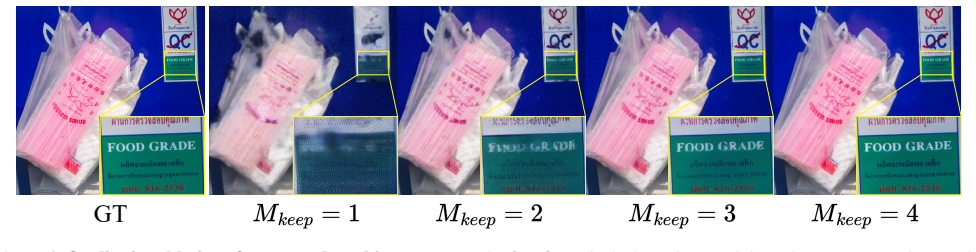
Multi-group quantization: the latent embedding z(x) of dimension Cl is uniformly split into G sub-tokens, each quantized by its own non-shared sub-codebook of size K and dimension Cl/G, then the quantized sub-tokens are concatenated to form zq(x), giving a discrete representation capacity of K^G while keeping each sub-codebook small and easy to train. A nested masking training strategy randomly keeps Mkeep of the G quantized sub-tokens during training, forcing the encoder to order information from coarse to fine and preventing sub-codebooks from collapsing onto each other.
What would settle it
Train a continuous SD-VAE-style tokenizer from scratch at 16x downsampling on ImageNet-only data, or evaluate MGVQ on a held-out dataset entirely disjoint from its training corpora; if the continuous model matches or beats MGVQ, or if MGVQ's zero-shot lead disappears without the overlapping training domains, the central claim would be falsified.
Extended reading notes
Core claim
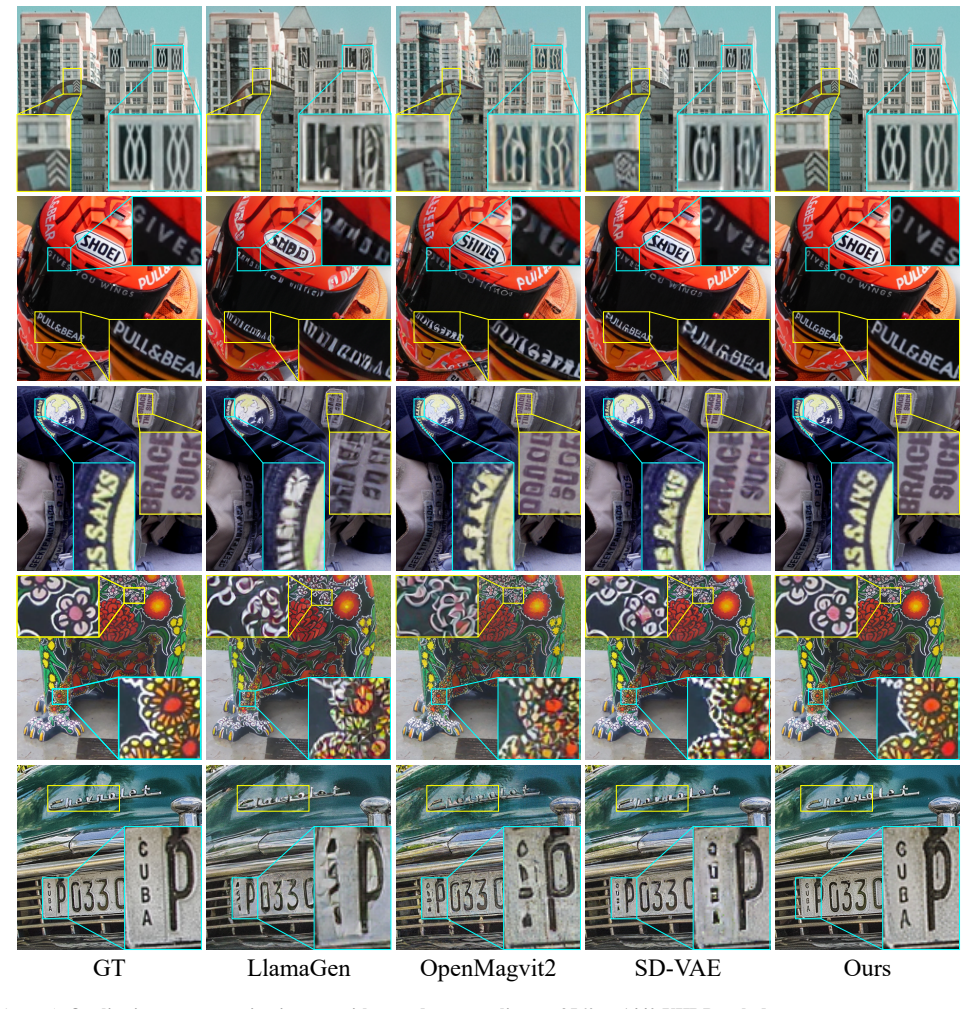
On its own terms, the paper claims that a VQ-VAE can beat a continuous VAE in reconstruction quality when quantization is organized as multiple independent sub-codebooks over a preserved latent dimension. Instead of shrinking the latent channel count to avoid codebook collapse, MGVQ keeps a larger latent dimension, splits each latent vector into G sub-tokens, and quantizes each sub-token with its own small codebook; concatenating the quantized sub-tokens gives a combined capacity of K^G. The paper reports that this removes the dead-code problem, yields 100% codebook usage, and on ImageNet 256x256 at 16x downsampling reaches rFID 0.49 and PSNR 24.70, surpassing the continuous SD-VAE tokenizer (rFID 0.91, PSNR 22.65) and all compared VQ-VAEs. The same pattern appears on zero-shot 512p and 2k benchmarks, where MGVQ leads in PSNR across the board.
Load-bearing premise
The headline comparison assumes SD-VAE is evaluated in a fair setting (16x downsampling on ImageNet, with unknown training data) and that the zero-shot test images are not present in the large collection of datasets MGVQ was trained on.
Editorial extensions
If this is right
- If discrete tokenizers can beat continuous VAEs at equal downsampling, autoregressive image generators can use the same tokenizer for both high-fidelity reconstruction and generation, without switching to continuous latents.
- The K^G capacity means a modest per-group codebook of a few thousand entries suffices to cover an enormous discrete space, keeping memory and optimization manageable where a monolithic codebook of equivalent capacity would collapse.
- At 8x downsampling, MGVQ-G8 reaches rFID 0.27 and PSNR 29.96 on ImageNet, suggesting the reconstruction gap to continuous tokenizers shrinks further as group capacity grows.
- Because MGVQ preserves the latent dimension instead of reducing it, the tokenizer can serve as a drop-in replacement in pipelines built on LlamaGen-style VQGAN backbones.
- The zero-shot results at 512p and 2k indicate that the multi-group quantizer generalizes beyond ImageNet, which matters for real-world HD image processing and compression.
- Nested masking enforces a coarse-to-fine ordering in the sub-tokens, so the model supports progressive decoding where early sub-tokens give a rough reconstruction and later ones add detail.
Reading between the lines
- The headline comparison at 16x downsampling places SD-VAE at a non-native setting; a fairer test would retrain SD-VAE at 16x on ImageNet-only data, so the 'VQ beats VAE' conclusion should be read as conditional on the evaluation protocol.
- The nested masking mechanism is effectively a matryoshka-style ordered representation, which could transfer to other discrete representation learners such as audio or video tokenizers as a way to enforce coarse-to-fine structure while training sub-codebooks.
- The paper's ablation finding that G=16 is worse than G=8 points to a capacity-versus-per-dimension trade-off; a testable extension would be to use variable-size sub-codebooks or a learned split instead of a uniform split, which might shift the optimum beyond G=8.
- If the 100% codebook usage claim transfers to low-resource training settings, MGVQ could improve reconstruction quality on smaller datasets, but the paper does not test that regime.
Editorial analysis
A structured set of objections, weighed in public.
Referee Report
Summary. The paper proposes MGVQ, a VQ-VAE-style image tokenizer that keeps a larger latent dimension (e.g., 32 channels) and splits each latent embedding into G sub-tokens, quantizing each sub-token with its own smaller sub-codebook. The authors argue that this design increases the discrete representation capacity from K to K^G while avoiding codebook collapse, and they introduce a nested masking training strategy to impose a coarse-to-fine ordering across sub-tokens. The method is evaluated on ImageNet 256x256 reconstruction at 8x and 16x downsampling, on eight claimed zero-shot benchmarks at 512p and 2K, and on ImageNet class-to-image generation. The headline results show MGVQ-G8 at 16x downsampling achieving rFID 0.49 and PSNR 24.70 on ImageNet, beating SD-VAE (rFID 0.91, PSNR 22.65), and MGVQ-G4 ranking first on PSNR in the zero-shot tables. The paper also reports ablations on the sub-codebook design, nested masking, group count, and codebook size.
Significance. If the headline claims held under matched conditions, the paper would be significant: it would demonstrate that a discrete tokenizer can beat strong continuous VAE tokenizers on reconstruction while retaining a discrete latent, which is directly relevant to autoregressive generation and to high-fidelity compression. The core decomposition idea—capacity via a product of independent sub-codebooks rather than a single large codebook—is simple, clearly explained, and supported by internal consistency in the ablations: the gains from sub-codebooks, nested masking, larger group counts (up to a point), and codebook size follow the paper's stated rationale. The ImageNet reconstruction comparisons against other VQ-VAE variants (VQGAN, LlamaGen, Open-MAGVIT2, VAR) are also credible as controlled comparisons because those tokenizers were trained under the same ImageNet setting. The paper's strengths include a concrete and checkable capacity argument, honest reporting of codebook usage, and a clear ablation table (Table 5) showing the contribution of each component.
major comments (5)
- [Sec. 4, Tables 2-3] The 'zero-shot' claim is undermined by a direct training/evaluation overlap: the zero-shot models are trained on OpenImages (Sec. 4), and TextOCR (cited as Singh et al., CVPR 2021) is a scene-text dataset built from Open Images images. Therefore the TextOCR row in Table 2 is not zero-shot; the model has very likely seen the same images in training. This contamination affects the claim in the abstract and in Sec. 5.1 that MGVQ achieves 'superior PSNR on all zero-shot benchmarks.' The remaining seven benchmarks are not audited for overlap with FFHQ, SA-1B, Argoverse2, Mapillary, or LAION-HQ, so their zero-shot status is also unverified. The paper should either remove contaminated benchmarks, provide overlap statistics for all eight, or re-run the evaluation on a curated non-overlapping subset.
- [Table 1, SD-VAE comparison] The headline comparison against SD-VAE is confounded by training-data and evaluation-protocol mismatch. SD-VAE is trained on unknown large-scale data and its native downsampling ratio is 8, not 16, yet the paper evaluates it at 16x downsampling in the first block of Table 1 and reports a PSNR of 22.65. MGVQ is trained on ImageNet and evaluated at its training resolution, so the comparison is not apples-to-apples. To support the claim that 'VQ beats VAE,' the paper should report MGVQ numbers under the same evaluation protocol as SD-VAE (e.g., at 8x downsampling with native SD-VAE input processing) or clearly state that the comparison is against an off-the-shelf SD-VAE applied outside its intended setting. As written, the claimed superiority over a continuous VAE is not established by Table 1.
- [Sec. 4, Sec. 5.2; Fig. 8 and Table 8] Key hyperparameters (group count G, sub-codebook size K, nested masking probabilities, loss weights lambda_1...lambda_6) appear to be selected on the same ImageNet validation set used for the headline numbers, with no separate validation split or hyperparameter sensitivity analysis reported. The paper states in Sec. 5.2.1 that 'We ablation on ImageNet,' and Fig. 8 shows PSNR versus G and codebook size on ImageNet. This raises a selection-on-test concern for the main ImageNet results, even though the ablations themselves are internally consistent. The authors should state explicitly whether the validation set was held out from model selection, or provide a separate validation split for hyperparameter tuning and report the headline numbers on a disjoint test split.
- [Sec. 3.3, Eq. (4) and Fig. 3] The 'representation capacity' argument is a direct combinatorial count (each sub-token is drawn from K choices, giving K^G possibilities), which is sound. However, the paper's framing that this capacity is 'exploitable by the decoder' is an assumption that is only indirectly tested: the ablations show that increasing G helps, but they do not measure whether the actual distribution of used sub-token combinations covers the claimed product space or whether the decoder learns to exploit the ordering imposed by nested masking. Table 6 shows that using only Mkeep=1 gives very poor performance (rFID 196.43, PSNR 12.83), which suggests the sub-tokens are not independently informative. The authors should add a quantitative analysis, e.g., token usage per sub-codebook and co-occurrence statistics, to substantiate the claim that the K^G product capacity is actually usable rather than a theoretical upper bound.
- [Table 3 and Fig. 5] In Table 3, MGVQ-G4 outperforms SD-VAE on PSNR on UHDBench (28.27 vs. 26.86) and DA VIS (29.50 vs. 28.02) but the rFID of MGVQ-G4 is worse than SD-VAE on both (1.59 vs. 1.07 on UHDBench; 2.77 vs. 1.92 on DA VIS). The paper's claim of 'superior PSNR on all zero-shot benchmarks' is therefore not matched by a uniform rFID improvement. The text in Sec. 5.1 says 'our performance ranks the first on both rFID and PSNR metrics,' but Table 3 contradicts this: SD-VAE ranks first on rFID for both 2K datasets. The authors should correct this overstatement and discuss why the discrete tokenizer wins on PSNR but loses on rFID at 2K resolution.
minor comments (6)
- [Abstract and Sec. 1] The abstract says '7 zero-shot HD datasets' in the contributions list but the experiments report 8 benchmarks (6 at 512x512 plus 2 at 2K). The count should be made consistent.
- [Eq. (5) and text] The sentence after Eq. (5) says 'lambda_1, lambda_2, lambda_3, lambda_4, lambda_5 denote the weights' but the equation and the values listed include lambda_6. Please correct the enumeration.
- [Sec. 3.3, line after Eq. (4)] The phrase 'the total codebook size is set to 32768 at most' is ambiguous: for a sub-codebook size of 8192 with 4 groups, the total number of stored vectors is 4 x 8192 = 32768, which is also the number of distinct parameter vectors, but the representation capacity is 8192^4. The paper should clarify the distinction between stored codebook parameters and representation capacity.
- [Fig. 3 caption] The caption refers to points '(i.a)', '(i.b)', '(i.c)', '(i.d)' but the figure itself is rendered in black and white and the visual distinction between 'used' and 'dead' points is hard to discern. A color legend or higher-contrast markers would improve readability.
- [References] The reference list has an irregular citation pattern: [49] and [50] are both Van Den Oord et al. entries, and [4] (Bengio et al., 2013) is a preprint version that could be replaced by the NeurIPS 2013 version. The authors should standardize the bibliography.
- [Table 4] The table reports gFID and IS for generation. The paper should state how many samples were used for gFID/IS computation, since generative metrics are sensitive to sample count.
Circularity Check
No circular derivation: MGVQ's capacity gain is a direct combinatorial definition, and performance claims are empirical comparisons against external baselines; the only self-citation is peripheral.
full rationale
The paper's central derivation is the multi-group quantization construction (Eq. 4): the latent z is split into G sub-tokens, each quantized with an independent sub-codebook, and the quantized sub-tokens are concatenated. The claimed capacity K^G is not a fitted prediction or a consequence of a circular definition: it is the number of joint lookup outcomes from G independent sub-codebooks of size K, equivalently the cardinality of the Cartesian product of the sub-codebooks. The paper states this directly ('representation capacity of 8192^4'), and it is a definitional counting statement, not a derived empirical result. No uniqueness theorem or load-bearing result is imported from the authors' prior work. The only self-citation is [16] (DrivingWorld) for the Charbonnier loss, and it is cited together with [24] (Lai et al.) for a standard reconstruction loss; it is not load-bearing for the central claims. Hyperparameters such as the group number G and codebook size are empirical choices evaluated on the same benchmark, which is standard tuning practice and not a 'prediction' derived from a fit. The zero-shot protocol may have an external-validity concern (TextOCR is built from OpenImages, which is in the training mixture), but that is a benchmark-contamination / evaluation-protocol issue, not a circular derivation: it does not make the capacity argument or the ImageNet results reduce to their own inputs. Therefore no circular step is identified.
Assumptions & free parameters
free parameters (5)
- latent dimension Cl =
32
- number of sub-codebooks G =
4 or 8
- sub-codebook size K =
8192 for G4, 2048 for G8
- nested masking probabilities =
{0.1, 0.1, 0.1, 0.7}
- loss weights lambda1 to lambda6 =
2, 1, 0.25, 1, 0.5, 1
assumptions (5)
- standard math Nearest-neighbor assignment with a straight-through gradient estimator is an effective training signal for discrete codebooks.
- domain assumption Larger latent dimension preserves more encoded information, so retaining Cl=32 instead of reducing to 8 reduces reconstruction loss.
- ad hoc to paper Independent small sub-codebooks avoid codebook collapse and their product capacity is exploitable by the decoder.
- ad hoc to paper Nested masking enforces an ordered coarse-to-fine encoding across sub-codebooks.
- domain assumption The zero-shot evaluation sets are not contaminated by the extra training data (FFHQ, OpenImages, SA-1B, Argoverse2, Mapillary, LAION-HQ).
Cite this review
Pith. "Pith review of MGVQ: Could VQ-VAE Beat VAE? A Generalizable Tokenizer with Multi-group Quantization." pith.science (2026). https://pith.science/paper/24K3T3ZR
@misc{pith2026250707997,
  author       = {Pith},
  title        = {Pith review of: MGVQ: Could VQ-VAE Beat VAE? A Generalizable Tokenizer with Multi-group Quantization},
  year         = {2026},
  howpublished = {\url{https://pith.science/paper/24K3T3ZR}},
  note         = {Machine review of arXiv:2507.07997}
}
read the original abstract
Vector Quantized Variational Autoencoders (VQ-VAEs) are fundamental models that compress continuous visual data into discrete tokens. Existing methods have tried to improve the quantization strategy for better reconstruction quality, however, there still exists a large gap between VQ-VAEs and VAEs. To narrow this gap, we propose MGVQ, a novel method to augment the representation capability of discrete codebooks, facilitating easier optimization for codebooks and minimizing information loss, thereby enhancing reconstruction quality. Specifically, we propose to retain the latent dimension to preserve encoded features and incorporate a set of sub-codebooks for quantization. Furthermore, we construct comprehensive zero-shot benchmarks featuring resolutions of 512p and 2k to evaluate the reconstruction performance of existing methods rigorously. MGVQ achieves the state-of-the-art performance on both ImageNet and 8 zero-shot benchmarks across all VQ-VAEs. Notably, compared with SD-VAE, we outperform them on ImageNet significantly, with rFID 0.49 v.s. 0.91, and achieve superior PSNR on all zero-shot benchmarks. These results highlight the superiority of MGVQ in reconstruction and pave the way for preserving fidelity in HD image processing tasks. Code will be publicly available at https://github.com/MKJia/MGVQ.
Figures


Figures from the paper (5 more)



Forward citations
Cited by 2 Pith papers
-
3D and 4D World Modeling: A Survey
A survey that defines 3D/4D world modeling, organizes methods into VideoGen, OccGen, and LiDARGen categories, and compiles datasets, metrics, and benchmark numbers.
-
Pixel-Space Diffusion Transformers
A systematic review of pixel-space diffusion transformers, categorizing architectures and challenges for end-to-end image generation without latent compression.
Reference graph
Works this paper leans on
-
[1]
Cosmos world foundation model platform for physical ai.arXiv preprint arXiv:2501.03575,
Niket Agarwal, Arslan Ali, Maciej Bala, Yogesh Balaji, Erik Barker, Tiffany Cai, Prithvijit Chattopadhyay, Yongxin Chen, Yin Cui, Yifan Ding, et al. Cosmos world foundation model platform for physical ai.arXiv preprint arXiv:2501.03575,
-
[2]
Eirikur Agustsson, Fabian Mentzer, Michael Tschannen, Lukas Cavigelli, Radu Timofte, Luca Benini, and Luc V Gool. Soft-to-hard vector quantization for end-to-end learn- ing compressible representations.NeurIPS, 30, 2017. 2
work page 2017
-
[3]
Factorized visual to- kenization and generation.arXiv preprint arXiv:2411.16681,
Zechen Bai, Jianxiong Gao, Ziteng Gao, Pichao Wang, Zheng Zhang, Tong He, and Mike Zheng Shou. Factorized visual to- kenization and generation.arXiv preprint arXiv:2411.16681,
-
[4]
Yoshua Bengio, Nicholas L´eonard, and Aaron Courville. Es- timating or propagating gradients through stochastic neurons for conditional computation.arXiv preprint arXiv:1308.3432,
-
[5]
Mu Cai, Jianwei Yang, Jianfeng Gao, and Yong Jae Lee. Matryoshka multimodal models. InWorkshop on Video- Language Models@ NeurIPS 2024, 2024. 5
work page 2024
-
[6]
Junyu Chen, Han Cai, Junsong Chen, Enze Xie, Shang Yang, Haotian Tang, Muyang Li, Yao Lu, and Song Han. Deep com- pression autoencoder for efficient high-resolution diffusion models.arXiv preprint arXiv:2410.10733, 2024. 4
arXiv 2024
-
[7]
Liuhan Chen, Zongjian Li, Bin Lin, Bin Zhu, Qian Wang, Shenghai Yuan, Xing Zhou, Xinhua Cheng, and Li Yuan. Od- vae: An omni-dimensional video compressor for improving la- tent video diffusion model.arXiv preprint arXiv:2409.01199,
-
[8]
Emu: Enhancing image generation models using photogenic needles in a haystack
Xiaoliang Dai, Ji Hou, Chih-Yao Ma, Sam Tsai, Jialiang Wang, Rui Wang, Peizhao Zhang, Simon Vandenhende, Xiao- fang Wang, Abhimanyu Dubey, et al. Emu: Enhancing image generation models using photogenic needles in a haystack. arXiv preprint arXiv:2309.15807, 2023. 4
arXiv 2023
Show all 68 references
-
[9]
Imagenet: A large-scale hierarchical image database
Jia Deng, Wei Dong, Richard Socher, Li-Jia Li, Kai Li, and Li Fei-Fei. Imagenet: A large-scale hierarchical image database. InCVPR, pages 248–255. Ieee, 2009. 7, 9
2009
-
[10]
Taming transformers for high-resolution image synthesis
Patrick Esser, Robin Rombach, and Bjorn Ommer. Taming transformers for high-resolution image synthesis. InCVPR, pages 12873–12883, 2021. 2, 3, 4, 5, 7, 8
2021
-
[11]
Scaling rectified flow transformers for high-resolution image synthesis
Patrick Esser, Sumith Kulal, Andreas Blattmann, Rahim En- tezari, Jonas M¨uller, Harry Saini, Yam Levi, Dominik Lorenz, Axel Sauer, Frederic Boesel, et al. Scaling rectified flow transformers for high-resolution image synthesis. InICML,
-
[12]
Dynamical variational autoencoders: A comprehensive review.arXiv preprint arXiv:2008.12595, 2020
Laurent Girin, Simon Leglaive, Xiaoyu Bie, Julien Diard, Thomas Hueber, and Xavier Alameda-Pineda. Dynamical variational autoencoders: A comprehensive review.arXiv preprint arXiv:2008.12595, 2020. 3
2008 arXiv
-
[13]
Vector quantization.IEEE Assp Magazine, 1 (2):4–29, 1984
Robert Gray. Vector quantization.IEEE Assp Magazine, 1 (2):4–29, 1984. 1
1984
-
[14]
Dome: Tam- ing diffusion model into high-fidelity controllable occupancy world model.arXiv preprint arXiv:2410.10429, 2024
Songen Gu, Wei Yin, Bu Jin, Xiaoyang Guo, Junming Wang, Haodong Li, Qian Zhang, and Xiaoxiao Long. Dome: Tam- ing diffusion model into high-fidelity controllable occupancy world model.arXiv preprint arXiv:2410.10429, 2024. 2
2024 arXiv
-
[15]
Learnings from scaling visual tokenizers for reconstruction and generation.arXiv preprint arXiv:2501.09755, 2025
Philippe Hansen-Estruch, David Yan, Ching-Yao Chung, Orr Zohar, Jialiang Wang, Tingbo Hou, Tao Xu, Sriram Vish- wanath, Peter Vajda, and Xinlei Chen. Learnings from scaling visual tokenizers for reconstruction and generation.arXiv preprint arXiv:2501.09755, 2025. 4
2025 arXiv
-
[16]
Driving- world: Constructingworld model for autonomous driving via video gpt.arXiv preprint arXiv:2412.19505, 2024
Xiaotao Hu, Wei Yin, Mingkai Jia, Junyuan Deng, Xiaoyang Guo, Qian Zhang, Xiaoxiao Long, and Ping Tan. Driving- world: Constructingworld model for autonomous driving via video gpt.arXiv preprint arXiv:2412.19505, 2024. 5
2024 arXiv
-
[17]
Image-to-image translation with conditional adversarial net- works
Phillip Isola, Jun-Yan Zhu, Tinghui Zhou, and Alexei A Efros. Image-to-image translation with conditional adversarial net- works. InCVPR, pages 1125–1134, 2017. 5
2017
-
[18]
A style-based generator architecture for generative adversarial networks
Tero Karras, Samuli Laine, and Timo Aila. A style-based generator architecture for generative adversarial networks. In CVPR, pages 4401–4410, 2019. 7
2019
-
[19]
Auto-encoding variational bayes, 2013
Diederik P Kingma, Max Welling, et al. Auto-encoding variational bayes, 2013. 2, 3
2013
-
[20]
An introduction to variational autoencoders.Foundations and Trends® in Machine Learning, 12(4):307–392, 2019
Diederik P Kingma, Max Welling, et al. An introduction to variational autoencoders.Foundations and Trends® in Machine Learning, 12(4):307–392, 2019. 3
2019
-
[21]
Segment any- thing
Alexander Kirillov, Eric Mintun, Nikhila Ravi, Hanzi Mao, Chloe Rolland, Laura Gustafson, Tete Xiao, Spencer White- head, Alexander C Berg, Wan-Yen Lo, et al. Segment any- thing. InICCV, pages 4015–4026, 2023. 7
2023
-
[22]
Matryoshka representation learning.NeurIPS, 35: 30233–30249, 2022
Aditya Kusupati, Gantavya Bhatt, Aniket Rege, Matthew Wallingford, Aditya Sinha, Vivek Ramanujan, William Howard-Snyder, Kaifeng Chen, Sham Kakade, Prateek Jain, et al. Matryoshka representation learning.NeurIPS, 35: 30233–30249, 2022. 5
2022
-
[23]
Alina Kuznetsova, Hassan Rom, Neil Alldrin, Jasper Uijlings, Ivan Krasin, Jordi Pont-Tuset, Shahab Kamali, Stefan Popov, Matteo Malloci, Alexander Kolesnikov, et al. The open im- ages dataset v4: Unified image classification, object detection, and visual relationship detection...
1956
-
[24]
Fast and accurate image super-resolution with deep laplacian pyramid networks.PAMI, 41(11):2599–2613,
Wei-Sheng Lai, Jia-Bin Huang, Narendra Ahuja, and Ming- Hsuan Yang. Fast and accurate image super-resolution with deep laplacian pyramid networks.PAMI, 41(11):2599–2613,
-
[25]
Autoregressive image generation using resid- ual quantization
Doyup Lee, Chiheon Kim, Saehoon Kim, Minsu Cho, and Wook-Shin Han. Autoregressive image generation using resid- ual quantization. InCVPR, pages 11523–11532, 2022. 2, 8
2022
-
[26]
Unimo-2: End-to- end unified vision-language grounded learning.arXiv preprint arXiv:2203.09067, 2022
Wei Li, Can Gao, Guocheng Niu, Xinyan Xiao, Hao Liu, Jiachen Liu, Hua Wu, and Haifeng Wang. Unimo-2: End-to- end unified vision-language grounded learning.arXiv preprint arXiv:2203.09067, 2022. 2
2022 arXiv
-
[27]
Efficient neural radiance fields for interactive free-viewpoint video
Haotong Lin, Sida Peng, Zhen Xu, Yunzhi Yan, Qing Shuai, Hujun Bao, and Xiaowei Zhou. Efficient neural radiance fields for interactive free-viewpoint video. InSIGGRAPH Asia Conference Proceedings, 2022. 7
2022
-
[28]
Cross- modal discrete representation learning.arXiv preprint arXiv:2106.05438, 2021
Alexander H Liu, SouYoung Jin, Cheng-I Jeff Lai, An- drew Rouditchenko, Aude Oliva, and James Glass. Cross- modal discrete representation learning.arXiv preprint arXiv:2106.05438, 2021. 2
2021 arXiv
-
[29]
J. Liu, D. Liu, W. Yang, S. Xia, X. Zhang, and Y . Dai. A comprehensive benchmark for single image compression arti- fact reduction.IEEE Transactions on Image Processing, 29: 7845–7860, 2020. 7
2020
-
[30]
Deep learning face attributes in the wild
Ziwei Liu, Ping Luo, Xiaogang Wang, and Xiaoou Tang. Deep learning face attributes in the wild. InICCV, pages 3730–3738, 2015. 7
2015
-
[31]
Decoupled weight decay regularization.arXiv preprint arXiv:1711.05101, 2017
Ilya Loshchilov and Frank Hutter. Decoupled weight decay regularization.arXiv preprint arXiv:1711.05101, 2017. 6
2017 arXiv
-
[32]
Open-magvit2: An open-source project toward democratizing auto-regressive visual generation.arXiv preprint arXiv:2409.04410, 2024
Zhuoyan Luo, Fengyuan Shi, Yixiao Ge, Yujiu Yang, Limin Wang, and Ying Shan. Open-magvit2: An open-source project toward democratizing auto-regressive visual generation.arXiv preprint arXiv:2409.04410, 2024. 2, 5, 7, 8
2024 arXiv
-
[33]
Uavid: A semantic segmentation dataset for uav imagery.ISPRS journal of photogrammetry and remote sensing, 165:108–119, 2020
Ye Lyu, George V osselman, Gui-Song Xia, Alper Yilmaz, and Michael Ying Yang. Uavid: A semantic segmentation dataset for uav imagery.ISPRS journal of photogrammetry and remote sensing, 165:108–119, 2020. 7
2020
-
[34]
Unitok: A unified tokenizer for visual generation and understanding
Chuofan Ma, Yi Jiang, Junfeng Wu, Jihan Yang, Xin Yu, Zehuan Yuan, Bingyue Peng, and Xiaojuan Qi. Unitok: A unified tokenizer for visual generation and understanding. arXiv preprint arXiv:2502.20321, 2025. 2
2025
-
[35]
Discrete representations strengthen vision transformer robustness.arXiv preprint arXiv:2111.10493, 2021
Chengzhi Mao, Lu Jiang, Mostafa Dehghani, Carl V ondrick, Rahul Sukthankar, and Irfan Essa. Discrete representations strengthen vision transformer robustness.arXiv preprint arXiv:2111.10493, 2021. 2
2021 arXiv
-
[36]
Spring: A high-resolution high- detail dataset and benchmark for scene flow, optical flow and stereo
Lukas Mehl, Jenny Schmalfuss, Azin Jahedi, Yaroslava Nali- vayko, and Andr´es Bruhn. Spring: A high-resolution high- detail dataset and benchmark for scene flow, optical flow and stereo. InCVPR, pages 4981–4991, 2023. 7
2023
-
[37]
Finite scalar quantization: Vq-vae made simple.arXiv preprint arXiv:2309.15505, 2023
Fabian Mentzer, David Minnen, Eirikur Agustsson, and Michael Tschannen. Finite scalar quantization: Vq-vae made simple.arXiv preprint arXiv:2309.15505, 2023. 3
2023 arXiv
-
[38]
The mapillary vistas dataset for semantic understanding of street scenes
Gerhard Neuhold, Tobias Ollmann, Samuel Rota Bulo, and Peter Kontschieder. The mapillary vistas dataset for semantic understanding of street scenes. InICCV, pages 4990–4999,
-
[39]
A benchmark dataset and evaluation methodology for video object segmentation
Federico Perazzi, Jordi Pont-Tuset, Brian McWilliams, Luc Van Gool, Markus Gross, and Alexander Sorkine-Hornung. A benchmark dataset and evaluation methodology for video object segmentation. InCVPR, pages 724–732, 2016. 7
2016
-
[40]
Sdxl: Improving latent diffusion models for high-resolution image synthesis.arXiv preprint arXiv:2307.01952, 2023
Dustin Podell, Zion English, Kyle Lacey, Andreas Blattmann, Tim Dockhorn, Jonas M¨uller, Joe Penna, and Robin Rombach. Sdxl: Improving latent diffusion models for high-resolution image synthesis.arXiv preprint arXiv:2307.01952, 2023. 2, 3, 5, 7
2023 arXiv
-
[41]
Generat- ing diverse high-fidelity images with vq-vae-2.NeurIPS, 32,
Ali Razavi, Aaron Van den Oord, and Oriol Vinyals. Generat- ing diverse high-fidelity images with vq-vae-2.NeurIPS, 32,
-
[42]
Learning ordered representations with nested dropout
Oren Rippel, Michael Gelbart, and Ryan Adams. Learning ordered representations with nested dropout. InICML, pages 1746–1754. PMLR, 2014. 5
2014
-
[43]
High-resolution image synthesis with latent diffusion models
Robin Rombach, Andreas Blattmann, Dominik Lorenz, Patrick Esser, and Bj ¨orn Ommer. High-resolution image synthesis with latent diffusion models. InCVPR, pages 10684– 10695, 2022. 2, 3, 4, 5, 7, 8
2022
-
[44]
Laion-5b: An open large-scale dataset for training next gener- ation image-text models.NeurIPS, 35:25278–25294, 2022
Christoph Schuhmann, Romain Beaumont, Richard Vencu, Cade Gordon, Ross Wightman, Mehdi Cherti, Theo Coombes, Aarush Katta, Clayton Mullis, Mitchell Wortsman, et al. Laion-5b: An open large-scale dataset for training next gener- ation image-text models.NeurIPS, 35:25278–25294, 2022. 7
2022
-
[45]
Textocr: Towards large- scale end-to-end reasoning for arbitrary-shaped scene text
Amanpreet Singh, Guan Pang, Mandy Toh, Jing Huang, Wo- jciech Galuba, and Tal Hassner. Textocr: Towards large- scale end-to-end reasoning for arbitrary-shaped scene text. In CVPR, pages 8802–8812, 2021. 7
2021
-
[46]
Autoregressive model beats diffusion: Llama for scalable image generation.arXiv preprint arXiv:2406.06525, 2024
Peize Sun, Yi Jiang, Shoufa Chen, Shilong Zhang, Bingyue Peng, Ping Luo, and Zehuan Yuan. Autoregressive model beats diffusion: Llama for scalable image generation.arXiv preprint arXiv:2406.06525, 2024. 2, 3, 4, 5, 7, 8
2024 arXiv
-
[47]
Sq-vae: Variational bayes on discrete representation with self-annealed stochastic quantization.arXiv preprint arXiv:2205.07547, 2022
Yuhta Takida, Takashi Shibuya, WeiHsiang Liao, Chieh- Hsin Lai, Junki Ohmura, Toshimitsu Uesaka, Naoki Murata, Shusuke Takahashi, Toshiyuki Kumakura, and Yuki Mitsu- fuji. Sq-vae: Variational bayes on discrete representation with self-annealed stochastic quantization.arXiv pre...
2022 arXiv
-
[48]
Visual autoregressive modeling: Scalable image gen- eration via next-scale prediction.NeurIPS, 37:84839–84865,
Keyu Tian, Yi Jiang, Zehuan Yuan, Bingyue Peng, and Liwei Wang. Visual autoregressive modeling: Scalable image gen- eration via next-scale prediction.NeurIPS, 37:84839–84865,
-
[49]
Neural discrete representation learning.NeurIPS, 30, 2017
Aaron Van Den Oord, Oriol Vinyals, et al. Neural discrete representation learning.NeurIPS, 30, 2017. 5
2017
-
[50]
Neural discrete representation learning.NeurIPS, 30, 2017
Aaron Van Den Oord, Oriol Vinyals, et al. Neural discrete representation learning.NeurIPS, 30, 2017. 2, 3, 5
2017
-
[51]
Emu3: Next-token prediction is all you need.arXiv preprint arXiv:2409.18869, 2024
Xinlong Wang, Xiaosong Zhang, Zhengxiong Luo, Quan Sun, Yufeng Cui, Jinsheng Wang, Fan Zhang, Yueze Wang, Zhen Li, Qiying Yu, et al. Emu3: Next-token prediction is all you need.arXiv preprint arXiv:2409.18869, 2024. 2, 4, 5
2024 arXiv
-
[52]
Hierarchical quantized autoen- coders.NeurIPS, 33:4524–4535, 2020
Will Williams, Sam Ringer, Tom Ash, David MacLeod, Jamie Dougherty, and John Hughes. Hierarchical quantized autoen- coders.NeurIPS, 33:4524–4535, 2020. 2
2020
-
[53]
Argoverse 2: Next generation datasets for self-driving perception and forecasting.arXiv preprint arXiv:2301.00493,
Benjamin Wilson, William Qi, Tanmay Agarwal, John Lam- bert, Jagjeet Singh, Siddhesh Khandelwal, Bowen Pan, Rat- nesh Kumar, Andrew Hartnett, Jhony Kaesemodel Pontes, et al. Argoverse 2: Next generation datasets for self-driving perception and forecasting.arXiv preprint arXiv:...
-
[54]
Vfhq: A high-quality dataset and benchmark for video face super-resolution
Liangbin Xie, Xintao Wang, Honglun Zhang, Chao Dong, and Ying Shan. Vfhq: A high-quality dataset and benchmark for video face super-resolution. InCVPR, pages 657–666,
-
[55]
Cogvideox: Text-to-video diffusion models with an expert transformer.arXiv preprint arXiv:2408.06072, 2024
Zhuoyi Yang, Jiayan Teng, Wendi Zheng, Ming Ding, Shiyu Huang, Jiazheng Xu, Yuanming Yang, Wenyi Hong, Xiao- han Zhang, Guanyu Feng, et al. Cogvideox: Text-to-video diffusion models with an expert transformer.arXiv preprint arXiv:2408.06072, 2024. 2
2024 arXiv
-
[56]
Locally hierarchical auto-regressive modeling for image generation.NeurIPS, 35:16360–16372, 2022
Tackgeun You, Saehoon Kim, Chiheon Kim, Doyup Lee, and Bohyung Han. Locally hierarchical auto-regressive modeling for image generation.NeurIPS, 35:16360–16372, 2022. 2
2022
-
[58]
Vector-quantized image modeling with improved vqgan.arXiv preprint arXiv:2110.04627, 2021
Jiahui Yu, Xin Li, Jing Yu Koh, Han Zhang, Ruoming Pang, James Qin, Alexander Ku, Yuanzhong Xu, Jason Baldridge, and Yonghui Wu. Vector-quantized image modeling with improved vqgan.arXiv preprint arXiv:2110.04627, 2021. 2, 3
2021 arXiv
-
[59]
Language model beats diffusion–tokenizer is key to visual generation.arXiv preprint arXiv:2310.05737, 2023
Lijun Yu, Jos´e Lezama, Nitesh B Gundavarapu, Luca Ver- sari, Kihyuk Sohn, David Minnen, Yong Cheng, Vighnesh Birodkar, Agrim Gupta, Xiuye Gu, et al. Language model beats diffusion–tokenizer is key to visual generation.arXiv preprint arXiv:2310.05737, 2023. 2, 3, 7
-
[60]
Towards efficient and scale-robust ultra- high-definition image demoir´eing
Xin Yu, Peng Dai, Wenbo Li, Lan Ma, Jiajun Shen, Jia Li, and Xiaojuan Qi. Towards efficient and scale-robust ultra- high-definition image demoir´eing. InECCV, pages 646–662. Springer, 2022. 7
2022
-
[61]
Towards high-resolution salient object detection
Yi Zeng, Pingping Zhang, Jianming Zhang, Zhe Lin, and Huchuan Lu. Towards high-resolution salient object detection. InICCV, pages 7234–7243, 2019. 7
2019
-
[62]
Regularized vector quantization for tokenized image synthesis
Jiahui Zhang, Fangneng Zhan, Christian Theobalt, and Shijian Lu. Regularized vector quantization for tokenized image synthesis. InCVPR, pages 18467–18476, 2023. 2
2023
-
[63]
Epona: Autoregressive dif- fusion world model for autonomous driving.arXiv preprint arXiv:2506.24113, 2025
Kaiwen Zhang, Zhenyu Tang, Xiaotao Hu, Xingang Pan, Xiaoyang Guo, Yuan Liu, Jingwei Huang, Li Yuan, Qian Zhang, Xiao-Xiao Long, et al. Epona: Autoregressive dif- fusion world model for autonomous driving.arXiv preprint arXiv:2506.24113, 2025. 2
2025 arXiv
-
[64]
The unreasonable effectiveness of deep features as a perceptual metric
Richard Zhang, Phillip Isola, Alexei A Efros, Eli Shechtman, and Oliver Wang. The unreasonable effectiveness of deep features as a perceptual metric. InCVPR, pages 586–595,
-
[65]
Cv-vae: A compatible video vae for latent generative video models
Sijie Zhao, Yong Zhang, Xiaodong Cun, Shaoshu Yang, Muyao Niu, Xiaoyu Li, Wenbo Hu, and Ying Shan. Cv-vae: A compatible video vae for latent generative video models. NeurIPS, 37:12847–12871, 2025. 2
2025
-
[66]
Online clustered code- book
Chuanxia Zheng and Andrea Vedaldi. Online clustered code- book. InICCV, pages 22798–22807, 2023. 3, 4, 5
2023
-
[67]
Movq: Modulating quantized vectors for high-fidelity image generation.NeurIPS, 35:23412–23425, 2022
Chuanxia Zheng, Tung-Long Vuong, Jianfei Cai, and Dinh Phung. Movq: Modulating quantized vectors for high-fidelity image generation.NeurIPS, 35:23412–23425, 2022. 2
2022
-
[68]
Open-sora: Democratizing efficient video production for all.arXiv preprint arXiv:2412.20404, 2024
Zangwei Zheng, Xiangyu Peng, Tianji Yang, Chenhui Shen, Shenggui Li, Hongxin Liu, Yukun Zhou, Tianyi Li, and Yang You. Open-sora: Democratizing efficient video production for all.arXiv preprint arXiv:2412.20404, 2024. 2
2024 arXiv
-
[69]
Address- ing representation collapse in vector quantized models with one linear layer.arXiv preprint arXiv:2411.02038, 2024
Yongxin Zhu, Bocheng Li, Yifei Xin, and Linli Xu. Address- ing representation collapse in vector quantized models with one linear layer.arXiv preprint arXiv:2411.02038, 2024. 3
2024
Reviewed August 6, 2026 · model on record in the stance chip above.
Discussion (0). Sign in to comment.