REVIEW 2 major objections 5 minor 35 references
Two-Staged Acoustic Modeling Adaption for Robust Speech Recognition by the Example of German Oral History Interviews
T0 review · 2 major / 5 minor · reviewed 2026-08-14 · deepseek-v4-flash
Pith's one-line read Two-stage acoustic-model adaptation cuts average word error on German oral-history interviews from 31.6% to 25.5%, a relative reduction of 19.3%.
desk verdict A useful two-stage recipe for low-resource ASR, but the Stage 1 gain is confounded with a 3x data increase; worth a serious referee with a request for a same-size clean control. read the letter →
The pith
A machine-rendered reading of the paper's core claim, the machinery that carries it, and where it could break.
The reading
What carries the argument
The load-bearing mechanism is the two-stage training pipeline around a ten-hidden-layer lattice-free maximum mutual information (LF-MMI) acoustic model with seven time-delay neural-network layers and three long short-term memory layers. In Stage 1, a 1000-hour German broadcast corpus is augmented threefold by speed perturbation, and two extra corrupted copies of every utterance are added: one convolved with a randomly selected room impulse response and one convolved with reverberation plus a superposition of up to three real noise recordings at 10–20 dB signal-to-noise ratio, giving 3000 hours of multi-condition training. The corruption is expressed by $(x_n)_n = (s_n)_n * (h_n)_n + (w_n)_n * (\tilde h_n)_n$, where $*$ is convolution, $s$ is the clean speech, $h$ and $\tilde h$ are room impulse responses, and $w$ is the noise. Stage 2 then initializes the whole target network, including the output layer, with the Stage 1 weights and trains for four epochs at a much lower learning rate on the 3.5-hour target set without dropout, keeping the same i-vector extractor.
What would settle it
Record a held-out evaluation set from the same archive but with recording equipment or room acoustics outside the 266 impulse responses and 14.5 hours of noise used in Stage 1. Train two full pipelines that differ only in the source model—one starting from the augmented Stage 1 model and one from a clean-trained baseline—and compare word error rates on that held-out set. If the augmented initialization is not better there, the central claim that synthetic noise and reverberation carries the robustness gain is falsified.
Extended reading notes
Core claim
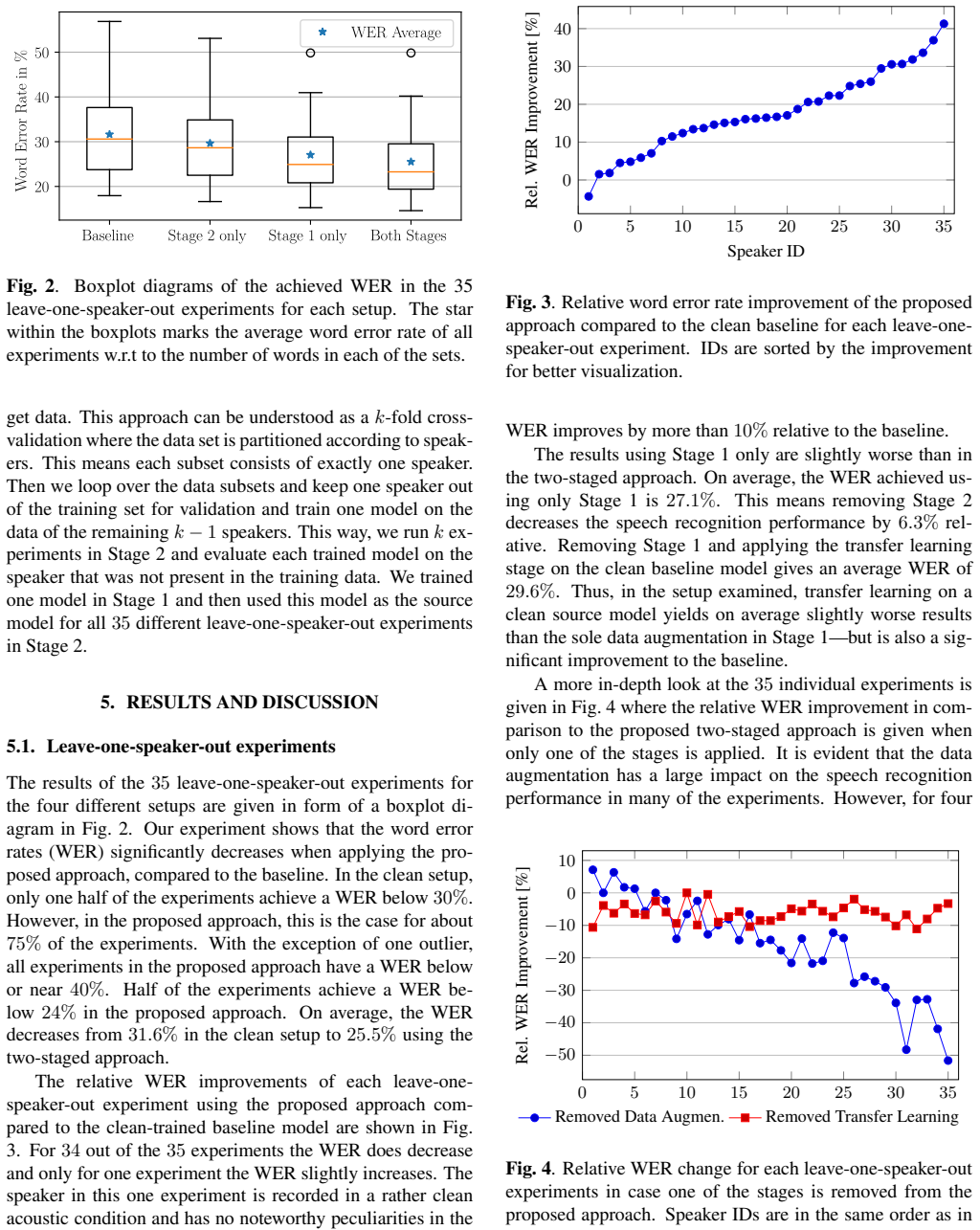
The central claim is that noise-and-reverberation augmentation and full-weight transfer learning attack different parts of the domain gap, so the greatest gain comes from applying both in sequence. The paper shows this by ablation: the clean baseline averages 31.6% word error rate, transfer learning on a clean source reaches 29.6%, augmentation alone reaches 27.1%, and the full two-stage approach reaches 25.5%. The pattern holds across nearly all speakers (34 of 35) and extends to other German evaluation sets, where the biggest gains appear on the most challenging acoustic material while clean tasks are not hurt. The authors read this as evidence that the method produces a genuinely more general acoustic model, not just a model tuned to one interview corpus.
Load-bearing premise
The whole gain rests on the assumption that 266 room impulse responses and 14.5 hours of real noises capture the acoustic conditions of the oral-history recordings; if the simulated channels are unlike the real ones, the augmented source model would be no better than a clean one, and the reported 19.3% improvement would evaporate.
Editorial extensions
If this is right
- A domain with only a few hours of transcribed target audio can adopt a strong out-of-domain source model: the paper's recipe needs just 3.5 hours and improves every held-out speaker but one.
- The two stages are complementary: removing either stage costs accuracy, with Stage 1 contributing more than Stage 2 alone on average.
- The benefit transfers beyond the target domain: on unrelated German evaluation sets the largest relative gains occur on the noisiest, most spontaneous material, while performance on clean planned speech is preserved.
- Because the full model outperforms both single-stage variants on average, the result is not driven by one speaker's data dominating the tiny training set; the leave-one-speaker-out design supports this.
- The same output layer is kept during transfer because the source and target share the same phoneme set, so the method does not require a new decision tree for the target domain.
Reading between the lines
- This paper's recipe is tested on German broadcast-to-oral-history transfer, but nothing in the mechanism is language-specific; a natural extension would be to test it on a non-German archival corpus with similarly small target data.
- The pattern that Stage 1 alone beats Stage 2 alone suggests that with very little target data, channel robustness from a large augmented source outweighs in-domain exposure; an untested prediction is that as target data grows, the ordering reverses and Stage 1 matters less.
- The paper does not investigate how sensitive the gain is to target-set size; sweeping from 1 to 10 hours of transcribed target data would reveal the smallest amount at which full-weight transfer still helps.
- Because the augmentation uses only 266 room impulse responses and 14.5 hours of noises, a corpus recorded with drastically different equipment or room acoustics would test whether the source model's robustness is genuinely transferable or merely tuned to the simulated conditions.
Signed reviews
Editorial analysis
A structured set of objections, weighed in public.
Referee Report
Summary. The paper proposes a two-stage acoustic modeling adaptation for automatic speech recognition of German oral history interviews. In Stage 1, a source acoustic model is trained on 1,000 h of German broadcast speech augmented by simulated reverberation and real noise to create a 3,000 h multi-condition training set; in Stage 2, the resulting model is transferred to 3.5 h of target oral history data via full-weight transfer learning. The evaluation uses a leave-one-speaker-out protocol with 35 speakers and compares the proposed approach against a clean baseline, Stage 1 only, and Stage 2 only. The authors report an average word error rate reduction from 31.6% to 25.5% (19.3% relative), with improvements in 34 of 35 held-out speakers, and additional robustness results on several other German evaluation sets.
Significance. If confirmed, the approach is practically valuable for low-resource ASR domain adaptation, and the evaluation design is a strength: the leave-one-speaker-out protocol is appropriate for the small corpus, and the ablations (baseline, Stage 1 only, Stage 2 only, proposed) directly estimate the contribution of each stage. The paper also provides a useful generalization analysis on multiple in-house evaluation sets. However, the empirical attribution of the Stage 1 gain is compromised by a confound with training data quantity, which must be resolved for the central claim to stand.
major comments (2)
- [Section 3, Fig. 1 and Sec. 5.1] The baseline and Stage 1 conditions differ in two variables at once. The source training data grows from 1,000 h of clean broadcast speech to a 3,000 h multi-condition set (clean + reverb + reverb+noise), and after the standard 3-fold speed perturbation the per-epoch training set grows from 3,000 h to 9,000 h. The paper explicitly notes in Section 3 that 'in our approach the data is increased 3-fold.' Thus the Stage 1-only improvement (31.6% to 27.1% average WER) is consistent with the model simply seeing three times more unique training utterances or three times more updates, and does not establish that the noise/reverberation augmentation is the causal factor. A control experiment with a 3,000 h clean training set (or with the number of training updates held fixed) is required to attribute the gain to the proposed augmentation. Without it, the contribution of the augmentation component to the reported 19.3% relative improvement is unidentified.
- [Section 5.1] The text states that the WER 'significantly decreases' and that the improvements are 'significant,' but no confidence intervals, standard errors, or paired significance tests are provided for the average WER comparisons. Given that the boxplots show considerable per-speaker variance and that one of the 35 experiments worsens, the statistical support for these significance claims is missing. A paired non-parametric test (e.g., Wilcoxon signed-rank) or bootstrap confidence intervals should be reported to substantiate the claims.
minor comments (5)
- [Section 5.1, Fig. 2 caption] Please state explicitly that the reported average WER is the micro-average (total errors / total words) rather than the mean of the 35 per-speaker WERs; the caption's phrasing 'w.r.t to the number of words' is easy to overlook.
- [Table 1] The dropout schedule notation (0, 0@0.2, 0.3@0.5, 0) is not explained; a sentence describing the schedule (e.g., dropout probability per epoch) would improve reproducibility.
- [Section 3, Eq. (1)] The notation in Eq. (1) would benefit from a brief explanation of the convolution indexing and the meaning of the subscripts; currently the symbols are only described in the surrounding text.
- [Table 3] The column headers 'Stage 2 only' and 'Stage 1 only' are slightly ambiguous because the models evaluated in Table 3 are trained with the entire oral history set in the second stage, unlike the leave-one-speaker-out experiments; please state this explicitly in the caption or text.
- [Title and Abstract] The spelling 'Adaption' appears in the title and abstract; consider using 'Adaptation' for standard English usage unless a deliberate variant is intended.
Circularity Check
No circularity: the WER reductions are measured on held-out speakers, not derived from fitted inputs or self-citation chains.
full rationale
The paper's central result is an empirically measured word error rate reduction from 31.6% to 25.5% under leave-one-speaker-out evaluation, with 34 of 35 held-out speakers improving. No equation in the paper is fitted to a target quantity and then reported as a discovery; the two-stage recipe (noise/reverberation augmentation followed by transfer learning) is evaluated directly against a clean baseline, Stage-1-only, and Stage-2-only systems. The self-citations [2,3] supply the oral-history corpus and prior motivation for multi-condition training, but they are not load-bearing evidence for the current improvement: the paper reproduces the Stage-1 effect in its own experiments (27.1% vs. 31.6% WER) on held-out speakers, so the argument does not reduce to an unverified self-citation. Citations such as [4,5,8,10] are external prior methods used for standard techniques, not uniqueness claims or ansatz smuggling. The only notable weakness is that Stage 1 increases the training data threefold at the same time as adding noise/reverberation, making the causal mechanism ambiguous; however, that is an experimental-design limitation about attribution, not circularity, because the reported numbers remain genuine predictions on held-out data. No self-definitional, fitted-input, imported-uniqueness, ansatz-via-citation, or renaming pattern is present.
Assumptions & free parameters
free parameters (6)
- Stage 2 initial/final learning rate =
1e-6 / 1e-7
- Stage 1 initial/final learning rate =
1e-3 / 1e-4
- SNR range for noise addition =
10 to 20 dB
- Maximum number of superposed noises =
3
- Speed perturbation factors =
0.9, 1.1
- Dropout schedule in Stage 1 =
0, 0@0.2, 0.3@0.5, 0
assumptions (4)
- domain assumption Synthetic noise and reverberation conditions adequately represent oral history acoustic conditions
- domain assumption The i-vector extractor trained on broadcast speech is applicable to oral history speech without adaptation
- domain assumption The fixed broadcast language model is adequate for decoding oral history content
- standard math LF-MMI training and the TDNN-LSTM architecture are suitable building blocks
Cite this review
Pith. "Pith review of Two-Staged Acoustic Modeling Adaption for Robust Speech Recognition by the Example of German Oral History Interviews." pith.science (2026). https://pith.science/paper/24POQHHF
@misc{pith2026190806709,
  author       = {Pith},
  title        = {Pith review of: Two-Staged Acoustic Modeling Adaption for Robust Speech Recognition by the Example of German Oral History Interviews},
  year         = {2026},
  howpublished = {\url{https://pith.science/paper/24POQHHF}},
  note         = {Machine review of arXiv:1908.06709}
}
read the original abstract
In automatic speech recognition, often little training data is available for specific challenging tasks, but training of state-of-the-art automatic speech recognition systems requires large amounts of annotated speech. To address this issue, we propose a two-staged approach to acoustic modeling that combines noise and reverberation data augmentation with transfer learning to robustly address challenges such as difficult acoustic recording conditions, spontaneous speech, and speech of elderly people. We evaluate our approach using the example of German oral history interviews, where a relative average reduction of the word error rate by 19.3% is achieved.
Figures
Reference graph
Works this paper leans on
-
[1]
INTRODUCTION Automatic speech recognition (ASR) has undergone enor- mous improvements in recent years. Nowadays, it is success- fully used in many applications, both in the commercial and industrial sectors. ASR not only enables the development of smart speech assistants but is also used for subtitling, infor- mation mining, analytics, and recommendation....
-
[2]
RELA TED WORK ASR is a popular and highly researched area and new ap- proaches are regularly proposed. Currently, lattice-free max- imum mutual information (LF-MMI) trained models achieve state-of-the-art results on many different ASR tasks [1]. Oral history in historical research refers to conducting and analyzing interviews with contemporary witnesses. ...
-
[3]
An overview of the proposed method is given in Fig
PROPOSED APPROACH We aim at improving the performance of robust ASR systems by performing a two-staged acoustic modeling adaption us- ing a very little amount of target training data. An overview of the proposed method is given in Fig. 1. In the first stage, multi-condition training is applied using noise and reverber- ation data augmentation to obtain a r...
-
[4]
EXPERIMENTAL SETUP 4.1. Lexicon and language model The lexicons needed for training in Stage 1, Stage 2 and de- coding are all obtained using the same grapheme-to-phoneme pronunciation model trained with Sequitur G2P [11]. This model is created using the German pronunciation database Phonolex from the Bavarian Archive for Speech Signals. For decoding, we ...
work page 1980
-
[5]
Overall, four major types of setups are examined in our experiments:
criterion. Overall, four major types of setups are examined in our experiments:
-
[6]
Baseline: For comparison, we train a baseline acous- tic model with the same setup as in Stage 1, excluding the noise and reverberation data augmentation and the entire transfer learning Stage 2
-
[7]
Stage 1 Only (Data Augmentation) : Evaluating the performance of the source model trained in Stage 1 us- ing the noise and reverberation data augmentation on the 35 speaker sets
-
[8]
Stage 2 Only (Transfer Learning) : Applying the transfer learning experiments on the clean-trained base- line model
Show all 35 references
-
[9]
Proposed Approach: Applying Stage 1 and Stage 2. 4.2.4. Leave-one-speaker-out evaluation Since only very little data from the target domain is avail- able, we apply a leave-one-speaker-out evaluation on the tar- Fig. 2 . Boxplot diagrams of the achieved WER in the 35 leave-one...
-
[10]
Leave-one-speaker-out experiments The results of the 35 leave-one-speaker-out experiments for the four different setups are given in form of a boxplot di- agram in Fig
RESULTS AND DISCUSSION 5.1. Leave-one-speaker-out experiments The results of the 35 leave-one-speaker-out experiments for the four different setups are given in form of a boxplot di- agram in Fig. 2. Our experiment shows that the word error rates (WER) significantly decreases w...
-
[11]
The speaker in this one experiment is recorded in a rather clean acoustic condition and has no noteworthy peculiarities in the nature of his speaking
For 34 out of the 35 experiments the WER does decrease and only for one experiment the WER slightly increases. The speaker in this one experiment is recorded in a rather clean acoustic condition and has no noteworthy peculiarities in the nature of his speaking. For 27 out of t...
-
[12]
We evaluated the reliability of our approach with a leave-one-speaker-out evaluation method in which we per- form 35 experiments for one setup
CONCLUSION In this work, we proposed a two-staged acoustic modeling adaption for robust speech recognition and evaluated the ap- proach on the challenging example of German oral history interviews. We evaluated the reliability of our approach with a leave-one-speaker-out evalu...
-
[13]
ACKNOWLEDGEMENTS This research has been funded by the Federal Ministry of Ed- ucation and Research of Germany (BMBF) in the projectKA3 - K¨olner Zentrum f¨ur Analyse und Archivierung von AV-Daten (Cologne center for the analysis and archiving of audiovisual data) (project numb...
-
[14]
Purely sequence- trained neural networks for ASR based on lattice- free MMI,
Daniel Povey, Vijayaditya Peddinti, Daniel Galvez, Pe- gah Ghahremani, Vimal Manohar, Xingyu Na, Yim- ing Wang, and Sanjeev Khudanpur, “Purely sequence- trained neural networks for ASR based on lattice- free MMI,” in 17th Annual Conference of the In- ternational Speech Communi...
2016
-
[15]
Im- proved transcription and indexing of oral history inter- views for digital humanities research,
Michael Gref, Joachim K ¨ohler, and Almut Leh, “Im- proved transcription and indexing of oral history inter- views for digital humanities research,” inEleventh Inter- national Conference on Language Resources and Eval- uation (LREC), 2018
2018
-
[16]
Improving robust speech recognition for german oral history interviews using multi-condition training,
Michael Gref, Christoph Schmidt, and Joachim K ¨ohler, “Improving robust speech recognition for german oral history interviews using multi-condition training,” in13. ITG Symposium on Speech Communication . 2018, pp. 256–260, IEEE
2018
-
[17]
A study on data augmentation of reverberant speech for robust speech recognition,
Tom Ko, Vijayaditya Peddinti, Daniel Povey, Michael L. Seltzer, and Sanjeev Khudanpur, “A study on data augmentation of reverberant speech for robust speech recognition,” in IEEE International Conference on Acoustics, Speech and Signal Processing (ICASSP) , 2017, pp. 5220–5224
2017
-
[18]
Audio augmentation for speech recognition,
Tom Ko, Vijayaditya Peddinti, Daniel Povey, and San- jeev Khudanpur, “Audio augmentation for speech recognition,” in 16th Annual Conference of the In- ternational Speech Communication Association (Inter- speech), 2015, pp. 3586–3589
2015
-
[19]
Goodfellow, Yoshua Bengio, and Aaron C
Ian J. Goodfellow, Yoshua Bengio, and Aaron C. Courville, Deep Learning, Adaptive computation and machine learning. MIT Press, 2016, pp. 526–528
2016
-
[20]
Transfer learn- ing for speech and language processing,
Dong Wang and Thomas Fang Zheng, “Transfer learn- ing for speech and language processing,” inAsia-Pacific Signal and Information Processing Association Annual Summit and Conference (APSIPA) , 2015, pp. 1225– 1237
2015
-
[21]
Investigation of transfer learning for ASR using LF-MMI trained neural networks,
Pegah Ghahremani, Vimal Manohar, Hossein Hadian, Daniel Povey, and Sanjeev Khudanpur, “Investigation of transfer learning for ASR using LF-MMI trained neural networks,” in IEEE Automatic Speech Recognition and Understanding Workshop (ASRU), 2017, pp. 279–286
2017
-
[22]
A binaural room impulse response database for the evaluation of derever- beration algorithms,
M. Jeub, M. Schafer, and P. Vary, “A binaural room impulse response database for the evaluation of derever- beration algorithms,” in 16th International Conference on Digital Signal Processing, 2009, pp. 1–5
2009
-
[23]
An exploration of dropout with lstms,
Gaofeng Cheng, Vijayaditya Peddinti, Daniel Povey, Vi- mal Manohar, Sanjeev Khudanpur, and Yonghong Yan, “An exploration of dropout with lstms,” in 18th Annual Conference of the International Speech Communication Association (Interspeech), 2017, pp. 1586–1590
2017
-
[24]
Joint-sequence models for grapheme-to-phoneme conversion,
Maximilian Bisani and Hermann Ney, “Joint-sequence models for grapheme-to-phoneme conversion,” Speech Communication, vol. 50, no. 5, pp. 434–451, 2008
2008
-
[25]
Exploiting the large- scale german broadcast corpus to boost the fraunhofer IAIS speech recognition system,
Michael Stadtschnitzer, Jochen Schwenninger, Daniel Stein, and Joachim K ¨ohler, “Exploiting the large- scale german broadcast corpus to boost the fraunhofer IAIS speech recognition system,” in Ninth Interna- tional Conference on Language Resources and Evalu- ation (LREC), 201...
2014
-
[26]
Front-end factor analysis for speaker verification,
Najim Dehak, Patrick Kenny, R ´eda Dehak, Pierre Du- mouchel, and Pierre Ouellet, “Front-end factor analysis for speaker verification,” IEEE Trans. Audio, Speech & Language Processing, vol. 19, no. 4, pp. 788–798, 2011
2011
-
[27]
Phoneme recognition using time-delay neural net- works,
Alexander H. Waibel, Toshiyuki Hanazawa, Geof- frey E. Hinton, Kiyohiro Shikano, and Kevin J. Lang, “Phoneme recognition using time-delay neural net- works,” IEEE Trans. Acoustics, Speech, and Signal Pro- cessing, vol. 37, no. 3, pp. 328–339, 1989
1989
-
[28]
A time delay neural network architecture for efficient modeling of long temporal contexts,
Vijayaditya Peddinti, Daniel Povey, and Sanjeev Khu- danpur, “A time delay neural network architecture for efficient modeling of long temporal contexts,” in 16th Annual Conference of the International Speech Com- munication Association (Interspeech), 2015, pp. 3214– 3218
2015
-
[29]
Long short- term memory,
Sepp Hochreiter and J ¨urgen Schmidhuber, “Long short- term memory,” Neural Computation, vol. 9, no. 8, pp. 1735–1780, 1997
1997
-
[30]
Learning to forget: Continual prediction with LSTM,
Felix A. Gers, J ¨urgen Schmidhuber, and Fred A. Cum- mins, “Learning to forget: Continual prediction with LSTM,” Neural Computation, vol. 12, no. 10, pp. 2451– 2471, 2000
2000
-
[31]
Recurrent nets that time and count,
Felix A. Gers and J ¨urgen Schmidhuber, “Recurrent nets that time and count,” in IJCNN (3), 2000, pp. 189–194
2000
-
[32]
Long short-term memory recurrent neural network ar- chitectures for large scale acoustic modeling,
Hasim Sak, Andrew W. Senior, and Franc ¸oise Beaufays, “Long short-term memory recurrent neural network ar- chitectures for large scale acoustic modeling,” in 15th Annual Conference of the International Speech Commu- nication Association (Interspeech), 2014, pp. 338–342
2014
-
[33]
The kaldi speech recognition toolkit,
Daniel Povey, Arnab Ghoshal, Gilles Boulianne, Lukas Burget, Ondrej Glembek, Nagendra Goel, Mirko Han- nemann, Petr Motlicek, Yanmin Qian, Petr Schwarz, Jan Silovsky, Georg Stemmer, and Karel Vesely, “The kaldi speech recognition toolkit,” inIEEE Workshop on Auto- matic Speech...
2011
-
[34]
DiSCo - A german evaluation corpus for challenging problems in the broadcast do- main,
Doris Baum, Daniel Schneider, Rolf Bardeli, Jochen Schwenninger, Barbara Samlowski, Thomas Winkler, and Joachim K ¨ohler, “DiSCo - A german evaluation corpus for challenging problems in the broadcast do- main,” in International Conference on Language Re- sources and Evaluation...
2010
-
[35]
7th open challenge on question an- swering over linked data (QALD-7),
Ricardo Usbeck, Axel-Cyrille Ngonga Ngomo, Bas- tian Haarmann, Anastasia Krithara, Michael R¨oder, and Giulio Napolitano, “7th open challenge on question an- swering over linked data (QALD-7),” in Semantic Web Challenges - 4th SemWebEval Challenge at (ESWC) , 2017, pp. 59–69
2017
Reviewed August 14, 2026 · model on record in the stance chip above.
Discussion (0). Continue with ORCID to comment.