REVIEW 3 major objections 4 minor 21 references
FlowBack-Adjoint: Physics-Aware and Energy-Guided Conditional Flow-Matching for All-Atom Protein Backmapping
T0 review · 3 major / 4 minor · reviewed 2026-08-06 · deepseek-v4-flash
Pith's one-line read A post-training physics pass makes FlowBack generate low-energy, clash-free protein structures without retraining from scratch, producing configurations that can directly initialize stable molecular dynamics simulations.
desk verdict Real, well-measured improvements in backmapping, but the energy-reweighting story is not verified as claimed. read the letter →
The pith
A machine-rendered reading of the paper's core claim, the machinery that carries it, and where it could break.
The reading
What carries the argument
The central machinery is adjoint matching: an adjoint state $a_t$ tracks how a perturbation of the generated configuration would change the terminal energy reward, and a control force $u_t(x) = -\frac{1}{2}\sigma_t(t)^2 a_t$ is added to the flow velocity to bias the generated distribution toward $e^{-\lambda U}$. The method requires a memoryless diffusion noise schedule $\sigma_t^2(t) = 2(1-t)/t$ with a zero-mean Gaussian base distribution, and assumes the base flow satisfies the continuity equation, so that the derived lean adjoint ODE gives an unbiased tilt toward the reward-weighted distribution. Three auxiliary velocity fields (chirality correction around $t \geq 0.25$, Lennard-Jones repulsion for $t \geq 0.85$, and harmonic bond-length restraints for $t \geq 0.95$) act as physics-based inductive biases that reduce the burden on the energy gradients.
What would settle it
Run the trained FlowBack-Adjoint model on a set of C-alpha traces drawn from a well-characterized molecular dynamics ensemble and compare the energies of the generated structures against an independent Markov-chain Monte Carlo or Hamiltonian Monte Carlo sampler using the same force field; if the generated energy histogram systematically differs from the reference Boltzmann distribution by more than the reported KL divergences, the claimed unbiased reweighting fails.
Extended reading notes
Core claim
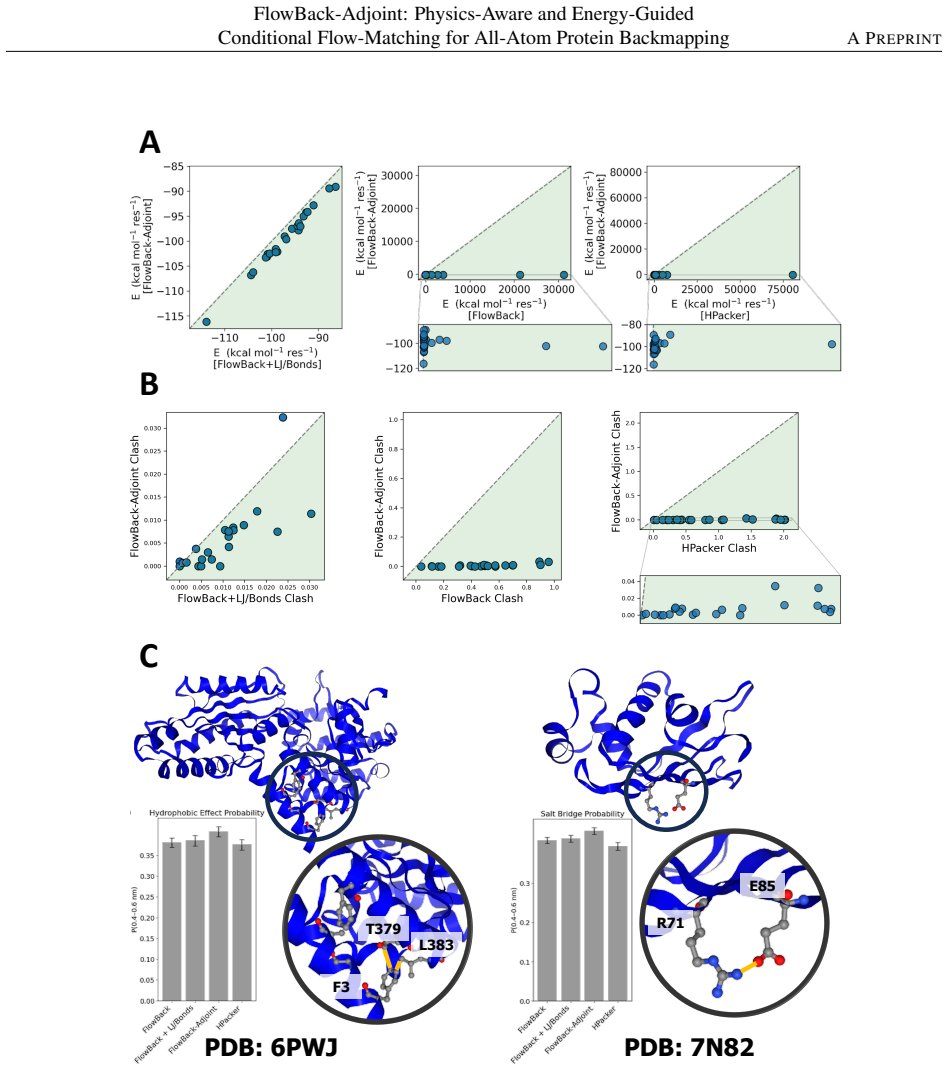
The paper's central discovery is that a pretrained conditional flow-matching model can be improved by adjoint matching to sample from a reward-weighted distribution $p_\phi(x) \propto p_\theta(x)e^{-\lambda U(x)}$, where $U$ is a molecular mechanics force-field energy and $\lambda$ a tuning parameter. Gradients of the energy are backpropagated through the flow trajectory using a lean adjoint ODE, and the resulting control force is added to the learned velocity, producing a fine-tuned model that generates lower-energy configurations while preserving the structural accuracy and diversity learned from data. The paper reports median energy reductions of $\sim$78 kcal/mol.residue against FlowBack, >92% reduction in bond-length errors, >98% elimination of clashes, strong retention of configurational diversity, and stability of the generated structures when directly used to launch all-atom MD simulations.
Load-bearing premise
The method's guarantee that the corrected flow samples the energy-reweighted distribution depends on the base flow being exactly a memoryless diffusion with a zero-mean Gaussian prior, and on the learned drift satisfying the continuity equation; in practice the flow is approximated with hand-added corrections and 100 explicit Euler steps, so the unbiasedness may not hold exactly.
Editorial extensions
If this is right
- Generated all-atom ensembles can be closer to a Boltzmann-like distribution, enabling more faithful downstream calculations of binding energies and other thermodynamic quantities.
- Backmapped structures can directly initialize stable MD simulations without prior energy minimization, removing a costly and error-prone preprocessing step in coarse-grained workflows.
- The post-training energy-guided tilt preserves configurational diversity even at larger prior noise values, breaking the usual accuracy-diversity trade-off.
- The adjoint-matching recipe is applicable to other pretrained flow or diffusion generators, since it only requires a differentiable reward and its gradient.
- Swapping the CHARMM27 energy for a general machine-learned potential could extend the method beyond proteins to nucleic acids, lipids, and synthetic polymers.
Reading between the lines
- The paper implicitly suggests that any differentiable energy function can serve as the reward; replacing the gas-phase CHARMM27 potential with an implicit-solvent or machine-learned potential could be a direct test of the method's modularity.
- The strong residual energy tail reported in the results could be further reduced by replacing the chirality-correction velocity with a chirality-aware architecture, since the paper's ablation attributes most of the remaining mismatch to that correction.
- If adjoint matching reliably tilts toward $e^{-\lambda U}$, the hyperparameter $\lambda$ could be tuned to target a specific temperature, moving the generator from "low-energy structures" toward an explicit Boltzmann ensemble.
- The method's dependence on a memoryless noise schedule implies it may not transfer unchanged to diffusion models with different noise schedules without re-deriving the adjoint dynamics.
Editorial analysis
A structured set of objections, weighed in public.
Referee Report
Summary. FlowBack-Adjoint augments the pretrained FlowBack flow-matching backmapping model with three auxiliary physics-based velocity fields (chirality, Lennard-Jones, bond-length) and a CHARMM27 energy-gradient adjoint-matching fine-tuning step. The authors evaluate the model on two held-out DESRES mini-protein trajectories and a 23-protein BIOEMU out-of-distribution set, reporting reduced bond-length errors, reduced clashes, lower CHARMM27 single-point energies, improved KL divergence to the MD energy distribution, and improved success rates of MD simulations launched without energy minimization.
Significance. The empirical gains are substantial and the paper includes several commendable practices: explicit out-of-distribution testing with homology-filtered sequences, a modular comparison within the BIOEMU pipeline, an honest ablation of the chirality correction, and an open statement of limitations (gas-phase energies, hydrogen placement). If the reweighting claim were verified, the method would be a lightweight and practical way to inject physical knowledge into pretrained generative models. However, the central theoretical claim about sampling a Boltzmann-tilted distribution is not verified for the actual implementation, and the MD-stability headline is weaker than stated. These gaps are fixable and should be addressed before publication.
major comments (3)
- [Section 2.3, Eq. (2)-(3); Algorithms 1-2] The paper claims that adjoint matching steers the generator to sample p_phi(x) = p_theta(x) exp(-lambda U(x)). The unbiasedness guarantee of the lean adjoint ODE requires the memoryless SDE (Eq. 1) with a drift v_theta satisfying the associated continuity equation, and the same stochastic dynamics at inference. In practice, v_theta is the sum of the learned FlowBack drift and three hand-designed auxiliary fields (Section 2.2), training is performed on the stochastic SDE (Algorithm 1), and inference uses a deterministic Euler map (Algorithm 2: x <- x + v_phi Delta t). No test is reported that the output distribution equals p_theta exp(-lambda U), e.g., via reweighting or a separate sampler. Table 1's KL divergence to the DESRES energy distribution is not such a test because the reference frames are evaluated with the same CHARMM27 force field used as the reward. The 'energy-guided reweighting' is therefore currently an interpretation rather than an established property. Please verify the target distribution or revise the theoretical claims accordingly.
- [Section 3.1 / Test 5 and Abstract] The abstract's claim that FlowBack-Adjoint produces configurations capable of initializing stable MD 'without requiring energy relaxation' is overstated: the reported stable-run fractions are 82.6% (WW domain) and 65.4% (Protein B) for 20 ps gas-phase runs, and values near 100% are obtained only after removing hydrogen/termini forces or using a united-atom treatment (Section 3.1 and Figure A.5). Please qualify the abstract and conclusions with the actual success rates.
- [Section 3.1 / Test 4 and Section 2.4.2] The energy-divergence metric is partially circular: the reward R = -lambda U uses CHARMM27, and both the generated and reference ensembles are evaluated with CHARMM27. The KL improvement therefore reflects, in part, the model optimizing the same energy function used for evaluation. The bond, clash, and diversity metrics plus the MD-stability tests provide independent evidence, and the manuscript should explicitly acknowledge this circularity and, ideally, include an energy comparison with an independent force field.
minor comments (4)
- [Section 2.1] The phrase 'Training of the learned vector field vector field v_gamma' contains a duplicated word; please remove the repetition.
- [Section 3.2] The sentence 'we inserted our integrator into the BIOEMU pipeline' is misleading because FlowBack-Adjoint is a generative model, not an integrator; consider rephrasing to 'we inserted our backmapping model into the BIOEMU pipeline'.
- [Section 2.4.2] The description of the periodic box ('expanded by 2 nm in each direction') would benefit from stating the initial box dimensions or the protocol used to define them, to make the energy calculations reproducible.
- [Table 1 and Figure 2] The scalar metrics in Table 1 and the force statistics in Figure 2 are reported without uncertainties or repeat counts; providing standard errors or confidence intervals would strengthen the quantitative comparisons.
Circularity Check
Energy headline is partly a self-consistency check (same CHARMM27 reward and metric); bond/clash gains are by-construction effects of hand-coded fields; independent MD/reference evidence keeps the core derivation non-circular.
-
fitted input called prediction
[Section 2.3 (reward definition) and Section 3.2 (energy result)]
"In this work, we choose R(x) = −λU (x), where λ is a hyperparameter controlling the degree to which the reward function modulates the base distribution and U (x) is the energy assigned to an AA configuration x by the CHARMM27 molecular mechanics force field ... Overall, F LOWBACK-A DJOINT lowers single-point energies in the OOD60 proteins by a median of ∼78 kcal/mol.residue relative to FLOWBACK."
The headline energy reduction is evaluated with the same CHARMM27 energy function U that is used to define the reward R = −λU(x) in the adjoint-matching objective. Because the training signal is the negative gradient of this U propagated through the adjoint, a decrease in single-point CHARMM27 energy is a direct consequence of optimizing the objective rather than an independent physical prediction. The only energy benchmark against external data is the KL divergence to DESRES trajectories, but those reference trajectories were generated with CHARMM22*, not CHARMM27, so the reward and the reference are not on the same potential surface. The ~78 kcal/mol.residue number is therefore substantially a self-consistency check against the model's own training target.
-
self definitional
[Section 2.2 (auxiliary velocity fields) vs. Section 2.6 (Bond Score and Clash Score)]
"Second, a repulsive Lennard-Jones (LJ) velocity is introduced for t ≥ 0.85, wherein heavy-atom pairs separated by more than two covalent bonds and residing within a distance d <0.42 nm are subjected to a Lennard-Jones interaction under the CHARMM27 force field ... Third, for (t ≥ 0.95), a harmonic bond length interaction is added around the equilibrium bond length mandated by the CHARMM27 force field in order to draw each covalent bond towards its low-energy equilibrium configuration."
The Bond Score is defined as the fraction of bonds within 10% of the amino-acid reference, and the Clash Score is the share of residues within 1.2 Å of another residue. The hand-added vθ fields apply exactly these physical targets: repulsive LJ interactions below 0.42 nm to separate clashing atoms and harmonic bond-length restoring forces near the end of the flow. Reported improvements in bond and clash metrics are therefore the direct intended effect of these hand-designed corrections rather than emergent predictions of the learned flow. The paper is transparent about them being inductive biases, but presenting the resulting bond/clash reductions as benchmark discoveries is a validation-by-construction circularity.
full rationale
The central construction is not circular in the strongest sense: the pre-trained FlowBack model is a real external artifact, the adjoint-matching theorem is imported from Domingo-Enrich et al. (not the present authors), and the DESRES MD trajectories are external reference data. The independently probative results are the diversity scores, out-of-distribution generalization on 23 proteins, and MD stability tests, which do not reduce to the training objective. The circularity is partial and confined to the headline energy metric, which uses the same CHARMM27 U as the reward, and the bond/clash metrics, which are directly targeted by the hand-coded auxiliary velocity fields. The paper's own ablation (Figure A.8) further shows that most of the residual energy gap originates from the ad hoc chirality correction, so the attribution of the energy gains to adjoint matching itself is weakened; that is an attribution/correctness concern rather than additional circularity. The mismatch between stochastic training dynamics and deterministic Euler inference is likewise a correctness gap, not a definitional reduction, and does not raise the circularity score. No load-bearing self-citation chain was found; Jones et al. [2025] is a legitimate base model citation. Overall score 4 reflects partial self-consistency in the headline benchmarks while the core derivation retains independent content.
Assumptions & free parameters
free parameters (5)
- lambda (reward scaling) =
0.01
- sigma_p (prior noise) =
0.003, 0.005, 0.010 nm
- Auxiliary physics-field parameters =
cutoffs, activation thresholds, force constants in Appendix A.1
- Noise schedule regularization offset Delta_t =
unspecified small offset
- Number of Euler steps N =
100
assumptions (5)
- ad hoc to paper Memoryless diffusion and lean adjoint ODE theory from Domingo-Enrich et al. applies exactly to the augmented flow v_theta.
- domain assumption CHARMM27 gas-phase energies and gradients are an adequate reward for protein backmapping.
- domain assumption DESRES mini-protein trajectories provide a representative Boltzmann-distributed training set.
- ad hoc to paper pdb2gmx hydrogen placement on backmapped heavy atoms is adequate for MD stability testing.
- ad hoc to paper Generated heavy-atom configurations and MD reference frames are energetically comparable under CHARMM27 despite differing hydrogen treatment and force field history.
Cite this review
Pith. "Pith review of FlowBack-Adjoint: Physics-Aware and Energy-Guided Conditional Flow-Matching for All-Atom Protein Backmapping." pith.science (2026). https://pith.science/paper/24Q5SCIH
@misc{pith2026250803619,
  author       = {Pith},
  title        = {Pith review of: FlowBack-Adjoint: Physics-Aware and Energy-Guided Conditional Flow-Matching for All-Atom Protein Backmapping},
  year         = {2026},
  howpublished = {\url{https://pith.science/paper/24Q5SCIH}},
  note         = {Machine review of arXiv:2508.03619}
}
read the original abstract
Coarse-grained (CG) molecular models of proteins can substantially increase the time and length scales accessible to molecular dynamics simulations of proteins, but recovery of accurate all-atom (AA) ensembles from CG simulation trajectories can be essential for exposing molecular mechanisms of folding and docking and for calculation of physical properties requiring atomistic detail. The recently reported deep generative model FlowBack restores AA detail to protein C-alpha traces using a flow-matching architecture and demonstrates state-of-the-art performance in generation of AA structural ensembles. Training, however, is performed exclusively on structural data and the absence of any awareness of interatomic energies or forces within training results in small fractions of incorrect bond lengths, atomic clashes, and otherwise high-energy structures. In this work, we introduce FlowBack-Adjoint as a lightweight enhancement that upgrades the pre-trained FlowBack model through a one-time, physics-aware post-training pass. Auxiliary contributions to the flow introduce physical awareness of bond lengths and Lennard-Jones interactions and gradients of a molecular mechanics force field energy are incorporated via adjoint matching to steer the FlowBack-Adjoint vector field to produce lower-energy configurations. In benchmark tests against FlowBack, FlowBack-Adjoint lowers single-point energies by a median of ~78 kcal/mol.residue, reduces errors in bond lengths by >92%, eliminates >98% of molecular clashes, maintains excellent diversity of the AA configurational ensemble, and produces configurations capable of initializing stable all-atom molecular dynamics simulations without requiring energy relaxation. We propose FlowBack-Adjoint as an accurate and efficient physics-aware deep generative model for AA backmapping from C-alpha traces.
Figures


Figures from the paper (1 more)
Reference graph
Works this paper leans on
-
[6]
Sarah Lewis, Tim Hempel, Jos ´e Jim ´enez-Luna, Michael Gastegger, Yu Xie, Andrew Y . K. Foong, Victor Garc ´ıa Satorras, Osama Abdin, Bastiaan S. Veeling, Iryna Zaporozhets, Yaoyi Chen, Soojung Yang, Adam E. Foster, Arne Schneuing, Jigyasa Nigam, Federico Barbero, Vincent Stimper, Andrew Campbell, Jason Yim, Marten Lienen, Yu Shi, Shuxin Zheng, Hannes Sc...
-
[8]
Generative coarse-graining of molecular conformations
19 FlowBack-Adjoint: Physics-Aware and Energy-Guided Conditional Flow-Matching for All-Atom Protein Backmapping A PREPRINT Wujie Wang, Minkai Xu, Chen Cai, Benjamin Kurt Miller, Tess Smidt, Yusu Wang, Jian Tang, and Rafael G ´omez- Bombarelli. Generative coarse-graining of molecular conformations. arXiv preprint arXiv:2201.12176,
-
[9]
Backdiff: a diffusion model for generalized transferable protein backmapping
Yikai Liu, Ming Chen, and Guang Lin. Backdiff: A diffusion model for generalized transferable protein backmapping. arXiv preprint arXiv:2310.01768,
-
[10]
Towards deep generative backmapping of coarse-grained molecular systems
Jiasheng Li, Zaiqiao Meng, and Shangsong Liang. Towards deep generative backmapping of coarse-grained molecular systems. In Proceedings of the 2024 2nd Asia Conference on Computer Vision, Image Processing and Pattern Recognition, pages 1–7,
work page 2024
-
[11]
Daniele Angioletti, Stefano Raniolo, and Vittorio Limongelli. HEroBM: A deep equivariant graph neural network for universal backmapping from coarse-grained to all-atom representations. arXiv preprint arXiv:2404.16911,
-
[13]
La-Proteina: Atomistic protein generation via partially latent flow matching
Tomas Geffner, Kieran Didi, Zhonglin Cao, Danny Reidenbach, Zuobai Zhang, Christian Dallago, Emine Kucukbenli, Karsten Kreis, and Arash Vahdat. La-Proteina: Atomistic protein generation via partially latent flow matching. arXiv preprint arXiv:2507.09466,
-
[14]
P(all-atom) is unlocking new path for protein design
Wei Qu, Jiawei Guan, Rui Ma, Ke Zhai, Weikun Wu, and Haobo Wang. P(all-atom) is unlocking new path for protein design. bioRxiv preprint bioRxiv:10.1101/2024.08.16.608235,
-
[15]
Aligning Protein Conformation Ensemble Generation with Physical Feedback
20 FlowBack-Adjoint: Physics-Aware and Energy-Guided Conditional Flow-Matching for All-Atom Protein Backmapping A PREPRINT Jiarui Lu, Xiaoyin Chen, Stephen Zhewen Lu, Aur ´elie Lozano, Vijil Chenthamarakshan, Payel Das, and Jian Tang. Aligning protein conformation ensemble generation with physical feedback. arXiv preprint arXiv:2505.24203 ,
Show all 21 references
-
[17]
Albergo, Nicholas M
Nanye Ma, Mark Goldstein, Michael S. Albergo, Nicholas M. Boffi, Eric Vanden-Eijnden, and Saining Xie. SiT: exploring flow and diffusion-based generative models with scalable interpolant transformers. arXiv preprint arXiv:2401.08740,
-
[18]
Path integrals and symmetry breaking for optimal control theory
H J Kappen. Path integrals and symmetry breaking for optimal control theory. Journal of Statistical Mechanics: Theory and Experiment, 2005(11):P11011,
2005
-
[21]
Aaron Havens, Benjamin Kurt Miller, Bing Yan, Carles Domingo-Enrich, Anuroop Sriram, Brandon Wood, Daniel Levine, Bin Hu, Brandon Amos, Brian Karrer, Xiang Fu, Guan-Horng Liu, and Ricky T. Q. Chen. Adjoint sampling: Highly scalable diffusion samplers via adjoint matching. arXi...
-
[2000]
Carles Domingo-Enrich, Michal Drozdzal, Brian Karrer, and Ricky T. Q. Chen. Adjoint matching: Fine-tuning flow and diffusion generative models with memoryless stochastic optimal control. arXiv preprint arXiv:2409.08861 ,
-
[2005]
Adam: A method for stochastic optimization
Diederik P Kingma and Jimmy Ba. Adam: A method for stochastic optimization. arXiv preprint arXiv:1412.6980,
-
[2006]
Wood, Misko Dzamba, Xiang Fu, Meng Gao, Muhammed Shuaibi, Luis Barroso-Luque, Kareem Ab- delmaqsoud, Vahe Gharakhanyan, John R
Brandon M. Wood, Misko Dzamba, Xiang Fu, Meng Gao, Muhammed Shuaibi, Luis Barroso-Luque, Kareem Ab- delmaqsoud, Vahe Gharakhanyan, John R. Kitchin, Daniel S. Levine, Kyle Michel, Anuroop Sriram, Taco Cohen, Abhishek Das, Ammar Rizvi, Sushree Jagriti Sahoo, Zachary W. Ulissi, a...
-
[2010]
AlphaFold meets flow matching for generating protein ensembles
Bowen Jing, Bonnie Berger, and Tommi Jaakkola. AlphaFold meets flow matching for generating protein ensembles. arXiv preprint arXiv:2402.04845,
-
[2016]
Learning conformational ensembles of proteins based on backbone geometry
Nicolas Wolf, Leif Seute, Vsevolod Viliuga, Simon Wagner, Jan St¨uhmer, and Frauke Gr¨ater. Learning conformational ensembles of proteins based on backbone geometry. arXiv preprint arXiv:2503.05738,
-
[2019]
Carles Domingo-Enrich, Jiequn Han, Brandon Amos, Joan Bruna, and Ricky T. Q. Chen. Stochastic optimal control matching. arXiv preprint arXiv:2312.02027,
-
[2022]
H-Packer: Holographic rota- tionally equivariant convolutional neural network for protein side-chain packing.arXiv preprint arXiv:2311.09312,
Gian Marco Visani, William Galvin, Michael Neal Pun, and Armita Nourmohammad. H-Packer: Holographic rota- tionally equivariant convolutional neural network for protein side-chain packing.arXiv preprint arXiv:2311.09312,
-
[2023]
High-resolution de novo structure prediction from primary sequence
Ruidong Wu, Fan Ding, Rui Wang, Rui Shen, Xiwen Zhang, Shitong Luo, Chenpeng Su, Zuofan Wu, Qi Xie, Bonnie Berger, Jianzhu Ma, and Jian Peng. High-resolution de novo structure prediction from primary sequence. bioRxiv preprint bioRxiv:10.1101/2022.07.21.500999,
-
[2024]
Protein conformation generation via force-guided SE(3) diffusion models
18 FlowBack-Adjoint: Physics-Aware and Energy-Guided Conditional Flow-Matching for All-Atom Protein Backmapping A PREPRINT Yan Wang, Lihao Wang, Yuning Shen, Yiqun Wang, Huizhuo Yuan, Yue Wu, and Quanquan Gu. Protein conformation generation via force-guided SE(3) diffusion mod...
-
[2025]
Emil Thomasen, Sergey Ovchinnikov, Charlotte M
Matteo Cagiada, F. Emil Thomasen, Sergey Ovchinnikov, Charlotte M. Deane, and Kresten Lindorff- Larsen. AF2 χ: Predicting protein side-chain rotamer distributions with AlphaFold2. bioRxiv preprint bioRxiv:10.1101/2025.04.16.649219,
2025 doi
Reviewed August 6, 2026 · model on record in the stance chip above.
Discussion (0). Sign in to comment.