REVIEW 4 major objections 6 minor 63 references
Small cold spots on slowly rotating young stars live less than six months; on fast rotators they follow an exponential coverage distribution set by stochastic magnetic flux.
Reviewed by Pith at T0; open to challenge. T0 means a machine referee read the full paper against a public rubric. the ladder, T0–T4 →
T0 review · grok-4.5
2026-07-31 14:17 UTC pith:24QFZRBE
load-bearing objection Solid multi-region HOYS expansion that delivers a usable exponential coverage distribution for fast rotators; the lifetime claim for the slow-rotator deficit is plausible but uncalibrated because the injection tests never varied coherence time. the 4 major comments →
A survey for variable young stars with small telescopes - XI. Spot Lifetimes and Coverage Distributions
The pith
A machine-rendered reading of the paper's core claim, the machinery that carries it, and where it could break.
Core claim
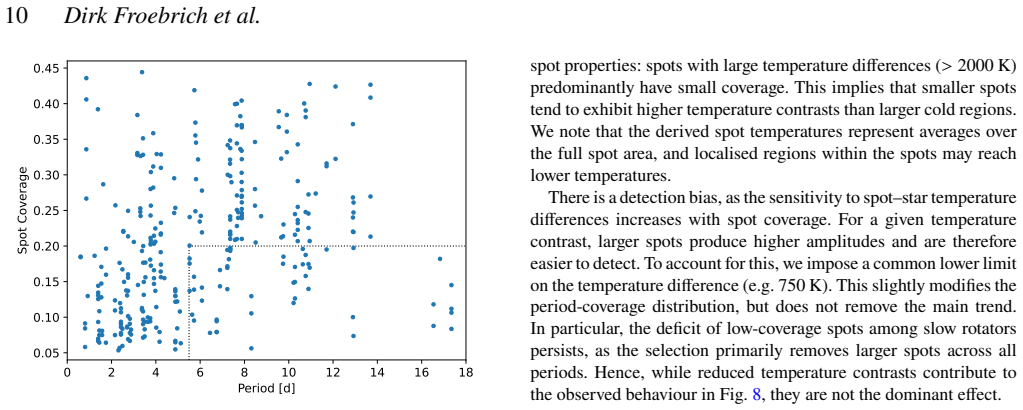
After bias correction the intrinsic cold-spot coverage distribution of fast-rotating young stars is exponential, while slow rotators show a clear deficit of small-coverage cold spots that is best explained by lifetimes shorter than roughly 150–200 days.
What carries the argument
Six-month light-curve slices analysed for multi-band peak-to-peak amplitudes, converted to spot coverage and temperature contrast; injection-recovery simulations then correct the observed coverage histogram, revealing the exponential form for fast rotators and the lifetime cut-off for slow rotators.
Load-bearing premise
The absence of small cold spots on slow rotators is caused by lifetimes shorter than the six-month detection window rather than by cooler contrasts, different geometry, or residual selection effects the recovery tests missed.
What would settle it
High-cadence photometry that recovers the same slow-rotator sample on timescales of weeks instead of months and either detects the missing small-coverage spots or still fails to find them.
If this is right
- Models of YSO magnetic activity must produce an exponential coverage distribution once spots live longer than a few months.
- Supergranule (or equivalent diffusion) scales are predicted to shrink by a factor of several when a star spins up after disc dispersal.
- Disc braking alone cannot set the observed period bimodality; an additional rotation-dependent magnetic process is required.
- Warm/hot-spot solutions separate into two populations (small accretion footprints and larger plage-like features) that can now be tested with phase-curve modelling.
Where Pith is reading between the lines
- If supergranule size really tracks rotation, the same lifetime–coverage relation should appear in older, fully convective M dwarfs once comparable multi-band baselines exist.
- The exponential coverage law supplies a ready prior for population synthesis of photometric jitter in young exoplanet-host candidates.
- Short-lived small spots on slow rotators may still modulate X-ray or UV emission on weekly timescales even when optical periods vanish.
Editorial analysis
A structured set of objections, weighed in public.
Referee Report
Summary. The paper presents a homogeneous analysis of HOYS multi-band (V,R,I) photometry across 25 star-forming regions, identifying 144 YSOs with robust periodic signals from 2047 candidate members. The period distribution is bimodal (55% fast, P<5.5 d; 45% slow), with fast rotators predominantly disc-less and slow rotators split between disc-bearing and disc-free, indicating disc braking alone is insufficient. Spot temperatures and coverages are derived from multi-band amplitudes and photometrically calibrated effective temperatures (Eq. 1). The two headline results are: (i) after bias correction via injection-recovery simulations, the intrinsic cold-spot coverage distribution of fast rotators is exponential, consistent with stochastic flux emergence; (ii) slow rotators show a deficit of small cold spots, which the authors attribute to small-spot lifetimes shorter than ~150-200 d, and interpret via turbulent magnetic diffusivity as evidence for rotation-dependent supergranule sizes.
Significance. If the results hold, the paper delivers the largest homogeneous, multi-region census of YSO spot properties to date (144 rotators across 12 fields, a ~2.5x increase over the IC 5070-only analysis), the first empirically bias-corrected intrinsic cold-spot coverage distribution for young stars, and a testable, falsifiable prediction — that small-spot lifetimes depend on rotation — directly checkable with continuous-cadence light curves from TESS or future PLATO data. The injection-recovery quantification of detection bias (Fig. 3) and the explicit robustness tests against Teff systematics and temperature-contrast selection (Sect. 4.2.1) are real methodological strengths that should be credited. The rotation–disc correlation analysis (Table 2, Fig. 4) is a useful, if incremental, confirmation that disc braking alone cannot explain the period bimodality.
major comments (4)
- [Sect. 4.2.2 (also Sect. 3.1, Fig. 3)] The 150-200 d lifetime threshold that anchors the paper's headline interpretation is asserted, not measured. The injection-recovery simulations (Sect. 3.1, Fig. 3) injected strictly coherent sinusoids, so they characterize detectability only on the (period, amplitude) plane and are blind by construction to spot evolution. A spot living ~100 d on a P=15 d star produces a phase-unstable signal over ~9-12 cycles that will fail the multi-method, multi-filter clustering cuts of Sect. 2.3 far more readily than the same lifetime on a P=2 d star (~90 cycles). Detection probability is therefore a function of (P, amplitude, lifetime), and the effective lifetime threshold is period-dependent. This is not a cosmetic issue: if small spots have shorter lifetimes everywhere (consistent with the size-lifetime relation the authors themselves cite, Giles et al. 2017), then part of the small-spot deficit a
- [Sect. 4.2.3, Fig. 9] The exponential characterization of the intrinsic cold-spot coverage distribution for fast rotators is a central claim, but no fit parameters, parameter uncertainties, or goodness-of-fit statistic are reported, and the rejection of log-normal and power-law forms is stated without any quantitative model comparison (chi-square, KS, AIC, or similar). Please report the exponential scale and its uncertainty, the number of objects (or slices) entering the fit, the binning sensitivity, and a statistical comparison of the three tested functional forms.
- [Sect. 2.2, Sect. 4.2] The sample comprises 620 amplitude sets from 144 objects, with 6-month slices generated every 3 months, so adjacent slices share half their data and multiple slices per object trace the same long-lived spot. The coverage distributions (Figs. 7-9) and the p<6e-5 Monte-Carlo significance (Sect. 4.2) appear to treat slices as independent. Please state explicitly how slices vs. objects were counted, and demonstrate (e.g., by re-computing the significance at the object level or with one randomly selected slice per object) that the period-coverage trend and the exponential fit are not inflated by the correlated repeated measurements.
- [Sect. 2.4, Eq. (1)] The Teff calibration of Eq. (1) never states the actual RMS of the fit in Kelvin; only that the worst colour combination is 10% higher than the best. Since the entire spot-fitting step hinges on Teff, the numerical RMS (and its dependence on spectral type within the ~200-star NAP calibration sample) should be given. Relatedly, the calibration absorbs the NAP region's mean reddening into the fit, but the target regions span a range of extinctions; while the Herbert et al. (2023) +-400 K robustness argument mitigates this, a sentence quantifying the differential-extinction risk across regions (e.g., comparing fitted Teff for the IC 5070 subsample against the Fang et al. 2020 spectroscopic values, which Fig. 6 implies exists) would strengthen Sect. 2.4.
minor comments (6)
- [Fig. 9] The y-axis label reads 'Fraction of Objcts' (typo). The same figure would benefit from stating N and the fit function explicitly in the caption.
- [Sect. 3.1 / Sect. 4.2.3] The bias-correction grid spans V-band amplitudes 0.02-0.16 mag. Please state the mapping from (coverage, temperature contrast) to V amplitude assumed when applying the Fig. 3 correction to the coverage distribution, and confirm the grid covers the full observed coverage range (up to ~0.45 in Fig. 8). Also clarify what contrast is assumed in quoting the detection limit as a coverage of 0.05.
- [Table 1] Several entries are surprising and warrant a brief explanation: NGC 2264 contributes 285 light curves but only 1 usable slice, and Berkeley 86 contributes 229 light curves and 25 slices with zero periodic detections. A sentence on why these fields yield so few qualifying slices/detections (cadence, crowding, extinction) would help the reader assess cross-region selection effects.
- [Sect. 5 (Conclusion)] The claim of the 'first empirical constraint on the intrinsic spot coverage distribution of YSOs' should be tempered or more carefully situated relative to cited prior work on spot coverage evolution (e.g., Morris et al. 2020) and the authors' own IC 5070 analysis (Herbert et al. 2024), of which this is an extension by a factor ~2.5.
- [Sect. 4.2.2] The supergranule-size estimates are read off 'their Fig. 1' (Bradshaw & Hartigan 2014). Please describe this procedure explicitly (which curves, what assumed stellar parameters), since the factor-of-five supergranule scaling is a notable secondary claim.
- [Sect. 2.4, Eq. (1); Fig. 7] Notation G_G for the absolute G magnitude in Eq. (1) is non-standard; consider M_G. The HS:CS quality-indicator thresholds used to flag degenerate solutions are referenced to Herbert et al. (2024) but never restated; a one-line reminder of the cut values would make Fig. 7 self-contained.
Circularity Check
No load-bearing circularity: exponential coverage and lifetime claims are empirical fits/interpretations on a new multi-region sample, not forced by definition or by self-cited uniqueness.
specific steps
-
self citation load bearing
[Sect. 2.3–2.4; comparison in Sect. 4.1]
"The search for periodic variability has been conducted following our investigations in Froebrich et al. (2021). ... The fitting of spot properties on the YSOs follows the procedure outlined in Herbert et al. (2023). ... In Herbert et al. (2024), the spot properties in IC 5070 were determined using measured Teff values from Fang et al. (2020). Here, we first compare those results with the updated Teff distributions obtained in this work."
Period search and spot-fitting procedures are taken from overlapping-author HOYS papers. This is methodological self-citation, but it is not load-bearing for the new claims: the exponential coverage form and the slow-rotator lifetime interpretation are not theorems or numerical results imported from those papers; they are fits and inferences on the expanded multi-region sample. Mild only.
full rationale
This is an observational HOYS paper. The central results—an exponential intrinsic cold-spot coverage distribution for fast rotators after injection–recovery bias correction, and a deficit of small cold spots on slow rotators interpreted as shorter lifetimes—are obtained by applying period-search and multi-band spot-fitting pipelines to a new 144-object, multi-region sample. Those pipelines are reused from the authors’ earlier HOYS papers (Froebrich et al. 2021; Herbert et al. 2023, 2024), which is ordinary method continuity, not a self-citation that forces the scientific conclusion. The exponential is a descriptive fit to the bias-corrected histogram (Fig. 9), not a quantity predicted from a parameter fitted to a closely related subset. The lifetime threshold (≳150–200 d) is an interpretive inference from non-detection in 6-month slices after ruling out detection bias, Teff bias, and temperature-contrast alternatives; it is not defined in terms of the claimed result, nor imported via a uniqueness theorem. Weaknesses in that interpretation (coherent-sinusoid injection tests do not directly calibrate lifetime × period sensitivity) are correctness/assumption issues, not circularity. Score 1 only for non-load-bearing methodological self-citation within the HOYS series.
Axiom & Free-Parameter Ledger
free parameters (5)
- fast/slow period boundary =
5.5 d
- exponential scale of cold-spot coverage (fast rotators)
- Teff colour-fit coefficients p_i =
lowest-RMS combination C1=K-W2, C2=H-W1
- periodogram power / FAP thresholds and slice length =
6 months / power 0.15 / FAP 0.1 %
- K-W2 disc-excess threshold =
0.5 mag
axioms (5)
- domain assumption Two-temperature (photosphere + single spot temperature) model adequately describes the multi-band amplitudes
- ad hoc to paper Non-detection of a periodic signal in a 6-month slice implies spot lifetime ≲150–200 d
- domain assumption K-W2 > 0.5 mag traces warm inner-disc dust and is a useful proxy for magnetic star–disc coupling
- domain assumption Injection-recovery with sinusoidal signals of fixed amplitude ratios adequately captures real detection efficiency
- domain assumption Gaia astrometric membership yields a sample with negligible field-star contamination
read the original abstract
We present a homogeneous analysis of rotational variability and spot properties in young stellar objects across multiple star-forming regions observed by the Hunting Outbursting Young Stars (HOYS) project. From over 2000 candidate members, we identify 144 YSOs with robust periodic signals and well-constrained multi-band amplitudes. The sample has a median age of $\sim$1~Myr, effective temperatures of 3500--6500~K (masses $\sim$0.6--2~M$_\odot$), and is dominated by Class~2 objects, one third of which exhibit inner disc dust emission. The rotation period distribution is strongly bimodal, with 55 percent fast rotators ($P<5.5$~d) and 45 percent slow rotators. Fast rotators are predominantly inner disc-less, whereas slow rotators include both disc-bearing and disc-free systems, indicating that disc braking alone cannot explain the observed rotational states. We derive spot properties from multi-band amplitudes and find that, after correcting for observational biases, the intrinsic cold-spot coverage distribution of fast rotators is well described by an exponential function. This implies that small spot coverages are intrinsically much more common than large ones, consistent with stochastic magnetic flux emergence governing spot formation. In contrast, slow rotators show a pronounced deficit of small cold spots. After considering observational biases and alternative physical explanations, we conclude that small spots on slowly rotating YSOs have significantly shorter lifetimes. These results provide new evidence that magnetic surface structure and its evolution depend on stellar rotation, placing new empirical constraints on models of magnetic activity and angular momentum evolution in young stars.
Figures



Reference graph
Works this paper leans on
-
[1]
A survey for variable young stars with small telescopes: First results from HOYS-CAPS. , keywords =. doi:10.1093/mnras/sty1350 , archivePrefix =. 1804.09128 , primaryClass =
-
[2]
A survey for variable young stars with small telescopes: II - mapping a protoplanetary disc with stable structures at 0.15 au. , keywords =. doi:10.1093/mnras/staa158 , archivePrefix =. 2001.05570 , primaryClass =
Pith/arXiv arXiv 2001
-
[3]
Properties of 1687 Gaia selected members in 21 nearby clusters
A survey for variable young stars with small telescopes - VIII. Properties of 1687 Gaia selected members in 21 nearby clusters. , keywords =. doi:10.1093/mnras/stae311 , archivePrefix =. 2401.16883 , primaryClass =
-
[4]
The Gaia mission. , keywords =. doi:10.1051/0004-6361/201629272 , archivePrefix =. 1609.04153 , primaryClass =
-
[5]
Summary of the content and survey properties
Gaia Data Release 3. Summary of the content and survey properties. , keywords =. doi:10.1051/0004-6361/202243940 , archivePrefix =. 2208.00211 , primaryClass =
-
[6]
The Two Micron All Sky Survey (2MASS). , keywords =. doi:10.1086/498708 , adsurl =
-
[7]
VizieR Online Data Catalog , keywords =
VizieR Online Data Catalog: AllWISE Data Release (Cutri+ 2013). VizieR Online Data Catalog , keywords =
2013
-
[8]
The UKIRT Infrared Deep Sky Survey (UKIDSS). , keywords =. doi:10.1111/j.1365-2966.2007.12040.x , archivePrefix =. astro-ph/0604426 , primaryClass =
arXiv 2007
-
[9]
The UKIDSS Galactic Plane Survey. , keywords =. doi:10.1111/j.1365-2966.2008.13924.x , archivePrefix =. 0712.0100 , primaryClass =
arXiv 2008
-
[10]
Spot properties on YSOs in IC 5070
A survey for variable young stars with small telescopes - VII. Spot properties on YSOs in IC 5070. , keywords =. doi:10.1093/mnras/stac3051 , archivePrefix =. 2210.09895 , primaryClass =
-
[11]
Evolution of spot properties on YSOs in IC 5070
A survey for variable young stars with small telescopes - IX. Evolution of spot properties on YSOs in IC 5070. , keywords =. doi:10.1093/mnras/stae812 , archivePrefix =. 2403.10595 , primaryClass =
-
[12]
Rotation periods of YSOs in IC 5070
A survey for variable young stars with small telescopes - IV. Rotation periods of YSOs in IC 5070. , keywords =. doi:10.1093/mnras/stab2082 , archivePrefix =. 2107.08524 , primaryClass =
-
[13]
The First Extensive Spectroscopic Study of Young Stars in the North America and Pelican Nebulae. , keywords =. doi:10.3847/1538-4357/abba84 , archivePrefix =. 2009.11995 , primaryClass =
Pith/arXiv arXiv 2009
-
[14]
doi:10.5281/zenodo.4406806 , version =
scipy/scipy: SciPy 1.6.0. doi:10.5281/zenodo.4406806 , version =
-
[15]
PARSEC: stellar tracks and isochrones with the PAdova and TRieste Stellar Evolution Code. , keywords =. doi:10.1111/j.1365-2966.2012.21948.x , archivePrefix =. 1208.4498 , primaryClass =
arXiv 2012
-
[16]
Rotation-disk connection for very low mass and substellar objects in the Orion Nebula Cluster. , keywords =. doi:10.1051/0004-6361/200913494 , archivePrefix =. 1001.5141 , primaryClass =
-
[17]
Protostars and Planets V , year = 2007, editor =
The Rotation of Young Low-Mass Stars and Brown Dwarfs. Protostars and Planets V , year = 2007, editor =
2007
-
[18]
Research in Astronomy and Astrophysics , keywords =
Variability of Young Stellar Objects in the Perseus Molecular Cloud. Research in Astronomy and Astrophysics , keywords =. doi:10.1088/1674-4527/acd58b , archivePrefix =. 2305.02514 , primaryClass =
-
[19]
Spitzer observations of NGC 2264: the nature of the disk population. , keywords =. doi:10.1051/0004-6361/201015326 , archivePrefix =. 1203.3754 , primaryClass =
-
[20]
Discovering protostars and their host clusters via WISE. , keywords =. doi:10.1007/s10509-012-1308-y , archivePrefix =. 1211.4032 , primaryClass =
-
[21]
On Sunspot and Starspot Lifetimes. , keywords =. doi:10.1088/0004-637X/795/1/79 , archivePrefix =. 1409.4337 , primaryClass =
-
[22]
Living Reviews in Solar Physics , keywords =
Starspots: A Key to the Stellar Dynamo. Living Reviews in Solar Physics , keywords =. doi:10.12942/lrsp-2005-8 , adsurl =
-
[23]
Izvestiya Glavnoj Astronomicheskoj Observatorii v Pulkove , keywords =
On the nature of solar activity. Izvestiya Glavnoj Astronomicheskoj Observatorii v Pulkove , keywords =
-
[24]
Ergebnisse und Probleme der Sonnenforschung
-
[25]
Making Sense of Sunspot Decay. I. Parabolic Decay Law and Gnevyshev-Waldmeier Relation. , keywords =. doi:10.1023/A:1004988123265 , archivePrefix =. astro-ph/9706029 , primaryClass =
-
[26]
Protostars and Planets VI , year = 2014, editor =
Angular Momentum Evolution of Young Low-Mass Stars and Brown Dwarfs: Observations and Theory. Protostars and Planets VI , year = 2014, editor =. doi:10.2458/azu_uapress_9780816531240-ch019 , archivePrefix =. 1309.7851 , primaryClass =
Pith/arXiv arXiv 2014
-
[27]
CSI 2264: Investigating rotation and its connection with disk accretion in the young open cluster NGC 2264. , keywords =. doi:10.1051/0004-6361/201629537 , archivePrefix =. 1610.08811 , primaryClass =
-
[28]
Disk-locking Regulates Stellar Rotation in Young Clusters: Insights from NGC 2264. , keywords =. doi:10.3847/1538-4357/ad98fb , archivePrefix =. 2412.00520 , primaryClass =
-
[29]
A Kepler study of starspot lifetimes with respect to light-curve amplitude and spectral type. , keywords =. doi:10.1093/mnras/stx1931 , archivePrefix =. 1707.08583 , primaryClass =
-
[30]
Rotational studies in the Orion Nebula Cluster: from solar mass stars to brown dwarfs. , keywords =. doi:10.1051/0004-6361/200811427 , archivePrefix =. 0906.2419 , primaryClass =
-
[31]
Stellar rotation and variability in the Orion Nebula Cluster. , keywords =. doi:10.1051/0004-6361:20021362 , adsurl =
-
[32]
CSI 2264: Simultaneous Optical and Infrared Light Curves of Young Disk-bearing Stars in NGC 2264 with CoRoT and Spitzer Evidence for Multiple Origins of Variability. , keywords =. doi:10.1088/0004-6256/147/4/82 , archivePrefix =. 1401.6582 , primaryClass =
-
[33]
Shadowplay in Hubble's variable nebula. , keywords =. doi:10.1093/mnras/239.2.665 , adsurl =
-
[34]
Protostars and Planets VII , year = 2023, editor =
Accretion Variability as a Guide to Stellar Mass Assembly. Protostars and Planets VII , year = 2023, editor =. doi:10.48550/arXiv.2203.11257 , archivePrefix =. 2203.11257 , primaryClass =
-
[35]
EAS Publications Series , year = 2013, editor =
Observation of rotation in star forming regions: clouds, cores, disks, and jets. EAS Publications Series , year = 2013, editor =. doi:10.1051/eas/1362002 , archivePrefix =. 1305.0627 , primaryClass =
arXiv 2013
-
[36]
Protostars and Planets V , year = 2007, editor =
Protostars and Planets V. Protostars and Planets V , year = 2007, editor =
2007
-
[37]
Disk Accretion onto Magnetic T Tauri Stars. , keywords =. doi:10.1086/185972 , adsurl =
-
[38]
Testing the Disk-locking Paradigm: An Association between U - V Excess and Rotation in NGC 2264. , keywords =. doi:10.1086/507525 , archivePrefix =. astro-ph/0607206 , primaryClass =
-
[39]
MHD simulations of accretion onto a dipolar magnetosphere. II. Magnetospheric ejections and stellar spin-down. , keywords =. doi:10.1051/0004-6361/201220168 , archivePrefix =. 1211.4844 , primaryClass =
-
[40]
Rotational evolution of solar-type protostars during the star-disk interaction phase. , keywords =. doi:10.1051/0004-6361/201935432 , archivePrefix =. 1910.03995 , primaryClass =
Pith/arXiv arXiv 1910
-
[41]
High-Resolution Spectroscopy in Tr 37: Gas Accretion Evolution in Evolved Dusty Disks. , keywords =. doi:10.1086/508058 , archivePrefix =. astro-ph/0607534 , primaryClass =
-
[42]
, year = 1919, month = apr, volume =
The Magnetic Polarity of Sun-Spots. , year = 1919, month = apr, volume =. doi:10.1086/142452 , adsurl =
doi:10.1086/142452 1919
-
[43]
A Systematic Study of Hale and Anti-Hale Sunspot Physical Parameters. , keywords =. doi:10.3847/1538-4357/aae31a , archivePrefix =. 1809.08980 , primaryClass =
-
[44]
Sunspots: An overview. , keywords =. doi:10.1007/s00159-003-0018-4 , adsurl =
-
[45]
The Magnetic Fields of Classical T Tauri Stars. , keywords =. doi:10.1086/519017 , archivePrefix =. 0704.2923 , primaryClass =
-
[46]
, year = 1961, month = mar, volume =
The Topology of the Sun's Magnetic Field and the 22-Year Cycle. , year = 1961, month = mar, volume =. doi:10.1086/147060 , adsurl =
doi:10.1086/147060 1961
-
[47]
Hunt for Starspots in HARPS Spectra of G and K Stars. , keywords =. doi:10.3847/1538-3881/ab9365 , archivePrefix =. 2005.06749 , primaryClass =
Pith/arXiv arXiv 2005
-
[48]
Magnetospheric accretion onto the T Tauri star AA Tauri. I. Constraints from multisite spectrophotometric monitoring. , keywords =
-
[49]
Near-Infrared Photometric Variability of Stars toward the Orion A Molecular Cloud. , keywords =. doi:10.1086/321086 , archivePrefix =. astro-ph/0102446 , primaryClass =
-
[50]
Results of the ROTOR-program. II. The long-term photometric variability of weak-line T Tauri stars. , keywords =. doi:10.1051/0004-6361:20078476 , archivePrefix =. 0801.3543 , primaryClass =
-
[51]
A survey for variable young stars with small telescopes: VI - Analysis of the outbursting Be stars NSW 284, gaia 19eyy, and VES 263. , keywords =. doi:10.1093/mnras/stad407 , archivePrefix =. 2302.02696 , primaryClass =
-
[52]
A Continuum of Accretion Burst Behavior in Young Stars Observed by K2. , keywords =. doi:10.3847/1538-4357/836/1/41 , archivePrefix =. 1612.05599 , primaryClass =
-
[53]
CSI 2264: Characterizing Young Stars in NGC 2264 with Stochastically Varying Light Curves. , keywords =. doi:10.3847/0004-6256/151/3/60 , archivePrefix =. 1601.03326 , primaryClass =
-
[54]
Magnetic activity and accretion on FU Tau A: clues from variability. , keywords =. doi:10.1111/j.1365-2966.2011.19781.x , archivePrefix =. 1109.3474 , primaryClass =
arXiv 2011
-
[55]
Variability in young very low mass stars: two surprises from spectrophotometric monitoring. , keywords =. doi:10.1093/mnras/stw455 , archivePrefix =. 1602.07925 , primaryClass =
-
[56]
Accretion Rates for T Tauri Stars Using Nearly Simultaneous Ultraviolet and Optical Spectra. , keywords =. doi:10.1088/0004-637X/767/2/112 , archivePrefix =. 1303.0769 , primaryClass =
-
[57]
Measuring the density structure of an accretion hot spot. , keywords =. doi:10.1038/s41586-021-03751-5 , archivePrefix =. 2109.00510 , primaryClass =
-
[58]
Warm spots on the active star V1598 Cyg
A survey for variable young stars with small telescopes - III. Warm spots on the active star V1598 Cyg. , keywords =. doi:10.1093/mnras/staa2275 , archivePrefix =. 2007.14969 , primaryClass =
Pith/arXiv arXiv 2007
-
[59]
Protostars and Planets VI , archivePrefix = "arXiv", eprint =
Episodic Accretion in Young Stars. Protostars and Planets VI , archivePrefix = "arXiv", eprint =. doi:10.2458/azu_uapress_9780816531240-ch017 , adsurl =
-
[60]
Accretion-powered Stellar Winds as a Solution to the Stellar Angular Momentum Problem. , keywords =. doi:10.1086/498066 , archivePrefix =. astro-ph/0510060 , primaryClass =
-
[61]
A wide survey for circumstellar disks in the Lupus complex. , keywords =. doi:10.1051/0004-6361/201936756 , archivePrefix =. 2007.14102 , primaryClass =
Pith/arXiv arXiv 2007
-
[62]
Evidence for Mass-dependent Circumstellar Disk Evolution in the 5 Myr Old Upper Scorpius OB Association. , keywords =. doi:10.1086/509121 , archivePrefix =. astro-ph/0609372 , primaryClass =
-
[63]
Stable accretion in young stars: the cases of EX Lupi and TW Hya. , keywords =. doi:10.1093/mnras/stad3029 , archivePrefix =. 2310.02681 , primaryClass =
discussion (0)
Sign in with ORCID, Apple, or X to comment. Anyone can read and Pith papers without signing in.