Coupling dynamical accretion and chemical differentiation: a unified framework for Earth-Mars diversity
Pith reviewed 2026-06-28 20:49 UTC · model grok-4.3
The pith
Earth and Mars analogs sample different disk reservoirs under a narrow ring planetesimal scenario, producing distinct redox states and core-mantle structures via impact equilibration.
A machine-rendered reading of the paper's core claim, the machinery that carries it, and where it could break.
Core claim
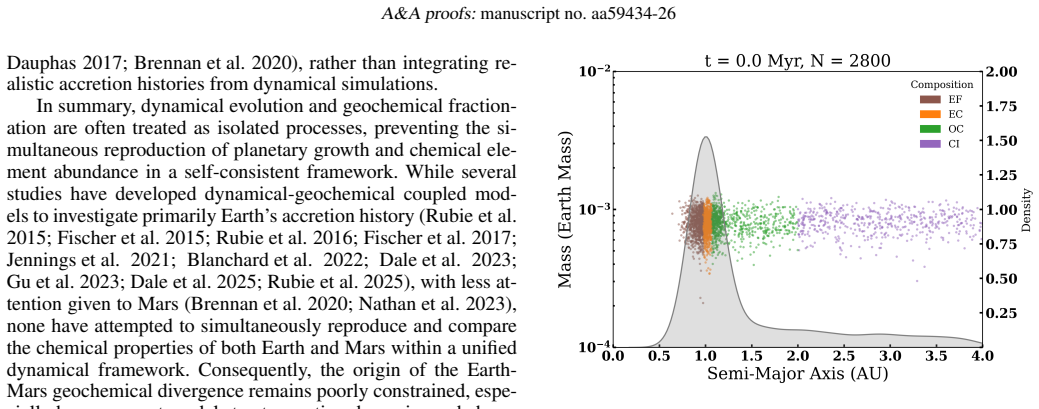
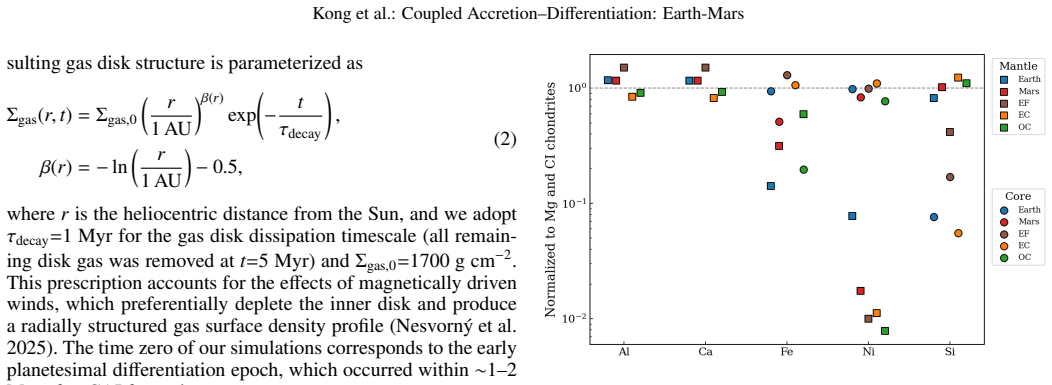
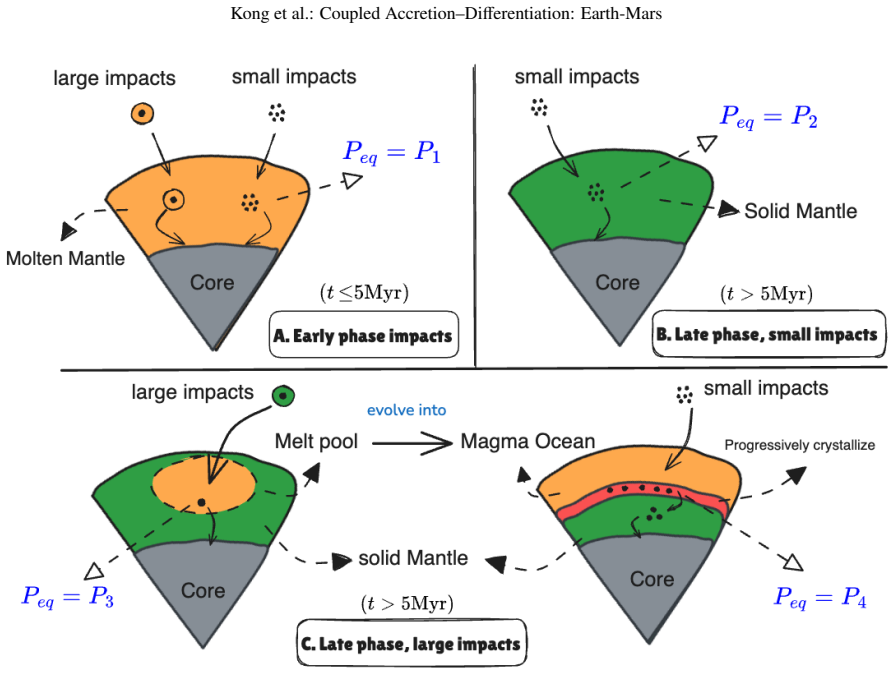
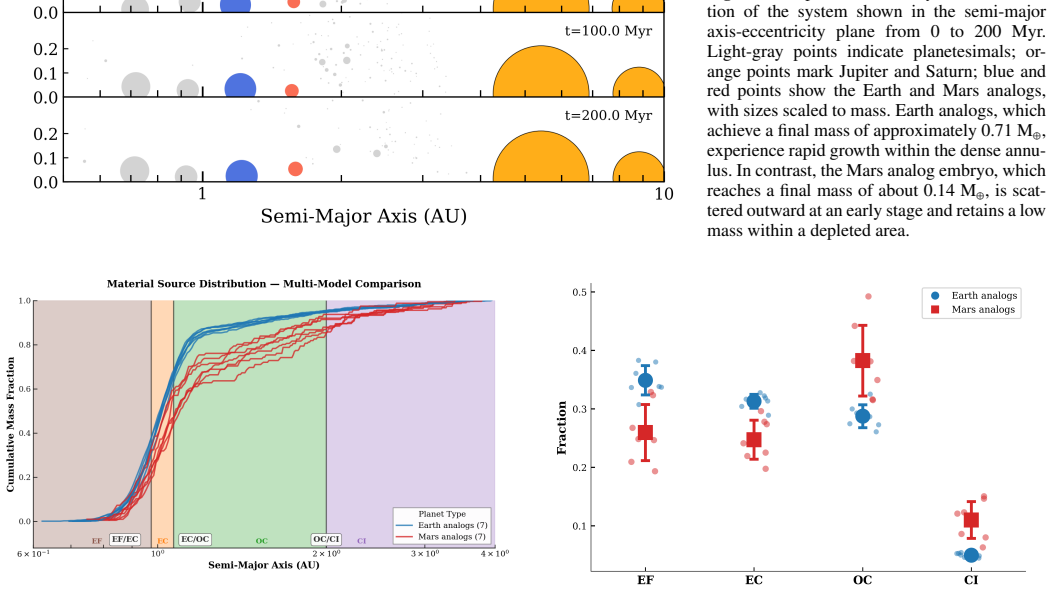
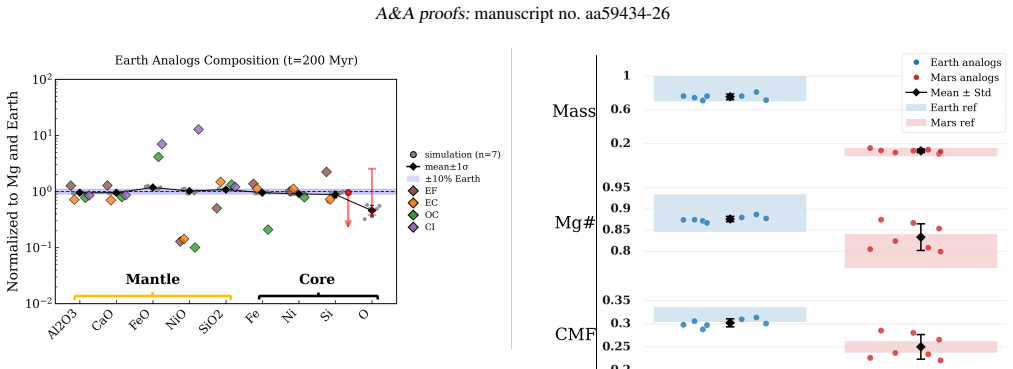
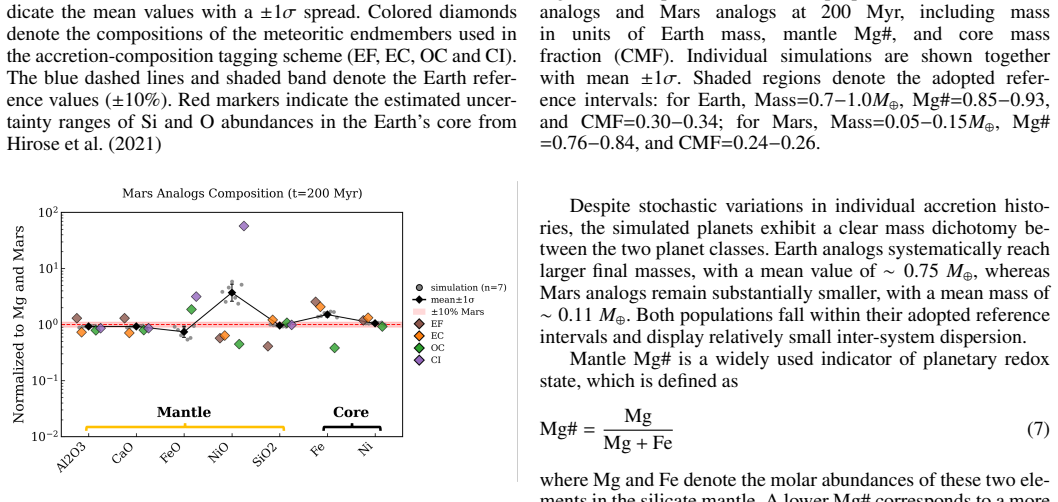
Using a narrow ring planetesimal accretion scenario, Earth and Mars analogs naturally sample systematically different solid reservoirs within the protoplanetary disk. Earth analogs preferentially accrete reduced material around the planetesimal ring center, whereas Mars analogs acquire a larger fraction of oxidized material exterior to the ring. This leads to diverse bulk redox states, with composition further modified by impact-dependent pressure-temperature equilibration conditions during core formation. As a result, Earth analogs experience deeper equilibration and more efficient transfer of iron into the core, producing mantles with low iron oxide contents and larger core mass fractions.
What carries the argument
Narrow ring planetesimal accretion scenario coupled with impact-driven metal-silicate equilibration that tracks both dynamical history and chemical differentiation.
If this is right
- Earth analogs develop larger core mass fractions than Mars analogs.
- Mars analogs retain more iron oxide in their mantles due to shallower equilibration conditions.
- The observed geochemical diversity between Earth and Mars emerges from the combined effects of accretion pathways, disk redox structure, and impact-controlled differentiation.
- The same coupled framework offers a pathway to interpret compositions of rocky planets in exoplanetary systems.
Where Pith is reading between the lines
- The radial redox gradient assumed in the disk becomes the decisive factor that must be present for the model to reproduce solar-system observations.
- The framework could be extended to predict core sizes for terrestrial exoplanets based on their feeding-zone locations relative to any analogous ring structure.
- Removing the narrow-ring restriction in future runs would test whether the Earth-Mars diversity still appears under broader disk distributions.
Load-bearing premise
Planetesimals are distributed in a narrow ring possessing a specific radial redox structure that assigns Earth and Mars analogs to systematically different chemical reservoirs.
What would settle it
A simulation in which Earth and Mars analogs under the narrow ring model sample identical redox reservoirs and reach equivalent core-mantle iron partitions despite different accretion paths.
Figures
read the original abstract
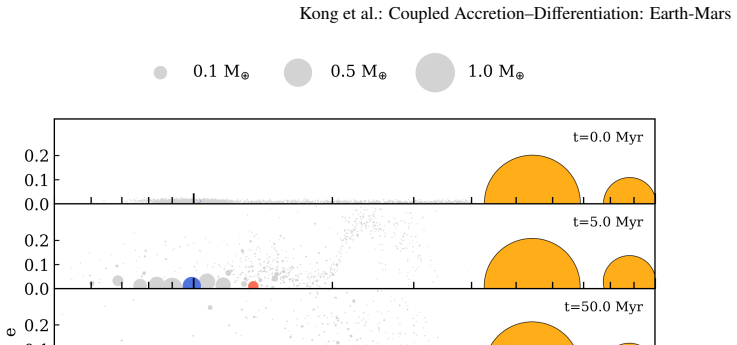
The distinct physical and geochemical differences between Earth and Mars provide fundamental constraints on terrestrial planet formation, yet a self-consistent framework linking dynamical and chemical aspects remains elusive. Here we present an integrated modeling framework that couples high-resolution N-body simulations with impact-driven metal-silicate equilibration to track the dynamical accretion history and chemical differentiation for Earth and Mars. Using a narrow ring planetesimal accretion scenario, we show that Earth and Mars analogs naturally sample systematically different solid reservoirs within the protoplanetary disk. Earth analogs preferentially accrete reduced material around the planetesimal ring center, whereas Mars analogs acquire a larger fraction of oxidized material exterior to the ring. This leads to diverse bulk redox states, with composition further modified by impact-dependent pressure-temperature equilibration conditions during core formation. As a result, Earth analogs experience deeper equilibration and more efficient transfer of iron into the core, producing mantles with low iron oxide contents and larger core mass fractions. In contrast, Mars analogs equilibrate at shallower conditions, retain more iron in their mantles, and develop smaller cores. Our results demonstrate that the dynamical and geochemical differences between Earth and Mars emerge from the coupled effects of accretion pathways, the disk's radial redox structure and impact-controlled differentiation, rather than from any single process. Our unified framework physically explains the geochemical diversity of terrestrial planets and offers a potential pathway to interpret compositions of rocky planets in exoplanetary systems.
Editorial analysis
A structured set of objections, weighed in public.
Referee Report
Summary. The paper presents a unified modeling framework that couples high-resolution N-body simulations of planetesimal accretion in a narrow ring with impact-driven metal-silicate equilibration to track dynamical histories and chemical differentiation. It claims that Earth analogs preferentially accrete reduced material near the ring center while Mars analogs accrete more oxidized material from exterior regions, producing distinct bulk redox states, deeper equilibration and larger core fractions for Earth analogs versus shallower conditions and smaller cores for Mars analogs, thereby explaining their observed differences as an emergent outcome of coupled accretion pathways, disk redox structure, and impact conditions rather than isolated processes.
Significance. If robust, the work offers a self-consistent dynamical-chemical link for terrestrial planet formation that could constrain interpretations of rocky exoplanet compositions. The explicit coupling of N-body accretion tracks with pressure-temperature dependent equilibration is a constructive integration of two modeling domains that are often treated separately.
major comments (2)
- [Abstract and model-setup description] Abstract and model-setup description: the central claim that Earth and Mars analogs 'naturally sample systematically different solid reservoirs' is demonstrated exclusively inside a narrow-ring initial condition with an imposed radial redox gradient. No tests against standard MMSN-like or wider disk distributions are reported, so the reported diversity may reduce to the chosen free parameters (ring location/width and redox profile) rather than emerge from the coupled physics.
- [Results and discussion sections] Results and discussion sections: the manuscript does not report sensitivity experiments that vary the narrow-ring parameters or the redox gradient while holding other aspects fixed. Without such tests, it remains unclear whether the reported differences in core-mass fraction and mantle FeO content are load-bearing predictions or artifacts of the specific setup used to initialize the N-body runs.
minor comments (1)
- [Abstract] The abstract would benefit from a brief statement of the number of realizations performed and the range of impact velocities or equilibration pressures sampled, to allow readers to gauge statistical robustness.
Simulated Author's Rebuttal
We thank the referee for their constructive comments. The manuscript is focused on demonstrating an integrated dynamical-chemical framework within the narrow-ring scenario, which is motivated by prior work reproducing solar system architecture. We respond point-by-point to the major comments below.
read point-by-point responses
-
Referee: [Abstract and model-setup description] Abstract and model-setup description: the central claim that Earth and Mars analogs 'naturally sample systematically different solid reservoirs' is demonstrated exclusively inside a narrow-ring initial condition with an imposed radial redox gradient. No tests against standard MMSN-like or wider disk distributions are reported, so the reported diversity may reduce to the chosen free parameters (ring location/width and redox profile) rather than emerge from the coupled physics.
Authors: The narrow-ring initial condition is adopted because multiple independent N-body studies have shown that it reproduces the masses, semi-major axes, and formation timescales of Earth and Mars; it is therefore the appropriate dynamical context in which to test whether coupled accretion and equilibration can generate the observed chemical differences. The radial redox gradient is likewise anchored in meteoritic evidence for a heliocentric oxidation gradient. Within this setup the Earth and Mars analogs do accrete from distinct radial zones, and the resulting differences in bulk redox state and core-mantle partitioning arise directly from the interaction between those accretion pathways and the pressure-temperature conditions of each impact. We do not claim the same outcome must occur in every disk architecture, and the manuscript is explicit about the initial conditions employed. Additional runs with MMSN-like or wider disks lie outside the scope of the present study. revision: no
-
Referee: [Results and discussion sections] Results and discussion sections: the manuscript does not report sensitivity experiments that vary the narrow-ring parameters or the redox gradient while holding other aspects fixed. Without such tests, it remains unclear whether the reported differences in core-mass fraction and mantle FeO content are load-bearing predictions or artifacts of the specific setup used to initialize the N-body runs.
Authors: The study employs a single fiducial narrow-ring configuration whose parameters are taken from the literature on terrestrial-planet formation and from cosmochemical constraints on redox structure. The reported differences in core-mass fraction and mantle FeO are shown to follow from the distinct impact histories and equilibration depths that the two classes of planets experience inside that configuration. A systematic exploration of ring width or redox slope would constitute a separate, more extensive parameter study and is not included here. We acknowledge that such tests would help quantify robustness and will add a short paragraph in the revised manuscript noting this limitation and the motivation for the chosen fiducial values. revision: partial
Circularity Check
Diversity of Earth-Mars redox states follows by construction from imposed narrow-ring redox gradient
specific steps
-
self definitional
[Abstract]
"Using a narrow ring planetesimal accretion scenario, we show that Earth and Mars analogs naturally sample systematically different solid reservoirs within the protoplanetary disk. Earth analogs preferentially accrete reduced material around the planetesimal ring center, whereas Mars analogs acquire a larger fraction of oxidized material exterior to the ring."
The radial redox structure (reduced at center, oxidized exterior) is presupposed by the narrow-ring scenario. The 'natural' sampling of different reservoirs is then identical to the imposed gradient, so the claimed emergence of diverse bulk redox states and core-mantle structures is equivalent to the input by construction.
full rationale
The paper's central claim—that Earth and Mars analogs naturally sample different solid reservoirs leading to distinct redox states and core-mantle structures—is demonstrated exclusively inside a narrow-ring planetesimal setup that already encodes a radial redox gradient (reduced material at ring center, oxidized exterior). The sampling difference and resulting diversity are therefore the direct consequence of this input assumption rather than an emergent outcome of the coupled N-body + equilibration dynamics. No derivation of the redox profile from disk physics is indicated; the framework therefore reduces the reported diversity to its chosen initial conditions.
Axiom & Free-Parameter Ledger
free parameters (2)
- narrow ring location and width
- radial redox gradient
axioms (2)
- domain assumption High-resolution N-body simulations accurately capture accretion history.
- domain assumption Impact-driven metal-silicate equilibration follows specific pressure-temperature conditions based on impact parameters.
Reference graph
Works this paper leans on
-
[1]
Armitage, P. J. 2011, Dynamics of Protoplanetary Disks Badro, J., Côté, A. S., & Brodholt, J. P. 2014, Proceedings of the National Academy of Science, 111, 7542 Batygin, K. & Morbidelli, A. 2023, Nature Astronomy, 7, 330 Bizzarro, M., Johansen, A., & Dorn, C. 2025, Nature Reviews Chemistry, 9, 711 Blanchard, I., Rubie, D. C., Jennings, E. S., et al. 2022,...
work page internal anchor Pith review Pith/arXiv arXiv 2011
-
[2]
All values are normalized to MgO=1 for consistency with Mg-normalized analysis used throughout the main text
Mantle compositions are reported as major ox- ides, while core compositions are reported as elemental abun- dances. All values are normalized to MgO=1 for consistency with Mg-normalized analysis used throughout the main text. Core elemental abundances are given as bulk contributions on the same normalization scale, rather than as fractions within the core...
2008
discussion (0)
Sign in with ORCID, Apple, or X to comment. Anyone can read and Pith papers without signing in.