Hydrodynamic cascade drives tumbling in sheared colloidal rod suspensions
Pith reviewed 2026-05-19 20:05 UTC · model grok-4.3
The pith
Hydrodynamic interactions drive a cascade of tumbling that disrupts alignment in sheared colloidal rod suspensions.
A machine-rendered reading of the paper's core claim, the machinery that carries it, and where it could break.
Core claim
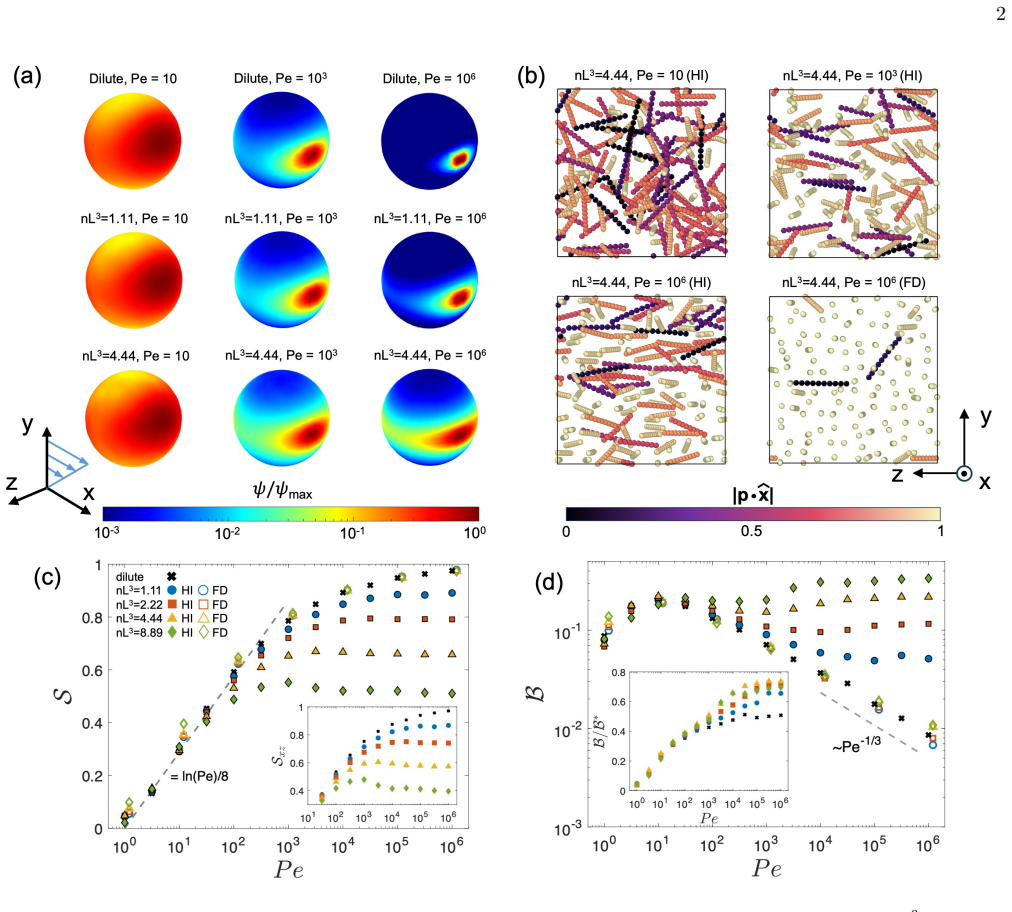
Particle-based simulations and scaling analysis show that hydrodynamic coupling among neighboring rods initiates a cascade of tumbling events. This collective dynamics disrupts flow alignment and produces a pronounced increase in viscosity and normal stress differences, in qualitative agreement with experiments. The discovery calls for revising existing constitutive models for colloidal rods to account for hydrodynamic interactions in semi-dilute regimes.
What carries the argument
The hydrodynamically driven cascade of tumbling events among neighboring rods
If this is right
- Existing constitutive models for colloidal rods must be revised to incorporate hydrodynamic interactions.
- Viscosity and normal stress differences increase because the tumbling cascade disrupts flow alignment.
- Hydrodynamic coupling governs collective dynamics in highly anisotropic suspensions at concentrations and shear rates reached in experiments.
- Assumptions that hydrodynamic interactions are screened break down in the semi-dilute regime under shear.
Where Pith is reading between the lines
- The same cascade mechanism may operate in other anisotropic suspensions such as fibers or elongated particles under flow.
- Varying rod aspect ratio or concentration could modulate the strength of the hydrodynamic effect for applications.
- Time-resolved imaging of individual rod orientations could directly confirm the sequential tumbling pattern.
Load-bearing premise
The particle-based simulations accurately capture long-range hydrodynamic interactions without numerical artifacts that would alter the observed cascade at the reported shear rates and concentrations.
What would settle it
Experiments that measure viscosity and normal stress differences in semi-dilute rod suspensions at the studied shear rates and find no excess over non-hydrodynamic predictions would falsify the central claim.
Figures


read the original abstract
Modeling the dynamics of colloidal rods remains a central challenge in soft-matter physics due to the anisotropic and long-ranged nature of their interactions. Hydrodynamic interactions in rods suspensions are often assumed to be screened or too week to play any role in semi-dilute regimes, yet we find here these assumptions to break down at shear rates and concentrations that are often attained in experiments. Using particle-based simulations and scaling analysis, we uncover a cascade of tumbling events driven by hydrodynamic coupling among neighboring rods. This collective dynamics disrupts flow alignment and leads to a pronounced increase in viscosity and normal stress differences, in qualitative agreement with recent experiments. The discovery of this hydrodynamically-promoted cascade effect calls for a revision of existing constitutive models for colloidal rods and highlights hydrodynamic coupling as a key mechanism governing collective dynamics in highly anisotropic suspensions.
Editorial analysis
A structured set of objections, weighed in public.
Referee Report
Summary. The manuscript uses particle-based simulations and scaling analysis to argue that hydrodynamic interactions (HI) in semi-dilute colloidal rod suspensions under shear are unscreened and drive a cascade of tumbling events. This collective dynamics disrupts flow alignment, producing elevated viscosity and normal stress differences in qualitative agreement with experiments, and implies that existing constitutive models must be revised.
Significance. If the central claim holds after validation, the work would be significant for soft-matter rheology: it directly challenges the standard assumption that long-range HI can be neglected or screened in semi-dilute regimes at experimentally relevant shear rates. The combination of simulations with scaling analysis supplies both mechanistic insight and a falsifiable prediction for the cascade, which is a strength. The result would motivate re-examination of hydrodynamic contributions in highly anisotropic suspensions.
major comments (1)
- [Simulation Methods] Simulation Methods (or equivalent section describing the hydrodynamic solver): No convergence tests with respect to system size, periodic-box dimensions, or hydrodynamic interaction cutoff are reported. Because the Oseen/Rotne-Prager tensor decays slowly in the semi-dilute regime, finite-size or truncation artifacts could artificially enhance the distant-rod coupling that produces the reported tumbling cascade; this is a load-bearing concern for the claim that the cascade is driven by unscreened physical HI rather than numerical representation.
minor comments (1)
- [Abstract] Abstract: 'too week' is a typographical error and should read 'too weak'.
Simulated Author's Rebuttal
We thank the referee for their positive assessment of our work and for the constructive comment on the simulation methods. We address the major comment below and will incorporate the requested validation in the revised manuscript.
read point-by-point responses
-
Referee: [Simulation Methods] Simulation Methods (or equivalent section describing the hydrodynamic solver): No convergence tests with respect to system size, periodic-box dimensions, or hydrodynamic interaction cutoff are reported. Because the Oseen/Rotne-Prager tensor decays slowly in the semi-dilute regime, finite-size or truncation artifacts could artificially enhance the distant-rod coupling that produces the reported tumbling cascade; this is a load-bearing concern for the claim that the cascade is driven by unscreened physical HI rather than numerical representation.
Authors: We agree that explicit convergence tests are necessary to substantiate the claim of unscreened hydrodynamic interactions. Although the original simulations employed system sizes and cutoffs chosen to represent the semi-dilute regime, these checks were not reported. In the revised manuscript we will add a dedicated subsection to the Methods that presents convergence data for (i) total number of rods (increased by a factor of two), (ii) periodic-box dimensions and aspect ratios, and (iii) hydrodynamic-interaction cutoff. The additional results will demonstrate that the tumbling cascade, viscosity, and normal-stress differences remain statistically unchanged, confirming that the reported collective dynamics originate from physical long-range HI rather than finite-size or truncation artifacts. revision: yes
Circularity Check
No circularity: claims rest on direct simulation outputs and independent scaling, not self-referential fits or definitions
full rationale
The paper derives its central claim—that hydrodynamic interactions drive a tumbling cascade in semi-dilute rod suspensions—from particle-based simulations that explicitly compute long-range HI and from separate scaling analysis. These outputs are not equivalent to the input parameters or assumptions by construction; the simulations generate emergent collective dynamics that are then compared to external experiments for qualitative agreement. No load-bearing step reduces a prediction to a fitted parameter, self-citation chain, or ansatz smuggled from prior work. The derivation chain remains self-contained and falsifiable against independent rheological data.
Axiom & Free-Parameter Ledger
axioms (1)
- domain assumption Hydrodynamic interactions are long-ranged and not fully screened in semi-dilute regimes at relevant shear rates.
Reference graph
Works this paper leans on
-
[1]
E. J. Hinch and L. G. Leal, The effect of Brownian mo- tion on the rheological properties of a suspension of non- spherical particles, Journal of Fluid Mechanics52, 683 7 (1972)
work page 1972
-
[2]
B. Chakrabarti, Y. Liu, O. Du Roure, A. Lindner, and D. Saintillan, Signatures of elastoviscous buckling in the dilute rheology of stiff polymers, Journal of Fluid Me- chanics919, A12 (2021)
work page 2021
-
[3]
B. Chakrabarti, Y. Liu, J. LaGrone, R. Cortez, L. Fauci, O. Du Roure, D. Saintillan, and A. Lindner, Flexible fil- aments buckle into helicoidal shapes in strong compres- sional flows, Nature Physics16, 689 (2020)
work page 2020
-
[4]
J. K. G. Dhont and W. J. Briels, Viscoelasticity of suspensions of long, rigid rods, Colloids and surfaces A: Physicochemical and engineering aspects213, 131 (2003)
work page 2003
-
[5]
V. Calabrese, S. J. Haward, and A. Q. Shen, Effects of shearing and extensional flows on the alignment of col- loidal rods, Macromolecules54, 4176 (2021)
work page 2021
-
[6]
C. Lang, J. Kohlbrecher, L. Porcar, A. Radulescu, K. Sellinghoff, J. K. G. Dhont, and M. P. Lettinga, Mi- crostructural understanding of the length-and stiffness- dependent shear thinning in semidilute colloidal rods, Macromolecules52, 9604 (2019)
work page 2019
-
[7]
M. Khan, R. V. More, A. A. Banaei, L. Brandt, and A. M. Ardekani, Rheology of concentrated fiber suspen- sions with a load-dependent friction coefficient, Physical Review Fluids8, 044301 (2023)
work page 2023
-
[8]
S. B. Lindstr¨ om and T. Uesaka, Simulation of semidilute suspensions of non-Brownian fibers in shear flow, The Journal of chemical physics128(2008)
work page 2008
-
[9]
L. Turetta and M. Lattuada, The role of hydrodynamic interactions on the aggregation kinetics of sedimenting colloidal particles, Soft Matter18, 1715 (2022)
work page 2022
-
[10]
L. H. P. Cunha, J. Zhao, F. C. MacKintosh, and S. L. Biswal, Settling dynamics of Brownian chains in viscous fluids, Physical Review Fluids7, 034303 (2022)
work page 2022
-
[11]
L. H. P. Cunha, L. Tubiana, S. L. Biswal, and F. C. MacKintosh, Hierarchical knot formation of semiflexible filaments driven by hydrodynamics, Physical Review Let- ters135, 248201 (2025)
work page 2025
- [12]
-
[13]
A. Furukawa and H. Tanaka, Key role of hydrodynamic interactions in colloidal gelation, Physical review letters 104, 245702 (2010)
work page 2010
-
[14]
J. De Graaf, W. C. Poon, M. J. Haughey, and M. Hermes, Hydrodynamics strongly affect the dynamics of colloidal gelation but not gel structure, Soft Matter15, 10 (2019)
work page 2019
-
[15]
N. J. Wagner and J. F. Brady, Shear thickening in col- loidal dispersions, Physics Today62, 27 (2009)
work page 2009
-
[16]
S. Jamali and J. F. Brady, Alternative frictional model for discontinuous shear thickening of dense suspensions: Hydrodynamics, Physical review letters123, 138002 (2019)
work page 2019
-
[17]
J. F. Morris, E. Guazzelli, F. Jeffrey, and P. Morris, A Physical Introduction to Suspension Dynamics(Cam- bridge University Press, Cambridge, UK, 2011)
work page 2011
-
[18]
D. J. Pine, J. P. Gollub, J. F. Brady, and A. M. Leshan- sky, Chaos and threshold for irreversibility in sheared sus- pensions, Nature438, 997 (2005)
work page 2005
-
[19]
D. Leighton and A. Acrivos, Measurement of shear- induced self-diffusion in concentrated suspensions of spheres, Journal of Fluid Mechanics177, 109 (1987)
work page 1987
-
[20]
D. R. Foss and J. F. Brady, Structure, diffusion and rheol- ogy of brownian suspensions by stokesian dynamics sim- ulation, Journal of Fluid mechanics407, 167 (2000)
work page 2000
-
[21]
A. Z. Zinchenko, Effect of hydrodynamic interactions be- tween the particles on the rheological properties of dilute emulsions, Journal of Applied Mathematics and Mechan- ics48, 198 (1984)
work page 1984
-
[22]
E. S. G. Shaqfeh and G. H. Fredrickson, The hydrody- namic stress in a suspension of rods, Physics of Fluids A: Fluid Dynamics2, 7 (1990)
work page 1990
-
[23]
J. E. Butler and B. Snook, Microstructural dynamics and rheology of suspensions of rigid fibers, Annual Review of Fluid Mechanics50, 299 (2018)
work page 2018
-
[24]
M. Doi, S. F. Edwards, and S. F. Edwards,The theory of polymer dynamics(Oxford University Press, Oxford, 1988)
work page 1988
-
[25]
R. G. Larson,The structure and rheology of complex flu- ids, Vol. 150 (Oxford university press New York, 1999)
work page 1999
-
[26]
M. Harasim, B. Wunderlich, O. Peleg, M. Kr¨ oger, and A. R. Bausch, Direct observation of the dynamics of semi- flexible polymers in shear flow, Physical review letters 110, 108302 (2013)
work page 2013
-
[27]
C. M. Schroeder, R. E. Teixeira, E. S. G. Shaqfeh, and S. Chu, Characteristic periodic motion of polymers in shear flow, Physical review letters95, 018301 (2005)
work page 2005
-
[28]
N. Kuzuu and M. Doi, Constitutive equation for nematic liquid crystals under weak velocity gradient derived from a molecular kinetic equation, Journal of the Physical So- ciety of Japan52, 3486 (1983)
work page 1983
-
[29]
M. Doi, Molecular dynamics and rheological properties of concentrated solutions of rodlike polymers in isotropic and liquid crystalline phases, Journal of Polymer Science: Polymer Physics Edition19, 229 (1981)
work page 1981
-
[30]
C. Lang, J. Kohlbrecher, L. Porcar, and M. P. Lettinga, The connection between biaxial orientation and shear thinning for quasi-ideal rods, Polymers8, 291 (2016)
work page 2016
-
[31]
G. K. Batchelor, The stress generated in a non-dilute sus- pension of elongated particles by pure straining motion, Journal of Fluid Mechanics46, 813 (1971)
work page 1971
-
[32]
P. F. Salipante, S. Kuei, R. P. Murphy, J. A. Fagan, C. M. Sims, K. M. Weigandt, and S. D. Hudson, Rheol- ogy and microstructural behavior of semidilute suspen- sions of semiflexible rods across five decades of shear rate, Macromolecules58, 2389 (2025)
work page 2025
-
[33]
P. T. Corona, K. Dai, M. E. Helgeson, and L. G. Leal, Testing orientational closure approximations in dilute and non-dilute suspensions with rheo-sans, Journal of Non-Newtonian Fluid Mechanics315, 105014 (2023)
work page 2023
-
[34]
G. B. Jeffery, The motion of ellipsoidal particles im- mersed in a viscous fluid, Proceedings of the Royal Soci- ety of London. Series A, Containing papers of a mathe- matical and physical character102, 161 (1922)
work page 1922
-
[35]
J. Rotne and S. Prager, Variational treatment of hydro- dynamic interaction in polymers, The Journal of Chem- ical Physics50, 4831 (1969)
work page 1969
-
[36]
D. L. Ermak and J. A. McCammon, Brownian dynamics with hydrodynamic interactions, The Journal of chemical physics69, 1352 (1978)
work page 1978
-
[37]
J. M. J. van Leeuwen and H. W. J. Bl¨ ote, Tumbling of a rigid rod in a shear flow, Journal of Statistical Mechanics: Theory and Experiment2014, P09007 (2014)
work page 2014
-
[38]
M. Rahnama, D. L. Koch, and E. S. G. Shaqfeh, The effect of hydrodynamic interactions on the orientation distribution in a fiber suspension subject to simple shear flow, Physics of Fluids7, 487 (1995)
work page 1995
-
[39]
F. P. Bretherton, The motion of rigid particles in a shear flow at low reynolds number, Journal of Fluid Mechanics 8 14, 284 (1962)
work page 1962
-
[40]
H. Brenner, Rheology of a dilute suspension of axisym- metric Brownian particles, International journal of mul- tiphase flow1, 195 (1974)
work page 1974
-
[41]
T. Geyer and U. Winter, An O(N 2) approximation for hydrodynamic interactions in Brownian dynamics simu- lations, The Journal of chemical physics130(2009)
work page 2009
-
[42]
M. M. Tirado, C. L. Mart´ ınez, and J. G. De La Torre, Comparison of theories for the translational and rota- tional diffusion coefficients of rod-like macromolecules. application to short dna fragments, The Journal of chem- ical physics81, 2047 (1984)
work page 2047
-
[43]
G. K. Batchelor, Slender-body theory for particles of ar- bitrary cross-section in stokes flow, Journal of Fluid Me- chanics44, 419 (1970)
work page 1970
-
[44]
M. B. Mackaplow and E. S. Shaqfeh, A numerical study of the rheological properties of suspensions of rigid, non- brownian fibres, Journal of Fluid Mechanics329, 155 (1996)
work page 1996
-
[45]
M. Doi and S. F. Edwards, Dynamics of rod-like macro- molecules in concentrated solution. part 1, Journal of the Chemical Society, Faraday Transactions 2: Molec- ular and Chemical Physics74, 560 (1978). [46]∇ iGjk =−x iδjk /x3 +δ ijxk/x3 +δ ikxj/x3 −3x ixjxk/x5. [47]∂ iJj =δ ij/r3 −3rjri/r5 −6(p·r)p irj/r5 −3(p·r) 2δij/r5+ 15(p·r) 2rjri/r7
work page 1978
-
[46]
Here, we used the relation for the mean distance from the nearest neighbors,⟨r⟩ −1/3 ∼n, assuming a homogeneous spacial distribution of rods
-
[47]
F. Folgar and C. L. Tucker III, Orientation behavior of fibers in concentrated suspensions, Journal of reinforced plastics and composites3, 98 (1984)
work page 1984
-
[48]
H. Yamakawa, Transport properties of polymer chains in dilute solution: hydrodynamic interaction, The Journal of Chemical Physics53, 436 (1970)
work page 1970
-
[49]
V. Rathee, S. Arora, D. L. Blair, J. S. Urbach, A. Sood, and R. Ganapathy, Role of particle orientational order during shear thickening in suspensions of colloidal rods, Physical Review E101, 040601 (2020). METHODS Computational model:Our computational domain consists ofN rods rods in a periodic cubic box of side lengthℓ= 3L, with concentrationn=N rods/ℓ3...
work page 2020
-
[50]
Orientation and rheology coupling The contribution of rods to the rheological response of suspensions in concentrations far from the nematic transition arises, in one part, from their responses to the compressional and extensional stresses induced by the flow, and in another part, from the entropic losses due to the flow-induced alignment. The first leads...
-
[51]
The rod is discretized as a linear array ofNtouching beads of radiusa, so the total length isL= 2aN
Disturbance flow from tumbling rods and the hydrodynamic diffusion Here, we calculate the flow disturbance induced by a rod based on theshish-kebabmodel described by Doi [24]. The rod is discretized as a linear array ofNtouching beads of radiusa, so the total length isL= 2aN. Following Doi [24], when subject to linear flowu, the non-hydrodynamic force act...
-
[52]
However, there is a strong orientation dependence on the strength of advection
Estimating the diffusion dominated region At high Pe numbers, orientation-averaged advection effects overcome diffusive ones, leading to a higher probability of rods aligned with the flow direction. However, there is a strong orientation dependence on the strength of advection. When the rods are highly aligned in the flow direction the effective role of a...
discussion (0)
Sign in with ORCID, Apple, or X to comment. Anyone can read and Pith papers without signing in.