REVIEW 4 major objections 6 minor 64 references
Trajectories of Change: Approaches for Tracking Knowledge Evolution
T0 review · 4 major / 6 minor · reviewed 2026-08-10 · deepseek-v4-flash
Pith's one-line read Word-frequency divergence and embedding density can track how an individual researcher aligns with the evolving mainstream of a scientific field, and the paper shows the two measures moving together for two physicists in opposite…
desk verdict Useful methods demonstration for digital history, but the Silk-Treder contrast is vulnerable to the corpus bias the authors themselves acknowledge. read the letter →
The pith
A machine-rendered reading of the paper's core claim, the machinery that carries it, and where it could break.
The reading
What carries the argument
The machinery has two parts. First, the Kullback-Leibler divergence between two unigram language models, one built from an author's lemmatised titles and abstracts in a two-year slice and one from the rest of the field in the same slice, with Jelinek-Mercer smoothing and a Welch t-test filtering which terms count; summing it gives a divergence-over-time curve and pointwise values name the words doing the work. Second, embedding density estimation: documents are embedded with a large text-embedding model, dimension-reduced and clustered, and a Gaussian kernel density estimate is evaluated at each reference document across successive two-year slices, so a rising value means the field is publishing more documents semantically close to that paper. The paper also runs asynchronous KLD comparisons, aligning each author's slice against all past and future field slices, which is what lets it say an author's vocabulary resembles the field's past rather than its present.
What would settle it
A decisive check would be to rebuild the corpus with a manually verified and completed record of Treder's German-language publications and then recompute his KLD and EDE curves; if his late rise in divergence and drop in density vanish, the claimed past-oriented trajectory is a missing-data artifact rather than a knowledge evolution.
Extended reading notes
Core claim
On the paper's own account, the discovery is that relative-entropy divergence and embedding density are two sides of one phenomenon: an author whose terminology matches the field's mainstream is an author whose topics other researchers continue to cluster around, and an author who drifts away from the mainstream is an author whose research neighbourhood disperses. The paper claims this correspondence holds across the two case studies, that KLD and EDE give complementary rather than redundant information—the first about the vocabulary that separates an individual from the collective, the second about how much ongoing work is semantically close—and that together they provide an operational way to connect an individual knowledge trajectory to a system-level field transformation. The specific case-study result is that Silk's trajectory tracks the future of general relativity and gravitation research while Treder's tracks its past, with the divergence visible in both synchronous and asynchronous comparisons.
Load-bearing premise
The load-bearing premise is that the large bibliographic corpus of titles and abstracts, translated into English, faithfully represents both the general-relativity field and the two authors' published work, so that word-frequency divergence and embedding density measure intellectual distance rather than gaps in indexing or translation artifacts.
Editorial extensions
If this is right
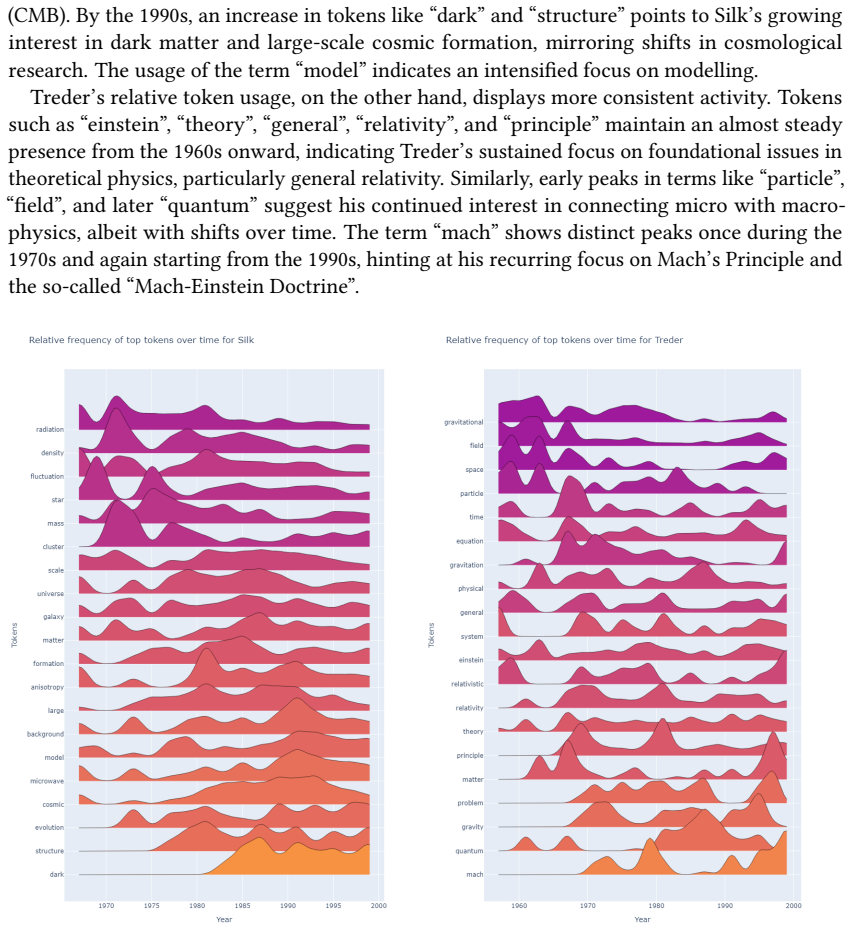
- In the two cases studied, the measures move together: Silk keeps a low divergence from mainstream terminology and a steady or rising embedding density, while Treder's divergence rises and his density falls from the mid-1970s onward.
- The combined method supplies an operational way to place an individual micro-history inside a field-level macro-history, which the socio-epistemic network framework leaves as an open integration problem.
- Because the measures work on any diachronic text corpus, the approach transfers to other sciences and to non-scientific settings such as migration-related knowledge dissemination or science-to-policy transitions.
- Asynchronous KLD comparison adds a directional component: the field slice whose vocabulary is closest to an author's identifies which period of the field's history that author's work belongs to.
Reading between the lines
- A stress test the paper does not run is to apply the same pair of measures to an author whose career history is well documented but who lies between the two extremes; an intermediate case would show how much noise the KLD-EDE correlation tolerates.
- Because the corpus contains only titles and abstracts translated into English, the measures may partly track changes in how scientists summarise their work, not only changes in the work itself; full-text analysis, which the paper names as future work, could separate these effects.
- The paper's own manual comparison (1.83 versus 16.69 references per publication for Treder) gives a concrete robustness check: rebuild the corpus with a manually completed bibliography and recompute the trajectories.
- The asynchronous comparison could be inverted into a 'field clock' that dates any document by the period in which its vocabulary would have been most typical, a tool for mapping when concepts become dominant and when they age.
Editorial analysis
A structured set of objections, weighed in public.
Referee Report
Summary. The paper presents two complementary quantitative methods for tracking the evolution of an individual researcher's language against a field-level corpus: (1) Kullback-Leibler divergence between unigram language models with Jelinek-Mercer smoothing and Welch t-test filtering, and (2) embedding density estimation (EDE) around individual documents. The methods are applied to a NASA/ADS-derived corpus of general relativity and gravitation (GRG) publications from 1911 to 2000, with case studies of Joseph Silk and Hans-Jürgen Treder over 1957-2000. The authors report that Silk's terminology increasingly aligns with the future mainstream of GRG while his EDE rises, whereas Treder's terminology aligns with the past and his EDE falls, and they interpret this as evidence that KLD and EDE are complementary indicators of individual versus system knowledge evolution.
Significance. The proposed combination of an information-theoretic corpus comparison and a contextual embedding density measure is a sensible and transferable contribution to quantitative history of science. The authors should be credited for making the corpus and code available, for using standard statistical machinery, and for explicitly listing dataset limitations. The two-author case study, however, cannot by itself validate the complementarity claim, and the empirical contrast is vulnerable to the acknowledged corpus biases, particularly for Treder. If the robustness issues are addressed, the framework would be a useful addition to the SEN toolkit; as it stands, the central finding is suggestive rather than demonstrated.
major comments (4)
- [Sections 3.1, 4.2, 5] The central empirical contrast is not protected against the corpus-asymmetry problem that the paper itself documents. Section 4.2 reports that Treder's references are under-reported in ADS (1.83 per publication versus 16.69 in manually verified data), and Table 1 shows he published primarily in Annalen der Physik and Astronomische Nachrichten, with roughly half of his publications in German. Since both methods operate on titles and abstracts translated into English (Section 3.1), missing or poorly translated German abstracts would mechanically inflate KLD and depress EDE for Treder relative to Silk, producing exactly the 'past versus future' pattern reported in Sections 4.3 and 4.4. The conclusion in Section 5 concedes that 'collection biases ... remain mostly unquantified.' This is load-bearing: the authors should either quantify abstract and translation coverage per author per time slice, re-run the analysis on English-only subsets, or compare Treder's German-original and English-language outputs as a control. Without such a check, the claim that Treder tracks the past while Silk tracks the future is not established.
- [Section 3.2.2, Eq. (2), Fig. 5] The EDE method's output is controlled by the KDE bandwidth h, but the manuscript never states the chosen value, the kernel implementation, or any sensitivity analysis. In Eq. (2), h is the only scale parameter; changing it can invert the relative density trajectories, and Figure 5's divergence between Silk and Treder after the mid-1970s is precisely the kind of qualitative pattern that a bandwidth choice can create or remove. Similarly, the choice of text-embedding-3-large is justified only as 'most accurate and meaningful' after experimentation, without reporting the compared models' scores or the embedding version. The authors should report h and the embedding configuration, and show that the main trends in Figure 5 are stable under reasonable variations of h and under an alternative embedding model.
- [Section 4.3.3] The asynchronous KLD result is interpreted as evidence that Silk's terminology aligns with the future of GRG while Treder's aligns with its past, but no statistical or effect-size measure is attached to the minima highlighted in Figure 4. Because KLD is asymmetric and the field distribution changes over time, a low KLD between an author's slice and a field slice can arise from a small number of high-frequency shared terms; the paper does not test whether the minima are distinguishable from a null model (e.g., random author-term distributions or cross-slice baselines). Without such a test, the 'future versus past' wording overstates what the figure shows. I request a significance or bootstrap-based assessment of the asynchronous minima.
- [Section 4, first paragraph] The paper's operating assumption at the start of Section 4, that low KLD and high EDE should correlate, is tested on exactly two authors. The conclusion appropriately notes this is not a general rule, but the complementarity claim is then used as the main takeaway. At minimum, the authors should test the correlation within authors over time slices (e.g., Spearman correlation between per-slice KLD and per-slice median EDE) and report the result; if the correlation is weak, the conclusion should be scaled back to a demonstration on two cases. As written, the 'complementary insights' claim is supported mainly by the same two cases that motivated the comparison.
minor comments (6)
- [Section 3.2.1] 'Kullback-Leiber' is misspelled; it should be 'Kullback-Leibler'.
- [Section 3.2.2] The numbered list uses 'a)' three times; the sub-steps should be labeled 2a, 2b, and 2c.
- [Section 4.4.1] The text says 'mean EDE starts to decline' while Figure 5's caption and the method description refer to median EDE; please make the statistic consistent.
- [Section 4.2] 'Treder's use of German (173 publications in English, 175 in German)' sums to 348, not the 355 total reported for Treder; please reconcile the counts.
- [Section 3.1] The lemmatization step is not specified (tool, language resources, and version); since Method 1 depends on lemmas, this should be stated for reproducibility.
- [Figure 4 caption] The caption's description of the y-axis slices and time differences is confusing; consider simplifying it or adding a schematic to clarify which slice is compared with which.
Circularity Check
No significant circularity: the two quantitative measures are independent, and the complementarity claim is an explicitly tested assumption rather than a construction.
full rationale
The paper's central quantitative derivation uses two independent measures: KLD on unigram language models (Eq. 1) and embedding density estimation on document embeddings (Eq. 2). Neither quantity is defined in terms of the other, and no fitted parameter is renamed as a prediction. The Section 4 statement that low KLD should correlate with high EDE is explicitly framed as an assumption to be tested ('The analysis is based on the assumption that...'), and Section 5 presents the observed agreement as only tentative ('seems to support'), not as a forced identity. The self-citations (SEN framework [2]; Treder biography [60][61]) provide framing and historical interpretation but are not the basis of the KLD/EDE computations, which are adopted from external work (Degaetano-Ortlieb and Teich; BERTopic; Sentence-BERT). The paper also expressly acknowledges corpus limitations, including unquantified collection biases, translation inaccuracies, and the under-reporting of Treder's citations (Sections 3.1 and 4.2); these are data-quality caveats that could weaken the empirical conclusions but do not constitute circular reasoning. No step in the derivation reduces by construction to its own input.
Assumptions & free parameters
free parameters (5)
- Jelinek-Mercer smoothing lambda =
0.05
- time slice window =
2 years
- KDE bandwidth h =
not specified
- embedding model choice =
OpenAI text-embedding-3-large
- Welch t-test significance threshold =
p < 0.05
assumptions (4)
- domain assumption Unigram language models with independence assumption are adequate for representing semantic similarity in this corpus.
- domain assumption Titles and abstracts translated into English preserve the semantic trajectory of the original texts.
- domain assumption The NASA/ADS corpus selection criteria approximate the GRG field's publication space.
- domain assumption Embedding vectors from a proprietary model capture semantic similarity relevant to knowledge evolution.
Cite this review
Pith. "Pith review of Trajectories of Change: Approaches for Tracking Knowledge Evolution." pith.science (2026). https://pith.science/paper/NQRCHF2O
@misc{pith2026250100391,
  author       = {Pith},
  title        = {Pith review of: Trajectories of Change: Approaches for Tracking Knowledge Evolution},
  year         = {2026},
  howpublished = {\url{https://pith.science/paper/NQRCHF2O}},
  note         = {Machine review of arXiv:2501.00391}
}
read the original abstract
We explore local vs. global evolution of knowledge systems through the framework of socio-epistemic networks (SEN), applying two complementary methods to a corpus of scientific texts. The framework comprises three interconnected layers-social, semiotic (material), and semantic-proposing a multilayered approach to understanding structural developments of knowledge. To analyse diachronic changes on the semantic layer, we first use information-theoretic measures based on relative entropy to detect semantic shifts, assess their significance, and identify key driving features. Second, variations in document embedding densities reveal changes in semantic neighbourhoods, tracking how concentration of similar documents increase, remain stable, or disperse. This enables us to trace document trajectories based on content (topics) or metadata (authorship, institution). Case studies of Joseph Silk and Hans-J\"urgen Treder illustrate how individual scholar's work aligns with broader disciplinary shifts in general relativity and gravitation research, demonstrating the applications, limitations, and further potential of this approach.
Figures


Figures from the paper (2 more)


Reference graph
Works this paper leans on
-
[1]
J. Renn, The evolution of knowledge: Rethinking science for the Anthropocene, Princeton University Press, Princeton and Oxford, 2020
work page 2020
-
[2]
A. Kaye, R. Schlattmann, M. Vogl, B. S. Buarque, J. Schmitz, L. Weiß, L. V. Welczeck, Socio- Epistemic Networks: A Framework for History of Knowledge, in: C. A. Lerg, J. Östling, J. Weiß, A. Kwaschik, C. Roesch (Eds.), History of Intellectual Culture 3/2024, De Gruyter, 2024, pp. 253–274. URL: https://www.degruyter.com/document/doi/10.1515/9783111291383-0...
-
[3]
J. Renn, D. Wintergrün, R. Lalli, M. D. Laubichler, M. Valleriani, Netzwerke als Wissensspeicher, in: J. Mittelstraß, U. Rüdiger (Eds.), Die Zukunft der Wissensspeicher, number Band 7 in Konstanzer Wissenschaftsforum, UVK Verlagsgesellschaft, Konstanz and München, 2016, pp. 35–79
work page 2016
-
[4]
A. Blum, R. Lalli, J. Renn, The renaissance of General Relativity: How and why it happened, Annalen der Physik 528 (2016) 344–349. doi:10.1002/andp.201600105
-
[5]
Will, The renaissance of general relativity, in: P
C. Will, The renaissance of general relativity, in: P. C. W. Davies (Ed.), The new physics, reprint ed., University Press, Cambridge, 1989, pp. 7–33
work page 1989
-
[6]
Eisenstaedt, The low water mark of general relativity, 1925 - 1955, in: D
J. Eisenstaedt, The low water mark of general relativity, 1925 - 1955, in: D. Howard, J. Stachel (Eds.), Einstein and the history of general relativity, number 1 in Einstein studies, Birkhäuser, Basel, 1989, pp. 277–292
work page 1925
-
[7]
A. Blum, R. Lalli, J. Renn, The Reinvention of General Relativity: A Historiographical Framework for Assessing One Hundred Years of Curved Space-time, Isis 106 (2015) 598–620. doi:10.1086/683425
-
[8]
D. Kaiser, D. Rickles, The Price of Gravity: Private Patronage and the Transformation of Gravitational Physics after World War II, HIST STUD NAT SCI 48 (2018) 338–379. URL: http://hsns.ucpress.edu/ content/ucphsns/48/3/338.full.pdf. doi: 10.1525/hsns.2018.48.3.338
Show all 64 references
-
[9]
Lalli, Building the General Relativity and Gravitation Community During the Cold War, SpringerBriefs in History of Science and Technology, Springer, Cham, 2017
R. Lalli, Building the General Relativity and Gravitation Community During the Cold War, SpringerBriefs in History of Science and Technology, Springer, Cham, 2017. doi: 10.1007/ 978-3-319-54654-4
2017
-
[10]
A. Blum, R. Lalli, J. Renn, Gravitational waves and the long relativity revolution, Nature Astronomy 2 (2018) 534–543. URL: https://www.nature.com/articles/s41550-018-0472-6.pdf. doi: 10.1038/ s41550-018-0472-6
2018
-
[11]
Lalli, R
R. Lalli, R. Howey, D. Wintergrün, The dynamics of collaboration networks and the history of general relativity, 1925–1970, Scientometrics 122 (2020) 1129–1170. URL: https://link.springer.com/ article/10.1007/s11192-019-03327-1#Tab1. doi: 10.1007/s11192-019-03327-1 , num Pages: 42
2020 doi
-
[12]
Lalli, R
R. Lalli, R. Howey, D. Wintergrün, The Socio-Epistemic Networks of General Relativity, 1925–1970, in: A. S. Blum, R. Lalli, J. Renn (Eds.), The Renaissance of General Relativity in Context, 16, Springer International Publishing, Cham, 2020, pp. 15–84. Num Pages: 70
1925
-
[13]
Kilgarriff, Comparing Corpora, International Journal of Corpus Linguistics 6 (2001) 97–133
A. Kilgarriff, Comparing Corpora, International Journal of Corpus Linguistics 6 (2001) 97–133. URL: https://www.jbe-platform.com/content/journals/10.1075/ijcl.6.1.05kil. doi:10.1075/ijcl.6. 1.05kil, gSCC: 0000763 Publisher: John Benjamins
2001 doi
-
[14]
Juola, The Time Course of Language Change, Computers and the Humanities 37 (2003) 77–96
P. Juola, The Time Course of Language Change, Computers and the Humanities 37 (2003) 77–96. URL: https://doi.org/10.1023/A:1021839220474. doi:10.1023/A:1021839220474, gSCC: 0002725
2003 doi
-
[15]
Bochkarev, V
V. Bochkarev, V. Solovyev, S. Wichmann, Universals versus historical contingencies in lexical evolu- tion, Journal of The Royal Society Interface 11 (2014) 20140841. URL: https://royalsocietypublishing. org/doi/10.1098/rsif.2014.0841. doi:10.1098/rsif.2014.0841, gSCC: 0000076 ...
2014
-
[16]
Kullback, R
S. Kullback, R. Leibler, On Information and Sufficiency, Annals of Mathematical Statistics 22 (1951) 79–86. doi:10.1214/aoms/1177729694, gSCC: 0026841
1951
-
[17]
Lin, Divergence measures based on the Shannon entropy, IEEE Transactions on Information Theory 37 (1991) 145–151
J. Lin, Divergence measures based on the Shannon entropy, IEEE Transactions on Information Theory 37 (1991) 145–151. URL: http://ieeexplore.ieee.org/document/61115/. doi: 10.1109/18. 61115, gSCC: 0005500
1991 doi
-
[18]
J. M. Hughes, N. J. Foti, D. C. Krakauer, D. N. Rockmore, Quantitative patterns of stylistic influence in the evolution of literature, Proceedings of the National Academy of Sciences 109 (2012) 7682–7686. URL: https://pnas.org/doi/full/10.1073/pnas.1115407109. doi:10.1073/pnas...
2012 doi
-
[19]
Klingenstein, T
S. Klingenstein, T. Hitchcock, S. DeDeo, The civilizing process in London’s Old Bailey, Proceedings of the National Academy of Sciences 111 (2014) 9419–9424. URL: https://pnas.org/doi/full/10.1073/ pnas.1405984111. doi:10.1073/pnas.1405984111, gSCC: 0000139
2014 doi
-
[20]
URL: https://aclanthology.org/L14-1191/
Peter Fankhauser, Jörg Knappen, Elke Teich, Exploring and Visualizing Variation in Language Re- sources, Proceedings of the Ninth International Conference on Language Resources and Evaluation (LREC’14) (2014) 4125–4128. URL: https://aclanthology.org/L14-1191/
2014
-
[21]
Nevalainen, Historical Sociolinguistics and Language Change, in: A
T. Nevalainen, Historical Sociolinguistics and Language Change, in: A. Van Kemenade, B. Los (Eds.), The Handbook of the History of English, Blackwell Publishing Ltd, Oxford, UK, 2006, pp. 558–588. URL: https://onlinelibrary.wiley.com/doi/10.1002/9780470757048.ch22. doi:10.1002...
2006 doi
-
[22]
Biber, E
D. Biber, E. Finegan, Styles of stance in English: Lexical and grammatical marking of evidentiality and affect, Text - Interdisciplinary Journal for the Study of Discourse 9 (1989) 93–124. URL: https://www.degruyter.com/document/doi/10.1515/text.1.1989.9.1.93/html?lang=en. doi...
1989 doi
-
[23]
A. T. J. Barron, J. Huang, R. L. Spang, S. DeDeo, Individuals, institutions, and innovation in the debates of the French Revolution, Proceedings of the National Academy of Sciences 115 (2018) 4607–4612. URL: https://www.pnas.org/doi/full/10.1073/pnas.1717729115. doi: 10.1073/ ...
2018 doi
-
[24]
Degaetano-Ortlieb, E
S. Degaetano-Ortlieb, E. Teich, Using relative entropy for detection and analysis of periods of diachronic linguistic change, Proceedings of the Second Joint SIGHUM Workshop on Computational Linguistics for Cultural Heritage, Social Sciences, Humanities and Literature (2018) 2...
2018
-
[25]
Eisenstein, R
J. Eisenstein, R. Barzilay, Bayesian unsupervised topic segmentation, in: Proceedings of the Conference on Empirical Methods in Natural Language Processing, EMNLP ’08, Association for Computational Linguistics, USA, 2008, pp. 334–343. GSCC: 0000311
2008
-
[26]
Degaetano-Ortlieb, E
S. Degaetano-Ortlieb, E. Teich, Toward an optimal code for communication: The case of scientific English, Corpus Linguistics and Linguistic Theory 18 (2022) 175–207. URL: https: //www.degruyter.com/document/doi/10.1515/cllt-2018-0088/html#j_cllt-2018-0088_ref_042. doi: 10. 151...
2022 doi
-
[27]
Fischer, J
S. Fischer, J. Knappen, K. Menzel, E. Teich, The Royal Society Corpus 6.0: Providing 300+ Years of Scientific Writing for Humanistic Study, in: N. Calzolari, F. Béchet, P. Blache, K. Choukri, C. Cieri, T. Declerck, S. Goggi, H. Isahara, B. Maegaard, J. Mariani, H. Mazo, A. Mor...
2020
-
[28]
Kermes, S
H. Kermes, S. Degaetano-Ortlieb, A. Khamis, J. Knappen, E. Teich, The Royal Society Corpus: From Uncharted Data to Corpus, in: N. Calzolari, K. Choukri, T. Declerck, S. Goggi, M. Grobelnik, B. Maegaard, J. Mariani, H. Mazo, A. Moreno, J. Odijk, S. Piperidis (Eds.), Proceedings...
2016
-
[29]
Bizzoni, S
Y. Bizzoni, S. Degaetano-Ortlieb, P. Fankhauser, E. Teich, Linguistic Variation and Change in 250 Years of English Scientific Writing: A Data-Driven Approach, Frontiers in Artificial Intelligence 3 (2020) 1–15. URL: https://www.frontiersin.org/articles/10.3389/frai.2020.00073/...
2020
-
[30]
Degaetano-Ortlieb, H
S. Degaetano-Ortlieb, H. Kermes, A. Khamis, E. Teich, An Information-Theoretic Approach to Modeling Diachronic Change in Scientific English, in: C. Suhr, T. Nevalainen, I. Taavitsainen (Eds.), From Data to Evidence in English Language Research, number volume 83 in Language and...
2019 doi
-
[31]
S. Degaetano-Ortlieb, Measuring informativity: The rise of compounds as informationally dense structures in 20th-century Scientific English, Corpus-based Approaches to Register Variation 103 (2021) 291–312. URL: https://benjamins.com/catalog/scl.103.11deg. doi:10.1075/scl.103....
2021 doi
-
[32]
Teich, P
E. Teich, P. Fankhauser, S. Degaetano-Ortlieb, Y. Bizzoni, Less is More/More Diverse: On The Communicative Utility of Linguistic Conventionalization, Frontiers in Communication 5 (2021) 142. URL: https://www.frontiersin.org/articles/10.3389/fcomm.2020.620275/full. doi:10.3389/...
2021
-
[33]
M. A. K. Halliday, M. A. K. Halliday, J. R. Martin, Writing Science: Literacy and Discursive Power, Falmer Press, 1993. GSCC: 0000567 Google-Books-ID: cFOCi_H5utwC
1993
-
[34]
Delogu, M
F. Delogu, M. W. Crocker, H. Drenhaus, Teasing apart coercion and surprisal: Evidence from eye- movements and ERPs, Cognition 161 (2017) 46–59. URL: https://www.sciencedirect.com/science/ article/pii/S0010027716303122. doi:10.1016/j.cognition.2016.12.017, gSCC: 0000045
2017 doi
-
[35]
Levy, Expectation-based syntactic comprehension, Cognition 106 (2008) 1126–
R. Levy, Expectation-based syntactic comprehension, Cognition 106 (2008) 1126–
2008
-
[36]
Steyvers, T
M. Steyvers, T. Griffiths, Probabilistic Topic Models, in: Handbook of Latent Semantic Analysis, Routledge, 2014, p. 544. URL: https://www.taylorfrancis.com/books/9780203936399. doi:10.4324/ 9780203936399.ch21, gSCC: 0007955
2014
-
[37]
D. M. Blei, J. D. Lafferty, Dynamic topic models, in: Proceedings of the 23rd international conference on Machine learning, ICML ’06, Association for Computing Machinery, New York, NY, USA, 2006, pp. 113–120. URL: https://doi.org/10.1145/1143844.1143859. doi:10.1145/1143844.11...
2006
-
[38]
T. L. Griffiths, M. Steyvers, Finding scientific topics, Proceedings of the National Academy of Sciences 101 (2004) 5228–5235. URL: https://www.pnas.org/doi/10.1073/pnas.0307752101. doi:10. 1073/pnas.0307752101, gSCC: 0008695 Publisher: Proceedings of the National Academy of Sciences
2004 doi
-
[39]
D. Hall, D. Jurafsky, C. D. Manning, Studying the history of ideas using topic models, in: Proceedings of the Conference on Empirical Methods in Natural Language Processing, EMNLP ’08, Association for Computational Linguistics, USA, 2008, pp. 363–371. GSCC: 0003389
2008
-
[40]
D. A. McFarland, D. Ramage, J. Chuang, J. Heer, C. D. Manning, D. Jurafsky, Differentiating language usage through topic models, Poetics 41 (2013) 607–625. URL: https://www.sciencedirect.com/science/ article/pii/S0304422X13000442. doi:10.1016/j.poetic.2013.06.004, gSCC: 0000604
2013 doi
-
[41]
T.-I. Yang, A. Torget, R. Mihalcea, Topic Modeling on Historical Newspapers, in: K. Zervanou, P. Lendvai (Eds.), Proceedings of the 5th ACL-HLT Workshop on Language Technology for Cultural Heritage, Social Sciences, and Humanities, Association for Computational Linguistics, Po...
2011
-
[42]
Mikolov, K
T. Mikolov, K. Chen, G. Corrado, J. Dean, Efficient Estimation of Word Representations in Vector Space, 2013. URL: https://arxiv.org/abs/1301.3781, gSCC: 0044161
2013 arXiv
-
[43]
Pennington, R
J. Pennington, R. Socher, C. Manning, Glove: Global Vectors for Word Representation, in: Proceedings of the 2014 Conference on Empirical Methods in Natural Language Processing (EMNLP), Association for Computational Linguistics, Doha, Qatar, 2014, pp. 1532–1543. URL: http://acl...
2014 doi
-
[44]
Kulkarni, R
V. Kulkarni, R. Al-Rfou, B. Perozzi, S. Skiena, Statistically Significant Detection of Linguistic Change, in: Proceedings of the 24th International Conference on World Wide Web, WWW ’15, International World Wide Web Conferences Steering Committee, Republic and Canton of Geneva...
2015
-
[45]
Dubossarsky, D
H. Dubossarsky, D. Weinshall, E. Grossman, Outta Control: Laws of Semantic Change and Inherent Biases in Word Representation Models, in: M. Palmer, R. Hwa, S. Riedel (Eds.), Proceedings of the 2017 Conference on Empirical Methods in Natural Language Processing, Association for...
2017 doi
-
[46]
Devlin, M.-W
J. Devlin, M.-W. Chang, K. Lee, K. Toutanova, BERT: Pre-training of Deep Bidirectional Transformers for Language Understanding, in: Proceedings of the 2019 Conference of the North, Association for Computational Linguistics, Minneapolis, Minnesota, 2019, pp. 4171–4186. URL: htt...
2019 doi
- [47]
-
[48]
Peters, M
M. Peters, M. Neumann, M. Iyyer, M. Gardner, C. Clark, K. Lee, L. Zettlemoyer, Deep Contextualized Word Representations, in: Proceedings of the 2018 Conference of the North American Chapter of the Association for Computational Linguistics: Human Language Technologies, Volume 1...
2018 doi
-
[49]
Reimers, I
N. Reimers, I. Gurevych, Sentence-BERT: Sentence Embeddings using Siamese BERT-Networks, in: Proceedings of the 2019 Conference on Empirical Methods in Natural Language Processing and the 9th International Joint Conference on Natural Language Processing (EMNLP-IJCNLP), Associa...
2019 doi
-
[50]
Radford, K
A. Radford, K. Narasimhan, T. Salimans, I. Sutskever, Improving Language Understanding by Generative Pre-Training, 2018. URL: https://hayate-lab.com/wp-content/uploads/2023/05/ 43372bfa750340059ad87ac8e538c53b.pdf, gSCC: 0011115
2018
- [51]
- [52]
-
[53]
Giulianelli, M
M. Giulianelli, M. Del Tredici, R. Fernández, Analysing Lexical Semantic Change with Contextualised Word Representations, in: Proceedings of the 58th Annual Meeting of the Association for Compu- tational Linguistics, Association for Computational Linguistics, Online, 2020, pp....
2020 doi
-
[54]
Conneau, K
A. Conneau, K. Khandelwal, N. Goyal, V. Chaudhary, G. Wenzek, F. Guzmán, E. Grave, M. Ott, L. Zettlemoyer, V. Stoyanov, Unsupervised Cross-lingual Representation Learning at Scale, in: Proceedings of the 58th Annual Meeting of the Association for Computational Linguistics, Ass...
2020 doi
-
[55]
Grootendorst, BERTopic: Neural topic modeling with a class-based TF-IDF procedure,
M. Grootendorst, BERTopic: Neural topic modeling with a class-based TF-IDF procedure,
-
[56]
Beltagy, K
I. Beltagy, K. Lo, A. Cohan, SciBERT: A Pretrained Language Model for Scientific Text, in: Proceedings of the 2019 Conference on Empirical Methods in Natural Language Processing and the 9th International Joint Conference on Natural Language Processing (EMNLP-IJCNLP), Associati...
2019 doi
- [57]
-
[58]
A. S. Blum, R. Lalli, J. Renn (Eds.), The Renaissance of General Relativity in Context, volume 16, Springer International Publishing, Cham, 2020. doi:10.1007/978-3-030-50754-1
2020 doi
-
[59]
Degaetano-Ortlieb, E
S. Degaetano-Ortlieb, E. Teich, Information-based Modeling of Diachronic Linguistic Change: from Typicality to Productivity, Proceedings of the 10th SIGHUM Workshop on Language Technology for Cultural Heritage, Social Sciences, and Humanities (2016) 165–173. URL: https://aclan...
2016 doi
-
[60]
Hoffmann, R
D. Hoffmann, R. Schlattmann, Prinzipien statt Orthodoxie, Physik Journal (2022) 35–39
2022
-
[61]
Schlattmann, Relativity and Dialectical Materialism: Science, Philosophy and Ideology in Hans- Jürgen Treder’s Early Academic Career, in: C
R. Schlattmann, Relativity and Dialectical Materialism: Science, Philosophy and Ideology in Hans- Jürgen Treder’s Early Academic Career, in: C. Forstner, M. Walker (Eds.), Biographies in the History of Physics, Springer International Publishing, Cham, 2020, pp. 129–144. doi: 1...
2020
-
[62]
Kaiser, Drawing Theories Apart: The Dispersion of Feynman Diagrams in Postwar Physics, University of Chicago Press, Chicago, 2005
D. Kaiser, Drawing Theories Apart: The Dispersion of Feynman Diagrams in Postwar Physics, University of Chicago Press, Chicago, 2005
2005
-
[1177]
doi:10.1016/j
URL: https://www.sciencedirect.com/science/article/pii/S0010027707001436. doi:10.1016/j. cognition.2007.05.006, gSCC: 0002482
2007 doi
- [2022]
Reviewed August 10, 2026 · model on record in the stance chip above.
Discussion (0). Continue with ORCID to comment.