REVIEW 4 major objections 6 minor 30 references
In Search of a Lost Metric: Human Empowerment as a Pillar of Socially Conscious Navigation
T0 review · 4 major / 6 minor · reviewed 2026-08-10 · deepseek-v4-flash
Pith's one-line read The paper argues that human empowerment, defined as the mutual information between a person's actions and their future states, should become a complementary metric for evaluating how robot navigation policies affect human autonomy.
desk verdict An appealing idea undone by a definition-to-algorithm gap: the computed quantity is not the defined empowerment. read the letter →
The pith
A machine-rendered reading of the paper's core claim, the machinery that carries it, and where it could break.
The reading
What carries the argument
The load-bearing object is the human empowerment estimator: a three-network variational pipeline (source policy, transition, planning) that rewrites the mutual information between a human's action and their next occupancy-map state into an expectation of $\log q_{\theta_q}(a_t \mid z^H_{t+1}) - \log \omega_{\theta_\omega}(a_t \mid z^H_t)$. The source policy supplies the action distribution, the transition network produces the predicted future ego-centric occupancy map, and the planning network approximates the posterior over actions given that future map; the entropy-regularized planning loss and the MSE transition loss make the pipeline trainable from trajectory triples alone. This machinery is what converts the abstract empowerment definition into a number that can be computed per human per timestep and averaged across a trajectory.
What would settle it
Give the same trajectory data to a version of the pipeline that replaces the learned source policy with an explicit maximization over a small discrete action set, and compute both numbers; if the two diverge or reverse the ordering of policies, the paper's empowerment estimates are not the empowerment of Eq. (2).
Extended reading notes
Core claim
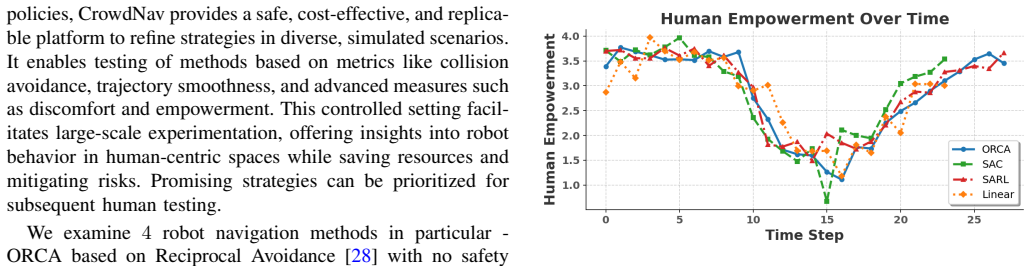
The central claim is that human empowerment, defined as $E(z^H_t) = \max_{w} I(a_t; z^H_{t+1} \mid z^H_t)$, is a viable complementary metric for social compliance in crowd navigation. Because the mutual information maximum is intractable, the paper estimates it with a variational lower bound in which a source policy network $\omega_{\theta_\omega}(a_t \mid z^H_t)$ models the human's action distribution, a transition network produces the next ego-centric occupancy map, and a planning network $q_{\theta_q}(a_t \mid z^H_{t+1})$ approximates the posterior; the estimate is $\log q_{\theta_q}(a_t \mid z^H_{t+1}) - \log \omega_{\theta_\omega}(a_t \mid z^H_t)$. Using this estimate in the CrowdNav simulator, the paper reports that empowerment falls as crowd size grows, follows the expected rise-and-fall pattern as humans converge and separate, and distinguishes SAC and Linear policies from each other and from ORCA and SARL in a Kruskal-Wallis test followed by Dunn's post-hoc comparisons. The authors take these results as evidence that empowerment tracks a human's perceived agency and offers a continuous, information-theoretic complement to existing social-comfort metrics.
Load-bearing premise
The strongest results rest on the assumption that the neural-network pipeline — which samples actions from a learned policy and predicts next states with a point estimate — actually computes the mutual information maximum defined in Eq. (2), even though the pipeline never performs the maximization over the human's policy.
Editorial extensions
If this is right
- Empowerment can be computed for any navigation policy that produces trajectory data, making it a general evaluation tool beyond the four policies tested.
- Because empowerment is continuous, it reveals gradual erosion of human agency, unlike discomfort which only spikes at close encounters.
- The metric's drop with crowd density and recovery afterward gives a temporal profile that could be used to compare when and how policies restrict freedom.
- The statistical separation of policies suggests empowerment can serve as a quantitative target for designing socially compliant robot behavior.
Reading between the lines
- Beyond the paper: the same pipeline could be applied to the robot's own empowerment, turning the metric from an evaluator into a reward signal for training socially aware policies.
- The dependency on the point-estimate transition network suggests that switching to a distributional transition model would likely change the computed values; a sensitivity analysis across transition architectures would clarify whether the policy rankings are stable.
- The paper's assumption that the learned source policy approximates the maximizing policy in Eq. (2) could be tested directly by comparing empowerment estimates against a brute-force maximum over a small discrete action space.
Signed reviews
Editorial analysis
A structured set of objections, weighed in public.
Referee Report
Summary. The paper proposes 'human empowerment' as a complementary metric for evaluating social compliance in crowd navigation. It defines human empowerment in Eq. (2) as the maximum over the human policy of the conditional mutual information between the human's action and next state, then presents a neural-network estimation pipeline (Source, Transition, and Planning networks) in Section IV-C/D and Algorithm 1. The paper reports temporal and density-dependent trends in the estimated quantity using CrowdNav simulations and claims statistically significant differences across ORCA, SAC, SARL, and Linear navigation policies. The central claim is that this metric measures a human's ability to influence future states and that it can rank robot navigation policies by their effect on human autonomy.
Significance. If the estimator faithfully computed the information-theoretic quantity defined in Eq. (2), the paper would offer a useful new evaluation axis for social navigation, complementing proxemics and discomfort metrics. The paper is clearly written, and the explicit statement of both the definition and the algorithm is a strength because it makes the proposed method reproducible. However, the central identity between the definition and the estimator is broken: the algorithm never performs the maximization over policies required by Eq. (2), and the transition model is trained as a deterministic point predictor. As a result, the reported values are, at best, a policy-dependent variational bound, and the empirical trends and statistical tests do not establish that the paper has measured human empowerment. The idea is promising, but the manuscript as it stands does not support its central claim.
major comments (4)
- [Section IV-B, Eq. (2); Section IV-C, Eq. (6); Algorithm 1] The estimated quantity is not the defined quantity. Equation (2) defines human empowerment as max_w I(a_t; z_{t+1} | z_t), a maximization over the human's policy w. However, Eq. (7) fits the source policy ωθω to observed actions by maximum likelihood, and Algorithm 1 (lines 6 and 14) samples actions from this fitted policy and evaluates log qθq(a_t|z_{t+1}) - log ωθω(a_t|z_t) with no maximization step. The algorithm therefore computes a variational lower bound under the data-generating policy (in the experiments, the simulated ORCA pedestrians), not the maximum over policies required by the definition. Since no optimization over w is performed, the reported values are policy-dependent and do not measure the human's maximal ability to influence future states.
- [Section IV-C, Eq. (5); Section IV-D, Eq. (9)] The variational bound in Eq. (5) appears invalid for the conditional mutual information in Eq. (2). The posterior needed for I(a_t; z_{t+1}|z_t) is p(a_t|z_{t+1}, z_t), but the Planning Network models qθq(a_t|z_{t+1}) without conditioning on z_t. Since z_{t+1} alone is generally not sufficient to determine z_t, a bound expressed with qθq(a_t|z_{t+1}) is not a valid lower bound for the intended conditional MI. The paper does not provide the required derivation showing that the omitted z_t conditioning is unnecessary.
- [Section IV-D, Eq. (8); Section IV-C, Eq. (3)] The transition network is trained with an MSE loss to produce a point estimate of the next state, not a probability distribution over next states. Yet Eqs. (3)-(6) require a stochastic transition model pθT(z_{t+1}|z_t, a_t). With a deterministic point predictor, the conditional mutual information under the learned transition model is degenerate (zero or undefined), so the finite values reported in Figs. 3, 5, and 6 cannot be attributed to the mutual information between actions and future states. The finite values most plausibly arise from the entropy of the learned action distribution, which means the density-dependent trends in Section V are consistent with an action-entropy artifact rather than with human empowerment.
- [Section V and Section VI] The validation of the metric is self-referential. The paper checks that the estimated quantity decreases with crowd density and recovers over time (Figs. 3 and 5), but these checks use the same simulation pipeline that generated the estimates; they do not compare the quantity against an independent ground truth or human judgments. The statistical tests in Section VI only establish that the policy-dependent scalar differs across policies, and because the estimator has not been shown to correspond to Eq. (2), those differences do not validate the metric as human empowerment. The paper's own Section VII concedes that user studies and more thorough investigations are needed, which is appropriate, but it means the current evidence does not support the abstract's claim that the metric 'aligns with intuitive social behavior' as a validation of empowerment.
minor comments (6)
- [Section III] The notation is inconsistent: N is said to be in R, but the number of humans should be a natural number, and the state component is written as s_k = [z_x^k, s_y^k]^T, which mixes z and s notation; this should be cleaned up.
- [Algorithm 1] Algorithm 1 uses 'while not converged' without specifying a convergence criterion, and it does not describe how the per-human, per-time-step estimates are aggregated into the Mean Empowerment used in Section VI; this should be made explicit.
- [Figure 4 caption] The caption states that empowerment decreases as the robot progresses, but Section V-A and Figure 3 describe a recovery phase after the initial decrease; please clarify whether Figure 4 shows an episode that terminates before recovery or whether the two statements refer to different scenarios.
- [Section V-C] Table 1 reports a success rate of 0.05 for Linear, and the text notes that early termination due to collisions may not impact the mean empowerment; comparing mean empowerment across episodes of very different lengths needs a more explicit justification or a sensitivity analysis.
- [Section IV-C, Eq. (3)] In Eq. (3), the differential in the inner integral is written as 'da' while the outer integral is over dz_{t+1}; the notation should be made consistent with the stated variables.
- [Section VI] There is a typo: 'Boneferroni' should be 'Bonferroni'.
Circularity Check
Algorithm 1 never performs the max over policies in Eq. (2); the reported 'empowerment' is a fitted log-ratio, so the intuitive-trend validation is partly self-referential, though the policy-difference statistics are independent.
-
fitted input called prediction
[Section IV-B Eq. (2); Section IV-D Eq. (7); Algorithm 1 lines 6 and 14]
"E(zH_t) = max_w I(a_t; zH_{t+1}|zH_t) (Eq. 2); Lpolicy(θω) = −E(zH_t,a_t)∼D[log ωθω(a_t|zH_t)] (Eq. 7); Sample action from source policy a_t ∼ ωθω(.|zH_t); Compute empowerment E(s) = [log qθq(a_t|zH_{t+1}) − log ωθω(a_t|zH_t)]."
Human empowerment is defined in Eq. (2) as a maximization over the human's policy w. Algorithm 1 never performs this maximization: it fits a single source policy ωθω to observed actions by maximum likelihood (Eq. 7), samples actions from that fitted policy, and then reports the log-ratio log qθq − log ωθω as 'empowerment.' This is, by construction, a variational lower bound on the mutual information under the policy that generated the dataset (the simulated ORCA pedestrians), not the maximum-over-policies quantity of Eq. (2).
full rationale
The only load-bearing circularity is the identification of the Algorithm 1 output with Eq. (2). No self-citations are load-bearing: Ref. [6], which shares authors with this paper, is cited only as an example of coupled counterfactual reasoning and does not support the empowerment metric. The statistical comparison across the four policies is a genuine empirical result computed on 500 fresh seeds, independent of the empowerment literature, and does not reduce to a fitted constant. However, the metric's definition includes a maximization that the implementation omits, and the fitted source policy is an input to the reported values, so the intuitive alignments (density dependence, temporal recovery) are partly artifacts of the fitted action distribution. The transition network's point-estimate MSE loss (Eq. 8) makes the conditional mutual information mathematically ill-defined under deterministic dynamics, reinforcing that the quantity reported is not the empowerment of Eq. (2). The paper's own concession in Section VII that user studies are needed to assess whether 'empowerment-based metrics effectively capture human perceptions' further confirms that the intuition-alignment claim is not externally anchored. Overall, the central metric label and its intuitive validation are partially circular, while the policy-differentiation result retains independent empirical content.
Assumptions & free parameters
free parameters (4)
- Entropy regularization coefficient λ =
not reported
- Occupancy grid dimensions c × r and cell resolution =
not reported
- Network hyperparameters and training details =
not reported
- Episode horizon and time discretization =
not reported
assumptions (5)
- domain assumption Empowerment, defined as maximum mutual information between actions and next state, is a meaningful measure of human agency in social navigation.
- domain assumption The ego-centric occupancy map z_t^H is a sufficient representation of the human state for computing empowerment.
- domain assumption The variational MI lower bound with the three networks faithfully approximates the true mutual information.
- domain assumption A point-estimate transition network is adequate for estimating an information-theoretic empowerment value.
- domain assumption Simulated ORCA pedestrians in the CrowdNav circle-crossing scenario are representative of humans for validating the metric.
Cite this review
Pith. "Pith review of In Search of a Lost Metric: Human Empowerment as a Pillar of Socially Conscious Navigation." pith.science (2026). https://pith.science/paper/AU2B67UQ
@misc{pith2026250101539,
  author       = {Pith},
  title        = {Pith review of: In Search of a Lost Metric: Human Empowerment as a Pillar of Socially Conscious Navigation},
  year         = {2026},
  howpublished = {\url{https://pith.science/paper/AU2B67UQ}},
  note         = {Machine review of arXiv:2501.01539}
}
read the original abstract
In social robot navigation, traditional metrics like proxemics and behavior naturalness emphasize human comfort and adherence to social norms but often fail to capture an agent's autonomy and adaptability in dynamic environments. This paper introduces human empowerment, an information-theoretic concept that measures a human's ability to influence their future states and observe those changes, as a complementary metric for evaluating social compliance. This metric reveals how robot navigation policies can indirectly impact human empowerment. We present a framework that integrates human empowerment into the evaluation of social performance in navigation tasks. Through numerical simulations, we demonstrate that human empowerment as a metric not only aligns with intuitive social behavior, but also shows statistically significant differences across various robot navigation policies. These results provide a deeper understanding of how different policies affect social compliance, highlighting the potential of human empowerment as a complementary metric for future research in social navigation.
Figures


Figures from the paper (4 more)


Reference graph
Works this paper leans on
-
[24]
Social navigation with human empowerment driven deep reinforcement learning,
T. van der Heiden, F. Mirus, and H. van Hoof, “Social navigation with human empowerment driven deep reinforcement learning,” in Artificial Neural Networks and Machine Learning – ICANN 2020. Springer International Publishing, 2020, pp. 395–407
work page 2020
-
[2]
Recent trends in social aware robot navigation: A survey,
K. Charalampous, I. Kostavelis, and A. Gasteratos, “Recent trends in social aware robot navigation: A survey,” Robotics and Autonomous Systems, vol. 93, pp. 85–104, 2017
work page 2017
-
[3]
Principles and guidelines for evaluating social robot navigation algorithms,
A. Francis, C. P ´erez-D’Arpino, C. Li, F. Xia, A. Alahi, R. Alami, A. Bera, A. Biswas, J. Biswas, R. Chandra, H.-T. L. Chiang, M. Everett, S. Ha, J. Hart, J. P. How, H. Karnan, T.-W. E. Lee, L. J. Manso, R. Mirksy, S. Pirk, P. T. Singamaneni, P. Stone, A. V . Taylor, P. Traut- man, N. Tsoi, M. V ´azquez, X. Xiao, P. Xu, N. Yokoyama, A. Toshev, and R. Mar...
work page 2023
-
[4]
Core challenges of social robot navigation: A survey,
C. Mavrogiannis, F. Baldini, A. Wang, D. Zhao, P. Trautman, A. Stein- feld, and J. Oh, “Core challenges of social robot navigation: A survey,” ACM Transactions on Human-Robot Interaction, vol. 12, no. 3, pp. 1– 39, 2023
work page 2023
-
[5]
Safe planning in dynamic environments using conformal prediction,
L. Lindemann, M. Cleaveland, G. Shim, and G. J. Pappas, “Safe planning in dynamic environments using conformal prediction,” IEEE Robotics and Automation Letters, vol. 8, no. 8, pp. 5116–5123, 2023
work page 2023
-
[6]
Multi-robot cooperative navigation in crowds: A game-theoretic learning-based model predictive control approach,
V .-A. Le, V . Tadiparthi, B. Chalaki, H. N. Mahjoub, J. D’sa, E. Moradi- Pari, and A. A. Malikopoulos, “Multi-robot cooperative navigation in crowds: A game-theoretic learning-based model predictive control approach,” in 2024 IEEE International Conference on Robotics and Automation (ICRA). IEEE, 2024, pp. 4834–4840
2024
-
[7]
The hidden dimension,
E. T. Hall, “The hidden dimension,” Garden City, 1966
1966
-
[8]
Evaluations of distance for passage for a social robot,
E. Pacchierotti, H. I. Christensen, and P. Jensfelt, “Evaluations of distance for passage for a social robot,” in 15th Annual IEEE International Symposium on Robot and Human Interactive Communication (RO-MAN06), 2006, pp. 315–320
work page 2006
Show all 30 references
-
[9]
Socially compliant robot navi- gation in crowded environment by human behavior resemblance using deep reinforcement learning,
S. S. Samsani and M. S. Muhammad, “Socially compliant robot navi- gation in crowded environment by human behavior resemblance using deep reinforcement learning,” IEEE Robotics and Automation Letters, vol. 6, no. 3, pp. 5223–5230, 2021
2021
-
[10]
Socially aware motion planning with deep reinforcement learning,
Y . F. Chen, M. Everett, M. Liu, and J. P. How, “Socially aware motion planning with deep reinforcement learning,” in 2017 IEEE/RSJ International Conference on Intelligent Robots and Systems (IROS). IEEE, 2017, pp. 1343–1350
2017
-
[11]
Learning a group-aware policy for robot navigation,
K. Katyal, Y . Gao, J. Markowitz, S. Pohland, C. Rivera, I.-J. Wang, and C.-M. Huang, “Learning a group-aware policy for robot navigation,” in 2022 IEEE/RSJ International Conference on Intelligent Robots and Systems (IROS). IEEE, 2022, pp. 11 328–11 335
2022
-
[12]
Evaluation of socially-aware robot naviga- tion,
Y . Gao and C.-M. Huang, “Evaluation of socially-aware robot naviga- tion,” Frontiers in Robotics and AI, vol. 8, p. 721317, 2022
2022
-
[13]
A survey on socially aware robot navigation: Taxonomy and future challenges,
P. T. Singamaneni, P. Bachiller-Burgos, L. J. Manso, A. Garrell, A. San- feliu, A. Spalanzani, and R. Alami, “A survey on socially aware robot navigation: Taxonomy and future challenges,” The International Journal of Robotics Research, vol. 43, no. 10, pp. 1533–1572, 2024
2024
-
[14]
Social force model for pedestrian dynamics,
D. Helbing and P. Molnar, “Social force model for pedestrian dynamics,” Physical review E, vol. 51, no. 5, p. 4282, 1995
1995
-
[15]
Robot navigation in urban envi- ronments: Socially compliant navigation among pedestrians,
G. Ferrer, A. Garrell, and A. Sanfeliu, “Robot navigation in urban envi- ronments: Socially compliant navigation among pedestrians,” Robotics and Autonomous Systems, vol. 61, no. 12, pp. 1153–1165, 2013
2013
-
[16]
Human approach distances to a mechanical-looking robot with different robot voice styles,
M. L. Walters, D. S. Syrdal, K. L. Koay, K. Dautenhahn, and R. Te Boekhorst, “Human approach distances to a mechanical-looking robot with different robot voice styles,” in RO-MAN 2008-The 17th IEEE international symposium on robot and human interactive communication. IEEE, 200...
2008
-
[17]
Human-aware robot navigation: A survey,
T. Kruse, A. K. Pandey, R. Alami, and A. Kirsch, “Human-aware robot navigation: A survey,” Robotics and Autonomous Systems, vol. 61, no. 12, pp. 1726–1743, 2013
2013
-
[18]
A human aware mobile robot motion planner,
E. A. Sisbot, L. F. Marin-Urias, R. Alami, and T. Simeon, “A human aware mobile robot motion planner,” IEEE Transactions on Robotics, vol. 23, no. 5, pp. 874–883, 2007
2007
-
[19]
Efficient crowd-robot interaction for human- aware navigation in dense crowds,
N. Truong and T. Ngo, “Efficient crowd-robot interaction for human- aware navigation in dense crowds,” in Proceedings of the IEEE International Conference on Robotics and Automation (ICRA). IEEE, 2019, pp. 1395–1401
2019
-
[20]
Empowerment: A universal agent-centric measure of control,
A. S. Klyubin, D. Polani, and C. L. Nehaniv, “Empowerment: A universal agent-centric measure of control,” in 2005 IEEE Congress on Evolutionary Computation, vol. 1. IEEE, 2005, pp. 128–135
2005
-
[21]
Keep your options open: An information-based driving principle for sensorimotor systems,
C. Salge, C. Glackin, and D. Polani, “Keep your options open: An information-based driving principle for sensorimotor systems,” Artificial Life, vol. 17, no. 1, pp. 91–115, 2012
2012
-
[22]
Empowerment–an introduction,
——, “Empowerment–an introduction,” Guided Self-Organization: Inception, pp. 67–114, 2014
2014
-
[23]
Empowerment as replacement for the three laws of robotics,
C. Salge and D. Polani, “Empowerment as replacement for the three laws of robotics,” Frontiers in Robotics and AI, vol. 4, p. 260425, 2017
2017
-
[25]
Variational information maximisation for intrinsically motivated reinforcement learning,
S. Mohamed and D. J. Rezende, “Variational information maximisation for intrinsically motivated reinforcement learning,” in Proceedings of the 28th International Conference on Neural Information Processing Systems - V olume2. MIT Press, 2015, p. 2125–2133
2015
-
[26]
Auto-Encoding Variational Bayes,
D. P. Kingma and M. Welling, “Auto-Encoding Variational Bayes,” in 2nd International Conference on Learning Representations, ICLR, 2014
2014
-
[27]
Crowd-robot interaction: Crowd-aware robot navigation with attention-based deep reinforcement learning,
C. Chen, Y . Liu, S. Kreiss, and A. Alahi, “Crowd-robot interaction: Crowd-aware robot navigation with attention-based deep reinforcement learning,” in 2019 international conference on robotics and automation (ICRA). IEEE, 2019, pp. 6015–6022
2019
-
[28]
Reciprocal n- body collision avoidance,
J. Van Den Berg, S. J. Guy, M. Lin, and D. Manocha, “Reciprocal n- body collision avoidance,” in Robotics Research: The 14th International Symposium ISRR. Springer, 2011, pp. 3–19
2011
-
[29]
An analysis of variance test for normality (complete samples),
S. S. Shapiro and M. B. Wilk, “An analysis of variance test for normality (complete samples),” Biometrika, vol. 52, no. 3-4, pp. 591–611, 1965
1965
-
[30]
Use of ranks in one-criterion variance analysis,
W. H. Kruskal and W. A. Wallis, “Use of ranks in one-criterion variance analysis,” Journal of the American statistical Association, vol. 47, no. 260, pp. 583–621, 1952
1952
-
[31]
Multiple comparisons using rank sums,
O. J. Dunn, “Multiple comparisons using rank sums,” Technometrics, vol. 6, no. 3, pp. 241–252, 1964
1964
Reviewed August 10, 2026 · model on record in the stance chip above.
Discussion (0). Continue with ORCID to comment.