REVIEW 2 major objections 7 minor 60 references
Developing a practical model for noise in entangled photon detection
T0 review · 2 major / 7 minor · reviewed 2026-08-10 · deepseek-v4-flash
Pith's one-line read This paper derives exact and approximate effective two-qubit density matrices for coincidence detection of entangled photon pairs, showing four detectors beat two while photon-number-resolving detectors add little.
desk verdict A clean, honest extension of Takesue-Shimizu with one genuinely new exact result (4-PNR); the approximations are clearly scoped, and the main gap is validation limited to the maximally entangled state. read the letter →
The pith
A machine-rendered reading of the paper's core claim, the machinery that carries it, and where it could break.
The reading
What carries the argument
The central object is the effective two-qubit density matrix $\rho_i$, defined by $C_i \propto \langle ab|\rho_i|ab\rangle$, which compresses all multipair, loss, and dark-count effects into a two-qubit state. The machinery is a conditional-probability hierarchy: per-detector click statistics follow a Bernoulli dark-count binomial detection model, ground-truth photon numbers follow a multinomial distribution over the four joint settings, and the total pair number is Poisson. Threshold detection enters by summing click numbers $n_i \geq 1$, and absent detectors by summing $n_i \geq 0$. The four-photon-number-resolving case is exact because the no-click factors $(1-\eta)^{m_i}$ telescope with the Poisson sum; the other cases require the low-efficiency linearization $(1-\eta)^{-m_i} \approx 1 + m_i\eta$ to make the sum close. The result is four closed-form density matrices and closed-form fidelities that turn a high-dimensional simulation into a back-of-envelope calculation.
What would settle it
Compute the exact coincidence visibility by evaluating the full sum in Eq. (5) at $\eta = 0.5$, $\mu = 0.5$ with four threshold detectors and compare it with the approximate visibility from Eq. (24); if the relative error exceeds a few percent, the closed-form effective density matrices for Cases 2-4 cease to describe the experiment in that regime.
Extended reading notes
Core claim
The paper's central claim is that the full physical model of coincidence detection on a two-qubit entangled source can be reduced to a four-dimensional effective density matrix that reproduces all coincidence statistics, and that this reduction is exact for four photon-number-resolving detectors and approximately valid for the other configurations. Concretely, the coincidence probability factors into a correlated term proportional to the single-pair joint probability plus an accidental term built from the marginal single-photon probabilities; the effective state is the sum of a tensor product of noisy single-qubit marginals and a term proportional to the ideal two-photon state. For a maximally entangled input under identical detectors, every effective state takes Werner form, so the entire noise comparison reduces to a single mixing weight for each detector configuration. The paper reports that four detectors visibly outperform two in fidelity and concurrence as efficiency and flux rise, while photon-number-resolving and threshold detectors are nearly identical in the low-flux, low-efficiency regime.
Load-bearing premise
Three of the four closed-form results depend on the assumption that efficiency and pair rate are small enough for $(1-\eta)^{-m_i} \approx 1 + m_i\eta$ to hold; if that linearization fails, those density matrices and the comparison of detector types are not guaranteed.
Editorial extensions
If this is right
- Equations (20)-(21) give an exact prediction for any coincidence measurement with four photon-number-resolving detectors, so no Monte Carlo simulation is needed to design or analyze such setups.
- In low-flux, low-efficiency spontaneous parametric down-conversion experiments, four-detector postselection raises the fidelity of the postselected entangled state relative to two-detector setups.
- Photon-number-resolving detectors can be replaced by threshold detectors in these two-photon coincidence measurements without a meaningful fidelity penalty, provided $\eta, \mu \ll 1$.
- All four effective states for the maximally entangled input are Werner states, so noise is fully described by one mixing weight and fidelity has a closed form.
- The closed-form fidelities can be inverted to choose tolerable dark-count probability, efficiency, and brightness for a target fidelity.
Reading between the lines
- The exact four-photon-number-resolving solution suggests that a squashing-style reduction exists for this configuration at all parameters, while whether the other configurations admit exact effective states outside the linearization regime remains open.
- If the low-efficiency approximation degrades at higher efficiency or flux, the 'photon-number-resolving does not help' conclusion may reverse: the dark-port no-click probability is what such detectors cannot improve, so regimes where multiphoton events dominate the dark ports could favor them.
- The same formalism extends directly to $d$-rail qudit encodings by lengthening the photon-count vectors from four to $d^2$ entries, giving a route to noise models for high-dimensional entanglement.
- A direct experimental test would sweep pump power and attenuation on an SPDC source, comparing measured fidelities for all four configurations against Eqs. (20)-(33).
Signed reviews
Editorial analysis
A structured set of objections, weighed in public.
Referee Report
Summary. The paper develops effective two-qubit density matrices for coincidence detection of entangled photon pairs from a Poisson-distributed parametric source under non-unit detection efficiency and Bernoulli dark counts. Four detector configurations are considered: four PNR detectors, four threshold detectors, two PNR detectors, and two threshold detectors. For the four-PNR case the authors derive an exact closed-form effective density matrix valid for all parameters; for the other three cases they introduce a low-efficiency linearization (1−η)^{-m_i} ≈ 1 + m_i η to obtain closed-form expressions. The approximations are validated by comparing exact and approximate visibilities for the maximally entangled state |Φ+⟩, and the paper analyzes the fidelity and concurrence of the effective states as a function of dark count probability, efficiency, and mean pair number. The central conclusions are that four detectors appreciably improve the postselected two-photon state relative to two detectors, while PNR detectors offer negligible advantage over threshold detectors in the regimes explored.
Significance. The exact 4-PNR result (Eqs. (20)-(21)) is a clean and useful analytic contribution that goes beyond the earlier two-threshold-detector treatment of Takesue and Shimizu. The derivations in the appendix are detailed, and the numerical validation against the exact coincidence-probability sum is a strength; the paper also provides reproducible code (though the repository link is missing in the manuscript). If the approximate effective density matrices are confirmed to be accurate for a broader class of input states, the model would be a practical tool for designing two-photon entanglement experiments under realistic nonidealities. The comparative conclusion regarding four versus two detectors is potentially valuable, but its current support is limited to a single input state and modest parameter ranges.
major comments (2)
- [Section IV.B and Appendix A] The low-efficiency linearization (1−η)^{-m_i} ≈ 1 + m_i η used in Eqs. (23), (27), and (31) is applied pointwise to m_i before averaging over the multinomial distribution in Eq. (13); therefore the approximation error depends on the distribution of m_i, which in turn depends on the single-pair probabilities p through the state ρAB. The numerical validation in Section IV.B is performed only for |Φ+⟩, for which p_a = p_b = 1/2. For states with p_a or p_b close to 1, the typical m_i for a given photon number x is larger, and the approximation error is expected to grow. I recommend adding either an analytical error bound on the approximate coincidence probabilities (24), (28), (32) in terms of μ, η, and p, or numerical comparisons with the exact sum in Eq. (5) for representative non-maximally entangled, product, and mixed states over the parameter ranges of Fig. 2. This is necessary to support the paper's claim that ρ_2–ρ_4 provide a practical effective description for arbitrary two-qubit states.
- [Abstract and Section IV.C] The statements that 'four detectors appreciably improve the postselected two-photon state' and 'PNR detectors provide negligible enhancements' are presented in the abstract and introduction as general findings, but the evidence in Figs. 2 and 3 is restricted to the maximally entangled state |Φ+⟩ and to parameter sweeps with each of P_d, η, μ in (0, 0.1). Please either demonstrate that the four-versus-two and PNR-versus-threshold orderings are preserved for other input states, or explicitly qualify these conclusions as applying to the maximally entangled state in the low-efficiency, low-flux regime.
minor comments (7)
- [Eq. (4)] In Eq. (4), the summation indices and the components of n use n_a for both the |a⟩ and |\bar a⟩ detectors; please use distinct symbols (e.g., n_a and n_{\bar a}, and similarly for b) throughout the definitions of c_3 and c_4.
- [Eq. (4)] In Eq. (4) there is a typo in the summation ranges: the second sum is written as ∞X na=0 but should carry the \bar a index rather than a.
- [Eqs. (5) and (38)] The symbol C_i is used both for the total coincidence probability in Eq. (5) and for the concurrence in Eq. (38); please rename one of these to avoid confusion.
- [Reference [49] and Data Availability] Reference [49] and the Data Availability statement refer to a GitHub repository but no URL is provided; the link should be included for reproducibility.
- [Eq. (22)] In Eq. (22), the statement m_a + m_a = m_b + m_b = x would be clearer with explicit bars: m_a + m_{\bar a} = m_b + m_{\bar b} = x.
- [Acknowledgments] The Acknowledgments contain a duplicated word: 'A portion of this work work was performed...'.
- [Fig. 2 caption] The caption of Fig. 2 reads 'from the model outlined in in Sec. III' with a doubled 'in'; please correct.
Circularity Check
No significant circularity: all effective density matrices are derived from stated probability axioms, not fitted or assumed.
full rationale
The paper's central objects, the effective density matrices ρi (Eqs. 20, 25, 29, 33), are obtained by explicitly summing the conditional detection probability Pr(n|m) (Eq. 10), the multinomial pair-projection probability Pr(m|x) (Eq. 13), and the Poisson pair-number distribution Pr(x) (Eq. 16). The single-pair state ρAB enters only as the ground-truth input through pab=⟨ab|ρAB|ab⟩, and the derived ρi are then used to compute fidelities and visibilities as consequences; no parameter is fit to a target output, and no 'prediction' is used as an input. The low-efficiency linearization (1−η)^{−m_i}≈1+m_iη is openly stated as an approximation in Section III.B and validated numerically against the exact visibility sum in Section IV.B, which is an independent check rather than a circular reduction. The authors do cite prior work (e.g., Takesue and Shimizu, Ref. [34]; Bernoulli dark-count model, Ref. [42]), but those citations supply only modeling ingredients, not the paper's conclusions. No self-citation is load-bearing. The known weakness—that the approximate Cases 2–4 are validated primarily for the maximally entangled state—is a generality and validation limitation, not a circularity.
Assumptions & free parameters
assumptions (6)
- domain assumption Total pair number x follows a Poisson distribution with mean μ (Eq. 16).
- domain assumption Given x pairs, the joint setting counts m follow a multinomial distribution with probabilities p_ab, etc. (Eq. 13).
- domain assumption Dark counts are Bernoulli: at most one dark count per detector per timeslot with probability Pd (Eq. 10).
- domain assumption All channels and detectors are identical, with the same efficiency η and dark count probability Pd for each mode.
- domain assumption The single-pair state ρ_AB is the same for all time-frequency modes and independent of the basis choice.
- ad hoc to paper Low-efficiency linearization (1-η)^{-m_i} ≈ 1 + m_i η, requiring m_i η << 1 and μ << 1, is used to derive ρ_2, ρ_3, ρ_4.
Cite this review
Pith. "Pith review of Developing a practical model for noise in entangled photon detection." pith.science (2026). https://pith.science/paper/6W6GLUI2
@misc{pith2026250101553,
  author       = {Pith},
  title        = {Pith review of: Developing a practical model for noise in entangled photon detection},
  year         = {2026},
  howpublished = {\url{https://pith.science/paper/6W6GLUI2}},
  note         = {Machine review of arXiv:2501.01553}
}
read the original abstract
We develop a comprehensive model for the effective two-photon density matrix produced by a parametric source of entangled photon pairs under a variety of detector configurations commonly seen in a laboratory setting: two and four photon number-resolving (PNR) and threshold detectors. We derive the probability of obtaining a single coincidence assuming Poisson-distributed photon pairs, non-unit detection efficiency, and dark counts; obtain the effective density matrix; and use this quantity to compute the fidelity of the generated quantum state. The 4 PNR case admits an analytic result valid for any combination of parameters, while all other cases leverage low-efficiency approximations to arrive at closed-form expressions. Interestingly, our model reveals appreciable fidelity improvements from four detectors as opposed to two yet minimal advantages for PNR over threshold detectors in the regimes explored. Overall, our work provides a valuable tool for the quantitative design of two-photon experiments under realistic nonidealities.
Figures


Figures from the paper (1 more)

Reference graph
Works this paper leans on
-
[49]
L. Manenti, C. Pepe, I. Sarnoff, T. Ibrayev, P. Oikonomou, A. Knyazev, E. Monticone, H. Garrone, F. Alder, O. Fawwaz, A. J. Millar, K. D. Mor ˚ a, H. Shams, F. Arneodo, and M. Rajteri, Dark counts in optical superconducting transition-edge sensors for rare-event searches, Phys. Rev. Appl. 22, 024051 (2024)
work page 2024
-
[1]
Case 1 — 4 PNR Detectors We start by expanding Eq. (17) as c1(m) = (1 − Pd)2(1 − η)2(x−1)[Pd(1 − η) + (1 − Pd)ηma][Pd(1 − η) + (1 − Pd)ηmb] = (1 − Pd)2(1 − η)2(x−1)[P 2 d (1 − η)2 + Pd(1 − Pd)η(1 − η)(ma + mb) + (1 − Pd)2η2mamb] = (1 − Pd)2(1 − η)2(x−1)[P 2 d (1 − η)2 + Pd(1 − Pd)η(1 − η)(2mab + mab + mab) + (1 − Pd)2η2(m2 ab + mabmab + mabmab + mabmab)],...
-
[2]
Case 2 — 4 Threshold Detectors Expanding Eq. (23), we find c2(m) ≈ (1 − Pd)2(1 − η)2x(Pd + maη)(Pd + mbη) ≈ (1 − Pd)2(1 − η)2x[P 2 d + Pdη(ma + mb) + η2mamb] ≈ (1 − Pd)2(1 − η)2x[P 2 d + Pdη(2mab + mab + mab) + η2(m2 ab + mabmab + mabmab + mabmab)], (A6) again leveraging Eq. (9). Summing over m and again invoking Eq. (A1): X m(x) c2(m) Pr(m|x) ≈ (1 − Pd)2...
-
[3]
Case 3 — 2 PNR Detectors Expanding Eq. (27), c3(m) ≈ [Pd(1 − maη) + (1 − Pd)maη][Pd(1 − mbη) + (1 − Pd)mbη] ≈ P 2 d + Pd(1 − 2Pd)η(ma + mb) + (1 − 2Pd)2η2mamb ≈ P 2 d + Pd(1 − 2Pd)η(2mab + mab + mab) + (1 − 2Pd)2η2(m2 ab + mabmab + mabmab + mabmab), (A9) 13 and summing over m, we find X m(x) c3(m) Pr(m|x) ≈ P 2 d + Pd(1 − 2Pd)η ⟨2mab + mab + mab⟩ + (1 − 2...
-
[4]
Case 4 — 2 Threshold Detectors Starting with Eq. (31), c4(m) ≈ [Pd + (1 − Pd)maη][Pd + (1 − Pd)mbη] ≈ P 2 d + Pd(1 − Pd)η(ma + mb) + (1 − Pd)2η2mamb ≈ P 2 d + Pd(1 − Pd)η(2mab + mab + mab) + (1 − Pd)2η2(m2 ab + mabmab + mabmab + mabmab), (A12) we sum over m, X m(x) c4(m) Pr(m|x) ≈ P 2 d + Pd(1 − Pd)η ⟨2mab + mab + mab⟩ + (1 − Pd)2η2 ⟨m2 ab + mabmab + mabm...
-
[5]
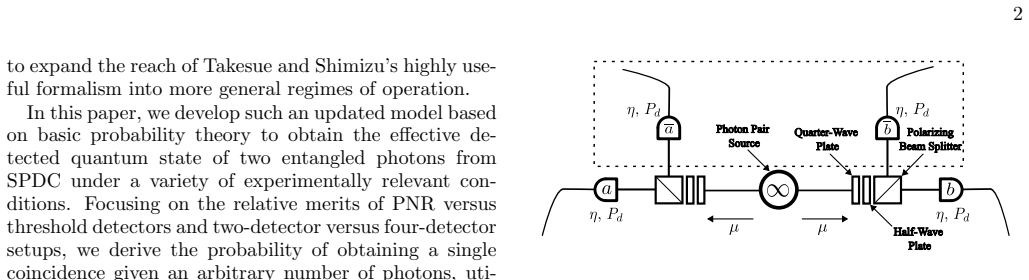
hold in general for any source of photon pairs, the development in this paper concentrates on a particular ground truth quantum state, which can be written in the full Hilbert space as the tensor product of contributions in T time-frequency modes: ρfull = TO t=1 h 1 − µ T |vac⟩ ⟨vac| + µ T ρAB i t , (7) where each index t corresponds to a specific quadrup...
-
[6]
R. H. Hadfield, Single-photon detectors for optical quan- tum information applications, Nat. Photon. 3, 696 (2009). 14
work page 2009
-
[7]
M. D. Eisaman, J. Fan, A. Migdall, and S. V. Polyakov, Invited review article: Single-photon sources and detec- tors, Rev. Sci. Instrum. 82, 071101 (2011)
work page 2011
Show all 60 references
-
[8]
Knill, R
E. Knill, R. Laflamme, and G. J. Milburn, A scheme for efficient quantum computation with linear optics, Nature 409, 46 (2001)
2001
-
[9]
P. Kok, W. J. Munro, K. Nemoto, T. C. Ralph, J. P. Dowling, and G. J. Milburn, Linear optical quantum computing with photonic qubits, Rev. Mod. Phys. 79, 135 (2007)
2007
-
[10]
C. S. Hamilton, R. Kruse, L. Sansoni, S. Barkhofen, C. Silberhorn, and I. Jex, Gaussian boson sampling, Phys. Rev. Lett. 119, 170501 (2017)
2017
-
[11]
Kruse, C
R. Kruse, C. S. Hamilton, L. Sansoni, S. Barkhofen, C. Silberhorn, and I. Jex, Detailed study of Gaussian boson sampling, Phys. Rev. A 100, 032326 (2019)
2019
-
[12]
Gottesman, A
D. Gottesman, A. Kitaev, and J. Preskill, Encoding a qubit in an oscillator, Phys. Rev. A 64, 012310 (2001)
2001
-
[13]
Eaton, R
M. Eaton, R. Nehra, and O. Pfister, Non-Gaussian and Gottesman–Kitaev–Preskill state preparation by photon catalysis, New J. Phys. 21, 113034 (2019)
2019
-
[14]
Tzitrin, J
I. Tzitrin, J. E. Bourassa, N. C. Menicucci, and K. K. Sabapathy, Progress towards practical qubit computation using approximate Gottesman–Kitaev–Preskill codes, Phys. Rev. A 101, 032315 (2020)
2020
-
[15]
Takase, K
K. Takase, K. Fukui, A. Kawasaki, W. Asavanant, M. Endo, J.-i. Yoshikawa, P. van Loock, and A. Furu- sawa, Gottesman–Kitaev–Preskill qubit synthesizer for propagating light, npj Quantum Inf. 9, 98 (2023)
2023
-
[16]
Rosenberg, A
D. Rosenberg, A. E. Lita, A. J. Miller, and S. W. Nam, Noise-free high-efficiency photon-number-resolving detectors, Phys. Rev. A 71, 061803 (2005)
2005
-
[17]
Harder, T
G. Harder, T. J. Bartley, A. E. Lita, S. W. Nam, T. Ger- rits, and C. Silberhorn, Single-mode parametric-down- conversion states with 50 photons as a source for meso- scopic quantum optics, Phys. Rev. Lett. 116, 143601 (2016)
2016
-
[18]
J. M. Arrazola, V. Bergholm, K. Br´ adler, T. R. Brom- ley, M. J. Collins, I. Dhand, A. Fumagalli, T. Gerrits, A. Goussev, L. G. Helt, J. Hundal, T. Isacsson, R. B. Israel, J. Izaac, S. Jahangiri, R. Janik, N. Killoran, S. P. Kumar, J. Lavoie, A. E. Lita, D. H. Mahler, M. Meno...
2021
-
[19]
L. S. Madsen, F. Laudenbach, M. F. Askarani, F. Rortais, T. Vincent, J. F. F. Bulmer, F. M. Miatto, L. Neuhaus, L. G. Helt, M. J. Collins, A. E. Lita, T. Gerrits, S. W. Nam, V. D. Vaidya, M. Menotti, I. Dhand, Z. Vernon, N. Quesada, and J. Lavoie, Quantum computational ad- van...
2022
-
[20]
C. M. Natarajan, M. G. Tanner, and R. H. Hadfield, Su- perconducting nanowire single-photon detectors: physics and applications, Supercond. Sci. Technol. 25, 063001 (2012)
2012
-
[21]
Ferrari, C
S. Ferrari, C. Schuck, and W. Pernice, Waveguide- integrated superconducting nanowire single-photon de- tectors, Nanophotonics 7, 1725 (2018)
2018
-
[22]
You, Superconducting nanowire single-photon detec- tors for quantum information, Nanophotonics 9, 2673 (2020)
L. You, Superconducting nanowire single-photon detec- tors for quantum information, Nanophotonics 9, 2673 (2020)
2020
-
[23]
Korzh, Q.-Y
B. Korzh, Q.-Y. Zhao, J. P. Allmaras, S. Frasca, T. M. Autry, E. A. Bersin, A. D. Beyer, R. M. Briggs, B. Bum- ble, M. Colangelo, G. M. Crouch, A. E. Dane, T. Gerrits, A. E. Lita, F. Marsili, G. Moody, C. Pe˜ na, E. Ramirez, J. D. Rezac, N. Sinclair, M. J. Stevens, A. E. Velas...
2020
-
[24]
D. V. Reddy, R. R. Nerem, S. W. Nam, R. P. Mirin, and V. B. Verma, Superconducting nanowire single-photon detectors with 98% system detection efficiency at 1550 nm, Optica 7, 1649 (2020)
2020
-
[25]
Chang, J
J. Chang, J. W. N. Los, J. O. Tenorio-Pearl, N. No- ordzij, R. Gourgues, A. Guardiani, J. R. Zichi, S. F. Pereira, H. P. Urbach, V. Zwiller, S. N. Dorenbos, and I. Esmaeil Zadeh, Detecting telecom single photons with 99.5+0.5 −2.07 % system detection efficiency and high time r...
2021
-
[26]
Esmaeil Zadeh, J
I. Esmaeil Zadeh, J. Chang, J. W. N. Los, S. Gyger, A. W. Elshaari, S. Steinhauer, S. N. Dorenbos, and V. Zwiller, Superconducting nanowire single-photon de- tectors: A perspective on evolution, state-of-the-art, fu- ture developments, and applications, Appl. Phys. Lett. 118, ...
2021
-
[27]
Cheng, Y
R. Cheng, Y. Zhou, S. Wang, M. Shen, T. Taher, and H. X. Tang, A 100-pixel photon-number-resolving de- tector unveiling photon statistics, Nat. Photon. 17, 112 (2022)
2022
-
[28]
Alexander, A
K. Alexander, A. Bahgat, A. Benyamini, D. Black, D. Bonneau, S. Burgos, B. Burridge, G. Campbell, G. Catalano, A. Ceballos, C.-M. Chang, C. Chung, F. Danesh, T. Dauer, M. Davis, E. Dudley, P. Er-Xuan, J. Fargas, A. Farsi, C. Fenrich, J. Frazer, M. Fukami, Y. Ganesan, G. Gibson...
2024 arXiv
-
[29]
Stasi, T
L. Stasi, T. Taher, G. V. Resta, H. Zbinden, R. Thew, and F. Bussi` eres, Enhanced detection rate and high photon-number efficiencies with a scalable parallel SNSPD, ACS Photon. 12, 320 (2025)
2025
-
[30]
Eckart and F
C. Eckart and F. R. Shonka, Accidental coincidences in counter circuits, Phys. Rev. 53, 752 (1938)
1938
-
[31]
B. J. Pearson and D. P. Jackson, A hands-on introduction to single photons and quantum mechanics for undergrad- 15 uates, Am. J. Phys. 78, 471 (2010)
2010
-
[32]
Mandel and E
L. Mandel and E. Wolf, Optical Coherence and Quantum Optics (Cambridge University Press, Cambridge, UK, 1995)
1995
-
[33]
M. H. Rubin, Transverse correlation in optical spon- taneous parametric down-conversion, Phys. Rev. A 54, 5349 (1996)
1996
-
[34]
T. E. Keller and M. H. Rubin, Theory of two-photon en- tanglement for spontaneous parametric down-conversion driven by a narrow pump pulse, Phys. Rev. A 56, 1534 (1997)
1997
-
[35]
Shih, Entangled biphoton source - property and prepa- ration, Rep
Y. Shih, Entangled biphoton source - property and prepa- ration, Rep. Prog. Phys. 66, 1009 (2003)
2003
-
[36]
Couteau, Spontaneous parametric down-conversion, Contemp
C. Couteau, Spontaneous parametric down-conversion, Contemp. Phys. 59, 291 (2018)
2018
-
[37]
Schneeloch, S
J. Schneeloch, S. H. Knarr, D. F. Bogorin, M. L. Levangie, C. C. Tison, R. Frank, G. A. Howland, M. L. Fanto, and P. M. Alsing, Introduction to the absolute brightness and number statistics in spontaneous para- metric down-conversion, J. Opt. 21, 043501 (2019)
2019
-
[38]
Zhang, Y.-F
C. Zhang, Y.-F. Huang, B.-H. Liu, C.-F. Li, and G.-C. Guo, Spontaneous parametric down-conversion sources for multiphoton experiments, Adv. Quantum Technol. 4, 2000132 (2021)
2021
-
[39]
Takesue and K
H. Takesue and K. Shimizu, Effects of multiple pairs on visibility measurements of entangled photons gener- ated by spontaneous parametric processes, Opt. Com- mun. 283, 276 (2010)
2010
-
[40]
N. J. Beaudry, T. Moroder, and N. L¨ utkenhaus, Squash- ing models for optical measurements in quantum com- munication, Phys. Rev. Lett. 101, 093601 (2008)
2008
-
[41]
Moroder, O
T. Moroder, O. G¨ uhne, N. Beaudry, M. Piani, and N. L¨ utkenhaus, Entanglement verification with realis- tic measurement devices via squashing operations, Phys. Rev. A 81, 052342 (2010)
2010
-
[42]
C.-H. F. Fung, H. F. Chau, and H.-K. Lo, Universal squash model for optical communications using linear op- tics and threshold detectors, Phys. Rev. A 84, 020303 (2011)
2011
-
[43]
Gittsovich, N
O. Gittsovich, N. J. Beaudry, V. Narasimhachar, R. R. Alvarez, T. Moroder, and N. L¨ utkenhaus, Squashing model for detectors and applications to quantum-key- distribution protocols, Phys. Rev. A 89, 012325 (2014)
2014
-
[44]
Chekhova, Progress in optics (Elsevier, London, 2011) Chap
M. Chekhova, Progress in optics (Elsevier, London, 2011) Chap. 4
2011
-
[45]
H. Lee, U. Yurtsever, P. Kok, G. M. Hockney, C. Adami, S. L. Braunstein, and J. P. Dowling, Towards photo- statistics from photon-number discriminating detectors, J. Mod. Opt. 51, 1517 (2004)
2004
-
[46]
Scherer, R
A. Scherer, R. B. Howard, B. C. Sanders, and W. Tit- tel, Quantum states prepared by realistic entanglement swapping, Phys. Rev. A 80, 062310 (2009)
2009
-
[47]
Dhara, S
P. Dhara, S. J. Johnson, C. N. Gagatsos, P. G. Kwiat, and S. Guha, Heralded multiplexed high-efficiency cas- caded source of dual-rail entangled photon pairs us- ing spontaneous parametric down-conversion, Phys. Rev. Appl. 17, 034071 (2022)
2022
-
[48]
M. O. Scully and W. E. Lamb, Quantum theory of an op- tical maser. iii. theory of photoelectron counting statis- tics, Phys. Rev. 179, 368 (1969)
1969
-
[50]
Hochberg, I
Y. Hochberg, I. Charaev, S.-W. Nam, V. Verma, M. Colangelo, and K. K. Berggren, Detecting sub-gev dark matter with superconducting nanowires, Phys. Rev. Lett. 123, 151802 (2019)
2019
-
[51]
Product info,
Quantum Opus, “Product info,” https://www. quantumopus.com/web/product-info/ (2025)
2025
-
[52]
ID Qube series NIR free- running,
ID Quantique, “ID Qube series NIR free- running,” https://www.idquantique.com/ quantum-detection-systems/products/ id-qube-nir-free-running/ (2025)
2025
-
[53]
W. K. Wootters, Entanglement of formation of an ar- bitrary state of two qubits, Phys. Rev. Lett. 80, 2245 (1998)
1998
-
[54]
Plots in this paper are available in the following GitHub repository
-
[55]
Quesada, J
N. Quesada, J. M. Arrazola, and N. Killoran, Gaussian boson sampling using threshold detectors, Phys. Rev. A 98, 062322 (2018)
2018
-
[56]
C. N. Gagatsos and S. Guha, Efficient representation of Gaussian states for multimode non-Gaussian quantum state engineering via subtraction of arbitrary number of photons, Phys. Rev. A 99, 053816 (2019)
2019
-
[57]
Quesada, L
N. Quesada, L. G. Helt, J. Izaac, J. M. Arrazola, R. Shahrokhshahi, C. R. Myers, and K. K. Sabapa- thy, Simulating realistic non-Gaussian state preparation, Phys. Rev. A 100, 022341 (2019)
2019
-
[58]
D. Su, C. R. Myers, and K. K. Sabapathy, Conversion of Gaussian states to non-Gaussian states using photon- number-resolving detectors, Phys. Rev. A 100, 052301 (2019)
2019
-
[59]
A. J. Pizzimenti, J. M. Lukens, H.-H. Lu, N. A. Peters, S. Guha, and C. N. Gagatsos, Non-Gaussian photonic state engineering with the quantum frequency processor, Phys. Rev. A 104, 062437 (2021)
2021
-
[60]
Quesada, R
N. Quesada, R. S. Chadwick, B. A. Bell, J. M. Arrazola, T. Vincent, H. Qi, and R. Garc ´ ıa −Patr´ on, Quadratic speed-up for simulating Gaussian boson sampling, PRX Quantum 3, 010306 (2022)
2022
Reviewed August 10, 2026 · model on record in the stance chip above.
Discussion (0). Continue with ORCID to comment.