REVIEW 2 major objections 6 minor 114 references
TOI-6038 A b: A dense sub-Saturn in the transition regime between the Neptunian ridge and savanna
T0 review · 2 major / 6 minor · reviewed 2026-08-10 · deepseek-v4-flash
Pith's one-line read The paper establishes TOI-6038 A b as a dense, core-dominated sub-Saturn at the boundary between the Neptunian ridge and savanna, and shows the wide binary companion alone probably cannot explain its orbit.
desk verdict A solid, standard sub-Saturn characterization; the unexplained exclusion of 14 RVs is the one gap that needs a referee's attention. read the letter →
The pith
A machine-rendered reading of the paper's core claim, the machinery that carries it, and where it could break.
The reading
What carries the argument
The argument is carried by joint modeling of TESS photometry and PARAS-2 radial velocities within EXOFASTv2, which simultaneously fits the transit, radial-velocity, spectral energy distribution, and MIST stellar models to produce stellar and planetary parameters; a circular orbit is adopted because AIC/BIC strongly favor it. The population placement depends on the period-radius and density-period diagrams defined by Castro-González et al. (2024a,b), which separate the Neptunian ridge from the desert and savanna. Internal-structure claims rest on the photoevolver code, using the Otegi et al. (2020) rocky-core mass-radius relation and the Chen & Rogers (2016) envelope model to solve for core mass and envelope fraction. The migration assessment uses the vZLK timescale and the short-range force parameters $\epsilon_\mathrm{GR}$, $\epsilon_\mathrm{rot}$, and $\epsilon_\mathrm{td}$ from Liu et al. (2015) to evaluate whether the wide stellar binary can excite the eccentricity needed for high-eccentricity tidal migration.
What would settle it
Measure the Rossiter-McLaughlin effect in the stellar lines during transit: a large spin-orbit misalignment would contradict the paper's conclusion that the wide companion cannot drive high-eccentricity migration and would reopen that channel, while a small misalignment would favor disk-driven, coplanar migration.
Extended reading notes
Core claim
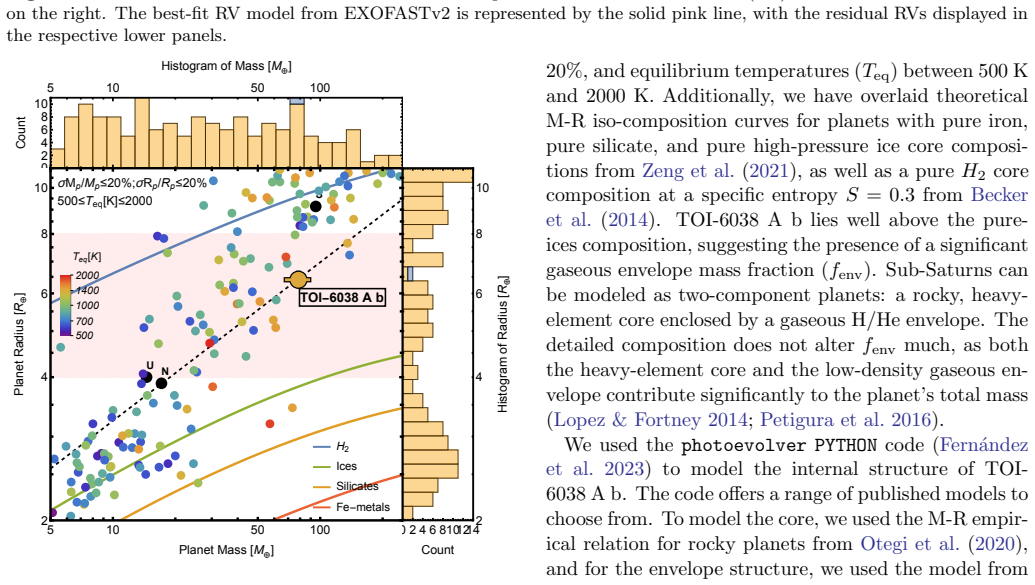
TOI-6038 A b is a dense sub-Saturn with $M_P = 78.5^{+9.5}_{-9.9}\,M_\oplus$, $R_P = 6.41^{+0.20}_{-0.16}\,R_\oplus$, and a circular orbit with period $P = 5.8267311^{+0.0000074}_{-0.0000068}$ days around a $1.291^{+0.066}_{-0.060}\,M_\odot$ late F-type star. The paper's central claim is that this object occupies the outer boundary of the Neptunian ridge, the orbital-period over-density of super-Neptunes and sub-Saturns at $3.2$--$5.7$ days, and that its density of $1.62^{+0.23}_{-0.24}\,\mathrm{g\,cm^{-3}}$ places it with the dense ridge population ($\rho_P \simeq 1.5$--$2.0\,\mathrm{g\,cm^{-3}}$) rather than the low-density savanna. Internal-structure modeling yields a rocky/iron core of about $58\,M_\oplus$ and an H/He envelope mass fraction $f_\mathrm{env} \approx 0.26$, so the planet is core-dominated. The authors further argue that vZLK oscillations induced by the wide companion at $\approx 3217$ AU are probably suppressed by relativistic apsidal precession, leaving high-eccentricity migration by an undetected companion or early disk-driven migration as open formation routes.
Load-bearing premise
The measured mass and radius are secure, but the inferred core mass of $58\,M_\oplus$ and envelope fraction of $0.26$ assume a two-layer planet whose core obeys the Otegi et al. (2020) rocky mass-radius relation and whose envelope follows Chen & Rogers (2016); if the true interior composition deviates from these models, the compositional claims would change.
Editorial extensions
If this is right
- TOI-6038 A b becomes a benchmark for the ridge-savanna transition: any successful theory of Neptunian-planet migration and evolution should reproduce a dense, core-dominated planet on a 5.83-day circular orbit in a wide binary.
- The density dichotomy between ridge and savanna is reinforced by this object, supporting the view that the two regimes correspond to different formation or migration sub-populations rather than a single mass-loss sequence.
- With a bright host star, the planet is observable for spin-orbit (Rossiter-McLaughlin) and atmospheric-escape (e.g., metastable helium) studies, which can discriminate between the proposed migration histories.
- The derived core mass of about $58\,M_\oplus$ and envelope fraction of $0.26$ provide a constraint on the timing of gas accretion and disk dissipation for sub-Saturns.
- The system adds to the small sample of hot sub-Saturns in multiple star systems, enabling statistical tests of whether wide companions trigger high-eccentricity migration.
Reading between the lines
- If a future Rossiter-McLaughlin measurement finds a small spin-orbit angle, the dynamically hot migration channel would be largely ruled out for this planet and disk-driven migration would become the leading explanation, implying that the ridge population may contain many dynamically cold members.
- The position of this planet at the edge of the ridge makes the boundary an empirical probe: discovering more planets just inside and outside 5.7 days would reveal whether the ridge-savanna transition in density is sharp or continuous.
- A metastable-helium observation that sets an upper limit on atmospheric escape would independently test the thin-envelope structure; escape rates much larger than expected for a core-dominated planet would call the internal-structure model into question.
- The authors' preliminary result that GR precession suppresses vZLK-driven migration for a formation radius near 5 AU suggests that similar transition planets in wide binaries could serve as clean tests of whether distant stellar companions ever drive close-in migration.
Signed reviews
Editorial analysis
A structured set of objections, weighed in public.
Referee Report
Summary. TOI-6038 A b is presented as a newly discovered dense sub-Saturn orbiting a bright, metal-rich late F star in a wide binary system. The analysis combines nine TESS transits from Sectors 18 and 58 with 29 PARAS-2 radial velocities, and uses EXOFASTv2 to jointly model the photometry, RVs, SED, and MIST isochrones. The adopted circular-orbit, high-stellar-mass solution yields P = 5.8267311 days, R_P = 6.41 R_Earth, M_P = 78.5 M_Earth, and a bulk density of 1.62 g/cm3, placing the planet at the boundary between the Neptunian ridge and savanna. Internal-structure modeling gives a core mass of about 58 M_Earth and a 26% H/He envelope mass fraction. The paper discusses tidal circularization, a possible von Zeipel-Lidov-Kozai migration pathway driven by the binary companion, and future atmospheric and orbital follow-up opportunities.
Significance. If the derived parameters hold, the paper delivers a precise mass and radius for a sub-Saturn in a sparsely populated region of parameter space, with a density consistent with the high-density ridge population and a wide binary companion that is relevant for testing high-eccentricity migration scenarios. The analysis has several strengths: contamination is quantified with TESS-cont; the planetary origin of the RV signal is supported by in-phase TESS photometry and null activity-indicator periodograms; speckle imaging and Gaia RUWE rule out close stellar companions; and both circular/eccentric and high/low stellar-mass solutions are compared. The two main weaknesses are the undocumented exclusion of 14 radial velocities from the fit and a numerical inconsistency in the quoted Kozai timescale; both are fixable and do not, by themselves, invalidate the central mass and radius measurement.
major comments (2)
- [§2.3, Table 4] The manuscript states that fourteen additional PARAS-2 spectra were excluded from the RV analysis 'due to poor seeing conditions', but these points are never listed, their orbital phases are not shown, and no fit including them is reported. Since the reported semi-amplitude K = 23.5 ± 2.8 m/s is the sole basis for the headline mass M_P = 78.5 ± 9.9 M_Earth, a phase-dependent selection could bias K by more than its formal uncertainty. Please provide the excluded epochs and RVs (or at minimum their phases, uncertainties, and a seeing/SNR criterion), and either include them in a fit with appropriate weights or demonstrate explicitly that their exclusion is phase-independent and does not shift K.
- [§4.2] The quoted von Zeipel-Lidov-Kozai timescale is numerically inconsistent with the stated parameters. Using the paper's formula t_vZLK = (a_comp/a_1,0)^3 (m_primary/m_comp) t_P,0 with a_comp = 3217 AU, a_1,0 = 5 AU, m_primary/m_comp ≈ 1.5, and t_P = 5.8267 days gives t_vZLK ≈ 6 × 10^6 yr, not 4 × 10^9 yr; the quoted 4 Gyr would correspond to a_1,0 ≈ 0.5 AU rather than 5 AU. Please correct the numerical value or the assumed initial semi-major axis and re-evaluate the sentence claiming that the timescale is 'comparable to the age of the system'. The qualitative conclusion based on epsilon_GR ≈ 3 may be unaffected, but the stated timescale is wrong as written.
minor comments (6)
- [§3.6, Tables 2 and 5] The low-mass stellar solution is reported only in the appendix and is not discussed in the main text. Since it gives M_P ≈ 72.5 M_Earth versus 78.5 M_Earth for the adopted high-mass solution, a sentence in §3.6 stating that the low-mass solution is within the quoted 68% interval and leaves the density and ridge/savanna classification unchanged would help readers judge the robustness of the result.
- [§4.1, Table 3] The internal-structure results (M_core ≈ 58 M_Earth, f_env ≈ 0.26) are computed with one core mass-radius relation (Otegi et al. 2020) and one envelope model (Chen & Rogers 2016). Please state explicitly that these values are model-dependent, and if possible quote the spread from an alternative envelope model (for example Lopez & Fortney 2014) rather than only the formal fit uncertainty.
- [§2.1] The TESS aperture contains a 10.4% flux contribution from TOI-6038 B (Star 1). Although the PDCSAP light curves are corrected for crowding and the paper reasonably does not include an extra dilution factor, a fit with a free dilution parameter constrained by the TESS-cont estimate would directly test the sensitivity of R_P and hence of the density to residual contamination errors.
- [§3.5] There is a minor wording error: 'not additional relevant peaks pop up' should read 'no additional relevant peaks pop up.'
- [§3.2] The sentence 'TOI-6038 is only the fifth known multiple star system...' should refer to TOI-6038 A, since TOI-6038 names the whole binary system.
- [§4.1, Table 3] The quantity labeled 'envelope radius' appears to be the envelope thickness R_P - R_core rather than a radius in the usual sense; consider renaming it to 'envelope thickness' for clarity.
Circularity Check
No significant circularity: TOI-6038 A b's mass and radius are measured from independent PARAS-2 RVs and TESS photometry, with cited models supplying only interpretation.
full rationale
The paper's central results—MP=78.5+9.5-9.9 M_Earth and RP=6.41+0.20-0.16 R_Earth—are obtained by a joint EXOFASTv2 fit to PARAS-2 radial velocities and TESS transit photometry (Sects. 2.3, 3.6). Nothing in that fit is defined in terms of the reported planet properties: the Keplerian RV model and Mandel & Agol transit model are standard forward models, and the fitted parameters (P, TC, K, depth, limb darkening, jitter) do not presuppose the headline mass or radius. The mass follows from the measured semi-amplitude K=23.5±2.8 m/s and the fitted stellar mass, while the radius follows from the transit depth and stellar radius; these are independent observables. The internal-structure interpretation (Sect. 4.1) uses published mass-radius relations (Otegi et al. 2020; Chen & Rogers 2016) as external inputs and reports core mass, core radius, envelope radius, and fenv as outputs; the outputs are not fed back into the RV or transit fit, so the compositional inference is model-dependent but not circular. Self-citations to Baliwal et al. (2024) describe the PARAS-2 pipeline and speckle reduction used here and are not used to force the target result; citations to Castro-González et al. (2024a,b) supply the ridge/savanna definitions and density dichotomy that frame the discussion, but the paper does not derive those definitions from its own data. The exclusion of fourteen RV points for poor seeing is a data-quality choice; absent a demonstration of phase bias it is a robustness concern, not a circular reduction, because the reported K is not constructed to equal any later output. No fitted parameter is renamed as a prediction, and no claimed result reduces by construction to its inputs.
Assumptions & free parameters
free parameters (4)
- Adopted stellar mass solution =
1.291 Msun (high-mass branch)
- Tidal quality factor Qp =
1e5
- Initial semi-major axis a1,0 for vZLK estimate =
5 AU
- Binary semi-major axis in vZLK estimate =
3217 AU (projected separation)
assumptions (6)
- standard math Keplerian orbits and Mandel-Agol transit model accurately describe the system
- domain assumption The observed radial velocity signal is of planetary origin, not stellar activity
- domain assumption The transit signal originates from TOI-6038 A, not from the contaminating nearby star Star 1 (TIC 194736419)
- domain assumption The PDCSAP light curves are correctly corrected for dilution from nearby stars
- domain assumption MIST stellar evolutionary models are appropriate for the host star
- domain assumption The Otegi et al. (2020) and Chen & Rogers (2016) models for rocky cores and H/He envelopes apply to this planet
Cite this review
Pith. "Pith review of TOI-6038 A b: A dense sub-Saturn in the transition regime between the Neptunian ridge and savanna." pith.science (2026). https://pith.science/paper/XWMCRHJK
@misc{pith2026250102272,
  author       = {Pith},
  title        = {Pith review of: TOI-6038 A b: A dense sub-Saturn in the transition regime between the Neptunian ridge and savanna},
  year         = {2026},
  howpublished = {\url{https://pith.science/paper/XWMCRHJK}},
  note         = {Machine review of arXiv:2501.02272}
}
abstract
We present the discovery and characterization of a sub-Saturn exoplanet, TOI-6038~A~b, using the PARAS-2 spectrograph. The planet orbits a bright ($m_V=9.9$), metal-rich late F-type star, TOI-6038~A, with $T_{\rm{eff}}=6110\pm100~\mathrm{K}$, $\log{g}=4.118^{+0.015}_{-0.025}$, and $[{\rm{Fe/H}}]=0.124^{+0.079}_{-0.077}$ dex. The system also contains a wide-orbit binary companion, TOI-6038~B, an early K-type star at a projected separation of $\approx3217$ AU. We combined radial velocity data from PARAS-2 with photometric data from the Transiting Exoplanet Survey Satellite (TESS) for joint modeling. TOI-6038~A~b has a mass of $78.5^{+9.5}_{-9.9}~M_\oplus$ and a radius of $6.41^{+0.20}_{-0.16}~R_\oplus$, orbiting in a circular orbit with a period of $5.8267311^{+0.0000074}_{-0.0000068}$ days. Internal structure modeling suggests that $\approx74\%$ of the planet's mass is composed of dense materials, such as rock and iron, forming a core, while the remaining mass consists of a low-density H/He envelope. TOI-6038~A~b lies at the transition regime between the recently identified Neptunian ridge and savanna. Having a density of $\rho_{\rm{P}}=1.62^{+0.23}_{-0.24}\rm~g\,cm^{-3}$, TOI-6038~A~b is compatible with the population of dense ridge planets ($\rho_{\rm{P}}\simeq$ 1.5-2.0 $\rm~g\,cm^{-3}$), which have been proposed to have reached their close-in locations through high-eccentricity tidal migration (HEM). First-order estimates suggest that the secular perturbations induced by TOI-6038~B may be insufficient to drive the HEM of TOI-6038~A~b. Therefore, it is not clear whether HEM driven by a still undetected companion, or early disk-driven migration, brought TOI-6038~A~b to its present-day close-in orbit. Its bright host star makes TOI-6038~A~b a prime target for atmospheric escape and orbital architecture observations, which will help us to better understand its overall evolution.
Figures


Figures from the paper (8 more)




Reference graph
Works this paper leans on
-
[1]
Adams, F. C., & Laughlin, G. 2006, ApJ, 649, 1004, doi: 10.1086/506145
doi:10.1086/506145 2006
-
[2]
2020, The Astronomical Journal, 159, 123, doi: 10.3847/1538-3881/ab4fee
Agol, E., Luger, R., & Foreman-Mackey, D. 2020, The Astronomical Journal, 159, 123, doi: 10.3847/1538-3881/ab4fee
-
[3]
1974, IEEE Transactions on Automatic Control, 19, 716
Akaike, H. 1974, IEEE Transactions on Automatic Control, 19, 716
1974
-
[4]
L., Chen, X., Ciardi, D., et al
Akeson, R. L., Chen, X., Ciardi, D., et al. 2013, Publications of the Astronomical Society of the Pacific, 125, 989, doi: 10.1086/672273
doi:10.1086/672273 2013
-
[5]
Albrecht, S., Winn, J. N., Johnson, J. A., et al. 2012, ApJ, 757, 18, doi: 10.1088/0004-637X/757/1/18
-
[6]
Aller, A., Lillo-Box, J., Jones, D., Miranda, L. F., & Barcel´ o Forteza, S. 2020, A&A, 635, A128, doi: 10.1051/0004-6361/201937118
-
[7]
Anderson, K. R., Storch, N. I., & Lai, D. 2016, 456, 3671, doi: 10.1093/mnras/stv2906
-
[8]
2023, A&A, 674, A27, doi: 10.1051/0004-6361/202243462
Andrae, R., Fouesneau, M., Sordo, R., et al. 2023, A&A, 674, A27, doi: 10.1051/0004-6361/202243462
Show all 114 references
-
[9]
2023, A&A, 674, A120, doi: 10.1051/0004-6361/202245237
Attia, O., Bourrier, V., Delisle, J.-B., & Eggenberger, P. 2023, A&A, 674, A120, doi: 10.1051/0004-6361/202245237
2023 doi
-
[10]
2021, A&A, 647, A40, doi: 10.1051/0004-6361/202039452
Attia, O., Bourrier, V., Eggenberger, P., et al. 2021, A&A, 647, A40, doi: 10.1051/0004-6361/202039452
2021 doi
-
[11]
2024, A&A, 691, A12, doi: 10.1051/0004-6361/202450934
Baliwal, S., Sharma, R., Chakraborty, A., et al. 2024, A&A, 691, A12, doi: 10.1051/0004-6361/202450934
2024 doi
-
[12]
1996, A&AS, 119, 373 Barrag´ an, O., Aigrain, S., Rajpaul, V
Baranne, A., Queloz, D., Mayor, M., et al. 1996, A&AS, 119, 373 Barrag´ an, O., Aigrain, S., Rajpaul, V. M., & Zicher, N. 2021, Monthly Notices of the Royal Astronomical Society, 509, 866, doi: 10.1093/mnras/stab2889
1996 doi
-
[14]
H., & Laughlin, G
Batygin, K., Bodenheimer, P. H., & Laughlin, G. P. 2016, The Astrophysical Journal, 829, 114, doi: 10.3847/0004-637X/829/2/114 Beaug´ e, C., & Nesvorn´ y, D. 2012, 751, 119, doi: 10.1088/0004-637X/751/2/119 Beaug´ e, C., & Nesvorn´ y, D. 2013, ApJ, 763, 12, doi: 10.1088/0004-6...
2016 doi
-
[15]
J., et al
Becker, A., Lorenzen, W., Fortney, J. J., et al. 2014, The Astrophysical Journal Supplement Series, 215, 21, doi: 10.1088/0067-0049/215/2/21
2014 doi
-
[16]
J., & Higgins, M
Bell, K. J., & Higgins, M. E. 2022, TESS PRF: Display the TESS pixel response function, Astrophysics Source Code Library, record ascl:2207.008 Ben ´ ıtez-Llambay, P., Masset, F., & Beaug´ e, C. 2011, A&A, 528, A2, doi: 10.1051/0004-6361/201015774
2022 doi
-
[17]
Bensby, T., Feltzing, S., & Oey, M. S. 2014, A&A, 562, A71, doi: 10.1051/0004-6361/201322631
2014 doi
-
[18]
Boisse, I., Bonfils, X., & Santos, N. C. 2012, A&A, 545, A109, doi: 10.1051/0004-6361/201219115
2012 doi
-
[19]
C., Contreras, A
Boley, A. C., Contreras, A. P. G., & Gladman, B. 2016, The Astrophysical Journal Letters, 817, L17, doi: 10.3847/2041-8205/817/2/L17
2016 doi
-
[20]
J., Koch, D., Basri, G., et al
Borucki, W. J., Koch, D., Basri, G., et al. 2010, Science, 327, 977, doi: 10.1126/science.1185402
2010 doi
-
[21]
2018a, Nature, 553, 477, doi: 10.1038/nature24677
Bourrier, V., Lovis, C., Beust, H., et al. 2018a, Nature, 553, 477, doi: 10.1038/nature24677
-
[22]
2018b, A&A, 620, A147, doi: 10.1051/0004-6361/201833675
Bourrier, V., Lecavelier des Etangs, A., Ehrenreich, D., et al. 2018b, A&A, 620, A147, doi: 10.1051/0004-6361/201833675
-
[23]
2023, A&A, 669, A63, doi: 10.1051/0004-6361/202245004
Bourrier, V., Attia, O., Mallonn, M., et al. 2023, A&A, 669, A63, doi: 10.1051/0004-6361/202245004
2023 doi
-
[24]
A., Bakos, G
Buchhave, L. A., Bakos, G. ´A., Hartman, J. D., et al. 2010, ApJ, 720, 1118, doi: 10.1088/0004-637X/720/2/1118
2010 doi
-
[25]
A., Latham, D., Johansen, A., et al
Buchhave, L. A., Latham, D., Johansen, A., et al. 2012, Nature, 486, 375
2012
-
[26]
A., Bizzarro, M., Latham, D
Buchhave, L. A., Bizzarro, M., Latham, D. W., et al. 2014, Nature, 509, 593, doi: 10.1038/nature13254 16
2014 doi
-
[27]
P., & Anderson, D
Burnham, K. P., & Anderson, D. R. 2002, Model Selection and Multimodel Inference, 2nd edn. (New York: Springer-Verlag), doi: 10.1007/b97636
2002 doi
-
[28]
P., Wright, J
Butler, R. P., Wright, J. T., Marcy, G. W., et al. 2006, ApJ, 646, 505, doi: 10.1086/504701
2006 doi
-
[29]
A., Tenenbaum, P., Twicken, J
Caldwell, D. A., Tenenbaum, P., Twicken, J. D., et al. 2020, Research Notes of the AAS, 4, 201, doi: 10.3847/2515-5172/abc9b3
2020 doi
-
[30]
W., Quinn, S
Carmichael, T. W., Quinn, S. N., Zhou, G., et al. 2021, The Astronomical Journal, 161, 97, doi: 10.3847/1538-3881/abd4e1 Castro-Gonz´ alez, A., Bourrier, V., Lillo-Box, J., et al. 2024a, A&A, 689, A250, doi: 10.1051/0004-6361/202450957 Castro-Gonz´ alez, A., D ´ ıez Alonso, E....
2021 doi
-
[31]
2018, in Ground-based and Airborne Instrumentation for Astronomy VII, ed
Chakraborty, A., Thapa, N., Kumar, K., et al. 2018, in Ground-based and Airborne Instrumentation for Astronomy VII, ed. C. J. Evans, L. Simard, & H. Takami, Vol. 10702, International Society for Optics and Photonics (SPIE), 107026G, doi: 10.1117/12.2313055
2018 doi
-
[32]
K., Prasad, N
Chakraborty, A., Bharadwaj, K. K., Prasad, N. J. S. S. V., et al. 2024, The PRL 2.5m Telescope and its First Light Instruments: FOC & PARAS-2. https://arxiv.org/abs/2401.07715
2024 arXiv
-
[33]
Chen, H., & Rogers, L. A. 2016, The Astrophysical Journal, 831, 180, doi: 10.3847/0004-637X/831/2/180
2016 doi
-
[34]
2016, ApJ, 823, 102, doi: 10.3847/0004-637X/823/2/102
Choi, J., Dotter, A., Conroy, C., et al. 2016, ApJ, 823, 102, doi: 10.3847/0004-637X/823/2/102
2016 doi
-
[35]
2017, A&A, 600, A30, doi: 10.1051/0004-6361/201629705
Claret, A. 2017, A&A, 600, A30, doi: 10.1051/0004-6361/201629705
2017 doi
-
[36]
2011, A&A, 529, A75, doi: 10.1051/0004-6361/201116451
Claret, A., & Bloemen, S. 2011, A&A, 529, A75, doi: 10.1051/0004-6361/201116451
2011 doi
-
[37]
Correia, A. C. M., Bourrier, V., & Delisle, J.-B. 2020, A&A, 635, A37, doi: 10.1051/0004-6361/201936967
2020 doi
-
[38]
Correia, A. C. M., Laskar, J., Farago, F., & Bou´ e, G. 2011, Celestial Mechanics and Dynamical Astronomy, 111, 105, doi: 10.1007/s10569-011-9368-9
2011 doi
-
[39]
W., & Butler, R
Cumming, A., Marcy, G. W., & Butler, R. P. 1999, ApJ, 526, 890, doi: 10.1086/308020
1999 doi
-
[40]
M., Skrutskie, M
Cutri, R. M., Skrutskie, M. F., van Dyk, S., et al. 2003, VizieR Online Data Catalog, II/246
2003
-
[41]
M., Wright, E
Cutri, R. M., Wright, E. L., Conrow, T., et al. 2021, VizieR Online Data Catalog, II/328
2021
-
[42]
2019, MNRAS, 489, 2555, doi: 10.1093/mnras/stz2216
Damasso, M., Pinamonti, M., Scandariato, G., & Sozzetti, A. 2019, MNRAS, 489, 2555, doi: 10.1093/mnras/stz2216
2019 doi
-
[43]
2023, A&A, 679, A33, doi: 10.1051/0004-6361/202347240
Damasso, M., Rodrigues, J., Castro-Gonz´ alez, A., et al. 2023, A&A, 679, A33, doi: 10.1051/0004-6361/202347240
2023 doi
-
[44]
I., & Johnson, J
Dawson, R. I., & Johnson, J. A. 2018, 56, 175, doi: 10.1146/annurev-astro-081817-051853 de Leon, J. P., Livingston, J., Endl, M., et al. 2021, MNRAS, 508, 195, doi: 10.1093/mnras/stab2305
2018 doi
-
[45]
2016, ApJS, 222, 8, doi: 10.3847/0067-0049/222/1/8
Dotter, A. 2016, ApJS, 222, 8, doi: 10.3847/0067-0049/222/1/8
2016 doi
-
[46]
Dumusque, X., Boisse, I., & Santos, N. C. 2014, ApJ, 796, 132, doi: 10.1088/0004-637X/796/2/132
2014 doi
-
[47]
D., Rodriguez, J
Eastman, J. D., Rodriguez, J. E., Agol, E., et al. 2019, arXiv e-prints, arXiv:1907.09480. https://arxiv.org/abs/1907.09480
2019 arXiv
-
[48]
J., et al
Ehrenreich, D., Bourrier, V., Wheatley, P. J., et al. 2015, Nature, 522, 459, doi: 10.1038/nature14501 Fern´ andez, J. F., Wheatley, P. J., & King, G. W. 2023, Monthly Notices of the Royal Astronomical Society, 522, 4251, doi: 10.1093/mnras/stad1257
2015 doi
-
[49]
A., Anglada-Escude, G., Arriagada, P., et al
Fischer, D. A., Anglada-Escude, G., Arriagada, P., et al. 2016, Publications of the Astronomical Society of the Pacific, 128, 066001, doi: 10.1088/1538-3873/128/964/066001
2016 doi
-
[50]
Ford, E. B. 2006, ApJ, 642, 505, doi: 10.1086/500802
2006 doi
-
[51]
B., & Rasio, F
Ford, E. B., & Rasio, F. A. 2008, The Astrophysical Journal, 686, 621, doi: 10.1086/590926
2008 doi
-
[52]
J., Dawson, R
Fortney, J. J., Dawson, R. I., & Komacek, T. D. 2021, Journal of Geophysical Research (Planets), 126, e06629, doi: 10.1029/2020JE006629
2021 doi
-
[53]
2009, A&A, 493, 645, doi: 10.1051/0004-6361:200810557 Gagn´ e, J., Mamajek, E
Forveille, T., Bonfils, X., Delfosse, X., et al. 2009, A&A, 493, 645, doi: 10.1051/0004-6361:200810557 Gagn´ e, J., Mamajek, E. E., Malo, L., et al. 2018, ApJ, 856, 23, doi: 10.3847/1538-4357/aaae09 Gaia Collaboration, Brown, A. G. A., Vallenari, A., et al. 2021, A&A, 649, A1,...
2009 doi
-
[54]
S., Seager, S., & Mallen-Ornelas, G
Gaudi, B. S., Seager, S., & Mallen-Ornelas, G. 2005, ApJ, 623, 472, doi: 10.1086/428478
2005 doi
-
[55]
2017, AJ, 154, 192, doi: 10.3847/1538-3881/aa8c04
Giacalone, S., Matsakos, T., & K¨ onigl, A. 2017, AJ, 154, 192, doi: 10.3847/1538-3881/aa8c04
2017 doi
-
[56]
1979, ApJ, 233, 857, doi: 10.1086/157448 Gonz´ alez Hern´ andez, J
Goldreich, P., & Tremaine, S. 1979, ApJ, 233, 857, doi: 10.1086/157448 Gonz´ alez Hern´ andez, J. I., Su´ arez Mascare˜ no, A., Silva, A. M., et al. 2024, A&A, 690, A79, doi: 10.1051/0004-6361/202451311 17
1979 doi
-
[57]
D., & L´ epine, S
Hartman, Z. D., & L´ epine, S. 2020, The Astrophysical Journal Supplement Series, 247, 66, doi: 10.3847/1538-4365/ab79a6
2020 doi
-
[58]
2014, Giant Planet Formation, Evolution, and Internal Structure (eprint: arXiv:1311.1142), 643–665, doi: 10.2458/azu uapress 9780816531240-ch028
Helled, R., Bodenheimer, P., Podolak, M., et al. 2014, Giant Planet Formation, Evolution, and Internal Structure (eprint: arXiv:1311.1142), 643–665, doi: 10.2458/azu uapress 9780816531240-ch028
2014 arXiv
-
[59]
X., Vanderburg, A., P´ al, A., et al
Huang, C. X., Vanderburg, A., P´ al, A., et al. 2020a, Research Notes of the AAS, 4, 204, doi: 10.3847/2515-5172/abca2e —. 2020b, Research Notes of the AAS, 4, 206, doi: 10.3847/2515-5172/abca2d Hu´ elamo, N., Figueira, P., Bonfils, X., et al. 2008, A&A, 489, L9, doi: 10.1051/...
-
[60]
V., Sch¨ ofer, P., Lamert, A., et al
Jeffers, S. V., Sch¨ ofer, P., Lamert, A., et al. 2018, A&A, 614, A76, doi: 10.1051/0004-6361/201629599
2018 doi
-
[61]
2016, in Software and Cyber infrastructure for Astronomy IV, doi: 10.1117/12.2233418
Jenkins, J., Twicken, J., McCauliff, S., et al. 2016, in Software and Cyber infrastructure for Astronomy IV, doi: 10.1117/12.2233418
2016 doi
-
[62]
M.-R., Bean, J
Kempton, E. M.-R., Bean, J. L., Louie, D. R., et al. 2018, Publications of the Astronomical Society of the Pacific, 130, 114401, doi: 10.1088/1538-3873/aadf6f
2018 doi
-
[63]
2007, Celestial Mechanics and Dynamical Astronomy, 98, 67, doi: 10.1007/s10569-007-9069-6
Kinoshita, H., & Nakai, H. 2007, Celestial Mechanics and Dynamical Astronomy, 98, 67, doi: 10.1007/s10569-007-9069-6
2007 doi
-
[64]
1962, The Astronomical Journal, 67, 591, doi: 10.1086/108790
Kozai, Y. 1962, The Astronomical Journal, 67, 591, doi: 10.1086/108790
1962 doi
-
[65]
Kurucz, R. L. 1992, in The Stellar Populations of Galaxies, ed. B. Barbuy & A. Renzini, Vol. 149, 225
1992
-
[66]
J., & Chiang, E
Lee, E. J., & Chiang, E. 2015, The Astrophysical Journal, 811, 41, doi: 10.1088/0004-637X/811/1/41 —. 2016, The Astrophysical Journal, 817, 90, doi: 10.3847/0004-637X/817/2/90
2015 doi
-
[67]
Leggett, S. K. 1992, ApJS, 82, 351, doi: 10.1086/191720
1992 doi
-
[68]
Lidov, M. L. 1962, Planetary and Space Science, 9, 719, doi: 10.1016/0032-0633(62)90129-0
1962 doi
-
[69]
P., Su´ arez Mascare˜ no, A., et al
Lillo-Box, J., Faria, J. P., Su´ arez Mascare˜ no, A., et al. 2021, A&A, 654, A60, doi: 10.1051/0004-6361/202141714
2021 doi
-
[70]
Lin, D. N. C., Bodenheimer, P., & Richardson, D. C. 1996, Nature, 380, 606, doi: 10.1038/380606a0
1996 doi
-
[71]
A., Hern´ andez, J., et al
Lindegren, Klioner, S. A., Hern´ andez, J., et al. 2021, A&A, 649, A2, doi: 10.1051/0004-6361/202039709
2021 doi
-
[72]
J., & Lai, D
Liu, B., Mu˜ noz, D. J., & Lai, D. 2015, Monthly Notices of the Royal Astronomical Society, 447, 747, doi: 10.1093/mnras/stu2396
2015 doi
-
[73]
H., Crossfield, I
Livingston, J. H., Crossfield, I. J. M., Petigura, E. A., et al. 2018, AJ, 156, 277, doi: 10.3847/1538-3881/aae778
2018 doi
-
[74]
D., & Fortney, J
Lopez, E. D., & Fortney, J. J. 2014, The Astrophysical Journal, 792, 1, doi: 10.1088/0004-637X/792/1/1
2014 doi
-
[75]
S., Kjeldsen, H., Albrecht, S., et al
Lundkvist, M. S., Kjeldsen, H., Albrecht, S., et al. 2016, Nature Communications, 7, 11201, doi: 10.1038/ncomms11201
2016 doi
-
[76]
J., & Barman, T
Madhusudhan, N., Knutson, H., Fortney, J. J., & Barman, T. 2014, Exoplanetary Atmospheres (University of Arizona Press), doi: 10.2458/azu uapress 9780816531240-ch032
2014 doi
-
[77]
2002, ApJL, 580, L171, doi: 10.1086/345520
Mandel, K., & Agol, E. 2002, ApJL, 580, L171, doi: 10.1086/345520
2002 doi
-
[78]
2016, ApJL, 820, L8, doi: 10.3847/2041-8205/820/1/L8
Matsakos, T., & K¨ onigl, A. 2016, ApJL, 820, L8, doi: 10.3847/2041-8205/820/1/L8
2016 doi
-
[79]
2016, A&A, 589, A75, doi: 10.1051/0004-6361/201528065
Mazeh, T., Holczer, T., & Faigler, S. 2016, A&A, 589, A75, doi: 10.1051/0004-6361/201528065
2016 doi
-
[80]
McLaughlin, D. B. 1924, ApJ, 60, 22, doi: 10.1086/142826
1924 doi
-
[81]
2015, International Journal of Astrobiology, 14, 201–232, doi: 10.1017/S1473550414000263
Alibert, Y. 2015, International Journal of Astrobiology, 14, 201–232, doi: 10.1017/S1473550414000263
2015 doi
-
[82]
2011, A&A, 526, A111, doi: 10.1051/0004-6361/200913521
Mordasini, C., Mayor, M., Udry, S., et al. 2011, A&A, 526, A111, doi: 10.1051/0004-6361/200913521
2011 doi
-
[83]
2016, 54, 441, doi: 10.1146/annurev-astro-081915-023315
Naoz, S. 2016, 54, 441, doi: 10.1146/annurev-astro-081915-023315
2016 doi
-
[84]
2011, 473, 187, doi: 10.1038/nature10076
Teyssandier, J. 2011, 473, 187, doi: 10.1038/nature10076
2011 doi
-
[85]
F., Bouchy, F., & Helled, R
Otegi, J. F., Bouchy, F., & Helled, R. 2020, A&A, 634, A43, doi: 10.1051/0004-6361/201936482
2020 doi
- [86]
-
[87]
G., Collins, K
Paegert, M., Stassun, K. G., Collins, K. A., et al. 2021, TESS Input Catalog versions 8.1 and 8.2: Phantoms in the 8.0 Catalog and How to Handle Them. https://arxiv.org/abs/2108.04778
2021 arXiv
-
[88]
A., Howard, A
Petigura, E. A., Howard, A. W., Lopez, E. D., et al. 2016, The Astrophysical Journal, 818, 36, doi: 10.3847/0004-637X/818/1/36
2016 doi
-
[89]
A., Sinukoff, E., Lopez, E
Petigura, E. A., Sinukoff, E., Lopez, E. D., et al. 2017, The Astronomical Journal, 153, 142, doi: 10.3847/1538-3881/aa5ea5
2017 doi
-
[90]
2015, The Astrophysical Journal, 805, 75, doi: 10.1088/0004-637X/805/1/75
Petrovich, C. 2015, The Astrophysical Journal, 805, 75, doi: 10.1088/0004-637X/805/1/75
2015 doi
-
[91]
B., Hubickyj, O., Bodenheimer, P., et al
Pollack, J. B., Hubickyj, O., Bodenheimer, P., et al. 1996, Icarus, 124, 62, doi: https://doi.org/10.1006/icar.1996.0190
1996
-
[92]
W., Sivan, J
Queloz, D., Henry, G. W., Sivan, J. P., et al. 2001, A&A, 379, 279, doi: 10.1051/0004-6361:20011308
2001 doi
-
[93]
Rossiter, R. A. 1924, ApJ, 60, 15, doi: 10.1086/142825
1924 doi
-
[94]
C., Mortier, A., Faria, J
Santos, N. C., Mortier, A., Faria, J. P., et al. 2014, A&A, 566, A35, doi: 10.1051/0004-6361/201423808
2014 doi
-
[95]
F., & Finkbeiner, D
Schlafly, E. F., & Finkbeiner, D. P. 2011, ApJ, 737, 103, doi: 10.1088/0004-637X/737/2/103 18 Sch¨ onrich, R., Binney, J., & Dehnen, W. 2010, MNRAS, 403, 1829, doi: 10.1111/j.1365-2966.2010.16253.x
2011
-
[96]
C., Stumpe, M
Smith, J. C., Stumpe, M. C., Van Cleve, J. E., et al. 2012, PASP, 124, 1000, doi: 10.1086/667697
2012 doi
-
[97]
2011, Monthly Notices of the Royal Astronomical Society, 417, 2166, doi: 10.1111/j.1365-2966.2011.19399.x
Southworth, J. 2011, Monthly Notices of the Royal Astronomical Society, 417, 2166, doi: 10.1111/j.1365-2966.2011.19399.x
2011
-
[98]
G., & Torres, G
Stassun, K. G., & Torres, G. 2016, ApJL, 831, L6, doi: 10.3847/2041-8205/831/1/L6
2016 doi
-
[99]
G., Oelkers, R
Stassun, K. G., Oelkers, R. J., Pepper, J., et al. 2018, AJ, 156, 102, doi: 10.3847/1538-3881/aad050
2018 doi
-
[100]
I., Anderson, K
Storch, N. I., Anderson, K. R., & Lai, D. 2014, Science, 345, 1317, doi: 10.1126/science.1254358
2014 doi
-
[101]
I., & Lai, D
Storch, N. I., & Lai, D. 2015, Monthly Notices of the Royal Astronomical Society, 448, 1821, doi: 10.1093/mnras/stv119
2015 doi
-
[102]
M., et al
Sulis, S., Lendl, M., Cegla, H. M., et al. 2023, A&A, 670, A24, doi: 10.1051/0004-6361/202244223 Szab´ o, G. M., & Kiss, L. L. 2011, ApJL, 727, L44, doi: 10.1088/2041-8205/727/2/L44
2023 doi
-
[103]
Teyssandier, J., Naoz, S., Lizarraga, I., & Rasio, F. A. 2013, 779, 166, doi: 10.1088/0004-637X/779/2/166
2013 doi
-
[104]
E., Coughlin, J
Thompson, S. E., Coughlin, J. L., Hoffman, K., et al. 2018, ApJS, 235, 38, doi: 10.3847/1538-4365/aab4f9
2018 doi
-
[105]
2018, PASP, 130, 035002, doi: 10.1088/1538-3873/aaa7d9
Tokovinin, A. 2018, PASP, 130, 035002, doi: 10.1088/1538-3873/aaa7d9
2018 doi
-
[106]
N., & Holman, M
Torres, G., Winn, J. N., & Holman, M. J. 2008, ApJ, 677, 1324, doi: 10.1086/529429
2008 doi
-
[107]
Triaud, A. H. M. J. 2018, in Handbook of Exoplanets, ed. H. J. Deeg & J. A. Belmonte, 2, doi: 10.1007/978-3-319-55333-7 2
2018 doi
-
[108]
Udry, S., Mayor, M., & Santos, N. C. 2003, A&A, 407, 369, doi: 10.1051/0004-6361:20030843
2003 doi
-
[109]
A., Greklek-McKeon, M., et al
Vissapragada, S., Knutson, H. A., Greklek-McKeon, M., et al. 2022, AJ, 164, 234, doi: 10.3847/1538-3881/ac92f2 von Zeipel, H. 1910, doi: 10.1002/asna.19091832202
2022 doi
-
[110]
2011, 735, 109, doi: 10.1088/0004-637X/735/2/109
Wu, Y., & Lithwick, Y. 2011, 735, 109, doi: 10.1088/0004-637X/735/2/109
2011 doi
-
[111]
2003, The Astrophysical Journal, 589, 605, doi: 10.1086/374598
Wu, Y., & Murray, N. 2003, The Astrophysical Journal, 589, 605, doi: 10.1086/374598
2003 doi
-
[112]
W., & Ramsahai, J
Wu, Y., Murray, N. W., & Ramsahai, J. M. 2007, 670, 820, doi: 10.1086/521996
2007 doi
-
[113]
2009, A&A, 496, 577, doi: 10.1051/0004-6361:200811296
Zechmeister, M., & K¨ urster, M. 2009, A&A, 496, 577, doi: 10.1051/0004-6361:200811296
2009 doi
-
[114]
B., Hyung, E., et al
Zeng, L., Jacobsen, S. B., Hyung, E., et al. 2021, The Astrophysical Journal, 923, 247, doi: 10.3847/1538-4357/ac3137
2021 doi
-
[115]
2020, AJ, 159, 19, doi: 10.3847/1538-3881/ab55e9 ˇSubjak, J., Endl, M., Chaturvedi, P., et al
Ziegler, C., Tokovinin, A., Brice˜ no, C., et al. 2020, AJ, 159, 19, doi: 10.3847/1538-3881/ab55e9 ˇSubjak, J., Endl, M., Chaturvedi, P., et al. 2022, A&A, 662, A107, doi: 10.1051/0004-6361/202142883 19 APPENDIX A. ADDITIONAL TABLE 20 T able 4.Radial velocity measurements of T...
2020
Reviewed August 10, 2026 · model on record in the stance chip above.
Discussion (0). Continue with ORCID to comment.