REVIEW 5 major objections 6 minor 2 cited by
KD-MSLRT: Lightweight Sign Language Recognition Model Based on Mediapipe and 3D to 1D Knowledge Distillation
T0 review · 5 major / 6 minor · reviewed 2026-08-10 · deepseek-v4-flash
Pith's one-line read A landmark-only sign language model beats video-based state of the art on PHOENIX14 and PHOENIX14T.
desk verdict A plausible lightweight SLR pipeline and a new dataset, but the headline accuracy claim over CorrNet is missing a text-correction control. read the letter →
The pith
A machine-rendered reading of the paper's core claim, the machinery that carries it, and where it could break.
The reading
What carries the argument
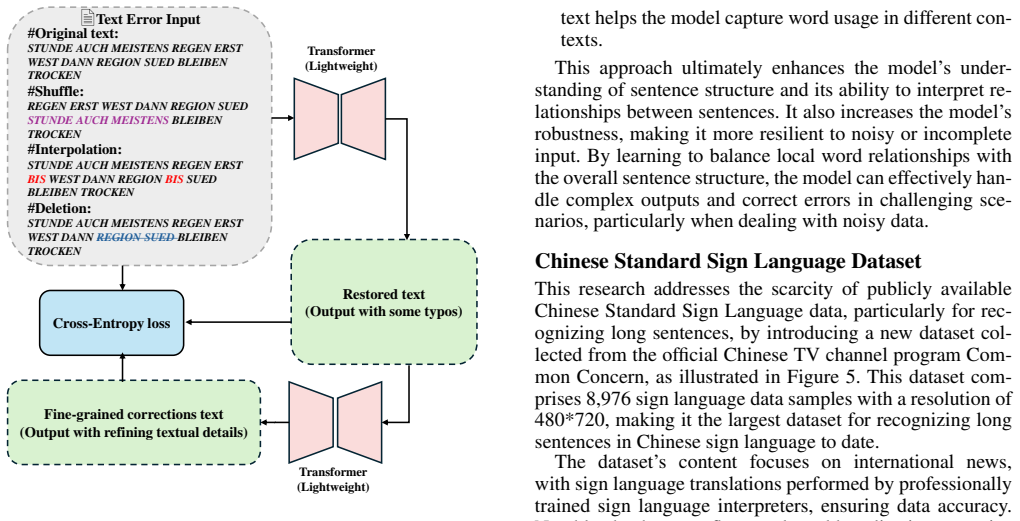
The key mechanism is 3D-to-1D knowledge distillation: a frozen video-based CorrNet teacher provides per-frame probability outputs from its convolutional and BiLSTM layers, and a lightweight MediaPipe landmark student (MSLR) is trained to match those probabilities while also solving the CTC alignment objective. Three distillation losses transfer knowledge at the convolutional level, the BiLSTM level, and through self-distillation, with a final CTC loss for gloss sequence prediction. A separate two-stage Transformer text correction network, pre-trained with self-supervised noise injection (shuffle, interpolation, deletion), then fixes residual errors in the student's output.
What would settle it
Run the KD-MSLRT training pipeline on PHOENIX14 with the teacher's frame-level probabilities artificially shifted by one or several frames before computing the distillation losses; if the student's final WER changes by more than the reported 0.5% margin, the frame-alignment assumption is load-bearing.
Extended reading notes
Core claim
The central discovery is that cross-modal knowledge distillation from a 3D video-based teacher to a 1D landmark-based student, combined with a text correction network, closes the accuracy gap between lightweight landmark models and heavy video models. On PHOENIX14, KD-MSLRT achieves a Word Error Rate of 17.4% (Dev) and 17.8% (Test); on PHOENIX14T, 16.9% and 18.4%, outperforming the CorrNet teacher baseline by 1.4 to 2.1 percentage points. The distilled student alone without text correction remains far behind (28.7–31.2% WER), so the paper's full claim depends on the combination of distillation and the two-stage text correction transformer.
Load-bearing premise
The distillation procedure assumes that the per-frame probability outputs of the video teacher and the landmark student correspond to the same time steps, so that summing the losses over time is meaningful.
Editorial extensions
If this is right
- The landmark-based model compresses video input by roughly 700x and reduces FLOPs by about 260x, making real-time inference possible on CPUs and edge devices.
- The INT8 quantized model is 12.93 MB with WER within 0.5% of the FP32 version, indicating deployment on mobile hardware is feasible.
- The model sets new state-of-the-art WER on PHOENIX14 and PHOENIX14T, improving over CorrNet by at least 1.4 percentage points on both benchmark splits.
- The newly released Chinese sign language dataset with 8,976 long news sentences provides a resource for research on Chinese Sign Language recognition.
- The landmark-specific data augmentation techniques (spatial rotation, random translation, frame fusion) are shown to improve the base student model's accuracy.
Reading between the lines
- The distillation loss assumes a one-to-one frame correspondence between the original video and the MediaPipe landmark sequence; the paper does not describe a synchronization step, so temporal misalignment in MediaPipe could silently distort the soft targets.
- The text correction network is trained on synthetic noise that mimics recognition errors, which suggests it could be reused as a general post-editor for other sequence outputs, not just this sign language model.
- The accuracy gain from distillation plus correction may partly inherit the teacher's blind spots, so the improvement over CorrNet should be re-checked on signers or dialects outside the benchmark distribution.
- The student uses only 72 hand and face keypoints, so it will fail when hands are occluded or out of frame; a stress test with occluded hand patches would quantify this robustness boundary.
Editorial analysis
A structured set of objections, weighed in public.
Referee Report
Summary. The paper proposes KD-MSLRT, a continuous sign language recognition (CSLR) model that runs on MediaPipe landmark keypoints (72 points) rather than raw video. A lightweight 1D-CNN/BiLSTM student is trained with knowledge distillation from a frozen video-based CorrNet teacher, using distillation losses at the convolutional, BiLSTM, and self-distillation levels. The student output is then post-processed by a two-stage Transformer text-correction network trained with self-supervised noise augmentation. The authors report WERs of 17.4%/17.8% on PHOENIX14 and 16.9%/18.4% on PHOENIX14T, claiming improvements of 1.4-2.1 points over CorrNet, with a 12.93 MB INT8 quantized model and large FLOPs/speed reductions. They also describe landmark-specific data augmentation, present ablation studies, and release a new 8,976-sample Chinese sign language dataset.
Significance. If the central claims hold, this is a practically valuable direction: a landmark-only model that is orders of magnitude cheaper than video-based CSLR while matching or beating the strongest video baseline would be a meaningful step toward deployable sign language tools, and the new Chinese dataset is a useful community resource. The paper also attempts a systematic ablation of data augmentation, distillation, and text correction. However, the empirical case is currently incomplete: the headline comparison is not controlled for the text-correction post-processor, the distillation loss equations are mathematically problematic as written, and the training corpus for the text corrector is unspecified. These issues must be resolved before the SOTA claim can be accepted.
major comments (5)
- [Methodology, Eqs. (1)-(3)] The distillation losses as printed are mathematically invalid. A standard KL/CE term would read p_T log(p_T/p_S) = p_T log p_T - p_T log p_S, but the equations contain p_T(log p_T - p_S) and p_SB(log p_SB - p_SC), i.e., the second term lacks a logarithm. As written, these terms are not divergences and can be negative or unbounded. Please correct the equations to the actual loss used, and clarify whether alpha is a temperature or a scalar mixing weight.
- [Experiments, Tables 1 and 4] The headline comparison against CorrNet is not controlled for the text-correction network. Table 4 shows that adding TC changes WER by roughly 10-12 points (e.g., PHOENIX14 Test from 30.7 to 18.7; PHOENIX14T Dev from 28.4 to 17.9), while the claimed advantage over CorrNet is only 1.4-2.1 points. No experiment applies the same TC network to CorrNet's predicted glosses. Since TC is a language-domain post-processor trained on noise-augmented text, it could plausibly reduce CorrNet's WER as well; even a 1-2 point reduction would erase the reported advantage. This missing control is directly testable and is required before claiming SOTA.
- [Text Correction Network and Training Details] The corpus used to train the text correction network is not specified. The paper does not state whether the self-supervised pre-training uses PHOENIX training-set glosses, a general German text corpus, or another source, nor does it describe the noise simulation procedure in sufficient detail. Without this information, the reader cannot determine whether TC was fitted to PHOENIX-domain gloss statistics, which would make the comparison to CorrNet (which has no TC) even less interpretable.
- [Methodology, Figure 2 and Data Augmentation] The distillation losses in Eqs. (1)-(3) sum over time index t, which assumes frame-level alignment between the teacher's video-frame probability outputs and the student's landmark-frame outputs. The paper does not describe how this alignment is maintained when teacher and student receive different augmentations (temporal scaling on 20% of teacher frames vs. frame fusion on 20% of student landmarks), or what happens if MediaPipe drops, duplicates, or reorders frames. Please specify the synchronization procedure or provide evidence that the time indices are aligned by construction.
- [Experiments, Evaluation Metric and Tables] No multiple-run statistics are reported. The claimed WER improvements over CorrNet are small (1.4-2.1 points), and the paper gives no error bars, standard deviations, or significance tests. Given the large variance typical of CSLR training, at least three independent runs with mean and standard deviation should be reported for the main comparison and the key ablations.
minor comments (6)
- [Abstract and Conclusion] The phrase "smallest, fastest, and most accurate model to date" is an overclaim: Table 1 compares only with CorrNet among recent models, and no comparison with other landmark-only or lightweight CSLR models is provided. Please qualify the claim.
- [Figure 1] Figure 1 contains typos ("1 Hunderd") and the horizontal axis label "Date" is unclear; also the legend does not explain how circle size maps to FLOPs precisely.
- [Notation, Eqs. (1)-(5)] The symbol T is used both for the number of time frames and for the teacher probabilities (pT), and alpha is called a "temperature parameter" though it appears as a scalar multiplier; please disambiguate the notation.
- [Table 2] The column headers "Orisize" and "Onnxsize" are misspelled, and the sign of the "Diff" column (0.5%/0.4%, -0.1%/0.1%) is unexplained; please clarify whether positive diff means INT8 is better or worse.
- [References] Several references are duplicated (Camgoz et al. 2018a/2018b, Cao et al. 2017a/2017b, Hu et al. 2023a/2023b, Li et al. 2020a/2020b); these should be merged.
- [Table 1 and Naming] The manuscript alternates between "KD-MSLR" and "KD-MSLRT" (e.g., in Table 1 and the ablation text); please use a single consistent name and define the difference clearly.
Circularity Check
No significant circularity: the reported WER gains are empirical measurements against external benchmarks, and the distillation and text-correction components are trained objectives rather than fitted predictions.
full rationale
KD-MSLRT's central claims are empirical: WER values are measured on held-out PHOENIX14 and PHOENIX14T Dev/Test sets, and the student network is trained with a distillation loss (Eqs. 1-5) using an external teacher, CorrNet (cited as Hu et al. 2023a), plus a CTC loss. The distillation losses minimize divergence between teacher and student probability outputs; the student is evaluated by the standard WER metric. No equation encodes the reported improvement by construction, and no fitted parameter is renamed as a prediction. The ablation in Table 4 shows that the text-correction network contributes a large WER reduction, and the comparison with CorrNet does not apply text correction to CorrNet; however, that is an experimental-control gap, not a circular derivation. No load-bearing self-citation was identified: CorrNet is an externally published model, and no cited reference appears to be authored by the present team. The frame-alignment assumption for distillation is a validity risk, not a circularity. Per the review rules, these concerns belong to correctness, not circularity, so the circularity score is 0.
Assumptions & free parameters
free parameters (5)
- temperature alpha in distillation loss =
not reported
- CTC vs KD loss weight ratio =
1:25
- augmentation probabilities =
flip 50%, rotation 30%, frame fusion 20%
- 1D CNN kernel size =
K=5
- number of landmark keypoints =
72
assumptions (5)
- standard math CTC loss is a valid objective for aligning unsegmented gloss sequences
- standard math KL divergence / cross-entropy is the correct distillation objective (assuming Eqs. 1-3 are typos)
- domain assumption MediaPipe landmarks preserve sufficient linguistic information for SLR when combined with teacher knowledge
- domain assumption Frame-level teacher probabilities align with student landmark time steps
- ad hoc to paper Text correction network trained on in-domain correct sentences generalizes to student errors
Cite this review
Pith. "Pith review of KD-MSLRT: Lightweight Sign Language Recognition Model Based on Mediapipe and 3D to 1D Knowledge Distillation." pith.science (2026). https://pith.science/paper/SQ23S3DH
@misc{pith2026250102321,
  author       = {Pith},
  title        = {Pith review of: KD-MSLRT: Lightweight Sign Language Recognition Model Based on Mediapipe and 3D to 1D Knowledge Distillation},
  year         = {2026},
  howpublished = {\url{https://pith.science/paper/SQ23S3DH}},
  note         = {Machine review of arXiv:2501.02321}
}
read the original abstract
Artificial intelligence has achieved notable results in sign language recognition and translation. However, relatively few efforts have been made to significantly improve the quality of life for the 72 million hearing-impaired people worldwide. Sign language translation models, relying on video inputs, involves with large parameter sizes, making it time-consuming and computationally intensive to be deployed. This directly contributes to the scarcity of human-centered technology in this field. Additionally, the lack of datasets in sign language translation hampers research progress in this area. To address these, we first propose a cross-modal multi-knowledge distillation technique from 3D to 1D and a novel end-to-end pre-training text correction framework. Compared to other pre-trained models, our framework achieves significant advancements in correcting text output errors. Our model achieves a decrease in Word Error Rate (WER) of at least 1.4% on PHOENIX14 and PHOENIX14T datasets compared to the state-of-the-art CorrNet. Additionally, the TensorFlow Lite (TFLite) quantized model size is reduced to 12.93 MB, making it the smallest, fastest, and most accurate model to date. We have also collected and released extensive Chinese sign language datasets, and developed a specialized training vocabulary. To address the lack of research on data augmentation for landmark data, we have designed comparative experiments on various augmentation methods. Moreover, we performed a simulated deployment and prediction of our model on Intel platform CPUs and assessed the feasibility of deploying the model on other platforms.
Figures


Figures from the paper (2 more)

Forward citations
Cited by 2 Pith papers
-
Beyond Words: AuralLLM and SignMST-C for Sign Language Production and Bidirectional Accessibility
Two new Chinese Sign Language datasets and two models are proposed, with a claimed SOTA on PHOENIX2014-T that is unsupported by released artifacts.
-
Developing Lightweight DNN Models With Limited Data For Real-Time Sign Language Recognition
A 7.2 MB branched DNN, fed with MediaPipe landmarks encoded as 947 ASL parameter features, classifies 343 isolated American Sign Language signs with 92% video-level accuracy and sub-10 ms latency on edge devices.
Reference graph
Works this paper leans on
-
[1]
, " * write output.state after.block = add.period write newline
ENTRY address archivePrefix author booktitle chapter edition editor eid eprint howpublished institution isbn journal key month note number organization pages publisher school series title type volume year label extra.label sort.label short.list INTEGERS output.state before.all mid.sentence after.sentence after.block FUNCTION init.state.consts #0 'before.a...
-
[2]
write newline
" write newline "" before.all 'output.state := FUNCTION n.dashify 't := "" t empty not t #1 #1 substring "-" = t #1 #2 substring "--" = not "--" * t #2 global.max substring 't := t #1 #1 substring "-" = "-" * t #2 global.max substring 't := while if t #1 #1 substring * t #2 global.max substring 't := if while FUNCTION word.in bbl.in capitalize " " * FUNCT...
-
[3]
Albanie, S.; Varol, G.; Momeni, L.; Afouras, T.; Chung, J. S.; Fox, N.; and Zisserman, A. 2020. BSL-1K: Scaling up co-articulated sign language recognition using mouthing cues. In Computer Vision--ECCV 2020: 16th European Conference, Glasgow, UK, August 23--28, 2020, Proceedings, Part XI 16, 35--53. Springer
work page 2020
-
[4]
C.; Hadfield, S.; Koller, O.; Ney, H.; and Bowden, R
Camgoz, N. C.; Hadfield, S.; Koller, O.; Ney, H.; and Bowden, R. 2018 a . Neural sign language translation. In Proceedings of the IEEE conference on computer vision and pattern recognition, 7784--7793
work page 2018
-
[5]
C.; Hadfield, S.; Koller, O.; Ney, H.; and Bowden, R
Camgoz, N. C.; Hadfield, S.; Koller, O.; Ney, H.; and Bowden, R. 2018 b . Neural sign language translation. In Proceedings of the IEEE conference on computer vision and pattern recognition, 7784--7793
work page 2018
-
[6]
o z, N. C.; K nd ro g lu, A. A.; Karab \
Camg \"o z, N. C.; K nd ro g lu, A. A.; Karab \"u kl \"u , S.; Kelepir, M.; \"O zsoy, A. S.; and Akarun, L. 2016. BosphorusSign: A Turkish sign language recognition corpus in health and finance domains. In Proceedings of the Tenth International Conference on Language Resources and Evaluation (LREC'16), 1383--1388
work page 2016
-
[7]
C.; Koller, O.; Hadfield, S.; and Bowden, R
Camgoz, N. C.; Koller, O.; Hadfield, S.; and Bowden, R. 2020. Multi-channel transformers for multi-articulatory sign language translation. In Computer Vision--ECCV 2020 Workshops: Glasgow, UK, August 23--28, 2020, Proceedings, Part IV 16, 301--319. Springer
work page 2020
-
[8]
Cao, Z.; Simon, T.; Wei, S.-E.; and Sheikh, Y. 2017 a . Realtime multi-person 2d pose estimation using part affinity fields. In Proceedings of the IEEE conference on computer vision and pattern recognition, 7291--7299
work page 2017
Show all 50 references
-
[9]
Cao, Z.; Simon, T.; Wei, S.-E.; and Sheikh, Y. 2017 b . Realtime multi-person 2d pose estimation using part affinity fields. In Proceedings of the IEEE conference on computer vision and pattern recognition, 7291--7299
2017
-
[10]
Chen, Y.; Wei, F.; Sun, X.; Wu, Z.; and Lin, S. 2022. A simple multi-modality transfer learning baseline for sign language translation. In Proceedings of the IEEE/CVF conference on computer vision and pattern recognition, 5120--5130
2022
-
[11]
L.; Yang, Z.; Chen, Q.; and Tai, Y.-W
Cheng, K. L.; Yang, Z.; Chen, Q.; and Tai, Y.-W. 2020 a . Fully convolutional networks for continuous sign language recognition. In Computer Vision--ECCV 2020: 16th European Conference, Glasgow, UK, August 23--28, 2020, Proceedings, Part XXIV 16, 697--714. Springer
2020
-
[12]
L.; Yang, Z.; Chen, Q.; and Tai, Y.-W
Cheng, K. L.; Yang, Z.; Chen, Q.; and Tai, Y.-W. 2020 b . Fully convolutional networks for continuous sign language recognition. In Computer Vision--ECCV 2020: 16th European Conference, Glasgow, UK, August 23--28, 2020, Proceedings, Part XXIV 16, 697--714. Springer
2020
-
[13]
Cihan Camgoz, N.; Hadfield, S.; Koller, O.; and Bowden, R. 2017. Subunets: End-to-end hand shape and continuous sign language recognition. In Proceedings of the IEEE international conference on computer vision, 3056--3065
2017
-
[14]
Cui, R.; Liu, H.; and Zhang, C. 2019. A deep neural framework for continuous sign language recognition by iterative training. IEEE Transactions on Multimedia, 21(7): 1880--1891
2019
-
[15]
Devlin, J.; Chang, M.-W.; Lee, K.; and Toutanova, K. 2018. Bert: Pre-training of deep bidirectional transformers for language understanding. arXiv preprint arXiv:1810.04805
2018 arXiv
-
[16]
S.; and Hinton, G
Fels, S. S.; and Hinton, G. E. 1993. Glove-talk: A neural network interface between a data-glove and a speech synthesizer. IEEE transactions on Neural Networks, 4(1): 2--8
1993
-
[17]
Graves, A.; Fern \'a ndez, S.; Gomez, F.; and Schmidhuber, J. 2006. Connectionist temporal classification: labelling unsegmented sequence data with recurrent neural networks. In Proceedings of the 23rd international conference on Machine learning, 369--376
2006
-
[18]
Grishchenko, I.; and Bazarevsky, V. 2020. Mediapipe holistic—simultaneous face, hand and pose prediction, on device. Google AI Blog. Dec
2020
-
[19]
Hao, A.; Min, Y.; and Chen, X. 2021. Self-mutual distillation learning for continuous sign language recognition. In Proceedings of the IEEE/CVF international conference on computer vision, 11303--11312
2021
-
[20]
Hu, L.; Gao, L.; Liu, Z.; and Feng, W. 2022. Temporal lift pooling for continuous sign language recognition. In European conference on computer vision, 511--527. Springer
2022
-
[21]
Hu, L.; Gao, L.; Liu, Z.; and Feng, W. 2023 a . Continuous sign language recognition with correlation network. In Proceedings of the IEEE/CVF Conference on Computer Vision and Pattern Recognition, 2529--2539
2023
-
[22]
Hu, L.; Gao, L.; Liu, Z.; and Feng, W. 2023 b . Continuous sign language recognition with correlation network. In Proceedings of the IEEE/CVF Conference on Computer Vision and Pattern Recognition, 2529--2539
2023
-
[23]
Hu, M.; Xia, P.; Wang, L.; Yan, S.; Tang, F.; Xu, Z.; Luo, Y.; Song, K.; Leitner, J.; Cheng, X.; et al. 2025. Ophnet: A large-scale video benchmark for ophthalmic surgical workflow understanding. In ECCV
2025
-
[24]
Hu, M.; Yuan, K.; Shen, Y.; Tang, F.; Xu, X.; Zhou, L.; Li, W.; Chen, Y.; Xu, Z.; Peng, Z.; et al. 2024. OphCLIP: Hierarchical Retrieval-Augmented Learning for Ophthalmic Surgical Video-Language Pretraining. arXiv preprint arXiv:2411.15421
2024 arXiv
-
[25]
Huang, J.; Zhou, W.; Zhang, Q.; Li, H.; and Li, W. 2018. Video-based sign language recognition without temporal segmentation. In Proceedings of the AAAI Conference on Artificial Intelligence, volume 32
2018
-
[26]
Kang, Y.; Cai, Z.; Tan, C.-W.; Huang, Q.; and Liu, H. 2020. Natural language processing (NLP) in management research: A literature review. Journal of Management Analytics, 7(2): 139--172
2020
-
[27]
Khurana, D.; Koli, A.; Khatter, K.; and Singh, S. 2023. Natural language processing: state of the art, current trends and challenges. Multimedia tools and applications, 82(3): 3713--3744
2023
-
[28]
C.; Ney, H.; and Bowden, R
Koller, O.; Camgoz, N. C.; Ney, H.; and Bowden, R. 2019. Weakly supervised learning with multi-stream CNN-LSTM-HMMs to discover sequential parallelism in sign language videos. IEEE transactions on pattern analysis and machine intelligence, 42(9): 2306--2320
2019
-
[29]
Koller, O.; Forster, J.; and Ney, H. 2015. Continuous sign language recognition: Towards large vocabulary statistical recognition systems handling multiple signers. Computer Vision and Image Understanding, 141: 108--125
2015
-
[30]
Koller, O.; Zargaran, S.; and Ney, H. 2017. Re-sign: Re-aligned end-to-end sequence modelling with deep recurrent CNN-HMMs. In Proceedings of the IEEE conference on computer vision and pattern recognition, 4297--4305
2017
-
[31]
Lewis, M.; Liu, Y.; Goyal, N.; Ghazvininejad, M.; Mohamed, A.; Levy, O.; Stoyanov, V.; and Zettlemoyer, L. 2019. Bart: Denoising sequence-to-sequence pre-training for natural language generation, translation, and comprehension. arXiv preprint arXiv:1910.13461
2019 arXiv
-
[32]
Li, D.; Rodriguez, C.; Yu, X.; and Li, H. 2020 a . Word-level deep sign language recognition from video: A new large-scale dataset and methods comparison. In Proceedings of the IEEE/CVF winter conference on applications of computer vision, 1459--1469
2020
-
[33]
Li, D.; Rodriguez, C.; Yu, X.; and Li, H. 2020 b . Word-level deep sign language recognition from video: A new large-scale dataset and methods comparison. In Proceedings of the IEEE/CVF winter conference on applications of computer vision, 1459--1469
2020
-
[34]
Li, D.; Xu, C.; Yu, X.; Zhang, K.; Swift, B.; Suominen, H.; and Li, H. 2020 c . Tspnet: Hierarchical feature learning via temporal semantic pyramid for sign language translation. Advances in Neural Information Processing Systems, 33: 12034--12045
2020
-
[35]
X.; Nie, J.-Y.; and Wen, J.-R
Li, J.; Tang, T.; Zhao, W. X.; Nie, J.-Y.; and Wen, J.-R. 2024. Pre-trained language models for text generation: A survey. ACM Computing Surveys, 56(9): 1--39
2024
-
[36]
Liu, Z.; Lin, Y.; Cao, Y.; Hu, H.; Wei, Y.; Zhang, Z.; Lin, S.; and Guo, B. 2021. Swin transformer: Hierarchical vision transformer using shifted windows. In Proceedings of the IEEE/CVF international conference on computer vision, 10012--10022
2021
-
[37]
Min, Y.; Hao, A.; Chai, X.; and Chen, X. 2021. Visual alignment constraint for continuous sign language recognition. In Proceedings of the IEEE/CVF international conference on computer vision, 11542--11551
2021
-
[38]
Niu, Z.; and Mak, B. 2020. Stochastic fine-grained labeling of multi-state sign glosses for continuous sign language recognition. In Computer Vision--ECCV 2020: 16th European Conference, Glasgow, UK, August 23--28, 2020, Proceedings, Part XVI 16, 172--186. Springer
2020
-
[39]
Pu, J.; Zhou, W.; Hu, H.; and Li, H. 2020. Boosting continuous sign language recognition via cross modality augmentation. In Proceedings of the 28th ACM international conference on multimedia, 1497--1505
2020
-
[40]
Secretariat, G. 2009. Deaf People and Human Rights
2009
-
[41]
Selvaraj, P.; Nc, G.; Kumar, P.; and Khapra, M. 2021. Openhands: Making sign language recognition accessible with pose-based pretrained models across languages. arXiv preprint arXiv:2110.05877
2021 arXiv
-
[42]
M.; and Keles, H
Sincan, O. M.; and Keles, H. Y. 2020. Autsl: A large scale multi-modal turkish sign language dataset and baseline methods. IEEE access, 8: 181340--181355
2020
-
[43]
Sutskever, I.; Vinyals, O.; and Le, Q. V. 2014. Sequence to sequence learning with neural networks. Advances in neural information processing systems, 27
2014
-
[44]
Tang, F.; Xu, Z.; Qu, Z.; Feng, W.; Jiang, X.; and Ge, Z. 2024. Hunting Attributes: Context Prototype-Aware Learning for Weakly Supervised Semantic Segmentation. In CVPR
2024
-
[45]
N.; Kaiser, .; and Polosukhin, I
Vaswani, A.; Shazeer, N.; Parmar, N.; Uszkoreit, J.; Jones, L.; Gomez, A. N.; Kaiser, .; and Polosukhin, I. 2017. Attention is all you need. Advances in neural information processing systems, 30
2017
-
[46]
Wang, J.; Huang, Q.; Tang, F.; Meng, J.; Su, J.; and Song, S. 2022. Stepwise feature fusion: Local guides global. In MICCAI. Springer
2022
-
[47]
Yin, K.; and Read, J. 2020. Better sign language translation with STMC-transformer. arXiv preprint arXiv:2004.00588
2020 arXiv
-
[48]
Yuan, X.; Wang, T.; Meng, R.; Thaker, K.; Brusilovsky, P.; He, D.; and Trischler, A. 2018. One size does not fit all: Generating and evaluating variable number of keyphrases. arXiv preprint arXiv:1810.05241
2018 arXiv
-
[49]
Zhao, X.; Tang, F.; Wang, X.; and Xiao, J. 2024. Sfc: Shared feature calibration in weakly supervised semantic segmentation. In AAAI
2024
-
[50]
Zuo, R.; and Mak, B. 2022. C2slr: Consistency-enhanced continuous sign language recognition. In Proceedings of the IEEE/CVF Conference on Computer Vision and Pattern Recognition, 5131--5140
2022
Reviewed August 10, 2026 · model on record in the stance chip above.
Discussion (0). Continue with ORCID to comment.