REVIEW 3 major objections 4 minor 57 references
LWFNet: Coherent Doppler Wind Lidar-Based Network for Wind Field Retrieval
T0 review · 3 major / 4 minor · reviewed 2026-08-10 · deepseek-v4-flash
Pith's one-line read A neural network trained on standard lidar wind estimates beats those estimates themselves.
desk verdict A genuinely novel end-to-end CDWL retrieval architecture whose headline accuracy claims are undermined by per-profile bias fitting to the test ground truth. read the letter →
The pith
A machine-rendered reading of the paper's core claim, the machinery that carries it, and where it could break.
The reading
What carries the argument
The central object is the line Transformer (LiT), which embeds each range gate's full 128-bin power spectrum as a single token via a convolutional layer with kernel (1, W), so the complete Doppler spectrum of each range gate is preserved rather than chopped into square patches. A two-layer Kolmogorov-Arnold network decoder, whose learnable univariate spline activations approximate the mapping from token to wind component, and a median filter over seven range gates complete the pipeline. This vector embedding is what lets the network pool information across all range gates while respecting the physical structure of the lidar signal.
What would settle it
Re-evaluate LWFNet with no per-profile bias adjustment, or with the offset estimated from an independent set of radiosondes collected at a different site or season, and compare against the spectral centroid estimator; if the super-accuracy gap disappears or reverses, the central claim is unsupported.
Extended reading notes
Core claim
LWFNet, built from a line Transformer encoder, a Kolmogorov-Arnold network decoder, and a median filter, retrieves horizontal wind speed and direction directly from the raw power spectra of a three-direction VAD scan. Trained on spectral centroid labels, it surpasses the spectral centroid estimator in high-SNR regions on RMSE, MAE, and Pearson correlation, and continues to produce meteorologically acceptable results in regions where the centroid method fails entirely. The authors call this 'super-accuracy' and attribute it to the model's global view across range gates, the inherent smoothing of deterministic models, and the masking of unreliable targets during training.
Load-bearing premise
The quantitative claims assume that a fixed per-profile offset, fitted by minimizing the error between the retrieval sequence and the radiosonde sequence in high-SNR regions, does not itself manufacture the reported accuracy gains.
Editorial extensions
If this is right
- If super-accuracy holds, deep models can be trained on existing operational retrieval outputs without needing simulated spectra or manual labels, and still beat the outputs they train on.
- LWFNet extends the credible wind detection range beyond the altitude at which spectral centroid estimates become unreliable, up to the 220 range gates of the lidar.
- The line Transformer's vector embedding outperforms patch-based ViT and ResNet baselines on this task, suggesting that preserving spectrum completeness matters for lidar retrieval.
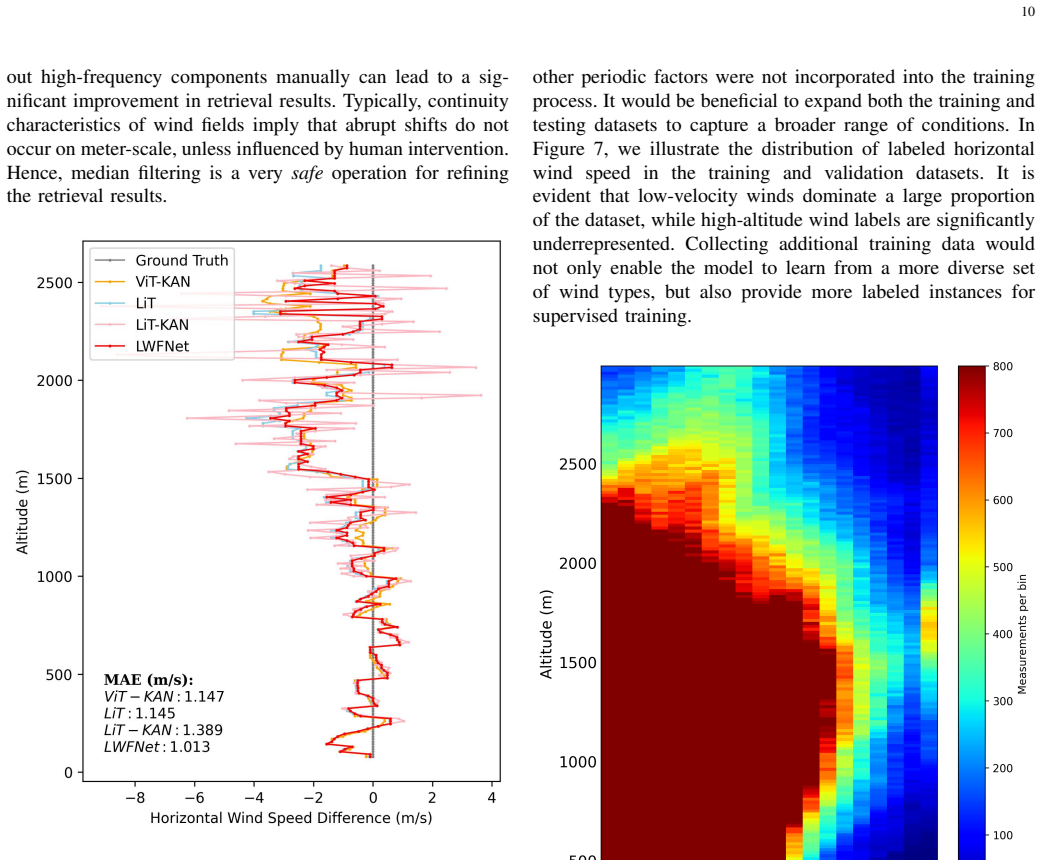
- Median filtering and target masking both contribute to accuracy, indicating that smoothness priors are useful for meter-scale wind fields.
- LWFNet fills in missing wind data across time, producing continuous wind fields without abrupt spatial or temporal changes.
Reading between the lines
- A natural test of super-accuracy would be to train on spectral-centroid labels from one lidar and evaluate against radiosondes from a different site or season; if the effect is real, it should survive without the per-profile offset fitted on the same test data.
- The reported super-accuracy may be partly a statistical consequence of label noise: if the centroid labels are noisy around the truth and the network learns a conditional mean, its predictions can be closer to the true wind than any single noisy label, which is consistent with the paper's smoothing discussion and is testable by adding controlled noise to labels.
- The architecture could be applied to other scanning geometries, such as four-beam or Doppler beam swinging, without structural change since the network consumes a fixed number of spectra as input channels.
Editorial analysis
A structured set of objections, weighed in public.
Referee Report
Summary. The manuscript proposes LWFNet, an end-to-end neural network for coherent Doppler wind lidar (CDWL) wind field retrieval. The network combines a line Transformer that treats each range-gate power spectrum as a token, a KAN decoder, and a median filter. It is trained on spectral-centroid retrieval labels filtered by hand-set criteria and evaluated against 32 radiosonde profiles from March 2024. The paper claims that LWFNet extends the valid detection range and achieves 'super-accuracy' relative to its training labels, and it reports comparisons with ResNet, ViT, and architectural ablations.
Significance. If the quantitative claims were supported, LWFNet would be a useful benchmark for deep-learning-based CDWL retrieval, and the line Transformer is a plausible inductive bias for this signal class. The paper also provides a fairly complete description of the data, architecture, and ablations. However, the evaluation protocol in Section IV-D fits a per-profile bias to the radiosonde ground truth before computing every reported metric, and the headline accuracy and super-accuracy claims rest on that in-sample adjustment. The current evidence is therefore not sufficient to support the central quantitative conclusions.
major comments (3)
- [IV-D, Table I, Fig. 3] The reported metrics are not a blind evaluation. Section IV-D states that 'we introduce a fixed bias to both the spectral centroid and LWFNet retrieval results,' with the bias 'determined by minimizing the mean squared error between the wind retrieval sequence and the corresponding radiosonde measurement sequence in high-SNR regions,' and that 'all subsequent results presented account for this bias adjustment.' Because this bias is fit for each of the 32 test profiles to the same radiosonde data used as ground truth, the RMSE, MAE, Pearson correlations, and scatter quantities in Table I and Fig. 3 are optimistically biased, and the comparison against the spectral centroid is not a head-to-head test of the retrieval methods. Moreover, the same protocol appears to underlie Tables II and IV. Please re-run the evaluation with a bias estimated only from independent data (e.g., training-period radiosondes or a held-out subset), or report all metrics without any bias adjustment, and clearly state which numbers are affected.
- [Abstract, IV-D, Table I] The central 'super-accuracy' claim is not established by the reported numbers. In the high-SNR region the horizontal speed RMSE difference is only 0.795 m/s versus 0.885 m/s for the spectral centroid, the comparison is made after the test-set-fitted bias described above, and no per-instance confidence intervals or significance tests are provided. With only 32 radiosonde profiles, this margin is not sufficient to support the claim that LWFNet 'surpasses the labeled targets' without an unbiased evaluation and uncertainty quantification.
- [IV-A, V] The training labels are produced by applying hand-set filtering thresholds (LOS speed < 42 m/s, SNR > -35 dB, spectral width between 0.5 and 7.5, and the -25 dB exception) to spectral centroid outputs. The paper does not test the sensitivity of the results to these thresholds, nor does it discuss the fact that the thresholds encode external assumptions about which spectral centroid outputs are credible. Because the super-accuracy claim is about surpassing these labels, a sensitivity analysis or a justification for the thresholds is needed.
minor comments (4)
- [IV-C, Eq. (16)] The formula for the Pearson correlation coefficient appears to have a malformed denominator; it should be the square root of the product of the variances of v and v_hat, not the printed expression.
- [III-B] There is a typo in the spline definition: 'B-sphinei(x)' should be 'B-spline_i(x)'.
- [IV-B] Please clarify how the invalid range gates 20-40 are handled in the evaluation metrics (e.g., excluded, masked, or treated as NaN) and how the 'theoretical maximum detection range' is converted to range-gate indices.
- [VII] The section heading 'Aknowledgement' should be 'Acknowledgments', and there are small typographical issues elsewhere (e.g., 'e,g,' in Section IV-F and inconsistent capitalization).
Circularity Check
Reported accuracy numbers are computed after fitting a per-profile constant bias to the same radiosonde profiles used as ground truth (Section IV-D), so the headline 'super-accuracy' claim is not an out-of-sample result.
-
fitted input called prediction
[Section IV-D, Experimental Results (around Table I and Fig. 3)]
"For each test instance, due to the inherent bias between the coordinate systems of the ground-based lidar and radiosonde, we introduce a fixed bias to both the spectral centroid and LWFNet retrieval results. This bias is determined by minimizing the mean squared error between the wind retrieval sequence and the corresponding radiosonde measurement sequence in high-SNR regions. All subsequent results presented account for this bias adjustment."
The bias is a per-test-instance constant fitted to the very radiosonde profiles that define the evaluation ground truth. All metrics in Table I, the scatter plots in Fig. 3, and the abstract's claim that LWFNet 'surpasses the labeled targets' are computed after this in-sample adjustment. The reported RMSE/MAE are therefore not blind predictions; they are partly minimized against the test target. Since a constant shift fitted by least squares always reduces the RMSE on the fitting data, the absolute accuracy numbers are optimistically biased, and the claim that the model is more accurate than its spectral-centroid training labels is not established independently of test-set information.
full rationale
The main circular step is the test-time bias adjustment in Section IV-D. The paper fits one constant per radiosonde profile by minimizing MSE against that same profile, then reports every accuracy number after this adjustment. This makes the quantitative evaluation in-sample: the evaluation target has been used to fit an evaluation parameter. The same adjustment is applied to the spectral centroid baseline, so the relative ordering between methods may remain informative, but the paper's headline 'super-accuracy' claim and the absolute RMSE/MAE values are partly constructed from the radiosonde data rather than derived from the network alone. This is the 'fitted input called prediction' pattern. The paper also acknowledges the small sample (32 March instances) and potential bias, which further weakens the generality but does not remove the in-sample fitting issue. No load-bearing self-citation chain or imported uniqueness theorem was found; the Transformer and KAN components are based on external prior work, and the model comparisons (ResNet, ViT, ablations) are conventional and not circular. If the bias were estimated on independent data (e.g., training-period radiosondes) or held out, the central comparisons would be valid; as written, the central accuracy claims are partially forced by the test-set fit, giving a partial circularity score of 6.
Assumptions & free parameters
free parameters (2)
- Per-test-profile bias offset =
Not reported; fitted per profile
- Training label filtering thresholds =
Speed <42 m/s, SNR > -35 dB, bandwidth 0.5-7.5, or SNR > -25 dB
assumptions (3)
- domain assumption Radiosonde measurements are an appropriate ground truth for lidar wind retrieval at matching times and locations.
- domain assumption There exists a constant per-profile coordinate bias between lidar and radiosonde that can be fit to the test data.
- domain assumption Spectral centroid estimates satisfying the hand-crafted filtering criteria are reliable enough to serve as training targets.
Cite this review
Pith. "Pith review of LWFNet: Coherent Doppler Wind Lidar-Based Network for Wind Field Retrieval." pith.science (2026). https://pith.science/paper/E756ETBM
@misc{pith2026250102613,
  author       = {Pith},
  title        = {Pith review of: LWFNet: Coherent Doppler Wind Lidar-Based Network for Wind Field Retrieval},
  year         = {2026},
  howpublished = {\url{https://pith.science/paper/E756ETBM}},
  note         = {Machine review of arXiv:2501.02613}
}
read the original abstract
Accurate detection of wind fields within the troposphere is essential for atmospheric dynamics research and plays a crucial role in extreme weather forecasting. Coherent Doppler wind lidar (CDWL) is widely regarded as the most suitable technique for high spatial and temporal resolution wind field detection. However, since coherent detection relies heavily on the concentration of aerosol particles, which cause Mie scattering, the received backscattering lidar signal exhibits significantly low intensity at high altitudes. As a result, conventional methods, such as spectral centroid estimation, often fail to produce credible and accurate wind retrieval results in these regions. To address this issue, we propose LWFNet, the first Lidar-based Wind Field (WF) retrieval neural Network, built upon Transformer and the Kolmogorov-Arnold network. Our model is trained solely on targets derived from the traditional wind retrieval algorithm and utilizes radiosonde measurements as the ground truth for test results evaluation. Experimental results demonstrate that LWFNet not only extends the maximum wind field detection range but also produces more accurate results, exhibiting a level of precision that surpasses the labeled targets. This phenomenon, which we refer to as super-accuracy, is explored by investigating the potential underlying factors that contribute to this intriguing occurrence. In addition, we compare the performance of LWFNet with other state-of-the-art (SOTA) models, highlighting its superior effectiveness and capability in high-resolution wind retrieval. LWFNet demonstrates remarkable performance in lidar-based wind field retrieval, setting a benchmark for future research and advancing the development of deep learning models in this domain.
Figures


Figures from the paper (3 more)


Reference graph
Works this paper leans on
-
[1]
N. Gonzalez, P. Serna-Torre, P. A. S ´anchez-P´erez, R. Davidson, B. Murray, M. Staadecker, J. Szinai, R. Wei, D. M. Kammen, D. A. Sunter et al. , “Offshore wind and wave energy can reduce total installed capacity re- quired in zero-emissions grids,” Nature Communications, vol. 15, no. 1, p. 6826, 2024
work page 2024
-
[2]
D. Harrison-Atlas, A. Glaws, R. N. King, and E. Lantz, “Artificial intelligence-aided wind plant optimization for nationwide evaluation of land use and economic benefits of wake steering,” Nature Energy, pp. 1–15, 2024
work page 2024
-
[3]
Review on probabilis- tic forecasting of wind power generation,
Y . Zhang, J. Wang, and X. Wang, “Review on probabilis- tic forecasting of wind power generation,” Renewable and Sustainable Energy Reviews , vol. 32, pp. 255–270, 2014
work page 2014
-
[4]
Application of short-range lidar in wind shear alerting,
P. Chan and Y . Lee, “Application of short-range lidar in wind shear alerting,” Journal of atmospheric and oceanic technology, vol. 29, no. 2, pp. 207–220, 2012
work page 2012
-
[5]
H. Gao, C. Shen, X. Wang, P.-W. Chan, K.-K. Hon, and J. Li, “Interpretable semi-supervised clustering en- ables universal detection and intensity assessment of diverse aviation hazardous winds,” Nature Communica- tions, vol. 15, no. 1, p. 7347, 2024
work page 2024
-
[6]
K. Hon and P. Chan, “Application of lidar-derived eddy dissipation rate profiles in low-level wind shear and turbulence alerts at h ong k ong i nternational a irport,” Meteorological Applications, vol. 21, no. 1, pp. 74–85, 2014
work page 2014
-
[7]
P. Nechaj, L. Ga ´al, J. Bartok, O. V orobyeva, M. Gera, M. Kelemen, and V . Polishchuk, “Monitoring of low- level wind shear by ground-based 3d lidar for increased flight safety, protection of human lives and health,” International Journal of Environmental Research and Public Health, vol. 16, no. 22, p. 4584, 2019
work page 2019
-
[8]
Deep neural networks for ultra-short-term wind forecasting,
M. Dalto, J. Matu ˇsko, and M. Va ˇsak, “Deep neural networks for ultra-short-term wind forecasting,” in 2015 IEEE international conference on industrial technology (ICIT). IEEE, 2015, pp. 1657–1663
work page 2015
Show all 57 references
-
[9]
An emd-recursive arima method to predict wind speed for railway strong wind warning system,
H. Liu, H.-q. Tian, and Y .-f. Li, “An emd-recursive arima method to predict wind speed for railway strong wind warning system,” Journal of Wind Engineering and Industrial Aerodynamics, vol. 141, pp. 27–38, 2015
2015
-
[10]
Seasonal tropical cyclone forecast- ing,
P. Klotzbach, E. Blake, J. Camp, L.-P. Caron, J. C. Chan, N.-Y . Kang, Y . Kuleshov, S.-M. Lee, H. Murakami, M. Saunders et al., “Seasonal tropical cyclone forecast- ing,” Tropical Cyclone Research and Review , vol. 8, no. 3, pp. 134–149, 2019
2019
-
[11]
A hybrid similarity-based method for wind monitoring system deployment optimization along urban railways,
W. Zhao, Z. Zhang, B. Hou, Y . Huang, and Y . Xie, “A hybrid similarity-based method for wind monitoring system deployment optimization along urban railways,” Urban Rail Transit , vol. 9, no. 4, pp. 310–322, 2023
2023
-
[12]
Impact of wind turbine sound on general health, sleep disturbance and annoyance of workers: a pilot-study in manjil wind farm, iran,
M. Abbasi, M. R. Monazzam, A. Akbarzadeh, S. A. Zakerian, and M. H. Ebrahimi, “Impact of wind turbine sound on general health, sleep disturbance and annoyance of workers: a pilot-study in manjil wind farm, iran,”Jour- nal of Environmental Health Science and Engineering , vol. ...
2015
-
[13]
Wind lidar for atmospheric research,
O. Reitebuch, “Wind lidar for atmospheric research,” in Atmospheric Physics: Background–Methods–Trends . Springer, 2012, pp. 487–507
2012
-
[14]
Airborne gnss-r wind retrievals using delay–doppler maps,
N. Rodriguez-Alvarez, D. M. Akos, V . U. Zavorotny, J. A. Smith, A. Camps, and C. W. Fairall, “Airborne gnss-r wind retrievals using delay–doppler maps,” IEEE transactions on geoscience and remote sensing , vol. 51, no. 1, pp. 626–641, 2012
2012
-
[15]
Meter-scale and sub-second-resolution coherent doppler wind lidar and hyperfine wind observation,
C. Liang, C. Wang, X. Xue, X. Dou, and T. Chen, “Meter-scale and sub-second-resolution coherent doppler wind lidar and hyperfine wind observation,” Optics Let- ters, vol. 47, no. 13, pp. 3179–3182, 2022
2022
-
[16]
An assessment of cygnss normalized bistatic radar cross section calibration,
F. Said, Z. Jelenak, P. S. Chang, and S. Soisuvarn, “An assessment of cygnss normalized bistatic radar cross section calibration,” IEEE Journal of Selected Topics in Applied Earth Observations and Remote Sensing, vol. 12, no. 1, pp. 50–65, 2018
2018
-
[17]
Characterizing and mitigating digital sampling effects on the cygnss level 1 calibration,
S. Gleason, M. M. Al-Khaldi, C. S. Ruf, D. S. McKague, T. Wang, and A. Russel, “Characterizing and mitigating digital sampling effects on the cygnss level 1 calibration,” IEEE Transactions on Geoscience and Remote Sensing , vol. 60, pp. 1–12, 2021
2021
-
[18]
Deep residual fully connected network for gnss- r wind speed retrieval and its interpretation,
H. Du, W. Li, E. Cardellach, S. Rib ´o, A. Rius, and Y . Nan, “Deep residual fully connected network for gnss- r wind speed retrieval and its interpretation,” Remote Sensing of Environment, vol. 313, p. 114375, 2024
2024
-
[19]
Multimodal deep learning for heterogeneous gnss-r data fusion and ocean wind speed retrieval,
X. Chu, J. He, H. Song, Y . Qi, Y . Sun, W. Bai, W. Li, and Q. Wu, “Multimodal deep learning for heterogeneous gnss-r data fusion and ocean wind speed retrieval,” IEEE Journal of Selected Topics in Applied Earth Observations and Remote Sensing , vol. 13, pp. 5971–5981, 2020
2020
-
[20]
Wind speed estimation from cygnss using artificial neural networks,
J. Reynolds, M. P. Clarizia, and E. Santi, “Wind speed estimation from cygnss using artificial neural networks,” IEEE Journal of Selected Topics in Applied Earth Ob- servations and Remote Sensing , vol. 13, pp. 708–716, 2020
2020
-
[21]
Gnss reflectometry global ocean wind speed using deep learning: Development and assessment of cygnssnet,
M. Asgarimehr, C. Arnold, T. Weigel, C. Ruf, and J. Wickert, “Gnss reflectometry global ocean wind speed using deep learning: Development and assessment of cygnssnet,” Remote Sensing of Environment , vol. 269, p. 112801, 2022
2022
-
[22]
Information fusion for gnss-r wind speed retrieval using statistically modified convolutional neural network,
W. Guo, H. Du, C. Guo, B. J. Southwell, J. W. Cheong, and A. G. Dempster, “Information fusion for gnss-r wind speed retrieval using statistically modified convolutional neural network,” Remote Sensing of Environment , vol. 272, p. 112934, 2022
2022
-
[23]
Glows-net: A deep learning framework for retrieving global sea surface wind speed using spaceborne gnss-r data,
J. Bu, K. Yu, X. Zuo, J. Ni, Y . Li, and W. Huang, “Glows-net: A deep learning framework for retrieving global sea surface wind speed using spaceborne gnss-r data,” Remote sensing, vol. 15, no. 3, p. 590, 2023
2023
-
[24]
Ddm-former: Trans- former networks for gnss reflectometry global ocean wind speed estimation,
D. Zhao, K. Heidler, M. Asgarimehr, C. Arnold, T. Xiao, J. Wickert, X. X. Zhu, and L. Mou, “Ddm-former: Trans- former networks for gnss reflectometry global ocean wind speed estimation,” Remote Sensing of Environment, vol. 294, p. 113629, 2023
2023
-
[25]
Spaceborne gnss-r minimum variance wind speed estimator,
M. P. Clarizia, C. S. Ruf, P. Jales, and C. Gommengin- ger, “Spaceborne gnss-r minimum variance wind speed estimator,” IEEE transactions on geoscience and remote sensing, vol. 52, no. 11, pp. 6829–6843, 2014
2014
-
[26]
Perceptual effects of spectral modifications on musical timbres,
J. M. Grey and J. W. Gordon, “Perceptual effects of spectral modifications on musical timbres,” The Journal of the Acoustical Society of America , vol. 63, no. 5, pp. 1493–1500, 1978
1978
-
[27]
Performance of a discrete spectral peak frequency estimator for doppler wind velocity measure- ments,
R. M. Hardesty, “Performance of a discrete spectral peak frequency estimator for doppler wind velocity measure- ments,” IEEE transactions on geoscience and remote sensing, no. 5, pp. 777–783, 1986
1986
-
[28]
Coherent doppler wind lidar with real-time wind pro- cessing and low signal-to-noise ratio reconstruction based on a convolutional neural network,
O. Kliebisch, H. Uittenbosch, J. Thurn, and P. Mahnke, “Coherent doppler wind lidar with real-time wind pro- cessing and low signal-to-noise ratio reconstruction based on a convolutional neural network,” Optics Express , vol. 30, no. 4, pp. 5540–5552, 2022
2022
-
[29]
Denoising coherent doppler lidar data based on a u-net convolutional neural network,
Y . Song, Y . Han, Z. Su, C. Chen, D. Sun, T. Chen, and X. Xue, “Denoising coherent doppler lidar data based on a u-net convolutional neural network,” Applied Optics , vol. 63, no. 1, pp. 275–282, 2023
2023
-
[30]
Wind speed ex- trapolation using machine learning methods and lidar measurements,
M. A. Mohandes and S. Rehman, “Wind speed ex- trapolation using machine learning methods and lidar measurements,” IEEE Access, vol. 6, pp. 77 634–77 642, 2018
2018
-
[31]
Atmospheric boundary layer wind profile estimation using neural networks applied to lidar mea- surements,
A. Garc ´ıa-Guti´errez, D. Dom ´ınguez, D. L ´opez, and J. Gonzalo, “Atmospheric boundary layer wind profile estimation using neural networks applied to lidar mea- surements,” Sensors, vol. 21, no. 11, p. 3659, 2021
2021
-
[32]
Atmospheric boundary layer wind profile estimation using neural networks, mesoscale models, and lidar measurements,
A. Garc ´ıa-Guti´errez, D. L ´opez, D. Dom ´ınguez, and J. Gonzalo, “Atmospheric boundary layer wind profile estimation using neural networks, mesoscale models, and lidar measurements,” Sensors, vol. 23, no. 7, p. 3715, 2023
2023
-
[33]
A spatio-temporal neural network for fine-scale wind field nowcasting based on lidar observation,
H. Gao, C. Shen, Y . Zhou, X. Wang, P.-W. Chan, K.- K. Hon, D. Zhou, and J. Li, “A spatio-temporal neural network for fine-scale wind field nowcasting based on lidar observation,” IEEE Journal of Selected Topics in Applied Earth Observations and Remote Sensing, vol. 15, pp. 55...
2022
-
[34]
A deep learning-based wind field now- casting method with extra attention on highly variable events,
H. Gao, C. Shen, Y . Zhou, X. Wang, P.-W. Chan, K.-K. Hon, and J. Li, “A deep learning-based wind field now- casting method with extra attention on highly variable events,” IEEE Geoscience and Remote Sensing Letters , vol. 19, pp. 1–5, 2022
2022
-
[35]
Integrating doppler lidar and machine learning into land-use regression model for assessing contribution of vertical atmospheric processes to urban pm2. 5 pollu- tion,
Y . Li, T. Huang, H. F. Lee, Y . Heo, K.-F. Ho, and S. H. Yim, “Integrating doppler lidar and machine learning into land-use regression model for assessing contribution of vertical atmospheric processes to urban pm2. 5 pollu- tion,” Science of The Total Environment , vol. 952,...
2024
-
[36]
An image is worth 16x16 words: Trans- formers for image recognition at scale,
A. Dosovitskiy, “An image is worth 16x16 words: Trans- formers for image recognition at scale,” arXiv preprint arXiv:2010.11929, 2020
2010 arXiv
-
[37]
Kan: Kolmogorov-arnold networks,
Z. Liu, Y . Wang, S. Vaidya, F. Ruehle, J. Halver- son, M. Solja ˇci´c, T. Y . Hou, and M. Tegmark, “Kan: Kolmogorov-arnold networks,” arXiv preprint arXiv:2404.19756, 2024
2024 arXiv
-
[38]
The kolmogorov–arnold representa- tion theorem revisited,
J. Schmidt-Hieber, “The kolmogorov–arnold representa- tion theorem revisited,” Neural networks , vol. 137, pp. 119–126, 2021. 13
2021
-
[39]
Techniques of wind vector estimation from data measured with a scanning coherent doppler lidar,
I. Smalikho, “Techniques of wind vector estimation from data measured with a scanning coherent doppler lidar,” Journal of Atmospheric and Oceanic Technology, vol. 20, no. 2, pp. 276–291, 2003
2003
-
[40]
Power spectrum parameter estimation,
M. Levin, “Power spectrum parameter estimation,” IEEE Transactions on Information Theory , vol. 11, no. 1, pp. 100–107, 1965
1965
-
[41]
Adap- tive iteratively reweighted sine wave fitting method for rapid wind vector estimation of pulsed coherent doppler lidar,
X. Rui, P. Guo, H. Chen, S. Chen, and Y . Zhang, “Adap- tive iteratively reweighted sine wave fitting method for rapid wind vector estimation of pulsed coherent doppler lidar,” Optics Express, vol. 27, no. 15, pp. 21 319–21 334, 2019
2019
-
[42]
Inversion probability enhancement of all-fiber cdwl by noise modeling and robust fitting,
T. Wei, H. Xia, Y . Wu, J. Yuan, C. Wang, and X. Dou, “Inversion probability enhancement of all-fiber cdwl by noise modeling and robust fitting,” Optics Express , vol. 28, no. 20, pp. 29 662–29 675, 2020
2020
-
[43]
Smoothed accumulated spectra based wdswf method for real-time wind vector estimation of pulsed coherent doppler lidar,
R. Lin, P. Guo, H. Chen, S. Chen, and Y . Zhang, “Smoothed accumulated spectra based wdswf method for real-time wind vector estimation of pulsed coherent doppler lidar,” Optics Express, vol. 30, no. 1, pp. 180– 194, 2021
2021
-
[44]
A probability- constraint-based method based on the honey badger al- gorithm for wind estimation with coherent doppler wind lidar,
F. Zhang, S. Zhang, L. Wang, and J. Ma, “A probability- constraint-based method based on the honey badger al- gorithm for wind estimation with coherent doppler wind lidar,” Optics Express, vol. 32, no. 26, pp. 45 662–45 678, 2024
2024
-
[45]
Squeezenet: Alexnet-level accuracy with 50x fewer parameters and¡ 0.5 mb model size,
F. N. Iandola, “Squeezenet: Alexnet-level accuracy with 50x fewer parameters and¡ 0.5 mb model size,” arXiv preprint arXiv:1602.07360, 2016
2016 arXiv
-
[46]
U-net: Con- volutional networks for biomedical image segmenta- tion,
O. Ronneberger, P. Fischer, and T. Brox, “U-net: Con- volutional networks for biomedical image segmenta- tion,” in Medical image computing and computer-assisted intervention–MICCAI 2015: 18th international confer- ence, Munich, Germany, October 5-9, 2015, proceedings, part III...
2015
-
[47]
Wind lidar,
S. W. Henderson, P. Gatt, D. Rees, and R. M. Huffaker, “Wind lidar,” inLaser remote sensing. CRC Press, 2005, pp. 487–740
2005
-
[48]
Signal to noise ratio characterization of coherent doppler lidar backscattered signals,
S. Abdelazim, D. Santoro, M. Arend, F. Moshary, and S. Ahmed, “Signal to noise ratio characterization of coherent doppler lidar backscattered signals,” in EPJ Web of Conferences, vol. 119. EDP Sciences, 2016, p. 17014
2016
-
[49]
Tcnet: Triple collocation-based network for ocean sur- face wind speed retrieval on cygnss,
X. Shi, Q. Su, W. Wang, W. Ni, B. Duan, and K. Ren, “Tcnet: Triple collocation-based network for ocean sur- face wind speed retrieval on cygnss,” IEEE Transactions on Geoscience and Remote Sensing , 2024
2024
-
[50]
Attention is all you need,
A. Vaswani, “Attention is all you need,” Advances in Neural Information Processing Systems , 2017
2017
-
[51]
Layer normal- ization,
J. Lei Ba, J. R. Kiros, and G. E. Hinton, “Layer normal- ization,” ArXiv e-prints, pp. arXiv–1607, 2016
2016
-
[52]
Kan4tsf: Are kan and kan-based models effec- tive for time series forecasting?
X. Han, X. Zhang, Y . Wu, Z. Zhang, and Z. Wu, “Kan4tsf: Are kan and kan-based models effec- tive for time series forecasting?” arXiv preprint arXiv:2408.11306, 2024
2024 arXiv
-
[53]
U-kan makes strong backbone for medi- cal image segmentation and generation,
C. Li, X. Liu, W. Li, C. Wang, H. Liu, Y . Liu, Z. Chen, and Y . Yuan, “U-kan makes strong backbone for medi- cal image segmentation and generation,” arXiv preprint arXiv:2406.02918, 2024
2024 arXiv
-
[54]
Precipitation motion by pulse doppler
R. M. Lhermitte, “Precipitation motion by pulse doppler.” in Proc. 9th Weather Radar Conf., Amer. Meteor. Soc. , 1961, pp. 218–223
1961
-
[55]
Decoupled weight decay regularization,
I. Loshchilov, “Decoupled weight decay regularization,” arXiv preprint arXiv:1711.05101 , 2017
2017 arXiv
-
[56]
Deep residual learning for image recognition,
K. He, X. Zhang, S. Ren, and J. Sun, “Deep residual learning for image recognition,” in Proceedings of the IEEE conference on computer vision and pattern recog- nition, 2016, pp. 770–778
2016
-
[57]
Masked autoencoders are scalable vision learners,
K. He, X. Chen, S. Xie, Y . Li, P. Doll´ar, and R. Girshick, “Masked autoencoders are scalable vision learners,” in Proceedings of the IEEE/CVF conference on computer vision and pattern recognition , 2022, pp. 16 000–16 009
2022
Reviewed August 10, 2026 · model on record in the stance chip above.
Discussion (0). Continue with ORCID to comment.