REVIEW 3 major objections 5 minor 24 references
PiLaMIM: Toward Richer Visual Representations by Integrating Pixel and Latent Masked Image Modeling
T0 review · 3 major / 5 minor · reviewed 2026-08-10 · deepseek-v4-flash
Pith's one-line read Jointly predicting pixels and latent features gives richer vision representations.
desk verdict Simple and mostly reproducible, but the low-level claim rests on a post-hoc token choice that should be controlled before the paper is trusted. read the letter →
The pith
A machine-rendered reading of the paper's core claim, the machinery that carries it, and where it could break.
The reading
What carries the argument
The load-bearing mechanism is the shared context encoder with two lightweight decoders operating on the same encoded visible patches. A pixel decoder reconstructs raw RGB values of masked patches; a latent decoder predicts the corresponding token representations produced by an exponentially moving-averaged target encoder. A third term, $L_{cls}$, predicts the target encoder's [CLS] token, which aggregates global image context, and the whole objective is simply $L = L_{pixel} + L_{latent} + L_{cls}$ with a masking ratio of 0.75 and no normalization of targets. The two decoders let one set of features be pulled toward low-level detail and high-level semantics simultaneously, while the [CLS] term discourages the encoder from collapsing to patch-local statistics.
What would settle it
Re-run the Clevr/Dist linear probing using each baseline's originally intended token—average pooled patch tokens for I-JEPA and BootMAE, [CLS] for MAE and PiLaMIM—and check whether PiLaMIM still beats them; if the gap narrows or reverses, the claimed low-level advantage is an artifact of token choice.
Extended reading notes
Core claim
PiLaMIM's central claim is that a single context encoder trained with the sum of three mean-squared-error losses—pixel reconstruction on masked patches, latent reconstruction on masked patches, and latent reconstruction on the [CLS] token—produces representations that are simultaneously strong on semantic tasks and on geometric/low-level tasks. The latent targets come from a target encoder whose weights are an exponential moving average of the context encoder, so the model predicts its own evolving features rather than a fixed offline representation. In linear probing, PiLaMIM at 800 epochs reaches 69.2% on ImageNet-1K, 92.4% on CIFAR10, 74.2% on CIFAR100, 31.0% on iNaturalist2021, and 47.6% on Places365, while on CLEVR it reaches 83.8% for counting and 67.8% for distance, all above the reported baselines. The paper reads these numbers as evidence that neither pixel MIM nor latent MIM is sufficient alone and that their integration, plus the global [CLS] signal, yields a better balance.
Load-bearing premise
The comparison on Clevr/Dist assumes it is fair to judge all models with the [CLS] token, even though the token-type choice was made after seeing a performance gap and may not match the token type each baseline was designed to use.
Editorial extensions
If this is right
- Linear probing accuracy on out-of-domain classification improves by several points over I-JEPA and MAE, notably +6.1 on CIFAR10 and +8.1 on CIFAR100 compared with I-JEPA.
- On low-level tasks, PiLaMIM beats MAE by 7.2 points on Clevr/Count and 2.8 points on Clevr/Dist, showing that the pixel decoder keeps fine detail that latent-only training discards.
- The [CLS] token contributes 1.9 points on CIFAR100 and 1.2 points on Clevr/Count in the ablation, so global-context reconstruction helps both semantic and geometric probing.
- PiLaMIM also outperforms BootMAE on most datasets, implying that the specific design of separate decoders plus the [CLS] term extracts more than simply summing the two objectives.
Reading between the lines
- A natural testable extension is to vary the weighting of the three losses; the paper fixes all weights at 1, and a trade-off curve would show whether the two targets interfere at other training budgets.
- The RankMe scores in the appendix suggest the joint model's representation has higher effective rank; one could check whether that rank advantage predicts performance on dense prediction tasks like semantic segmentation, which the paper did not evaluate.
- Because the target encoder is an EMA, the method inherits the same collapse-avoidance behavior as I-JEPA; it remains to be seen whether the pixel decoder's gradient through the shared encoder changes the EMA dynamics in a way that harms very long training runs.
Signed reviews
Editorial analysis
A structured set of objections, weighed in public.
Referee Report
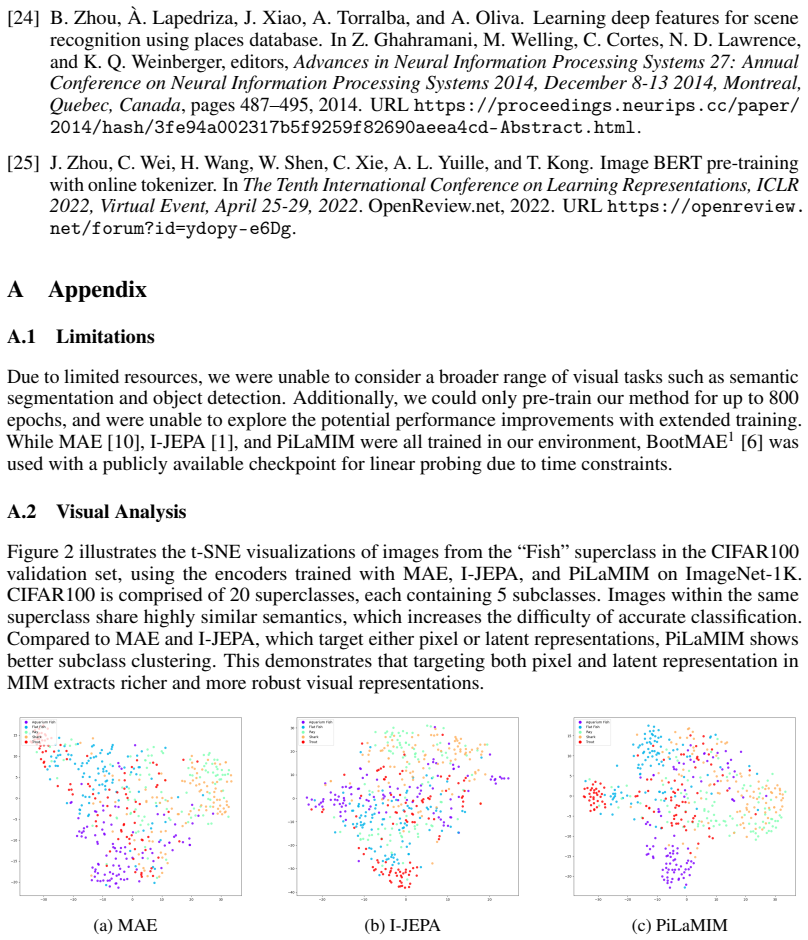
Summary. The paper proposes PiLaMIM, a self-supervised pretraining method for Vision Transformers that combines pixel-level masked reconstruction (as in MAE) with latent-representation prediction (as in I-JEPA). A shared context encoder feeds two separate decoders, one for raw pixels and one for target-encoder latent features, and a third loss is imposed on the [CLS] token. The method is evaluated by linear probing on high-level tasks (ImageNet-1K, CIFAR-10/100, iNaturalist2021, Places365) and low-level tasks (Clevr/Count, Clevr/Dist), reporting that PiLaMIM outperforms MAE, I-JEPA, and BootMAE in most settings. The paper also includes an ablation of the [CLS] loss, a t-SNE visualization, and RankMe scores. Code is provided.
Significance. If the empirical claims hold, PiLaMIM offers a conceptually simple and reproducible way to obtain representations that are strong on both semantic and geometric low-level tasks, and the [CLS]-token loss is a small but interesting addition. The method is clearly specified: the losses in Eq. (4)-(5) are concrete, the architecture is described in sufficient detail, and the code repository is provided. However, the evidence supporting the central claim is weakened by a post-hoc change in the evaluation token on Clevr/Dist, the lack of multiple seeds or variance estimates, and the use of an external BootMAE checkpoint. These issues need to be addressed before the 'richer visual representations' claim is firmly established.
major comments (3)
- [Section 3, Table 1(b)] The evaluation protocol for Clevr/Dist is changed after observing results, which undermines the low-level comparison. The text states that I-JEPA and BootMAE were evaluated with average pooled patch tokens while MAE and PiLaMIM used the [CLS] token, and that after observing a large performance gap on Clevr/Dist, the evaluation was 'standardized' to the [CLS] token. This is post-hoc selection of the evaluation token, and the paper does not report the discarded numbers. Because Clevr/Dist is one of only two low-level tasks supporting the claim of richer low-level representations, please report both token choices for all methods, or otherwise demonstrate that the conclusion is insensitive to token choice.
- [Section 3, Table 1] All results are single runs without variance estimates. Several differences are small (e.g., Clevr/Dist 67.8 for PiLaMIM vs 68.7 for BootMAE; Places365 47.0 vs 47.6 between PiLaMIM 600 and 800 epochs) and may be within run-to-run noise. To support the claim that PiLaMIM 'outperforms key baselines in most cases', please report means and standard deviations over multiple pretraining or linear-probing seeds, or at least provide a statistical analysis of the differences.
- [Appendix A.1] The BootMAE baseline was not retrained in the authors' environment but was evaluated using a publicly available checkpoint. Since pretraining details (data processing, augmentation, optimizer settings, and training length) may differ from those used for the other models, the comparison against BootMAE may reflect training-setup differences rather than the method itself. Please retrain BootMAE under identical conditions, or temper the claim of outperforming BootMAE and explicitly state the limitation in the main text.
minor comments (5)
- [Equation (4)] The notation D_t (or D_T) is used without definition; please define it consistently with D_x, and ensure the subscripts in the normalization factors match the text.
- [Abstract] The phrase 'proving its effectiveness' is stronger than what a finite set of empirical comparisons can establish; consider using 'indicating' or 'suggesting' to match the evidence level.
- [Section 3] The sentence 'For MAE and PiLaMIM, we used the [CLS] token from the same layer' is ambiguous because MAE in its original formulation does not use a [CLS] token for linear probing; please clarify whether a [CLS] token was added to MAE and, if so, how it was trained.
- [Section 2] The description of the learnable mask tokens M_M and N_M is easy to confuse with the index sets M; please explicitly state that these are distinct learnable vectors for the two decoders.
- [Table 2] The ablation of the [CLS] token is reported on only two datasets (CIFAR100 and Clevr/Count). If the claim is that [CLS] benefits both high-level and low-level tasks, consider adding at least one more dataset from each category.
Circularity Check
No circularity found: the method is an empirical combination of standard pixel and latent MIM losses evaluated on held-out linear probing tasks.
full rationale
PiLaMIM's derivation chain is not circular. The training objective (Eqs. 4-5) is an explicit sum of three MSE losses: pixel reconstruction, latent reconstruction, and CLS-token latent prediction. These losses are standard self-supervised targets; neither the targets nor the evaluation metrics are defined in terms of PiLaMIM's own outputs or fitted to the reported downstream numbers. The main claim of richer visual representations is supported by held-out linear probing on ImageNet-1K, CIFAR, iNaturalist, Places365, Clevr/Count, and Clevr/Dist, comparing against externally published baselines. No parameter is fitted to the test set, and no result is equal by construction to an input assumption. The paper contains no load-bearing self-citation chain; references are to prior external work. Two evaluation concerns appear in the manuscript but are not circularity: (1) the post-hoc standardization to the [CLS] token for Clevr/Dist after observing a performance gap, and (2) the A.1 admission that BootMAE was evaluated using a public checkpoint rather than retrained in the authors' environment. These are potential fairness or reproducibility confounds, not cases where a prediction reduces to its inputs by definition. Accordingly, the circularity score is 0.
Assumptions & free parameters
free parameters (3)
- masking ratio =
0.75
- EMA momentum schedule =
lambda: 0.996 to 1.0
- loss weights =
1, 1, 1
assumptions (4)
- domain assumption Linear probing accuracy of frozen features measures representation quality.
- domain assumption The EMA target encoder with stop-gradient yields stable latent targets that do not collapse.
- ad hoc to paper Simple summation of pixel and latent MSE losses with equal weights is a valid multi-task objective.
- ad hoc to paper The post-hoc choice to evaluate all models on Clevr/Dist with the [CLS] token is fair across methods.
Cite this review
Pith. "Pith review of PiLaMIM: Toward Richer Visual Representations by Integrating Pixel and Latent Masked Image Modeling." pith.science (2026). https://pith.science/paper/PWJADXFC
@misc{pith2026250103005,
  author       = {Pith},
  title        = {Pith review of: PiLaMIM: Toward Richer Visual Representations by Integrating Pixel and Latent Masked Image Modeling},
  year         = {2026},
  howpublished = {\url{https://pith.science/paper/PWJADXFC}},
  note         = {Machine review of arXiv:2501.03005}
}
read the original abstract
In Masked Image Modeling (MIM), two primary methods exist: Pixel MIM and Latent MIM, each utilizing different reconstruction targets, raw pixels and latent representations, respectively. Pixel MIM tends to capture low-level visual details such as color and texture, while Latent MIM focuses on high-level semantics of an object. However, these distinct strengths of each method can lead to suboptimal performance in tasks that rely on a particular level of visual features. To address this limitation, we propose PiLaMIM, a unified framework that combines Pixel MIM and Latent MIM to integrate their complementary strengths. Our method uses a single encoder along with two distinct decoders: one for predicting pixel values and another for latent representations, ensuring the capture of both high-level and low-level visual features. We further integrate the CLS token into the reconstruction process to aggregate global context, enabling the model to capture more semantic information. Extensive experiments demonstrate that PiLaMIM outperforms key baselines such as MAE, I-JEPA and BootMAE in most cases, proving its effectiveness in extracting richer visual representations.
Figures

Reference graph
Works this paper leans on
-
[1]
M. Assran, Q. Duval, I. Misra, P. Bojanowski, P. Vincent, M. G. Rabbat, Y . LeCun, and N. Ballas. Self-supervised learning from images with a joint-embedding predictive architecture. In IEEE/CVF Conference on Computer Vision and Pattern Recognition, CVPR 2023, V ancouver , BC, Canada, June 17-24, 2023 , pages 15619–15629. IEEE, 2023. doi: 10.1109/CVPR5272...
-
[2]
A. Baevski, W. Hsu, Q. Xu, A. Babu, J. Gu, and M. Auli. data2vec: A general framework for self-supervised learning in speech, vision and language. In K. Chaudhuri, S. Jegelka, L. Song, C. Szepesvári, G. Niu, and S. Sabato, editors, International Conference on Machine Learning, ICML 2022, 17-23 July 2022, Baltimore, Maryland, USA , volume 162 of Proceeding...
work page 2022
-
[3]
H. Bao, L. Dong, S. Piao, and F. Wei. Beit: BERT pre-training of image transformers. In The Tenth International Conference on Learning Representations, ICLR 2022, Virtual Event, April 25-29, 2022 . OpenReview.net, 2022. URL https://openreview.net/forum?id= p-BhZSz59o4
work page 2022
- [4]
-
[5]
X. Chen, M. Ding, X. Wang, Y . Xin, S. Mo, Y . Wang, S. Han, P. Luo, G. Zeng, and J. Wang. Context autoencoder for self-supervised representation learning. CoRR, abs/2202.03026, 2022. URL https://arxiv.org/abs/2202.03026
arXiv 2022
-
[6]
X. Dong, J. Bao, T. Zhang, D. Chen, W. Zhang, L. Yuan, D. Chen, F. Wen, and N. Yu. Bootstrapped masked autoencoders for vision bert pretraining. In European Conference on Computer Vision, pages 247–264. Springer, 2022
work page 2022
-
[7]
A. Dosovitskiy, L. Beyer, A. Kolesnikov, D. Weissenborn, X. Zhai, T. Unterthiner, M. Dehghani, M. Minderer, G. Heigold, S. Gelly, J. Uszkoreit, and N. Houlsby. An image is worth 16x16 words: Transformers for image recognition at scale. In9th International Conference on Learning Representations, ICLR 2021, Virtual Event, Austria, May 3-7, 2021 . OpenReview...
work page 2021
-
[8]
P. Gao, T. Ma, H. Li, Z. Lin, J. Dai, and Y . Qiao. Convmae: Masked convolution meets masked autoencoders. CoRR, abs/2205.03892, 2022. doi: 10.48550/ARXIV .2205.03892. URL https://doi.org/10.48550/arXiv.2205.03892
Show all 24 references
-
[9]
Garrido, R
Q. Garrido, R. Balestriero, L. Najman, and Y . LeCun. Rankme: Assessing the downstream performance of pretrained self-supervised representations by their rank. In A. Krause, E. Brun- skill, K. Cho, B. Engelhardt, S. Sabato, and J. Scarlett, editors, International Conference on...
2023
-
[11]
G. V . Horn, O. M. Aodha, Y . Song, Y . Cui, C. Sun, A. Shepard, H. Adam, P. Perona, and S. J. Belongie. The inaturalist species classification and detection dataset. In 2018 IEEE Conference on Computer Vision and Pattern Recognition, CVPR 2018, Salt Lake City, UT, USA, June 1...
2018
-
[12]
Johnson, B
J. Johnson, B. Hariharan, L. van der Maaten, L. Fei-Fei, C. L. Zitnick, and R. B. Girshick. CLEVR: A diagnostic dataset for compositional language and elementary visual reasoning. In 2017 IEEE Conference on Computer Vision and Pattern Recognition, CVPR 2017, Honolulu, HI, USA,...
2017 doi
-
[13]
Krizhevsky, G
A. Krizhevsky, G. Hinton, et al. Learning multiple layers of features from tiny images. 2009
2009
-
[14]
Y . Liu, S. Zhang, J. Chen, K. Chen, and D. Lin. Pixmim: Rethinking pixel reconstruction in masked image modeling. Trans. Mach. Learn. Res., 2024, 2024. URL https://openreview. net/forum?id=qyfz0QrkqP
2024
-
[15]
Loshchilov and F
I. Loshchilov and F. Hutter. Decoupled weight decay regularization. In 7th International Conference on Learning Representations, ICLR 2019, New Orleans, LA, USA, May 6-9, 2019 . OpenReview.net, 2019. URL https://openreview.net/forum?id=Bkg6RiCqY7
2019
- [16]
-
[17]
Russakovsky, J
O. Russakovsky, J. Deng, H. Su, J. Krause, S. Satheesh, S. Ma, Z. Huang, A. Karpathy, A. Khosla, M. S. Bernstein, A. C. Berg, and L. Fei-Fei. Imagenet large scale visual recognition challenge. Int. J. Comput. Vis., 115(3):211–252, 2015. doi: 10.1007/S11263-015-0816-Y. URL http...
2015 doi
-
[18]
Z. Tong, Y . Song, J. Wang, and L. Wang. Videomae: Masked autoencoders are data-efficient learners for self-supervised video pre-training. In S. Koyejo, S. Mo- hamed, A. Agarwal, D. Belgrave, K. Cho, and A. Oh, editors, Advances in Neural Information Processing Systems 35: Ann...
2022
-
[19]
Van der Maaten and G
L. Van der Maaten and G. Hinton. Visualizing data using t-sne. Journal of machine learning research, 9(11), 2008
2008
- [21]
-
[22]
Z. Xie, Z. Zhang, Y . Cao, Y . Lin, J. Bao, Z. Yao, Q. Dai, and H. Hu. Simmim: a simple framework for masked image modeling. In IEEE/CVF Conference on Computer Vision and Pattern Recognition, CVPR 2022, New Orleans, LA, USA, June 18-24, 2022 , pages 9643–9653. IEEE, 2022. doi:...
2022
-
[23]
Y . You, I. Gitman, and B. Ginsburg. Large batch training of convolutional networks. arXiv preprint arXiv:1708.03888, 2017. 6
2017 arXiv
-
[24]
B. Zhou, À. Lapedriza, J. Xiao, A. Torralba, and A. Oliva. Learning deep features for scene recognition using places database. In Z. Ghahramani, M. Welling, C. Cortes, N. D. Lawrence, and K. Q. Weinberger, editors, Advances in Neural Information Processing Systems 27: Annual C...
2014
-
[25]
J. Zhou, C. Wei, H. Wang, W. Shen, C. Xie, A. L. Yuille, and T. Kong. Image BERT pre-training with online tokenizer. InThe Tenth International Conference on Learning Representations, ICLR 2022, Virtual Event, April 25-29, 2022 . OpenReview.net, 2022. URL https://openreview. ne...
2022
-
[9640]
doi: 10.1109/ICCV48922.2021.00951
IEEE, 2021. doi: 10.1109/ICCV48922.2021.00951. URL https://doi.org/10.1109/ ICCV48922.2021.00951
2021
Reviewed August 10, 2026 · model on record in the stance chip above.
Discussion (0). Continue with ORCID to comment.